Webometric Analysis of Central Universities in India: A Study
Samir Kumar Jalal
1, Subal Chandra Biswas
2and Parthasarathi Mukhopadhyay
2Birla Institute of Technology Mesra, Ranchi, India
1The University of Burdwan, Burdwan, India
2jalal_gtz, scbiswas_56{@yahoo.co.in}, [email protected]
Abstract
Web presence of Indian Universities has been reflected in general and Central Universities in particular. Webometric data have been collected through Yahoo! and Google search engines using special query syntax. An attempt has been made to rank Central Universities in India using appropriate webometric indicators. Results reveled that University of Delhi becomes top rank (with score 4.28 and Sikkim University occupied the last (with score 1.64) among Central Universities in India.
1.
Introduction
In the wake of globalization, the planners and top administrators are giving emphasis to revise the strategies in the higher education to cope up with the changing paradigm, redefining the education system to compete with the global requirements. The globalization has made a remarkable impact on academic education system and Internet is the constant source of energy for the institute to make its facilities and opportunities available globally. In order to achieve the goal, there is a need to have websites of each academic institute in order to perform well and stay in the competition. People come to a website to get information. Therefore, the primary goal of the universities’ website is to prove information to its users. Prospective students may use university website for choosing for their admission, to find out a particular course offered. Current students may look for semester examination schedule and results. Some students may download application form and prospectus. Some teacher may search for job vacancy and benefits. University websites are increasingly used for wide variety of purposes like attracting new students, online library catalogue. In the case of research, university website can announce existence research and promote individual achievement of individual, research group, departments and institutions as a whole.
Therefore, there is a high requirement to know the web presence of universities in general and Indian universities in particular. It is also required to measure the web impact through various WIFs using appropriate webometric
indicators in order to enhance its efficiency through optimizing web content, analysis and re-designing.
Ingwersen [1] proposed the concept of Web Impact Factor to measure the impact of website. Most studies in the web impact of academic web sites have been carried our for data sets of university websites or department websites for departmental interlinks. The relationship between web impact measures and other measures like hyperlinks to organizations and research performance through peer-reviewed ratings or publication impact [2,3,4]. Although some studies reflect that there is no signification correlation between general WIF and research rating for Australian universities [5] but Thelwall [6] showed that there is a high correlation between research ratings and four different WIFs calculated from several source domains for UK universities.
The web presence can be measured with the help of search engine’s advanced facilities. Here, we have taken the help of Yahoo!, AltaVista and Google wherever required. The webometric analysis can be performed through the number of webpages, number of rich files, number of inlinks and self-links. It can also be appropriate to see the number of Internet users, percentage of literacy, number of hosts, ICT literate and high-speed broadband facilities.
Since students, teachers, institutions, government and general public are interested to know the rankings of universities. The reputation of universities cannot be precisely measured by numbers. It would be very difficult to get a comprehensive and reliable data set for qualitative ranking. An attempt has been taken in this study to rank all the Indian universities with the help of appropriate webometric indicators
2.
Higher Educational Systems in India
Besides, All India Council of Technical Education (AICTE) and National Assessment and Accreditation Council (NAAC) are also working hard to render the quality education by implementing various quality improvement techniques and measures.
2.1.
State Universities
State level universities are setup by an act of State Legislature. As per section 12(B) of the UGC Act, State Universities established after 17th June, 1972 shall not be eligible to receive any grant from the Central Government, UGC or any other Organization receiving funds from the Govt. of India, unless the Commission satisfies itself, as per the prescribed norms and procedures, that such a university is fit to receive grants. There are 181 State Universities in India.
2.2.
Central University
There are 23 Central Universities under the purview of Ministry of HRD, created under Acts of Parliament.
2.3.
Deemed University
There are total 150 Deemed Universities in India as of March 2009 out of which the list of 124 universities is mentioned in the UGC website [7] and remaining from other websites such as educationobserver.com. An institution of higher education, other than universities, working at a very high standard in specific area of study, can be declared by the Central Government on the advice of the UGC as an Institution ‘Deemed-to-be-university’. Institutions that are ‘deemed-to-be-university’ enjoy academic status and privileges of a university. There are 20 National Institute of Technologies (NITs), which have been considered as Deemed Universities.
2.4.
Institute of National Importance
All Indian Institute of Technologies are coming under the purview of institute of national importance. There are 24 universities are under the category of Institute of National Importance. The institute of national importance includes all IITs (including new IITs), IIMs and some other universities declared as national importance by UGC.
2.5.
Distance Learning
Due to huge population pressure in India there is a over burden for the higher educational institute to accommodate the need of the people. Therefore, Open and Distance Learning (ODL) system is necessary for the country to set up a system wherein teachers and learners need not necessarily be present either at same place or same time and is flexible in regard to modalities and timing of teaching and learning as also the admission criteria without compromising necessary quality considerations. ODL system of the country
consists of State Open Universities (SOUs), Institutions and Universities offering education and includes Correspondence Course Institutes (CCIs) in conventional dual mode universities. There are 13 open universities, one national Open University and many more duel universities in the distance educational system.
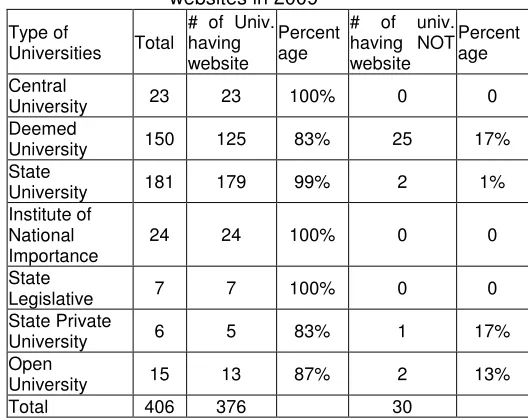
Table 1: Various types of universities having their websites in 2009
Type of
Universities Total
# of Univ. having website
Percent age
# of univ. having NOT website
Percent age
Central
University 23 23 100% 0 0
Deemed
University 150 125 83% 25 17%
State
University 181 179 99% 2 1%
Institute of National Importance
24 24 100% 0 0
State
Legislative 7 7 100% 0 0
State Private
University 6 5 83% 1 17%
Open
University 15 13 87% 2 13%
Total 406 376 30
3.
Literature Review
University web sites play an important role in facilitating a wide range of types of communication. A few reported hyperlink studies have focused on international academic web interconnectivity. In a study of 16 European countries, the importance of English for academic interlinking was established. Besides, universities’ websites were tended to link mostly to countries geographically nearer [8]. Similar patterns may also appear within a single country such as the UK [6]) and Canada [9, 10]. Greece was an exception in the EU study.
4.
Objectives
Following objectives have been set for this study, which have been mentioned below.
1. To measure the performance of Indian universities on the Web by examining their web presence and web impact.
2. To find out number of web pages, in-links and out-links for each university’s website
3. To know the web presence of Indian Universities in the web Space.
4. To know the various Web Impact Factors (WIF) for the university domain level.
5. To find out suitable ranking of all the universities having web presence using appropriate webometric indicators.
5.
Methodology
Following steps have been pursued to achieve the above objectives.
5.1 Selection of Universities
We have selected commercial search engines: AltaVista and Yahoo! for data collection because of its popularity, coverage and reliability. The list of Indian universities had been extracted through the following:
• The University Grants Commission
(www.ugc.ac.in)
• State-wise List of Universities (www.123careers.net/university/); which gives the state-wise list of universities with address, phone no and Fax number;
• State-Wise List of Universities in India (UGC Recognised and NAAC accredited) extracted from
(educationobserver.com/resources/universsities/)
• The list of Open Universities has been taken from the website of ‘The Distance Education Council’ (wwwdec.ac.in)
• The complete updated list of deemed universities
has been taken from the UGC
websites(www.ugc.ac.in).
5.2 Selection of Search Engines
We have used AltaVista, Yahoo, Google, Exalead, MSN and Google Scholar for retrieving the required webometric data for analysis purpose.
5.3 Use of Appropriate Query Syntax
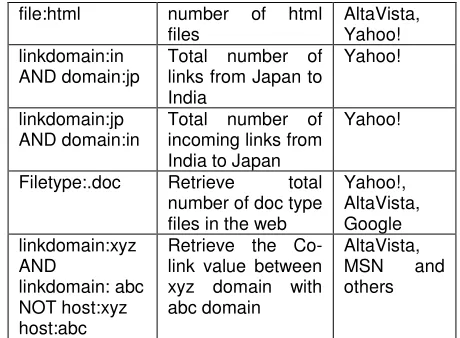
The Webometric analysis is based on the data collected from the Web using various search engines. In each search engines there are some specific search keywords assigned by the search engines to retrieve the information from the Web. These specific search keywords along with search syntax (Table-2) are mentioned below:
Table 2: Webometric query syntax with results
Search Command
Results Supported by domain:abc Total number of
webpages
Google, AltaVista, Yahoo! site:abc Total number of
webpages
Google, AltaVista, Yahoo! linkdomain:abc
–domain:abc
Total number of inlinks
AltaVista, Yahoo! linkdomain:in
domain:in
Total number of self-links
AltaVista, Yahoo! linkdomain:abc Total number of
links
AltaVista, Yahoo! site:abc Report total Google,
file:html number of html files
AltaVista, Yahoo! linkdomain:in
AND domain:jp
Total number of links from Japan to India
Yahoo!
linkdomain:jp AND domain:in
Total number of incoming links from India to Japan
Yahoo!
Filetype:.doc Retrieve total number of doc type files in the web
Yahoo!, AltaVista, Google linkdomain:xyz
AND
linkdomain: abc NOT host:xyz host:abc
Retrieve the Co-link value between xyz domain with abc domain
AltaVista, MSN and others
5.4 Data Collection
AltaVista and Yahoo! had been chosen to collect the data for this study. Data collection was done during March 28 to April 3, 2009. All the domain names were verified to check whether Yahoo!, Google and AltaVista supports the domain name. For each of these domain a search was carried out to determine the total number of links, total webpages, selflinks and inlinks using the following commands:
• The total number of webpages to ccTLD, China (for example) domain:domainname
• The number of total links at the ccTLD, China
(for example) linkdomain:domainname
• The number of inlinks can be calculated using the command linkdomain:domainname –
domain:domainname
• The number of self-links can be measured using the formula linkdomain:domainname
domain:domainname
5.5 Calculation of Web Impact Factors
WIF is the web versions of impact factor. There are three types of WIFs: simple, revived and WIF-overall. Due to non-satisfaction of WIF measures Prof Thelwall has introduced the concept of introducing staff member as a indicator for measuring the WIF. In the following Tables-3, various types of WIF calculations have been shown using the appropriate webometric indicators. The impact factor is a measure of frequency with which average article in a journal had been cited in a particular year or period. The WIF introduced by Ingwersen [1] is the ratio of the number of backlinks to a site, divided by the number of webpages at the site.
Let,
A = Total number of webpages to a particular site B = Number of external backlinks to a given site C = Number of self-links to a given site
D = Total number of links to a site
6.
Measuring Web Presence
Web presence can be measured according to several Web-based indicators, some of which include the number of pages, and the number of in and out-links. The data relating to the web presence of Indian universities have been retrieved using the above webometric query syntax
(Table-2) as supported by the commercial search engines. Web Impact Factors (WIFs) were calculated and reported in order to compare the universities’ web influence. Results indicate that half of Indian universities have made remarkable progress in their web presence, which is at an advanced stage of development.
Table 3: Calculation of WIFs for India (March 28, 2009)
Values Results
Search
Engines Webpage inlinks self-link Total links WIF (Simple) WIF (external) WIF (self-link) AltaVista 132000000 36100000 11500000 47500000 0.36 0.27 0.09 Google 372000000 349000000 479000 326000000 0.88 0.94 0.00 Yahoo 760000000 35700000 11400000 760000000 1.00 0.05 0.02 Source: AltaVista! Dated 28th March 2009
The above table-3 reflects that India as a whole is having strong value of WIF e.g. 0.94 through Google search engine.
Another study [11] on calculation of WIF for selected countries of Asia reflects that India is able to achieve 5th position based on WISER indicators.
Table 4: Calculation of WIF for Indian Academic Web Space (i.e. ac.in)
Values Results
Search Engines Webpage inlinks self-link Total links WIF (Simple) WIF (external) WIF (self-link) AltaVista 2310000 434000 1080000 1130000 0.49 0.19 0.47
Google 7570000 26000000 369000 8880 0.00 3.43 0.05
Yahoo 1319835 445000 1100000 233,955 0.18 0.34 0.83 Source: AltaVista! Dated 28th March 2009
It has been found from above table-4 that Google search engine reported more than six times higher webpage than Yahoo! and more than double of the size of webpage than AltaVista.
Table 5: Distribution of Domain Name for the Central Universities
SLD No of websites Percentage (%)
.in 20 86.96
.ac.in 10 43.48
.ernet.in 2 8.696
.org 3 13.04
.nic.in 3 13.04
.org.in 1 4.348
It has been observed from the above table-5 that only (.in) domain contribute 87% and .ac.in domain share is 44%. Therefore, the lion share of webspace occupies the academic domain.
7.
Measuring Web Impact Factors
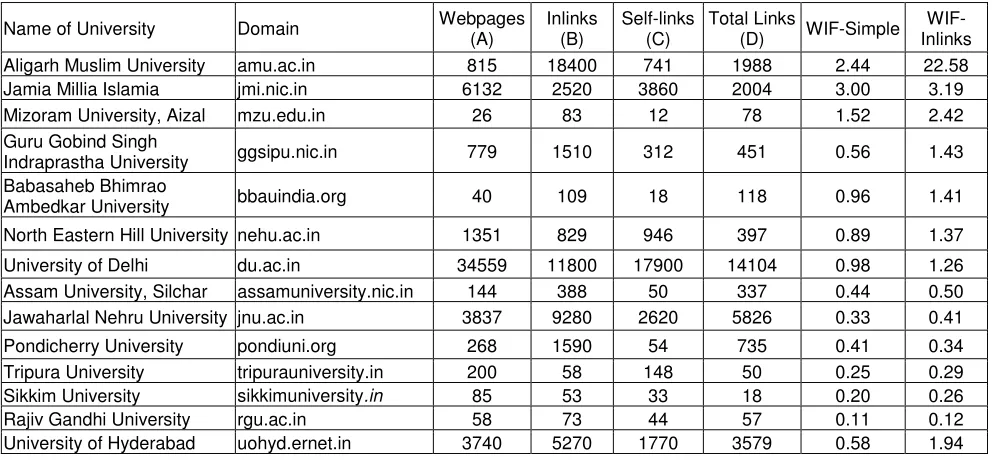
Various types of calculation of WIFs have been shown in the following table-6.
Table 6: Calculation of WIFs for Central Universities in India based on WIF-inlinks
Name of University Domain Webpages (A) Inlinks (B) Self-links (C) Total Links (D) WIF-Simple Inlinks
WIF-Aligarh Muslim University amu.ac.in 815 18400 741 1988 2.44 22.58 Jamia Millia Islamia jmi.nic.in 6132 2520 3860 2004 3.00 3.19
Mizoram University, Aizal mzu.edu.in 26 83 12 78 1.52 2.42
Guru Gobind Singh
Indraprastha University ggsipu.nic.in 779 1510 312 451 0.56 1.43 Babasaheb Bhimrao
Ambedkar University bbauindia.org 40 109 18 118 0.96 1.41
North Eastern Hill University nehu.ac.in 1351 829 946 397 0.89 1.37
University of Delhi du.ac.in 34559 11800 17900 14104 0.98 1.26 Assam University, Silchar assamuniversity.nic.in 144 388 50 337 0.44 0.50 Jawaharlal Nehru University jnu.ac.in 3837 9280 2620 5826 0.33 0.41 Pondicherry University pondiuni.org 268 1590 54 735 0.41 0.34 Tripura University tripurauniversity.in 200 58 148 50 0.25 0.29 Sikkim University sikkimuniversity.in 85 53 33 18 0.20 0.26
Rajiv Gandhi University rgu.ac.in 58 73 44 57 0.11 0.12
Visva-Bharati University,
Santiniketan, visva-bharati.ac.in 1209 1730 948 678 2.74 5.93 Manipur University manipuruniv.ac.in 155 94 77 88 2.95 2.73 University of Allahabad allduniv.ac.in 420 287 244 108 2.34 2.69 Mahatma Gandhi
Antarrashtriya Hindi Vishwavidyalaya
hindivishwa.org
119 163 15 106 0.29 0.61
Nagaland University nagauniv.org.in 54 44 16 35 0.47 0.63
Central Institute of English
and Foreign Languages ciefl.ac.in 665 418 18 314 0.26 0.68
Banaras Hindu University bhu.ac.in 7338 3680 4340 3264 0.57 0.61 Maulana Azad National
Urdu University manuu.ac.in 949 246 450 189 0.21 0.62
Tezpur University tezu.ernet.in 3951 461 2290 434 0.65 0.81 Source: Yahoo! March 28-April 3, 2009
It has seen from Table-6 that Aligarh Muslim University is having highest WIF-inlinks (22.58) due to its highest inlinks but Tezpur university, Assam is having WIF-inlinks least because of very low WIF-inlinks value.
8.
Ranking of Central Universities in India
There are various approaches for ranking universities. Some of the methods have been explained in detail.
8.1.
Ranking of Central Universities through
WISER
University activity is multi-dimensional and this is reflected in its web presence. So the best way to build the ranking is combining a group of indicators that measures these different aspects. Almind & Ingwersen [12] proposed the first Web indicator, Web Impact Factor (WIF), based on link analysis that combines the number of external inlinks and the number of pages of the website, a ratio of 1:1 between visibility and size. This ratio is used for the ranking but adding two new indicators to the size component: Number of documents, measured from the number of rich files in a web domain, and number of publications being collected by Google Scholar database. As it has been already commented, the four indicators were obtained from the quantitative results provided by the main search engines as follows:
• Size (S). Number of pages recovered from four engines: Google, Yahoo, Live Search and
Exalead. For each engine, results are log-normalised to 1 for the highest value. Then for each domain, maximum and minimum results are excluded and every institution is assigned a rank according to the combined sum.
• Visibility (V). The total number of unique
external links received (inlinks) by a site can be only confidently obtained from Yahoo Search, Live Search and Exalead. For each engine, results are log-normalised to 1 for the highest value and then combined to generate the rank.
• Rich Files (R). After evaluation of their relevance to academic and publication activities and considering the volume of the different file formats, the following were selected: Adobe Acrobat (.pdf), Adobe PostScript (.ps), Microsoft Word (.doc) and Microsoft Powerpoint (.ppt). These data were extracted using Google and merging the results for each filetype after log-normalising in the same way as described before.
• Scholar (Sc). Google Scholar provides the number of papers and citations for each academic domain. These results from the Scholar database represent papers, reports and other academic items.
The four ranks were combined according to a formula [13] where each one has a different weight:
Webometrics Rank (position) = 4*RankV +2*RankS +1*RankR+1*RankSc
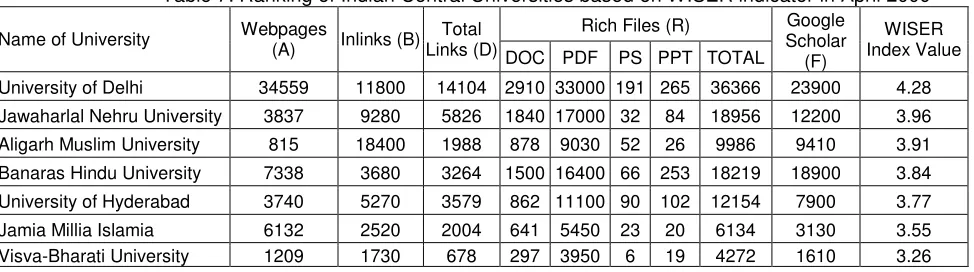
Table 7: Ranking of Indian Central Universities based on WISER indicator in April 2009
Rich Files (R) Name of University Webpages
(A) Inlinks (B) Total
Links (D) DOC PDF PS PPT TOTAL
Google Scholar
(F)
WISER Index Value
University of Delhi 34559 11800 14104 2910 33000 191 265 36366 23900 4.28
Jawaharlal Nehru University 3837 9280 5826 1840 17000 32 84 18956 12200 3.96 Aligarh Muslim University 815 18400 1988 878 9030 52 26 9986 9410 3.91 Banaras Hindu University 7338 3680 3264 1500 16400 66 253 18219 18900 3.84
North Eastern Hill University 1351 829 397 334 3550 5 33 3922 2690 3.14 Pondicherry University 268 1590 735 643 3930 10 50 4633 1650 3.12 Guru Gobind Singh
Indraprastha University 779 1510 451 267 2150 0 3 2420 229 3.03 Tezpur University 3951 461 434 317 1480 2 57 1856 550 2.95
University of Allahabad 420 287 108 297 5030 16 18 5361 5350 2.87 Central Institute of English
and Foreign Languages 665 418 314 82 341 1 2 426 625 2.69 Assam University, Silchar 144 388 337 89 576 2 3 670 331 2.53 Maulana Azad National
Urdu University 949 246 189 136 352 0 2 490 33 2.42
Manipur University 155 94 88 160 1920 0 7 2087 810 2.36 Tripura University 200 58 50 267 815 0 5 1087 257 2.16 Rajiv Gandhi University 58 73 57 487 2000 0 10 2497 225 2.15 Mizoram University, Aizal 26 83 78 90 659 0 5 754 113 1.98 Babasaheb Bhimrao
Ambedkar University 40 109 118 33 173 0 1 207 64 1.96
Nagaland University 54 44 35 94 836 0 4 934 164 1.95
Mahatma Gandhi Antarrashtriya Hindi Vishwavidyalaya
119 163 106 7 69 0 0 76 8 1.94
Sikkim University 85 53 18 26 176 0 1 203 2 1.64
Source: Yahoo! March 28-April 3, 2009
8.2
Ranking of Central Universities through
WIF-inlinks
Ranking of Central universities can be made based on WIF-inlinks indicator. The result is explained (Table-6) where it is been reflected that Aligarh Muslim University become the top position with the WIF-inlink value (0.91) and Tezpur University is the last place with the value of WIF-inlink (0.31).
8.3
Comparison
of
Ranking
of
Central
Universities in India
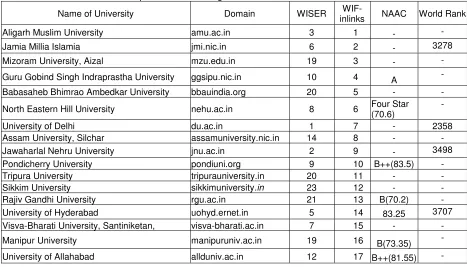
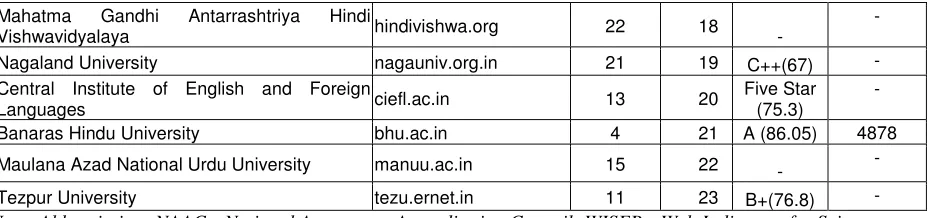
The comparison of ranking of Indian central universities is being done using WISER, NAAC and WIF-inlinks. In NAAC, there is various grading system for ranking the universities based through quality assessment. The latest method is CGPA (Cumulative Grade Point Average) method with 5 point scale, assigns grade A, B, C and D (very good, good, satisfactory and unsatisfactory respectively).
Table 8: Comparison of Ranking of Indian Central Universities in 2009
Name of University Domain WISER
WIF-inlinks NAAC World Rank
Aligarh Muslim University amu.ac.in 3 1 - -
Jamia Millia Islamia jmi.nic.in 6 2 - 3278
Mizoram University, Aizal mzu.edu.in 19 3 - -
Guru Gobind Singh Indraprastha University ggsipu.nic.in 10 4 A -
Babasaheb Bhimrao Ambedkar University bbauindia.org 20 5 - -
North Eastern Hill University nehu.ac.in 8 6 Four Star (70.6)
-
University of Delhi du.ac.in 1 7 - 2358
Assam University, Silchar assamuniversity.nic.in 14 8 - -
Jawaharlal Nehru University jnu.ac.in 2 9 - 3498
Pondicherry University pondiuni.org 9 10 B++(83.5) -
Tripura University tripurauniversity.in 20 11 - -
Sikkim University sikkimuniversity.in 23 12 - -
Rajiv Gandhi University rgu.ac.in 21 13 B(70.2) -
University of Hyderabad uohyd.ernet.in 5 14 83.25 3707
Visva-Bharati University, Santiniketan, visva-bharati.ac.in 7 15 - -
Manipur University manipuruniv.ac.in 19 16 B(73.35) -
Mahatma Gandhi Antarrashtriya Hindi
Vishwavidyalaya hindivishwa.org 22 18 -
-
Nagaland University nagauniv.org.in 21 19 C++(67) -
Central Institute of English and Foreign
Languages ciefl.ac.in 13 20
Five Star (75.3)
-
Banaras Hindu University bhu.ac.in 4 21 A (86.05) 4878
Maulana Azad National Urdu University manuu.ac.in 15 22 - -
Tezpur University tezu.ernet.in 11 23 B+(76.8) -
Note: Abbreviation: NAAC= National Assessment Accreditation Council; WISER= Web Indicators for Science, Innovation and Research
The world ranking (Table-8) implies that only five central universities are having world rank among
6000 universities [12] in the world. Here hyphen implies that there is no score for these universities.
Table 9: Correlation between ranking of WISER and WIF-inlinks
Name of Central University WISER (X)
WIF-inlinks
(Y)
Square (X)
Square (Y) XY
x=(X-Xbar)
y=(Y-Ybar) xy Square (x) Square
(y)
Aligarh Muslim University 3 1 9 1 3 -9.39 -11 103.30 88.19 121
Jamia Millia Islamia 6 2 36 4 12 -6.39 -10 63.91 40.84 100
Mizoram University, Aizal 19 3 361 9 57 6.61 -9 -59.48 43.68 81 Guru Gobind Singh Indraprastha
University 10 4 100 16 40 -2.39 -8 19.13 5.72 64
Babasaheb Bhimrao Ambedkar
University 20 5 400 25 100 7.61 -7 -53.26 57.90 49
North Eastern Hill University 8 6 64 36 48 -4.39 -6 26.35 19.28 36
University of Delhi 1 7 1 49 7 -11.39 -5 56.96 129.75 25
Assam University, Silchar 14 8 196 64 112 1.61 -4 -6.44 2.59 16 Jawaharlal Nehru University 2 9 4 81 18 -10.39 -3 31.17 107.97 9
Pondicherry University 9 10 81 100 90 -3.39 -2 6.78 11.50 4
Tripura University 17 11 289 121 187 4.61 -1 -4.61 21.24 1
Sikkim University 23 12 529 144 276 10.61 0 0.00 112.55 0
Rajiv Gandhi University 18 13 324 169 234 5.61 1 5.61 31.46 1 University of Hyderabad 5 14 25 196 70 -7.39 2 -14.78 54.63 4 Visva-Bharati University,
Santiniketan, 7 15 49 225 105 -5.39 3 -16.17 29.06 9
Manipur University 16 16 256 256 256 3.61 4 14.44 13.02 16
University of Allahabad 12 17 144 289 204 -0.39 5 -1.96 0.15 25 Mahatma Gandhi Antarrashtriya Hindi
Vishwavidyalaya 22 18 484 324 396 9.61 6 57.65 92.33 36
Nagaland University 21 19 441 361 399 8.61 7 60.26 74.11 49
Central Institute of English and
Foreign Languages 13 20 169 400 260 0.61 8 4.87 0.37 64
Banaras Hindu University 4 21 16 441 84 -8.39 9 -75.52 70.41 81 Maulana Azad National Urdu
University 15 22 225 484 330 2.61 10 26.09 6.81 100
Tezpur University 11 23 121 529 253 -1.39 11 -15.30 1.93 121
Total 276 276 4324 4324 3541 - - 229.00 1015.52 1012
Hence, Mean for the variable (X & Y) can be calculated as:
In this case mean (X & Y) are same i.e. 12. Standard deviation will be calculated with the help of:
Where n=23.
In such a situation, standard deviation (X) & Y are same: square root of (1012/23) = σx= σy= 6.6332
fit. The coefficient of determination (i.e. r2) is such that 0 < r2 < 1, and denotes the strength of the linear association between x and y. The formula can be given as follows:
or
r2 = COV(X, Y)/ σx * σy = [(1/N∑XY – mean(X)*mean(Y))/ σx * σy]
∑XY= 3541; Mean (X)=12;Mean (Y)=12; σx =6.6322 & σy = 6.6332
Therefore, the calculated value of r would be =0.2262
where, n is the number of pairs of data and r denotes correlation coefficient. σx is the standard deviation of X and c standard deviation of Y. The correlation between WISER Ranking and WIF-inlinks is having correlation i.e. 0.2262 which implied that there is not much association or closeness between two ranking methods. In other words, there is a huge difference between two ranking methods.
Table 10: Reliability of ranking methods in comparison with world ranking for central universities
Name of
University Domain WISER WIF-inlinks
Inlink s
NAAC Score
World Rank University
of Delhi du.ac.in 1 5 1 - 2358(1) Jamia Millia
Islamia jmi.nic.in 5 4 5 - 3278(2) Jawaharlal
Nehru University
jnu.ac.in 2 1 2 - 3498(3)
University of
Hyderabad
uohyd.ern
et.in 4 2 3 83.25 3707(4)
Banaras Hindu University
bhu.ac.in 3 3 4 86.05 4878(5)
9.
Motivation for Hyperlinks
Kim [14] investigated motivations for creating links in electronic publications in order to find out the relationship between citations and scholarly e-journals. He identified three factors- scholarly, social and technological reasons. Harrison [15] identified some principles of link creation and proposed a classification of links. Park [16] conducted a survey of 64 Korean webmasters of commercial websites to assess their motivations for linking to other websites. He found that webmasters were more likely to hyperlink to websites possessing practical content, information or services. Chu [17] analyzed sample of links and generated list of reasons of hyperlinks. He found that only 27% of the links were made out of research or teaching motivations. Kousha and Horri [18] made a survey in Iranian university and found that 63% hyperlinks were made for navigational purpose. Links
between UK universities in the field of Mathematics, Physics and Sociology were analyzed. Wilkinson et al. [19] surveyed 414 links between UK university websites and classified them. They found that less than 1% of hyperlinks targeted formal scholarly articles in journals or conferences; 90% of targeted materials were some way or rather related to scholarly activity. Bar-Ilan [20] made an academic link studies and included categories for the type of sources and target pages of inter-university links in Israel. He found that 20% links related to research category while Wilkinson et al. found 27% links related to research. Thelwall [21] surveyed a sample of 100 random inter-site links to UK university homepage and found four types of motivations: ownership, social, general and navigation reasons. Thelwall [22] made an attempt to distinguish links between research related and non-research oriented.
10.
Findings of the Study
Following are some of the findings observed from the study.
• As per WIF-inlinks, Aligarh Muslim
University got the top rank whereas University of Delhi occupied top rank based on WISER;
• There is very very low correlation between
WISER Rank and WIF-inlinks for the case of Indian Central Universities
• University of Delhi is having the highest
webpage (34559) whereas Aligarh Muslim University is having highest number of inlinks (Table-7).
• Having World Rank (2358), University of
Delhi occupied top position among Central universities in India
11.
Conclusion
Indian universities are having a good web presence in general. Central universities in India were having total of 66894 webpages and 59086 outlinks (Table-7), producing an average score of 0.88 inlinks per page, which means that per 100 webpage there are 88 inlinks. An analysis of each university’s average number of webpages, using yahoo! Search engine have shown that there are total of 2908 webpages and 2568 inlinks per university. Therefore, it seems that Indian Central Universities have made remarkable progress in developing their websites the a\study also reflected the comparison of different methodological approach and visibility of Indian universities. The study is able to raise further research possibility on the following aspects
• Comparison between results drawn from webometric studies and using other performance indicators (e.g. publication count and citation analysis) for Indian Universities.
• To establish suitable reasons for web sitation and
categorization of sitations.
It is our findings that more than 75 Indian universities are having web-pages less than 100 therefore, they may not qualify for comparative webometric studies, especially for ranking purposes, due to underdeveloped websites. Similarly, universities which are operating under different economic, political and social conditions and unless these aspects are taken into consideration.
12. References
[1] P. Ingwersen (1998). The calculation of Web Impact Factors. Journal of Documentation, 54(2), 236-43.
[2] X. Li, M. Thelwall, P. Musgrove and D. Wilkinson (2003). The relationship between the links/Web Impact Factors of computer science departments in UK and their RAE (Research Assessment Exercise) ranking in 2001. Scientometrics, 57(2), 239-255
[3] R. Tang and M. Thelwall (2003). Disciplinary differences in US academic departmental web site interlinking, Library & Information Science Research, 25(4), 437-458.
[4] M. Thelwall (2001). Extracting macroscopic information from Web links. JASIST, 52 (13); 1157-68.
[5] A. Smith (1999). A tale of two Web spaces: comparing sites using Web impact factors. Journal of
Documentation, 55(5), 577-592.
[6] M. Thelwall (2002). A comparison of sources of links for academic Web Impact Factor calculations. Journal of Documentation, 58 (1), 60-72.
[7] The University Grants Commissions of India (http://www.ugc.ac.in . Accessed 10 September 2009)
[8] M. Thelwall, R.Tang and E. Price (2003). Linguistic patterns of academic web use in Western Europe. Scientometrics, 56(3), 417-432.
[9] L. Vaughan (2007). Why are websites co-linked? The Case of Canadian universities. Scientometrics, 72(1), 81-92.
[10]L. Vaughan and M. Thelwall (2003). Scholarly use of the web: What are the key inducers of links to journal web sites? JASIST, 54(1), 29-38.
[11]S.K. Jalal, B.C. Biswas and P. Mukhopadhyay. Web presence of selected Asian countries: A Webometric study. Fifth International conference on WIS and 10th COLLNET meeting, 13-16 Sept. 2009.
[12]T.C. Almind and P. Ingwersen (1997). Informetric analyses on the World Wide Web: Methodological approaches to Webometrics, Journal of
Documentation, 53(4), 404-26.
[13]Ranking Web of World universities.
http://www.webometrics.info/methodology.html
Accessed 10 September 2009
[14]H.J. Kim (2000). Motivations for hyper-linking in scholarly electronic articles: a qualitative study. JASIS, 51(10), 887-99.
[15]C. Harrison (2002). Hypertext links: Whither Thou Guest and Why. First Monday, 7(10). Available: http://firstmonday.org/issues/issue7_10/harrison/index. html. Accessed 10 September 2009
[16]H.W. Park (2002). Examining the determinants of who is hyperlinked to whom: a survey of webmasters in Korea. First Monday, 7(11). Available:
http://firstmonday.org/issues/issue7_11/park/. Accessed 10 September 2009
[17]H. Chu (2005). Taxonomy of inlinked web entities: what does it imply for webometric research? Library
and Information Science Research, 27(1), 8-27.
[18]K. Kousha and A. Horri (2004). The relationship between scholarly publishing and the counts of academic inlinks to Iranian university web sites: Exploring academic link creation motivations. Journal of Information Management and Scientometrics, 1(2), 13-22.
[19]D. Wilkinson, M. Thelwall and X. Li (2003). Exploiting hyperlinks to study academic Web use.
Social Science Computer Review, 21(3); 340-351.
[20]J. Bar-Ilan (2004). What do we know about links and linking? A framework for studying links in academic environment. Information Processing and Management, 41(4), 973-986
[21]M. Thelwall (2003). What is this link doing here beginning a fine-grained process of identifying reasons for academic hyperlink creation? Information Research, 8(3).
[22]M. Thelwall (2001). Conceptualizing documentation on the web: an evaluation of different heuristic-based models for counting links between university websites.