University of New Orleans University of New Orleans
ScholarWorks@UNO
ScholarWorks@UNO
University of New Orleans Theses and
Dissertations Dissertations and Theses
Spring 5-19-2017
Examining the Impact of Sexual Orientation on the Career
Examining the Impact of Sexual Orientation on the Career
Development of LGBQ+ Students
Development of LGBQ+ Students
Michael D. Hoffshire
University of New Orleans, [email protected]
Follow this and additional works at: https://scholarworks.uno.edu/td
Part of the Higher Education Commons
Recommended Citation Recommended Citation
Hoffshire, Michael D., "Examining the Impact of Sexual Orientation on the Career Development of LGBQ+ Students" (2017). University of New Orleans Theses and Dissertations. 2328.
https://scholarworks.uno.edu/td/2328
This Dissertation is protected by copyright and/or related rights. It has been brought to you by ScholarWorks@UNO with permission from the rights-holder(s). You are free to use this Dissertation in any way that is permitted by the copyright and related rights legislation that applies to your use. For other uses you need to obtain permission from the rights-holder(s) directly, unless additional rights are indicated by a Creative Commons license in the record and/ or on the work itself.
Examining the Impact of Sexual Orientation on the Career Development of LGBQ+ Students
A Dissertation
Submitted to the Graduate Faculty of the University of New Orleans In partial fulfillment of the Requirements for the degree of
Doctor of Philosophy In
Educational Administration Higher Education
By
Michael David Hoffshire B.S. Roger Williams University, 2009 M.A. Michigan State University, 2011
ii
iii
Acknowledgements
Over the past four years, I have received support and encouragement from a number of
individuals. First, I’d like to recognize Dr. Chris Broadhurst, who has been an incredible
teacher, mentor, advisor, friend and now colleague throughout my dissertation process. Without
his insight and feedback, this study would not be possible. Second, I would like to thank those
individuals who have served on my committee and have made a lasting impact on me as a
researcher, including Dr. Brian Beabout, Dr. D’Lane Compton and Dr. Alonzo Flowers. Third, I
would like to thank the unwavering support of my family and friends. While you may not
always understand the context of my work as an educator in higher education and student affairs,
you have always offered a listening ear or an encouraging word. I appreciate you understanding
the sacrifices I have made as a doctoral student. To my classmates also studying educational
leadership at the University of New Orleans, I appreciated being a part of our community of
scholars. Thank you for the thought provoking class discussions and rigorous feedback of my
research study and design. An additional thank you to Christy Heaton and Dr. Emily Campbell
who guided me through this thoughtful and rewarding journey. Finally, I’d like to acknowledge
my dog, Luke who spent many long days by my side as I wrote, coded and analyzed data.
To the LGBQ+ undergraduate students who served as participants in my study, I have
learned a lot from you. It is my hope that the findings from this dissertation study will be
utilized to impact the delivery of career services for marginalized populations in the future. I
iv
Table of Contents
List of Figures ... vii
List of Tables ... viii
Abstract ... ix
Chapter 1 ...1
Introduction ...1
Problem Statement ...4
Purpose of the Study ...8
Conceptual Framework ...9
Methods...10
Research Questions ...11
Terminology ...11
Organization of the Dissertation ...13
Chapter 2 ...14
Introduction ...14
Historical Perspectives of Homosexuality ...14
Gay Rights Movement ...15
Campus Climates ...19
Homosexual Identity Development ...23
Vivienne Cass “Homosexual Identity Development Model” ...24
Anthony D’Augelli “Homosexual Lifespan Development Model” ...25
Ruth Fassinger “Homosexual Development Model” ...26
Career Development ...26
Definition ...27
Historical Roots ...27
Career Services on Campuses ...31
Structure ...32
Purpose ...33
Future ...34
Social Cognitive Career Theory ...35
Known Challenges to Successful Career Development...38
Gender ...39
People of Color ...40
Sexual Orientation ...40
Social Stigma ...41
Environmental Influences ...42
Discrimination & Homophobia on College Campuses ...44
Discrimination & Homophobia in the Workplace ...45
Mentors ...47
Conclusion ...48
Conceptual Framework ...48
Lent, Brown, & Hackett “Social Cognitive Career Theory” ...48
Identity ...51
Ruth Fassinger’s “Homosexuality Development Model” ...52
v
Chapter 3 ...58
Introduction ...58
Research Question ...59
Phenomenology...59
Site Selection ...60
Participants ...63
Recruitment Strategy ...67
Sample Size ...68
Data Collection ...68
Interview Protocol ...69
Document Review ...69
Semi-Structured Interview ...71
Journaling ...72
Data Analysis ...72
Coding Scheme ...73
Trustworthiness ...75
Researcher Identity. ...76
Credibility ...76
Transferability ...76
Dependability ...77
Confirmability ...77
Ethical Considerations ...78
Conclusion ...78
Chapter 4 ...80
Findings...80 Participants ...80 Sam ...81 Aaron...81 Klaire...82 Alicia ...82 Mary ...83 Jennifer ...83 Beth ...83 Christina ...83 Ant...84
Introduction to Findings ...84
“All of this has been a process”: Coming Out ...85
“I feel this weird half for everything”: Intersectionality ...90
“Careers look different to queer students”: Navigating careers ...94
Impact on Major Selection ...95
Impact on Professional Career ...96
Level of Outness ...97
Relationships with Colleagues & Supervisors ...99
Homophobia/Discrimination...103
“Being Queer Friendly”: Identifying Employers & The Role of Counselors ...105
vi
Role of Counselors ...107
Conclusion ...109
Chapter 5 ...111
Discussion ...111
Coming Out ...111
Selection of a Major ...117
Level of Outness ...121
Implications for Theory & Practice ...124
Implications for Theory ...124
Implications for Practice ...128
Campuses ...128
Educators & Career Counselors ...133
Identifying & Creating LGBQ+ Friendly Organizations ...136
Limitations & Future Research ...139
Conclusion ...141
References ...144
Appendix A ...194
Appendix B ...196
Appendix C ...198
Appendix D ...200
vii List of Figures
viii List of Tables
States Lacking Protections for Sexual Orientation or Gender Identity...5
McCarn and Fassinger’s Model of Homosexual Identity Development ...55
ix Abstract
College is a significant stage that heavily contributes to who and what citizens become
after degree attainment. During career development, college students’ interests develop through
taking part in coursework and employment based occupational exploration. It has been
speculated that because sexual identity development and vocational identity development are
active during the same phase of life, these processes might exert influence on each other (Chen,
Stacuzzi, Ruckdeschel, 2004; Fassinger, 1996; Morrow, 1997). With the changing
socioeconomic climate over the past decade, individuals of varying sexual orientation identities
have found it necessary or desirable to be more open regarding their identity in their career.
Currently, a lack of research exists that examines LGBQ+ students’ career development (Datti,
2009; Degges-White & Shoffner, 2002; Chung, 1995; Morrow, 1997; Schneider & Dimito,
2010).
The purpose of this research study was to examine the career development of LGBQ+
students. Through a qualitative, phenomenological approach utilizing nine participants, the
researcher examined how a LGBQ+ sexual orientation impacts a student’s career
development. Four themes emerged from the study: the participant coming out process,
awareness of intersectionality of identities, navigating their career as an LGBQ+ individual,
identifying potential employers, and the role of career counselors. Recommendations are shared
to further support LGBQ+ individuals in their career development. As a result of this study,
leaders in post-secondary education as well as policymakers are able to gain insight into the
career development of this population.
1 CHAPTER 1
Introduction
In the current challenging economic climate, the availability and delivery of career
services to college students is more important than ever. College students rely on career service
units/offices to help them prepare and review documents such as resumes and cover letters,
identify career options, search for job opportunities, develop and foster interview skills, and
evaluate job offers (Schaub, 2012). As Gore and Metz (2008) stated, “college is a critical time in
young people’s career development” (p. 128). Students are engaging in academic and social
endeavors, exploring various identities, and learning to become productive citizens. While
institutions have adapted to offer more individualized approaches to student development and
success, career counselors have become more educated on the specific needs of their student
body populations (Gore & Metz, 2008). It has become imperative for career counselors to have a
better understanding of the various identities students are entering the collegiate context with so
they can be better equipped to address individual concerns and questions regarding future career
decisions. Career counselors may use the student’s salient identities and personalities to gain
insight into their preferences for engaging in the career development process and to describe
work related strengths and challenges (Schaub, 2012).
Over the past twenty years, the student population of many higher education institutions
have become increasingly diverse (Datti, 2009; Evans, Forney, Guido, Patton, & Renn, 2010).
Along with the expansion of higher education and increasing tuition costs, the pressure on
institutions to retain all students to degree completion has been mounting (Campbell & Mislevy,
2013). As such, institutions have responded by taking a more student-centered approach,
2
population that campuses have actively attempted to decrease the marginalization of, are those
who identify as a member of the lesbian, gay, bisexual, or queer (LGBQ+1) community.
The researcher has elected to utilize the acronym LGBQ+ as an umbrella term that
includes anyone whose sexual orientation falls outside societal norms (American Educational
Research Association, 2015). The term refers to an identity of an individual who is physically,
emotionally, or sexually attracted to some or all members of the same sex. In addition, per the
Oxford English Dictionary, the term queer originated from the English language in the 16th
century as a Northern English expression meaning odd or peculiar (“Queer,” 2015). Up until the
late 19th century, authors utilized the term queer in the literature to describe feminine men who
engaged in same-sex relationships (Chauncey, 1994). However, beginning in the 1980s, the term
was reclaimed by the lesbian, gay, and bisexual (LGB) community with the help of academia,
art, and popular culture. Today, LGB communities have reclaimed the term queer to mean a
resistance to oppression and as a means for empowerment (Dilley, 1999; Dyer, 2002; Hall,
2003). For the purposes of this study, LGBQ+ will refer to those individuals who do not identify
as heterosexual. The term heterosexual can be defined as an individual who is sexually, and
emotionally attracted to a member of the opposite sex (Chase & Ressler, 2009).
The creation of lesbian, gay, bisexual, transgender and LGBQ+ (LGBTQ) Centers (Fine,
2012; Rankin, 2005; Zemsky & Sanlo, 2005), greater inclusion of LGBTQ issues in the
curriculum and student affairs programming (Malaney, Williams, & Geller, 1997; Mayo, 2009;
McRee & Cooper, 1998; Zemsky & Sanlo, 2005), the creation of student organizations based on
LGBTQ identity (Beemyn, 2003; Dilley, 2002; Hall, 2010; McRee & Cooper, 1998; Walls,
1 Consistent with recommendations set forth by the American Educational Research Association (AERA), the
3
Kane, & Wisneski, 2010), and the addition of sexual and gender identity to non-discrimination
clauses (Githens, 2012; Rankin, 2005; Rhoads, 1997; Woodford, Atteberry, Derr, & Howell,
2013) are just a few mechanisms that campuses have utilized to create a more supportive and
accepting environment for students. Within the past twenty years, individuals of differing sexual
orientations have become more widely visible and accepted within mainstream society (Datti,
2009; Pew Research Center, 2013).
With the changing socioeconomic climate over the past decade, individuals of varying
sexual orientation identities have found it necessary or desirable to be more open regarding their
identities in their career environments. Openness regarding one’s sexual orientation enables
LGBQ+ workers to achieve congruence in their public and private identities, establish closer
relationships with peers and coworkers, and avoid negative cognitive effects (Fassinger, 1995;
Reynolds & Hanjorgiris, 2000; Griffith & Hebl, 2002). For organizations, creativity,
satisfaction, productivity, and team member well-being are potential positive impacts of cultural
and gender diversity (Stahl, Mäkelä, Zander, & Maznevski, 2010). However, some LGBQ
individuals choose not to disclose their sexual orientation identity, a concept known as
“passing”. According to Berger (1992), the concept of passing represents the notion that
homosexuality is an invisible identity which often can be hidden from others. Berger (1992) also
commented that passing leads to poor self-concept and potential emotional distress. In addition,
Weinberg and Williams (1975) found that failure to disclose one’s sexual orientation can
encourage the internalization of negative concepts. If an individual chooses to engage in
“passing” over the long term, it can cause themselves to create a negative self-concept (Berger,
1992; Weinberg & Williams, 1975). As such, career counseling with LGBQ+ individuals should
4
the impact that this discrimination has on the decision to be open regarding sexuality on the job,
and the problems faced within their career (Elliott, 1993; Maree, 2014; Parnell, Lease, & Green,
2012; Schmidt, Miles, & Welsh, 2011). This study offers an examination of LGBQ+ students
and their career development in a collegiate setting.
Problem Statement
According to recent results of a Pew Research Center (2013) survey, over 92% of LGBT
Americans say society has become more accepting of them in the past decade. Participants in
the survey attributed these changes to a variety of factors, from people interacting with someone
who is LGBQ to engaging in some form of LGBQ advocacy and education. However, the same
survey indicated that many in the LGBQ community continue to feel stigmatized, have been
rejected by a family member or close friend (39%), physically attacked (30%) or felt treated
unfairly by an employer (21%). Furthermore, a recent 2013 study found that LGB adults are
unemployed at a rate 40% higher than the overall average (Movement Advancement Project,
Center for American Progress & Human Rights Campaign, 2013).
Recent legislation continues to openly discriminate against the LGBQ+ community. For
example, North Carolina recently passed the Public Facilities Privacy and Security Act, which
requires individuals to use public restrooms according to the biological sex on their birth
certificate. Furthermore, it strips workers from the ability to sue under a state anti-discrimination
law against LGBT individuals (Logue, 2016). In 2016, Georgia passed the Free Exercise
Protection Act, which enabled clergy to refuse to conduct same sex marriages on the basis of
their religious beliefs. It also allowed faith based organizations the right to refuse to employ an
individual who identifies as a member of the LGBT community (Nanos, 2016). According to
5
as the constitutional right of religious exercise and expression are the key issues that make
religious exemption from employment so contentious (p. 299).” After drawing wide spread
criticism, Georgia Governor Nathan Deal exercised his veto power on the act (Capehart, 2016).
Currently, there are twenty-eight states that do not offer protections against
discrimination based on sexual orientation (see Table 1.1) (Movement Advancement Project,
2016). In these states, there are no employment non-discrimination laws covering sexual
orientation, although federal law does offer some protections. Employment practices that target
LGBQ+ employees are not uncommon, especially among religious organizations (Thompson,
2015). In fact, 52% of the LGBT population resides in a state where employers can discriminate
based on sexual orientation (Movement Advancement Project, 2016). Those impacted by such
discriminatory policies have little recourse, as Title XII of the Civil Rights Act does not protect
LGBT identity (Thompson, 2015). However, current efforts by several legislators, such as
Senator Jeff Merkley, have sought to change that in the form of the Equality Act (an addition to
Title XII that would outlaw workplace discrimination on behalf of sexual orientation and gender
identity) (Terkel, 2015). To date, the measure has not passed.
Table 1.1: States Lacking Protections for Sexual Orientation or Gender Identity
Idaho Montana Wyoming North Dakota
South Dakota Nebraska Kansas Oklahoma
Texas Arizona Alaska Louisiana
Arkansas Missouri Mississippi Alabama
Tennessee Kentucky Georgia Florida
South Carolina North Carolina Virginia West Virginia
6
During career development, college students’ interests develop through taking part in
coursework and employment based occupational exploration. According to Sung, Turner, and
Kaewchinda (2013), for students, “career trajectories are also supported or hindered by their
abilities to set and meet academic and career-related goals, and by the support and influence of
peers, professors, parents, and advisors” (p.128). College is a significant stage that heavily
contributes to who and what citizens become after degree attainment. In addition, college is a
crucial time for self-identity, self-discovery, and identity solidification (Gortmaker & Brown,
2006; Taulke-Johnson, 2010). It has been speculated that because sexual identity development
and vocational identity development are active during the same phase of life, these processes
might exert influence on each other (Chen et al., 2004; Fassinger, 1997; Morrow, 1997).
Therefore, these processes of identity development have caused some scholars to hypothesize
that the process of vocational identity development for LGBQ+ identified individuals might
occur along a different trajectory when compared to heterosexual individuals (Morrow, Gore, &
Campbell, 1996; Fassinger, 1997).
Due to the emergence of a larger gay culture in mainstream society, LGBQ+ individuals
are no longer funneled through a certain stereotypical career path (gay males as hairdressers or
lesbian women as truck drivers) (Datti, 2009). During adolescence, students become more aware
of environments surrounding various careers and slowly come to identify which fields may be
lesbian and gay friendly (Morrow, 1997). For example, a LGBQ+ student may assess the
compatibility of a particular occupation with their self-image to determine how much energy and
effort they are willing to exert on a particular occupation (Hoyle & Sherrill, 2006; Lent, Brown,
& Hackett, 1994; Morrow, 1997). Furthermore, LGBQ+ students may be less willing to put in
7
exerting an incredible amount of energy on their sexual identity development (Ueno, Abraham,
Pena-Talamantes, & Roach, 2013). Social relations and lifestyles associated with each
occupation suggest that individuals are concerned about the social identity conferred with each
occupational type (Holland, 1997). In addition, LGBQ+ students may not want to put
themselves on a career path on which they feel vulnerable or threatened (Plug, Webbink, &
Martin, 2014). The presence of homophobia, both on a college campus and in a work
environment, can hinder a LGBQ+ individual’s career development (Ragins, Singh, & Cornwell,
2007; Sailer, Korschgen, & Lokken, 1994).
Throughout their life span, LGBQ+ students face a plethora of issues, including but not
limited to rejection, low self-esteem, identity confusion, environmental barriers, and social
isolation (Datti, 2009). This is particularly salient during the collegiate years as LGBQ+ identity
formation is considered a “primary developmental task” (Hetrick & Martin, 1987, p. 25). While
it can be argued that all students face similar challenges as they transition to the college
environment, sexual minority students face increased pressure from societal norms and a culture
of heteronormativity (Kirsch, Conley, & Riley, 2015; Zubembis & Snyder, 2007).
Heteronormativity can be defined as the implicit framework that supports the practice of
heterosexuality in which those that do not conform are considered deviant (Warner, 1991).
Examples of heteronormativity include the opposition of same-sex marriage, same-sex benefits,
and same sex adoption. Datti (2009) proposed the concept of a “bottleneck hypothesis” in which
LGBQ+ individuals cope with career development and related tasks at a slower pace than their
heterosexual counterparts because they are simultaneously dealing with a marginalized sexual
orientation. Therefore, LGBQ+ students often get caught in the space “in between” identity
8
are often “put on hold” making career exploration difficult (Chen, Stracuzzi, & Ruckdeschel,
2004; Fassinger, 1997; Morrow, 1997; Schmidt & Nilsson, 2006). The disclosure of a
stigmatized identity may make the individual the subject of prejudice, discrimination, or
victimization (Chaudoir & Fisher, 2010). Studies conducted by Lyons, Brenner, and Lipman
(2010) and Schmidt and Nilsson (2006) supported the concept of the “bottleneck hypothesis.”
Currently, limited research exists that examines LGBQ+ students’ career development
(Datti, 2009; Degges-White, & Shoffner, 2002; Chung, 1995; Morrow, 1997; Schneider &
Dimito, 2010). LGBQ+ individuals may experience obstacles in career development if a
preponderance of mental energy is given to developing sexual identity (Russon & Schmidt,
2014). Garnets and Kimmel (1993) and Mohr and Fassinger (2000) hypothesized that many
major developmental tasks are delayed because of cultural stigma and lack of modeling and
social support. In selecting a major or career, LGBQ+ students must go through a mental
process that includes weighing the variables or obstacles that stand in the way of their
achievement (Datti, 2009). Current research suggests that there are many barriers to effective
career development among LGBQ+ students, including social stigmas, open discrimination,
homophobia and lack of mentors (Datti, 2009; Mobley & Slaney, 1996; Morrow, 1997.;
Schnedier & Dimito, 2010). As sexuality becomes more visible within mainstream society, it is
important that researchers undertake a critical examination of the way a student’s sexuality
intersects with their career development processes.
Purpose of the Study
There has been limited research published examining the career development of LGBQ+
individuals despite calls for increasing diversity in the workplace in addition to ethical and
9
Saucier, & Woodword, 2001; Pope, Prince, & Mitchell, 2000; Schmidt & Nilsson, 2006;
Tomlinson & Fassinger, 2003). The purpose of this qualitative case study was to understand the
impact a LGBQ+ sexual orientation had on a student’s career development. The study
examined how LGBQ+ students explored their identity and its relationship to their understanding
of their career development. By conducting this study, the researcher uncovered the perceived
challenges LGBQ+ students faced in their career development and the potential impact it played
on their major and/or career choices. Because more LGBQ+ students are open regarding their
sexuality throughout college, educators need to have a better understanding of how to assist this
student population in their career development (Chojnacki & Gelberg, 1994; Maree, 2014). This
researcher will produce a qualitative analysis of the career development of LGBQ+ students.
Conceptual Framework
The researcher has developed a conceptual framework that encompasses Ruth Fassinger’s
(1998) homosexual identity development and Lent, Brown, and Hackett’s (1994) social cognitive
career theory (SCCT). Ruth Fassinger’s (1998) theory of gay and lesbian identity development
serves two purposes in the building of the proposed study’s conceptual framework. First, it
offered an explanation of LGBQ+ identity development. Second, this theoretical model allows
the researcher to explore sexual orientation identity development from both an individual and
group prospective. Lent et al.’s (1994) social cognitive career theory suggested that an
individual’s career choice can be influenced by their belief system, which can be refined through
personal performance accomplishments, social persuasion, learning, and physiological states.
Throughout an individual’s career development, there is a focus on the way self-efficacy, ability,
expectations, and goals relate to the person, context, and learning experiences. Lent et al. (1994)
10
satisfaction, and interest would help explain the process of career choice. SCCT postulates that
personal inputs (such as gender, sexual orientation, religion, etc.) and contextual background
factors directly affect learning experiences which in turn affect self – efficacy leading to actions,
interests, and goals of a potential career. This conceptual framework provides a lens from which
to view the research undertaken and offers a theory of the phenomenon that was under
investigation (Maxwell, 2005).
Methods
Max Van Manen (1997) described a phenomenological study as one that studies “a lived
experience…the world as we immediately experience it pre-reflectively rather than as we
conceptualize, categorize, or reflect upon it” (p. 9). This method is appropriate for researching
the career development of LGBQ+ students as it does not require the researcher to have
assumptions or hypothesis regarding the phenomenon under investigation. Therefore,
phenomenology is the study of people’s “conscious experience of their life-world that is their
everyday life and social action” (Schram, 2003, p. 71). It allows the researcher to learn how
LGBQ+ students understand and conceptualize their career development, apart from theories or
models that attempt to explain the phenomenon. The result of a phenomenological study
culminates in the essence of the experience for several individuals who have all experienced the
phenomenon (Creswell, 2013).
Merriam (2009) argued that in order to understand the basic underlying structure or the
true meaning of the phenomenon under investigation, the interview is the primary method of data
collection. In addition, as the researcher, I explored my own experiences as a gay male
undergoing my own career development to become aware of personal viewpoints and
11
temporarily bracketed as to not interfere with seeing the elements or structure of the
phenomenon.
Participants were between the ages of 18 – 24, classified as a sophomore, junior, or senior
and enrolled part or full time at an institution of higher education. In addition, participants had
to identify as a member of the LGBQ+ community. Primary methods of data collection involved
document review and analysis, semi-structured interviews, and reflective journals. In the process
of data analysis “qualities are recognized and described; every perception is granted equal value,
nonrepetitive constituents of experience are linked thematically, and a full description is derived”
(Moustakas, 1994, p. 96). For this study, the researcher utilized three phases of coding: open,
axial, and selective (Creswell, 2013) as a method for data analysis.
Research Question
A research question is the fundamental core of a research study. Merriam (2009) stated
that the research question should reflect the researcher’s thinking, guide inquiry, and explain
what the study will attempt to explain. As such, the following question had been developed in
order to examine the research topic:
• What is the experience of LGBQ+ college students in their career development?
Terminology
Terminology can play an important role in the understanding of a research study. The
following terms have been provided to ensure the reader’s understanding of their relation to the
research topic being studied.
Career Development. Career development can be defined as a lifelong process in which
an individual makes intentional decisions regarding their career (Hiester, Nordstrom, &
12
and integration (Knowdell, 1996). In addition, career development embodies four major
outcomes, which include personal development (Super, 1957), personal skills (Holland, 1997),
learning (Lindstrom, Doren, & Miesch, 2011), and environmental context (Szymanski,
Hershenson, Enright, & Ettinger, 1996). These four themes blend together to assist an individual
in choosing a career. According to the United States Bureau of Labor Statistics’ Career Onestop
(2009), a student who assesses his or her interests in a particular career is establishing a positive
pattern of career preparation.
Heteronormative. According to Chase and Ressler (2009), heteronormativity can be
defined as the “assumption that heterosexuality is the only valid sexual orientation, and therefore
anyone who is not heterosexual is abnormal, marginalized, and/or made invisible” (p. 23). In a
heteronormative society, individuals are assumed to be heterosexual.
Homophobia. The irrational fear of LGBQ+ individuals and those perceived to be
LGBQ+ (Chase & Ressler, 2009).
LGBQ+. An umbrella term referring to individuals whose sexuality falls outside societal
norms (Oswald, Blume, & Marks, 2005). In the spirit of inclusivity, the researcher utilizes the
word LGBQ+ to mean all non-heterosexual individuals. It can include members of the lesbian
and gay community (those individuals who are physically, emotionally and sexually attracted to
members of the same sex) or more recent terms such as pansexual (physical, emotional and
sexual attraction towards people of any sex and/or gender). It could also include terms such as
asexual (having lack of sexual attraction) or polyamorous (physical, emotional and sexual
attraction to more than one partner at a time). The researcher uses the acronym to be inclusive of
13
For the purposes of this study, the researcher has elected to remove transgender students.
It is important to note that transgender status is not a sexual orientation; it is a gender identity.
While sexual orientation can be defined as the type of sexual, romantic, and emotional attraction
felt for another (often defined by gender), transgender can be defined as an umbrella term used to
describe individuals who do not subscribe to dominant cultural gender (Schneider & Dimito,
2010). Because LGBQ+ and transgender individuals often face discrimination and
marginalization, they have been increasingly lumped together in various research studies (Datti,
2009; Schneider & Dimito, 2010). The needs, experiences, and identities of LGBQ+ and
transgender individuals are vastly different and thus should be treated as such (Airton, 2009).
Organization of the Dissertation
This dissertation offers a critical examination of LGBQ+ college students in their career
development at various institutions (such as public, private, HBCUs, etc.) in the New Orleans,
Louisiana region. Chapter two provides the reader with an overview of current literature
exploring LGBQ+ students in collegiate contexts and prominent career development theories. It
concludes with an overview of current literature detailing known barriers to successful career
development. In addition, it provides a detailed exploration of the conceptual framework to be
utilized throughout the study. Chapter three provides the reader with an overview of the
researcher’s methods grounded in current literature and methodological practices. Findings are
presented in chapter four. Finally, the researcher concludes with a discussion of the findings,
14 CHAPTER 2
Introduction
Findings from a 2005 research study conducted by Susan Rankin suggested that sexual
minority students “encounter unique challenges because of how they are perceived and treated
because of their sexual orientation, gender identity, and gender expression” (p.17). She defined
campus climate as “the cumulative attitudes, behavior, and standards of employees and students
concerning access for, inclusion of, and level of respect for individual and group needs, abilities,
and potential” (Rankin, 2005, p. 17). In the fourteen institutions that participated, 73% of
faculty, 74% of students, and 73% of administrators described their campuses as homophobic.
This homophobic climate can have detrimental effects on students’ development (Rankin, 2005).
If LGBQ+ students are subject to the stressors of discrimination, they may develop a negative
self-concept (Berger, 1992; Weinberg & Williams, 1975) and become less likely to spend time
on career related tasks.
This chapter addresses the sociopolitical context and the educational research that has
been conducted on LGB individuals and their career development since the 1900s. It opens with
a brief overview of the gay rights movement, educational and psychological campus climate
research, theories of sexual orientation identity, and concludes with current literature regarding
the career development of LGBQ+ individuals. Furthermore, this chapter helps to establish the
presence of LGBQ+ individuals in educational contexts. It concludes with a detailed explanation
of the conceptual framework utilized for this study.
Historical Perspectives of Homosexuality
Colleges across the United States have welcomed more LGBQ+ students to their
campuses as they have become more open regarding their sexual orientation identity (Cegler,
15
every significant movement in the past century has had a significant relationship with the
university system” (p. 256). These social movements are important because they can change
universities and societies (Scott, 2008). Rojas (2012) suggested that the campus revolts of the
1960s led to ethnic and women studies (Olzak & Kangas, 2008). Later, student movements
formed around social issues of marginalized student rights, recycling (Lounsbury, 2001) and
sweatshop activism (Mandle, 2000). Each of these movements demanded that institutions of
higher education change policies and practices (Rojas, 2012). Notably, Rojas (2012) cited that
most recently, the gay rights movement encouraged the change, development, and inclusivity of
collegiate environments for the LGBQ+ community. The Stonewall Inn riots, identity based
developmental theories, and legal mechanisms have served as major milestones that marked a
paradigm shift in the manner college campuses contextualize LGBQ+ individuals.
Gay Rights Movement
The start of the gay rights movement in the United States is most often associated with
the riots at Stonewall Inn in New York City that occurred on June 28, 1969. According to
Paquette (1994), police in New York City raided the Stonewall Inn under false pretenses of
liquor law violations among homosexual men who were visiting the bar. The men resisted arrest
claiming that they were simply socializing and should not be criminalized for their sexuality
(D’Emilio, 1983). Word of this disruption and riots quickly spread on mainstream media and
press and the modern gay rights movement was born (Duberman, 1993). After the Stonewall
riots, LGBQ+ individuals began to foster cohesive communities that advocated for equal
treatment and protection under the law. However, due to the fears instilled in the nation
regarding communism during WWII, LGBQ+ individuals were still a target of discrimination
16
States government labeled them as security risks and communist sympathizers because these
LGBQ+ individuals were said to lack conformity and were more susceptible to blackmail
(Johnson, 2004). In 1953, President Dwight Eisenhower signed an executive order barring
homosexuals from working in state and federal government.
Beginning in the late 1950s, developments emerged alongside scientific publications that
challenged traditional views of sexuality. Most prominent among the publications were the
Kinsey reports, in 1948 and 1953, which attempted to describe a person’s sexual experience or
response at a given time, ranging from exclusively heterosexual to exclusively homosexual.
Kinsey, professor and sexologist, was the first major theorist to posit that sexuality was fluid and
not operating on a binary. Kinsey (1953) argued “there appears to be no other major culture in
the world in which public opinion and the statute law so severely penalize homosexual
relationships as they do in the United States today” (p. 483). Due to advances in the medical,
psychological, and sociological fields, homosexuality began to be viewed as a mental illness that
could be treated. Simon Hall (2010) noted that during the late 1960s, “homophile activists
adopted the language and ideology of minority rights, engaged in public protest, and were
increasingly unapologetic, even celebratory, about the homosexual lifestyle” (p. 540). The
deconstruction of sexual orientation identity in the 1970s led individuals to become more open
regarding their sexuality within mainstream society. This activism followed a decade of
significant changes in the way psychologists and educators understood homosexual identity. In
1974, The American Psychiatric Association removed homosexuality as a medical illness from
the Diagnostic and Statistical Manual of Mental Disorders (DSM) IV (Heching, 2016).
Consequently, LGBQ+ individuals were no longer expected to be different and/or seek treatment
17
The 1990s brought forth many efforts by activists to end longstanding discriminatory
policies and practices. For example, efforts to end the long-standing prohibition from gay
individuals serving in the military yielded what intended to be a compromise when President Bill
Clinton signed the Don’t Ask, Don’t Tell policy (Burrelli, 2010). Don’t Ask, Don’t Tell
consisted of a specific regulation that required sexual orientation to be considered personal and
private. As such, individuals of the LGBQ+ community were permitted to serve as long as they
never disclosed their sexual orientation. According to Herek (2007), the U.S. military has
always been situated in heterosexuality as the prevailing and expected norm. As such, Burks
(2011) cited that this policy led to a significant increase in the amount of victimization against
LGBQ individuals in the military. In 2010, President Barack Obama signed the Don’t Ask,
Don’t Tell Repeal Act of 2010, which eliminated all restrictions prohibiting gay individuals from
serving openly in the nation’s military (Lee, 2010).
In addition to specific actions taken by the Executive branch of government, the strongest
expansions in LGBQ+ rights in the United States have originated from legal mechanisms. In
1992, Colorado voters approved an amendment to their state constitution that prevented any city,
town, or county in Colorado from taking legislative, executive, or judicial action to recognize
homosexuals as a protected class. In 1996, the Supreme Court ruled lesbian and gay
discrimination laws unconstitutional in Romer v. Evans, with Justice Anthony Kennedy writing
the majority opinion stating that the amendment imposed a special disability which lacked a
legitimate state interest. This decision marked the beginning of an era in which the Supreme
Court examined the discrimination faced by homosexual people (Sparling, 2016). In 2003, the
Supreme Court also heard the case of Lawrence v. Texas, where the Court struck down a Texas
18
home after officers responded to a report of the two men engaging in sexual relations with each
other, thus violating Texas’s homosexual conduct law. The ruling established a fundamental
liberty right to private sexual intimacy between consenting adults. In the 2013 United States v.
Windsor case, the United States Supreme Courtruled that the 1996 Defense of Marriage Act
(DOMA), which defined marriage for federal purposes as a union between one man and one
woman, was unconstitutional. Recently, on June 26th, 2015, the Supreme Court ruled in
Obergefell v. Hodges that same sex couples have a fundamental right to marry.
The speed at which the legal and social climate for LGBQ+ individuals has changed in
the United States has few historical precedents (Gates, 2015). As a result of homosexuality
being removed from the Diagnostic and Statistical Manual of Mental Disorders (DSM) IV
(1973), Supreme Court rulings such as Romer v. Evans (1996), Lawrence v. Texas (2003),
United States v. Windsor (2013), Obergefell v. Hodges (2015), and a major shift in public
opinion, many institutions have welcomed the idea of having LGBQ+ students on their campus.
In a 2014 report on the National Trends in Public Opinion on LGBT Rights in the United States
conducted by the Williams Institute, researchers found that support of the rights of lesbians, gay
men, bisexuals, and transgender people in the United States has increased significantly and
rapidly over the last three decades (Flores, 2014). Findings suggested that this increase in
support is due to a younger, more supportive generation that has fostered a cultural shift of
acceptance. The 2015 Cooperative Institutional Research Program (CIRP) Freshmen Survey
found that 81% endorse the right of same-sex couple to marry (Eagan et al., 2016). Today, being
LGBQ+ is viewed more as an identity instead of an illness (Heching, 2016). While many of
these significant events have had a positive and lasting impact on the gay rights movement today,
19
adoption. The intersection of sexual orientation and religion is still debated. Further advocacy is
needed to address these issues to help shape the gay rights movement moving forward
(Schwartz, 2010). Thus, it is important to research LGBQ+ students’ career development.
Campus Climates
Rankin and Reason (2013) described campus climate as the “current attitudes, behaviors,
standards, and practices of employees and students at an institution” (p. 264). Additionally,
campus climate is a construct that is comprised of multiple items that attempt to measure the
attitudes, beliefs, and standards of a particular group or community. The items that comprise the
construct are typically those perceptions of attitudes that are related to a specific group on a
college campus. Throughout this study, the researcher is referring to the campus climate of
LGBQ+ students.
From 1970 to 1990, LGBQ+ college students often waited until they arrived at college
and found other individuals who identified within the community before they came out (Beemyn
& Rankin, 2011). Most were fearful of the social stigma and mistreatment associated with
possessing a marginalized sexual orientation. However, the late 1990s have brought a growing
number of gay-straight alliances in middle and high schools, increased awareness of this
population, and availability of support services. As such, LGBQ+ students are often choosing to
come out in middle and high school (Gay, Lesbian and Straight Education Network, 2011;
Macgillivray & Whitlock, 2007).
While the United States has seen a significant shift in public opinion regarding
homosexuality in the 21st century, discriminatory policies and practices remain in higher
education. As Lorri Jean (in Rankin, 2003), Executive Director of the National Gay and Lesbian
20
from larger society, but they really reflect the problems and bias found in society as a
whole.” Although LGBQ+ students are present on campuses throughout the country, very few
institutions appear to be taken proactive steps to provide support to this student population (Fine,
2012). Discrimination in the form of LGBQ+ jokes and slurs, verbal harassment, unfair
treatment, and physical attacks still occur (Rankin, Weber, Blumenfeld, Frazer, 2010; Woodford,
Chonody, Kulick, Brennan, & Renn, 2015; Woodford, Kulick, Sinco, & Hong,
2014). Unfortunately, many institutions have not changed to become safer and more inclusive
environments for the LGBQ+ community (Beemyn & Rankin, 2011). In fact, as few as 200
LGBT resource centers have been established across institutions today (Marine,
2011). Additionally, Marine and Nicolazzo (2014) highlighted several challenges that threaten a
centers’ ability to be inclusive and innovative, which may include budget and staffing
restrictions.
Rankin (2005) suggested that campus climate impacts the academic and social
development of LGBQ+ students. Recent studies have investigated the experiences of LGBTQ
individuals using qualitative and quantitative techniques (Dilley, 2005; Evans & Broido, 2002;
Evans & Heriot, 2004; Gortmaker & Brown, 2006; Rankin, 2003; Renn, 2007). In addition,
some studies have highlighted the obstacles and challenges associated with the possession and
intersectionality of multiple marginalized identities (such as African American, Korean, and
female) and sexual orientation (Patton, 2011; Stayhorne, 2014; Tomlinson & Fassinger,
2003). These studies discussed the implications of navigating multiple identities, which often
include the desire to remain closeted to avoid additional harassment, racism and
21
environment is shaped and influence by their identity (Patton, 2011; Rankin et al., 2010;
Stayhorne, 2014).
Evans and Rankin (1998) and Rankin, Weber, Blumenfeld and Frazer (2010) suggested
that the campus climate for LGBQ+ students consisted of both perceptions of discrimination and
the attitudes of non-heterosexual individuals on campus towards the LGBQ+
community. Studies of the experiences of LGBQ+ students have indicated that college campus
climates continue to be negative and non-inclusive (Gortmaker & Brown, 2006; Brown et al.,
2004; Rankin, 2003; Tomlinson & Fassinger, 2003). For example, researchers have found a
significant relationship between membership in the Greek and athletic communities and
unsupportive and negative attitudes towards the LGBQ+ community (Hesp & Brooks, 2009;
Worthen, 2014). Furthermore, Rankin et al. (2010) found that negative experiences are still
commonplace for the LGBQ+ student population. Many of these individuals reported
encountering heterosexism in schools, which often included social isolation and interpersonal
discrimination (Sherriff, Hamilton, Wigmore, Giambrone, 2011; Silverschanz, Cortina, Konik,
Magley, 2008; Woodford et al., 2015). In a national study of 5,149 LGBT college students (one
of the first of its kind), 25% reported being harassed on campus due to their sexual orientation,
30% felt uncomfortable with their overall climate, and 30% seriously thought about withdrawing
from their institution (Rankin et al., 2010). Having nationally based data allows educators and
researchers to draw conclusions regarding the campus climate for this student population.
Gortmaker and Brown’s (2006) study on out students found that open LGBQ+ students
were at a higher risk of victimization due to increased visibility. Findings suggested that as
students neared graduation, they became less involved in LGBQ+ related programs and
22
may be considered a hindrance (Gortmaker & Brown, 2006). Research by Tomlinson and
Fassinger (2003) found that a positive relationship exists between lesbian students’ perceptions
of their campus climate and their career development. The more positive lesbian students’
perception were of their campus climate, the less likely they were to experience a hindrance in
their career development.
Despite the increased awareness and support of the LGBQ+ population through visibility,
resource centers, and ally training programs, significant challenges and obstacles remain for the
LGBQ+ community. Campuses can change their policies, procedures, and facilities to be more
inclusive towards the LGBQ+ community (Beemyn, Curtis, Davis, & Tubbs, 2005; Fassinger,
1991). Today, many students have organized to form campus-wide organizations and offer
educational programming (Beemyn, 2003; Dilley, 2002; Hall, 2010; Malaney et al., 1997; Mayo,
2009; McRee & Cooper, 1998; Walls et al., 2010; Zemsky & Sanlo, 2005). The 1990s brought
more inclusive practices for LGBQ+ students and employees, which included the opening of
resource centers (Fine, 2012; Rankin; 2005; Zemsky & Sanlo, 2005) and nondiscriminatory
policies and practices (Githens, 2012; Rankin, 2006; Woodford et al., 2013). To further create
more inclusive environments, institutions should quickly respond to anti-LGBQ+ incidents/bias,
create dialogue, offer comprehensive counseling and improve the recruitment and retention of
this student population in order to create a more inclusive campus climate for LGBQ+ students
(Rankin et al., 2010). This study contributes to the understanding of how campus climates can
aid or hinder a LGBQ+ students’ career development process.
Homosexual Identity Development
Throughout the gay rights movement of the late 1970s, developmental models of
23
explain how one comes to understand what it means to be an LGBQ+ individual. Typically,
these models start with an individual realizing they do not conform to societal expectations and
norms of possessing a heterosexual identity and end with an individual reaching identity
synthesis. A central point in all homosexual identity development models is the decision for an
individual to “come out.” The “coming out” phase of any homosexual identity model is by far
the most important an individual can select to be open regarding their sexuality. It is also a
critical point in development where individuals can offer support and encouragement. Because
heterosexual individuals are born and raised in heteronormative environments, they often do not
think about how they came to understand their heterosexual identity (Fassinger, 2000; Striepe &
Tolman, 2003; Worthington, Savoy, Dillon, & Vernaglia, 2002). As the United States has
become more diverse, understanding how a student confers their social identity has become
increasingly important (Evans et al., 2010). While psychosocial, cognitive-structural, and
learning style approaches and theories are all an integral part of holistic student’s identity
development, social identity development is of particular importance. As Mead (1934) argued,
individuals come to understand who they are and form a self-definition by embracing the
attitudes of others with whom they interact. Social identity emerges from the interaction of the
individual and collective (Jenkins, 1997; Stets & Burke, 2000). In a collegiate context, students
are striving to find consistency between their personal identity and their social identity
(ascriptions from others). Additionally, “it is a site in which students construct a sense of self
that situates them in a particular social location with a set of corresponding social roles”
(Kaufman, 2014, p. 37). While sexual orientation is just one aspect of a students’ social identity,
it is important that researchers examine the role it plays in career development. Through the
24
others, both stage and lifespan models of homosexual identity development were created. The
following is a brief summary of well-established sexual orientation identity theories.
Vivienne Cass. Cass’s (1979) model of homosexuality development provided six stages
of perception and behavior of LGBQ+ identity, which moves from minimal awareness to
acceptance. The process of movement through these six stages is complicated and is based on
the individual’s needs, desires, and behaviors. These stages include identity confusion, identity
comparison, identity tolerance, identity acceptance, identity pride, and identity synthesis (Cass,
1979). Bilodeau and Renn (2005) discussed that Cass’s model typically begins with an
individual using defense strategies to block personal homosexual feelings. Cass’s model is
focused on the resolution of the internal conflict of same sex feelings.
Evans et al. (2010) cite that Vivienne Cass’ (1979) model of lesbian and gay identity
development was the first to remain in use over a period of time. In addition, Vivienne Cass’s
model has been validated through the studies of Brady and Busse (1994), Levine (1997), and
Marszalek, Cashwell, Dunn, and Heard Jones (2004). However, critics of Cass’s model, such as
Kaufman and Johnson (2004) and Rust (2003) argued that her assumption that all individuals
pass through the same six stages is flawed. Fassinger (1998) and Reynolds and Hanjorgiris
(2000) argued that this is no longer the case. More recent literature has suggested that an
integrated sense of self can be achieved without moving through a period of anger towards
heterosexuals (Eliason, 1996; Rust, 2003). In addition, Cass argued that to be mentally healthy,
a person must publicly identify as gay or lesbian to be considered active in the homosexual
community. Morris (1997) argued that Cass’s participants were not diverse in age, race or
ethnicity. Furthermore, the applicability of Cass’s model to women has been challenged in
25
Rice, & Myers, 2000). Furthermore, Cass’s sample lacks generalizability to current society as
her sample was based on a gay, Eurocentric, male population (Fukuyama & Ferguson, 2000).
Anthony D’Augelli. One of the most widely accepted theories in LGBQ+ identity
development is Anthony D’Augelli’s life span model. D’Augelli’s (1994) model argued that
sexual identity development is a “social construction” shaped by one’s environment and
experiences. His model discussed LBG identity development as interactive processes as opposed
to the stage model developed by Vivienne Cass. These processes include exiting heterosexual
identity, developing a personal LGB identity status, developing an LGB social identity,
becoming an LGB offspring, developing an LGB intimacy status, and entering an LGB
community (D’Augelli, 1994). Individuals are free to move fluidly through one or all the stages
at any period of time and have the ability to shape their own identity. Lastly, D’Augelli (1994)
argued that everyone’s developmental path is different. These include feeling different from
peers, the onset of same sex attraction, questioning one’s sexuality, first same sex experiences,
self-labeling, disclosure to others, and self-acceptance (Savin-Williams, 2015). In practice,
D’Augelli’s theory suggested that environmental factors play a major role in the development of
an LGB identity (Evans et al., 2010).
D’Augelli (1994) accepted the notion of a lifespan model of identity development, and
thus believed that changes can occur over time in attitudes, feelings, and behavior. However,
Clark and Caffarella (1999) argued that D’Augelli’s model does not allow for the multiple layers
or intersections of identity an individual possesses. Significant research has been conducted
utilizing D’Augelli’s lifespan model, including that of Savin-Williams (1995), Kahn (1991),
Rhoads (1994), Evans and Broido (1999), Evans and Herriott (2004), Stevens (2004), and Love,
26
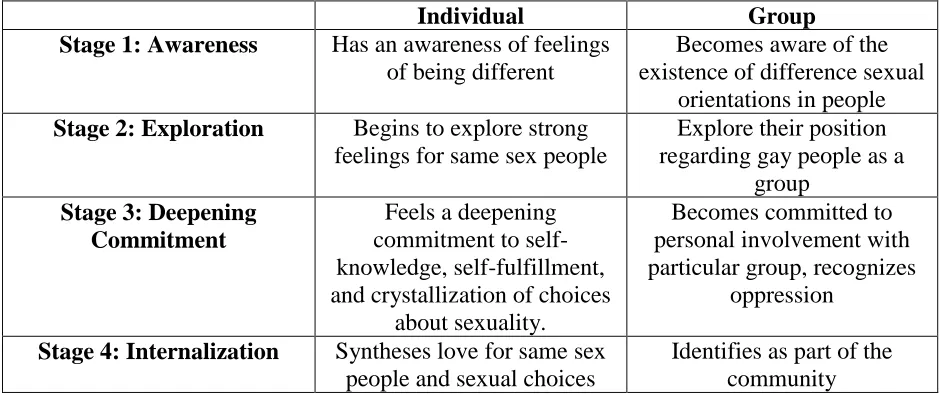
Ruth Fassinger. Fassinger’s (1998) model of homosexuality development argued that
two parallel processes of individual development occur within individuals: one related to
individual sexual identity and the other relating to group membership identity. Each of these two
process consists of a four-phase sequence of development: awareness, exploration,
deepening/commitment, and internalization (Fassinger, 1998). The research presented by
Fassinger (1998) addressed the criticism of earlier stage theory models in which cultural and
contextual influences on development are taken into account. Moreover, it offers a more
inclusive perspective of individuals in their sexual orientation identity formation. Fassinger’s
(1998) revision of this model incorporated gay, lesbian and bisexual identity (as opposed to just
the sexual orientation identity of women). Fassinger (1998) stressed the importance of
recognizing that gay and lesbian individuals may be in different places with relation to their
individual and group identity. Utilizing this model in the researcher’s conceptual framework
allows for participants to be in various levels of outness and commitment internally and
externally. For example, an individual may have made a commitment to themselves and their
family members, choosing to be “out” regarding their sexual orientation. However, the same
individual may engage in passing in their work environment. This model allows for a deeper
understanding of the complexity of sexual orientation.
Career Development
The literature provides support for the idea that students are expected to solidify
occupational goals and objectives in college (Gore & Metz, 2008; Johnson, Nichols, Buboltz, &
Riedesel, 2002; Super, 1990). However, a lack of readiness, knowledge about process, and
options related to occupation are challenges that have been cited when exploring career
27
to the above challenges becomes more salient on college campuses (Yazedjian, Toews, Sevin, &
Purswell, 2008).
Definition
While there are many definitions that can be utilized to describe career development,
Niles & Harris-Bowlsbey (2013) defined career development as “the lifelong psychological and
behavioral processes as well as contextual shaping one’s career over the lifespan” (p.12). An
important career development related task is to identify a particular career path and the related
education and training that is required (Savickas & Super, 1993). In an ideal environment,
college students would assess their interests and capabilities with current opportunities to
determine if the potential career may be a good match. Unfortunately, some students need
additional support in this area as this process may be constrained by real or imagined barriers and
challenges, such as those dealing with a LGBQ+ identity. In this case, such perceived barriers or
challenges may lead college students to adjust their desired career options (Datti, 2009).
Historical Roots
Prior to the 1930s, terms such as vocational guidance or career guidance were often used
in the literature (Herr, 2001). The rise of vocational guidance occurred during the late nineteenth
century and was directly associated with a major shift from a national economy based on
agriculture to industry. As a result of this shift, national concerns regarding vocational education
became more prevalent. These issues included concerns regarding the appropriate level of
education for children and placement of adults into an industrialized occupational structure
(Herr, 2001). In addition, the public wanted information regarding the types of positions
28
In 1909, Frank Parsons (considered to be the father of the vocational guidance
movement) wrote his classic book Choosing a Vocation. Parsons felt that too many individuals’
talent was being wasted as they found themselves pigeon-holed into factory work. Parsons
condemned the use of traditional learning in public school settings and suggested that book
learning should be balanced with practical, industrial education (Parsons, 1909). It was through
his work that researchers have come to better understand that individual people should be
matched with the needs of the occupational structure (Herr, 2001). This later became known as
the trait factor approach (Parsons, 1909).
In 1950, a major breakthrough occurred when Robert Hoppock, President of the National
Vocational Guidance Association (NVGA), observed that the traditional view of vocational
guidance was “crumbling” (Hoppock, 1950). Instead of individuals being matched with careers
based on their personality, researchers began to explore the role of self in the process of career
selection. Furthermore, organizations began to believe that knowledge and skills could be taught
to employees aspiring into certain career fields. In 1951, following Hoppock’s observation,
Donald Super recommended that the 1937 definition of vocational guidance be rewritten. The
1937 definition stated that vocational guidance was “the process of assisting the individual to
choose an occupation, prepare for it, enter upon it, and progress in it” (Super, 1951, p. 92). The
adapted definition adopted by the NVGA created by Super stated it was the “process of helping a
person to develop and accept an integrated and adequate picture of him/herself and of his/her
role in the world of work” (Super, 1951, p. 92). This definition shifted the focus away from the
practice of choosing a vocation for an individual to the chooser selecting their vacation based on
their own characteristics and training. In the process, it diminished the emphasis on matching an
29
while emphasizing a life span approach to career development. Super (1990) suggested that
individuals progress through a number of career related tasks throughout the lifespan which
include growth, exploration, establishment, maintenance, and decline. Super’s (1990) definition
helped to articulate the interaction of career development and personal development, how an
individual processes meaning in their work, and the elements related to career maturity.
Along with the changing definition of career development and support for the NVGA,
alternative theories of career development began to be created. The career theories of Holland
(1966), Bandura (1986), and Super (1969, 1980, 1990) explored career behavior, occupational
interests, behavioral styles and personality types. Building on the foundation of Parson’s trait
approach, John Holland (1977) introduced a theory of careers and vocational choice based upon
personality types. His basic premise was that one’s occupational preference was in a sense a
veiled expression of underlying character. He labeled these six types as Realistic, Investigative,
Artistic, Social, Enterprising, and Conventional. Holland’s research demonstrated that
individuals flourish in career environments where congruence is achieved between personality
and environment (Holland, 1997). While Holland’s types provided a mechanism to better
understand work environments, it provided little insight into how one develops a specific type.
In addition to Holland’s work, Albert Bandura’s (1986) work on social cognitive theory
indicated that individuals exercise control over their thoughts, feelings, and actions. He
proposed that the higher self-efficacy an individual possesses, the more inclined he/she will be to
take on a specific task. Therefore, when applied to career development, individuals would be
drawn to majors and careers in which they feel they would have a high chance of success.
Finally, Donald Super’s (1969, 1980, 1990) career development theory is perhaps the most
30
development is the process of developing a self-concept. As the self-concept becomes more
concreate and realistic throughout adolescence and into adulthood, so does one’s vocational
choice. Super (1990) argued that people choose occupations that permit them to express their
self-concepts. This ties in to the Social Cognitive Career Theory utilized as the conceptual
framework in this study. Ultimately, these career theories led to a wide variety of assessment
instruments including the Self-Directed Search, the Vocational Preference Inventory, and the
Values Inventory (Whitfield, Feller, & Wood, 2013).
University career services have been evolving since their inception (See Figure 1).
According to Teal & Herrick (1962), career services offices were often known as career
placement offices. Individuals at these offices were responsible for the placement of college
graduates in professional positions. Success was often measured in the amount of college
graduate placements in a professional position. These offices were created to help meet the
demand for a larger workforce post-WWI. However, due to the influx of students, faculty had to
move away from this role thus creating a more professionalized profession staffed by full time
professionals (Dey & Cruzvergara, 2014). The expansion of services towards career
development, consultation, and planning followed soon after. Post WWII, a booming economy
and the return of a high number of war veterans saw a greater employer demand for college
graduates. Utilizing Parson’s trait and factor approach, career service units sought to match
individual interests and skills with a specific job (Dey & Cruzvergara, 2014). In the 1970s, as
higher education moved towards a more developmental and self-actualization approach, a
slowing economy and increased competitiveness among employers changed the landscape of
career services once again (Casella, 1990; Dey & Cruzvergara, 2014). This paradigm shift
31
to step back into their role as guidance counselors (Dey & Cruzvergara, 2014). During this era,
success was often measured by the number of appointments and/or attendees at workshops. The
next shift occurred in the 1990s, when the advent of the internet increased competition among
candidates as well as the availability of internship and job postings. This era allowed career
service units to build relationships with employers and facilitate relationships between employers
and students (Dey & Real, 2010). The downturn of the economy in 2008 caused career service
offices to focus on matching employers with students once again with a focus on internships and
experiential learning. As such, senior administrative leaders began to understand the link that
exists between career development and the economic norms of a given time period and in the
recruitment and retention of its students (Ceperley, 2013).
Career Services on Campus
The Council for the Advancement of Standards in Higher Education (CAS) was founded
in 1979 as a consortium comprised of over 43 organizations and 100,000 professionals to
“promote the improvement of programs and services to enhance the quality of student learning