R E S E A R C H A R T I C L E
Open Access
Comparative evaluation of patients
’
and
physicians
’
satisfaction with interferon
beta-1b therapy
Uwe Klaus Zettl
1, Ulrike Bauer-Steinhusen
2, Thomas Glaser
2, Klaus Hechenbichler
3, Michael Hecker
1*, for the Study
Group
Abstract
Background:Due to the preventive nature of disease-modifying therapies for multiple sclerosis, treatment success particularly depends on adherence to therapeutic regimens and patients’perception of treatment efficacy. The latter is strongly influenced by the confidence in the involved health care professionals and the relationship to the treating physician.
Methods:In this report, we considered physicians’and patients’evaluation of satisfaction with interferon beta-1b treatment efficacy for assessing the congruence in ratings. Data were queried in a study conducted between 2009 and 2013.
Results:After 6 months of therapy, > 80 % of the patients and physicians (N= 445) showed high degrees of satisfaction regarding interferon beta-1b treatment, with only few physicians and patients (≤2.0 %) rating“not satisfied”. The proportion of patients rating with the same category as their physicians was similar after 6 months (47 % congruence) and at the 24 months/study end visit (49 %). Discrepancies between ratings were observed with respect to study end: for patients with premature study end, more patients and physicians rated being not satisfied with the therapy, accompanied by a considerably lower congruence of 33 % compared to 54 % for patients receiving the therapy for at least 2 years and completing the study regularly.
Conclusions:Regular communication between physicians and patients about their perception of therapy might improve alignment of treatment evaluation and could result in increased therapy persistence. In addition, patients’ willingness to perform a long-term therapy−even in the absence of disease symptoms−might be promoted by repeated exchange between health care providers and patients with regard to realistic treatment expectations. Trial registration:ClinicalTrials.gov NCT00902135 (registered May 13, 2009).
Keywords:Multiple Sclerosis, Interferon beta-1b, Treatment Satisfaction, Patient-Physician Relationship, Therapy Adherence
Background
Multiple sclerosis (MS) is a chronic inflammatory dis-ease of the central nervous system and affects more than 2.5 million individuals worldwide [1]. Due to the chronic nature of the disease and the preventive character of ap-proved disease-modifying drugs (DMD), long-term treat-ment of patients is indispensable. Various therapeutic
agents with diverse routes of administration and consid-erable differences in the safety profiles are available. Treatment with first-line DMD such as interferon beta-1b is well-established and well-tolerated [2, 3]. However, adherence to treatment regimens and persistence to therapy play central roles for therapeutic success. In par-ticular, adverse events and (perceived) lack of efficacy often interfere with treatment initiation and long-term treatment continuation [4, 5]. Management of common adverse events−in part through specific nursing support programs and/or by dose titration at therapy onset−as
* Correspondence:[email protected]
1Department of Neurology, Neuroimmunology Section, University of Rostock,
Gehlsheimer Str. 20, 18147 Rostock, Germany
Full list of author information is available at the end of the article
well as education of patients with respect to reasonable expectations and knowledge of associated risks and be-nefits can prevent therapy discontinuation and increase satisfaction of patients [2, 4, 6].
Patients‘ and physicians‘ opinions on therapy might differ remarkably, as known from a survey among dia-betic patients who were recommended to start long-term insulin therapy [7]. Therefore, recognizing and under-standing patients‘concerns regarding therapeutic options can be critical for therapy initiation and subsequent com-pliance [8]. In addition, accommodating patients‘ prefe-rences regarding the physician’s role (e.g., the desire to be or not to be involved in the decision making, and the mode of communication) might have an impact on patient adherence to an agreed treatment as well as on health benefits resulting from sense of autonomy and satisfaction with the decision [9].
Here, we report our results from a prospective national cohort study with comparison of patients’and physicians’ satisfaction with interferon beta-1b therapy.
Methods
The data are based on a prospective, non-interventional, open-label, national cohort study, BETAPATH, which was designed to assess the utility of an electronic patient diary in MS patients treated with interferon beta-1b (Betaferon®). The study was conducted in Germany between 04/2009 and 12/2013 [10]. Prerequisites for enrollment were con-firmed clinically isolated syndrome (CIS) or relapsing-remitting MS (RRMS) and appropriate age (≥18 years). In addition, patients were included in this study only after ini-tiation of treatment with interferon beta-1b and completion of the initial dose escalation. Patients were followed for a period of 24 months after the baseline visit and had to give written informed consent. The study was conducted in accordance with the Declaration of Helsinki, approved by the Ethics Committee of the Ärztekammer Nordrhein (03/ 2009), and registered at ClinicalTrials.gov (NCT00902135).
Standardized case report forms (CRF) were used at the initial visit, all follow-up visits, and the final visit. The final visit (study end) was after 24 months for study completers, whereas for patients who discontinued the study prematurely, it was the documented end of obser-vation at any previous time point. In the CRF, the treat-ing physicians recorded the date, disease course and progression, cognitive state, and changes in therapy [10]. At follow-up visits, the physicians also evaluated their satisfaction concerning the efficacy of interferon beta-1b therapy with regard to the individual case. In addition, at 6, 12, and 24 months/study end, patients were queried on separate questionnaires addressing health-related issues such as quality of life, fatigue, depression, and satisfaction with therapy. Satisfaction ratings were per-formed by use of 4 categories (very satisfied, satisfied,
neutral, or not satisfied). For the analysis of congruence in these ratings, cases with missing data were omitted, physi-cians’ratings were taken as a basis, and the proportion of patients rating with the same category was calculated.
Adherence to the treatment regimen as well as side ef-fects were investigated within the BETAPATH study as well. To assess the regularity of treatment for the individ-ual patients, the number of injections as recorded in the electronic diary was analyzed. Non-adherence was defined as >5 missed injections per 6-month interval as previously described [11]. Drug-related adverse events (AE), which occurred during or after injection of interferon beta-1b and not later than 28 days after the end of observation, were recorded using the MedDRA coding system. Baseline characteristics and data on adherence and persistence to treatment have been published elsewhere [10, 11].
Results
Satisfaction with interferon beta-1b therapy
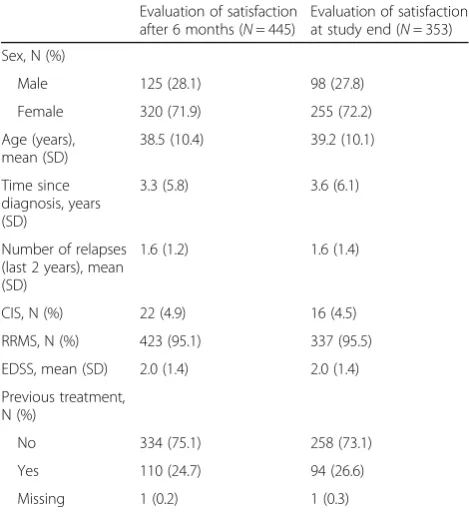
A total of 669 patients participated in the BETAPATH study [11]. For the present study, a subset of this cohort was considered, because the question on satisfaction with interferon beta-1b therapy was not in all cases answered simultaneously by both the patient and the physician. Satisfaction with the therapy was evaluated after 6 months by N= 445 patients (125 men and 320 women) and their physicians. At study end, satisfaction was evaluated by N= 353 physicians/patients (98 men and 255 women) (Table 1). The regular study end after 24 months was achieved by N= 266 of these 353 cases, whereas N= 87 patients terminated the study prema-turely (Table 2, Additional file 1). Reasons for premature study end were diverse: N= 70 patients quit the treat-ment, N= 7 patients were tired of questionnaires,N= 3 patients moved to another place, and N= 7 indicated other reasons.
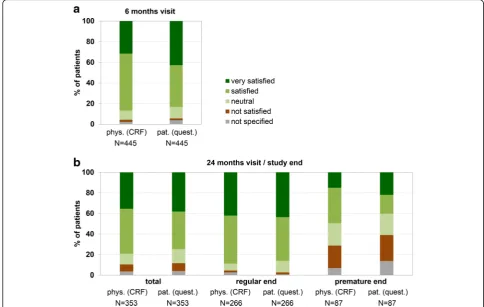
M satisfied or very satisfied with treatment efficacy throughout the study. At study end, 79.0 % of the physi-cians chose the ratings “very satisfied” or “satisfied”, compared to 86.7 % at the 6 months visit. Satisfaction was lower in patients’opinion: 74.8 % of the patients rated “very satisfied”or“satisfied”according to the questionnaire at the final visit (83.1 % at the 6 months visit) (Fig. 1). Only a minority of physicians was not satisfied with the treat-ment (6.8 % at final visit and 2.0 % at month 6). This was similar to the patients’point of view: 7.6 % of the patients were not satisfied at study end as documented in the ques-tionnaires (1.8 % at the 6 months visit) (Fig. 1).
regularly. Differences became also obvious at study end within the category“not satisfied”(1.9 % of the pa-tients with regular termination [N= 5] vs. 25.3 % of the patients with premature termination [N= 22]). How-ever, absolute numbers of not satisfied patients were small. Evaluations of the physicians were similar to pa-tients’ opinion although a higher proportion of physi-cians was“very satisfied/satisfied”(49.4 %) and a lower proportion rated with “not satisfied” (21.8 %) in the case that the patients terminated the study prema-turely (Fig. 1b).
Congruence of ratings
Total congruence rates (that is, the degree of agreement between patients and physicians) were 47 % after 6 months and 49 % at the 24 months/study end visit (Table 2). On closer consideration of the category “very satisfied”, the congruence between physicians’ratings of the therapy in the CRF compared to self-documentation of the patients in the questionnaire was even higher with 62.9 % at month 6 and 63.2 % at the 24 months/study end visit. With de-creasing satisfaction rating, divergences became more pro-nounced in the categories “neutral” and “not satisfied” (congruence rates < 35 %) (Fig. 2a, b, Table 2).
Data review with respect to study termination revealed relevant differences in congruence of therapy ratings: total congruence at study end varied from 54 % for patients with regular study end to 33 % for patients with premature study end. Patients with regular study end and their physi-cians concordantly chose the rating “very satisfied” in 64.3 % of cases compared to 53.8 % when considering pa-tients with premature study end. The divergence was even greater in the categories “satisfied” (52.4 % upon regular end vs. 26.7 % upon premature end) and “not satisfied” (0 % vs. 42.1 %). In the latter case, however, the total num-ber of patients/physicians was low (Fig. 2c, d, Table 2).
Adherence and side effects
For the subgroup of patients who received an electronic patient diary (instead of a conventional paper diary) in the BETAPATH study, adherence to interferon beta-1b injection therapy could be evaluated. The electronic diary was used by 234 and 138 patients out of the 445 and 353 patients who rated their satisfaction with ther-apy (together with their physicians) after 6 months and at the final study visit, respectively (Additional file 1). Within the first 6 months, 158 patients (67.5 %) docu-mented less than 6 missed injections, and within the last 12 months of the study, 64 patients (46.4 %) were con-sidered adherent to the injection schedule. However,
Table 2Congruence of ratings of patients (questionnaire) and their physicians (CRF)
6 Months 24 Months/study end Regular study end Premature study end Congruence Congruence Congruence Congruence Total N N % Total N N % Total N N % Total N N %
Total 445 353 266 87
Very satisfied 140 88 62.9 125 79 63.2 112 72 64.3 13 7 53.8 Satisfied 246 107 43.5 154 73 47.4 124 65 52.4 30 8 26.7 Neutral 40 9 22.5 37 11 29.7 18 5 27.8 19 6 31.6 Not satisfied 9 3 33.3 24 8 33.3 5 0 0.0 19 8 42.1 Not specified 10 2 20.0 13 1 7.7 7 1 14.3 6 0 0.0 Total congruence rate 209 47 % 172 49 % 143 54 % 29 33 %
CRFcase report forms,total Ntotal number of patients‘and physicians‘assessments available for congruence analysis,Nnumber of patients with ratings
congruent to physicians‘evaluation
Table 1Clinical and demographic characteristics of the patients at study onset
Evaluation of satisfaction after 6 months (N= 445)
Evaluation of satisfaction at study end (N= 353) Sex, N (%)
Male 125 (28.1) 98 (27.8) Female 320 (71.9) 255 (72.2) Age (years),
mean (SD)
38.5 (10.4) 39.2 (10.1) Time since
diagnosis, years (SD)
3.3 (5.8) 3.6 (6.1)
Number of relapses (last 2 years), mean (SD)
1.6 (1.2) 1.6 (1.4)
CIS, N (%) 22 (4.9) 16 (4.5) RRMS, N (%) 423 (95.1) 337 (95.5) EDSS, mean (SD) 2.0 (1.4) 2.0 (1.4) Previous treatment,
N (%)
No 334 (75.1) 258 (73.1) Yes 110 (24.7) 94 (26.6) Missing 1 (0.2) 1 (0.3)
CISclinically isolated syndrome,EDSSexpanded disability status scale,RRMS
(non-)adherence was not associated with satisfaction with therapy. The percentage of patients rating“very satisfied” was > 43 % in the group of adherent patients and in the group of non-adherent patients after 6 months and after 24 months/at study end. Conversely, only < 7 % rated“not satisfied”in both patient groups and at both time points.
Drug-related AE were reported by the physicians during the observational period for 65 (18.4 %) out of the 353 pa-tients (Additional file 1). The most common AE were in-jection site reactions (N= 24), influenza-like symptoms (N= 16), and headache (N= 6). Of the patients with AE, 16.9 % rated “very satisfied” and 15.4 % rated“not satis-fied” with the therapy after 24 months/at study end. For comparison, 43.1 % and 5.9 % of the patients without AE were“very satisfied”and“not satisfied”, respectively.
Discussion
Patients often complain about a lack of information and difficulties in making a qualified therapeutic choice. Al-though the treating neurologist is crucially responsible for starting or changing a DMD treatment in MS, stopping a treatment is mainly based on patients‘decision [5]. There-fore, communication between patient and physician and
close cooperation are important for a consensual opinion on a given therapy, as this has an impact on adherence and persistence to therapeutic regimens [12–14]. We investi-gated the patient-physician relationship by evaluating physi-cians’ and patients’ individual ratings of the Betaferon® therapy as well as their congruence.
The degrees of satisfaction were high: most physicians and patients (around 80 %) chose the categories “very satisfied“ or “satisfied“. More patients chose the rating “very satisfied” than physicians after 6 months. We can only speculate if this difference is due to a poor relation-ship between some physicians and patients or if patients feel committed to more positive opinions regarding ther-apy in the setting of a study. Therther-apy ratings of physi-cians and MS patients have not been addressed in parallel previously in the literature. However, in two cross-sectional surveys with respect to satisfaction with botulinum toxin for treating post-stroke spasticity, simi-larly high satisfaction rates were observed (88.6 % of pa-tients and 94.2 % of physicians were satisfied with the treatment) [15].
In this study, discrepancies in patient ratings were ob-served after substratification for study termination. For
instance, 1.9 % of the patients with regular study end were not satisfied with the therapy after 24 months, whereas, as expected, this proportion was remarkably higher among patients who discontinued the study pre-maturely (25.3 %). This trend was also observed in the physicians’ ratings: for patients with premature study
end, 21.8 % of the respective physicians were“not satis-fied”. However, after 6 months, only few patients and physicians chose this category, and no predictions with regard to treatment discontinuation of unsatisfied pa-tients in the long-term course of the study could be made. Data from an observational study with RRMS
patients indicated a significant association of adherence and overall patient satisfaction with therapy [16]. Thus, poor satisfaction with treatment might be a predictor of therapy adherence and continuation. In our data, adher-ence to therapy as recorded in the electronic patient diary was not related to better satisfaction ratings. This suggests that patients are not necessarily not satisfied with the treatment if they simply forget injections or if they are tired of documentation.
Patients’and physicians’consensus in the ratings of ther-apy was 47 % after 6 months and 49 % at the 24 months/ study end visit. However, the total congruence rate was only 33 % with respect to patients who discontinued the study, while it was 54 % for patients completing the study and continuing the treatment with interferon beta-1b to the 24 months visit. Deficiencies in documentation (e.g., CRF documentation with temporal distance to the pa-tient’s visit) might have influenced this outcome. Mohr and coworkers found that overoptimistic attitudes towards therapy before treatment initiation are conversely associ-ated with therapy continuation [17]. Empathic relations between physicians and patients might reveal unrealistic opinions and help counteracting therapy discontinuation by proper education of patients. An improved adherence was observed if the treating neurologists involved the patients in the treatment plans at the onset of therapy [16]−pointing to the importance of the patient-physician relationship and shared decision making. Due to the asso-ciation between patients’ perception of their relationship with physicians and patients’ satisfaction with the treat-ment, the involvement of MS patients is crucial for the best long-term treatment outcomes [18].
We observed that patients who were not satisfied oftentimes showed therapeutic side effects, as reflected by the higher rate of AE in this group. It is thus import-ant to continuously educate the patients in how to pre-vent and manage drug-related AE [19], e.g., by rotating injection sites. In addition, other factors deteriorating patient satisfaction and treatment adherence might arise in the course of therapy, e.g., depression or changes in the personal situation [12, 13], and their impact seems to be influenced by the offered support of health care professionals [20].
The clinical practice environment is evolving, altering the daily tasks performed by physicians and other health care workers [21]. Primary care physicians spend more time supervising assistants and less time listening to pa-tient concerns. On the contrary, the roles of nurses and medical assistants are increasingly important [22]. As physicians often cannot invest the required amount of time in the practice setting [14], MS nurses can provide personal services, and they are the preferred health care workers for a majority of patients to discuss their prob-lems [4, 12, 23]. Besides provision of information and
reinforcement of motivation to continue DMD therapy, they can also support patients in the use of autoinjectors in order to minimize anxiety associated with self-administered injections, which might be a barrier to maintenance of treatment [12]. More regular contact by telephone from health care providers may also help to confirm adequate compliance. In addition, the involvement of family members into treatment plans can improve ad-herence to therapy [16]. Multidisciplinary approaches in therapy and psychological support are important factors in patients’ opinion [24]. In consequence, the interpersonal relationship between the patient and the physician is one determinant of patient satisfaction among others [25, 26].
Conclusions
In summary, overall physicians’and patients’satisfaction with efficacy of interferon beta-1b treatment was high. Performing a congruence analysis revealed discrepancies, especially in case of patients who later discontinued the therapy. It seems advisable to regularly assess and align patients’and physicians’evaluation of treatment satisfac-tion during scheduled appointments, with the aim of iden-tifying reasons for dissatisfaction. Therapeutic side effects and emerging psychological symptoms (e.g., depression) might explain deviations from the physician’s opinion and provoke non-adherence to therapy [12, 19, 27]. Other health care professionals also have an impact on patients’ satisfaction with treatment. Consequently, optimized com-munication across multiple disciplines and coordination of continuity in medical care are needed to maintain effi-cacy of long-term DMD treatment in MS.
Additional file
Additional file 1:Full data set used for congruence analysis. Satisfaction with interferon beta-1b therapy as evaluated by patients and their physicians after 6 months of treatment and at the 24 months/study end visit. For a subgroup of patients, records of an electronic patient diary allowed to assess adherence to the injection schedule in the first 6 months and in the last 12 months of the study. Moreover, the table provides the information, for which patients drug-related adverse events were reported. (XLSX 30 kb)
Abbreviations
CIS:Clinically isolated syndrome; CRF: Case report form; DMD: Disease-modifying drug; MS: Multiple sclerosis; pat.: Patients; phys: Physicians; quest: Questionnaire; RRMS: Relapsing-remitting multiple sclerosis
Acknowledgments
Medical writing services from Dr. Carmen Koch, employee of KW medipoint, were funded by Bayer Vital GmbH.
Funding
The BETAPATH study was funded by Bayer Vital GmbH, Leverkusen, Germany. The sponsor participated in the design and conduct of the study, analysis of the data, and preparation of the manuscript.
Availability of data and materials
Authors’contributions
Conception and coordination of the study: TG, UKZ, and UB-S. Data collec-tion and statistical analysis: KH. Data interpretacollec-tion: UKZ, UB-S, TG, and MH. Manuscript drafting: UB-S and MH. Critical revision of the manuscript: UKZ, TG, and KH. All authors read and approved the final manuscript.
Competing interests
UKZ received speaking fees and financial support for research activities from Bayer HealthCare, Biogen, Merck Serono, Novartis, Sanofi, Almirall, and Teva. UB-S and TG are employees of Bayer Vital GmbH. MH received speaking fees and travel support from Bayer HealthCare, Biogen, Novartis, and Teva. KH declares no potential conflicts of interest in connection with this paper.
Consent for publication
Not applicable.
Ethics approval and consent to participate
The study was conducted in accordance with the Declaration of Helsinki, approved by the Ethics Committee of the Ärztekammer Nordrhein, and registered at ClinicalTrials.gov (NCT00902135). All patients gave written informed consent to participate in this study.
Author details
1Department of Neurology, Neuroimmunology Section, University of Rostock,
Gehlsheimer Str. 20, 18147 Rostock, Germany.2Neurology, Immunology, and
Ophthalmology, Bayer Vital GmbH, Leverkusen, Germany.3Institute Dr.
Schauerte, Munich, Germany.
Received: 8 January 2016 Accepted: 15 September 2016
References
1. Kamm CP, Uitdehaag BM, Polman CH. Multiple sclerosis: current knowledge and future outlook. Eur Neurol. 2014;72:132–41.
2. Reder AT, Oger JF, Kappos L, O'Connor P, Rametta M. Short-term and long-term safety and tolerability of interferonβ-1b in multiple sclerosis. Mult Scler Relat Disord. 2014;3:294–302.
3. Wingerchuk DM, Carter JL. Multiple sclerosis: current and emerging disease-modifying therapies and treatment strategies. Mayo Clin Proc. 2014;89:225–40. 4. Ross AP. Tolerability, adherence, and patient outcomes. Neurology. 2008;71:
S21–3.
5. Visser LH, van der Zande A. Reasons patients give to use or not to use immunomodulating agents for multiple sclerosis. Eur J Neurol. 2011;18: 1343–9.
6. Katsarava Z, Ehlken B, Limmroth V, Taipale K, Patel SN, Niemczyk G, et al. Adherence and cost in multiple sclerosis patients treated with IM IFN beta-1a: impact of the CARE patient management program. BMC Neurol. 2015;15:170. 7. Yoshioka N, Ishii H, Tajima N, Iwamoto Y. DAWN Japan group. Differences in
physician and patient perceptions about insulin therapy for management of type 2 diabetes: the DAWN Japan study. Curr Med Res Opin. 2014;30:177–83. 8. Coyle PK, Cohen BA, Leist T, Markowitz C, Oleen-Burkey M, Schwartz M, et al. Therapy optimization in multiple sclerosis: a prospective observational study of therapy compliance and outcomes. BMC Neurol. 2014;14:49. 9. Street Jr RL, Elwyn G, Epstein RM. Patient preferences and healthcare
outcomes: an ecological perspective. Expert Rev Pharmacoecon Outcomes Res. 2012;12:167–80.
10. Zettl UK, Bauer-Steinhusen U, Glaser T, Hechenbichler K, Limmroth V, Study Group. Evaluation of an electronic diary for improvement of adherence to interferon beta-1b in patients with multiple sclerosis: design and baseline results of an observational cohort study. BMC Neurol. 2013;13:117. 11. Zettl UK, Bauer-Steinhusen U, Glaser T, Czekalla J, Hechenbichler K, Limmroth V,
et al. Adherence to Long-Term Interferon Beta-1b Injection Therapy in Patients with Multiple Sclerosis Using an Electronic Diary. Adv Ther. 2016;33:834–47. 12. Lugaresi A, Rottoli MR, Patti F. Fostering adherence to injectable
disease-modifying therapies in multiple sclerosis. Expert Rev Neurother. 2014;14:1029–42. 13. Treadaway K, Cutter G, Salter A, Lynch S, Simsarian J, Corboy J, et al. Factors
that influence adherence with disease-modifying therapy in MS. J Neurol. 2009;256:568–76.
14. Kern S, Reichmann H, Ziemssen T. Adherence to neurologic treatment. Lessons from multiple sclerosis. Nervenarzt. 2008;79:877–90.
15. Bensmail D, Hanschmann A, Wissel J. Satisfaction with botulinum toxin treatment in post-stroke spasticity: results from two cross-sectional surveys (patients and physicians). J Med Econ. 2014;17:618–25.
16. Devonshire V, Lapierre Y, Macdonell R, Ramo-Tello C, Patti F, Fontoura P, et al. The Global Adherence Project (GAP): a multicenter observational study on adherence to disease-modifying therapies in patients with relapsing-remitting multiple sclerosis. Eur J Neurol. 2011;18:69–77.
17. Mohr DC, Goodkin DE, Likosky W, Gatto N, Neilley LK, Griffin C, et al. Therapeutic expectations of patients with multiple sclerosis upon initiating interferon beta-1b: relationship to adherence to treatment. Mult Scler. 1996;2:222–6. 18. Koudriavtseva T, Onesti E, Pestalozza IF, Sperduti I, Jandolo B. The
importance of physician-patient relationship for improvement of adherence to long-term therapy: data of survey in a cohort of multiple sclerosis patients with mild and moderate disability. Neurol Sci. 2012;33:575–84. 19. Smrtka J, Caon C, Saunders C, Becker BL, Baxter N. Enhancing adherence
through education. J Neurosci Nurs. 2010;42:S19–29.
20. Mohr DC, Goodkin DE, Masuoka L, Dick LP, Russo D, Eckhardt J, et al. Treatment adherence and patient retention in the first year of a Phase-III clinical trial for the treatment of multiple sclerosis. Mult Scler. 1999;5:192–7. 21. Okie S. The evolving primary care physician. N Engl J Med. 2012;366:1849–53. 22. Jongen PJ, Lemmens WA, Hupperts R, Hoogervorst ELJ, Schrijver HM,
Slettenaar A, et al. Persistence and adherence in multiple sclerosis patients starting glatiramer acetate treatment: assessment of relationship with care received from multiple disciplines. Patient Prefer Adherence. 2016;10:909–17. 23. Kohlmann T, Wang C, Lipinski J, Hadker N, Caffrey E, Epstein M, et al. The
impact of a patient support program for multiple sclerosis on patient satisfaction and subjective health status. J Neurosci Nurs. 2013;45:E3–14. 24. Lorefice L, Mura G, Coni G, Fenu G, Sardu C, Frau J, et al. What do multiple
sclerosis patients and their caregivers perceive as unmet needs? BMC Neurol. 2013;13:177.
25. Batbaatar E, Dorjdagva J, Luvsannyam A, Savino MM, Amenta P. Determinants of patient satisfaction: a systematic review. Perspect Public Health. 2016. doi:10.1177/1757913916634136.
26. Everett CM, Morgan P, Jackson GL. Primary care physician assistant and advance practice nurses roles: Patient healthcare utilization, unmet need, and satisfaction. Healthc (Amst). 2016. doi:10.1016/j.hjdsi.2016.03.005. 27. Menning M, Twork S, Kugler J. Adherence, self-efficacy, physician visits in a
clinical trial over 6 months in multiple sclerosis patients. Gesundheitswesen. 2011;73:e84–8.
• We accept pre-submission inquiries
• Our selector tool helps you to find the most relevant journal
• We provide round the clock customer support
• Convenient online submission
• Thorough peer review
• Inclusion in PubMed and all major indexing services
• Maximum visibility for your research
Submit your manuscript at www.biomedcentral.com/submit