Ethernet Based Data Acquisition and Control
System for Industrial Application
Ms. Snehal K.Paliwal
1, Mrs. Shaila P. Kharde
21
PG Student, Dept. of E&TC, Shreeyash College of Engg. & Tech, Dr.BAMU University, Aurangabad (MS), India.
2
Assistance Professor, Dept. of E&TC, Shreeyash College of Engg. & Tech, Dr.BAMU University, Aurangabad (MS),
India
ABSTRACT: In industrial area now a day’s systems are becoming very complex. Several technologies are already been introduced for industrial automation by the different researchers. This paper present new approach that contains inbuilt data acquisition and control system (DACS) with on-line interaction. In proposed system ARM processer handles two modes at the same time, DAC and Web Server. At the DAC mode, processer can measure signals which are coming from various external sources and application and it can control the industry machineries by using the instructions sent by client via Embedded Web Server.
KEYWORDS: DACS, ARM processer, Embedded Web Server.
I.INTRODUCTION
In this modern, fast moving and insecure world, it is necessity to be aware of one’s safety. In Industries, systems are becoming very complex Industrial system needs to test the site equipment’s and environmental conditions to track the state of system in real time [1]. In the last few years, some newly introduced connectivity solutions such as Ethernet, Wireless LAN, etc are used in industrial application. All these system contain devices that are sensitive to voltage variation, current deviations and to all the power quality and quantities. This system measure and store any kind of electrical and non-electrical signals in embedded web server. And it can able to control the devices remotely. Data acquisition and control system plays major role in the field of measurement and control system. Such system designed with the help of much electrical, electronic and high voltage equipment; it makes the system more complicated and not reliable. This paper approaches the new system that contains inbuilt data acquisition and control system (DACS) with on-line interaction.
II.
LITERATURE SURVEYSuraj U. Patinge and Mrs. G. M. Kadu [2] proposed ARM based data Acquisition & Control using Wireless Network. This system based on ARM Processor with RTOS, GSM, GPS, and Sensors. Embedded systems with ARM processor are useful for industrial applications with a real-time monitoring and control.RTOS can be ported to ARM hardware, and embedded system designed provides a generic design with all kind of data acquisition and control.
Bhushan R. Khangare, and Mrs. A. P. Rathakanthiwar [4], presents ARM Based Embedded System for Industrial Application Using TCP/IP Network also provides design and development of IDACS i.e. online Interactive Data Acquisition and Control system using ARM base embedded web server. Interactive Data Acquisition and Control system is a digital distributed control system. In the proposed system processing capability of a system was increased by using single chip IDACS.
provides the facility to manage the operation at the same time can be transmitted through RJ-45 Ethernet network to remote DDAS, this mode to acquire the signals and control the devices remotely or DCS monitoring system by using HTTP protocol.
III. SYSTEM DEVELOPMENT
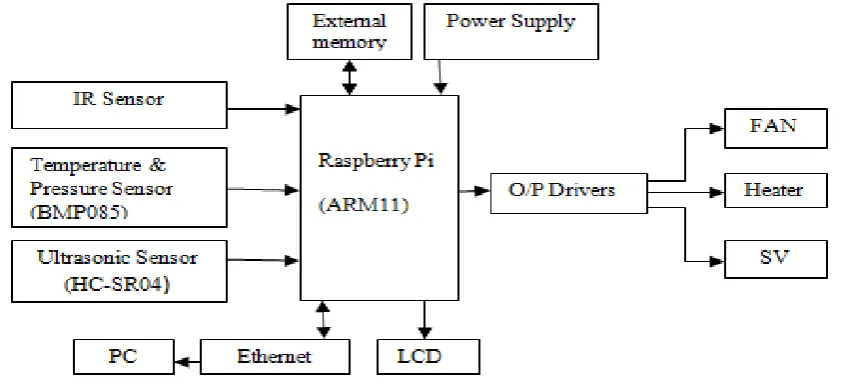
Fig 1 shows proposed system Architecture contains ARM11 processer is centre core. 32 bit Raspberry pi board which has ARM11 is used in the proposed system. This processor has reach sources including USB, inbuilt Ethernet port, 512 MB RAM,128 KB cache memory, Micro SD slot,700mA(3.5W) power consumption, to achieve Ethernet services. By using web browser client system is connected to the Ethernet to get access to the embedded web server. This proposed is mainly divided in to two modules system section and the client section.
Fig 1 Block
diagramof Proposed Architecture
A. System Section
System section contains Raspberry Pi board, Sensors, Ethernet, 16 x 2 Characters LCD, LED, Relay, ULN2003, USB, Solenoid Valve (SV), FAN, and Heater. Raspberry Pi board contains different parts like The Processor (This chip is a 32 bit, 700 MHz System on a Chip, which is built on the ARM11 architecture), The Secure Digital (SD) Card slot, The USB port, Ethernet port, HDMI connector, Analog Audio output, Analog Audio output, Power input, General Purpose Input and Output (GPIO) and other pins, Display Serial Interface (DSI) connector, Camera Serial Interface (CSI) connector, and P2 P3 headers.
IV. PERFORMANCE ANALYSIS
A. System side
Ultrasonic sensor: It is used to measure level of material. According to the output coming from the ultrasonic sensor, the Solenoid Valve (SV) will operate. The following function will perform according to the sensor output.
Material Rang Solenoid Valve (SV)
Above 15 cm SV will turn ON
Below 15 cm SV will turn OFF
Fig 2. Operation of SV v/s Level of material.
Temperature sensor: Temperature sensor is used to measure Temperature. According to the output coming from the temperature sensor, the FAN and Heater will operate.
Temperature FAN / Heater
Above 50°C
FAN will turn ON
Below 40°C
Fig 3. Operation of Fan & Heater v/s Temperature.
Proximity sensor: TSOP detects a frequency of 38 KHz. The output of TSOP goes low when it receives this frequency. Hence the output pin is normally high because, though the IR LED is continuously transmitting, due to no obstacle, nothing is reflected back to the TSOP. The indication LED is off. When an obstacle is encountered, the output of TSOP goes low, as the required frequency is reflected from the obstacle surface. This output is connected to the cathode of the LED, which then turns ON.
Sensor Input Obstacle not detect output
voltage Obstacle detect output voltage
5V 0V 5V
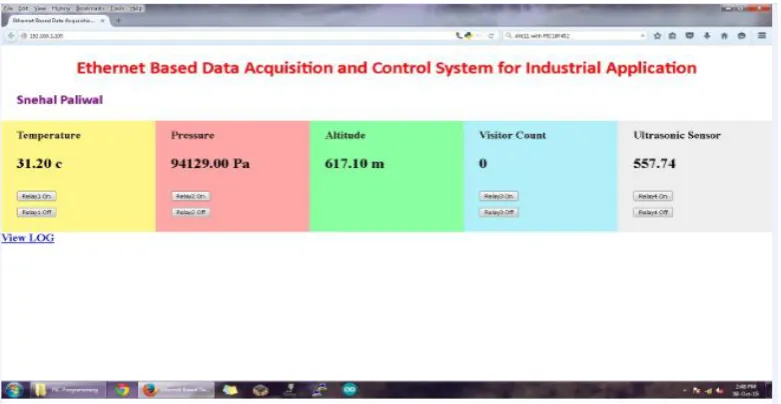
B. Client side
VI.CONCLUSION
This embedded ARM system can adapt to the strict requirements of the data acquisition and control system such as the function, reliability, cost, size, power consumption, and remote access and so on. This system operated by DACS mode to acquire the signals and control the devices remotely. Embedded web server mode is used to share the data with clients in online. Both modes are efficiently carried out by Linux multitasking operating system
REFERENCES
[1] Gan-ping Li “Design of an Embedded Control and Acquisition System for Industrial Local Area Networks Based on ARM” 2010 IEEE
[2] SurajU.Patinge and Mrs.G.M.Kadu, “Design of ARM Based Data Acquisition & Control Using Wireless Network”, International Journal on
Recent and Innovation Trends in Computing and Communication, Volume 3 Issue2, 2015, pp.11-14.
[3] Bhushan Khangare and Bhushan Khangare, “Design of ARM Based Interactive Data Acquisition and Control System for Embedded System”,
International Journal of Innovative Research in Advanced Engineering (IJIRAE), Volume 1, Issue 1, March 2014,pp. 01-06.
[4] Bhushan R. Khangare, and Mrs. A. P. Rathakanthiwar, “Design of ARM Based Embedded System for Industrial Application Using TCP/IP
Network”, International Journal of Engineering Research and Applications (IJERA), April 2014, pp. 6-10.
[5] Joby Antony, Sachin Sharma, Basanta Mahato, and Gaurav Chitranshi, “Distributed data acquisition and control system based on low cost