http://dx.doi.org/10.9717/JMIS.2017.4.4.243
243
I. INTRODUCTION
Almost all engineering departments understand the importance of team project engineering design courses globally. In South Korea, the Federation of Korean Industries conducted an investigation on ‘What Industries Look for in a University Curriculum’ in 2003. After surveying approximately 200 CEO’s from various industries, they found out that problem solving, human relations, basics of business administration, and leadership are the core skills business corporations look for when hiring. At the same time, the ABBEK (Accreditation Board for Engineering Education in Korea) also introduced the concept of design education to engineering education. ABEEK is similar to ABET (Accreditation Board for Engineering and Technology) in the United States. Two major programs, Computer Engineering and Information Engineering in Division of Computer and Information Technology at Daegu University have achieved an accreditation from the ABEEK in 2009. To get an accreditation, the program committee has changed its curriculum so as to reinforce engineering design education and establish a program operation manual including program educational objectives, program learned outcomes, student counselling, and so on. As a result, the introduction to engineering design course for freshmen students and the
capstone design course for senior students were opened. These two courses have no exams and assess students only based on in-class assignments and team projects [1].
This work covers team forming methods in team project classes. It specifically discusses team forming methods in the engineering design course. Unlike the senior students taking capstone design, freshmen students have the tendency to join the people they are familiar with, regardless of their study habits. Therefore, allowing students taking the engineering design course to autonomously form their teams would limit and confine the students from experiencing different ideas and from broadening their perspective. Speaking as someone who has taught this course for more than seven years, the author believes that it is not effective for students taking engineering design to form into teams at the beginning of semester. This is because this course mainly consists of freshmen students who have not had any experience in team projects and are taking a team project class for the first time. For that reason, early forming a team in the beginning of semester would be ineffective.
In the past, students were put into teams only slightly considering heterogeneity such as gender or grade in the beginning of semester, but after watching the students’ progress, it became clear that the learning outcomes of groups containing a hard-working and diligent student in
A New Team Forming Method in Engineering Design Course
Jongwan Kim
1*Abstract
In a basic engineering design class, first year engineering department students learn about engineering design relevant theories and carry out simple projects in teams. By doing a group project in this subject, students develop basic skills such as creativity, teamwork, communication, and problem solving. Before, class proceeded in a way where teams were randomly configured in the beginning of semester and students began working on their project immediately. However, this research introduces a new method where at the beginning of the semester, students are assigned group assignments. Teammates are randomly chosen and constantly switched so that students get a chance to work with different people and experience diverse styles and characteristics. Then, they autonomously form into teams with people they work best and carry out their project. We present the behavior of a monkey robot that recognizes emotions as a case of applying the proposed method. The feedback from the students suggest that this proposed team forming method serves to be effective especially since students who were not aware of other students’ characteristics can get to know one another better and form a productive team.
Key Words: Creative problem solving, Emotion recognition, Engineering design class, Stepwise team formation, Teamwork.
Manuscript received December 13, 2017; Revised December 19, 2017; Accepted December 20, 2017. (ID No. JMIS-2017-0047)
244 contrast to groups consisting of students that did not
participate differed greatly at the end of semester. This shows that all of the students in a team with just one or two hard-working students can get an excellent grade, even if some of the students did not work hard. However, in a group of students with not good work habits, students are often unable to get a satisfactory grade even if they work hard. A disappointing result can lower the morale of students who tried hard and is often the result of dissatisfaction with grades. Consequently, a new team forming method is needed for basic engineering design, a subject consisting mostly of first-year students.
This paper is organized as following. Section II will present related works to this research, section III will propose a new team forming method, section IV will conduct practices based on the proposed method, and section V will conclude this work.
II. RELATED WORKS
Team building is a process that helps a group of employees or project participants work as a team instead of working as individuals. Team building is a necessary activity that takes place in companies, schools, sports teams, non-profit organizations, and other organizations so that they can improve their performance as an overall team. According to Dyer in 2007, the group process of team building was originally developed to improve individual relationships and social interactions and to achieve goals and fulfil tasks [2]. Team building practice happens in a variety of practices and it is more complicated than simply putting members together; often, teams need to be tailored to complex situations and include group dynamics. Team building started from organizational development in companies. However, now it is a crucial process in team sports, such as soccer, baseball, and basketball, and its prominence has been increasing in university project classes, as well. Whatever the motive, team building regularly happens in society and with effective leadership, a more dynamic team can be achieved. Team building is an advantageous process that leads to better self-development, communication, leadership skills, and ability to work cooperatively to resolve problems. In addition, in an era where global collaboration is absolutely required, team building is internationally recognized as an important issue.
In 1965, B. Tuckman devised a four-step team building model. The stages are as follows: team forming, storming, norming, and performing [3]. In 1977, he suggested adding another step – team adjourning – to the model [4]. His theory is accepted as a realistic process for team building. Tuckman’s model explains how a team matures, how the relationship between teammates develops, and how the
team leader begins to understand his or her role through the process. Below is a brief explanation of each step.
In the first stage, forming, the team relies on the leader for direction. In this step, the team gathers and decides on a project theme and each member’s roles and responsibilities in that project. In the second stage, storming, teammates make technological decisions together or cover how to manage their project. This is a difficult stage and sometimes leads to the failure of the project due to conflicts of opinion between teammates or because of teammates with lack of responsibility. In the third stage, norming, teammates start to cooperate by contributing to their team and fine-tuning their work-habits. In this stage members of the team are not individuals – they work as one single unit, a team. In the fourth stage, performing, members start to understand their team strategically and they become fully aware of the purpose of the project. This is the most vigorous stage is where teammates strive to meet their project objectives and reach their goal. In the fifth and final stage, adjourning, the team completes and adjourns the project.
José Borges et al. proposed a new group-formation method for student projects [5]. In their group-formation method, students are asked to answer a questionnaire to evaluate their teamwork profiles and are assigned to groups by an algorithm aiming to achieve maximum diversity within groups and homogeneity among groups. In contrast to [5], the proposed method is differentiated in that it forms a team by actually experiencing collaborations with students during the first half of the course. There has been a recent analysis of how teaming influences students’ performance [6]. S. Pociask et al. compared team composition to the way students set themselves, how the teacher assigned it, and how they randomly determined it with a computer program. They concluded that students in these teams performed no better than their peers in self-selected or randomly decided teams [6]. The proposed method differs in terms of constructing a team by students while performing classroom practice step by step.
http://dx.doi.org/10.9717/JMIS.2017.4.4.243
245
III. PROPOSED TEAM FORMING
METHOD
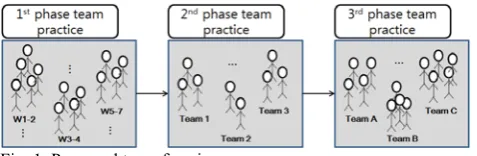
This research on team forming in Introduction to Engineering Design based on freshmen proceeds as follows. In most conceptual class time, teams of four switch every 2-3 weeks so that students get a chance to learn the pros and cons of others. By going through this process three times, students have a chance to interact with many students and team forming for the actual team project becomes more straightforward. After conceptual class, students autonomously form into a group of two or three people to complete a Lego Mind Storm midterm project – writing a proposal - in three weeks. Once brainstorming is close to being finished, teams submit a project proposal. After reviewing all the proposals, the instructor selects the top proposals (50-70%). Teams are finally formed based on selected proposals and the students whose proposals were unselected are separated and put into successful proposal teams to form groups of 4-5 people. In short, this is the procedure: a team of four → a team of 2 or 3 → a team of 4 to 5. Fig. 1 shows the proposed team forming process. This step-by-step procedure allows the students to familiarize themselves with other students and the instructor to learn the level of the students, making this team forming method very effective. Note: the Wi-j in Figure 1 refers to the period from week i to j and Team i is a symbol to identify each team.
Fig. 1. Proposed team forming process.
From now on, we will describe the team project class (week 15 periods) by following the proposed method. First, conceptual theory class (7 weeks) enables students to acquire the skill of creative problem solving and to understand their roles (leader, presenter, recorder, and participant) in their teams. Although this is the same as the previous teaching method, students now switch teammates every 2-3 weeks, enabling them to understand one another. This phase is similar to the forming and storming stages of Tuckman’s model. But there is a difference that team members change.
Next, for the 1st project assignment (3 weeks), students form small teams of 2-3 so that members share responsibility and are motivated to participate in the class with enthusiasm. Being in small teams will motivate students to differentiate between their own project topics and decide on a final topic as a group. This stage is
comparable to the norming stage of Tuckman’s model where teammates cooperate.
Finally, students complete their second project assignment (5 weeks). They form into new teams in consideration of other students’ abilities so that there is not much of a difference in skill within a group. Being in a group with people of relatively similar skill level will lessen the probability of students abandoning the topic, help motivate the students more, and raise the maturity of the topic. This stage, where students complete the project within five weeks, corresponds with the performing stage of Tuckman’s model. Dissimilar to corporations, there is no adjourning stage in student team projects.
Along with this proposed team forming method, the author has a team project assessment method from a previous research which proceeds as follows [1]. A creative process can be considered in the path from a problem to a solution in engineering design education. These creative elements are put into three stages including brainstorming, building, and demonstration phases. We analyzed these creative elements and rearranged them into the creative process of a team project. Novelty, fluency, variety, and feasibility are required in the brainstorming phase; resources, efforts, and viability are in the building phase; and value, usefulness, and design are put in the demonstration phase, respectively [1].
The above ten creative elements are transformed into the primary traits for the team project engineering design course. These elements are evaluated in the three phases such as brainstorming, building, and demonstration phases. Process based assessment means evaluating students’ creative processes such as idea generation, innovative thinking, feasibility analysis, planning, etc. Outcome based assessment focuses on the output of the engineering design process such as comparison to the previous works, prototype and product, and so on [1]. This work also followed process based assessment and outcome based assessment together.
246
IV. CLASS PRACTICES AND SURVEY
ANALYSIS
4.1. Class practices
This illustrates how the suggested team forming model can be applied in class. First, manage all the students taking the course by adding them to an Excel file so that no problems arise for assessment even when teams are switched. Second, during the concept learning class (7 weeks), only proceed with team evaluation. Third, during the 3 weeks when students are completing the first project assignment, evaluate by observing each group of 2-3. During this stage, students are brainstorming and coming up with ideas together; thus, it is difficult to evaluate each individual member of each team. Fourth, during the 5 weeks while students complete the second project assignment, observe the teammates of the groups of 4-5 and proceed with team evaluation and individual evaluation. For individual evaluation, the instructor checks each student’s weekly journal. Finally, after the second project presentation demonstration, the students’ self- assessment note is reflected in its individual evaluation. The step-by-step team project performing process is illustrated in Figure 2.
Fig. 2. Team project performing phase.
4.2. Case study: Emotion recognition robot
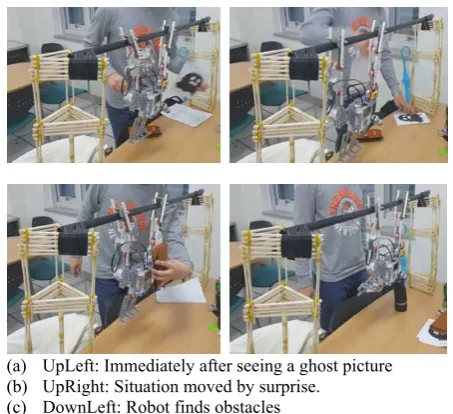
In the first year of the 2014 student year, the early team members performed the same tasks as the previous ones, creating a common robot, such as a ball catching robot, a basketball robot, a hockey robot, and a golf robot. However, some of the teams in the 2015 and 2016 teams that implemented the team project with the proposed step-by-step team forming have produced robots that show more creativity. As a memorable subject, the author would like to briefly introduce the most impressive monkey robot that feels emotion. This robot was prepared by using five large motors, one color sensor and one infrared sensor in Lego Mindstorm, and performed the following functions. First, by using the color sensor to detect the color of the picture, if you show a black ghost picture, the robot can rush backwards. If you show a yellow banana picture, it will be pleased and come on a line. By recognizing the position of the obstacle by using the infrared sensor, if it finds an obstacle, it kicks and goes forward again. The author remembers the robot as the most exciting and creative work that he has done for eight years. It is helpful to estimate the function by presenting a photo and an obstacle of the running robot in sequence in Figure 3. It is possible to check
the moved state of Fig. 3 (b) backward compared to the state of Figure 3 (a) before showing ghost picture by photograph. Figure 3. (c) and (d) show that the robot finds an obstacle, kicking it and moving forward.
(a) UpLeft: Immediately after seeing a ghost picture (b) UpRight: Situation moved by surprise.
(c) DownLeft: Robot finds obstacles (d) DownRight: Robot's kicking motion
Fig. 3. The behavior and situation when the robot sees a horrible picture and when it detects an obstacle.
4.3. Class survey and Analysis
Student surveys were conducted after the final presentations of the course in 2014, 2015, and 2016. In 2014, 34 students participated in the survey; in both 2015 and 2016, all 45 students participated each year. In 2014 classes, the previous method of forming teams was used in which students formed their own teams. Meanwhile, in 2015 and 2016, the proposed method was put into use where students were given a chance to get to know each other before forming their teams. The survey results demonstrate that students are more satisfied with the course that follows the proposed team forming method.
http://dx.doi.org/10.9717/JMIS.2017.4.4.243
247
Table 1. Means for the survey for the early fixed team forming students in 2014 and for the proposed team forming students in 2015 and 2016.
Question items 2014
2015-2016
1. Was the introduction to engineering design
class flow as you expected? 3.47 3.80
2. Were you satisfied with the step-by-step process of the project (brainstorming, building,
demonstrating, etc.)? 3.74 3.96
3. Did the team based activities (having team meetings, doing assignments, and writing team reports) help you understand the concept of engineering design?
3.65 3.87
4-1. Is the method of forming the team early in the semester and keeping it the same through the semester effective?
3.50 3.24
4-2. Is switching the formation of the teams in steps (theory and project 1: team of 3 or less,
project 2: team of 4-5) effective? 3.44 3.73
5. Is mid-term assessment criteria (creativity, idea generation, diversity, and feasibility)
appropriate? 3.50 3.69
6. Is the criteria for effort in the prototyping of
the project appropriate? 3.65 3.89
7. Is the demonstration criteria (value, usability, design, and presentation) of the final
project appropriate? 3.44 3.82
8. Is the current method of evaluating journals and attendance for an individual mark and assessing the mid-term and final presentation for a team mark reasonable?
3.47 4.00
9. Do you think that what you have learned in this class will help you participate in team
projects in your future career? 3.41 3.82
Lastly, further comments and opinions regarding the improvement of future classes have been collected. A minority of students was more comfortable with forming teams with friends; however, a majority preferred forming teams after getting to know each other from theory classes early on. For the most part, the students’ satisfaction with the course was determined based on the teaching method. The survey results from Q4-1 and Q4-2 in Table 1 demonstrate that the 2014 students were more inclined to the team forming method that they went through and the 2015 to 2016 students preferred the new team forming method, which they partook. According to Table 1, the average satisfaction rating in 2014 of the formation of the
team was 3.53 while in 2015 and 2016, the average satisfaction rating was 3.78 which is a 7.1% higher rating. Although this is not an entirely objective comparison as the participating students were different, the proposed team forming method seems to be an effective method for first year engineering design project education. However, to supplement the validity of the method, it is necessary for other instructors who carry out similar classes to apply this method into class.
V. CONCLUSION
In this study, the author tested a new team forming method in order to effectively run the freshmen based course, Introduction to Engineering Design. Previously, students autonomously formed into teams in the beginning of the semester and completed the project by the end. However, in this new research, during the theory class continued until halfway through the semester, students had a chance to determine other students’ willingness and abilities in weekly regular practices and formed into teams for the first time to complete a Lego Mindstorm project where they practiced writing a proposal. Then, they spontaneously selected their teammates for the 5 week team project, which makes this team forming model flexible. According to the results of a survey, the students’ satisfaction rate on the team forming method was higher than the conventional fixed team forming one. Particularly, in terms of teaming method, the satisfaction rate of the existing method is lower by 7.42% in 2015-2016 than in 2014. However, the satisfaction of the team formation of the students increased by 8.43% in terms of the proposed teaming method. This shows quantitative excellence in the proposed teaming method. Also, regardless of the team’s performance, to avoid the often unreasonable distribution of the same grades among teammates, in the final project stage, students were also evaluated based on self-assessment, which greatly contributed to avoiding grades solely based on team performance.
Since the suggested team forming model and evaluation method are still in their early stages, there is a need for them to be applied to other classes for them to be critiqued. In the future, the survey results will be analyzed to validate the suggested teaching method so that class can proceed more objectively.
Acknowledgement
248 REFERENCES
[1] J. Kim, “An assessment method to evaluate team project based engineering design,” in Proceedings of International Conference on Computer Science and Education, Vancouver, pp. 257-260, 2014.
[2] W. G. Dyer, W. G. Dyer Jr., and J. H. Dyer, Team Building: proven strategies for improving team performance. 4th ed. San Francisco: Jossey-Bass, 2007.
[3] B. W. Tuckman, “Developmental Sequence in Small Groups,” Psychological Bulletin, vol. 63, pp. 384-399,
1965.
[4] B. W. Tuckman and M. A. C. Jensen, “Stages in Small
Group Development Revisited,” Group and
Organizational Studies, vol. 2 pp. 419-427, 1977.
[5] J. Borges, T. G. Dias, and J. F. Cunha, “A new group-formation method for student projects,” European Journal of Engineering Education, vol. 34, issue 6, pp.
573-585, 2009.
[6] S. Pociask, D. Gross, and M. Shih, “Does Team Formation Impact Student Performance, Effort and Attitudes in a College Course Employing Collaborative Learning?,” Journal of the Scholarship of Teaching and Learning, vol. 17, no. 3, pp. 19-33, 2017.
[7] J. Kim, “Exception Handling Education Approach Incorporating Role-Changing Brainstorming Technique in HCI Design Process,” International Journal of Multimedia and Ubiquitous Engineering, vol.
9, no. 6, pp. 159-170, 2014.
Author