In vitro Comparative Evaluation of the Antibacterial and Antifungal Activities of Different Root Canal Sealers
IJPCDR
In vitro Comparative Evaluation of the Antibacterial
and Antifungal Activities of Different Root Canal
Sealers against Endodontic Pathogens
1Praveen KM Ramachandra, 2Sahadev C Krishnegowda, 3Bharath M Jaganath, 4Sandeep Rudranaik 5CG Manjula, 6Nisha B Kurup, 7Sajin Madanan
IJPCDR
ORIGINAL ARTICLE
10.5005/jp-journals-10052-0058
1,4
Reader, 2Professor and Head, 3Professor, 5-7Postgraduate Student
1-7Department of Conservative Dentistry and Endodontics, Sri
Hasanamba Dental College & Hospital, Hassan, Karnataka India
Corresponding Author: CG Manjula, Postgraduate Student Department of Conservative Dentistry and Endodontics, Sri Hasanamba Dental College & Hospital, Hassan, Karnataka, India Phone: +919448410163, e-mail: [email protected]
ABSTRACT
Introduction: Elimination of microorganisms from the root canal and preventing them from reinfecting is the main objective of endodontic treatment. The sealers exhibit antimicrobial activity that may contribute to the elimination of intracanal microorganisms and the success of endodontic treatment.
Aim: To evaluate the antibacterial and antifungal activities of different root canal sealers against endodontic pathogens.
Setting and design: This in vitro study was carried out at the Department of Conservative Dentistry and Endodontics, Sri Hasanamba Dental College & Hospital, Hassan, Karnataka, India.
Materials and methods: Agar diffusion method was used. A double-base layer of Mueller-Hinton agar was prepared. The suspensions of Enterococcus faecalis, Escherichia coli, and Candida albicans were inoculated on agar medium. Four wells of equal dimensions were prepared and immediately
filled with freshly mixed zinc oxide eugenol-based (Tubli-Seal), epoxy-based (AH Plus), polymethacrylate-based (EndoREZ), calcium hydroxide-based (Sealapex) sealers according to the
manufacturer’s instructions. All the plates were incubated at
37°C for 24 hours, and microbial inhibition zones formed around
the wells were measured after 24, 48, and 72 hours.
Statistical analysis: Data were statistically analyzed by one-way analysis of variance to compare the differences among four sealers.
Results: All the four sealers caused microbial growth inhibition. AH Plus showed the greatest mean microbial growth inhibition
of 17 mm followed by EndoREZ. The Sealapex and Tubli-Seal
comparatively exhibited mild antimicrobial activity.
Conclusion: It could be concluded that all the sealers used
showed antimicrobial activity. The AH Plus and EndoREZ
showed the highest antimicrobial activity against tested organisms.
Keywords: Agar diffusion method, AH Plus, Endodontic
bacterial strains, EndoREZ, Sealapex, Tubli-Seal.
How to cite this article: Ramachandra PKM, Krishnegowda SC, Jaganath BM, Rudranaik S, Manjula CG, Kurup NB, Madanan S.
In vitro Comparative Evaluation of the Antibacterial and Antifungal Activities of Different Root Canal Sealers against Endodontic Pathogens. Int J Prev Clin Dent Res 2016;3(4):261-266. Source of support: Nil
Conflict of interest: None
INTRODUCTION
Microorganisms are the main etiological factors in the development and progression of pulpal and periapical disease. The main objective of root canal therapy is to prevent and treat periradicular inflammation by the elimi-nation of microorganisms from the root canal system.1-3 A second factor of the outcome of root canal treatment is the healing potential of periradicular tissues and root canal treatment procedures. The absence of irritating agents like bacterial metabolic products or chemicals released from sealing materials will act as a stimulus for the healing process.2 Elimination of microorganisms from the root canal and preventing them from reinfecting by proper diagnosis, instrumentation, thorough cleaning and shaping, irrigation and intracanal dressing, compact obturation under aseptic conditions, and coronal resto-ration can increase the success rate.1,4,5 Several studies have shown that certain facultative aerobic and anaerobic microorganisms are repeatedly recovered from endodon-tically treated tooth, such as Enterococcus faecalis, Esch-erichia coli, Staphylococcus aureus, Streptococcus anginosus, Bacteroides gracilis, Actinomyces, Fusobacterium nucleatum, and Candida albicans.3,4 Enterococcus spp. constitutes a small proportion of the initial flora in the untreated root canal, also the causative agent in persistent root canal infections.4 Many studies have proved that despite utmost care, there is persistence of the microorganism and its growth in dentinal tubules, lateral canals, and apical ramifications.3
and tissue fluids, and disintegration.4,6
Root canal sealers help in bringing good marginal sealing between gutta-percha and dentin.6 Antimicrobial agents are added to root canal sealers, which exhibit antimicrobial activity. This may contribute to the elimination of intracanal microorganisms and the success of endodontic treatment.3,6,7 These antimicrobial properties are due to their chemical constituents.8 Nowadays, calcium hydroxide-based, zinc oxide eugenol (ZOE)-based, epoxy resin-based, methacrylate-based sealers are available. Many studies have compared antibacterial efficacy of the different root canal sealers against different endodontic pathogens.1-10 The agar diffusion method has been widely used to evaluate the antimicrobial activity of root canal sealers.9,11,12
The objective of the present study was to evaluate the antibacterial and antifungal activities of different root canal sealers against endodontic pathogens by measuring the diameter of zones of growth inhibition using precision ruler on the surface of agar plates.
AIM
To evaluate the antibacterial and antifungal activities of different root canal sealers against endodontic pathogens.
MATERIALS AND METHODS
Standard methodology was selected from previous studies, and slight modifications were made according to the needs of our study.1-24 Three reference strains of E. faecalis (ATCC 29212), E. coli (ATCC 25922), and
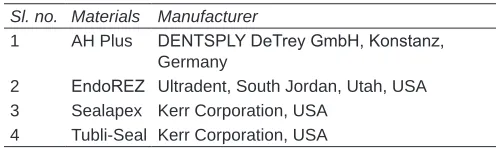
C. albicans (ATCC 10231), as shown in Table 1, and four ZOE-based (Tubli-Seal; Kerr Corporation, USA), epoxy-based (AH Plus; DENTSPLY DeTrey GmbH, Konstanz, Germany), polymethacrylate-based (EndoREZ; Ultra-dent, South Jordan, Utah, USA), calcium hydroxide-based (Sealapex; Kerr Corporation, USA) sealers, as shown in Table 2, are selected for this study.
C. albicans (ATCC 10231) were prepared. Bacteria were diluted to obtain a suspension of approximately 5 × 10⁸ colony-forming units/mL in sterile Trypticase Soy Broth. Petri dishes of 120 mm diameter containing double-base layer of Mueller-Hinton agar were prepared. Suspension containing organisms were inoculated on Petri dish containing Mueller-Hinton agar medium with sterile cotton swabs. Four wells of equal dimensions (3 mm diameter and 3 mm deep) were prepared with a glass puncher, and immediately filled with freshly mixed ZOE-based (Tubli-Seal; Kerr Corporation, USA), epoxy-based (AH Plus; DENTSPLY DeTrey GmbH, Konstanz, Germany), polymethacrylate-based (EndoREZ; Ultradent, South Jordan, Utah, USA), calcium hydroxide-based (Sealapex; Kerr Corporation, USA) sealers. The sealers were mixed according to manufacturers’ instructions. The materials were kept for 2 hours at room temperature for prediffusion. All the plates were incubated at 37°C, and microbial growth inhibition zones were measured using 0.5 mm precision ruler after 24, 48, and 72 hours.
Statistical Analysis
Data were collected and statistically analyzed using Sta-tistical Package for Social Sciences software. The results were expressed as mean and standard deviation. Data were statistically analyzed by one-way analysis of vari-ance to compare the differences among four sealers.
RESULTS
Figures 1 to 3 and Tables 3 to 5 show the antimicrobial activities of the four ZOE-based (Tubli-Seal), epoxy-based (AH Plus), polymethacrylate-based (EndoREZ), calcium hydroxide-based (Sealapex) sealers against three micro-bial strains like E. faecalis, E. coli, and C. albicans. Microbial growth inhibition zones were measured after 24, 48, and 72 hours using a precision ruler (Figs 1 to 3). Antimicro-bial activity of all the four sealers against microbes is compared as shown in Graphs 1 to 3. All sealers were significantly effective against E. faecalis, E. coli, and C. albicans. The AH Plus showed the highest antimicrobial and antifungal activity among all the sealers. The anti-microbial action of AH Plus sealer was superior to that of EndoREZ, Sealapex, and Tubli-Seal, showing a mean inhibition zone of 17 mm. The AH Plus showed greater inhibition zones for C. albicans than for E. faecalis and E. coli (p < 0.05, statistically significant). EndoREZ showed greater inhibition zones for C. albicans and E. faecalis than
E. coli. Sealapex and Tubli-Seal comparatively exhibited mild antimicrobial activity. Tubli-Seal showed greater inhibition zones for E. coli compared with C. albicans and
Table 1: Root canal sealers used in this study Sl. no. Materials Manufacturer
1 AH Plus DENTSPLY DeTrey GmbH, Konstanz,
Germany
2 EndoREZ Ultradent, South Jordan, Utah, USA
3 Sealapex Kerr Corporation, USA
4 Tubli-Seal Kerr Corporation, USA
Table 2: Microbial strains and their sources used in this study
Sl. no. Microorganism Source
1 Enterococcus faecalis ATCC 29212
2 Escherichia coli ATCC 25922
In vitro Comparative Evaluation of the Antibacterial and Antifungal Activities of Different Root Canal Sealers
IJPCDR
Table 3: Inhibition zones of four sealers after 24 hours
(in millimeters)
Name of Organism AH Plus EndoREZ Sealapex Tubli-Seal
Escherichia coli 15 12 12 10
Enterococcus
faecalis 16 14 14 9
Candida albicans 20 14 12 9
Mean 17 13.3 12.6 9.3
Standard deviation 2.64 1.19 1.15 0.57
p < 0.05, highly significant
Table 4: Inhibition zones of four sealers after 48 hours
(in millimeters)
Name of Organism AH Plus EndoREZ Sealapex Tubli-Seal
Escherichia coli 13 10 11 9
Enterococcus
faecalis 12 12 10 8.5
Candida albicans 16 12 10 7.5
Mean 13.6 11.3 10.3 8
Standard deviation 2.08 1.15 0.57 0.76
p < 0.05, highly significant
Figs 1A to C: Microbial inhibition zones of E. faecalis after (A) 24 hours; (B) 48 hours; and (C) 72 hours
A B C
Figs 2A to C: Microbial inhibition zones of E. coli after (A) 24 hours; (B) 48 hours; and (C) 72 hours
A B C
Figs 3A to C: Microbial inhibition zones of C. albicans after (A) 24 hours; (B) 48 hours; and (C) 72 hours
E. faecalis. Effectiveness of sealers decreased gradually with time. Size of zone of inhibition does not necessarily reflect the exact strength of sealers used.
DISCUSSION
The persistence of bacteria in the root canal system often leads to failure of root canal treatment leading to pulpal and periapical disease.2,6 Enterococcus faecalis, E. coli, C. albicans, and many other organisms have been shown to survive in root canals and are often associated with persistent apical periodontitis.9 Therefore, these were
activity of root canal sealers against these microorganisms may assist in controlling infection.4
Agar diffusion method is the most commonly employed technique for evaluation of antimicrobial activity of dental materials.9,11,12 This method allows direct comparison of sealers against microorganisms by the diffusion of the material across the medium.1,9 The inhibition zone around the wells gives qualitative information about antimicrobial activity of sealers.8 Variations in agar medium, bacterial strains, toxicity of the material, diffusion capacity of inhibitory agents, and cellular density may interfere with the formation of inhibition zones around materials used in antimicrobial testing.4,5
Numerous root canal sealers are available, based on various formulas and chemical compositions. Antimicrobial effect of calcium hydroxide-based (Sealapex) sealer is because of the release of hydroxyl ions, which increases the pH above 12.5.4,13-19
Hydroxyl ions are highly oxidant free radicals, which are extremely reactive with biomolecules of the cytoplasmic membrane and result in a loss of cytoplasmic membrane integrity.6,13,14,16-19 The pH declines (pH 9.14) as the sealer sets, causing loss of effectiveness of sealer.2,4,6 The inefficiency of some Ca(OH)2-containing sealers might be related to low solubility and diffusibility of these substances in agar.11 Bodrumlu and Semiz4 and other studies have reported that Sealapex sealers showed mild antimicrobial activity against E. faecalis.6,16-19
Zinc oxide eugenol-based (Tubli-Seal) sealers are the most commonly used sealers and have a strong antibacterial effect because of their chemical composition. Eugenol is a phenolic compound that acts by protein denaturation3,10,17,20 and is also lipophilic, affecting the lipids in the cell membrane and resulting in increasing
Name of Organism AH Plus EndoREZ Sealapex Tubli-Seal
Escherichia coli 12 8 7 7
Enterococcus
faecalis 12 10 8 6
Candida albicans 11 10 6.5 6.5
Mean 11.6 9.3 7.16 6.5
Standard deviation 0.57 1.15 0.55 0.5
p < 0.05, highly significant
Graph 1: Inhibition zones of four sealers after 24 hours (in mm)
In vitro Comparative Evaluation of the Antibacterial and Antifungal Activities of Different Root Canal Sealers
IJPCDR
the cell membrane permeability of the microorganisms.8 Many studies have reported that ZOE along with paraformaldehyde has shown higher antibacterial activity.1,3,4,8,10,11 Zinc oxide eugenol sealers exhibit bactericidal effect when freshly mixed, but the effect declines with time.3,4,15 The antibacterial activity of ZOE-based sealers is due to its diffusion property into the agar media.16 Nirupama et al20 reported that Tubli-Seal showed significantly higher antimicrobial activity against
C. albicans and S. aureus.
Dual-cured polymethacrylate-based EndoREZ sealer is hydrophilic and bacteriostatic in nature.20 Due to its hydrophilic character, it penetrates the dentinal tubules, thereby, exhibiting good sealing property.10,11 The results of some studies have showed that EndoREZ has the least antimicrobial activity.20 The reports of few studies state that EndoREZ also showed greater inhibition zones.15,21 Ustun et al22 and Zhang et al23 showed that EndoREZ was still bacteriostatic on the 7th day.
The AH Plus is an epoxy resin and amine-based sealer.6,8 It adapts closely to the canal walls with minimal shrinkage after setting, and has long-term dimensional stability and better sealing properties due to good flow.19,21,22 The reason for the high antibacterial activity of this sealer could be due to the unpolymerized residues during polymerization, in addition to the amine and epoxy resin components of the sealer.19 The oxygen inhibition layer of the surface of any polymerizing resin leaves an uncured monomer layer, which could be another reason.24 Gomes et al,1 Poggio et al11 and others reported that AH Plus showed the smallest inhibitory zones in their study due to discrete release of formaldehyde.17 Pizzo et al,3 Ustun et al,22 and others showed that fresh AH Plus had significant antibacterial effects, whereas set samples did not show any antibacterial activity.15,23 Other studies showed that AH Plus exhibited the highest antimicrobial activity.6,20,21 Few studies reported that AH Plus had no antibacterial action.14,16 Also, positive results go in favor of our present study. In this study, AH Plus has shown the highest antibacterial effect among the tested sealers.
The antimicrobial activity of each sealer decreased with time, may be because sealers become more stable after setting. Many studies have been performed to evaluate the antimicrobial activities of different endodontic sealers. The present study tested the antimicrobial activity of four sealers against microorganisms, which were resistant to endodontic treatment. All the tested sealers were significantly effective against E. faecalis, E. coli, and
C. albicans. The AH Plus showed the highest antimicrobial and antifungal activities among all the sealers. The AH Plus showed greater inhibition zones for C. albicans
than for E. faecalis and E. coli. EndoREZ showed greater inhibition zones for C. albicans and E. faecalis than for
E. coli. Sealapex and Tubli-Seal comparatively exhibited mild antimicrobial activity. Tubli-Seal showed greater inhibition zones for E. coli compared with C. albicans
and E. faecalis. This goes in favor of many other studies as discussed above. The findings of the present study conform with earlier studies.
CONCLUSION
All materials showed antimicrobial activity against the tested strains. The highest antimicrobial effect was observed for the C. albicans group. The AH Plus showed the highest antimicrobial effect than all the other tested sealers. The effectiveness of sealers decreased gradually with time.
ACKNOWLEDGMENT
The authors thank the entire faculty members of the Department of Conservative Dentistry and Endodontics, Sri Hasanamba Dental College & Hospital, Hassan, Karna-taka, India, for their kind cooperation and encouragement.
REFERENCES
1. Gomes BPFA, Pedroso JA, Jacinto RC, Vianna ME, Ferraz CCR, Zaia AA, Souza-Filho FJ. In vitro evaluation of the antimicrobial activity of five root canal sealers. Braz Dent J 2004;15(1):30-35.
2. Sipert CR, Hussne RP, Nishiyama CK, Torres SA. In vitro antimicrobial activity of fill canal, seaalapex, mineral trioxide aggregate, Portland, cement, and EndoRez. Int Endod J 2005 Aug;38(8):539-543.
3. Pizzo G, Giammanco GM, Cumbo E, Nicolosi G, Gallina G. In vitro antibacterial activity of endodontic sealers. J Dent 2006 Jan;34(1):35-40.
4. Bodrumlu E, Semiz M. Antibacterial activity of a new end-odontic sealer against Enterococcus faecalis. J Can Dent Assoc 2006 Sep;72(7):637.
5. Miglani R, Shankar, Indira R, Ramachandran S. An in vitro evaluation of calcium hydroxide root canal sealers and its effect on six microorganisms. J Conserv Dent 2007 Feb;10(3):99-103.
6. Yasuda Y, Kamaguchi A, Saito T. In vitro evaluation of the antimicrobial activity of a new resin–based endodontic sealer against endodontic pathogens. J Oral Sci 2008 Sep;50(3):309-313. 7. Asgary S, Kamrani FA. Antibacterial effects of five different
root canal sealing materials. J Oral Sci 2008 Dec;50(4):469-474. 8. Muhammed AA, Al-Azzawi AKJ, Al-Mizraqch AS. An evalua-tion of the antimicrobial activity of five endodontic sealers on three bacterial species. (In vitro study). MDJ 2009;6(3):203-213. 9. Cavalcanti AL, Limeira F, Sales EALS, Oliveira AAG,
Lima DMB, Castro RD. In vitro antibacterial activity of root canal sealers and calcium hydroxide paste. Contemp Clin Dent 2010 Jul;1(3):164-167.
10. Saha S, Samadi F, Jaiswal JN, Ghoshal U. Antimicrobial activ-ity of different endodontic sealers: An in vitro evaluation. J Indian Soc Pedod Prev Dent 2010 Oct-Dec;28(4):251-257. 11. Poggio C, Lombardini M, Colombo M, Dagna A, Saino E,
13. Siqueira JF Jr, Lopes HP. Mechanisms of antimicrobial activity of calcium hydroxide: a critical review (Review). Int Endod J 1999 Sep;32(5):361-369.
14. Kaiwar A, Nadig G, Hedge J, Lekha S. Assessment of antimi-crobial activity of endodontic sealers on Enterococcus faecalis: an in-vitro study. World J Dent 2012 Jan-Mar;3(1):26-31. 15. Prasad MP. In-vitro antimicrobial evaluation of endodontic
cavity sealers against Enterococcus faecalis. Int J Innov Res Sci Eng Technol 2013 Dec;2(12):7662-7666.
16. Habeeb MA. Analysis of antimicrobial activity of root canal sealers against endodontic pathogens using agar dif-fusion test (In vitro study). J Bagh Coll Dent 2014 Sep;26(3): 27-33.
17. Arora R, Rawat P, Bhayya DP. A comparative evaluation of antimicrobial efficacy of three endodontic sealers: Endoflas FS, AH Plus and sealapex against Enterococcus faecalis – an in vitro study. IOSR-JDMS 2014 Mar;13(3):90-93.
18. Kaur A, Shah N, Logani A, Mishra N. Biotoxicity of commonly used root canal sealers: a meta-analysis. J Conserv Dent 2015 Mar-Apr;18(2):83-88.
time polymerase chain reaction: an ex vivo study. J Conserv Dent 2015 Nov-Dec;18(6):474-478.
20. Nirupama DN, Nainan MT, Ramaswamy R, Muralidharan S, Usha HHL, Sharma R, Gupta S. In vitro evaluation of the antimicrobial efficacy of four endodontic biomaterials against Enterococcus faecalis, Candida albicans, and Staphylococcus aureus. Int J Biomater 2014 Oct;2014:1-6.
21. Maekawa LE, Nassri MRG, Ishikawa CK, Martins C, Chung A, Koga-Ito CY. In vitro antimicrobial activity of AH plus, EndoREZ and Epiphany against microorganisms. Indian J Dent Res 2012 Jul-Aug;23(4):468-472.
22. Ustun Y, Sagen B, Durmaz S, Percin D. In vitro antimicrobial efficiency of different root canal sealers against Enterecoccus faecalis. Eur J Gen Dent 2013 May;2(2):134-138.
23. Zhang H, Shen Y, Ruse ND, Haapasalo M. Antibacterial activity of endodontic sealers by modified direct contact test against Enterococcus faecalis. J Endod 2009 Jul;35(7): 1051-1055.