Vol
u
me 2, Issue 2
, 2013
THE ROLE OF TRUST IN E-ENGAGEMENT:
A CASE STUDY ON EU GOVERNMENTS
Donatella Padua1
Abstract: The objective of the paper is to illustrate the impact of digital
technology on the relationships between institutions and stakeholders in the Internet environment. The study sheds light on how trust builds value within the social dynamics of the digital ecosystem. The following case study on the ‘EU Governments – Stakeholders e-Engagement’is meant to clarify the effort that the governments of the EU member states aremaking to change the citizens’ mindset required to face the new Internet Age society.
Keywords: Digital technology, Ecosystem, Complexity, Dialogue,
Engagement, Horizontal society, Trust, e-Governments, Internet Age, Stakeholders.
The complex digital ecosystem
The ‘Internet Age’ is an era that started with the diffusion of the internet global network (Cavanah 58-49, Padua 3-18), characterized by a radicalization of social postmodern complexity (Appadurai 27-47, Castells 36-63, Luhmann 1995: 12-58, 2010: 105-214, Bauman 21-38). Indeed, the Internet is an ecosystemcharacterized by high levels of complexity (Luhmann5-1, Prigogyne27-40) leading to a paradigmatic shift from verticality to horizontality. This statement is justified by the following phenomena:
- the disruption of vertical top-down power and control systems exerted by organisations and institutions tracing to the creation of a new horizontal society.
- The generation of horizontal value-chains based on peer-to-peer sharing and on the production and control of information not governable by traditional top-down value chains.
- The dissolution of rational linear patterns versus creative disorder and connecting dots methodologies. This fact implies that knowledge develops more on the surface than following mainstream vertical traditional patterns, which were based on depth rather than superficiality.
The role of trust
In the Internet Age, trust has become essential to business. In a world where the new paradigm is based on connection, collaboration and innovation, marketing is shifting from a measure of success based on Return OnInvestment (ROI) to
1 PhD in the Science of Education, Senior Researcher in Sociology at the University for
Vol
u
me 2, Issue
2
, 2013
value measured in relationships and trustworthiness. As trust is the essence of relationship, building a ‘Trust Strategy’ (Padua 91-95) is of utmost importance for both private and public organisations. Some institutions are already operating in this direction via e-governments, participation strategies and transparency politics, namely: ‘Open Government’ or ‘Wikicracy’. These terms relate to a form of democracy empowered by web collaborative tools (wikis) aiming to reach win-win solutions between institutions and stakeholders. As shown below in the case-study, these forms of engagement allow institutions to meet the stakeholders’ need to express their opinions freely, to become protagonists by exerting a ‘control’ over the government, empowering people to access data and information. This process forces institutions to become more transparent and benevolent, showing integrity, key requirements to become trustworthy.
With all the difficult challenges institutions have to face today – shrinking public budgets, a fragmented and diversified society, global movements, to mention only some of the reasons behind the loss of central powers – it is much harder than earlier for governments to solve all the issues related to their institutional role.
That’s why stakeholders are increasingly invited to help solve governments’ problems with creative and innovative solutions.In the Internet environment opportunities for stakeholders-government collaboration lie in all forms of crowdsourcing. Challenge.gov2, for example, is the US platform where the public and government can solve problems together; SeeClickFix.com3 is an opportunity for the government to hear citizens’ ideas about the perfect system to receive feedback and service requests; Mysociety.org4 builds websites which benefit the civic and community aspects of people’s lives. The objective is to help people become more powerful in these areas: reporting transport issues and street problems, receiving answers from public bodies and contacting public representatives are just some of the ways to exert civic rights and contribute to the improvement of the civic society.
In this light, building trust via the design of trust strategies becomes of utmost relevance. However, this is a complex challenge for more than one reason: trust is multidimensional and it requires to establish a one-to-one personalized relationship between the institution and the stakeholder to gain insights on his or her real need; secondly, customers are increasingly distrustful, particularly regarding institutions. As the Edelman Trust Barometer indicates5, in the past two years institutions have been undergoing the highest drop in trust by people, followed, at a distance, by business and NGOs: specifically, comparing the average of 2012-2013 vs. 2011, governments scored – 7 vs. – 1.5 % pointsof business and NGOs.
2 Challenge.gov, 16 Nov 2013. Web 3 Seeclickfix.com, 15 Dec. 2013. Web 4 Mysociety.org, 15 Dec. 2013. Web. 5
Vol
u
me 2, Issue 2
, 2013
Who has gained trust then? ‘A person like you’ and ‘Regular employees’ scored + 21,5% and + 15% respectively vs. – 12,5% of government officials and – 12,5% of CEOs(average 2011-2013).
Some reasons have to be traced to scandals and lack of competence on the institutions and organisations side versus the transparency of peer-to-peer relationships granted by the absence of any form ofhidden interests: peer-to-peer trust is more immediate and irrational rather than rational and logic. As a matter of fact, trust has two sides, an irrational one and a rational one, calledrespectively trust and confidence.
These two constructs have several definitions in literature (Giddens 39-44, Luhmann 35-45). By synthesizing the various interpretations, trust and confidence may be considered two sides of the same coin: on the trust side, non-rational attributes prevail; on the confidence side, rationality emerges quite clearly.
Within the complex Internet social ecosystem, the irrational side of trust prevails over the rational one. This accounts for its unpredictability, to the disruption of linear patterns and the impossibility to connect causes to effects.
Relevantly, trust allows the possibility of an action within a framework of reciprocity. The circulatory process of exchange, which is an inside link among persons and a builder of society, is the main framework within which interaction takes place generating reciprocal influence and exchange6. As society is made up of social interactions and exchange is not possible without trust, it is clear that trust generates social cohesion and it is a very powerful tool of integration, allowing action to take place (Giddens 85-112).
The objective of a trust strategy (Padua 95, 179-182), is to manage reputation via:
a. working on the five critical areas of trust, which are Competence, Benevolence, Integrity, Transparency and Value Congruence:
1. Competence relates to technical ability and performance (Cofta 39-40);
2. Benevolence relates to the positive quality of relationship. It is the extent to which a trustee is believed to want to do good to the trustor, aside from an egocentric profit motive (Mayer et al. 709-34).
3. Integrity refers to values and to an ethical approach. It implies that the trustor perceives the trustee as adhering to a set of principles (personal integrity) considered acceptable (that is, to display moral integrity) by the trustor, including honesty, fair treatment and the avoidance of hypocrisy (ivi718); 4. Transparencyrelates to the rule to communicate. It may be interpreted as the
possibility of the trustor to acquire information about the trustee’s integrity.
6 Georg Simmel, a philosopher and sociologist, in his work on the ‘philosophy of money’
Vol
u
me 2, Issue
2
, 2013
5. Value congruence is related to identity (Pirson and Malhotra 43-50). It expresses the sociological relation between identification and integration or sharing (Simmel 500-1).
a. being able to create positive experiences and perceptions, via a communication strategy and dialogue. In the case-study shown below, different communicational formats emerge from various governments’ websites, indicating different levels of emotional communication and involvement: an example isthe Denmarkwebsite7, rich in pictures, colours and engaging content versus the Latvia8website, which appears very informative and straightforward.
Trust and social capital
Trust is an enabler of social capital.
In sociology as in economics, these two concepts are of primary importance. Social capital allows an understanding of the new meaning of value within the digital society – the relationship upon which relational goods are founded. In our perspective of digital context and responsibility, we focus less on Coleman’s utilitarian position (Coleman 300-21), giving more attention instead to the collectivist positions of Putnam, and to the relational-dialogic approach of Donati, who has investigated the concept of relational goods in depth (Donati and Solci 140-187; Putnam 65-78, Nussbaum, 343-354). In fact, as the utilitarian position refers to a cooperative rationale (i.e. an entrepreneur cooperating for a project with other entrepreneurs), the collectivist positions refer to building social capital as an outcome of a reciprocal exchange of relations useful to the collective. Fixmytransport, for instance, is a web community to make petitions for the fixing of transport problems9. According to Putnam, social capital is the «set of socio-organizational elements – as trust, shared norms, social networks – which may improve the efficiency of society itself, facilitating the coordinated activity of individuals» (Putnam 65-78).
Based on this consideration, it is evident how social capital puts trust at the centre of the process: social capital, by connecting people, is an essential element in the building of social networks that are vital in nurturing and meetingthe expectations and preserving of social norms. In turn, trust reduces distances between brands and stakeholders following viral patterns. Trust is a diffusive good, tending to expand from one point of a society to many others (Stzompka37-62). Trust virality leverages the invaluable trustworthiness of thosestakeholders having a leadership in opinions, the so-called ‘influencers’ or ‘trust agents’ (Brogan and Smith 1-31) of a company. Within social networks, trust may be inferred by the observation of other agents’ behavior, without a complete pre-existing set of information.
7 denmark.dk, 10 Aug. 2013.Web.
8 mk.gov.lv/en/mk/sastavs12 Aug. 2013. Web. 9
Vol
u
me 2, Issue 2
, 2013
In summary, managing trust online reduces brand-consumer distances and may be a fast diffuser of a positive reputation, thanks also to the role of influencers or trust agents. For this reason, building a trust strategy means managing reputation in time and space.
Casstudy: Analysis of the EU Governments – Stakeholders e-Engagement Background
Institutions provide different levels of interpretation to the concept of e-government. According to the definition of the World Bank,
«e-Government” refers to the use by government agencies of information technologies (such as Wide Area Networks, the Internet, and mobile computing) that have the ability to transform relations with citizens (G2C), businesses (G2B), and other arms of government (G2G) into more friendly, convenient, transparent, and inexpensive relationships. These technologies can serve a variety of different ends: better delivery of government services to citizens, improved interactions with business and industry, citizen empowerment through access to information, or more efficient government management. The resulting benefits can be less corruption, increased transparency, greater convenience, revenue growth, and/or cost reductions»10.
In some countries, the meaning is restricted to a mere offer of electronic inquiry or to file an application, to electronically receive information, to ease the handling of administrative procedures; in the other cases, instead,e-government relates to the adoption of digital stakeholders’engagement strategies to build deeper and long-lasting relationships with people, to encourage bottom-up participation and horizontal dialogue.
The below analysis is grounded on this latter more extensive interpretation of e-government. Results provide a ranking of EU countries based on digital stakeholders engagement.
Key Learnings
It is evident how a well-established stakeholders’ engagement strategy doesn’t make the political, economic and social success of a whole country. However, it is clear how it represents an initial way to drive the socio-political strategy of a country towards a stakeholders’ engagement strategy, matching the new needs of the digital empowered society. Giving voice to the people, letting them participate in the process, building long-lasting relationships represents the strategy of capturing value from the horizontal society. Indeed, a digital
Vol
u
me 2, Issue
2
, 2013
stakeholder’s engagement strategy has to be integrated within a whole offline strategy, aiming at accomplishing the same objectives.
Not with standing these considerations, a signal of an innovative strategic approach such as digital stakeholders engagement hasto be interpreted critically. In fact, not always does it represent a well-rooted and trusted new approach. In some cases it may only represent a media-oriented ‘maquillage’ strategy, simply tied to the communication strategies of the institutional leader of the moment.
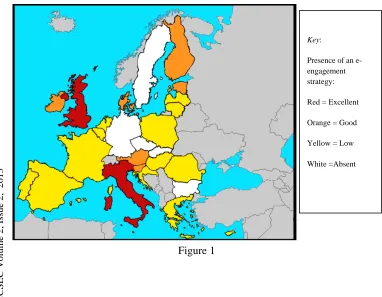
As evidenced in the first part of the study, many institutions still strive to change mindset and strategies towards an ongoing revolution requiring such a cultural change. This is the reason behind why only one-third of the EU member states (32%) appear to adopt stakeholder’sengagement strategies at excellent or good levels (see Figure 1, red and orange colour). Specifically, even though only a limited percentage of EU countries (7%, United Kingdom and Italy) hold excellent positions, indeed, another interesting group of countries (25%) also shows very good levels in encouraging dialogue through their digital channels (Austria, Denmark, Estonia, Finland, Ireland, Malta, Slovenia). This translates into governments encouraging participation via specific digital and e-government platforms, well evidenced within their institutional website, and, in top performing cases, stimulating open consultations on different topics and encouraging petitions. Moreover, in these cases, participation such as volunteering or direct involvement in improving communities demonstrate the intention of governments to transfer power to stimulate bottom-up and horizontal decisional processes.
Key:
Presence of an e-engagement strategy:
Red = Excellent
Orange = Good
Yellow = Low
White =Absent
Vol
u
me 2, Issue 2
, 2013
Indeed, a substantial two-third of EU countries are still reluctant to start an interaction with their stakeholders. Out of this figure, 47%, representing the overall highest percentage of performance (yellow colour), show low levels of engagement. This reflects a lack of any form of participation platform, missing open consultations or petitions encouraged by the government and lack of any other form of participation such as volunteering and direct involvement in improving communities. The residual 6% don’t show any form of engagement.
Sample and Methodology
The totality of the universe of the 28 EU member states has been considered. For each country the official government website has been analysed according to the following variables:
a. Presence of participation platforms. This variable refers to dedicated webpages such as ‘gov.uk/government/get-involved’ for UK or ‘partecipa.gov.it’ for Italy. In some cases this variable includes the presence of social media links well evidenced in the institutions’ website homepage.
b. Level of evidence of the above specified webpage link in the home-page. If well-evidenced, it reflects a clear-cut strategy of stakeholder engagement, encouraging an open dialogue and participation.
c. Social media channels. Presence of blogs and/or other social media such as Twitter, Facebook, Flickr, Pinterest, Youtube, G+, to encourage conversation and horizontal WOM (Word of Mouth).
d. Open consultations with stakeholders on specific subjects. This is a major way of building trust via participation. It corresponds to co-production processes in the business sector.
e. Petitions encouraged by governments. Often, petitionwebsites are bottom-up sourced, created by other constituencies. In this study we refer only to specific petitions webpages linked to the official government’s website.
e. Participation. The analysis refers to other forms of participation following the UK ‘Big Society’ concept. According to this model, the government supports people who care about their communities and want to get involved in improving them. It believes that people understand the needs of their area best, which is why it transfers power so people can make more decisions locally and solve their own problems to create strong, attractive and thriving neighbourhoods11. It includes volunteering, community organisation, protecting building, and many other bottom-up initiatives.
11
Vol
u
me 2, Issue
2
, 2013
Key findings
Figure 2
The percentage of governments putting stakeholders engagement at the centre of their strategies is still very low, 7% vs. 25% of governments showing a good level of engagement. The majority of governments (68%, 47% at C-level + 21% at D-level) have a low or absent level of engagement (see Figure 2).
Undoubtedly, the UK shows a top performing website both under the communicational and engagement perspective. The claim ‘Simpler, clearer, faster’ perfectly summarizes the opening to involvement and dialogue. The four ‘trust beliefs’ clearly emerge both from the content and execution of the website, matching transparency, benevolence, competence, integrity and identity.The number of closed and open consultations confirm the success of the strategy: 76open consultations and 600 closed consultationsin the past 12 months12 indicate a positive government-stakeholders engagement. Consultations cover a wide range of topics, from arts and culture to law and justice, fromemploymentto crime and policing.
The Italy website13, at the time this study was carried out, had an excellent and well-evidenced platform, stimulating participation14: partecipa.gov.it, aiming to a consultation on Constitutional reforms. The outcomes appear encouraging: more than 200.000 filled applications (validated by ISTAT, the Institute of National Statistics), 4 million minutes spent online by Italians of all ages to express their own ideas on forms of government, on tools of free and democratic expression, on priorities on the effectiveness of the Parliament. However, after the consultation was successfully closed, the government website didnot show any other open
12 gov.uk/government/get-involved, 3 Feb. 2014. Web. 13 Governo.it, 13 Aug. 2013.Web.
14
Vol
u
me 2, Issue 2
, 2013
consultation (nor does it currently15). For this reason, time will confirm if there is a consistent intent by the government to field a stakeholders’ engagement strategy.
Germany is a case apart. No traces of any encouragement to participation, no stakeholder engagement emerge. Clearly, this reflects an institutional decision and strategy.
Some other governments are positioned in between an A- and B-rating, indicated as a B+. This rank reflects a solid presence of an e-government platform although with a somehow restricted interpretation of the e-government approach. Specifically, the Austrian government’swebsite highlights Austria as the ‘2013 European Champion in e-Government’ for the fourth time in a row16. Although this is an excellent result, digitalization appears to work essentially for electronic inquiries or to file an application, to electronically receive information, to ease the handling of administrative procedures. No direct encouragement to dialogue is expressed in the official website. Seemingly, the Slovenian government shows an e-government website17; however, the concept of e-government is interpreted in a quite restrictive and one-way direction, being informative only and not encouraging any thorough interaction with stakeholders.
The Estonia18, Ireland19, Malta20 websites represent similar cases, performing same rankings.
B+ -ranking also indicates governments not using any specific platform dedicated to stakeholders’ participation, indeed showing an engaging and rich scope of social media links, well evidenced in the homepage. The Danish and Finnish governments’ websites are cases in point.
In the C-ranking cases, there is a lack of any specific participation platforms and other indicators are usually negative. However, an encouragement to dialogue via blogs or social media is often present, evidenced at low or good level. This may reflect a genuine first step to an engagement strategy that reveals a ‘shop-window’ approach, aiming just at a communicational or ‘maquillage’ effect.
In this view, and close to the Germany-case, it would be worthwhile to further investigate the reasons behind the poor performance of the French government’s website, which restrictsdialogue with stakeholders to a few social media links posted on the home page. Seemingly, Spain just adds to some social media links an invitation to write to the President.
D-ranking shows no engagement in any form: besides the ‘Germany’ case, there are Bulgaria, Czech Republic, Luxembourg, Slovakia, Sweden.
15 At Feb. 3, 2014.
16
digitales.oesterreich.gv.at, 11 Aug. 2013.Web.
17 http://e-uprava.gov.si, 12 Aug. 2013. Web. 18 e-estonia/digital-society, 10 Aug 2013. Web.
19 gov.ie/services/egovernment-suggestions, 11 Aug. 2013. Web. 20
Vol
u
me 2, Issue
2
, 2013
Concluding remarks
In the Internet Age we are witnessing an unprecedented reversal of roles, where stakeholders are able to freely produce content, dramatically impacting on an organisation’s reputation (Padua 46). These are premises that point to a new dynamic concept of value, based on a direct participation in the process, calling for two-ways dialogic communication patterns.
Opening a dialogue to the extent of building relationships has become the critical objective for organisations as, in the Internet Age, this means building loyalty to the brands of institutions. To achieve this intent, however, organisations have to become trustworthy, as trust allows the opening towards buildinga relationship. Indeed, it means complying with the power of stakeholders, able to ‘act’ on the web, that is: to get information, express their judgment and govern the reputation of the institution. In other words, institutions are called to reach win-win solutions, matching their compelling objectives with the stakeholders’ new digital needs. The case-study shown in this paper is a case in point, shedding light on a cultural issue generating a massive communication gap between institutions and stakeholders and on many missing opportunities of dialogue (only about one-third of governments show an excellent or good level of engagement).
Importantly, this study may represent auseful basis for further researches aiming to investigate the impact of the above analysed e-engagement strategiesin terms of value generation. The goal would be to capture the real effectiveness of the levels of engagement and trustworthy relationships between governments and stakeholders. An interesting route could be to apply indicators such as Social capital and Relational or Common goods (Donati 140-187) and models of measurement of engagement and trust (Cofta, 73-85, Lacohée 29-31, Padua, 167-200).
Appendix I: Levels of Engagement of the Websitesof the EU Countries
EU Countries Partici- pation Plat-forms Level of Evi-dence Social media Chan- nels (FB, g+, Twitter, …) Open Consul-tations Petitions Encou- raged by govern-ment Partici-pation (big society model: volunteering , community org., national service, protecting buildings…) Rating on Engage- ment
1 Austria http://www.aus tria.gv.at
Yes (1)
No No No No No B+
(digitales. oesterreic h.gv.at) 2 Belgium
http://www.bel gium.be/en/
Vol
u
me 2, Issue 2
, 2013
3 Bulgaria http://www.go vernment.bg
No No No No No No D
4 Croatia http://www.vl ada.hr/en
No No Yes No No No C
5 Cyprus http://www.cy prus.gov.cy
No No Yes No No Yes C
6 Czech Republic http://www.vl ada.cz/en/
No No No No No No D
7 Denmark http://denmar k.dk Yes (2) Yes +
Yes No Yes No B
8 Estonia http://valitsus. ee/en/
Yes Yes +++
Yes No No No B+
(e- estonia/ digital-society) 9 Finland
http://valtione uvosto.fi/etusi vu/en.jsp
Yes(2) Yes +
Yes No No No B
10 France http://www.go uvernement.fr
No No Yes No NO No C
11 Germany http://www.bu ndesregierung .de/Webs/Bre g/EN/Homepa ge/_Node.htm l
No No No No No No D
12 Greece http://www.pr imeminister.g ov.gr
No No Yes No No No C
13 Hungary http://www.ko rmany.hu/en
No No Yes No No No C
14 Ireland http://www.go v.ie
yes Yes ++
Yes Yes No No B+
(gov.ie/se rvices/ Egovern- ment- suggesti-ons/ ) 15 Italy
http://www.go verNo.it
yes Yes +++
Vol
u
me 2, Issue
2
, 2013
16 Latvia http://www.m k.gov.lv/en/m k/sastavs/
No No Yes No No No C
17 Lithuania http://www.lr v.lt
No No Yes No No No C
18 Luxembourg http://www.go uvernement.lu
No No No No No No D
19 Malta http://www.go v.mt/en/Pages /gov.mt%20h omepage.aspx Yes (2) Yes +
Yes No No No B+
(mygov .mt/ portal)
20 Netherlands http://www.go vernment.nl
No No Yes No No No C
21 Poland http://www.po land.gov.pl
No No Yes No No No C
22 Portugal http://www.po rtugal.gov.pt/e n.aspx
No No Yes No No No C
23 Romania http://www.go v.ro/main/ind ex/l/2/
No No Yes No No No C
24 Slovakia http://www.go vernment.gov. sk
No No No No No No D
25 Slovenia http://www.go v.si
yes (1)
No No No No No B+
(http://e -uprava. gov.si) 26 Spain
http://www.la moncloa.gob. es/home.htm
No No Yes No No No C
27 Sweden http://www.go vernment.se
No No No No No No D
28 United Kingdom https://www.g ov.uk
yes Yes +++
Yes 404 closed in past 12 mos
Yes Yes
https://www .gov.uk/ petition-government
Vol
u
me 2, Issue 2
, 2013
Key:
A=excellent. Key indicators are positively performed: the presence of interaction
platformsis well evidenced, enforced by social media and consultations. In top performance cases, petitions and other forms of participation are performed such as: volunteering, community organisations, national service, protection of national buildings.
B=good. Interaction platforms, e-government websites are present on the homepage.
Sometimes well evidenced social media links replace specific interaction websites, often integrated with other indicators. Consultations, petitions, citizens’ participation are usually not encouraged. B+are ratings between A and B, due to effective digital technology efforts such as e-government platforms, even though sometimes intended in a restricted way, and not directly encouraging dialogue.
C=low.Absence of specific participation platforms. However, an encouragement to
dialogue via blogs or social media is often present, evidenced at low or good level. Other indicators are usually not performing.
D=absent. There isn’t any form of engagement; dialogue is not encouraged.
Notes:
(1) Government websites with a restrictive interpretation of the e-government concept, not directly encouraging any interaction with stakeholders. E-government works essentially for electronic inquiries or to file an application, to electronically receive information, to ease the handling of administrative procedures.
(2) In these countries, even in the absence of a specific webpage, a rich scope of social media is well evidenced on the homepage.
WORKS CITED
Appadurai, Aryun. Modernity at Large. Cultural Dimension of Globalization. University of Minnesota Press, 1997. Print.
Bauman, Zygmunt. La società individualizzata. Come cambia la nostra esperienza. Bologna: IlMulino, 2010. Print.
Brogan, Chris and Julien Smith.Trust Agents. Using the web to build influence, improve reputation, and earn trust. Hoboken, New Jersey: Wiley & Sons Inc. 2010. Print.
Castells, Manuel. Il potere dell’ Identità. Milano: Università Bocconi, 2002. Print. Cavanah, Allison. Sociology in the Age of the Internet. McGraw-Hill International,
2007. Print.
Coleman, James S. Foundations of Social Theory. Cambridge, Mass.: The Belknap Press of Harvard University Press. 1990. Print.
Cofta, Piotr. Trust, Complexity and Control: Confidence in a Convergent World.Chirchester: Wiley, 2007. Print.
Donati, Pierpaolo, and Roberto Solci. I beni relazionali. Che cosa sono e quali effetti producono. Torino: Bollati Boringhieri, 2011. Print.
Vol
u
me 2, Issue
2
, 2013
Lacoheé, Hazelet al. Understanding Public Perceptions: Trust and Engagement in ICT-Mediated Services. Chicago Ill.: International Engineering Consortium, 2008. Print.
Luhmann, Niklas. La Fiducia. Bologna: Il Mulino, 2002. Print.
Mayer, Roger C., James H. Davis and F. David Schoorman, An integrative model of organizational trust, Academy of Management Review 20(3), 1995. Print. Nussbaum, Martha C..The fragility of Goodness.Luck and Ethics in Greek Tragedy
and Philosophy. Cambridge: Cambridge University Press. 1986. Print. Padua, Donatella.Trust, Social Relations and Engagement.Understanding Customer
Behaviour on the Web. Basingstoke: Palgrave Macmillan, 2012a. Print. Pirson Michael and Deepak Malhotra. Unconventional Insights for Managing
Stakeholder Trust, MIT Management Review, 49(4).2008. Print. Prigogyne, Ilye. Le leggi del caos. Bari-Roma: Laterza. 1993. Print.
Putnam, Robert D.. "Bowling Alone. America’s Declining Social Capital". Journal of Democracy, 6 (1) 65-78. 1995. Print.
Simmel, Georg. Philosophie des Geldes, Leipzig, 1900. Print.