Research Journal
Volume 10, No. 29, March 2016, pages 168–175
DOI: 10.12913/22998624/61949 Research Article
Received: 2015.12.15 Accepted: 2016.02.01 Published: 2016.03.01
INVESTIGATING THE ROLE OF STRUCTURAL FACTORS IN
THE PERFORMANCE OF SMES BY USING STRUCTURAL
EQUATIONS TECHNIQUE
Amir Abbas Rahmati Alaei1, Younos Vakil Alroaia2
1 Student of the Department of Management, Semnan Branch, Islamic Azad University, Semnan, Iran, e-mail:
2 Department of Management, Semnan Branch, Islamic Azad University, Semnan, Iran, e-mail: y.vakil@
semnaniau.ac.ir
ABSTRACT
Small and medium sized enterprises (SMEs) have plenty of competitive advantages compared to large companies. They are more capable of being original and
innova-tive, and due to their flexibility, they can respond better to environmental changes and
satisfy their customers’ emerging needs. They also have more opportunities to rede-sign or alter and improve their management tools and information systems. Moreover,
the employees can improve their expertise in novel fields. Due to the significance of
SMEs in countries’ economies, a great number of studies and investigations have been conducted on them. According to the previous studies of the researcher and review of the literature, relying on the three-dimensional model, three groups of structural,
con-tent, and environmental factors were identified as the most important factors affecting
the performance of SMEs in Semnan province in Iran. Nevertheless, owing to the wide area of research and also in order to achieve better results, this study has focused only on investigating the role of structural factors in the performance of SMEs in Semnan province. The research method used in this study in terms of target is applied and in terms of data collection is analytical. The method used for data analysis is the technique of structural equations of second rank factor analysis . The results of the re-search revealed that structural factors affect SMEs performance to the amount of 3.99.
Keywords: small and medium sized enterprises, performance, structural equations technique, companies of industrial city in Semnan province.
INTRODUCTION
In Canada, 98% of enterprises are small and medium sized (SMEs), and in Japan 60% of in-dustry exports belong to this kind of enterprises [7]. Although 99% of enterprises in Iran are small and medium sized, only 17% of industry value-added tax belongs to them [10]. Various defini -tions of SMEs have been presented. In its report in 2003, UNIDO indicated that the definitions of SMEs in Iran are not in agreement, and different organizations and institutions have provided dif-ferent definitions [15]. Azizi in a study entitled “Evaluating the factors affecting
entrepreneur-ship in small and medium sized enterprises by us-ing balanced reward cards” introduced the units with the personnel of below 150 people as small and medium sized enterprises [3].
eliminat-ing the existeliminat-ing weaknesses in each index, we will help improve the performance of the active companies in small and medium sized industries. Ballantine illustrated that 11% of the SMEs set up one year ago and also 80% of the new SMEs set up five years ago experience failure [4]. Although setting up a successful SME in any segment of in-dustry and trade is complicated, these challenges and problems are reduced by identifying the fac-tors affecting positive or negative performance of small and medium industries. According to the re-port of Iran’s small industries and industrial cities organization, about 90% of economic institutions in Iran are the ones with less than 50 [11].
Since structural factors have a fundamental role in SMEs performance and these factors are usually common among SMEs, investigating the role of each component of structural factors helps managers and entrepreneurs improve, reduce, or eliminate these factors in order to improve their performance. So by considering what was men-tioned above, the significance of this study is evi -dent because studying the role of each structural factor gives managers and policymakers a better understanding and helps them achieve a desirable performance along their purposes and strategies.
LITERATURE OF THE REVIEW
Karpak and Topcu utilized a network analysis process to prioritize the factors affecting the suc-cess of manufacturing SMEs in Turkey. Accord-ing to the results of this research in which ANP has been used, rules and regulations are the most effective factor in the success of small enterprises [8]. Chorev and Anderson analyzed crucial fac-tors of success of small newly formed enterprises possessing superior technology in Israel. Ac-cording to the results of this research, the most important factors affecting the success of these enterprises include the commitment of manage-ment group, expertise, organization methods in general and marketing methods in particular, rela-tion with customers, and managerial capabilities and research [6].
Also, Man et al. in a study reviewed the lit-erature of SMEs success and showed that three features affect the success of these enterprises: endogenous factors, personal qualities, and en-trepreneurs’ personal qualities [9]. Rogoff et al. identified 11 factors affecting the success of small enterprises: personal qualities, managerial issues,
financial affairs, marketing activities, human re -sources issues, economic conditions, product characteristics, competition, discipline, technol-ogy, and environmental factors [13]. In another study, Benzing et al. investigated the factors of success and failure of entrepreneurship in Tur-key by utilizing factor analysis statistical method. According to the results of this research, entre-preneurs in Turkey believe that the popularity of the firm and its management including sincerity and social skills, previous experience and man -ager’s character traits are the most important fac-tors of success of small enterprises. Additionally, a complicated tax system and inability to absorb and keep reliable staff were mentioned as the most important problems of entrepreneurship [5]. Sepehrdoost and Kamran in an article entitled “The evaluation of technical efficiency of small industries in Hamedan province” mentioned that some reasons of developing countries’ attention to small and medium industries compared to large ones are high flexibility, low cost investments, orientation towards target groups, and dynamic management in these kinds of industries which can create job opportunities, reduce poverty, im-prove income distribution, and meet basic needs as well as increase gross national product. The re-sults obtained from the research showed that the average technical efficiency of the performance of small industries in the provinces of the country is 96% during the study. Analyzing the sensitivity of the factors affecting the efficiency proved that such factors as employment, value of investment, and products value have an important role in the improvement of efficiency of the country’s small industries. The average efficiency of small indus -tries in Hamedan province was obtained at 92% during the study and ranked 12 on average among the provinces of the country. Also, the analysis of efficiency index of all the production factors showed that the efficiency growth of small indus -tries in the province does not have a positive and expected procedure [14].
affecting the performance of Iran’s small ru-ral industries can clarify some important points concerning the reasons of lack of agreement between Iran’s small rural industries and rural development goals and clarify basic planning lines of enterprises managers and government policymakers. The factors affecting the perfor-mance of Iran’s small rural industries have been categorized into three groups, namely structural, environmental and content factors. Then by uti-lizing the descriptive-quantitative method, Iran’s rural development experts’ viewpoints are studied regarding the extent to which each factor affects the performance of small rural industries and then each factor is ranked [1].
Aminbeidokhti and Zargar in an article en-titled “The study of existing obstacles to SMEs development and presentation of a framework supporting them” maintain that SMEs in Semnan province have encountered various endogenous and exogenous obstacles and problems. Besides, the results of the statistical analyses showed that facilities and financial and nonfinancial supports from SMEs have not been sufficient in financial, technical, marketing, and executive fields [2]. Piri et al. indicated that the purpose of this research was to study the direct and indirect effects of com-petitive industrial forces on adopting strategies and performance of small and medium industries in industrial cities and areas in Hamedan province that was tested by 3 hypotheses. The method of this research is applied based on the purpose of research, but in terms of procedure and nature, it
is a causative research. The population of study, i.e. the managers of manufacturing companies of industrial cities and areas in Hamedan province, is 501 people. In this research, a questionnaire was designed to collect data, and after testing its validity and reliability, it was given to the sample including 273 managers employed in manufac-turing companies of industrial cities and areas in Hamedan province. Data analysis in this research is carried out by utilizing modeling techniques of structural equations with the software LISREL. The research findings confirm the moderating role of managers’ performance by adopting strategies and show that the managers of small and medium industries can moderate some of the negative ef-fects of competitive industrial forces by adopting appropriate strategies in production, study of en-vironment, and adjusting decision-making. This research also indicates that the managers’ perfor-mance can be assessed by comparing direct and indirect effects of competitive industrial forces on performance. The obtained results of this research confirm the moderating role in the performance of managers of industrial units in Hamedan prov-ince by adopting an appropriate strategy [12].
METHODOLOGY
This research is applied in terms of purpose and descriptive in procedure. It was conducted in companies located in industrial cities in Semnan province in 2014. The main purpose of the pres
ent research is investigating the role of structural factors in the performance of small and medium industries of Semnan province. For this reason, first with the help of experts’ viewpoints and also studying the literature of the review, the compo-nents of structural factors were identified and then refined by using factor analysis test and eventu -ally 4 main components were identified. Then the extent of effect of these four components and fi -nally the total effect of structural factors on SMEs performance were identified by using structural equations technique.
DATA ANALYSIS
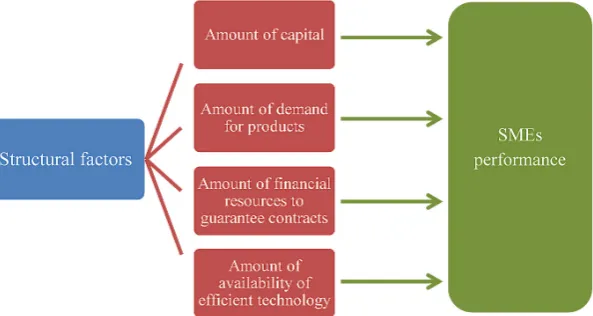
By studying the literature of the review and experts’ viewpoints, the following factors were identified as the main components of structural factors affecting SMEs performance.
Table 1. The components of structural factors affect-ing SMEs performance obtained from literature of the
review and statistical investigations and experts’ view -points
Row Structural factors
1 The amount of capital
2 The amount of demand for products
3 The amount of financial resources to guarantee contracts 4 The amount of availability of efficient technology
5 Condition of machinery of small and medium manufacturing units 6 Marketing and sales costs
7 Financial facilities
8 Affiliating to larger enterprises
9 Fluctuations in raw materials costs
10 Amount of availability of raw materials
Table 2. The main components selected by factor anal-ysis test and SPSS software
Row Structural factors
1 The amount of capital
2 The amount of demand for products
3 The amount of financial resources to guarantee contracts
4 The amount of availability of efficient technology
Conceptual model of research
In this study, structural factors are an indent variable and SMEs performance is a depen-dent variable. By considering experts’ viewpoints and studying literature of the review and the re-sult of factor analysis test by using SPSS software and indices screening, the following conceptual model was obtained (Figure 2).
The phases of data analysis by using structural equations technique (factor analysis)
Prior to carrying out factor analysis, sampling adequacy test must be conducted in order to make sure of sampling adequacy. To determine this, two categories of Bartlett and Kaiser measures (KMO) are used. The value of KMO test varies between 0 and 1. If the value of KMO is less than 0.50, the data will not be suitable for factor analy-sis. If its value is between 0.50 and 0.69, then the data must be analyzed carefully. But if its value is equal to or more than 0.7, the correlations be-tween data are suitable for factor analysis. Bartlett tests the hypothesis that the observed matrix of correlations belongs to a population with depen-dent variables. If the hypothesis that the variables are not correlated is rejected (level of significance is 0.05 and less than that), the data are suitable
for factor analysis, otherwise factor analysis must not be used.
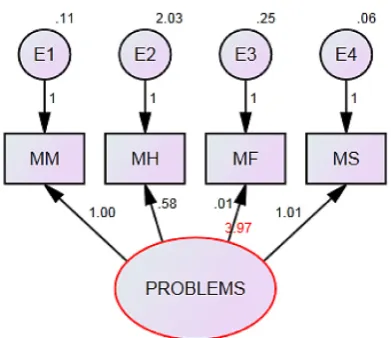
As is observed in Table 3, the value of KMO test is 0.84 and the level of the significance of Bartlett test is zero. Both of them show that the data are suitable for factor analysis. In this phase, in order to investigate the significance of research model, answer research questions, and examine research hypotheses, structural equations tech-nique of factor analysis model was used. First, in Table 4 we will introduce abbreviations of com -ponents used in this software.
In Figure 4, structural equations model of standard coefficients (factor weights) was shown for research components obtained by means of Amos software.
Factor weight is a value between zero and one. If factor weight is less than 0.03, the relation is considered weak and so it is ignored. The factor weight between 0.03 and 0.06 is acceptable and if it is greater than 0.06, it is highly desirable.
Here the variable of the amount of availabil-ity of technology with 0.01 has the weakest rela-tion with SMEs performance. Since its value is less than 0.3, we will remove it from the model and in the factor analysis of second rank we will
show the extent of effect of the other three factors in the model. The rest of the variables have very strong relations with the hidden variable of SMEs performance.
Factor analysis of second rank
In Figure 5, the output of standard coeffi -cients for the components of structural factors has been shown by using three components of the amount of capital, the amount of demand for pro-duction, and the amount of financial resources to guarantee contracts and eliminating the compo-nent of amount of availability of technology. As is seen, in the standard output (that is, by consid-ering amount of error), the amount of capital and the amount of demand for production are related to SMEs performance with the same extent of 0.063. Now with the help of nonstandard output of Amos software (Figure 6), we will investigate the level of significance of factor weights.
Table 3. The results of Kaiser and Bartlett tests
The value of KMO test 0.84 It is greater than 0.70, so the data are suitable for factor analysis
The level of significance
of Bartlett test 0.00
It is less than 0.05, so the
variables are correlated and suitable for factor analysis
Table 4. Abbreviations used in the software
Component Abbreviation
Amount of demand for production MM
Amount of availability of technology MF
Amount of financial resources MH
Amount of capital MS
SMEs performance PROBLEMS
Fig. 3. Degree of dependence of research variables in factor analysis of first rank
Fig. 4. Structural equations model of components of structural factors
Table 5. Interpretation of significance of factor weights
of variables of research model
Row Variable of factor Value
weight
1 Amount of capital (MS) 1.01
2 Amount of demand for production (MM) 1.00
In Table 6, we will investigate the amount of factor weight of each of the components.
Here all the factors have very strong relations with the hidden variable of SMEs performance, but the components of the amount of capital and demand for production have strong relations and component of amount of availability of financial resources has a medium relation with SMEs perfor-mance. As is seen, these three factors affect SMEs performance with the extent of 3.99 altogether.
As evident, by eliminating the variable of amount of availability of technology, the extent of dependence of the other three factors has increased to the extent of 0.02. In order to investigate the significance of relations between variables in fac -tor analysis of the second rank, t-test statistic or t-value is used. Since significance is examined in 0.05 level of error, the relation is not significant if the amount of the factor weights obtained from t-value test is smaller than the critical t-value of 1.96.
RESULTS
In this section, the significance of the model obtained values is examined. Since in this re -search we try to test the hypotheses in the level of confidence of 0.95 or error level of 0.05, it is significant if the value of t-test is between –1.96 and +1.96.
Major hypothesis. The components of struc-tural factors (amount of capital, demand for pro-duction, and amount of availability of financial resources) have a significant effect on SMEs per -formance (Table 7).
Also in Table 8, CR is the same as statistic. If it is higher than 1.96, it shows that the relation is significant. It is seen in this table that CR of all the factors is higher than 1.96. It means that all factors have a significant dependence with SMEs performance. In other words, the amount of capi-tal and the amount of demand for production af-fect SMEs performance to the extent of 14.22 and the amount of financial resources affect it to the extent of 3.77.
The result of testing the first minor hypoth -esis – amount of capital has a significant effect on SMEs performance (Table 9).
The result of testing the second minor hy-pothesis – amount of demand for production has a significant effect on SMEs performance (Table 10).
The result of testing the third minor hypoth-esis – the amount of availability of financial re -sources to guarantee contracts has a significant effect on SMEs performance (Table 11).
Evaluating fitting of model of factor analysis of second rank – as is seen in Table 10, the model has a good fitting.
Fig. 5. The extent of dependence of research variables
in factor analysis of second rank (standard output) Fig. 6.the second rank (Coefficients of significance) Structural equations model, factor analysis of
Table 6. Interpretation of significance of factor weights of research variables in factor analysis of the second rank
Row Variable Value of factor weight Interpretation
1 Amount of capital (MS) 1.00 It is greater than 0.5, so level of significance is strong
2 Amount of demand for production (MM) 1.00 It is greater than 0.5, so level of significance is strong
DISCUSSION
According to the results of the research by Karpak and Topcu in which ANP has been used, rules and regulations are the most effective fac-tor in the success of small enterprises. But in the present research, the amount of capital and the amount of demand for production have the great-est effect on SMEs performance. Rogoff identi-fied 11 factors affecting the success of small en -terprises: personal qualities, managerial issues, financial affairs, marketing activities, human resources issues, economic conditions, product characteristics, competition, discipline, technol-ogy, and environmental factors. In our research, we concluded that financial affairs such as the Table 7. Testing the major hypothesis of the research
From On Standardized coefficient Figures of significance (t) Confirm or reject the hypothesis
Components of
structural factors SMEs performance 3.99 >1.96 confirm
Table 8. Amount of statistic of C.R (statistic of t for all factors)
Having significant dependence<1.96 Value of statistic of CR Variable
The relation is significant 14.22 Amount of capital
The relation is significant 14.22 Amount of demand for production
The relation is significant 3.77 Amount of availability of financial resources
Table 9. Testing the first minor hypothesis of the research
From On Component coefficient Figures of significance (t)
Component of amount of capital SMEs performance 14.22 Greater than 1.96
Table 10. Testing the second minor hypothesis of the research
From On Component coefficient Figures of significance (t)
Component of amount of demand for production SMEs performance 14.22 Greater than 1.96
Table. 11. Testing the third minor hypothesis of the research
From On Component coefficient Figures of significance (t)
Component of amount of availability of
financial resources SMEs performance 3.77 Greater than 1.96
Table. 12. Testing the fitting of model of factor analysis of second rank
Fitting index Acceptability criterion Statistic of model of effect indices
RMSEA (testing deviation of each degree of freedom) 0.08 > RMSEA 1.085
GFI (fitting index) 0.90 < GFI 1.00
CFI (comparative fitting index) 0.90 < CFI 1.00
CMIN (Chi-square fitting index) 1 < CMIN < 5 1.04
PRATIO (fitting index of economics ratio) 1 > PRATIO 0.00
amount of capital and availability of financial re -sources affect SMEs performance.
that facilities and financial and nonfinancial sup -ports from SMEs have not been sufficient in fi -nancial, technical, marketing, and executive fields. And financial affairs affect SMEs performance.
CONCLUSIONS
In the present research, after ten main com-ponents of structural factors affecting SMEs per-formance were identified by studying literature of the review and experts’ viewpoints, we recog -nized four main factors of the amount of capital, the size of demand for production, availability of financial resources andtechnology by means of factor analysis test. Then according to the results of structural equations technique and factor analy-sis of first rank, the availability of technology was eliminated, and in factor analysis of second rank, we concluded that components of structural factors (amount of capital, demand for production, and the availability of financial resources) affect SMEs (companies of industrial city in Semnan province in Iran) performance with the extent of 3.99 totally. Since the demand for production is one of the fac-tors affecting SMEs performance, it is suggested that enterprises use this factor to improve their per-formance through factors of marketing and man-agement of marketing and proper and novel sales.
On the other hand, due to the effect of the amount of capital and amount of financial re -sources to guarantee contracts on SMEs perfor-mance, it is suggested that companies improve this factor in order to improve their performance by using funding tools, such as different kinds of loans and also cooperation with banks and finan -cial institutions.
REFERENCES
1. Amin Aqae M., 2008. Study of factors affecting performance of small industries from rural
devel-opment experts’ viewpoints. Village and Develop
-ment, 11(4), 125–146.
2. Aminbeidokhti A., Zargar M., 2011. Study of ex -isting obstacles to SMEs development and presen-tation of a framework supporting them. Cultural,
economic, social, and scientific monthly publica -tion of work and society, issue 138.
3. Azizi M., Vakilalroaya Y., Tavangar A., 2012. Eval -uation of the factors affecting entrepreneurship in small and medium companies by utilizing balanced reward cards. Case study: Semnan’s industrial city.
National conference of entrepreneurship and man-agement of knowledge-based enterprises. Sari.
4. Ballantine J., Levy M., Powell P. 1998. Evaluating information systems in small and medium-sized enterprises: issues and evidence. European Journal
of Information Systems, 7(4), 241–255.
5. Benzing C., Chu H.M., Kara O. 2009. Entrepre -neurs in Turkey: A factor analysis of motivations, success factors, and problems. Journal of Small
Business Management, 47(1), 58–91.
6. Chorev S. and Anderson A.R. 2006. Success in Is-raeli high-tech start-ups; critical factors and
pro-cess. Technovation, 26(2), 162–174.
7. Halabisky D. 2006.The growth process in firms: job creation by firm age, small business policy
branch industry. Canada.
8. Karpak B. and Topcu I. 2010. Small medium man-ufacturing enterprises in Turkey: Ananalytic net-work process frame net-work for prioritizing factors affecting success. Int. J. Production Economics,
125, 60–70.
9. Man T.W., Lau T., Chan K.F. 2002. The competi-tiveness of small and medium enterprises: A concep-tualization with focus on entrepreneurial
competen-cies. Journal of Business Venturing, 17, 123–142.
10. Nasehifar V., Saadat M., Masoumzadeh Zavvareh
A., Ahmadi M., 2010. Strategies and policies in sup-port of institutions of marketing services. Journal
Commercial Research Publication, 55, 109–150.
11. Organization of small industries and industrial cit -ies, 2011. Successful policies in development of small industries in 20 industrial and developing countries. Tehran: publications of organization of Iran’s small industries.
12. Piri A., Safaeshakib A., Hosseinzadeh A., 2013. Evaluation of performance of managers of manu-facturing companies in response to competitive industrial forces in SMEs (Case study: Industrial cities and areas in Hamedan province). Conference of Management, Challenges and Guidelines, Shi-raz, 2013.
13. Rogoff E.G., Lee M.S., Suh D.C. 2004. Who done it? Attributions by entrepreneurs and experts of
the factors that cause and impede small business success. Journal of Small Business Management,
42(4), 364–376
14. Sepehrdoost H., Kamran N. 2012. Evaluation of
technical efficiency of small industries in Hamedan province, 4(4), 147–174.
15. UNIDO 2003. Strategy of Increase in effective and
competitive participation in small and medium in-dustries in economy and industry of Islamic Re-public of Iran. Translator: Abdoreza Sheghaghi and
Masood Shafie (2004), 1st ed., Cultural Institution