ISSN :2394-2231 http://www.ijctjournal.org Page 52
Analysis of Big Data Processing Using Data Mining
Shashank Dubey
1,Vidya Chitre
2Department of Information Technology, VIT,Mumbai,India
---
***********************
---Abstract:
Cloud computing is a powerful technology that are highly used to perform large- scale and complex computing. It completely remove requirement to maintain expensive computing hardware, or software and large space. Massive growth has been observed in the generation of data or big data over the year through cloud computing. For processing and anlaysing result from that large data generally require lots of computational power and large infrastructure requirement. Hence there is a need to conjoined big data with cloud computing. Since this big data is important to analysis in order to extract insight knowledge from the data. Traditional association rule mining for frequent itemset which scan the dataset into main memory may become inconvenient when handling large dataset. Hence there is need of processing this dataset on multiple commodity machine using parallel technique of Map Reduce Framework. This paper gives overview of different big data mining algorithm used for processing dataset.
Keywords —Big Data,Hadoop,MapReduce,Data Mining
---
***********************
---I. INTRODUCTION
In this modern era, there is sudden increase in amount of data generated and ability to collect this large data has increased signicantly because of advances in hardware and software platforms. For example, Wal-Mart alone handles more than 1 million customer transactions each hour and imports those into databases estimated to contain more than 2.5 petabytes of data. Web log data sites such as Facebook and Twitter handles, stores and generated terabyte to petabyte of data each day alone and this number keeps on growing. Since the data is often so large that specialized methods are required for the mining process. With this extremely large data set it may be dicult or infeasible for single machine to process and nd association pattern rules between the data set. Because the traditional algorithm has issues of scalability, memory and computation cost, stability and low performances when it comes to deal with this huge data. Also the streaming and big-data architectures are slightly dierent and pose dierent challenges for the mining process. When processing this big data for the problem of frequent itemset there is need to consider a lots of challenges. A major problem arises when the data is large enough to be stored in a distributed way. Therefore, signicant costs are incurred in shuing the
data or the intermediate results of the mining process across the distributed nodes. These costs are also referred to as data transfer costs. Therefore when handling large dataset, then the algorithms need to designed to take into account both the disk access constraint and the data transfer costs. In addition, many distributed frameworks such as MapReduce require specialized algorithms for frequent pattern mining. The focus of big data framework is somewhat dierent from streams, in that it is closely related to the issue of shuing large amounts of data around for the mining process. Interestingly, it is sometimes easier to process the algorithms in a single pass in streaming fashion, than when they have already been stored in distributed frameworks where access costs become a major issue.
Dealing with big datasets in the order of terabytes or even peta bytes is a challenging. Hence cloud computing provides an eective technique called Parallel programming which is becoming a necessity to deal with the massive amounts of data, which is produced and consumed more and more every day. Parallel programming architectures, and hence the algorithms, can be grouped into two major subcategories: shared memory and distributed (share nothing). On shared memory systems, all processing units can concurrently ac-cess a shared memory area.
ISSN :2394-2231 http://www.ijctjournal.org Page 53
On the other hand, distributed systems are composed of processors that have their own internal memories and communicate with each other by passing messages [10]. It is easier to adapt algorithms to shared memory parallelism in general, but they are typically not scalable enough [10].
II. LITERATURE SURVEY
Association rule mining was introduced by R.Agrawal in 1993. It still has an active research area in the data mining and machine learning. Association rule mining nds correla-tions between items in a database. The classic application for association rule mining is market basket analysis , in which business experts aim to investigate the shopping behaviour of customers in an attempt to find some commonness . The aim is to nd groups of items that are frequently sold together in order that marketing experts can develop strategic decisions concerning shelving, sales promotions and planning. Associ-ation rule mining has been widely used in various industries beside supermarkets such as mail order, telemarketing, and e-commerce.
The author R.Agarwal[1] has proposed an Apriori which scan the database to generate candidate k-itemset and it has to repeatedly scan k+1 times for k itemset. To overcome this limitation, JW. Han, J. Pei and YW. Yin.[2 ] has proposed FP-Growth algorithm which scan the database twice and accordingly it construct the FP-tree. Based on FP-tree which
TABLE I
COMPARISON OF APRIORI, FP-GROWTH AND MFP ALGORITHM
Parameter Apriori FP-Growth MFP
Techniques It uses the apriori property and It construct FP-tree from which It uses the TL table along with
eliminates the items that does not conditional frequent itemset is gen- MFP-tree to generate frequent
satisfy the minimum count erated that satisfy the minimum itemset
Count
Utilization of Mem- It generate large candidate which It does not require much memory It also does not require large
mem-ory may require large memory space space since it uses the FP-tree ory space.
Number of Scans It scan the database multiple times It scan the database only twice. It only require once database scan.
to generate candidate itemset
Execution Times Lots of times wasted for producing Execution times is less as com- Require less time than FP-Growth
ISSN :2394-2231 http://www.ijctjournal.org Page 54
TABLE II
SUMMARY ANALYSIS OF BIG DATA MINING TECHNIQUES
Sr Author Title Algorithms Observation
No Remarks
1 Yang, Xin Yue, MapReduce as a programming Parallel Apriori It uses the Hadoop technology to
Zhen Liu, and model for association rules algo- improve the traditional Apriori
Al-Yan Fu rithm on Hadoop[4] gorithm
2 Haoyuan Li,Yi PFP: Parallel FP-Growth for Query Parallel FP- Growth It consider the memory and
com-Wang,Ming Recommendation[5] putation cost of processing large
Zhang dataset and hence it proposed the
Parallel FP-Growth which
parti-tions the data on commodity
ma-chine for processing
3 Moens, Sandy, Frequent itemset mining for big- Dist-Eclat and BigFIM The author has proposed two
tech-Emin Aksehirli, data[6] nology to speed up and optimized
and Bart the run on large scale data
Goethals
4 Rong, Zhuobo, Complex statistical analysis of big Apriori and FP-Growth based on The author has consider the
prob-Dawen Xia, and data: implementation and applica- MapReduce lem of single machine environment
Zili Zhang tion of apriori and FP-growth al- for processing large dataset. Hence
gorithm based on MapReduce[7] it implemented the traditional
algo-rithm (Apriori and FP-Growth) on
MapReduce parallel environment
to overcome the issues of memory
utilization,scalability and low
per-formances
5 Wei, Xiaoting Incremental FP-Growth Parallelized Incremental FP- This algorithm realizes the
effec-mining strategy for dynamic Growth tive data mining when threshold
thresholdvalue and database based value and database changes at the
on MapReduce[8] same time
6 Liao, Jinggui, MRPrePost-A parallel algorithm MRPrePost MRPrePost is more superior than
Yuelong Zhao, adaptedfor mining big data[9] PrePost and Parallel FP-Growth
and Saiqin Long algorithm in terms of
scalabil-ity,stability and performances
7 Yen-huiLiang Sequence-Growth: A Scabale and Sequence-Growth A lexicographical order is used to
and Shiow-yang Effective Frequent Itemset Mining construct a tree which help to find
Wu Algorithm for Big Data Based on all frequent itemset from dataset
ISSN :2394-2231 http://www.ijctjournal.org Page 55
stored in memory, it process to find frequent itemset. But it create a large number of conditional tree to process the tree which is recurrsive process.Gao, Jun.[3] also the same algorithm which follow the FP-Growth algorithm, but it reduces the scan of a database by one time. MFP algorithm is efficient in terms of time execution as compared to FP-Growth and Apriori. It can be used on any input dataset where FP-Growth or Apriori are applied.Table 1. show the comparison of these 3 algorithm.
III. REVIEW OF BIG DATA MINING ALGORITHM AND
MAPREDUCE
This section will focus on the recent work done on handling big data through MapReduce technology. Table II. shown above give summary analysis of different algorithm the author has proposed and its observation result.
A. Mapreduce On Hadoop Framework
MapReduce is data parallel and scalable programming model which introduce by Google. The MapThe MapReduce consist of two function i.e mapper and reducer. The mapper function work on the input data which is split among the mapper on multiple node. Each mapper take as key ,value pair as input to generate output intermediate result. Then on this intermediate result MapReduce perform the shuffling and sorting operation to give the combined output from all mapper as input to reducer. The reducer function will aggregate all the <key,value> pair to generate the final output. Mapreduce has the advantage it automatically handle the complicated issues like the load balancing, distribution of data on multiple node and fault tolerances. MapReduce can be served on low commodity hardware and it is scalable which is another alternative to expensive infrastructure. The input data for MapReduce is mainly stored in HDFS which provide high I/O bandwidth when running on cluster of multiple node. Hadoop has several component namely Na-menode, Datanode, Jobtracker and TaskTracker. Namenode is the heart of HDFS and it is master server
which maintain the metadata regarding the input which split across the node. Jobtracker is also master server which request for metadata to Namenode so as to assign and schedule the task for TaskTracker. TaskTracker is mainly responsible for execution of mapper and reducer task.
IV. FUTURE WORK
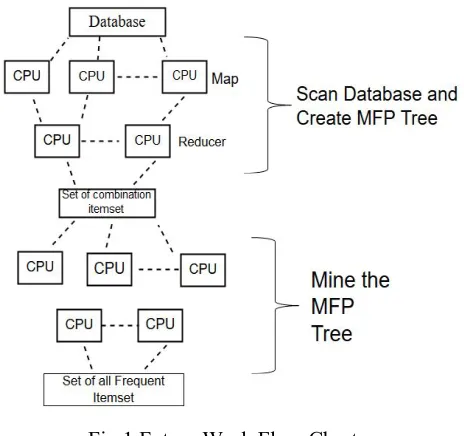
In this section we have applied the idea to implement the MFP algorithm on MapReduce Framework. Since the Parallel FP-Growth algorithm based on MapReduce also need to scan the database twice and it also recursive procedure to construct the conditional tree. Hence using MFP algorithm based on MapReduce Framework, we can overcome the limitation of excessive scanning database which improve the efficiencies and scalable of Parallel FP-Growth and MFP algorithm. Fig. show flow of future work.
Fig.1.Future Work Flow Chart V. CONCLUSIONS
This paper gives the overview of different traditional and big data mining algorithm with its comparative analysis. We also suggested an new algorithm using MFP to implement based on MapReduce so as to improve the scalalbility and efficiencies problem.
REFERENCES
ISSN :2394-2231 http://www.ijctjournal.org Page 56
Tech-nology, vol. 15, 1994, pp. 487-499.
[2]JW. Han, J. Pei and YW. Yin.“ Mining Frequent Patterns without Candidate Generation”, International Conference on Management of Data, vol. 29(2), 2000, pp. 1-12.
[3]Gao, Jun. “Realization of a new association rule mining algorithm.” cis. IEEE, 2007.
[4]Yang, Xin Yue, Zhen Liu, and Yan Fu.“MapReduce as a program-ming model for association rules algorithm on Hadoop.”Information Sciences and Interaction Sciences (ICIS), 2010 3rd International Conference on. IEEE, 2010
[5]Li, Haoyuan, et al. “Pfp: parallel fp-growth for query recommenda-tion.” Proceedings of the 2008 ACM conference on Recommender systems. ACM, 2008.
[6]Moens, Sandy, Emin Aksehirli, and Bart Goethals.“Frequent itemset mining for big data.” Big Data, 2013 IEEE International Conference on. IEEE, 2013.
[7]Rong, Zhuobo, Dawen Xia, and Zili Zhang. “Complex statistical anal-ysis of big data: implementation and application of apriori and FP-growth algorithm based on MapReduce.” Software Engineering and Service Science (ICSESS), 2013 4th IEEE International Conference on. IEEE, 2013. [8]Sun, Li, et al. “An efficient algorithm for updating
association rules with incremental transactions and minimum support changes simul-taneously.” Intelligent Systems (GCIS), 2012 Third Global Congress on. IEEE, 2012
[9]Liao, Jinggui, Yuelong Zhao, and Saiqin Long.“MRPrePost-A parallel algorithm adapted for mining big data.” Electronics, Computer and Applications, 2014 IEEE Workshop on. IEEE, 2014.