Efficient Background Subtraction using
Improved Multilayered Codebook
1
Jyothi Anusha,
2Ch.Kavitha,
3M.Baburao,
1
PG Student,2, 3 Professor CSE, Gudlavalleru Engineering College
Abstract : Detection of moving objects in video is
a highly demanding area of research for object tracking. Background subtraction is the technique used to extract the foreground for object recognition in a video. The fast background subtraction algorithms can yield optimal results in foreground detection models. Codebooks are used to store compressed information by demanding high speed processing and less memory usage. Multilayered codebook(MCB) model provides a mechanism which uses block based and pixel based codebooks for high speed background subtraction with out refining noise and smoothing of edges, so it detects the single object as the multiple objects. Improved MCB perform refining the results from MCB by employing medianfilter which is one kind of smoothing technique at the same time it reduces the noise in a video. As a result, the improved multilayered codebook model performs well against the noise and smoothing of edges compared to traditional models.
Keywords : Codebook , Foreground substraction ,
Moving object detection.
1.INTRODUCTION
The detection of moving objects in video sequences is the first step in video surveillance system. The performance of the visual surveillance depends on the quality of the object detection. Many segmentation algorithms extract moving objects from image/video sequences. The goal of segmentation is to isolate moving objects from static and dynamic background. The variation of local or global light intensity, object shadow, regular or irregular background and foreground will have an impact on the results of object detection. There are different methods of object detection. Optical flow [1] is the pattern of apparent motion of objects, surfaces and edges in a visual scene, it involves calculating the image optical flow field and doing clustering process and gets complete movement information of an object and useful for detecting the moving object from the background. However, there are some disadvantages like includes large quantity of calculations, sensitivity to noise, not suitable for realtime object detection and tracking. Frame differencing[2] is the presence of moving objects in a frame is found out by calculating the difference
between two consecutive images. The advantage is it has a strong adaptability for a variety of dynamic environments. Yet, it has some disadvantanges are accuracy level of detection of moving object is very low. Temporal differencing[3] use pixelwise difference between 2 or 3 consecutive frames in a video imagery to extract moving regions from the background, high adaptability with dynamic scenes change although it can always extract all relevant pixels of a foreground object mostly when objects moves slowly or has relevant texture, cannot detect the consecutive frames and results in loss of objects when foreground object stops moving. Point detectors[4] are used in finding the useful points in images which have an expressive texture in their respective localities. In Background subtraction the pixels in the regions of undergoing changes are marked as moving objects and preserved for further processing. Background subtraction has two algorithm approaches are of recursive and non_recursive algorithms.
Recursive algorithm :
1. Donot maintain a buffer for background subtraction estimation
2. Update background based on each input frame
3. Input frames from the distant past cloud have been effect the current background model being analysed.
4. Requires less storage Non_recursive algorithm :
1. Uses a sliding window approach for estimation changes in the background. 2. The process includes a buffer for storing
the previous L video frames and estimating the background image based on the temporal variation of each pixel with in the buffer.
3. High adaptability as they donot depend on the history beyond those frames stored in buffer as in recursive algorithms.
large buffer is needed to manage the slow moving traffic.
Different techniques are employed in background subtraction which are of, Gaussian mixture model(GMM)[3],in this two tasks are performed in real time a) Learning background b) Classifying pixels as background and foreground, consisting of combination of Gaussian probability density function(pdf), maintains density function for each pixel, parameters are mean, median and weight.The disadvantage is it doesn’t cope with multimodel background. Approximate median is a running estimate of the median is incremented by one of the input pixel is larger than the estimate and decreased by one if smaller. yet, the disadvantage is computation requires a buffer with the recent pel values.Simple background subtraction method is the static background without object is first taken as reference then the current image of the video is subtracted pel by pel and convert into binary image. Disadvantage is sensitivity to noise and illumination change detection procedure. In Mean filter Background is calculated using mean of the last N frames then foreground is detected, in Medianfilter Background is calculated using foreground in mean. Advantage is fast and easy to implement adaptive background calculation. W4 system is for detecting, tracking people and monitoring their activities in an outdoor environment, employes a combination of shape analysis and tracking to locate people and their parts, foreground regions are detected in every frame by combination of background analysis and simple low level processing of the resulting binary image. Eigen background method is based on eigen value decomposition, principle Component Analysis(PCA) is used to mold the background by significantly reducing the dimension of data, the drawback is only useful for small and medium objects. In most of the cases there is no training set of pre-labeled images to build a background model. Therefore, the key assumption in background subtraction is that most of the pixel values in the image sequence belong to the background. This usually results in a higher number of mislabeled pixels in the beginning of the process as some moving objects are classified as background since there is not yet enough evidence. Eventually the model stabilizes as more samples are collected and the number of misclassified pixels decreases. To avoid this problem some algorithms perform a training step during which they collect enough samples over some period of time to build a background model which contains pixel values that reappeared often during the training.
2. RELATED WORK
There is a technique called Block Truncation Code(BTC) [5] that extends the concept of Codebook(Cb), BTC algorithm divides the image into Non_overlapped blocks, each pixel in a block is substituted by its high mean or low mean, it is simple and efficient, however the compression ratio of the BTC is limited, since, the image quality deteriorates rapidly when compression ratio is increased. Cb [6] is Bag Of Words(BOW) model can be applied to image classification by treating image features as words. Codebook generation is BOW model is to convert Vector represented patches to Codeword(Cw), also produces a Codebook(Cb), Cb can be considered as representative of similar patches, Codewords are defined as the centers of the learned clusters, extracting local image descriptors and clustering with a user designated number of clusters. Cb can be mainly used to compress information to achieve a high and efficient processing speed, it is a feature representation used in text processing, this is applied to image processing application for image retrieval, scene recognition and classification, Cb algorithm adopts a quantization/clustering technique , to construct a background model from long observation sequences. For each pixel, it builds a Cb consisting of one or more Codewords(Cws). Samples at each pixel are clustered into the set of Cws based on a color distortion metric together with brightness bounds, not all pixels have same number of Codewords. The cluster represented by Cws donot necessarily corresponds to single Gaussian or other parametric distributions, even if the distribution at a pixel were a single normal, there could be several Cws for that pixel. The Background is encoded on a pixel_by_pixel basis. Detection involves testing the difference of the current image from the Background model with respect to color and brightness, it is classified as Background. (1) the color distortion to some Cw is less than the detection threshold, (2) its brightness is less with in the brightness range of the codeword, otherwise classified as foreground .The disadvantage of Cb is that cannot model new Background scene during input sequences. To overcome this problem TWO_LAYER Codebook model is proposed here it consists of two background model Cbs, one is permanent(main M) and the other is non_parmanent(hidden or cache H), in training phase only basic Cb is modeled, cache Cb is empty. During input sequence, Foreground and Background is segmented and layered Cb model is updated. For layered codebook 3 thresholds are defined TH, Tadd and Tdelete used to
define M and H Cbs[7].
Main idea for the construction of Codebook : 1. Starts with an initial Codebook of NC
2. From NC classes from a set of
training vectors V in the class i, if the initial Codeword is the closest match to V.
3. Repeatedly restructure the classes by computing the new centroids of the reacent classes, and putting the each training V vector in the class of Vs closest new centroid.
4. Stop when the total distortion (difference between the training vectors and their centroids) cease to change much.
5. Take most reacent centroids as the Codebook.
Hierarchical codebook(HCB)[8] is a coarse-to-fine foreground detection strategy, in which it involves two types of Cbs are of blockbased and pixel based Cbs to filter with different sizes of areas, this is of similar to the former Cb. The former Cbs can provide a high efficiency in background model updating, it still involves many redundancies in the observations. To ease this problem, the weighting concept of the MOG is adopted for preserving the advantage of Cb and then further speeds up the classification of foreground and background.
a). Features used in blockbased background subtraction :
Suppose a frame (xt , where t ≤ T) of size P×Q is divided into multiple non_overlapped blocks of size M×N, and each block is processed independently, in this for extracting the features BTC is used, HCB uses more mean parameters than the BTC, parameters like (μ)mean, (μh)highmean,μl(lowmeam),μht(hightopmean),μhb(h
ighbottommean),μlt(lowtopmean),
μlb(lowbottommean) are used in HCB in some
special cases such as :
variable xm,n denotes the pixel value in a block
1. If all xm,n in one block are identical then
set μht, μhb, μlt, μlb as μ.
2. If all xm,n ≥ μ in one block are identical,
then set μht and μhb as μh.
3. If all xm,n < μ in one block are identical,
then set μlt and μlb as μl.
Due to the frames in the RGB color space, and each block in each color channel is represented by v ={μR
ht ,μRhb ,μRlt ,μRlb ,μGht ,μGhb ,μGlt ,μGlb ,μBht ,μBhb ,μBlt ,
μB
lb}.comparing with hierarchical method [11], in
which the texture information is employed to form a 48-D feature, the HCB can effectively classify
foreground and background by simply using 12 dimensions, thus the processing speed is superior to the former method.
b). Block-based background models (Cbs) updation in training phase :
Each Cw is constructed with 12-D features as V, an additional weight wi is geared for indicating the
importance of the ith Cw and which is of similar to [9]Cw with a greater weight has higher likelihood of being a background Cw in Cb, this is to utilize multiple Ci with different features for describing
the entire block contents across various time slots, a match function is used to judge whether a block feature had appeared, it is to measure the correlation with the vectors in the Cb.
Match(rsource, rcodeword)=
{
true 2dim( )
T
d d
d
, falseotherwise
}
Where as rsource and rcodeword , denote the compared
vectors with arbitrary dimensions, dim(.) denotes the dimension of the input vector, λ denotes the threshold for determining the compared two vectors are matched or not d= rsource – rcodeword, when
the Cw is matched and updated, the importance of the ith vector should be increased by increasing the value of the variable wi.The concept is straight
forward that normally the background that does not change as time goes on, by extracting the L(L ≤ K) codewords which similar to the background from the obtained pairs (c,w)={(ci,wi)| 1 ≤ i ≤ k}, the
codewords are sorted in descending order according to the corresponding weights, and the L codewords meet the equation below are selected for the codebook,
L = argmink
[(
1
1 k
i i
w
>ᶯ)]
where k ≤ k,where w1i denotes of the sorted the corresponding weightsof the sorted Ci, k and L denotes the size of the Cb
before and after the refining procedure, parameter
ᶯ
denotes the threshold for reserving the qualified Cws. The refined Cb C={Ci|1 ≤ i ≤ L} will beemployed for further foreground detection.
c). Pixel-based background models (Cbs) updation in training phase :
The pixel-based Cbs updation is similar to the block-based Cbs, this is more powerful in rendering the detail information than that of the block-based Cb. Each codeword fi =(fR,i,fG,i,fB,i)
the parameter λ in match function is used in pixel-based Cb, updating is different from that used in block-based Cb. Normally the λ in block-based updating should be smaller than that of the pixel-based updating to ensure a high TPrate can be achieved, after a refining procedure is done as that of block-based Cb. These Cbs are used for Foreground detections in HCB. Yet, there are some disadvantages of HCB like more computations are required and is not preffered for different block sizes. To overcome these problems MCBS came into existence, In MCBS one mean value of a block is defined to replace the roles of the former means in the HCB, the mean used in MCBS [9] is as shown below,
Μ(M,e)=
,
1 1
1
M Me m n
m n
M
M
x
,where e=R,G,B are used to represent the three colors. Thus, only one mean value is used to describe a block in a specific color channel. Each block can be represented by BM = {μ(M,e) |e=R,G,B}, where M=1, 4, 8, 16 and when M=1, the corresponding B1 is equivalent to {xem,n|e=R,G,B}.
3.PROPOSED APPROACH
The hierarchical structure Cb method is to reduce the computational complexity for the foreground detection, in which multiple Cws are employed to fully describe an which multiple Cws are describe an image block. Subsequently, the Fake Foreground Removal(FFRM) is employed to update the Background model Cbs. To adapt the current situations, the nonbackground information is also used to update the block-based and pixel-based background models. This method provides an independent way to update the background model according to the time that the foreground stays, rather than the former method, which must confirm a color similarity(sim). Finally, the results are then further refined during the pixel-based phase. This phase also provides additional functions that distinguish whether a target belongs to highlight or shadow, which might confuse the procedure of the foreground determination. After finishing the background model construction by training on T frames, four layers of Cbs, the block-based C16 , C8 , C4 and the pixel-based C1 are obtained, these are then utilized for the Multilayer background subtraction, the refining procedure retains the top 70% of the Cws according to the priority of importance. Consequently even if moving objects randomly appear during the training, the Multilayer Codebook Background Subtraction(MCBS) can still build the background information robustly because these objects associates with Unstable Cws. Fake foreground removal model(FFRM), the refinement of the
block-based phase using the four-layer strategy can lead to performance able to address most situations, there are still some specific scenarios to be considered. If a moving object becomes stationary background when it stands for a length of time during the period of background subtraction.
The drawback of the MCBS is it detect the moving objects in the video with some noise, that noise tends to a problem of detecting single object as multiple objects when the clustering is performed on that particular detected object/objects. So to overcome this problem median filtering technique is used in this paper. Median filtering is the non-linear digital filtering technique, often used to remove the noise, such noise reduction is a typical pre-processing step to improve the result of later processing as an example edge detection of an image. The median filter is applied to obtain noise free images, it is a well known method to deal with impulse noise images, standard mean filtering method works by using a sliding window, it filters the corrupted input image by replacing the corresponding pixel that located on the centre of the window, with the median value determined from the intensity samples, defined by the sliding window of that position[10]. The traditional hierarchical structural Cb method is to reduce the computational complexity for the foreground detection, in which multiple codewords are employed to fully describe an image block. Subsequently, the FFRM is employed to update the background model Cbs. To adapt the current situations, the non background information is also used to update the block-based and pixel-based background models. This method provides an independent way to update the background model according to the time that the foreground stays, rather than the former method, which must confirm a color similarity (Sim). Finally, the results are then further refined during the pixelbased phase.
Each frame
Blockbased and Pixel based Cb classification
Proposed noiseless Cb updation
Detect Moving objects without noise
Fig.1. Block diagram for proposed approach
Step.1: take the input video
Step.2: convert the video into frames
Step.3: backkground subtraction and background modeling takes place
Step.4: noise removal is done for each frame Step.5: labels the moving object in the video Step.6: edge smoothing takes place with the median
filter.
Improved multilayer codebook Model :
Input :Video S
Output: moving object l1=0,t1=0;
For each frame wF of input sequence S do
For each pixel p of frame F do p=(R,G,B)
l1=
2 2 2
R
G
B
for i=1 to l1 do
if (colordist(p,v)) and (brightness(I)) then select a matched codeword c
break
if there is no match then l ← l + 1
create codeword CL by setting parameter
υL ← (R,G,B) and auxL {I , I, 1,t – 1, t , t}
else
update codeword Ci by setting
υi ←
(
,
,
)
1
1
1
t t t t t t
t t t
F R
R F G
G F B
B
F
F
F
andauxi ← {min(I , Ii) , max(I , Ii) , fi + 1 ,
max(λi , t – qi) , pi , t}
for each codeword Ci do
λi ← max{λi , ((m × n × t)- qi + pi - 1}
if t > N then Ψ ← BGS(Ft)
Set the pixels which are in convex hull of each Contour detected in Ψ to foreground pixel (t1).
← Threshold (convert Ft from RGB to
grayscale)
Set the pixels which are in the convex hull of each Contour detected in to foreground pixel (t2).
4.EXPERIMENTAL RESULTS
The evaluation of the proposed system is carried out using standard performance measures which are of
falsepositiverate(fpr), truepositiverate(tpr), accuracy and errorrate, true positives(tp), false
positives(fp), true negatives(tn), false negatives(fn). (fp+tn) indicates the total number of pixels represented foreground and background. Thus,in this paper the video sequences intelligentroom, atrium and visionTraffic are adopted as the training sequences.
fp
fpr
fp tn
;
tp
tpr
tp
fn
;
tp tn
accuracy
tp
fn
fp tn
;
1
errorrate
accuracy
Table.1. Accuracy comparision for the existing and
Proposed technique
Dataset Accuracy of MCBS
Accuracy of proposed
Intelligentroom 0.94800 0.97344 Atrium 0.92955 0.96454 Visiontraffic 0.93676 0.95724
The above table shows the performance measure of accuracy i.e is the proportion of total number of predictions that were correct, by observing the table it is clear that the proposed technique can perform better than the existing technique.
Table.2. Errorrate comparision for the existing and proposed technique
Dataset Errorrate of MCBS
Errorrate of proposed
Intelligentroom 2.59016% 1.54094% Atrium 2.49545% 0.88426% Visiontraffic 2.57387% 1.46817%
The above table shows one of the performance measure which is of Errorrate,by observing the table it we can say that the proposed technique works better than the technique MCBS.
Mcbs Proposed
(a) (b) (c) (d)
Fig.2. segmented results for the dataset Intelligentroom
2(d) is the result of proposed technique. In the above figure the results are segmented for the dataset intelligentroom, the results are of MCBS and PROPOSED, in the dataset human in the video walk around the table in the room, by observing the result of MCBS there is some noise in the detection of moving object(human), that is in the result of MCBS there is a gap inbetween human feet and the fingers of right leg, so when we perform number of objects are detected in a video then it consider the human as two objects, so to rectify this problem the proposed technique is used.
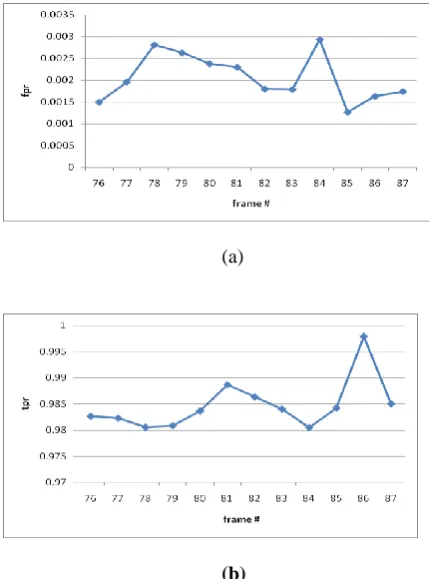
(a)
(b)
Fig.3. performance comparision of each frame for the sequence intelligent room. (a) fpr (b)
tpr.
The above graph is ploted by taking the fpr values of each frame from 76th frame to 87th frame, horizontal axis representes the frame number, vertical axis represents the fpr in fig.3(a)and the fpr values of the sequence varies inbetween the threshold values 0.001 to 0.003.in fig.3(b) vertical axis represents the tpr value
Mcbs Proposed
(a) (b) (c) (d)
Fig.4. segmented results for the dataset atrium
6(a) is the taken video , 6(b) is the result of moving object detection , 6(c) is the same video of 6(a) and foreground segementation below the taken video , 6(d) is the result of prposed technique.The above figure shows the sequence of atrium, in the sequence two humans are walking, the result with the technique MCBS shows that the human in left have missed the hand to detect by some noise,it is rectified by the proposed technique by adding the median filter and earlier the testing is performed for the sequence consisting of only one human, but here the sequence consists of two humans, the method can detect the any moving object not only human, can detect vehicles, ball etc…..
(a)
(b)
Fig.5. values of each frame for sequence atrium.
(a) fpr (b) tpr.
Mcbs Proposed
(a) (b) (c) (d)
Fig.6. segmented results for the dataset visiontraffic
6(a) is the taken video , 6(b) is the result of moving object detection , 6(c) is the same video of 6(a) and foreground segementation below the taken video , 6(d) is the result of proposed technique.The results of above are of the dataset visiontraffic,in this sequence the vehicles are moving on, MCBS can detect the moving object with some noise, where as the proposed technique remove the noise existed in MCBS. So, that we can say the proposed technique performs well than the previous.
(a)
(b)
Fig.7. values of each frame for sequence visiontraffic. (a) fpr (b) tpr.
The above graph is ploted by taking the fpr values of each frame from 76th frame to 87th frame, horizontal axis representes the frame number, vertical axis represents the fpr in fig.3(a)and the fpr values of the sequence varies inbetween the threshold 0.0015 to 0.003.in fig.3(b) vertical axis represents the tpr, and the values of tpr varies inbetween the threshold 0.978 to 0.99.
Table.3. comparision of avg fpr of existing and prop
osed technique
Dataset Avg fpr of MCBS Avg fpr of proposed Intelligentroom 0.0023 0.00542
Atrium 0.00203 0.00478 Visiontraffic 0.00274 0.00462
Above table shows the comparision of avgfpr for MCBS and proposed technique, by observing the values we notice the proposed technique avg performance are higher than the MCBS, it is because of the proposed technique consider the frames that which object is not detected in that particular frame.
Table.4. comparision of avg tpr of MCBS and prop
osed technique
Dataset Avg tpr of MCBS Avg tpr of proposed Intelligentroom 0.90512 0.93721
Atrium 0.89596 0.93114 Visiontraffic 0.89434 0.93271
Above table shows the comparision of avgtpr for MCBS and proposed techniques, by observing the values in the table can say that the proposed technique performs well than the former methods.
5.CONCLUSION
Efficient Background subtraction using improved Multilayered Codebook is proposed. In this we use a single mean value where as the former methods use more mean values, it takes more time for execution. In MCBS the moving objects are detected with some noise. The proposed technique extract the moving objects with accurate shape and minimum errorrate by employing median filter which is shown visually and numerically. Where as the median filter is a good smoothing technique at the same time it reduces the noise in a video signal. As documented in the experimental results, the improved method provides high efficient for background subtraction.
5.REFERENCES
[1]. Deval jansari, Shankar parmar “Novel Object Detection Method Based on the Optical Flow”. In proc. ICETCIP conf. Jan. 2015
[2] Nishu Singla “Motion Detection Based on Frame Differencing Method” in international journal of Information & Computation Technology. vol.4 No.15, pp.1559-1565, 2014. [3]Ssu-Wei Chen, Luke K. Wang, Jen-Hong Lan “Moving Object tracking Based on Background Subtraction Combined TemporalDifference” In proc. ICETCIP conf. Dec. 2011. [4]Reza Oji” An Automatic Algorithmfor Object Recognition and Detection Based On ASIFT Key Points” Signal & Image Processing: An International Journal (SIPIJ) Vol.3, No.5, October 2012
element-reduced error-diffused blocktruncation coding” IEEE transactions on communications,vol.58,No.6,June 2010 [6]Yuanyuan Cui, Xiaoqiang Guo, Wan Liu and Aidong Men, “An advanced codebook background model using confidence and membership function”2014 IEEE international conference on acoustic, speech and signal processing (icassp).
[7]. Mohamad Hoseyn Sigari, Mahmood Fathy,” Real-time Background Modeling/Subtraction using Two-Layer Codebook Model” Proceedings of the International MultiConference of Engineers and Computer Scientists 2008 Vol IIMECS 2008, 19-21 March, 2008, Hong Kong
[8]Jing-Ming Guo, Member, IEEE and Chih-Sheng Hsu “Hierarchical Method for Foreground Detection Using Codebook Model” Proceedings of 2010 IEEE 17th International Conference on Image Processing
[9] Jing-Ming Guo, Senior Member, IEEE, Chih-Hsien Hsia, Member IEEE, Yun-Fu Liu, Student Member, IEEE,Min-Hsiung Shih, Cheng-Hsin Chang, and Jing-Yu Wu” Fast Background Subtraction Based on a Multilayer Codebook Model for Moving Object Detection” IEEE transactions on circuits and systems for video technology, vol. 23, no. 10, october 2013