CORPORATE CAPITAL STRUCTURE PRACTICES
Naresh Vashist*, Puneet Jain
Department of Management, CMJ University, Shillong Meghalaya, India 793003.
ABSTRACT
This research paper is the study of the corporate investment in Information Technology Industry and in the Banking Industry. The study examines the trends and determinants of capital structure in Indian Banking and IT industries from the perspective of empirical capital structure literature. There are several fundamental disparities between financial and non financial firms that contribute to large difference in their capital structure position. However, the theory of Corporate Capital Structure that evolves in recent years provides a useful framework for analyzing bank capital structure. Two independent variables, specifically, Profitability and Growth Opportunities are the chief fragments that generally direct capital structure decisions in this industry. Nevertheless, these capital structure decisions are not straightforward. Four independent variables, specifically, Tangibility of assets, Size of the company, Volatility and Non debt tax shield are the major aspects directing capital structure decisions in the industry. The regression coefficient of size of company is showing significant impact of this variable on decisions related to capital structure of Indian IT industry. However, it has negative relation with capital structure. Present study largely confirms the results of earlier Indian studies vis-à-vis IT Industry but this is not the case with Banking Industry; Banking Industry results confirm the results of research carried out in developed countries.
KEY WORDS: Determinants, fragments tangibility, regression coefficient, volatility.
INTRODUCTION
In the context of asymmetric information and market imperfections firms’ choice of debt-equity ratio (leverage) depends upon multiple factors. The empirical studies on corporate capital structure in industrialized countries are immense, for example studies of Titman and Wessels (1998) and Rajan and Zingales (1995). These studies provided that how institutional factors could explain differences in firm’s capital structure in largest industrialized countries. However, there exists chaos in the industry as well as academics about determinants of capital structure. It has also been discovered in the survey conducted by Graham and Harvey (2001) on financial management practices. The present study is based on Indian Banking and Information Technology Industries.
negligible variation. However, in the words of Pringle (1974), “although often precise in appearance, regulatory guidelines regarding capital are little more than rules of thumb and their application is subject to wide disagreement”. More to the point, Barth et al. (2005), Flannery and Rangan (2006) and Berger et al. (2007) confirm that the level of capital of banks in the US and around the world is much higher than regulation would suggest which implies that there are other factors governing capital and capital structure issues in banks. Flannerey (1994), Ashcraft (2001) and Allen et al (2006) find little evidence that changes in banks’ capital structure are related to changes in regulatory requirements. If capital adequacy norms are not the only factors that are affecting capital and capital structure decisions in the banks, then there is a need to search out the hidden factors. Myers and Rajan (1998) show that a financial firm will have an optimal interior level of capital structure depending upon the liquidity of assets. Barrios and Blanco (2003) argue that Spanish banks’ capital ratios over the period 1985-1991 were primarily driven by the pressure of market forces rather than regulatory constraints. Now, the question is as to what are these factors affecting capital structure choice of banks. Nevertheless, several previous studies, like, Fama (1980), Taggart and Greenbaum (1978) have taken the view that banks are corporations and are thus susceptible to corporate capital structure theory. However, banks are intentionally being excluded from the investigation of capital structure, for instance, study on capital structure by Titman and Wessels (1988), Rajan and Zingales (1995). Furthermore, Marques and Santos (2003) examined theoretically and empirically the problem of the banking firm’s capital structure (voluntary) decisions during 1989-1998. Findings support the notion that Portuguese banks’ debt/equity choice does matter. Survey results are consistent with a number of theoretical propositions typically associated with the determinants of debt-equity choice of non-financial firms. Gropp and Heider (2008) are unable to detect a first order effect of capital regulation on the capital structure of banks and confirm the robustness of current corporate finance findings in a holdout sample of banks.
Different corporate finance theories offer a long list of factors that derive capital structure decisions in the corporate world (see Harris and Raviv, 1991). The literature (for instance, Pandey and Chotigeat (2006), Baarclay and Smith (2005), Drobetz and Fix (2003), Bevan and Danbolt (2000), Rajan and Zingales (1995) has converged on following set of measures of capital structure and its determinants:
MEASURE AND DETERMINANTS OF CAPITAL STRUCTURE
Book Value of Equity: it includes Equity Share Capital, Preference Share Capital, Securities Premium, General Reserve, Capital Reserve, Other Reserves and Credit balance of Profit and Loss Account. However, accumulated losses and fictitious assets like preliminary expenses, underwriting commission, share issue expenses etc. should be deducted.
Capital Structure defined for IT Industry: For the purpose of analysis, long-term debt to shareholders fund can be taken as measure of capital structure. It indicates the proportion of funds, which are acquired by long-term borrowings in comparison to shareholders funds.
Long-term debt: It includes all long-term liabilities that mature after one year. These include Debentures, Mortgage Loan, Bank Loan, Loan from financial institutions and Public Deposits.
Shareholder’s Funds or Net Worth: It includes Equity Share Capital, Preference share Capital, Securities Premium, General Reserve, Capital Reserve, Other Reserves and Credit balance of Profit and Loss Account. However, accumulated losses and fictitious assets like preliminary expenses, underwriting commission, share issue expenses etc. should be deducted.
DETERMINANTS
Collateral (COL): Previous empirical studies by Titman and Wessels (1988) and Rajan and Zingales (1995) argue that the ratio of fixed to total assets (tangibility) should be an important factor for capital structure. Firms with assets that can be used as collateral may be expected to issue more long-term debt to take benefit of the opportunity. This variable can be measured as the ratio of Securities, cash and bank balance, fixed assets to total assets. Instead of collateral, the term used for IT industry is Tangibility of Assets (TA). By issuing debt secured by assets, the firms can avoid higher interest costs. This variable can be measured as the ratio of fixed assets to total assets.
Size (SZ): Size denotes the firm’s capacity for financing and investment. Size is expected to have a positive impact on leverage as per the arguments given by capital structure theories. Larger the business, better informed is the investor about the firm and if the public is more aware of what is going on in large firms, the firms will find it easier to get access to loans. Large firms are likely to be more diversified and less prone to bankruptcy (Rajan and Zingales, 1995). They are also expected to incur lower direct costs in issuing debt or equity. Measure of variable for size is natural logarithm of total assets.
Titman and Wessels (1988) find a negative relationship while Rajan and Zingales (1995) report a positive relationship between leverage and growth. The measure for growth opportunities is growth rate of total assets.
Profitability (PR): Neither financial theory nor empirical researches have been able to provide satisfactory argument as how profitability affects the capital structure of the firm. Profitability has been measured as return on assets (PBDIT/Total Assets). Myers (1984) and Myers and Majluf (1984) argue that there exists a hierarchy in the financing funds of companies. Due to informational asymmetries, firms prefer internal to external capital sources. This suggests that highly profitable companies will tend to finance investments with retained earnings rather than using debt. Whereas, in the agency models of Jensen and Meckling (1976), Easterbrook (1984), and Jensen (1986), higher leverage helps to control agency problems by forcing managers to pay out more of the firm’s excess cash. The strong commitment to pay out a larger fraction of their pre-interest earnings to debt payments suggests a appositive relationship between book leverage and profitability.
This notion is also consistent with the signaling hypothesis by Ross (1977), where higher levels of debt can be used by managers to signal an optimistic future for the firm.
Volatility (VO): Barclay and Smith (1995) argued that higher the earnings variation higher the bankruptcy risk, especially to creditors. DeAngelo and Masulis (1980) argue that for firms that have variability in their earnings, investors will have little ability to accurately forecast future earnings based on publicly available information. The market will see the firm as a “lemon” and demand a premium to provide debt. This drives up the cost of debt. In the study, volatility has been measured in terms of coefficient of variation of return on capital employed.
Non-debt tax shield (NDTS): Firms will exploit the tax deductibility of interest to reduce their tax bill. Therefore, firms with other tax shields, such as depreciation deductions, will have less need to exploit the debt tax shield. De angelo and Masulis (1980) presented a model of optimal capital structure that incorporated the impact of corporate taxes, personal taxes and non debt tax shields such as depreciation, investment tax credits etc. They argued that the existence of large non-debt tax shield relative to their expected cash flows would induce the firms to use less borrowed capital. Indicator for the non-debt tax shield is [operating income minus interest payments minus (tax payment/corporate tax rate)] divided by total assets.
Cost of equity (CE): If the cost of equity increases, the firm is likely to depend more on debt than equity capital. Thus, the leverage ratio can be expected to be an increasing function of cost of equity. This variable can be measured as ratio of dividend payment to share capital of the company.
Tax rate (TR): Modigliani and Miller (1958) suggest that firms would prefer debt to other financing resources due to tax deductibility of interest payments. Firms are more prone to debt because of tax concessions that they get on debt instruments.
OBJECTIVES AND METHODOLOGY
Objectives: The objective of this chapter is to assess the trend of capital structure in Indian banking industry for the period 1999-2008; and to establish and test the functional relationship between capital structure of Indian Banking and IT Industries and its various determinants. Hypothesis for the purpose of analysis is that there is significant impact of various variables on capital structure of Indian Banking and IT companies;
The Methodology: The Fixed Effects Panel Data Model has been applied to know the impact of various variables on capital structure. The analysis is based on two assumptions; the slope coefficients are constant but the intercept varies over individuals and the second is the slope coefficients are constant but the intercept varies over individuals and time. Therefore, the model can be specified as below:
Fixed Effects: Firm
Lit = a1 + ∑ an Cni + b1COLit + b2SZit + b3GOit + b4PRit + b5VOit + b6NDTSit + b7CBit + b8CEit
+ b9TRit + u ………(i)
Fixed Effects: Firm and Time
Lit = a1 + ∑ an Cni + ∑ knTnt + b1COLit + b2SZit + b3GOit + b4PRit + b5VOit + b6NDTSit + b7CBit
+ b8CEit + b9TRit + u ……….(ii)
Where:
Lit = Capital structure position of bank in year t; Cni = Sample Companies;
Tnt = Time (1999-2008); COLit = Collateral; SZit = Size of firm; GOit + Growth Opportunities; PRit
= Profitability; VOit = Volatilityt; NDTSit = Non Debt Tax Shield; CBit = Cost of Borrowing; CEit
For analyzing capital structure of Indian IT Industry, slight variation has been made in the model depending upon the peculiar nature of the industry. The model is as follows:
Fixed Effects: Firm
Lit = a1 + ∑ an Cni+ b1TAit + b2SZit + b3GOit + b4PRit + b5VOit + b6NDTSit + b7CEit + b8CBit +
b9TRit + u ……….(i)
Fixed Effects: Firm and Time
Lit = a1 + ∑ an Cni + ∑ knTnt + b1TAit + b2SZit + b3GOit + b4PRit + b5VOit + b6NDTSit + b7CEit
+ b8CBit + b9TRit + u ……….(ii)
Where:
Lit = Capital structure position in year t; Cni = Sample Companies; Tnt= Time (1999-2008); TAit
= Tangibility of assets in year t; SZit = Size of firm in year t-1; GOit = Growth Opportunities in
year t; PRit = Profitability in year t; VOit = Volatility in year t; NDTSit = Non Debt Tax Shield in
year t; CBit = Cost of Borrowing in year t; CEit = Cost of Equity in year t; TRit = Tax Rate in year
t; and u = Random disturbance term.
RESULTS AND DISCUSSIONS: BANKING INDUSTRY
Table 4.1 indicates that average leverage in percentage has increased to 94.09 in 2007-08 from 90.28 in 1998-99. Throughout the period under study, average leverage of Indian banking has been increasing. If we look at the latest trend, i.e. the numbers for 2007-08, Bank of Rajasthan is having highest leverage ratio, it is 96.47 percent. Other banks, which are playing with high debt in their capital structure, are Bank of India, Dena Bank, Dhanlakshmi Bank, State Bank of Travancore, South Indian Bank, UTI Bank and Vijaya Bank. All these banks are upholding more than 95 percent debt in relation to total assets. Whereas, Karur Vysya Bank is continuing with lowest leverage, its ratio is 90.40 percent. The huge disparity between highest and lowest leverage ratio is worth taking note of, as the industry is highly regulated and all the banks work under same set of capital adequacy norms.
Table 4.1 Leverage Ratio of Indian Banking Industry (in percent)
Company Name
1998 -99
1999 -00
2000 -01
2001 -02
2002 -03
2003 -04
2004 -05
2005 -06
2006 -07
2007 -08
Allahabad Bank
95.05 95.13 95.49 95.84 96.04 95.83 95.53 94.84 93.42 93.38 95.06
Andhra Bank
92.60 95.75 96.31 97.76 95.78 95.48 94.62 94.39 92.88 93.36 94.90
Bank Of Baroda
94.19 94.45 94.48 94.70 94.60 94.26 93.97 94.06 93.08 93.95 94.18
Bank of India
95.00 95.54 95.52 95.52 95.94 95.38 95.28 95.30 95.56 95.84 95.49
Bank Of Maharashtr a
91.63 96.08 96.43 96.97 96.75 96.07 95.55 95.31 94.97 95.55 95.53
Bank Of Rajasthan
96.95 99.15 97.26 95.88 95.15 95.36 96.11 96.17 96.32 96.30 96.47
Canara Bank
94.65 94.99 95.23 95.77 95.19 94.95 94.71 94.47 94.63 93.76 94.84
CBP Ltd. 92.15 95.18 95.98 96.31 98.63 91.07 98.20 89.56 91.81 92.57 94.15 City Union
Bank Ltd.
94.53 93.57 93.27 93.53 93.62 93.72 93.64 93.11 93.07 93.18 93.53
Corporation Bank
92.42 93.50 93.17 93.16 91.33 90.98 90.50 90.99 91.67 92.85 92.06
Dena Bank 95.54 95.31 95.10 96.92 96.91 96.74 96.18 95.41 94.96 95.24 95.83 Dhani Bank
Ltd.
Federal Bank Ltd.
94.8 96.00 95.24 95.29 95.58 95.67 95.71 95.71 93.96 94.03 95.21
H F D C Bank Ltd.
89.92 92.21 93.48 94.09 91.81 92.61 93.64 91.22 92.80 92.95 92.47
I C I C I Bank Ltd.
91.86 95.58 90.48 93.47 94.42 93.57 93.65 92.55 91.05 92.95 92.96
I N G
Vysya Bank Ltd.
92.66 94.24 93.42 93.60 93.63 93.86 94.36 95.39 93.92 94.27 93.94
Indian Bank
83.0 84.10 85.48 87.31 84.16 84.86 84.33 85.17 94.77 93.16 86.64
Indian Overseas Bank
96.87 97.06 97.29 96.92 96.80 96.45 95.60 94.93 94.65 95.15 96.17
Indusind Bank Ltd.
89.79 91.41 93.33 93.71 94.49 94.93 95.16 94.69 95.10 94.96 93.76
IDBI 86.02 87.03 87.25 87.24 89.95 88.95 0.00 92.80 92.81 92.00 80.41 J&K Bank
Ltd.
95.07 94.30 95.00 94.50 93.62 92.60 92.48 93.18 93.20 92.98 93.70
Karnataka Bank Ltd.
Karur Vysya Bank Ltd
93.60 93.76 93.04 92.25 91.58 90.95 89.98 90.35 90.32 90.40 91.63
Kotak Mah Bank Ltd.
72.86 69.27 61.92 59.86 65.15 74.96 89.59 88.39 91.51 91.65 76.52
Lakshmi Vil Bank Ltd.
94.23 94.64 94.73 94.53 94.23 93.98 94.07 94.33 94.09 93.20 94.20
OBC 92.67 93.44 94.18 94.28 94.98 93.80 93.47 93.85 91.23 92.42 93.43 Punjab
National Bank
95.84 95.83 96.19 95.80 95.59 95.33 95.10 93.54 93.55 93.57 95.04
South Indian Bank
96.32 95.43 95.80 95.81 95.81 95.79 95.73 95.20 94.08 94.69 95.47
SBBJ 95.96 95.90 95.80 95.61 95.15 94.98 94.29 94.46 94.89 95.20 95.23 State Bank
of India
94.65 95.32 95.35 95.74 95.63 95.43 95.04 94.77 94.41 94.47 95.08
SBT 96.15 96.49 96.51 96.45 96.31 96.21 96.15 96.09 95.82 95.79 96.20 Syndicate
Bank
96.93 96.81 96.14 95.69 95.56 95.41 95.97 95.78 95.36 95.94 95.96
Union Bank Of India
93.87 94.61 95.01 95.26 95.25 94.97 94.71 95.01 94.89 94.95 94.85
UTI Bank Ltd.
94.97 94.74 96.41 97.21 95.72 95.31 95.29 93.59 94.20 95.35 95.28
Vijaya Bank
95.64 93.49 96.51 95.80 95.89 95.75 94.45 94.58 94.71 95.52 95.23
Yes Bank Ltd.
0.00 0.00 0.00 0.00 0.00 0.00 0.00 83.28 86.25 92.91 87.48
Average 90.28 91.03 91.06 91.27 91.29 91.19 89.41 93.53 93.71 94.04 93.26 Source: Prowess Database of CMIE
Fixed Effects: Firm
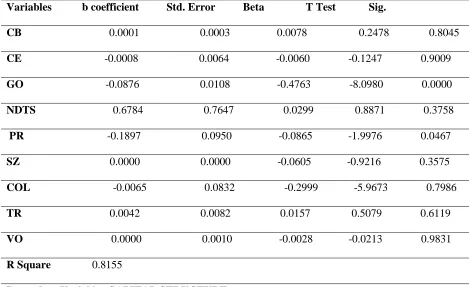
Two independent variables, specifically, profitability and growth opportunities are the ones which are directing capital structure decisions in the industry. The model fits the data very well, the R square is 0.8155. The table 4.2 revels that the regression coefficient of profitability has negative sign and it is significantly affecting capital structure decisions of the Indian banks. This suggests that highly profitable companies will tend to finance investments with retained earnings rather than using debt and confirms the view of Myers (1984) and Myers and Majluf (1984) and contrasts agency theories. The regression coefficient of growth opportunities has negative impact on leverage. It attests Myers’ (1977) view on under investment problem and earlier empirical studies like Titman and Wessels (1988) have also verified this.
negative influence on leverage decisions, but coefficient is insignificant. Non debt tax shield and volatility, though insignificant, are exhibiting opposite signs in comparison to the evidence available in literature.
All the factors that are not confirming earlier theoretical and empirical results raise the issue related to Indian banks, reason for these needs to be searched.
Table 4.2 Panel Data Analysis: Fixed Effects Firm
Variables b coefficient Std. Error Beta T Test Sig.
CB 0.0001 0.0003 0.0078 0.2478 0.8045 CE -0.0008 0.0064 -0.0060 -0.1247 0.9009 GO -0.0876 0.0108 -0.4763 -8.0980 0.0000 NDTS 0.6784 0.7647 0.0299 0.8871 0.3758 PR -0.1897 0.0950 -0.0865 -1.9976 0.0467 SZ 0.0000 0.0000 -0.0605 -0.9216 0.3575 COL -0.0065 0.0832 -0.2999 -5.9673 0.7986 TR 0.0042 0.0082 0.0157 0.5079 0.6119 VO 0.0000 0.0010 -0.0028 -0.0213 0.9831 R Square 0.8155
Dependent Variable: CAPITAL STRUCTURE
Results related to factors affecting capital structure are observed as similar (through table 4.3) to
that of firms effect. Profitability and Growth Opportunities are the only factors affecting capital
structure decisions in the industry. R square increased to 0.9130 by introduction of time effect.
All other factors are insignificant.
Table 4.3 Panel Data Analysis: Fixed Effects Firm and Time
Variables b coefficient Std. Error Beta T Test Sig.
CB -0.0001 0.0003 -0.0048 -0.1542 0.8799
CE -0.0018 0.0063 -0.0133 -0.2791 0.7804
GO -0.0899 0.0105 -0.4887 -8.5535 0.0000 NDTS 1.8761 0.8282 0.0826 2.2652 0.0743 PR -0.3847 0.1511 0.1753 -2.5458 0.0114
R 0.9130
Dependent Variable: CAPITAL STRUCTURE
Source: The raw data has been taken from Prowess Database of CMIE
RESULTS AND DISCUSSIONS: IT INDUSTRY
Four independent variables, specifically, Tangibility of assets, Size of the company, Volatility and Non-debt tax shield are the major aspects directing capital structure decisions in the industry. F Statistics are showing significant results for both firm effect and firm & time effect; it confirms that the model has been rightly specified. Results elucidate that firm as well as time effect are not playing considerable role in capital structure decisions of Indian IT industry.
Capital structure of Indian IT industry has undergone tremendous change during 1999-2008. Average debt equity ratio has decreased to 28 percent in 2007-08 from 50 percent in 1998-99. It has decreased considerably during the period under concern; it slipped down to 9 percent in 2002-03, afterwards, leverage ratio has been increasing gradually. Average debt equity ratio for the whole period is 20 percent. Business risk of the industry is very high due to its peculiar features; therefore, most of the companies prefer to keep their financial risk low. The list of IT companies that have maintained a higher debt equity ratio than the industry average includes D S Q Software Ltd, G T L Ltd, I gate Global Solutions Ltd, K P I T Cummins Infosystems Ltd, Maars Software International Ltd, Onward Technologies Ltd, Ramco Systems Ltd, Rolta India Ltd, Satyam Computer Services Ltd and Zensar Technologies Ltd. However, it is worth mentioning that these companies have reduced their debt equity ratio considerably during last few years. It is evident from the list that none of the top companies of the industry are maintaining higher debt equity ratio. Overall average debt-equity ratio of Indian IT industry is fairly lower than the total industries average.
Company Name 1998-99 1999-00 2000-01 2001-02 2002-03 2003-04 2004-05 2005-06 2006-07 2007-08 Average
Aftek Ltd 24.4 2 0
0
0 0 0 12.5 7.2 0 5.5
Aztecsoft Ltd. 0 16 3
0
0 0 0 0 0 0 2.2
Blue Star Infotech
0 0 0
0
0 0 0 0 0 0 0
C M C Ltd. 64.5 66.4 46.5 24
40.3 40.2 47.3 32.4 8 10.2 38.2
D S Q
Software Ltd.
0 7
0
22 44 0 0 0 0 60.5
Finan Tech (India)
0 0 0
0
8 0 0 0 0 28.2
G T L Ltd. 31.4 4.5 4.2 6 11.3 30.6 0 79.3 76.6 39.2 Geom Sr S
Co. Ltd.
0 10 0
0
4 0 1 0 11 7 3
H C L Tech Ltd.
0 0 0
0
0 0 4 3 1 1 1
Hexawaare Tech Ltd.
54.3 5 0
16
8 1 1 0 0 0 9
Hinduja T M T Ltd.
16.6 0 5.2 0
I-Flex
Solutions Ltd.
0 0 0
0
0 0 0 0 0 0 0
Igate Global Solu
11
0
0 16 13 19.3 16.3 1 134.3
Info Tech (India) Ltd.
38.2 1 4.2 4.6 38.7 93.4 0 0 0 0 30.3
Infosys Tech Ltd.
0 0 0
0
0 0 0 0 0 0 0
Infotech Enterpris
18.3 48.5 27.6 12.5 0 0 0 0 6 6 12
K P I T Cumm Info
45.3 18.5 26.6 32.5 20.7 56.8 33.6 62.5 63.7 32.4 39.4
Kale Consultants
17 0
16.3 16.5 18.6 28.7 31.4 19.3 14.3 0 18.3
Maars Soft Inter Ltd.
45.t 8.6
35.4 58.4 48.4 39.4 37.4 26.4 0 48.3
Mastek Ltd. 18 20
6
0
1.3 1.6 1.4 0 1.4 1 5.3
Mphasis Ltd. 1.3 1.3
0
0
0 0 0 0 0 0 0
N I I T Ltd. 30 0
0
9
Onward Tech Ltd.
46.4 57.5
67.6 59.6 27.3 29.2 40.7 39.8 65.4
Orient Info Tech Ltd. 13 0 0 0
0 0 0 0 10
0 3
Patni Computer S 0 0 0 0
0 0 0 0 0
0 0
Pentasoft Tech Ltd. 7.5 1.4 6.3 8.6
10.3 6.2 51.6 51.2 27.4 29.2 20.2
Polaris Soft Lab Ltd. 10 0 0 0
0 0 0 0 0 0 1
Quintergra Solu Ltd. 0 2 0 8
9 3 6 8 44 0 10
Ramco Systems
0 4.2
14.4 19.5 58.5 48.2 34.5
Rolta India Ltd
50.4 48.6 44.7 46.3 43.5 50.3 44.2 33.5 45.4 53.2 41.2
Satyam Comp S Ltd.
21.3 12.4 1.3 0 0 0 0 0 11.2
Sonata Infor Tech Ltd. 25 0 0 0
0 0 0 0 0 0 3
S S I Ltd. 52.4 7.5 6.3 9
Tata consul S Ltd. 0 0 0 0
0 0 4 1 1 0 1
Tata Elxsi Ltd.
30 42
50 5
5 0 0 0 0 47 18
Visesh Infotecnics L 0 1 0 0
1 5 6 19 22 0 7
Visualsoft Tech Ltd. 0 0 0 0
0 0 0 0 0 0 0
Wipro Ltd. 64 9
2 1
2 3 1 1 3 33 12
Zenith Infotech Ltd 0 2 0 0
0 0 0 11 212 341 57
Zensar Tech Ltd.
12
4 1
1 0 12 12 8 0 20
Average 50.3 25.5
10.3 9.3
12.2 15.7 13.6 14.4 27.3 28.4 20.7
Source: Prowess Database of CMIE
Fixed Effects: Firm
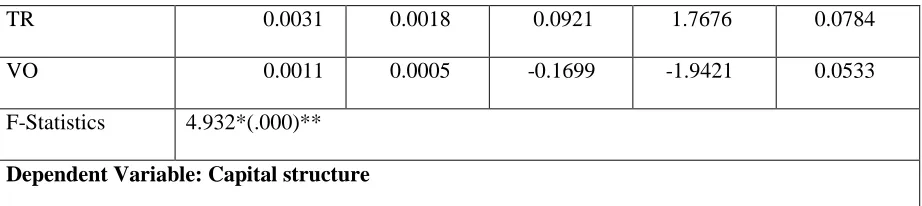
having positive impact on capital structure. The result is in favor of agency models and against pecking order theory. But regression coefficient is insignificant. The regression coefficient of size of company is showing significant impact of this variable on decisions related to capital structure of Indian IT industry. It has negative relation with capital structure. Yet again, the negative sign confirms the behavior of top IT companies. It demonstrates that higher the size of the firm lower will be the debt content in the capital structure of the firm.
Tangibility of assets is having positive impact on leverage. The reason behind it is quite logical; firms with assets that can be used as collateral may be expected to issue more long-term debt to take benefit of the opportunity. The regression coefficient of this factor is significantly affecting leverage decisions in Indian IT industry.
The regression coefficient of Tax rate is positively affecting leverage decisions. Also, review of literature suggests that firms are more prone to debt because of tax concessions they get on debt instruments. But the analysis completed in this study is giving opposite results.
Literature related to capital structure argue that for firms which have variability in their earnings, investors will have little ability to accurately forecast future earnings base on publicly available information. But in this study volatility of assets is demonstrating negative impact on leverage and the regression coefficient is also significant.
Table 4.5 Panel Data Analysis: Fixed Effects Firm
TR 0.0031 0.0018 0.0921 1.7676 0.0784
VO 0.0011 0.0005 -0.1699 -1.9421 0.0533
F-Statistics 4.932*(.000)** Dependent Variable: Capital structure
Source: The raw data has been taken from Prowess Database of CMIE
Fixed Effects: Firm and Time
Results related to factors affecting capital structure are observed as similar to that of firms effect. Only one variable, Non Debt Tax Shield is having significant impact on capital structure decisions of Indian IT industry. Cost of equity has expected sign but it is also not a significant factor affecting capital structure of Indian IT industry. Profitability is having constructing positive but insignificant impact on capital structure. The result is in favor of agency models and against pecking order theory. Tangibility of assets is having positive impact on leverage. The regression coefficient of tax rate is negatively affecting leverage decisions.
The regression coefficient of cost of borrowing is having negative sign but it is not significant during the period of study. The regression coefficie4nt of size of company is shoeing insignificant impact of this variable on decisions related to capital structure of Indian IT industry. It has negative relation with capital structure. It illustrates that higher the size of the firm lower will be the debt content in the capital structure of the firm. Volatility of assets is demonstrating negative impact on leverage but the regression coefficient is insignificant.
Table 4.6 Panel Data Analysis: Fixed Effects Firm and Time
NDTS -2.6905 0.7980 -0.4556 -3.3716 0.0009 PR 0.3091 0.7856 0.0574 0.3934 0.6944 SZ -0.0773 0.0552 -0.1860 -1.3994 0.1630 TA 2.2009 0.3732 0.4448 5.8974 0.0000 TR 0.0032 0.0018 0.0940 1.7360 0.0839 VO -0.0011 0.0006 -0.1725 -1.9295 0.0549 F Statistics 4.090*(.000)**
Dependent Variable: Capital structure
Source: The raw data has been taken from Prowess Database of CMIE
CONCLUSION
The study has examined the trends and determinants of capital structure in Indian Banking and IT industries from the perspective of empirical capital structure literature. There are several fundamental disparities between financial and non-financial firms that contribute to large difference in their capital structure position. However, the theory of Corporate Capital Structure that has evolved in recent years provides a useful framework for analyzing bank capital structure (Orgler and Taggert 1981). It has been observed that leverage ratios of Indian banks have increased considerably during the period under study. Panel Data Analysis confirms that model used for non-financial firms fits Banking Industry as well. R square is very much significant proving the same. Two independent variables, specifically, Profitability and Growth Opportunities are the chief fragments that generally direct capital structure decisions in this industry. Nevertheless, these capital structure decisions are not straightforward. They are complicated and the researchers need to add more light to it keeping in view the basic characteristics of the Banking Industry.
is in favor of agency models and against pecking order theory. The regression coefficient of size of company is showing significant impact of this variable on decisions related to capital structure of Indian IT industry. However, it has negative relation with capital structure. This is in opposition to what has been established by previous studies e.g. Johnson (1997) and Rajan and Zingales (1995).
Earlier empirical researches on capital structure determinants have resulted into diverse results. For instance, Bhole and Mahakud (2003) found that leverage ratios generally have increased significantly during 1966-2000. Also, unlike in countries like USA, UK, Australia, the pecking order of funds in India broadly has been borrowings, trade dues, external equity, and reserves and surplus. The results of the study by Sahoo and Omkarnath (2005) are fairly different from the empirical findings done in the developed countries by, for instance, Titman and Wessels (1988) and Barclay and Smith (1995) in many aspects. In their study, profitability and asset structure were found to be most significant factors deciding the capital structure, instead of firm size and growth opportunity. Present study largely confirms the results of earlier Indian studies vis-à-vis IT Industry but this is not the case with Banking Industry; Banking Industry results confirm the results of research carried out in developed countries.
As a result, much remains to be done to bridge the research gap between developed and developing countries. More research on capital structure, especially in India, need to swell the broader understanding of capital structure’s determinants.
REFERENCES
Allen, F., E Carletti and R. Marquez (2006), “Credit market competition and capital regulation”, Working Paper, University of Pennsylvania.
Ashcraft, A (2001), “Do Tougher Bank Capital Requirements Matter? New Evidence from the Eighties”, Working paper, Federal Reserve Bank of New York.
Barclay, B J and C W Smith JR (1995), “The Maturity Structure of Corporate Debt”, Journal of Finance, June, pp. 609-631.
Barclay, M., and C. Smith (2005), “The Capital Structure Puzzle: The Evidence Revisited”, Journal of Applied Corporate Finance, 17, pp. 8-17.
Barrios, V., and J. Blanco (2003), “The Effectiveness of Bank Capital Adequacy Regulation: A Theoretical and Empirical Approach”, Journal of Banking and Finance, 27, pp 1935-1958.
Berger, A., R. De Young and M. Flannery (2007), “Why do large banking organizations hold so much capital?”, Working Paper, Board of Governors, FDIC and University of Florida.
Bevan, A. and Danbolt, J. (2000), “Dynamics in the determinants of capital structure in the UK”, Working Paper, University of Glasgow.
Bhole, L.M. and Mahakud, Jitendra, (2004), “Trends and Determinants of Corporate capital Structure in India: A Panel Data Analysis”, Finance India, Vol. XVIII, No. 1, March, pp. 37-55.
DeAngelo, A., and R. Masulis (1980), “Optimal Capital Structure under Corporate and Personal Taxation”, Journal of Financial Economics, 8, pp. 3-29.
Drobetz, Wolfgang and Fix, Roger (2003), “What are the Determinants of the Capital Structure: Some Evidence for Switzerland”, Working paper No. 4/03, WWZ/Department of Finance.
Easterbrook, Frank H. (1984), “Two Agency-cost Explanations of Dividends”, American Economic Review, 74, pp 650-659,
Fama, Eugene F. (1980), “Banking in the Theory of Finance”, The Journal of Monetary Economics, 6: 39 – 57.
Flannery, M. (1994), “Debt ;maturity and the deadweight cost of leverage: Optimally financing banking firms”, American Economic Review, 84: 320-331.
Flannery, M. and K. Rangan 2006. Partial adjustment toward target capital structures. Journal of Financial Economics, 79: 469-506.
Grah;am, J., and C. Harvey, (2001), “The Theory and Practice of Corporate Finance: Evidence from the Field”, Journal of Financial Economics 60, 187-243.
Gropp, Reint and Heider, Florian (200d), “The determinants of capital structure: Some evidence from banks. Discussion Paper No. 08-015, Zew Research,
ftp://ftp.zew.de/pub/zew-docs/dp/dp08015.pdf, Accessed on March 20, 2008.
Harris, M., and A. Raviv (1991), “The Theory of the Capital Structure”, Journal of Finacne, 46, pp. 297-355.
Jensen, M., and W. Meckling (1976), “Theory of the Firm: Managerial Behavior, Agency Costs and Ownership Structure”, Journal of Financial Economics, 3, pp, 305-360.
Marques, Manuel O. and Santos, Mario C. (2003), “Capital Structure Policy and determinants: Evidence from the Portuguese Banking Industry”, http://www.fep.up.pt/investigacao/cempre/actividades/sem_fin/sem_fin_01/PAPERS_PDF/paper _sem_fin_14nov03.pdf Accessed on June 24, 2008.
Myers, S. (1977), “The Determinants of Corporate Borrowing. Journal of finance, 32, pp. 147-175.
Myers, S. (1984), “The Capital Structure Puzzle”, Journal of Finance, 39, pp. 575-592.
Myers, S. and R. Rajan (1998), “The paradox of liquidity”, Quarterly Journal of Economics, 113, pp. 733-771.
Myers, S., and N. Majluf (1984), “Corporate Financing and Investment Decisions When Firms Have Information Investors Do Not Have”, Journal of Financial Economics, 13, pp 187-222.
Pandey, I.M. and Chotigeat, T. (2006), “The Capital Structure of Asian Firms”, Global Business and Finance Review, Spring, pp 63-77.
Pringle, John H (1974), “The Capital Decisions in Commercial Banks” Journal of Finance, 29, pp 779-95.
Rajan, R., and L. Zingales, 1995, “What Do We Know about Capital Structure? Some Evidence from International Data”, Journal of Finance 50, pp 1421-1460.
Ross, S., (1977), “The Determination of Financial Structure: The Incentive Signalling Approach”, Bell Journal of Economics 8, pp 23-40.
Sahoo, Sudhansu Mohan and Omkarnath, G, (2005), “Capital Structure of Indian Private Corporate Sector: An Empircal Analysis”, The ICFAI Journal of Applied Finance, November, pp. 41-56.
Taggart, Robbert A, Jr and Greenbaum, Stuart (1978), “Bank Capital and Public Regulation”. Journal of Money, Credit and Banking, 10, pp. 158-69.