STUDY ON RELATIONSHIP BETWEEN HORMONES
AND AGGRESSION IN DIFFERENT ANIMALS AND
HUMAN
Suresh Bhardwaj1Dr. D.B. Singh2 1
Research Scholar, CMJ University, Shillong, Meghalaya
2
Deptt. Of Management, Lord Krishana College Of Engineering, Ghaziabad (U.P.)
ABSTRACT
To compare brain activity in 41 convicted violent offenders to activity in 41 age matched control subjects. They found that the people convicted of murder had reduced activity in the prefrontal cortex and increased activity in sub-cortical regions such as the thalamus. This finding fits nicely with previous research showing that the damage to the prefrontal cortex impairs decision making and increasing impulsive behavior. Indeed, Raine's work is perhaps the best evidence yet that impaired brain functioning may underlie some types of violent aggression. However, it is important to remember that his subjects lie at the extreme end of a spectrum and may not be typical of most aggressors.
Key words: prefrontal cortex, evidence, aggression
INTRODUCTION
Although it seems that everybody understands what aggression is, yet there is considerable
disagreement about how to define it. The published literature on human aggression show
variations in definitions proposed. From the review of literature related to the conceptualization
of human aggression, it is clear that three important distinctions should be made for proper
understanding of the concept. The first is whether it should be defined simply interms of hurtful
behaviour, or a persons hurtful intentions should be taken into consideration. Behaviourists have
taken aggression as any behaviour that hurts others. The advantage of this definition is that the
intention of person who does this act. Intentions have a central role in the judgments about
aggression. In this context aggression can be taken as any action that is intended to hurt others.
REVIEW OF LITERATURE
Testosterone is another attractive candidate for mediating aggression because males in of all
ages, races and cultures are more physically aggressive than their female counterparts. In
animals, testosterone is linked to social aggression. Reducing testosterone in the alpha male by
castrating him eliminates his dominant social status, and restoring testosterone through injection
causes him to regain his social status. However, administering testosterone to males with less
social status does not usually allow them to take over the alpha male position, indicating that
there is not a direct relationship between testosterone and position in the dominance hierarchy.
There is some evidence in humans that high testosterone males are more likely to be socially
aggressive, but no evidence that they are necessarily more violent. Often they are successful in
professions that thrive on competition, such as successful leading of a company, running for
president, or pursuing a sports career. Also, a few psychologists have suggested that females are
not necessarily less aggressive than males; rather, they display a different kind of aggression.
Females are more likely to show non-violent types of aggression such as ostracizing their peers
or spreading false rumors with the intent to cause pain. Thus, while there does seem to be a
connection between testosterone and physical aggression, a person's testosterone level will not
necessarily be a good predictor of aggressive behavior.
MATERIAL AND METHOD
Measures of brain functioning such as the EEG have long suggested that violent criminals have
impaired neurological processes, but the recent advancement of neuroimaging techniques has
allowed researchers to examine violent offenders' brains in more detail. Adrian Raine and
colleagues have conducted the largest and most thorough study to date, in which they used
positron emission tomography (commonly called a PET scan) to compare brain activity in 41
convicted violent offenders to activity in 41 age matched control subjects. They found that the
sub-cortical regions such as the thalamus. This finding fits nicely with previous research showing
that the damage to the prefrontal cortex impairs decision making and increasing impulsive
behavior. Indeed, Raine's work is perhaps the best evidence yet that impaired brain functioning
may underlie some types of violent aggression. However, it is important to remember that his
subjects lie at the extreme end of a spectrum and may not be typical of most aggressors. Also,
there are plenty of examples of people with prefrontal cortex damage who do not commit violent
acts, so PET scans cannot be used to ferret out potential murders.
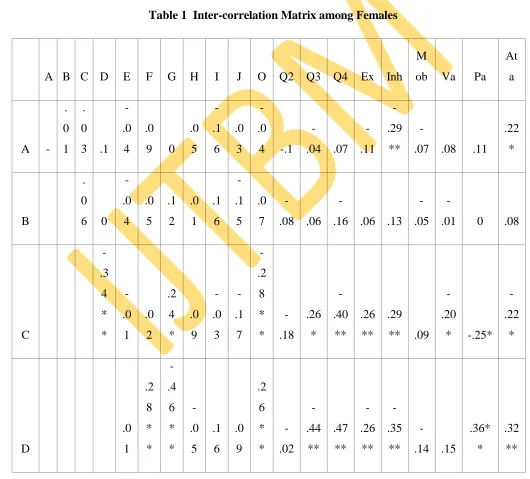
Table 1 Inter-correlation Matrix among Females
A B C D E F G H I J O Q2 Q3 Q4 Ex Inh M
ob Va Pa At
a
A - .
0
1 .
0
3 .1
-.0
4 .0
9 0 .0 5 -.1 6 .0 3 -.0
4 -.1
-.04 .07 -.11 -.29 **
-.07 .08 .11 .22
*
B .
0
6 0 -.0 4 .0 5 .1 2 .0 1 .1 6 -.1 5 .0 7
-.08 .06
-.16 .06 .13
-.05
-.01 0 .08
C -.3 4 * * -.0 1 .0 2 .2 4 * .0 9 -.0 3 -.1 7 -.2 8 * * -.18 .26 * -.40 ** .26 ** .29
** .09
-.20
* -.25* -.22 * D .0 1 .2 8 * * -.4 6 * * -.0 5 .1 6 .0 9 .2 6 * * -.02 -.44 ** .47 ** -.26 ** -.35 **
-.14 .15 .36*
* .32
E .0 1 -.2 5 * .0 7 -.2 5 * .0 5 .0
3 .03 .15 .10 .11
-.05 .09 .11 .02 0 F -.1 3 * * .0 3 .1 3 -.0 3 .0 2 -.13 -.41
** .09
-.03
-.25
* .02 0 .06 .06
G .0 8 .0 5 -.0 9 -.1
7 .11 .35
**
-.25
* .13 .32
** .13 -.05 -.26* * -.21 * H -.1 9 .0 5 -.2 7 * * -.09 .25 * -.06 .33
** .02
-.01
-.07 .03 .02
I -.0 1 -.0 4 -.07
-.11 .03
-.11 .12 -05
-.02 -.04 -.02 J .0 8 .45
** .05 .09 -.06 -.07 -.09
-.12 -.1 .11
O .14 -.26 ** .28 ** -.43 ** -.15
-.03 .05 .15 .16
Q2 .12 .12
.11 * .04
Q3
-.36
** .42
** .40
** .16
-.03 -.21*
-.20
*
Q4
-.40
**
-.39
**
-.15 .09 .34*
* .22
*
Ex
.37
** .21
*
-.09 -.21*
-.29
**
Inh
.25
*
-.28
**
-.38*
*
-.25
*
M
ob
-.06
-.26*
*
-.15
Va .19 .09
Pa
.42
**
At
CONCLUSION
Several lines of converging evidence indicate that the neurotransmitter serotonin plays a key role
in mediating aggressive and violent behavior. Mice with a selective knockout of the serotonin 1B
receptor show an increase in aggression. Similarly, depleting serotonin levels in vervet monkeys
increases their aggressive behavior, whereas augmenting serotonin levels reduces aggression and
increases peaceable interactions like grooming. Serotonin has also been implicated in human
aggression. For example, pharmacological interventions that augment serotonergic efficacy have
been shown to reduce hostile sentiment and violent outbursts in aggressive psychiatric patients.
Also, people with a history of impulsively violent behavior, such as arsonists, violent criminals,
and people who die by violent methods of suicide show low levels of the serotonin in their
cerebral spinal fluid. These findings represent an interesting correlation, but it is important to
remember that the direction of effect is unclear. It may be that aggressive behavior induces low
serotonin levels in the cerebral spinal fluid rather than vice versa.
REFERENCES
Bushman,B.J.development(1996).Individual differences in the extent and of aggressive
cognitive-associative networks. Personality and Social Psychology Bulletin, 22, 811-819.
DeRidder, R., Schruijer, S.G.L., & Tripathi, R.C. (1992). Norm violation as a precipitating factor
of negative intergroup relations. In R. DeRidder & R.C. Tripathi (Eds.), Norm violation and
intergroups relations (pp. 3-37).
Karma, Akko P.; Visser, Lieuwe & Peeters, Allerd. (Utrecht U, Inst of social & Organizational
Psychology, Netherlands). Sociable and aggressive dominance: Personality differences in
leadership style? Leadership Quarterly, 1993(Spr), Vol. 4(1), 45-64.
Ohannessian, Christine McCauley & Hesselbrock, Victor M.(U Connecticut Heath Ctr, Dept of
Psychiatry, Farmington) Temperament and personality typologies in adult off spring of
alcoholics. Journal of Studies on Alcohol, 1995(May), vol. 156(3), 318-327.
Parker, J.G., & Asher, S.R. (1987). Peer relations and later personal adjustment: Are
Paterson, Gill & Sanson, Ann. (Australian Catholic U. Dept of Pederson, N.L., Lichtenstein, P.,
Plomin, R., DeFaire, U., Mc-Clearn, G.E., & Matthews, K .A. (1989). Genetic and
environmental influences for Type A-like measures and related trails: A study of twins reared
apart and twins reared to gether, Psychosomatic Medicine, 51, 428-440.
Rothbart, Mary K.; Ahadi, Stephan A. & Hershey, Karen L. (U Oregon, Eugene) Temperament
and social behavior in childhood.
Rule, B.G., Taylor, B.R., & Dobbs, A.r (1987). Priming effects of heat on aggressive thoughts.
Social Cognition, 5, 131-143.
Ruston, J.P., Fulker, D.W., Neale, M.C., Nias, D.K.13., & Eysenck, H.J. (1986), Altruism and
aggression: The heritability of individual differences. Journal of personality and social
psychology, 50, 1192-1198.
Rutter, Michael. (MRC, Child Psychiatry Unit, England) Temperament, Personality, and
personality disorder. British Journal of Psychiatry, 1987 (Apr). vol. 150, 443-458.
Sakic, Vlado & Fulgosi-Masnjak, Rea. (Migration Research Ctr, Smith, T. W. (1992). Hostility
and health: Current status of psychosomatic hypothesis. Health Psychology, 11, 139-150.
Spielberger, C.D., Johnson, E.H., Russell, S.F., Crane, 12..1., Jacobs, G..i., & Worden, T.,I.
(1985). The experience and expression of anger: Construction and validation of an anger
expression scale. In M.A. Chesney & R.H. Ronsenman. (Eds.), Anger and hostility irr