International Journal of Engineering
J o u r n a l H o m e p a g e : w w w . i j e . i rThe Analysis of a Beam Made of Physical Nonlinear Material on Nonlinear Elastic
Foundation Under a Moving Harmonic Load
E. Mardani*
Department of Civil Engineering, Urmia University, Iran.
P A P E R I N F O
Paper history:
Received 26 August 2012
Recivede in revised form 12 January 2013 Accepted 24 January 2013
Keywords:
Physical nonlinear Harmonic moving load Hamilton Principle Lagrange Equation Dufing Equation Critical Velocity Resonance
A B S T R A C T
A prismatic beam made of a behaviorally nonlinear material situated on a nonlinear elastic foundation is analyzed under a moving harmonic load moving with a known velocity. The vibration equation of motion is derived using Hamilton principle and Euler Lagrange equation. The amplitude of vibration, circular frequency, bending moment, stress and deflection of the beam can be calculated by the presented solution. Considering the response of the beam., in the sense of its resonance, it is found that there is no critical velocity when the behavior of the beam and foundation material is assumed to be physically nonlinear. Thus, in this case there are finite values for the deflection, stress and bending moment of the beam.
doi:10.5829/idosi.ije.2013.26.05b.07
1. INTRODUCTION 1
Presently, there are many structures made from materials which do not obey the Hook’s law. Therefore there is a great tendency to study stress and strain at elements of structures made of physical nonlinear material under various static and dynamic loads. In linear theory, the property of material is not taken into consideration. However, all of the relevant parameters are taken into consideration at the theory of nonlinearity. Thus, physical nonlinear theory for small deformations demonstrates an exact calculation method for the analysis of stress, strain and other internal forces at structural elements.
Finally the relationship between stress and strain in the case of physical nonlinearity was presented by Hans Kaudrer [1]. As the formula proposed by Kaudrer is comprehensive and expresses the relationship between the stress and strain in three dimensional manners; we preferred to use the formula for the analysis of the physically nonlinear stress and strain [1]:
) ( 2
) ( 3
) (
0 2 0 0 0
ij ij ij KsK s ltG d sd
e = + - (1)
1*Corresponding Author Email: [email protected] (E. Mardani)
where, i, j = 1, 2, and K and G at small deformation are volume contraction and shear elastic moduli, respectively. K (s0) is average stress function and l(t02) is shear stress function; It can be indicated through the following expression [2]:
å
å
¥
= ¥
=
= + + + =
= + + + =
0 2 0 2 4
0 4 2 0 2 2 0
0 0 2
0 2 0 1 0
... 1
) (
... 1
) (
n n n
n n n
t l t
l t l t l
K K
K
Ks s s s
(2)
Researches have demonstrated that K(s0) in physical nonlinear material on average relative deformation is close to the straight line K(s0) = 1. Also, the two first terms of the shear stress function are sufficient for most practical purposes.
2 0 2 2 0) 1 (t l t
l = + (3)
In the above, the expression is the physically nonlinear coefficient, and the following formula is obtained from the formula (1) for a two dimensional case:
) 27
2
( 3
3 3
2 z
z z
G E l
Ee e
The purpose of this paper is to analyze a beam made of physically nonlinear material on nonlinear elastic foundation subject to harmonic moving load discussed through analytical examples.
2. THEORY
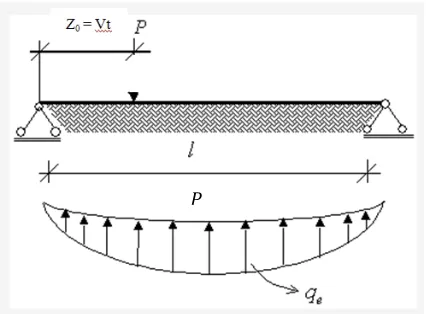
It is assumed that the harmonic moving load along the simply supported prismatic beam made of physical nonlinear material laid on nonlinear elastic foundation shown in Figure 1.
The harmonic load P moves on the beam with a constant velocity V. The reaction of the nonlinear elastic foundation is [3]:
) W k 1 ( W k e q 2 2 1 -= (5)
where, k1,k2 are coefficients with respect to nonlinear elastic foundation which are determined experimentally and W is the beam deflection. The principle of Hamilton for this beam is as follow [4]:
( A E)dt
H t t -Õ
ò
= 2 1 (6)The potential and kinetic energy of this system can be written as follows:
dz W k k W k Z W J G E l Z W EJ l ] 4 2 1 4 1 2 1 2 1 4 2 2 1 3 4 2 54 1 2 2 2 2 1 0 [ + + ¶ ¶ -¶ ¶ = Õ ú ú û ù ê ê ë é ú ú û ù ê ê ë é
ò
o (7)Z t W F
E l d
dxdy y J dxdy y J 2 0 4 1 2
0 , 21 ú
û ù ê ë é =
=òò òò = r
ò
¶¶ (8)where, E, G, L2, ρ and F denote modulus of elasticity, shear modulus, nonlinearity coefficient, and density and cross sectional area, respectively. In addition, x and y are coordinate axes of section. The work of the external moving load is given by [5]:
Figure 1. Schematic view of a prismatic beam under harmonic
moving load l z k l z k k t z q l
P q t p p
sin sin 11 1 ) ,
( å¥ 2 cos 0
= = (9) dz t z W l z k Sin l z k l t A dz t z W t z q A K l l ) , ( . sin 1 cos 2 ) , ( ). , ( 1 0 0 p p q o å R = = ¥ =
ò
ò
(10)By substitution of expressions (7), (8), (10) in (6), we will have: + ¶ ¶ -ê ê ê ë é ú ú û ù ê ê ë é ÷ ÷ ø ö ç ç è æ = ¶ 
ò
ò
2 42 3 4 2 2 2 z 1 J G E 54 1 EJ
H W W
2 1 2 0 l 0 2 t 1 l z t (11) dzdt t W F t z w l z k l z k l t P W k k W k
k úúû
ù ÷ ø ö ç è æ ¶ ¶ -å -¥ = 2 0 1 1 4 2 1 2 1 2 1 ) , ( . sin sin cos 2 4 1 2 1 r p p q Substituting l z p
x = in t =wt Equation (11) the
principle of Hamilton Will can be represents as follows:
-÷ ÷ ø ö ç ç è æ ¶ ¶ = ú ú ú û ù ÷÷ ÷ ø ö çç ç è æ ê ê ê ë é ¶ 
-ò
ò
2 42
2 1
541 8 3
4 8 2 2 2 4 2 4 0 2 0 x p x p pw p p W J l G l E W EJ l l H o dt d W F k k l P W W k W k k x t w r x t w q x ú ú û ù ÷ ø ö ç è æ ¶ ¶ -å ¥ = -2 2 2 1 . sin 1 1 cos 2 ) 2 2 2 1 1 ( 2 1 2 1 sin o (12)
Assuming p(x)and q(t) as the coordinate and generalized functions, deformation of the beam can be expressed in the following form [6]:
) ( ). ( ) ,
(xt px qt
W = (13)
Substituting Equation (13) in (12) and further simplifications, the Hamilton principle is rearranged as:
[ ¢¢ ]
-= êê
ë é
ò
ò
( ). ()24 4 2 1 0 2 0 t q P l EJ l
H p x
pw
p p
o
[ ] 2 2)
4 1 1 ( 2 1 2 1 4 ) ( ). ( 1 3 8 4 8 2
541 l G J P q t kW k W
E
l ¢¢ +
-ú ú û ù x p -x x å t w q x ¥
= Sink .Sink
cos l P 2 ) t ( q ). ( p 0 1 k 1 dt d 2 ) t ( q . 2 ) ( P 2 F 2
1r w x ¢ x
- ú
û ù
(14)
It is assumed that p(x) is known, so the Hamilton integral will be as follows:
t
p w
pw aq bq c q d q d
l
ò êëé + - ¢ - úûù
= 02 2 4 2 2 1
H t pw p Ld l
ò
= 2 0 (15)where, the coefficients a, b, c and d1 are: P
[ x ] x x
x
p p p
d P k d p l
EJ 2 2
4 4 ) ( 1 2 1 ) ( '' 2 1 0 0 0
a=
ò
úûù +ò
êë é
[ ] x
p p x x x p d p K K d p l G E
l J 4 4
8 8 3 4
2 "( ) 41 1 2 ( )
541 -b
0 0
1
ò
-ò
= úûù
êë é
[
x]
xrF p p 2d
0 ( )
2 1
c=
ò
. 2
1 lP Sin k lvt
d = p
(16)
For Integral (15), Euler formula gives:
0 = ¶ ¶ -÷÷ ÷ ÷ ø ö çç ç ç è æ ¶ ¶ ¶ ¶ ¶ q L q L t t (17) l Vt K l P q a b aq q
c t p
w q p
w 2 (1 2 ) cos sin
2 2 ¢¢+ + 2 = 1 (18)
t w q t w q p ht t
h cos sin
2 sin
cos 1
1 clP
d = Or: t w q t w q
w2 (1 2 q2) dcos 1 sin
a b q c a
q¢¢+ + = (19)
where,
clP 2
d = p , h =wq ,q=kplV,
c a
= =w0 w
By substitution of q
d
X=w2 in to equation, we have:
ht t h Sin eX
X
X"+ (1+ 2) =cos 1 (20)
where, 2 2 2 2 3 2 2 4 0 l p a b d a b e p w = = (21)
To solve the Duffing Equation (20), it is assumed [7]:
ht t h
å
¥=
= sinn
1 cos n X X ,... 3 , 2 , 1 n ... 5 sin 3 sin
sin 3 5
1 + + +
= X ht X ht X ht
(22)
Substrituting Equation (22) in (20) and comparing the results with similar cases of coefficeients of
ht t h sinn
cos 1 , many algebraic equations result, to our
knowledge there is no exact solution for these equations. Thus, it would be appropriate to employ an approximate method, and for n³1,Xn£X1 as a result, it is applied the first constraint of Equation (22) that is:
ht t h =x cos .sin )
z (
x 1 1
By substitution of Equation (23) in Equation (20) and comparing the same coefficients, it will be:
1 4 3 ) 1
( -h2-h12 x1+ ex13= (23)
If, m2=h2+h12 Equation (23) can be rewritten as
follows: 1 4 3 ) 1 ( 3 1 1
2 + =
-m x ex (24)
since the vibration amplitude can be determined. From Equation (24), it can be concluded that the resonance of the system depends on the velocity and the circular frequency of load. Knowing X1 and considering Equation (13), the deflection of beam can be derived as below [8]: ( ) l Vt sin n X .t 1 cos . z p 2 d ) t , z ( W 0 p q w = (25) where, ( )
[
x]
xp p
w eJ p d
l d 2 3 3 0 0
2 = ò R ¢¢
o
Bending stress at any sections of beam can be determined by:
) 27
2
( z 2 33 3z z
G E l
E e e
s = - (26)
Bending moment is calculated as follows:
òò
== z xdxdy
M s .
ê ê ê ë é ú ú û ù ÷ ÷ ø ö ç ç è æ ¶ ¶ -¶ ¶ = ú ú û ù ÷ ÷ ø ö ç ç è æ ¶ ¶ ê ê ë é -¶ 
òò
2 2 2 3 3 2 2 2 3 2 2 3 3 2 2 2 2 27 2 1 27 2 z w x G E l z w EJ z w x G E l z w x E o (27)2. 1. When the Load is out of the Beam Differential equation of free vibration will be as follows:
0 2
1 2
2 ÷=
ø ö ç è æ + + ¢¢ q a b c a q w (28)
Finally, by solving Equation (27) we find the period of vibration [9]:
( )
qw K Q a b c a T . 1 . 4 2÷ ø ö ç è æ + = (29) where,
Q- is amplitude of vibration
úû ù + + + êë é +
= sin ..
256 25 . sin 64 9 sin 4 1 1 2 )
(q p 2q 4q 6q
K
And circular acceleration of vibration will be as follows:
) ( 1 . ) 1 ( 2 2 q p w k Q b a c a + = (30)
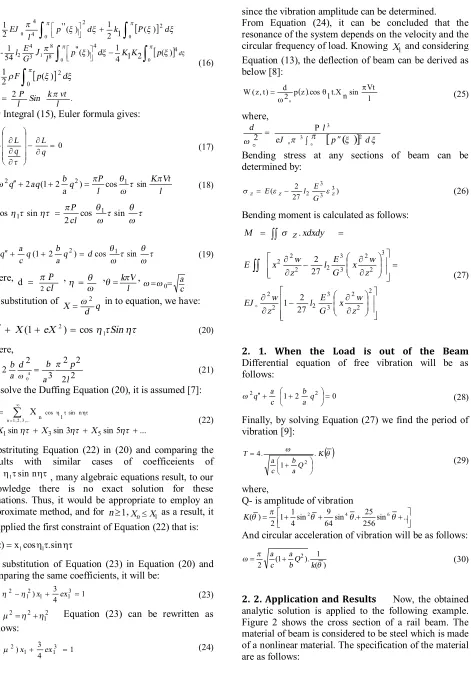
4 0 0.3252 10
-´ =
I m4
I1=17.827´10-8m6
8 10 1 .
2 ´
=
E KN/m2
G=0.87´108KN/m2 6
2=0.085´10
l r=78KN/m3
KN
P=62.5 F=0.007122 m2 m
l=6.00
2500 , 2000 , 1500 , 1000 , 500
k1= KN/m2
1 2
2 0.00, k 0.4k
k = =
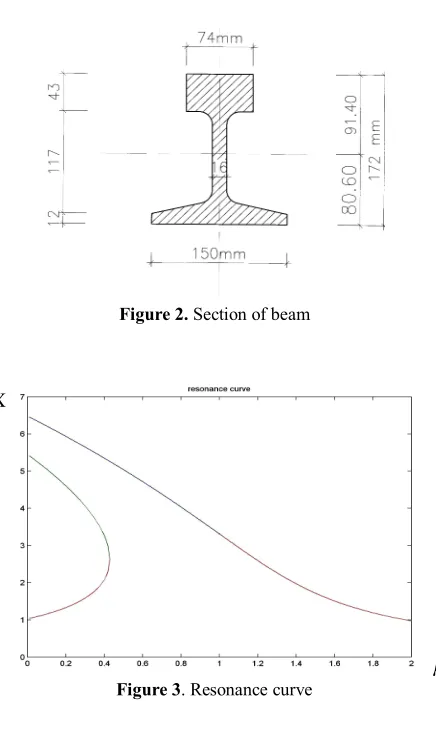
Then, vibration amplitudes determined for k1=1500 and K2=0.4k1 are shown in the Table 1. Based on Table 1, resonance curve is shown in Figure 3 and when h2 =1, for k1=500,1000,1500,2000,2500 k2=0.4k1, the deformation, bending stress and bending moment at the middle span is determined and is shown in Table 2. When k2=0.0 it means nonlinear beam on elastic foundation (Winkler Theorem). In this case, the deformation, stress and bending moment at the middle span is determined and is showed in the Table 3. Table 3 indicates that at critical velocity, the deflection bending stress and bending moment at beam on elastic foundation (Winkler Theorem) have constant values and do not depend on foundation constant. When m2 =1
and q1=0.4w, circular frequency, critical velocity are calculated and shown in Table 4, and coefficient of dynamic for any velocity can be calculated. So, it is obtained form 2= 0.2, 0.3, and 0.4 and are shown at Table 4.
TABLE 1. Amplitudes of vibration
2
m 1
1
X
1
2
X 1
3
X
0 -6.48 5.45 1
0.6195 -4.65 3.60
1 -3.31
2 -1
TABLE 2. Deformation, stress and bending moment for k1,
K2
) /
( 2
1
m KN k
e X1
) (cm W
) (MPa
t s
) . (KNm M
500 -0.0371 -3.30 5.014 229.80 87.00 1000 -0.0393 -3.24 3.041 167.59 61.08 1500 -0.0366 -3.31 2.063 131.39 47.93 2000 -0.03311 -3.43 2.019 112.02 40.26 2500 -0.03 -3.54 1.087 96.57 34.65
Figure 2. Section of beam
Figure 3. Resonance curve
TABLE 3. Circular frequency ,critical velocity for k1
) m / KN (
k 2
1 500 1000 1500 2000 2500
) (
s r
w 133.63 163.38 188.44 210.55 230.55
) s m (
Vcr 233.96 285.92 329.78 368.47 403.46
TABLE 4. Velocity for k1
) m / KN (
k 2
1
h km 180 V
2 . 0 2
= = m
h km 340 V
3 . 0 2
= = m
h km 450 V
4 . 0 2
= = m
500 1.2610 1.4476 1.702
1000 1.2580 1.4411 1.6850
1500 1.2540 1.4363 1.6750
2000 1.2504 1.4298 1.6689
2500 1.2500 1.4293 1.6680
X
3. CONCLUSION
The effects of material nonlinearity on the response parameters of beam on linear and nonlinear elastic foundations under harmonic load are investigated analytically. Using Hamilton principles and Euler's equations, the nonlinear vibration equation of the system are obtained. The Fourier series are used to decompose the deflection as a multiplication of functions in time and space. The resulting equation in time is the well known Duffing's equation. Solving the Duffing equation by perturbation method, the response parameters of the system are evaluated.
In the case of linear material under harmonic moving load on elastic foundation, theoretically with increasing the speed of the moving load resonance might happen. However, considering the material nonlinearity, resonance dose not happen and the internal forces will have definite values. Taking into account the material nonlinearity, the internal forces for velocities blew critical velocity reduce as much as 10-15 percent in comparison with the linear case. For the various k1 and K2=0.4 k1 (nonlinear elastic foundation) and
0 . 0
2=
k (winkler elastic foundation) values of
deformation, stress and bending moments have been determined. When k2=0.0 obtained results shows that deformation, bending stress and bending moment approaches to a constant value and dose not depend of foundation constant. The coefficient of dynamics for
m2= 0.2, 0.03, 0.04 for two cases are obtained. Thus, for any velocity V, deformation, stress and bending moment can also be determined.
4. REFERENCES
1. Kauderer, H., "Nichtlineare mechanik: Mit 229 abb", Springer, (1958).
2. Qaribov, R. and Hasanov, N., "Analysis of deformation of prismatic beams made of physical nonlinear material under impulse loads", Scientific Works in Structural Mechanic, No. 11, (2001), 178-180.
3. Mardani, E., "Physical nonlinear analysis of a beam on elastic foundation under moving load", in Scientific Effects on Structural Mechanic,: .Baku-ElM, (1997), 75-80.
4. Meirovitch, L., "Principles and techniques of vibrations", Prentice Hall New Jersey, (1997).
5. Mardani, E., Garibov, R. and Isayev, A., "Physical nonlinear analysis of a beam under moving load", in The Second International Conference on Bridges, Tehran, Iran, (1996), 20-25.
6. Nayfeh, A. H. and Mook, D. T., "Nonlinear oscillations", Wiley-VCH, (2008).
7. Wang, P.-H., Lin, H.-T. and Tang, T.-Y., "Study on nonlinear analysis of a highly redundant cable-stayed bridge", Computers & Structures, Vol. 80, No. 2, (2002), 165-182.
8. Marur, S. R., "Advances in nonlinear vibration analysis of structures. Part-i. Beams", Sadhana, Vol. 26, No. 3, (2001), 243-249.
The Analysis of a Beam Made of Physical Nonlinear Material on Nonlinear Elastic
Foundation Under a Moving Harmonic Load
E. Mardani
Department of Civil Engineering, Urmia University, Iran.
P A P E R I N F O
Paper history:
Received 26 August 2012
Recivede in revised form 12 January 2013 Accepted 24 January 2013
Keywords:
Physical nonlinear Harmonic moving load Hamilton Principle Lagrange Equation Dufing Equation Critical Velocity Resonance
هﺪﯿﮑﭼ
ﺖﺤﺗﯽﻄﺧﺮﯿﻏﮏﯿﺘﺳﻻا نﻮﯿﺳاﺪﻧﻮﻓيور ﺮﺑﻊﻗاو ﯽﮑﯾﺰﯿﻓﯽﻄﺧﺮﯿﻏرﺎﺘﻓرﺎﺑﺢﻟﺎﺼﻣزا هﺪﺷﻪﺘﺧﺎﺳ يرﻮﺸﻨﻣﺮﯿﺗﮏﯾ كﺮﺤﺘﻣﮏﯿﻧﻮﻣرﺎﻫرﺎﺑ
دﻮﺸﯿﻣﺰﯿﻟﺎﻧآمﻮﻠﻌﻣﺖﻋﺮﺳﮏﯾﺎﺑ
.
ﻪﻟدﺎﻌﻣونﻮﺘﻠﯿﻣﺎﻫﻞﺻايﺮﯿﮔرﺎﮑﺑﺎﺑﯽﺷﺎﻌﺗراﺖﮐﺮﺣﻪﻟدﺎﻌﻣ
ﮋﻧاﺮﮔﻻ
-ﺪﺑﺮﻠﯾوا ﺪﯾآﯽﻣﺖﺳ
.
وﺶﻨﺗﯽﺸﻤﺧﺮﮕﻨﻟﯽﺷﺎﻌﺗراﺖﮐﺮﺣدﻮﯾﺮﭘﯽﻧارودﯽﻌﯿﺒﻃﺲﻧﺎﮐﺮﻓﯽﺷﺎﻌﺗراﺖﮐﺮﺣﻪﻨﻣاد
ﺪﻧﻮﺸﯿﻣﻪﺒﺳﺎﺤﻣهﺪﻣآﺖﺳدﻪﺑﻂﺑاور ﻂﺳﻮﺗﺮﯿﺗﺰﯿﺧ
.
ﺶﻨﮐاو ﯽﺳرﺮﺑ دﻮﺸﯿﻣمﻮﻠﻌﻣنآﺲﻧﺎﻧوزرﻪﺑﺮﯿﺗ
.
رﺎﺘﻓرﻪﮐﯽﺘﻗو
ﺮﻓﯽﮑﯾﺰﯿﻓﯽﻄﺧﺮﯿﻏﺮﯿﺗﺢﻟﺎﺼﻣ دراﺪﻧدﻮﺟوﯽﻧاﺮﺤﺑﺖﻋﺮﺳدﻮﺷﯽﻣض
ونآردو ﺶﻨﺗوﺰﯿﺧياﺮﺑمﻮﻠﻌﻣﺮﯾدﺎﻘﻣﺖﯿﻌﺿ
دراددﻮﺟوﺮﯿﺗﯽﺸﻤﺧنﺎﻤﻣو
.