Distribution Network Expansion Using Hybrid SA/TS
Algorithm
M. Sedghi* and M. Aliakbar-Golkar**
Abstract: Optimal expansion of medium-voltage power networks is a common issue in
electrical distribution planning. Minimizing total cost of the objective function with technical constraints and reliability limits, make it a combinatorialproblem which should be solved by optimization algorithms. This paper presents a new hybrid simulated annealing and tabu search algorithm for distribution network expansion problem. Proposed hybrid algorithm is based on tabu search and an auxiliary simulated annealing algorithm controls the tabu list of the main algorithm. Also, another auxiliary simulated annealing based algorithm has been added to local searches of the main algorithm to make it more efficient. The numerical results show that the method is very accurate and fast comparing with the other algorithms.
Keywords: Distribution Network Expansion, Simulated Annealing, Tabu Search.
Nomenclature1
A
α CCon,a
CSub
CE
d F H1, H2
Ii
Iter Incr Infr Intr k L Lj
Li,a
N1, N2
Nb
Nl
Ps,i
PLoss
Iranian Journal of Electrical & Electronic Engineering, 2009. Paper is first received 20 Dec. 2008 and in revised form 19 Apr. 2009. * Mahdi Sedghi is the M.Sc. student of the Electrical Engineering Department, K.N. Toosi University of Technology, Tehran, Iran. E-mail: [email protected]
** Masoud Aliakbar-Golkar is an Associate Professor of the Electrical Engineering Department, K. N. Toosi University of Technology, Tehran, Iran.
E-mail: [email protected]
PLoss,i
PLoss,m
Sb
Sbn
Sc
SCarrier
Si
SIns,m
Si,a
Smax,i,a
Sm
Sn
SNew
T0
TAux
TMain
Vi
Vmax
Vmin
xi,a
ym
Zi
1 Introduction
Expansion of existent distribution networks, because of the load growth, is a common and combinatorial Set of branches exist in current solution
Cooling rate
Fix cost of installation feeder of size a ($/km) Cost function of installing a substation ($) Electrical energy cost ($/kWh)
Neighborhood search size Objective function ($) Branches saver lists
Current of branch i while the loop exists (A) Number of iterations
Annual increment load rate Inflation rate
Interest rate
Number of operation year Set of branches exist in loop Load of node j (MW)
Length of feeder i of size a (km) Number of moved branches
Number of branches in the candidate network Load nodes number
Capacity of substation i (MW) Total loss in network (MW)
Loss of feeder i (MW) Loss of substation m (MW) The best solution
The best neighbor solution Current solution
Solution carrier Initial solution
Capacity of substation m that was installed before (MVA)
Power flow of feeder i of size a (MVA)
Maximum allowed power flow of feeder i of size a (MVA)
Total capacity of substation m (MVA) Neighbor solution
New solution
Initial temperature of the SA for tabu list controlling
Temperature of the SA for local search Temperature of the SA for tabu list controlling Voltage of node i (p.u.)
Maximum allowed operation voltage (p.u.) Minimum allowed operation voltage (p.u.) Binary decision variable associated to the installation of feeder i of size a
Binary decision variable associated to the installation of substation m
Impedance of branch i (Ω)
problem which is important economically and technologically. The problem consists of optimal HV/MV substations placement and sizing as well as medium-voltage feeders routing and design using complex cost objective function and technical constraints. The objective function includes network investment cost and power-loss cost. The optimal solution must satisfy the supply requirements and voltage-drop and power flow of feeders constraints. Moreover the distribution network should have a radial configuration because of protection system constraints. Occasionally, we need to design a system to meet load demand in new areas without existing facilities. But the most common issue in distribution planning deals with the reinforcement and expansion of an existing system. So, existing substations and feeders have no construction costs associated with them, however, they have associated power loss costs.
In recent years, a lot of mathematical models and algorithms have been developed for solving this problem. A comprehensive review of classical models and issues can be found in [1], while [2] analyzes and compares the recent modern algorithms. Branch Exchange (BE), Simulated Annealing (SA), Tabu Search (TS), Genetic Algorithm (GA), Ant Colony Optimization (ACO) and Particle Swarm Optimization (PSO) are the famous modern algorithms which have been used for distribution network planning [3]-[9], and some improvements have been proposed for them [10]-[18].
Among these algorithms, SA has a very accurate result and could pass the local optimum points by accepting low quality solutions at initial iterations. It can be shown mathematically that the algorithm converge asymptotically to the global optimal solution with probability one [19], moreover the quality of the final solution does not depend on the initial configuration. But SA needs excessive computation time comparing to the other algorithms [20]. On the other hand, in TS algorithm the quality of the final solution depends on the initial configuration and convergence property is not guaranteed [21]. But TS is a fast algorithm because it selects the best neighbor solution of the current solution for the next iteration and a tabu list avoids cycling. So in a hybrid SA/TS method, the advantages of each algorithm can make up the disadvantages of the other and as a result, the hybrid algorithm could be faster and more reliable.
In this paper the hybrid SA/TS algorithms for distribution network expansion planning have been suggested. The optimization algorithms can be either SA based SA/TS algorithm, or TS based SA/TS algorithm. Here, the two approaches are compared and new TS based SA/TS algorithm is shown to be better for distribution network expansion studies. Finally, the proposed algorithm has been tested on a 73-node power distribution network.
2 Problem Statement
This section describes the problem formulation for distribution network expansion planning. It results in the problem that optimizes the location and type of new feeders as well as the location and the capacity of new substations and the capacity increment of existing substations while minimizing the cost objective function of the network under technical constraints. The objective function includes fix installation cost and variable loss cost of the network. The optimal distribution system must supply the required loads and keep the load node voltages in the acceptable boundary. In addition, feeder capacities can not be exceeded and the configuration of the network must be radial. As a result, the mathematical formulation may be written as follows. Objective function: } 8760 Incr) 1 ( ) Infr 1 Intr 1 ( C ] P P [ { ) ,S (S C y C L x F ) 1 (k 2 E
k i Loss,i m Loss,m m m Sub m Ins,m i i,a i,a Con,i,a
× + × + + × × + + × + × × = −
∑ ∑
∑
∑
∑
(1) Constraints:∑
∑
≥ + j j Loss i si,L P
P (2)
max i min V V
V ≤ ≤ (3)
, , max, ,
0
≤
x
i a×
S
i a≤
S
i a (4)l b N
N = (5)
where CCon,i,a= 0, for existent feeders. In a radial
configuration, each load node should be feed by only one substation. So feeding a load from two different substations makes a loop in the network which is not allowed.
3 Hybrid SA/TS Algorithms
In the SA based SA/TS algorithm, SA is the mother algorithm and TS is an auxiliary algorithm. So the neighborhood size is 1 and an aspiration criterion is not used. SA has a good convergence property, while local search is performed in a lower temperature, so this search may revisit solution already visited in the past. In the hybrid algorithm, tabu search, prevents revisiting and cycling of solution [21]. As a result, more different solutions would be studied and the computational time is less comparing to only using SA algorithm. Although, using of tabu search with perturbation mechanism, might penalize a good zone of solutions that one of
Start
TMain = T0 & Iter = 0 & Empty tabu list
Generate Siand calculate F(Si) by Eq. (1)
Update tabu list
Sb= Sc= Si & F(Sb) = F(Sc) = F(Si)
Generate d neighbors of Sc and calculate
their objective functions by Eq. (1)
Iter = Iter + 1
Select the best neighbor solution (Sbn) which:
{satisfies Eqs. (2)-(5)} AND
{ [is not tabu] OR [satisfies the aspiration criterion] OR [exp(F(Sb)-F(Sbn))/TMain >rand(0,1)] }
Stop
No
Sb= Sc & F(Sb) = F(Sc)
Yes No
Sc= Sbn & F(Sc) = F(Sbn)
TMain= α . TMain
Update tabu list
F(Sc) < F(Sb) ?
Yes
Is iteration criterion satisfied ? them had already been visited. So the final result might
be a local optimum.
In the TS based SA/TS algorithms, TS is the main algorithm and SA is an auxiliary algorithm. However, here the proposed TS based hybrid SA/TS algorithm includes an adaptive heuristic local search for distribution networks expansion planning, too.
This algorithm, like a tabu search, starts from a proper initial solution, searches in the neighbor solutions and selects the best of them for the next iteration start point. For avoiding a cycle search, a tabu list has been added but not exactly like the standard TS. In the standard TS, solutions which have been visited before are penalized by the tabu list and so some good zones might be penalized, although the fix aspiration criterion is applied to. Controlling the tabu list application, by a simulated annealing based algorithm, could make up this weakness. As a result, at the initial iterations, the hybrid algorithm visits the zones more carefully and continues with better solutions. But at the later iterations, it will be prevented revisiting solutions smoothly because of annealing process, so cycling will be avoided. The flow chart of this algorithm is shown in Fig. 1.
The initial solution and heuristic local search, which have been used in the proposed hybrid SA/TS algorithm, are as follows.
a) Initial Solution
In distribution network expansion study all of the existing substations, candidate substations, existing feeders and candidate feeders must be considered. Because of the higher installation and operation cost of substations, selecting the optimum substations among the candidates could be performed by considering all of the substations in the initial solution. So feeding each load by the nearest substation, while all of the substations have an appropriate chance in the final solution, is a good choice for the initial solution.
b) Proposed Heuristic Local Search
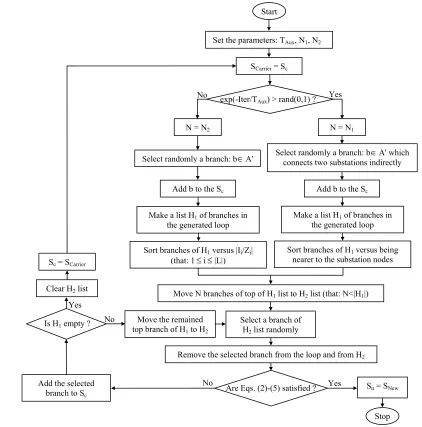
In the TS algorithm (and also the proposed SA/TS algorithm) local searches should find the best neighbor of the current solution. So normally, one must evaluate the objective function for every element of the neighborhood current solution. This can be extremely expensive from a computational standpoint. In practice, the probabilistic local searches are used and this allows a shorter tabu lists be used too. This may lead to miss excellent solutions [19]. To overcome this weakness, a heuristic algorithm which is based on a quasi simulated annealing algorithm and two lists is proposed which is adequate for distribution network expansion problem. In this algorithm, the branch exchange method is used for local transformations, in which added branch selection is performed randomly but selecting the removed branch is controlled At the initial iterations of the main SA/TS algorithm, branches which are directly
Fig. 1. Flow chart of the proposed TS based SA/TS algorithm
connected to the substations, have more chance to be removed from the network (Fig. 2). At the later iterations, branches which have less electrical current in the created loop and more impedance, have more chance to be removed. This is because that electrical current flows from the better routes regarding the network configuration and the impedance of the feeders is relevant to their length (installation cost) and their electrical loss cost.
Set the parameters: TAux, N1, N2
SCarrier= Sc
exp(-Iter/TAux) > rand(0,1) ?
N = N1
Select randomly a branch: b∈A' which connects two substations indirectly
Add b to the Sc
Make a list H1 of branches in
the generated loop
Sort branches of H1 versus being
nearer to the substation nodes N = N2
Select randomly a branch: b∈A'
Add b to the Sc
Sort branches of H1 versus |Ii/Zi|
(that: 1≤i≤|L|)
Move N branches of top of H1list to H2list (that: N<|H1|)
Select a branch of H2list randomly
Remove the selected branch from the loop and from H2
Are Eqs. (2)-(5) satisfied ? Sn = SNew
Add the selected branch to Sc
Is H1 empty ? Move the remained
top branch of H1to H2
Sc = SCarrier
Clear H2 list
Make a list H1 of branches in
the generated loop
Yes No
Yes No
No Yes
Start
Stop
Fig. 2. Removing branches are directly connected to
substations
Two lists control this selection: the first list (H1)
compares the feasible branches for being removed, after adding a branch. At the initial iterations, H2 sorts
branches versus nearing to substations and at the later iterations, H2 sorts them versus |Ii/Zi| criterion. This
removing branch selection strategy is very accurate
because all of the feasible solutions are compared with each others. The second list (H2) is created by some of
the best top components of H1 and remaining
components of H1 will be added to H2, later. The final
branch selection for removing is done by using H2
components (not just by the best component of H1). The
second list makes the selection more supple and controllable and avoids local optimum points because it lets the algorithm visit good solutions instead of visiting the best solutions only.
As a result, bad neighbor solutions won't be generated and considered by the algorithm and less local search numbers are needed to find the best neighbor solution. So the main algorithm will be faster. A flow chart of the proposed algorithm is shown in Fig. 3.
Fig. 3. Flow chart of the proposed local search algorithm
Substation
Load Point Nearest Branches for Removing Added Branch
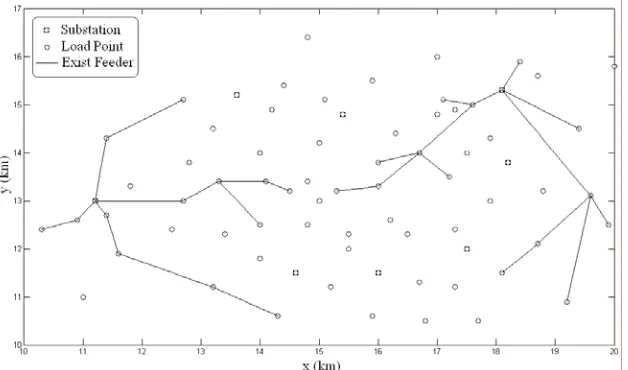
Fig. 4. Existent distribution network configuration as a case study
4 Numerical Results
In order to show the capability of the proposed hybrid SA/TS algorithm for solving distribution network expansion problem, the following example is presented. It is a 20 kV distribution network which consists of 65 load nodes, 2 existent substations and 6 candidate substations. Fig. 4 shows the existent distribution network, new load points and candidate substations. The data required for the analysis is presented in Table 1, and Table 2. The test is run on a 2×1.6 GHz Pentium PC having 1 GB RAM.
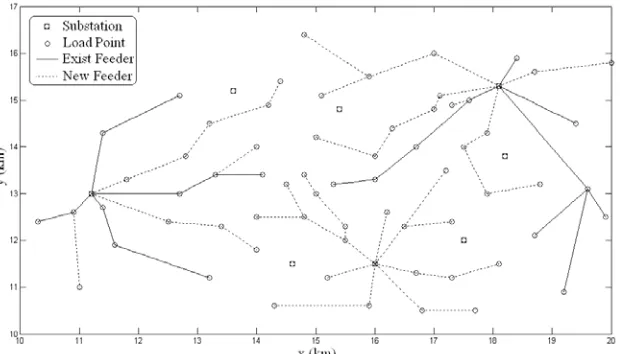
Fig. 5 presents the optimal distribution network which has the average objective function, resulted from several running of the proposed hybrid SA/TS algorithm. This figure shows that two substations is needed to feed the new load points.
Table 1. Economic data
Parameter Value Electrical Energy cost ($/kWh)
Annual increment load rate (%) Inflation rate (%)
Interest rate (%)
Time period (years)
0.05 3 12
7 25
Table 2. Parameters of the algorithm
Parameter Value T0
α d TAux
N1
N2/|L|
4×10⁶
0.7 30 60 2 0.75
Fig. 5. Optimal distribution network configuration, as a good solution, having the average objective function resulted from the proposed algorithm
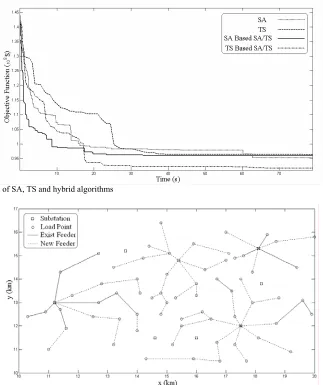
Fig. 6. Comparison of SA, TS and hybrid algorithms
Fig. 7. Optimal distribution network configuration, as a local optimum solution, having the average objective function resulted from
the SA, TS and SA based SA/TS algorithms
4.1 Comparisons
In order to show the advantages of the proposed TS based SA/TS algorithm, the results have been compared with the SA, TS and SA based SA/TS algorithms in Fig. 6. This comparison considers the average objective functions that result from several running. The figure shows that the TS is faster than SA, but the solution of SA is better. The SA/TS which is based on SA is faster than TS and much faster than SA, however the result is not better than SA's. The proposed TS based SA/TS has the best solution and is faster than the others all (even when the standard local search instead of proposed heuristic local search algorithm is used). As a result, the average solutions of the other algorithms are local optimums (Fig. 7), while our computations show that the best solutions of them are not better than the average solution of the proposed algorithm, too.
To show the advantages of using |Ii/Zi| criterion in
the proposed local search algorithm, the solving process of two algorithms which one includes this criterion and the other is not, have been compared. The comparison shows that the solution of the first is better than the other. This is because of generating better neighbors for the current solution, by the proposed local search.
Increasing the local search size of the second algorithm (up to 50), could improve this weakness, but computational time will increase clearly. So the first algorithm reaches to better solutions sooner than the second and thus the first algorithm result would be better than the other, in the same running time. Fig. 8 presents this comparison.
4.2 Parameter Analysis
The proposed hybrid TS based SA/TS algorithm has some important parameters which influence the
Fig. 8. A section of optimization process for two algorithms, 1st: N
2/|L|=0.75 & d=30 (solid line) and 2nd: N2/|L|=1 & d=50
(dash line)
optimization process. The most important parameters are T0, TAux, N2/|L|, size of local searches (d) and tabu
list size.
Main algorithm initial temperature (T0) should set to
a value where the initial probability of accepting tabu solutions is high. We set the other parameters like Table 2 and vary T0 from 4×10⁴ to 4×10⁷ and run the
algorithm several times for each sample. The result has been shown in Fig. 9.
This figure shows that the initial temperature of the main algorithm has an optimal value which equals to 4×10⁶ and also the objective function varies linearly
Fig. 9. Objective function variation versus main hybrid algorithm initial temperature
versus the logarithm of the T0. Our computations show
that T0 has much more influence on the objective
function than the convergence time.
The temperature of the auxiliary local search algorithm (TAux) has severe influence on the final
objective function and the convergence time, both. Fig. 10 presents this influence (other parameters are similar to Table 2). This figure shows that if we do not use the first half of the proposed local search algorithm (e.i. TAux = 0), the algorithm will be fast but the solution
is not good enough. Increasing TAux leads to better
solutions with lower objective functions but the convergence time increases linearly. TAux = 300 leads to
the best solution which is a global optimum and the relevant distribution network configuration has only one new substation (Fig. 11).
Fig. 10. Influence of TAux on the final objective function (solid
line) and the convergence time (dash line)
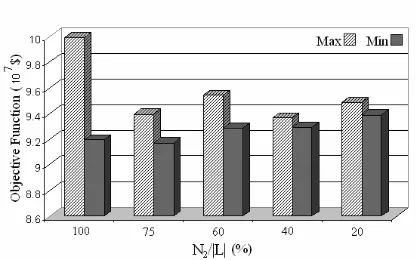
Fig. 12 presents the influence of the N2/|L| parameter
on the objective function of the proposed algorithm result. Proposed algorithm has been run several times for some N2/|L| parameters and the minimum and
maximum of the results have been obtained.
This figure shows that using the second part of the proposed local search (i.e. |Ii/Zi| criterion) causes a
lower average objective function in all of the N2/|L| < 1,
because of leading the algorithm to fairly better
Fig. 11. Optimal distribution network configuration, as a global optimum solution, resulted from the proposed algorithm at TAux=300
Fig. 12. Influence of N2/|L| on the minimum and maximum
objective function, in several runs
solutions in local searches. But this might limit the algorithm in certain zones, so the best solution is obtained at N2/|L| = 75 %.
The impact of local searches size and tabu list size on objective function of the resulted solution and convergence time has been shown in Fig. 13 and Fig. 14, respectively. Corresponding to them, increasing the local searches size and tabu list size leads to the best objective functions because of more accurate study on solutions space, but the convergence time would be much longer. Increasing tabu list size, even without increasing local searches size, results better solutions at approximately fix convergence time. For example, while tabu list size is 2000 the objective function will be the same for 30≤d≤100 and convergence time is good enough for 10≤d≤40. So using a large tabu list and mid
Fig. 13. Influence of tabu list size and local neighborhood
search size on the result objective function
Fig. 14. Influence of tabu list size and local neighborhood
search size on the convergence time
local search size is the best choice for this optimization algorithm.
5 Conclusion
In this paper, a hybrid TS based SA/TS algorithm, in which the TS was the main and SA was the auxiliary algorithm, proposed for distribution network expansion. TS algorithm has a good convergence time but the result might be a local optimum. Adding the SA algorithms to TS algorithm, improves the result without increasing the convergence time. The first auxiliary algorithm, as a diversification, lets the main algorithm consider wider zones of solution space, so the final solution is more accurate and the second auxiliary algorithm, as an intensification, makes the local searches more efficient and decreases required local search numbers at each iteration, so the computational time is less. Numerical results showed that the resultant algorithm can reach to a near optimum solution very fast and to the global optimum a little later after optimum parameter selection. So it is better than all the SA based SA/TS, SA, and TS algorithms.
References
[1] Khator S.K., “Power distribution planning: A review of models and issues”, IEEE Trans. on Power Syst., Vol. 12, pp. 1151-1159, 1997. [2] Golkar M.A., Sedghi M.,
“
Comparison andanalysis of modern optimization algorithms for electrical distribution networks planning
”
, 16th Iranian Conf. on Electrical Engineering, Power, pp. 760-766, Iran, May. 2008.[3] Aoki K., Nara K., Satoh T., Yamanaka K. . M., “New approximate optimization method for distribution system planning”, IEEE Trans. on Power Syst., Vol. 5, No.1, pp. 126-132, 1990. [4] Parada V., Ferland J.A., Arias M., Daniels K.,
“Optimization of electrical distribution feeders using simulated annealing”, IEEE Trans. on Power Delivery, Vol. 19, No. 3, pp. 1135-1141, 2004.
[5] Rosado I.J.R., Navarro J.A.D., “New multiobjective tabu search algorithm for fuzzy optimal planning of power distribution systems”, IEEE Trans. on Power Syst., Vol. 21, No. 1, pp. 224-233, 2006.
[6] Miranda V., Ranito J.V., Proença L.M., “Genetic algorithm in optimal multistage distribution network planning”, IEEE Trans. on Power Syst., Vol. 9, pp. 1927–1933, 1994.
[7] Ramirez-Rosado I.J., Bernal-Agustin J.L., “Genetic algorithm applied to design of large power distribution system”, IEEE Trans. on Power Syst., Vol. 13, pp. 696–703, 1998.
[8] Gómez J.F., Khodr H.M., De Oliveira P.M., Ocque L., Yusta J.M., Villasana R., Urdaneta
A.J., “Ant colony system algorithm for the planning of primary distribution circuits”, IEEE Trans. on Power Syst., Vol. 19, No. 2, pp. 996-1004, 2004.
[9] Siahkali H., Roshanfekr R., “Distribution network planning using supplying area and PSO algorithms”, Journal of Iranian Association of Electrical and Electronics Engineers, Vol. 2, No. 1, pp. 17-30, 2005.
[10] Miguez E., Cidras J., Diaz-Dorado E., Garcia-Dornelas J.L., “An improved branch-exchange algorithm for large-scale distribution network planning”, IEEE Trans. on Power Syst., Vol. 17, No. 4, pp. 931-936, 2002.
[11] Mori H., Yamada Y., “Two-layered neighborhood tabu search for multi-objective distribution network expansion planning”, IEEE International Symposium on Circuits and Systems, May 2006.
[12] Mori H., Iimura Y., “Application of parallel tabu search to distribution network expansion planning with distributed generation”, IEEE Power Tech. Conf., Italy, June. 2003.
[13] Davalos F.R., Irving M.R., “An Efficient Genetic Algorithm for Optimal Large-Scale Power Distribution Network Planning”, IEEE Power Tech. Conf., Vol. 3, pp. 797–801, 2003.
[14] Davalos F.R., Irving M.R., “The Edge-set Encoding in Evolutionary Algorithms for Power Distribution Network Planning Problem Part I: Single-objective Optimization Planning”, Electronics, Robotics and Automotive Mechanics Conf. (CERMA 2006), México, 2006.
[15] Davalos F.R., Irving M.R., “The edge-set encoding in evolutionary algorithms for power distribution network planning problem part II: multi-objective optimization planning”, Electronics, Robotics and Automotive Mechanics Conf. (CERMA 2006), México, 2006.
[16] Zhang X., Yuan J., Yang X., “An improved hybrid particle swarm optimization method for distribution network planning”, 6th
World Congress on Intelligent Control and Automation, pp. 7470-7474, China, June. 2006.
[17] Jung H.S., Shin D.J., Kim J., “Neural-tabu algorithm in optimal routing of distribution network considering reliability indices”, IEEE Power Engineering Society Winter Meeting, Vol. 4, pp. 2340-2344, 2000.
[18] Ahmed W., Sheta A.F., “Optimization of electric power distribution using hybrid simulated
annealing approach”, American Journal of Applied Science, Vol. 5 ,pp. 559-564, 2008. [19] Burke E.K., Kendall G., “Search methodologies
introductory tutorials in optimization and decision support techniques”, Library of Congress Cataloging - in - Publication Data, springeronline.com, pp. 165-207, 2005.
[20] Neimane V., “On development planning of electricity distribution networks”, PhD. Dissertation, Royal Institute of Technology, Stokholm, 2001.
[21] Jeon Y.J., Kim J.C., “Network reconfiguration in radial distribution system using simulated annealing and tabu search”, IEEE Power Engineering Society Winter Meeting, Vol. 4, pp. 2329-2333, 2000.
[22] Zhang C.Y., Li P.G., Rao Y.Q., Guan Z.L., “A very fast TS/SA algorithm for the job shop scheduling problem”, Elsevier Computers & Operations Research, Vol. 35, pp. 282-294, 2008.
Mahdi Sedghi was born in Iran in
1982. He received his B.Sc. degree from K N Toosi University of Technology Tehran-Iran in 2006, in Electrical Engineering (Power Systems). He is now an M.Sc student in the Department of Electrical Engineering, K N Toosi University of Technology. His current research interest includes electrical distribution networks planning, optimization algorithms, distributed generation and power quality.
Masoud AliAkbar-Golkar was born in Tehran Iran in 1954. He received his B.Sc. degree from Sharif University of Technology Tehran-Iran in 1977, M.Sc. from The Oklahoma State University USA in 1979 and his Ph.D. degree from the Imperial College of Science, Technology, and Medicine (The University of London, UK) in 1986, all in Electrical Engineering (Power Systems). His employment experience included working as an Associate Professor at the K N Toosi University, Tehran, Advisor to Tehran Electricity Board, Head of research group at Electric Power Research Center in Tehran. Now he is an Associate Professor at K N Toosi University of Technology in Tehran, Iran.