Psychology: Journal Articles (Peer-Reviewed) Psychology
1999
An integrative model of factors related to
computing course performance
John P. Charlton
University of Bolton, [email protected]
Paul E. Birkett
University of Bolton, [email protected]
This Article is brought to you for free and open access by the Psychology at UBIR: University of Bolton Institutional Repository. It has been accepted for inclusion in Psychology: Journal Articles (Peer-Reviewed) by an authorized administrator of UBIR: University of Bolton Institutional Repository. For more information, please [email protected].
Digital Commons Citation
Charlton, John P. and Birkett, Paul E.. "An integrative model of factors related to computing course performance." (1999).Psychology: Journal Articles (Peer-Reviewed).Paper 9.
Computing Course Performance
JOHN P. CHARLTON and PAUL E. BIRKETT
Psychology Subject Group,
Bolton Institute,
Deane Road, Bolton, BL3 5AB, England.
Please send proofs to: Please send reprint requests to:
J.P. Charlton, J.P. Charlton,
14 Ladyhouse Close, Psychology Subject Group,
Milnrow, Bolton Institute,
Rochdale, OL16 4EB, Deane Road,
England. Bolton, BL3 5AB,
ABSTRACT
A path modeling approach is adopted to examine inter-relationships between factors
influencing computing behavior and computing course performance. Factors
considered are gender, personality, intellect and computing attitudes, ownership and
experience. Among many other conclusions, intrinsic motivation is suggested as a
major factor which can explain many variables’ relationship with course performance.
Similarly to the common finding for non-computing specialist students, a male
advantage in previous computing experience is observed, gender differences in
computer ownership partially explaining this. In the absence of an attitudinal gender
difference, the ownership difference is suggested to stem from the perception of
computers as objects stereotypically bought by and for males. However, while having
implications with respect to the gender imbalance usually observed on
programming-oriented and more technically-programming-oriented applications courses, these differences are not
shown to confer a male advantage in course performance.
INTRODUCTION
Although commonplace, multivariate studies of factors related to computing course
performance have tended to adopt a largely atheoretical perspective, explanations for
relationships often remaining unclear [e.g. 1, 2, 3, 4]. This results from the studies’
agenda of identifying variables useful in predicting success in introductory computing
chance of success in subsequent computing majors. There is therefore a shortage of
work on computing-specialist students and of theoretically-oriented literature
exploring the structure of predictor variables’ inter-relationships and these variables’
relationships with computing course performance.
The present work sought to build and test a theoretically coherent path model1 describing the structure of relationships among variables influential in determining the
performance of students on a programming-oriented computing course. Particular
attention was paid to the role which the stable or relatively stable individual
difference factors of gender, personality and intellect have in influencing computing
attitudes and behaviors, and the implications of such influences for performance.
Consideration of these connections is important in understanding why certain
variables predict performance, with the goal of identifying key unifying concepts
responsible for predictivity. Quite apart from its importance in advancing theoretical
understanding, from a practical perspective, the identification of such concepts is
useful for counseling purposes and in developing a minimal set of selection criteria
which can yield maximal predictive utility. Also, and equally important, this type of
study can be informative on the issue of redressing the gender imbalances, favoring
males, almost always observed on technical computing courses and in industrial and
commercial technical computing posts. It is with this topic that we commence.
Previous work seeking to explain the above gender imbalances concentrates
almost entirely on schoolchildren or members of non-specialist introductory
computing courses. Such work has often shown lesser female computing experience
1
Although path modeling assumes the existence of specific causal relationships, the acceptance of a
model does not prove the veracity of such causal assumptions. Hence, though causal terminology is
[e.g. 5, 6, 7, 8] and less positive female attitudes towards computing [e.g. 9, 10, 11].
Computer dependency has also been cited as a largely male phenomenon [12].
Explanations of these observations include lack of female confidence resulting from
male monopolization of computing resources at school [13, 14, 15], lack of female
role models and transfer of female mathematics anxiety to the computing domain [6],
and lesser encouragement of female computing activity [e.g. 6, 8, 16]. These factors
have also been cited in connection with lesser female computer ownership [e.g. 11,
14, 16, 17], lesser female computer game playing [14, 18, 19] and perceived lesser
vocational relevance of computers on the part of females [e.g. 14, 20].
Based on the previous literature then, the present theoretical model assumed that
social stereotyping of computing as a male activity results in less positive female
computing attitudes in terms of computer engagement (a behavioral construct
indicating a high degree of computing activity, but, in the present context at least,
involving no negative consequences). The model depicted this greater male
engagement as leading to greater male accumulation of computing experience both
directly (e.g. greater engagement should lead to greater male utilization of computing
resources in schools, colleges and places of work) and indirectly via computer
ownership (greater male computer engagement leading to a greater likelihood of male
computer ownership, in turn resulting in greater male accumulation of computing
experience). Given that the present focus was on computing specialists, and that
therefore the approach to computing of the present females might be gender atypical,
whether the attitudinal, ownership and experiential gender differences found in the
non-specialist literature would be present was one of the most interesting aspects of
the study. This was particularly so given evidence that females often enroll in
prospects [5], thus implying that the present females may not be gender atypical in
their computing attitudes and behavior.
Gender differences in personality might be added to social reasons as a partial
explanation of gender differences in computer engagement. In particular, the
emotional sensitivity - tough-poise continuum is relevant here. Relative to
emotionally sensitive people, those high in tough-poise lack sensitivity, focus upon
facts rather than feelings, and are quicker to adopt definite positions on issues, paying
little attention to subtleties [21]. Such differences have been linked to a bias towards
arts (emotional sensitivity) or sciences (tough-poise) [22]. Additionally, males and
females are often considered as falling towards the higher and lower ends of this
continuum respectively [23, 24]. So, granted that programming is clustered with
sciences in terms of its perceived attributes [25], that computer science students’
vocational interests are similar to those of science and engineering students [26], and
that science attitudes are positively related to computer attitudes [18, 27], the present
theoretical model included an indirect path linking gender and computer engagement
by way of differences in tough-poise. The existence or otherwise of a bivariate gender
– tough poise relationship bore upon the issue of whether females opting to specialize
in programming-oriented computing exhibit more masculine personality
characteristics than females generally.
To the extent that males were hypothesized to be more highly computer
engaged than females, this predicted a male advantage in course performance as a
result of greater intrinsic motivation, the model representing engagement as having a
direct positive influence upon course performance. Although it is possible that
extreme computer involvement can have negative effects upon working performance
performance [12], high computer engagement was seen in the present work as
indicating the presence of a positive motivating force having positive effects upon
academic performance. This was the case if only because the present students were
studying computing, rather than other academic subjects where high computer
engagement might be a distraction.
A second personality dimension which can be adduced as a possible causal
influence in the development of high computer engagement is introversion –
extraversion. Here, self-reports of computer dependent individuals indicate a lack of
sociability, and a greater concern with objects than people. Rather than this arising
from dependency, Shotton [12] portrayed this orientation as resulting from lack of
parental closeness and warmth during childhood, viewing dependency as a strategy
for coping with life adopted by introverted individuals. Hence, dependents were said
to see computers as offering many of the benefits of social interaction without any of
the drawbacks. The more anecdotal literature has also painted highly computer
involved individuals as lacking sociability [e.g. 30, 31]. From this, the present
theoretical model depicted decreasing extraversion (increasing introversion) as
leading to increasing computer engagement and subsequently computer ownership.
Shotton’s dependents were characterized as schizoid personalities. Though often
used in connection with clinical disorders nowadays [32], the term schizoid also
describes solitary individuals who tend to divorce emotional from intellectual
considerations. It is this second usage which is adopted here, and note then that both
high tough-poise and introversion are constituents of the schizoid typology. The
introverted, non-emotional nature of schizoids leads them to concentrate much energy
upon intellectual matters and to attach importance to intellectual prowess [12, 33].
expect better performance upon psychometric measures of intellect on the part of
schizoid personalities. This follows because the energy invested in intellectual matters
over an extended period of time should sharpen schizoids’ reasoning skills and
because of higher schizoid test- taking motivation. Such reasoning led to hypotheses
directly linking both greater introversion and greater tough-poise with better
intellectual performance. Subsequently, in that measured intellectual level should
obviously be positively associated with educational attainment (both because of true
differences in intelligence and the above performance reasons), the model also
contained a direct positive link between intellectual performance and course
performance. This link was consistent with studies of students on non-specialist
computing courses [e.g. 2, 34, 35]. The foregoing hypotheses implied a negative
indirect effect of extraversion upon course performance via intellectual performance,
and a positive indirect effect of tough-poise upon course performance via intellectual
performance, thereby testing the proposition that the greater motivation and
intellectual acuity of schizoid individuals would lead to better course performance.
The hypothesis relating to the former of these two effects was consonant with
observations of better introvert intelligence test performance for teenage
schoolchildren and university students [36] and of better introvert educational
performance in the general educational literature [37, 38].
As well as having negative indirect effects via intellectual performance,
extraversion was represented as having a negative effect upon course performance
more directly. The rationale here stemmed from Eysenck’s neurophysiological model
of introversion – extraversion [39], which explains introvert – extravert differences in
terms of the latter requiring greater environmental stimulation to reach an optimal
extraverts are said to be likely to neglect their academic studies in favor of (more
stimulating) social activities [40, 41]. At the same time, and at a cognitive level,
extraverts often perform optimally because of under-arousal in the
non-stimulating situations typical of academic study. Also, extraverts are more adept at
processing rapidly presented information, while introverts perform better on tasks
with slower information processing demands and at tasks requiring reflectiveness:
academic work in general, and computing work such as programming and systems
analysis in particular, is of this nature [42]. Support for such reasoning in the literature
on non-specialist computing students is equivocal. For example, as would be
predicted, negative relationships have been identified between scores on the Active,
Vigorous, Impulsive, Dominant and Sociable scales of the Thurstone Temperament
Schedule and introductory computing course performance [2]. But other work has
failed to identify better introvert performance in introductory computing courses [43,
44], possibly because of methodological factors [44, 45]. Given the theoretical
rationale, the present hypotheses concerning negative direct and indirect links
between extraversion and course performance were forwarded despite this confusion
in the computing literature.
Having considered gender, attitudinal, intellectual and personality issues, a final
factor considered in the model was computing experience, with the expectation that
increasingly greater experience would lead directly to better computing course
performance because of the declarative and procedural knowledge which it furnishes.
Previous findings for students taking both rudimentary courses [7, 46] and
non-rudimentary courses [47, 48] confirm the intuition that a positive relationship between
experience and computing course performance should exist. Also, by definition, a
are computer engaged: to some extent, people compute (and therefore build-up
experience) because they are drawn towards computers, and a direct path expressing
this was also included in the model. Finally, note that the two aforementioned
hypotheses implied an indirect relationship between computer engagement and course
performance via experience.
The hypotheses developed in the preceding pages are represented in the
theoretical path model presented as Figure 1. The aim of the present study was to
assess the accuracy of this model in the light of data for students specializing in
programming-oriented computing and to consider the ensuing theoretical and
practical implications.
--- INSERT FIGURE 1 HERE ---
METHOD
Design
The study was of a correlational nature, adopting a path modeling approach involving
the eight variables depicted in Figure 1.
Participants were students studying full-time for the Higher National Diploma (HND)
in Computing at Bolton Institute (HNDs are vocationally-oriented subdegree
qualifications available in the UK.). The Computing course is taken by aspiring
programmers and systems analysts.
Participation in the study was encouraged but voluntary. Complete data sets
were obtained for 86 students (74 males and 12 females) in the age range 18 to 47
(mean age=22.08 years, SD.= 5.94 years). This represented 50.89% of students
enrolling. Students yielding full data sets were representative of the students as a
whole in terms of both gender and age.
Materials
The British edition of the Computer Programmer Aptitude Battery (CPAB) was used
to measure intellectual performance. This consists of five time-limited tests, each
adopting a multiple choice format. The Verbal Meaning test is said to measure
communication skill, the Reasoning test to measure ‘ability to translate ideas and
operations from word problems into mathematical notations’, the Letter Series test to
measure ‘abstract reasoning ability’, the Number Ability test to measure ‘ability to
quickly estimate reasonable answers to computations’, and the Diagramming test to
measure ‘ability to analyze a problem and order the steps for solution in a logical
sequence’ (all quotations from the Examiner's Manual [49]). Scores for these subtests
were summated to give an overall measure of intellectual performance. Because of the
distinction between performance and intelligence / aptitude mentioned elsewhere, in
‘programming aptitude’ in naming the CPAB variable.
Form A of the Sixteen Personality Factor Questionnaire (16PF – [50]) measured
personality. Low and high scores on each dimension indicate tendencies towards the
first and second mentioned ends of the continua respectively. Scores on the
second-order introversion - extraversion factor were calculated using Krug and Johns’ [51]
equation for combined genders. However, since the aforementioned authors presented
no combined gender equation for emotional sensitivity - tough-poise, the earlier
equation of Cattell, Eber and Tatsuoka [50] was used to calculate this index. Both
equations assumed Sten score data and therefore data was converted to Sten scores
using Sten score equivalents for undifferentiated British undergraduates [52].
Information on age, gender, ownership of a computer (yes/no) and computing
experience was obtained using a biographical questionnaire. Questions relating to
previous computing experience were partially derived from previous research on
computing experience [9, 53]. Data relating to number of word processing packages
previously used, number of database packages previously used, number of
spreadsheet packages previously used, number of miscellaneous applications
packages previously used, number of high-level programming languages previously
used and number of low-level programming languages previously used were
subjected to Principal Axis Factoring. This analysis yielded a single factor, indicating
the presence of a general experiential factor. Factor scores relating to this factor were
used as experiential data.
Computer engagement was measured by the Apathy – Engagement subscale of
the Computer Apathy and Anxiety Scale (CAAS – [54]). This instrument consists of a
number of opinion statements requiring agreement / disagreement using a five-point
Finally, course performance was measured in terms of average performance
during the course, this taking into account both coursework gradings (70%) and
examination gradings (30%).
Procedure
Students sat the CPAB during induction week. Attempts were made to increase
motivation by stressing the CPAB’s relevance, students being informed that
employers often use the instrument in selection of computing staff. Subsequent to this,
the battery was administered in accordance with standardized instructions laid down
in the manual. Students were either asked to complete the CAAS and biographical
questionnaire at the end of the CPAB testing session or were mailed the
questionnaires a few weeks before the start of term.
For some students, 16PF administration had to be delayed until the final week
of the course’s first term. This was not a problem inasmuch as psychometric
personality approaches assume personality to be reasonably stable [24].
Prior to administration, as with the CPAB, the 16PF’s use in employment
selection procedures was emphasized in an attempt to relate the instrument to
students’ circumstances. Subsequently, students were asked to read the instructions in
the 16PF question booklet before filling in the response sheet.
RESULTS
Path analysis was conducted using EQS [65]. As is often the case, a significant
chi-square statistic (χ2=32.60, df =15, p=0.005) and a low Comparative Fit Index (CFI=0.78) revealed that the theoretical path model inadequately reflected the input
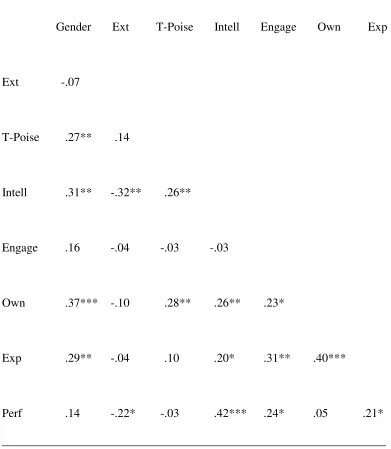
covariance matrix describing relationships between variables in the model (see Table
1 for the corresponding correlation matrix).
--- INSERT TABLE 1 HERE ---
The theoretical model was modified by freeing and then adding constraints
according to results of Lagrange Multiplier and Wald tests respectively [56].
Lagrange multiplier statistics for the run testing the theoretical model and a
second run, in turn, suggested the addition of direct paths linking gender and
computer ownership (indicating greater male ownership) and gender and intellectual
performance (males performing better). Examination of fit statistics confirmed that
addition of each of these links considerably improved the model’s fit to the data.
After adding the above two links, Wald tests resulting from repeated runs
suggested the presence of six redundant direct links. However, in the event, only the
first four of these links were removed (direct paths between extraversion and
engagement, experience and course performance, tough-poise and engagement, and
extraversion and course performance). The Wald tests’ suggestions of the removal of
not acted upon, since, though these links’ path coefficients were non-significant, their
deletion resulted in a marked decrease in CFI (CFI is preferred to chi-square, and
Bentler-Bonett normed and non-normed fit indices for models based upon small
sample sizes – [55, 56]).
The above process gave a non-significant chi-square value of 18.28 (df =17,
p=0.371), signifying a good fit between model and data. This was confirmed by a CFI
of 0.98: a value greater than the 0.90 acceptable as a minimum [56].
The partially data driven nature of the modified model (see Figure 2) demanded
some assessment of its validity. Here, correlation of parameter estimates present in
both the original and modified models revealed a high degree of correspondence
(Pearson’s r =0.99, df =15, p<.0005 – one-tailed). This showed that relationships
expressed in the modified model constituted a good reflection of those in the original
model, despite the post hoc alterations made [56].
While derived by maximum likelihood methods, the path coefficients reported
can be considered identical to ordinary least squares regression beta coefficients. In
the following verbal summary, all Pearson’s r coefficients are evaluated at 84 df for
one-tailed hypotheses.
--- INSERT FIGURE 2 HERE ---
Starting with gender differences, the observed correlation matrix revealed
significantly greater male tough-poise as hypothesized (r =.27, p<.05 – with males
prior to tough-poise, this relationship was modeled as a simple bivariate relationship
and the direct link in the model corresponded to the above Pearson’s r (p21=.27,
p<.05), resulting in explanation of around 7% of the variance in tough-poise (df
=1,84, p<.05).
Contrary to hypothesis, male computer engagement was not significantly
greater than that of females (r =.16, p>.05). However, though the link was
non-significant, retention of the direct gender – engagement path hypothesized in the
theoretical model (p51=.16, p>.05) made a substantial contribution to the fit between
the modified model and the data. But the small magnitude of this link meant that only
a very small portion of the correctly hypothesized greater male computer ownership (r
=.37, p<.0005) was attributable to gender differences in engagement (p51p65=.03).
Rather, a non-hypothesized direct gender - ownership link (p61=.34, p<.0005)
explained the bulk of the relationship between these two variables. Together, gender
and engagement explained roughly 17% of computer ownership’s variance (df =2,83,
p=.0005).
Further to the above, the hypothesized male advantage in computer experience
was observed (r =.29, p<.01), but the notion that this would largely be attributable to
gender differences in computer engagement causing gender differences in computer
ownership, and therefore experience, went unsupported, this effect being negligible.
Nearly half the magnitude of the gender - experience relationship was explained by
the indirect gender - ownership - experience path (p61p76=.12), ownership having a
strong relationship with experience as hypothesized (r =.40, p<.0005 and p76=.34,
p<.01). The remainder of the gender - experience relationship went unexplained.
Although computer engagement was represented as influencing experience via
the engagement – ownership component of this compound path not reaching
significance (p65=.18, p>.05). Nevertheless, engagement was positively related to
experience (r =.31, p<.01), and this was reflected in a direct link in the model as also
hypothesized (p75=.23, p<.01). In total, engagement and ownership accounted for
approximately 21% of the variance in experience (df =2,83, p=.0001).
Both extraversion (r = -.32, p<.01) and tough-poise (r =.26, p<.01) exhibited
bivariate relationships with intellectual performance and, as hypothesized, the model
contained direct links showing increases in intellectual performance with both
decreasing extraversion (p43= -.34, p<.001) and increasing tough-poise (p42=.25,
p<.05). Also, in one of the modified model’s two non-hypothesized links, male
intellectual performance was depicted as exceeding that of females (p41=.22, p<.05),
this reflecting the significant bivariate relationship (r =.31, p<.01). Around 24% of
intellectual performance’s variability was attributable to the above three variables
combined (df =3,82, p<.0001).
In contrast to their roles in explaining intellectual performance, the two
personality variables were not related to computer engagement: contrary to
hypotheses, null bivariate correlations showed that lesser extraversion (or increasing
introversion) and tough-poise did not make for greater engagement (r = -.04, p>.05
and r = -.03, p>.05 respectively). Consequently, the previously mentioned
(non-significant) effect of gender upon engagement (p51=.16, p>.05) constituted the only
direct effect on the latter variable, limiting the predicted variance in engagement to a
non-significant 3% (df =1,84, p>.05).
Finally, bivariate relationships existed between course performance and all
variables hypothesized to have direct effects upon it: r = -.22 (p<.05) for extraversion,
=.21 (p<.05) for experience. On the other hand, only intellectual performance
(p84=.43, p<.01) and engagement (p85=.25, p<.01) had direct links in the modified
model. Despite this latter link, there was minimal support for the hypothesized male
advantage in course performance via computer engagement (p51p85=.04), owing to
the non-significant gender – engagement effect. A large proportion of the negative
extraversion - course performance relationship was explained by an indirect effect via
intellectual performance (p43p84= -.15), while a precursory (or ‘spurious’) effect
arising from engagement’s direct links with both experience and course performance
(p75p85=.06) and a number of smaller spurious effects were enough to explain the
absence of a direct link between experience and course performance. By virtue of the
two direct links present, around 26% of the variance in course performance was
explained (df =2,83, p<.0001).
DISCUSSION
In considering the implications of the present research, the discussion is structured
around the themes of gender, personality and course performance.
As is usually the case for programming-oriented courses, males greatly
outnumbered females (by a ratio of seven to one). Towards the end of remedying such
imbalances, it is useful to tease out possible explanations as to what enabled the
present females to enroll in and persist with such a male dominated course.
Results supported the previous finding that the male advantage in computing
[e.g. 6, 7, 8] sometimes generalizes to computing specialists [5]. Findings were also
consistent with the non-computing specialist literature showing greater male computer
ownership [e.g. 11, 14, 16]. However, the merely marginal greater male computer
engagement which existed proved insufficient to explain the male ownership and
experiential advantages. Also then, the compound hypothesis of greater male
engagement leading to greater male computer ownership and subsequently to greater
computing experience went unsupported. The same was also true for the hypothesis
that there would be a male advantage in course performance by virtue of the greater
intrinsic motivation which higher male computer engagement would have signaled.
The observation of only a slight (non-significant) gender difference in computer
engagement contrasts with the more markedly positive male attitudes often found for
non-computing specialists [e.g. 9, 10, 11].
The failure of gender differences in engagement to explain greater male
computing experience suggests that, even where females are not averse to engaging in
computing activities, social factors may limit such activities. One way in which such
factors seem to act is via gender differences in computer purchasing. Here, the
non-hypothesized direct link expressing greater male ownership (rather than an indirect
gender – ownership link via engagement) indicates that factors such as gender
stereotyping of computers as objects to be purchased by and for males, rather than
gender differences in computing interest, can help to explain gender differences in
computer ownership which occur even among students starting to specialize in
computing.
Though computer ownership was depicted as directly influencing computing
experience, and ownership differences played a part in explaining experiential gender
that female ownership and experiential disadvantages did not produce a substantial
female deficit in course performance (and neither did the non-hypothesized male
advantage in intellectual performance which existed). It is possible though, to
envisage how lesser female ownership and experience might make enrollment in
programming-oriented courses appear a non-viable option to females less positively
computer engaged than those presently considered.
The observation that gender differences in computer ownership can occur in the
presence of minimal differences in computer engagement implies that at any
particular time there is likely to be a body of non-computer owning females with
reasonably strong positive attitudes to computers. The targeting of advertising at such
females might be lucrative for computer manufacturers. Such a marketing strategy
might de-emphasize issues which possibly reinforce female beliefs in computers as
objects stereotypically owned by males (e.g. issues surrounding computing power,
and graphics capabilities for game playing) and instead emphasize the machines’
usefulness for general applications. This follows from research showing females as
more likely than males to view computers as tools for performing tasks which are not
intrinsically computer-centered [9]. As well as proving profitable for the computing
industry, by increasing the number of female computer owners and thereby increasing
the number of females with greater computing experience, such a strategy could only
have positive benefits in reducing gender asymmetries in programming-oriented and
more technically-oriented applications courses (although, as discussed subsequently,
to have a major impact upon asymmetries in the former type of course, females would
still need encouragement to engage in programming activities). On the other hand, the
present negligible bivariate relationship between ownership and course performance
female course performance. The extent to which this null relationship was attributable
to previously non-computer-owning students purchasing a computer during the course
or because college computing facilities were adequate for non-computer-owning
students’ needs is unclear. Whatever the case, although greater computer self-efficacy
has been cited as a benefit of computer ownership [57], it seems that ownership at a
course’s outset does not necessarily translate into better course performance when
students are computing specialists.
While supporting the general literature on gender differences [23, 24], the
observation of greater male tough-poise was interesting in that, given their willingness
to enter a male dominated domain, the present females might have been assumed to
exhibit a more masculine position on the emotional sensitivity – tough-poise
continuum than females in general. The evidence that this is not the case is reinforced
by the observation that, though a subset of the present females exhibited greater
computer engagement than a group of females taking a non-programming-oriented IT
course with some technical components, the tough-poise of the two groups of females
did not differ [33].
Overall, the present results suggest that non-stereotypically positive female
computer attitudes, rather than possession of personality characteristics more
stereotypical of males, had a bearing upon females' enrollment in the present course.
It also seems that females displayed a real interest in the subject domain, and did not
simply enroll out of pragmatism associated with enhancing employment prospects [5].
Further study is needed to determine why some females develop highly positive
computer attitudes. In spite of the present conclusion that males enjoyed an advantage
in computing experience generally, the study contrasting the present females with IT
applications experience) in explaining the present females’ disposition towards
enrolling in a programming-oriented course. Since gender differences in the extent to
which males and females stereotype computing as a male activity have been identified
in children as young as four years old [17], developmental studies, focussing on issues
such as occupations, academic biases and pastimes of parents, could provide useful
pointers as to why some females display greater computer engagement and acquire
greater programming experience than other females. The observation that the present
females had previously studied fewer arts subjects, but not more science subjects, than
IT females [33], endorses the notion that an arts-oriented background biases some
females against enrolling in programming-oriented courses.
Turning away from gender issues, along with the other schizoid personality
dimension of introversion - extraversion, tough-poise exhibited a negligible bivariate
relationship with computer engagement. This did not support anecdotal writings [30,
31] and non-psychometric empirical observation [12] concerning the personality
characteristics of highly computer involved individuals. Another null finding was that
involving the possibility of greater computer ownership among more introverted
individuals because of greater computer engagement, the bivariate extraversion -
ownership relationship approaching zero.
The above fails to sustain the idea that, because of the opportunities which
computers present for non-social interaction, increasing introversion and tough-poise
leads to increasing computer engagement, and consequently greater computer
ownership, among programming-oriented students. Despite this, comparison of the
present students (male and female combined) with IT students revealed the present
students to display greater introversion but not tough-poise [33]. Thus, combined the
towards introversion, within groups of such individuals there is no relationship
between introversion and engagement. This raises the possibility of a threshold effect,
whereby above a certain level of computer engagement a negative extraversion –
engagement relationship disappears. Further investigation of the existence and
possible causes of this effect would be useful, as would research into the causes of
computer engagement more generally, in view of the small amount of variance
presently explained. As previously recommended with respect to females, such
research might concentrate on developmental issues surrounding art – science
orientation, especially since, though excluded from modeling on the grounds of
theoretical parsimony, a science attitude variable explained 14% of the variance in
engagement. This confirms previous work showing science - computing attitude
connections [18, 27].
While not related to computer engagement, both increasing tough-poise and
introversion made for better intellectual performance. This favors the notion that
students tending towards the schizoid personality type display sharper intellects
because of long-term engagement in reflective intellectual activities and because their
greater pride in intellectual skills results in higher motivation to perform well. Further,
intellectual performance was positively related to course performance. Hence, the two
hypothesized indirect effects of the schizoid personality factors upon course
performance via intellectual performance were both present, the intellectual bent and
greater motivation of the more schizoid individuals appearing to equip them better
with respect to the course’s demands. (However, there was a null bivariate
tough-poise - course performance relationship: a number of small paths in a saturated model
[not depicted] nullifying the indirect effect of tough-poise upon course performance
The bivariate relationship indicating superior course performance of relative
introverts, reflected in the negative extraversion – intellectual performance – course
performance path, was consistent with general research on the role of personality as a
determinant of higher education performance [37, 38], and some of the literature on
non-computing specialists [2]. But while greater introversion seemed to aid course
performance, the hypothesized direct linkage was absent from the modified model.
The lack of this direct linkage suggests that the oft found better educational
performance of introverts from the teenage years onwards might be the product of a
complex interplay between intellectual and motivational factors, rather than largely
resulting from more extraverted students neglecting study in favor of more arousing
pursuits as is sometimes mooted [40, 41]. With regard to this, it is important to
appreciate the significance of the idea that the more schizoid individuals were partly
hypothesized to exhibit better intellectual performance because of pride in their
intellectual skills. This implies that students’ perception of the importance of
performing well in intelligence / aptitude tests is a salient factor in determining the
magnitude of relationships between schizoid personality variables and performance
on such tests. Specifically, if much hinges upon test performance (e.g. if it is part of a
selection process or forms part of course assessment), then extrinsic motivation is
likely to result in better test performance on the part of students with greater
extraversion and lower tough-poise relative to voluntary testing situations where only
intrinsic motivation is likely to be important. In this latter situation (which pertained
here), students possessing more schizoid characteristics will still be motivated to
perform well (because of pride in their intellect). For these reasons, it can be
hypothesized that personality by situation interactions will lead to greater
the presence of only intrinsically motivating circumstances, and smaller relationships
in the presence of both intrinsic and extrinsic motivational factors. (Only in the latter
circumstances can we justifiably claim to measure the intellectual capacity / aptitude
of non-schizoid individuals: in the former situation only the intellectual performance
of such individuals is measured [36].)
The possible moderating effect of situational variables on the relationship
between schizoid personality factors and intellectual test performance is important
because lack of test-taking motivation on the part of some (less-schizoid) members of
a cohort will influence the size of relationships between scores on intellectual
measures and indices of educational outcomes. In particular, when intelligence test
outcomes are important to all individuals (e.g. when tests are used for selection
purposes etc.), the closer matching of motivational factors across the testing and the
educational situation would be expected to lead to higher test – course performance
correlations. However, despite the fact that such conditions were not presently met,
both the bivariate and path modeling results warranted the conclusion that intellectual
performance exceeded attitudinal, personality and experiential factors in the size of its
relationship with course performance. The connection between intellectual
performance and course performance was consistent with previous observations for
both specialist and non-specialist students [2, 34, 47].
The relatively stable nature of personality traits means that some (more
schizoid) students will tend to have an advantage over other (less schizoid) students
simply because of their nature, the intrinsic motivation which causes the former
students to perform well on tests also making them perform well on educational
courses. In addition to this general intellectually rooted intrinsic motivation, a second
to have been at work, this explaining the positive relationship between computer
engagement and course performance. For example, if a student finds learning about a
course’s subject matter intrinsically rewarding, they will devote greater time to it, and
will assimilate knowledge with less cognitive effort. Knowledge is even likely to be
accumulated during leisure hours, computing activities probably occupying much of
highly engaged students’ spare time. Indeed, the intrinsic motivation associated with
computer engagement and leading to greater computing experience probably
constitutes one reason why the hypothesized direct connection between experience
and course performance did not materialize, although, in common with previous
research on specialists and non-specialist students [47, 7, 46], a bivariate relationship
was observed. The modified model partially explained this in terms of computer
engagement’s positive relationships with both experience and course performance
(the positive computer engagement - experience link adds to other studies showing
attitude - experience relationships [e.g. 10, 58]). Thus, differences in computer
engagement, and therefore intrinsic motivation, were represented as leading both to
differences in computing experience and differences in course performance, and these
differences were seen as partially responsible for the relationship between experience
and computing course performance. However, bear in mind that the magnitude of the
residual coefficient, expressible as a direct experience – performance link in a
saturated model, was twice the size of the effect involving prior differences in
engagement, and in other situations a direct effect might occur. Specifically, the
course’s relatively long duration might have allowed early parts of the course to have
a buffering effect by providing less experienced students with skills already possessed
by their more experienced colleagues [7]. The direct effects of experience might be
To conclude, the present theoretical approach has resulted in many important
insights. Paying greater attention to theory can help us to be more selective in the
variables we use in our attempts to predict computing performance and to understand
mechanisms underlying predictivity. For example, it appears that a major construct
responsible for much of the present model’s predictive power is intrinsic motivation.
Future research might compare the predictive utility of a psychometric measure of
intrinsic motivation (tapping both general intellectual and computing-specific factors)
with the utility of more commonly used predictors. The present evidence suggests that
such a measure might be valuable, particularly in educational counseling situations
where there is no incentive for a student to give misleading answers. On the theme of
gender differences, female computer engagement was just as positive as that of males,
but females were less likely to own a computer and had less computing experience.
While this did not hinder the present females’ course performance, encouraging
greater female computer ownership and experience should lead to greater female
participation in technical computing courses, whether programming or
applications-oriented.
ACKNOWLEDGEMENT
The authors would like to thank Dr. Ian Christensen of the University of Manchester
REFERENCES
1. G.E. Evans and M.G. Simkin, What Best Predicts Computer Proficiency?,
Communications of the ACM, 32:11, pp. 1322-1327, 1989.
2. C.G. Petersen and T.G. Howe, Predicting Success in Introduction to Computers,
AEDS Journal, 12:Fall, pp. 182-191, 1979.
3. G.C. Fowler and L.W. Glorfeld, Predicting Aptitude in Introductory Computing:
a Classification Model, AEDS Journal, 14:2, pp. 96-109, 1981.
4. P.F. Campbell and G.P. McCabe, Predicting the Success of Freshmen in a
Computer Science Major, Communications of the ACM, 27:11, pp. 1108-1113,
1984.
5. A. Durndell, H. Macleod and G. Siann, A Survey of Attitudes to, Knowledge
About, and Experience of Computers, Computers and Education, 11:3, pp.
167-175, 1987.
6. I.T. Miura, The Relationship of Computer Self-Efficacy Expectations to
Computer Interest and Course Enrollment in College, Sex Roles, 16:5/6, pp.
7. V.A. Clarke and S.M. Chambers, Gender-Based Factors in Computing
Enrollments and Achievement: Evidence From a Study of Tertiary Students,
Journal of Educational Computing Research, 5:4, pp. 409-429, 1989.
8. T. Busch, Gender, Group Composition, Cooperation, and Self-Efficacy in
Computer Studies, Journal of Educational Computing Research, 15:2, pp.
125-135, 1996.
9. M.E. Lockheed, Women, Girls, and Computers: A First Look at the Evidence,
Sex Roles, 13:3/4, pp. 115-122, 1985.
10. M.C. Kernan and G.S. Howard, Computer Anxiety and Computer Attitudes: An
Investigation of Construct and Predictive Validity Issues, Educational and
Psychological Measurement, 50, pp. 681-690, 1990.
11. A. Durndell, P. Glissov and G. Siann, Gender and Computing: Persisting
Differences, Educational Research, 37:3, pp. 219-227, 1995.
12. M.A. Shotton, Computer Addiction?: A Study of Computer Dependency, Taylor
and Francis, London, 1989.
13. M. Gribbin, Boys Muscle in on the Keyboard: Girls and Information Technology,
In Educational Computing, E. Scanlon, and T. O’Shea (eds.), John Wiley,
14. L. Culley, Girls, Boys and Computers, Educational Studies, 14:1, pp. 3-8, 1988.
15. L.S. Klein, Female Students' Underachievement in Computer Science and
Mathematics: Reasons and Recommendations, in In Search of Gender Free
Paradigms for Computer Science Education, C.D. Martin and E. Murchie-Beyma
(eds.), International Society for Technology in Education, Eugene, 1992.
16. T. Busch, Gender Differences in Self-Efficacy and Attitudes Toward Computers,
Journal of Educational Computing Research, 12:2, pp. 147-158, 1995.
17. C.M. Fletcher-Flinn and T. Suddendorf, Computer Attitudes, Gender and
Exploratory Behavior: A Developmental Study, Journal of Educational
Computing Research, 15:4, pp. 369-392, 1996.
18. M.H. Mohamedali, D.J. Messer and B.(C). Fletcher, Factors Affecting
Microcomputer Use and Programming Ability of Secondary School Children,
Journal of Computer Assisted Learning, 3, pp. 224-239, 1987.
19. L. Temple and H.M. Lips, Gender Differences and Similarities in Attitudes
Toward Computers, Computers in Human Behaviour, 5:4, pp. 215-226, 1989.
20. N.J. Campbell and K.M. Perry, Sex and Ethnic Group Differences in High School
Students' Computer Attitudes and Computer Attributions, EDRS document
21. IPAT, Administrator's Manual for the 16 Personality Factor Questionnaire,
Institute for Personality and Ability Testing, Champaign, 1986.
22. N. Entwistle, Styles of Learning and Teaching, Fulton, London, 1983.
23. E.J. Phares, Introduction to Personality (Third Edition), HarperCollins, New
York, 1991.
24. P. Kline, Personality: The Psychometric View, Routledge, London, 1993.
25. J.P. Charlton, The Influence of Cognitive and Affective Factors on the Acquisition
of a First Computer Programming Language, M.Phil. Thesis, Bolton Institute of
Higher Education, 1992.
26. D.N. Jackson, R.R. Holden, R.H. Locklin and E. Marks, Taxonomy of Vocational
Interests of Academic Major Areas, Journal of Educational Measurement, 21:3,
pp. 261-275, 1984.
27. J. Voogt, Computer Literacy in Secondary Education: The Performance and
Engagement of Girls, Computers and Education, 11:4, pp. 305-312, 1987.
28. J. Weizenbaum, Computer Power and Human Reason, Penguin, London, 1984.
30. S. Levy, Hackers, Penguin, London, 1994.
31. R.S. Davidson and P.B. Walley, Computer Fear and Addiction: Analysis,
Prevention and Modification, Journal of Organizational Behavior Management,
6:3/4, pp. 37-51, 1984.
32. A.S. Reber, The Penguin Dictionary of Psychology, Penguin, Harmondsworth,
1985.
33. J.P. Charlton and P.E. Birkett, Psychological Characteristics of Students on
Programming-Oriented and Applications-Oriented Computing Courses, Journal
of Educational Computing Research, 18, in press.
34. T.R. Hostetler, Predicting Student Success in an Introductory Programming
Course, SIGCSE Bulletin, 15:3, pp. 40-43, 1983.
35. M.A. Hudak and D.E. Anderson, Formal Operations and Learning Style Predict
Success in Statistics and Computer Science Courses, Teaching of Psychology,
17:4, pp. 231-234, 1990.
36. H.J. Eysenck, Personality and Intelligence: Psychometric and Experimental
Approaches, In Personality and Intelligence, R.J. Sternberg and P. Ruzgis (eds.),
37. N. Entwistle and J. Wilson, Degrees of Excellence: The Academic Achievement
Game, Hodder and Stoughton, London, 1977.
38. R.M. Beard and I.J. Senior, Motivating Students, Routledge & Kegan Paul,
London, 1980.
39. H.J. Eysenck, The Biological Basis of Personality, C.C.Thomas, Springfield,
1967.
40. R.B. Cattell and P. Kline, The Scientific Analysis of Personality and Motivation,
Academic Press, London, 1977.
41. W. McCown and J. Johnson, Personality and Chronic Procrastination by
University Students During an Academic Examination Period, Personality and
Individual Differences, 12:5, pp. 413-415, 1991.
42. I.J. Deary and G. Matthews, Personality Traits Are Alive and Well, The
Psychologist, 6:7, pp. 299-311, 1993.
43. P.R. Newsted, Grade and Ability Predictions in an Introductory Programming
Course, SIGCSE Bulletin, 7:2, pp. 87-91, 1975.
44. C. Bishop-Clark and D.D. Wheeler, The Myers-Briggs Type Indicator and its
Relationship to Computer Programming, Journal of Research on Computing in
45. K.E. Pocius, Personality Factors in Human-Computer Interaction: A Review of
the Literature, Computers in Human Behavior, 7, pp. 103-135, 1991.
46. D.M. Kagan and L.R. Pietron, Cognitive Level and Achievement in Computer
Literacy, The Journal of Psychology, 121:4, pp. 317-327, 1987.
47. F.H. Dambrot, S.M. Silling and A. Zook, Psychology of Computer Use: II. Sex
Differences in Prediction of Course Grades in a Computer Language Course,
Perceptual and Motor Skills, 66, pp. 627-636, 1988.
48. R.H. Nowaczyk, The Relationship of Problem Solving Ability and Course
Performance Among Novice Programmers, International Journal of
Man-Machine Studies, 21, pp. 149-160, 1984.
49. Science Research Associates, Computer Programmer Aptitude Battery
Examiner's Manual (Third Edition), Science Research Associates, Chicago, 1985.
50. R.B. Cattell, H.W. Eber and M.M. Tatsuoka, Handbook for the 16PF, Institute
for Personality and Ability Testing, Champaign, 1970.
51. S.E. Krug and E.F. Johns, A Large Scale Cross-Validation of Second-Order
Personality Structure Defined by the 16PF, Psychological Reports, 59, pp.
52. P. Saville and S. Blinkhorn, British Undergraduate Norms to the 16PF (Forms A
& B), NFER, Windsor, 1976.
53. P.W. Oman, Identifying Student Characteristics Influencing Success in
Introductory Computer Science Courses, AEDS Journal, 19:Winter/Spring, pp.
226-233, 1986.
54. J.P. Charlton and P.E. Birkett, The Development and Validation of the Computer
Apathy and Anxiety Scale, Journal of Educational Computing Research, 13:1,
pp. 41-59, 1995.
55. P.M. Bentler, EQS Structural Equations Program Manual, Multivariate Software
Inc., Encino, 1995.
56. J.B. Ullman, Structural Equation Modelling, in Using Multivariate Statistics
(Third Edition), B.G. Tabachnick and L.S. Fidell, HarperCollins, New York,
1996.
57. P.A. Houle, Toward Understanding Student Differences in a Computer Skills
Course, Journal of Educational Computing Research, 14:1, pp. 25-48, 1996.
58. G.S. Howard and R.D. Smith, Computer Anxiety in Management: Myth or
Table 1 – Observed correlation matrix (Pearson's r) for the eight variables in the
theoretical path model.
Gender Ext T-Poise Intell Engage Own Exp
Ext -.07
T-Poise .27** .14
Intell .31** -.32** .26**
Engage .16 -.04 -.03 -.03
Own .37*** -.10 .28** .26** .23*
Exp .29** -.04 .10 .20* .31** .40***
Perf .14 -.22* -.03 .42*** .24* .05 .21*
________________________________________________________________
*p<.05, **p<0.01, ***p<.0005 (df =84, one-tailed)
Figure 1 – The theoretical path model
(Algebraic signs indicate nature of relationship hypothesized)
+
+
+
Tough- Poise
Extraversion
Intellectual Performance
Engagement
Experience
Course Performance M+
M+
+
+
+
+
+
_
.23** Gender Tough- Poise Extraversion Intellectual Performance Engagement Ownership Experience Course Performance
Figure 2 – The modified model
*p<.05, **p<.01, ***p=/<.0001
(significance levels for residuals are for the corresponding R2s)
.34***
.27*
E2 .96*
.34** .89***E7