Abstract:Cloud computing has caused a significant paradigm shift that has changed the way data and software applications are accessed. It is the set of disciplines, technologies, and business models used to deliver IT capabilities as an on-demand, scalable, elastic service. Although cloud computing offers a number of opportunities and benefits,, there is a need to understand the factors before making decisions about the adoption of cloud computing. The present study proposes and further delves into the cloud computing model, by exploring the impact of factors of cloud computing (based on TAM model) towards the intention of using cloud computing services in future by professionals. Discriminant Analysis through SPSS software was used for the prediction of usage related to cloud computing services considering four factors of the TAM model as independent variables. Our study shows that security, attitude, and usefulness are important predictors of using cloud computing services while ease of use is not a significant predictor. This study can be of help for the organizations which look forward to adopting cloud computing services and also can provide a base to cloud computing service providers to formulate their strategies accordingly.
Keywords: Cloud computing, Data centers, Security, Network, Infrastructure
I. INTRODUCTION
Through the quick advancement of handling and capacity innovations and the accomplishment of the web, registering resources take ended up being more affordable, more overwhelming n more inescapably available than whenever in ongoing recall. This powered example has engaged the affirmation of another enlisting model called disseminated registering, in which resources (e.g., CPU n limit) are set as commonbenefits that can be leased n released by customers through the Internet in an on-demand fashion. According to Kumar and Goudar (2012) and Nazir (2012), the cloud is a web space where services, technological capabilities, data, operating systems, uses, stockpiling, foundation, ntreatmentcontrolare on the web and are equipped to be mutual. Dispersed computing has caused a critical change in outlook that has changed the manner in which information n programming uses are gotten to n used (Gilbert, 2011).
Revised Manuscript Received on May 28, 2019.
Bharti Motswana, Balaji Institute of Modern Management, Pune, India
Bhuvneshwar Kumar Sharma, Balaji Institute of Modern Management,
Pune, India
Distributed computing is the arrangement of orders, advancements, and plans of action used to convey IT abilities (programming, equipment, individuals) as an on-request, versatile, flexible administration (Cloud Computing, 2011). Vaquero et al. (2009) considered 22 meanings of distributed computing n recommended that Clouds are an enormous pool of effectively usable and available virtualized assets (equipment, improvement stages as well as services).In a distributed computing condition, the conventional job of the authority association has isolated into two: the establishment providers who regulate cloud stages n lease resources as shown by an utilization based esteeming ideal, n master communities, who rent resources from one or various structure providers to serve the end customers. The entire appropriated figuring structure is subject to three obstructs that are stacked one over the other. At the base is Infrastructure-as-an administration (IaaS) that gives fundamental equipment parts (Central Processing Units (CPU's), memory, and capacity).The second is PaaS that gives programming designers a stage to creating, testing, sending and facilitating of web applications and at the top is Software-as-a-Service that gives prepared to utilize applications to associations. Dispersed computing administrations are demonstrating to be a resource for the associations. As indicated by cloud specialist organizations, the matter of distributed computing will increment numerous folds in not so distant future. Dispersed computing can perhaps turn into a lead in evolving a innocent, simulatedneconomicallyviable IT arrangement later on (Nazir, 2012). Rimai et al. (2009) suggested that cloud computing takes been considered as a knowledge which is aheadimpetus at a very disturbing rate. Ta-Tao et al. (2015) expressed that it has become the association to react to clients. Bricklayer and George (2011) communicated that the advancement of distributed computing may altogether influence the gathering and maintenance of computerized proof. As per Kumar and Goudar (2012), distributed processing exercises could impact the endeavors inside a couple of years as it can basically change IT.
Hence, Amazon, Google,
Salesforce, IBM,
Microsoft, n Sun
Prediction of Professionals Perception
Related to Usage of Cloud Computing
Services: Application of TAM Model
the world to offer overabundance n ensure steadfastness if there ought to be an event of site failures (Buyaa et al., 2009).
Veil computing is projected to variation the method organizations operate and is associated with obvious business benefits. However, in the event that the administrations are not conveyed in a legitimate way, at that point poor administration of these highlights can wreck the trade condition. In spite of the fact that distributed computing offers various chances and advantages,, we have to comprehend the variables before settling on choices about the reception of distributed computing (Solms and Viljoen, 2012). Shukla (2010) additionally proposed that however the capacity to plan, engineer, create, and actualize a bigger cloud-based framework can add value to life, but it is not easy to implement. This is the reason why the present study proposes and further delves into the cloud computing model, which is derived from the theoretical foundation of previous research in the theories of TAM. TAM is constructed on the foundations of perceived practicality, professedcomfort of practise, perceived safetyn perceived attitude and these factors were considered as important independent factors to influence the results from cloud computing.
II. CONSTRUCT DEVELOPMENT AND FRAMING OF HYPOTHESIS
Associations affecting their administrations to the cloud must know about the difficulties and dangers that they may look on verifying touchy data, exchange insider facts, managing privacy, uprightness, n accessibility issues, information misfortune, and framework blackouts because of assaults from programmers. Badamas (2012) lays importance on data security concerns especially confidentiality and integrity of data, which can derail the future of public cloud computing n Kamara and Lauter (2010) identified processes that could be utilized to support the certainty of existing cloud clients and draw in potential users. Perceived security is associated with the risk that users are exposed to when they are using cloud computing services. The different type of risks includes financial risk (monetary loss due to incorrect services), time risk (amount of time lost while using cloud computing), psychological risk (feelings of frustration or anxiety in using the cloud services) and privacy risk (when organizations confidential information is transmitted to unintended destinations). Gilbert (2011) recommends that associations want to focus on legally binding and consistence matters while executing cloud advancements n administrations.
Mujahidi et al. (2014) and Ryan and Falvey (2012) expressed that organizations have strong anxieties about the safety of their informationn they are hesitating to take initiatives in the deployment of their businesses. According to Pancholi and Patel (2016) also, security of the data in the cloud DB attendant is the lock territory of worry in the acknowledgment of cloud, since it wants an extremely high level of privacy and authentication. Monjur and Mohammad (2014) expressed that figuring method are legitimately relative to its existing focal points. The hazard increments
and long-term viability are also some issues that need to be tended to for distributed computing. It ought to be ensured that the information put on the cloud will never end up invalid. Severalusesnfacilitiescan’tbe stimulated to the cloud. In this manner, administration supportability can be trying for the venture. Applications that require broad reconciliation with other inward assets of the association won't be a best alternative to transfer to the cloud.
Cloud-created administrations are inclined to numerous assaults like phishing, sniffing, listening stealthily and so on. One of the significant assaults on the cloud specialist organization is Distributed Denial of Services assault. (Vidhya, 2014; Wang et al., 2014) which is a digital assault, propelled by an enormous group of associated gadgets broadly known as botnets and these ambushes may keep going for a considerable length of time, weeks or smooth months creation it ruinous for any online association. Multi-occupancy n detachment is in like manner a significant estimation in the cloud safety issue that wants a upright course of action after the SaaS layer down to physical framework (Morsy et al., 2010). Since organizations convey every one of the information (private or non-secret) on the cloud, consequently, the delicate data is submitted to the cloud supplier. This creates it simpler for an interloper to get to the data that is available in the cloud. The area of capacity is obscure in the cloud atmosphere. Hence, companies can face a security threat issue (Kavitha, 2014; Ting et al. 2016; Apostu et al., 2015). Hence, it is reasonable to assume that: H1 - Perceived Security is a good predictor of using cloud
computing services.
Distributed computing model can assist associations with surviving in an intense monetary atmosphere, furnishing with the most recent business instruments and giving you access to cutting edge innovations at a small amount of the expense of acquiring and running similar frameworks in-house. It liberates ventures after the limitations of the customer/server ideal, where in advance interests in framework are necessary to seek after mechanical answers for trade issues. Developing markets, little urban areas, and private ventures have as much access to the advantages of distributed computing as enormous undertakings or created countries. The accessibility of private IT cloud benefits as an alternative where open cloud IT administrations are not completely accessible or where there are framework challenges is a pleasant support for developing marketplaces Distributed computing nFacilities have numerous incredible highlights (Craig and Steve, 2009). Appropriation and organization of these administrations for SMEs have amazed the creation. Iyer and Henderson (2010) have the supposition that the primary motivation behind distributed computing and administrations is to decrease multifaceted nature, limit costs, and improve authoritative agility. Distributed computing empowers associations to burn through cash just on administrations that they really get and expend with the additional adaptability of altering the number of resources they
need as their circumstance varies. Associations
administrations don't likewise need to claim equipment and all expenses related with it (Smith, 2009). Since companies hurtafterfinancialindecision and the price of emergingnupholding the IT substructure is difficult to maintain.
The distributed computing model dispenses with the expense of conveying, procuring, and keeping up figuring power. Cloud frameworks improve the capability of associations to build productivity over the decrease in interests in capital resources, IT upkeep prices, n direct work costs (Brendl, 2010). Janakiramm (2010) shared that cloud very well suits growing business people as they can profit by 'versatile' wildlife of Cloud by disbursing for what they truly usage.
Cloud registering server gives the capacity and the data, which is effectively open to the workers anyplace and whenever and adds to the joint basic leadership process (Kavitha, 2014). Finger (2009) states that when little n medium sized organizations study of the possible advantages of distributed computing, they will almost certainly tap IT foundations, stages, and programming that just tremendous ventures could send previously. Throughout the world, organizations and governments are holding onto distributed computing as an approach to decrease cost, adjust to the recurring patterns of market requests, streamline access to data, and substantially more (Gilbert, 2011). Distributed computing changes over the expense of obtaining the most recent equipment innovation and programming redesigns from occasional, enormous capital uses to unsurprising, month to month, fixed working costs (Glaser, 2011).
Cloud computing delivers the services in the shortest time and thus provides agility to procure the business needs. Monetarily, the principle intrigue of distributed computing is that clients just use what they need, and pay for what they really use. Assets are accessible to be gotten to from the cloud whenever, and from any area by means of the web. Henceforth, distributed computing has additionally been called utility figuring, or 'IT on interest'. This new, online age of registering uses remote servers housed in profoundly secure server farms for information stockpiling and the executives, so associations never again need to buy and take care of their IT solutions in-house.
As indicated by Ting et al. (2016), distributed computing gives bother free administration as the administration is truly adaptable. It additionally empowers the versatility of assets because of its quick flexibility highlight. Clients can begin with few assets and increment the processing administrations as and when required. The need to invest widely inclusive energy in precise anticipating of things to come assets is kept away from. Additionally, the time spared in building up the assets by the clients can be utilized in understanding the business estimation of their thoughts. It additionally settle the issues and accomplish consumer loyalty. Investigation of the colossal measure of information winds up simpler with distributed computing. Distributed computing likewise benefits the association regarding serenity of usage. There are different mechanical headways
accessible around the world. Distributed computing has a focused edge over every one of these developments as it can without much of a stretch be executed by some kind of business. In adding, the method of saving the informationdevelopsfarinformalsince the cloud (Apostu et al. (2015). Distributed computing administration likewise starts the simplicity of keeping up reinforcement and recuperation. Information is put away in the cloud n not on a animal gadget. The cloud supports in putting away enormous measure of information and encourages information recuperation.According to Chaudhary and Vithayathil (2013), infrastructure services should in an organization and highly discernedfacilities such as cloud-createdinitiative-variedinitiativereservedevelopment or tradeacumen are offered under the profit-center structure. To summarize, cloud computing improves business efficiency, effectiveness, n transformation (Müller et al., 2015).
Based on these arguments, the different hypotheses corresponding to other independent variables of the TAM model are formulated as:
H3 - Perceived Attitude is a good predictor of using cloud
computing services.
H3 - Perceived Ease of Use is a good predictor of using
cloud computing services.
H4 - Perceived Usefulness is a good predictor of using cloud
computing facilities.
III. RESEARCH METHODOLOGY
The study plans to investigate the effect of variables of distributed computing towards the expectation of utilizing distributed computing administrations later on by specialists. The objective of investigativestudy is to examine or look for through an issue or situation to give information and cognizance (Kothari, 2004). A self-organized survey motivated by the scale created by Venkatesh, Morris and Davis (2003) in their well known article on the UTAUT. The questionnaire comprises of 18 items for independent variables based on five points Likert rule anchored afterpowerfully disagree to strongly agree. Four factors of cloud computing related to TAM model were considered as independent variables specificallyprofessed ease of usage, professedworth, seen safety and saw mentality. Out of which saw frame of mind was estimated utilizing 5 things, saw value was estimated utilizing 4 things, saw convenience was estimated utilizing 4 things and saw security was estimated utilizing 5 things. The nonprobability judgmental inspecting technique was utilized for the accumulation of essential information from 565 respondents belonging to139 organizations (91 SME and 48 Large Enterprises). The Cronbach alpha for all the four factors of the TAM model is observed to be 0.74 showing great consistency between the things and consequently the poll is viewed as dependable.
Reliability Statistics Cronbach's
Alpha N of Items
influences as independent variables n the dependent variable was usage meaning which is a triflingmutable with dual levels of groups i.e 1= use cloud computing services and 2= not use the cloud services.
Discriminant examination is a parametric strategy to figure out which weightings of measureable factors or indicators top separate among at least 2 than 2 gatherings of cases and do as such superior to risk (Cramer, 2003). The examination makes a discriminant work which is a direct blend of the allowancesnmarks on these factors. The most extreme amount of capacities is either the quantity of indicators or the quantity of gatherings less one, either of these two qualities is littler.
𝑍𝑗𝑘= 𝑎 + 𝑊1𝑋1𝑘+ 𝑊2𝑋2𝑘+ ⋯ … … . +𝑊𝑛𝑋𝑛𝑘
where:
𝑍𝑗𝑘 = Discriminant Z score of discriminant function j for
object k. a = Intercept.
𝑊𝑖= The Discriminant coefficient for the Independent
variable i.
𝑋𝑖𝑘= Independent variable i for object k.
IV. RESULTS AND DISCUSSION
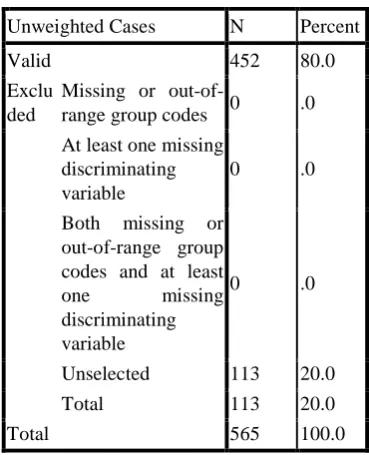
The information was broke down utilizing the enter technique for discriminant examination in the factual bundle SPSS Statistics 16.0. The information was separated into two segments in the 80:20 proportion. The 80% of the dataset (452 observations) was considered for analysis and 20% of the dataset (113 observations) was considered for determining the accuracy of the model. A irregularthought of factors that might be significant can be gotten by examining the gathering incomentypicaldeviances. On the
the gathering measurements mean qualities obviously demonstrate that there is a huge division between all the indicators inside one another. The methods for all the free factors: handiness, convenience, security and frame of mind for both the gatherings are essentially extraordinary. Aside from this, a similar relationship has been set up in Tests of fairness of Group Means Table where the various four indicators have a factually huge distinction. The pooled inside gathering grid (see table 2) likewise sets up the way that the intercorrelations among every one of the factors are low and measurably unimportant. Hence, we can apply discriminant analysis on the data set
Analysis of Case Processing Summary
Unweighted Cases N Percent
Valid 452 80.0
Exclu ded
Missing or
out-of-range group codes 0 .0 At least one missing
discriminating variable
0 .0
Both missing or out-of-range group codes and at least
one missing
discriminating variable
0 .0
Unselected 113 20.0
Total 113 20.0
Total 565 100.0
Table 1 . Mean Values, Test of Equality of Group Means
Mean Value Mean Value
Wilks' Lambda F df1 df2 Sig.
EaseofUse 16.94 16.67 .995 2.055 1 450 .152
Usefulness 14.84 10.48 .701 191.551 1 450 .000
Attitude 19.01 11.32 .446 558.638 1 450 .000
[image:4.595.312.497.243.471.2]Security 19.78 12.06 .457 533.800 1 450 .000
Table 2 . Pooled Within-Groups Matrices
EaseofUse Usefulness Attitude Security
Correlation EaseofUse 1.000 .204 .049 -.017
Usefulness .204 1.000 .345 .259
[image:4.595.50.553.505.826.2]Table 2 . Pooled Within-Groups Matrices
EaseofUse Usefulness Attitude Security
Correlation EaseofUse 1.000 .204 .049 -.017
Usefulness .204 1.000 .345 .259
Attitude .049 .345 1.000 .286
Security -.017 .259 .286 1.000
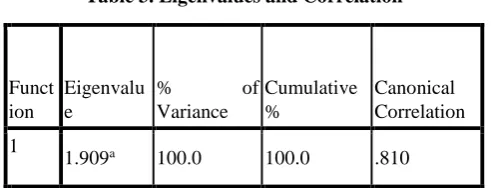
[image:5.595.304.556.265.359.2]The greatest amount of discriminant capacities is equivalent to the quantity of gatherings in the reliant variable less one, or the quantity of factors in the examination, whichever is littler. In our examination, the greatest number of discriminant capacities is one. The accepted relationship is the different connections be tween’s the indicators and the discriminant work. With just a single capacity, it gives a file of by and large ideal fit which is translated like to the range of fluctuation explained ( R^2). Here, a sanctioned relationship of 0.810 (allude Table3) proposes the model clarifies 65.6% (square of accepted connection) of the variety in the gathering variable High standard esteem portrays the great in general attack of the examination, which in our discoveries is moderately great.
Table 3. Eigenvalues and Correlation
Funct ion
Eigenvalu e
% of
Variance
Cumulative %
Canonical Correlation 1
1.909a 100.0 100.0 .810
a. First 1 canonical discriminant functions were used in the analysis.
Wilks' lambda demonstrates the criticalness of the discriminant work. The table 4 underneath demonstrates an exceedingly noteworthy capacity (p = .000, which is under .05, n we acknowledge the Worthless Hypothesis).The bring down the Wilks' lambda the well is the ideal.
Table 4 . Wilks' Lambda
Test of
Function(s)
Wilks'
Lambda Chi-square df Sig.
1
.344 478.403 4 .000
Further, we thought about the exactness amount for the holdout test which is 80% in our examination the by chance precision amounts. In the table of Prior Likelihoods for Sets, we see that the two gatherings limited .56, and .44 extent of the example of 452 cases recycled to determine the discriminant ideal.
The relative shot principles for surveying section fit is determined by summing the squared extent of the example
that each set represents, we get
0.56*0.56+0.44*0.44=0.50.In light of the prerequisite that section precision is 25% superior to the shot criteria, the normal to use for contrasting the sections exactness is 1.25 x 0.50= 0.625 which is 62.5%. Our section precision rate of 96.5 % surpasses this normal.
[image:5.595.44.290.424.518.2]The most extreme shot principles utilize the extent of bags in the biggest gathering, 0.56 in this issue. In light of the necessity that model exactness is 25% superior to the possibility principles, the ordinary to usage for looking at the sections precision is 1.25 x 0.56 = 0.70 which is 70%. Our model precision rate of 96.5% surpasses this normal.
Table 5 . Classification Resultsa,b
Intentio n
Predicted Group Membership
Total
1 2
Cases Selected Original Count 1 239 15 254
2 22 176 198
[image:5.595.55.560.648.829.2]Cases Not Selected Original Count 1 72 1 73
2 3 37 40
% 1 98.6 1.4 100.0
2 7.5 92.5 100.0
a. 91.8% of selected original grouped cases correctly classified. b. 96.5% of unselected original grouped cases correctly classified. As appeared, in the order table 5, the prescient precision of the section for the investigation test was 91.8 % n the holdout test was 96.5% separately. The qualities demonstrate that the hit proportion of 96.5% for the holdout test surpassed both the most extreme n relative possibility esteems. The forecast precision is additionally made a decision by press Q insights, the equation for press Q is
Press Q = (N−n∗k)2
𝑁∗(𝑘−1)
Where:
Q 2 with 1 degree of freedom.
N = Total sample size.
n = Number of observations correctly classified, k= number of groups.
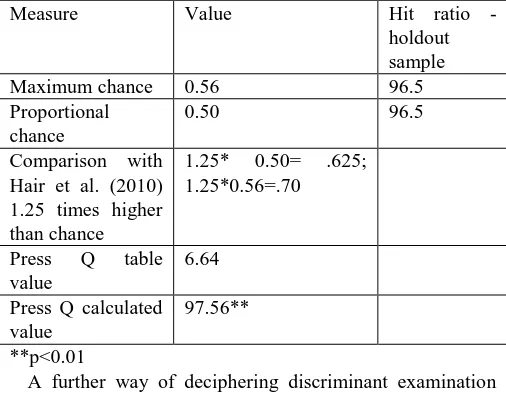
[image:6.595.44.563.50.135.2]Replacing the qualities for this issue (all out unselected 113 cases, 109 right groupings, and 2 gatherings), we get press Q = [113 - (109 x 2)] ^ 2/113 * (2 - 1) = 97.56. This esteem surpasses the basic Chi-square esteem 6.64 with a level of opportunity one. In this way, we reason that the forecast exactness is more prominent than that normal by some coincidence. By every one of the three principles, we must translate our a precision above than anticipated by some coincidence. Hence, this is an important or helpful model that bolsters expectations of the needy mutable (Table 6).
Table 6 . Comparison of the goodness of results
Measure Value Hit ratio -
holdout sample
Maximum chance 0.56 96.5
Proportional chance
0.50 96.5
Comparison with Hair et al. (2010) 1.25 times higher than chance
1.25* 0.50= .625; 1.25*0.56=.70
Press Q table value
6.64
Press Q calculated value
97.56**
**p<0.01
A further way of deciphering discriminant examination results
is to depict each assembling the extent that its outline,
using the social occasion strategies for the marker factors. These social event infers are termed as Centroids. These are appeared in the Group Centroids table. In our investigation, the positive aim to utilize has a mean of 1.217 while negative goal has a malicious of – 1.562. Luggage with marks near Centroids are anticipated as having a place with that gathering.
Intention of the cutting score:
For unequal groups the formula for finding cutting scores is
𝑍𝑐𝑠=
𝑁𝐴𝑍𝐵+ 𝑁𝐵𝑍𝐴
𝑁𝐴+ 𝑁𝐵
Where:
𝑍𝑐𝑠 = Optimal cutting score between group A and B.
𝑁𝐴= Number of observations in group A=254
𝑁𝐵= Number of observations in group B=198
𝑍𝐴= Centroid for Group A= 1.217
𝑍𝐵= Centroid for Group B= -1.562
Along these lines, the cutting score in our investigation is Z_cs= - 0.344
Therefore the defendantrecording Z score more than - 0.344 will have a place with gathering one which implies that the intention is positive whereas those who score less than -0.344 has negative intention.
The Institutionalized Canonical Discriminant Function Coefficients offers a file of the like the institutionalized relapse coefficient. As per which the variable security has the most astounding positive score of 0.588 and thus can be considered as the strongest predictor. Since all the variables have positive scores n in this manner are considered as effective indicators. Various experts use the construction grid connections since they are seen as more accurate than the Standardized Canonical Discriminant Function Constants. The structure grid table demonstrates the connections of every factor with each separate capacity. These Pearson numbers are constructionconstants or loadings. They help like calculate loadings factor investigation. By distinguishing the biggest loadings for each separate capacity, the scientist picks up knowledge to build up the capacity. In our examination, mentality is positioned first with the most noteworthy stacking of 0.806 pursued by security with the stacking of 0.788. The contentions above are bolstered by the outcomes known in
table 7
Functions at Group Centroids
INTENTION
[image:6.595.42.295.512.711.2]TABLE 7 . DISCRIMINANT FUNCTION COEFFICIENTS Independent
variable
Unstandardized Canonical Discriminant Function Coefficients
Standardized Canonical Discriminant Function Coefficients
Discriminant loading (rank) Structure matrix
Univariate F ratio
Sig
EaseofUse .004 .007 0.049(4) 2.055 0.152
Usefulness .034 .111 0.472(3) 191.551 0.00**
Attitude .175 .599 0.806(1) 558.638 0.00**
Security .167 .588 0.788(2) 533.800 0.00*
(Constant -5.962 ** p <0.01
The un-standardized authoritative discriminant work coefficients are used to create the discriminant work (condition). It works simply like a relapse condition. In this examination, we have:
D = (0.034 X Usefulness) + (0.004 X Ease of Use) + (.175 X Attitude) + (0.167 X Security) + (-5.962)
The discriminant effort constants b or established structure beta together demonstrate the imperfect commitment of each factor to the separate capacity regulatory for each condition aside from Ease of Use. It very well may be seen from the table that frame of mind has the most elevated significance and is rank first. Security and Usefulness are ranked second and third respectively and are also considered as significant variables. Ease of Use does not contribute to the intention of marketing professional. In this way, every one of the qualities are critical with the exception of convenience and they can be utilized to survey every indicator's one of a kind commitment to the segregate work and consequently give data on the general significance of every factor.
On the foundation of the training we can see F value for Attitude, Security and Usefulness was found to be 558.638, 533.800 and 191.551 respectively with p<0.01(denote table
7). So, we receiveH1 H2 and H4 which shows that Security,
Attitude, and Usefulness are good predictors of intention to continue using cloud computing services. In our study, H3 is
not accepted indicating that Comfort of Use is not a good forecaster of meaning to continue cloud computing services. In accordance to our study, Muhammed et al. (2016) revealed that the selection of distributed computing has helped in bringing down expense for most associations utilizing the cloud innovation, arrangement of on-request self-administration, getting to various significant applications from the cloud specialist organization and it is very proficient, solid and more verified.
V. CONCLUSION
When the growth of the business, there is a growth in the requirement of information technology (IT). The scalability nhustle of placement offered by cloud computing help us to expand IT provision instantly to see increased requirements. Our study shows that safety, attitude, and usefulness are important predictors of
using cloud computing services while ease of use is not a significant
1 1.217
and can change the perception of professional linked to practise of cloud computing services to a great extent. Also, the user’s attitude towards the adoption and usage of new technologies and usefulness of these new technologies will have an impact on their decision associated to services in organizations. Our study revealed that ease of use is not a importantissue for determining the usage of cloud computing services in the future. The outcome seems to be obvious because using cloud computing services is not very different from using computers. Since, all the people in the present world are using computers at a great scale, hence this cannot be truly considered as a significant variable. This study can be of help for the organizations which look forward to adopting cloud computing services and also can provide a base to cloud computing service providers to formulate their strategies accordingly
VI. LIMITATIONS
Our study proposes that the model clarifies 65.6% of the variety in the gathering variable. There is a degree to find revealed factors which are a piece of 34.4% of the variety. Oneself composed survey was expected for the reason and respondents for the review were taken from India. The examination could have logically strong and would have yield different results if the target statistic was more extensive than now. Like each examination including human criticism, there is dependably a major space for inclination. Defendants could takeset false information in light of the view that it might reflect their character. Regardless, growing test size n respondent aftershifting socioeconomics will empty this restriction.
REFERENCES
1. Apostu, A. , Puican,F., Ularu, G.,Suciu,G.,Todoran, G. (2015) Study on advantages and disadvantages of Cloud Computing – The advantages of Telemetry Applications in the Cloud. Recent Advances in Applied Computer Sciences and Digital Services, 118-123. 2. Buyyaa, R.; Yeoa, C.S., Venugopala, S. , Broberg, J., Brandic, I.
(2009). Cloud Computing And Emerging It Platforms: Vision, Hype, And Reality for Delivering Computing as the 5th Utility. Future Generation Computer Systems 25, 599-616.
3. Badamas, M.A. (2012). Data Security Concern in Public Cloud Computing.International Journal of Strategic Management, 12(1), 122-129
4. Brendl, D. (2010). Don’t cloud your compliance data. Control Engineering, 57(1), 1-23.
5. Choudhary V. And Vithayathil, J. (2013). The Impact of Cloud Computing: Should the IT Department Be Organized as a Cost Center or a Profit Center? Journal of Management Information Systems, 30(2), 67–100., 0742–1222.
6. Cloud Computing. (2011). Cloud computing in higher education. Retrieved from:
https://www.workday.com/landing_page/whitepaper
7. Craig, D. W., and Steve, B. (2009). The Design of the force.com Multitenant Internet Application Development Platform. Proceedings of the 35th SIGMOD International Conference on Management of Data, USA.
8. Fingar, P. (2009). Dot Cloud: The 21st Century Business Platform on Cloud Computing. Meghan-Kiffer Publishing, Tampa, Florida. 9. Gilbert, F. (2011). Cloud service providers as joint-data controllers.
Journal of Internet Law, 15(2), 3-13.
10. Glaser, J. (2011). Cloud computing can simplify HIT infrastructure management. HealthcareFinancial Management, 65(8), 52-55.
Quarterly Executive, 117-131.
12. Janakiramm (2010). Cloud Computing: What's in it for you?'. Cloud Computing Strategist, Retrieved from www.janakiramm.net on 29th oct’2017
13. Kamara, S. and Lauter, K. (2010). Cryptographic Cloud Storage. Proceedings of FinancialCryptography: Workshop on Real-Life Cryptographic Protocols and Standardization
14. Kavitha, K. (2014). Study on cloud Computing Model and its Benefits Challenges. International Journal of Innovative Research in Computer and Communication Engineering, 2(1).
15. Kumar, S. and Goudar, R.H. (2012). Cloud Computing – Research Issues , challenges, Architecture , Platforms and Applications : A Survey . International Journal of Future Computer and Communication, 1(4).
16. Mason, S. and George, E. (2011). Digital Evidence and Cloud Computing. Computer Law & Security Review,
17. Monjur, A.. and Mohammad, A. (2014). Cloud Computing and Security Issues In the Cloud. International Journal of Network Security and its Applications , 6.
18. Morsy, M., Grundy, J. and Müller,I. (2010) Analysis of The Cloud Computing Security Problem. In Proceedings of APSEC 2010 cloud workshop Sydney.
19. Muhammed, K. Zaharaddeen, I., Rumana, K. and Abdulkadir M. (2016). Cloud Computing Adoption In Nigeria: Challenges And Benefits. Proceedings:The Academic Conference of Mediterranean Research and Publications International on Sustainable Development, 4(1).
20. Mujahid, A. ,Mahmood, T., Iqbal, W.,Ali Mian, N. (2014). Comparative Analysis of Cloud Computing Security Issues. Vawkum Transactions on Computer Sciences, 3(2), 2308-8168.
21. Müller, S.D., Holm, S.R., Sebdergaard, J. (2015). Benefits of Cloud Computing: Literature Review in a Maturity Model Perspective. Communication of Association for Information System, 37- 32. 22. Nazir, M.(2012) Cloud Computing: Overview and Current Research
Challenges. IOSR Journal of Computer Engineering, 8(1), 2278-0661, 14-22.
23. Pancholi, V., Patel, B.P. (2016). Enhancement of Cloud Computing Security with Secure Data Storage using AES. IJIRST, 2(9), 2349-6010.
24. Rimai, B. P., Choi, E., and Lumb, I. (2009). A Taxonomy and Survey of Cloud Computing System. Fifth International Joint Conference on INC, IMS and IDC, 44-51.
25. Ryan, P. and Falvey, S.(2012). Trust in the clouds. Computer Law and Security Reviews.
26. Shukla, A. (2010). Cloud can deliver more efficient e-govemance in APAC, Analysis by IDCGovt. Insights, Network World, <URL:http://www.networkworld.com>
27. Smith, R. (2009). Computing in the Cloud. Research Technology Management, 52(5), 65-68.
28. Solms, R.V. and Viljoen, M. (2012). Cloud computing service value: A message to the board. S.Afr. Journal of Business Management , 43(4) 73-82
29. Ta-Tao, C., Kazuo, N. , Thoma, T. C. (2015). An Exploratory Study of Expected Business Value of Cloud Computing. Issues in Information Systems, 16(4), 37-47.
30. Ting Si Xue, Colin & Tiong Wee Xin, Felicia. (2016). Benefits and Challenges of the Adoption of Cloud Computing in Business. International Journal on Cloud Computing: Services and Architecture (IJCCSA).
31. Vaquero, L.M., Rodero-Merino, L., Caceras, J., and Lindner, M. (2009). A Break in the Clouds: Towards a Cloud Definition. ACM SIGCOMM Computer Communication Review, 50-55.
32. Vidhya, V., 2014. A Review of DoS Attacks in Cloud Computing. IOSR Journal of Computer Engineering, 16(5), pp. 32-35.