*Corresponding author: Jude Annie Cynthia V ISSN: 0976-3031
Research Article
DOMINATION PARAMETERS OF SPLIT GRAPHS
Jude Annie Cynthia V and Kannammal SP
Department of Mathematics, Stella Maris College (Autonomous), Chennai, India
DOI: http://dx.doi.org/10.24327/ijrsr.2018.0909.2733
ARTICLE INFO ABSTRACT
A set D of vertices in a graph G is a dominating set if every vertex not in D is adjacent to atleast one
vertex in D. The domination number γ(G) is the minimum cardinality of a dominating set of G. In
this paper we investigate certain domination parameters of cyclic split graph, uniform n-fan split graph, uniform n-wheel split graph and uniform n-star split graph.
INTRODUCTION
A subset of the vertex set in an undirected graph is a dominating set if every vertex not in is adjacent to atleast one vertex in . The theory of dominating sets was introduced formally by Ore and Berge and now it is one of the vast areas of research. This concept evolves in finding a team of representatives. For example in the problem of locating radar stations, a number of strategic locations are to be kept under observation. These form the dominating sets. Finding the minimum number of strategic locations form the minimum dominating set. We call this as domination number denoted as ( ). Domination number is the minimum cardinality of a dominating set of .
The concept of domination in graphs began in the mid of 1860s with the game of chess. The goal of the problem was to use certain chess pieces to dominate the squares of the chess board. Knowing that a queen can move horizontally, vertically or diagonally, de Jaenish in 1862 considered the problem of finding the minimum number of queens that can be placed on a chess board such that every square is either occupied by a queen in a single move. This is referred as the queens problem [3,18].
Total domination in graphs was introduced by Cockayne, Dawes and Hedetniemi. A dominating set of a graph is a total dominating set, if its induced sub graph has no isolated vertices. Alternately we define a set of vertices of an undirected graph as a total dominating set, if each vertex in V
is adjacent to some vertex of . The minimum cardinality of a total dominating set is the total domination number denoted by
( ) [11].
A dominating set of a graph is a connected dominating set, if its induced sub graph is connected. The minimum cardinality of a connected dominating set is the connected domination number denoted by ( )[18]. The study of connected domination has extensive application in routing problems.
A dominating set of a graph is an independent dominating set, if its induced subgraph has no edges. Alternately, we define a set of vertices of an undirected graph is an independent dominating set, if is an independent set and every vertex not in is adjacent to a vertex in .The minimum cardinality of an independent dominating set is the independent domination number denoted by ( ) [2].
A wheel is a graph obtained from the cycle ≥ 3 by adding a new vertex. A cyclic split graph has a complete graph with vertices , ,… and wheels , attached at each vertex in , such that , = + , , 1 ≤ ≤
International Journal of
Recent Scientific
Research
International Journal of Recent Scientific Research
Vol. 9, Issue, 9(B), pp. 28799-28803, September, 2018
Copyright © Jude Annie Cynthia V and Kannammal SP, 2018, this is an open-access article distributed under the terms of the Creative Commons Attribution License, which permits unrestricted use, distribution and reproduction in any medium, provided the original work is properly cited.
DOI: 10.24327/IJRSR
CODEN: IJRSFP (USA)
Article History:
Received 6th June, 2018
Received in revised form 15th
July, 2018
Accepted 12th August, 2018
Published online 28th September, 2018
Key Words:
1 ≤ ≤ . The deletion of the spokes of the wheel results in the disjoint union of the complete graph and independent cycles , , 1 ≤ ≤ and 1 ≤ ≤ where each cycle has vertices which are labeled as , , [6].
A fan graph , is defined as graph join + , where is an empty graph on nodes and is the path graph on nodes.A uniform n-fan split graph contains a star with hub at x such that the deletion of n edges of partitions the graph into n independent fans = + , 1 ≤ i ≤ n and an isolated vertex [14].
Let , 1 ≤ ≤ be thevertices of the complete graph . Let = + be the wheels with hubs , 1 ≤ ≤
respectively. Let ,1 ≤ ≤ be an edge. The graph constructed is called uniform n-wheel split graph and denoted
[5,14].
A star graph of order is a tree on nodes with one node having vertex of degree − 1 and the other − 1 vertices having degree one. A uniform n-star split graph contains a clique such that the deletion of edges of partitions the graph inton-independent star graphs . The number of vertices are ( + 1)[5].
It is well known and generally accepted that the problem of determining the domination number of an arbitrary graph is a difficult one. Because of this, researchers have turned their attention to the study of classes of graphs for which the domination problem can be solved in polynomial time.
In this paper we investigate total, connected and independent domination numbers of cyclic split, uniform -wheel split, uniform -fan split and uniform -star split graphs.
LITERATURESURVEY
Domination in graph theory is studied by Cockayne, Hedetneimi and Dawes [1, 3]. Jasintha Quadras et al. initiated the quest of finding the total bondage number and total domination number of windmill graph, friendship graph, circular necklace graph, helm graph, wheel graph [4]. A transversal in a hyper graph is a subset of vertices which intersects every edge. These edges are the neighbourhoods of the vertices of G. [16] reveal a traversal is a total dominating set.
The domination number of is almost the point-point covering of is explained in [15]. Results on complement of connected domination number is explained in [10]. W.J.Desormeaux et al. have defined when ( ) = and the diameter of a disconnected graph is empty then diameter 2-graph is a connected 2-graph [11].
The independent domination number of path, cycle and complete bipartite graph is found in [2]. The independent domination number of helm graph, web graph and wheel graph is determined in [17]. The domination number of G equals the independent domination number if G doesnot have an induced subgraph isomorphic to , . This interpretation is given by R.B.Allan et al. [13].
The local metric dimension of cyclic split graph has been investigated in [6]. The inverse domination number for cyclic split graph is determined by Jude Annie Cynthia et al. [8]. The cordial labelling and antimagic labelling of cyclic split graph is
investigated in [7, 9]. Pinnar Heggernes et al. have proved that disjoint paths remain NP-complete on split graphs [12]. S.Roy found the packing chromatic number of uniform fan and -wheel split graphs [14]. The average distance of uniform n-star split graph and uniform -wheel split graph is determined in [5].
Domination Parameters of Cyclic Split Graphs
Lemma3.1: ( ) ≤
Proof: Consider . Let denote the vertices of complete
graph and each is adjacent to n vertices in the wheel which are labeled as , , , = 1,2, . . . Each vertex dominates
, , , 1 ≤ ≤ ,1 ≤ ≤ , 1 ≤ ≤ . Also each dominates , where 1 ≤ ≤ . Thus the set of vertices where the indices are taken modulo forms a total dominating set. Hence the total domination number, ( ) ≤ .
Lemma 3.2: ( ) > − 1
Proof: Without loss of generality choose , … to be
the members of the total dominating set of C K . Then each dominates , . , 1 ≤ ≤ ,1 ≤ ≤ − 1,1 ≤ ≤ . The vertex is an isolated vertex in C K . This contradicts the statement a total dominating set has no isolated vertices. Hence there cannot be − 1 vertices comprising the total dominating set(i.e) γ ( ) = which means ( ) > − 1.
Theorem 3.1:The total domination number of the cyclic split
graph is ( ) = .
Proof: The proof follows from above two lemmas.
Theorem 3.2: The connected domination number of the cyclic
split graph is ( ) ≤ .
Proof: Let denote the vertices in the complete graph of
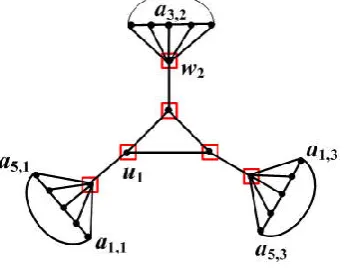
.The vertices of complete graph , , , … forms the dominating set of . The dominating set formed is itself connected. Hence we can say every dominating set of the cyclic split graph is a connected dominating set.
Remark: The induced sub graph of the vertices of the total
dominating set of is connected.
Fig 2 connected and total dominating set of cyclic split graph
Observation
1. The total dominating set and connected dominating set of are the same.
2. The cyclic split graph has (G)= (G) = (G) = r, for 1 ≤ ≤ .
3. Every connected dominating set is a total dominating set.
4. The total dominating set of is a connected dominating set.
Theorem3.3: The independent domination number of the
cyclic split graph is
( ) = ( − 1) + 1, for ≥ 5 and varying.
Proof: Consider the cyclic split graph . Choose to be a member of the dominating set D. Then dominates all the vertices of the cycle , , .Consider the wheels attached to a vertex , 2 ≤ ≤ . Let , , , 1 ≤ ≤ , 2 ≤ ≤ , 1 ≤
≤ be the set of vertices of the wheel , , 2 ≤ ≤ , 1 ≤
≤ attached at . Then the vertices , , dominates , ,
and , ,, where = 2,5, … − ( 3) − 1. If 3 =
1 2, then the vertex also belongs to the dominating set . Hence forms an independent dominating set and ( ) =
( − 1) + 1.
Fig 3 independent dominating set of cyclic split graph
Domination Parameters of Fan Split Graph, Wheel Split Graph and Star Split Graph
Let denote the vertices in a star and each , 1 ≤ ≤ is adjacent to m vertices in the fan labelled as ,, 1 ≤ ≤
, 1 ≤ ≤ .
Theorem4.1: The connected and total domination number of a
fan split graph is = = + 1.
Proof: Consider the fan split graph . Each vertex
dominates , , 1 ≤ ≤ , 1 ≤ ≤ . Thus the collection forms a dominating set. Deleting n edges of the star partitions into n-independent fans, , 1 ≤ ≤ and the isolated vertex . The collection and the isolated vertex form a total dominating set which is also connected. Hence
= = + 1.
Fig 4 connected and total domination number of SF
Theorem 4.2 The independent domination number of a fan split
graph is ( ) = , where 1 ≤ ≤ .
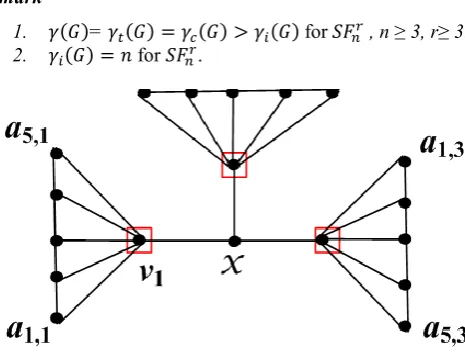
Proof: Consider the collection { , 1 ≤ i ≤ n}.We can see that
d( , ) = 2, for ≠ , 1 ≤ ≤ . Therefore { , 1 ≤ i ≤ n}
forms an independent dominating set. Hence γ (G) = .
Remark
1. ( )= ( ) = ( ) > ( ) for , n ≥ 3, r≥ 3.
2. ( ) = for .
Fig 5 independent domination number of fan split graph SF
Theorem4.3: The connected and total domination number of
is ( ) = ( ) = 2 . The independent domination number of a wheel split graph is ( ) = , where 1 ≤ ≤ .
Proof: Consider . Let ,1 ≤ ≤ n denote the vertices of
the complete graph and each is adjacent to , 1 ≤ ≤ .
Each is adjacent to k vertices ,. We can see that
d ( , ) = 3, for ≠ , 1 ≤ ≤ . Thus the collection
. The collection and forms a total dominating set which is also connected. Hence = = 2 .
Remark:
1. ( )= ( ) = ( ) > ( ) for , n ≥ 3, r ≥ 3
2. ( ) = for .
Fig 6 independent domination number of wheel split graph K W
Fig 7 connected and total domination number of wheel split graph K W
Theorem4.4:The connected and total domination number of a
star split graph is ( ) = ( ) = , for all .
Proof: Consider . Let , 1 ≤ n denote the vertices of the
complete graph . Each is adjacent to ,,1 ≤ ≤ , 1 ≤ ≤ n. Deleting all edges of results into -independent star graphs . Hence we observe that the n-vertices of clique are the total dominating set. This is also a connected dominating set. Hence ( ) = ( ) = .
Fig.8 connected and total domination number of star split graph
The independent domination number of a star split graph is ( ) = ( − 1) + 1
Proof: Consider the star split graph . Choosing to be a
member of the dominating set, it dominates all the vertices of .Consider the star attached to , 2 ≤ ≤ . Let ,,1 ≤ ≤ r, 2 ≤ ≤ be the set of vertices of the star attached at
, 2 ≤ ≤ . Then each ,, 2 ≤ ≤ individually dominate. Hence each , also belongs to the dominating set and
forms an independent dominating set. Thus ( ) = ( − 1) + 1.
Fig 9 independent domination number of star split graph
References
1. E.J. Cockayne and S.T. Hedetniemi, “Towards a Theory of Domination in Graphs”, Networks, vol.7, pp. 247-261, 1977.
2. W.Goddard and Michael A.Henning, ”Independent domination in graphs: A survey and recent results”, vol 313, issue7, pgs:719-732
3. T.W. Haynes, S.T. Hedetniemi and P.J. Slater, Fundamentals of Domination in Graphs, Marcel Dekker, New York, 1998.
4. Jasintha Quadras and A. Sajiya Merlin Mahizl, “Total Bondage Number of Certain Graphs,” IJPAM, vol. 87, No. 6, 863-870, 2013.
5. Jasintha Quadras, K.Arputha Christy, A.Nelson and S.Sarah Surya, “Average Distance of Certain Graphs,” IJMAA, vol.5, 373-381, 2017.
6. Jude Annie Cynthia and Ramya, “The Local Metric Dimension of Cyclic Split Graph,” Annals of Pure and Applied Mathematics, vol.8, No. 2, 201-205, 2014. 7. Jude Annie Cynthia, Ramya, Kavitha, “On Cordial
Labelling of Cyclic Split Graph”, International Journal of Pure and Applied Mathematics, Vol. 101, No. 6, pp 1063-1071 (2015).
8. Jude Annie Cynthia and Kavitha, "Inverse Domination Number of Cyclic Split Graph,” IJPAM, vol.109, No:9, 19-27,2016.
9. Jude Annie Cynthia, Sravya, “Antimagic Labeling of Cyclic Split Graphs”, Proceedings of International Conference on Applicable Mathematics, pp 70 (2016). 10. H.Karami and S.M.Sheikoleslami, Abdulla Khodkar,
D.B.West, ”Connected domination number of a graph and its complement”, National Security Agency
12. Pinar Heggernes.Pim van Hof .Erik Jan van Leeuwen.Reza Saei, “Finding Disjoint Paths in Split Graphs,”pp.315-326, Jul. 2015.
13. Robert B.Allan and RenuLaskar, "On the domination and independent domination numbers of a graph.” 14. S.Roy, “Packing chromatic number of certain fan and
wheel related graphs,” AKCE International Journal of Graphs and Combinatorics, 2016.
15. SampathKumar.E and Walikar.H.B., “The connected domination number of a graph,” vol. 13, No.6, 1979. 16. S.Thomasse and A.Yeo, "Total domination of graphs
and small traversals of hyper graphs”
17. S.K.Vaidya and R.M.Pandit, “Independent Domination in Some Wheel Related Graphs, "AAM, vol. 11(June 2016), pp.397-407.
18. Wyatt J.Desormeanx, Teresa W.Haynes, Michael A.Henning, ”Bounds on the connected domination number of a graph”, Discrete Applied Mathematics, vol 161,issue 18,pages 2925-2931
How to cite this article:
Jude Annie Cynthia V and Kannammal SP.2018, Domination Parameters of Split Graphs. Int J Recent Sci Res. 9(9), pp. 28799-28803. DOI: http://dx.doi.org/10.24327/ijrsr.2018.0909.2733