Vol. 2 (2012) No. 1 ISSN: 2088-5334
NN robust based-PID Control of A Two-Link Flexible Robot
Manipulator
Moh. Khairudin, Sudiyatno, Fatkhul Arifin
Engineering Faculty, Universitas Negeri Yogyakarta, Karangmalang, Yogyakarta, 55281, Indonesia E-mail: [email protected], [email protected], [email protected]
Abstract— This paper presents control of a two-link flexible robot manipulator. A planar two-link flexible manipulator that moves in the horizontal plane is considered. A dynamic model of the system is developed using an assumed mode methods. The NN robust
based-PID controller is used to reduce a nonlinearities problem that can be efficiently solved.The system responses namely hub
angular position, deflection and end-point acceleration responses at both links are obtained and analysed.
Keywords— Assumed mode; modelling; two-link flexible robot manipulator
I. INTRODUCTION
The main objectives of modelling of a two-link flexible manipulator are to achieve an accurate model representing the actual system behaviour. It is important to recognise the flexible nature and dynamic characteristics of the system and construct a suitable mathematical framework. Previous study utilising the assumed mode method (AMM) for modelling of a single-link flexible manipulator has shown that the first two modes are sufficient to identify the dynamic of flexible manipulators. A good agreement between theory and experiments has been achieved [1]. Dogan and Istefanopulos [2] have developed the finite element models to describe the deflection of a planar two-link flexible robot manipulator. The AMM have been utilised to derive a dynamic model of multilink flexible robot arms limiting to the case of planar manipulators with no torsional effects [3, 4]. A systematic approach for deriving the dynamic equations for n-link manipulator where two-homogenous transformation matrices are used to describe the rigid and flexible motions respectively has been presented by [5].
The challenges of two-link flexible manipulator control are exacerbated by the fact that control inputs as well as external disturbances induce flexural vibrations in the manipulator structures. A number of control methods have been proposed for control of two-link flexible manipulators. A PID controller for force and constrained motions of the flexible manipulator has been proposed by [7]. A combined PD control for vibration control of a single-link flexible manipulator using an array of fiber optic curvature sensors and piezoelectric transducer actuators have also been proposed [8]. A PD controller was also designed by [6],
whose purpose is to maintain stabilization of the robot system after the capture of the object. The dynamical simulations are carried out in two cases: the robot system is uncontrolled and controlled after impact. A learning controller and a feedforward controller for control of a two-link flexible manipulator system are shown by [9].
The tracking performance of the neural network (NN) controller is far better than that of the PD or PID standard controllers has been proofed by [10, 11]. Tian and Collin [12] show a good performance control using adaptive neuro fuzzy control of a single link flexible manipulator. Subudhi and Moris [13] developed a hybrid fuzzy neural control scheme for a multi-link flexible manipulator.
This is a challenging task for a MIMO system and the system behaviour is affected by several factors. This paper mainly presents the dynamic modelling and NN control of a two-link flexible robot manipulator incorporating payload. The payloads are attached at the end-point of the second-link whereas hub inertias are considered at the actuator joints. Simulation of the dynamic model is performed in Matlab and Simulink. The rest of the paper is structured as follows: a brief description and modelling of the two-link flexible manipulator system considered in this study, introduces the NN and the controller constraints taken into account. Then simulation results comparing the performance of the NN based PID controller with the Ziegler-Nichols (ZN) PID case numerically are also presented.
II. DYNAMIC OF ATWO-LINK FLEXIBLE MANIPULATOR
shown in Table 1. Mh2 is the mass considered at the second
motor which is located in between both links, Jhi is the
inertia of the ith motor and hub.
Figure 1: Structure of a two-link flexible manipulator.
The input torque, τi(t) is applied at each motor and Giis
the gear ratio for the ith motor. M
h2 is the mass considered at
the second motor which is located in between both links. TABLE I
PARAMETERS OF A TWO-LINK FLEXIBLE MANIPULATOR
Symbol Parameter Value Unit
l Length 0.5
Ip Payload inertia max 0.0015 kgm2
Payload inertia min 0
Mh2 Mass of the centre rotor 0.2 kg
ρ Mass density 0.1 kgm-1
G Gear ratio 0.5 -
ML1=ML2 Mass of link 0.1 kg
EI Flexural rigidity 0.5 Nm2
Jh Motor and hub inertia 0.02 kgm2
Mp Payload mass max 0.05 kg
The description of kinematics is developed for a chain of n serially connected flexible links. To derive the dynamic equations of motion of a two-link flexible manipulator, the total energies associated with the manipulator system needs to be computed using the kinematics formulations. The total kinetic energy of the manipulator is given by
TTRTLTPL (1)
where TR, TL and TPL are the kinetic energies associated with the rotors, links and the hubs, respectively.
Furthermore, the time derivative of the global
transformation matrix Ti can be recursively calculated from
[3], [4]
Ti Tˆi1AiTˆi1Ai,Tˆi TiEiTiEi (2)
The total potential energy of the system due to the deformation of the link i by neglecting the effects of the gravity can be written as
i i i i l i n i dx dx x d EI U i 2 2 2 0 ) ( ) ( 2 1
(3)where EI is the flexural rigidity of the system.
The dynamics of the link at an arbitrary spatial point xi along the link at an instant of time t can be written using Euler-Beam theory as
( ) 4 (4, ) 2 (2 , )0
t t x x t x
EI i i
i i i i i (4)
On the other hand, bending deflections i(xi,t) can be
expressed as a superposition of mode-shapes and time dependent modal displacements as
nm
j
ij i ij i
i x t x q t
1 ) ( ) ( ) , (
(5)
The co-ordinate vector consists of link positions, (θ1, θ2)
and modal displacements (q11, q12, q21, q22). The force vector
is F = {τ1, τ2, 0, 0, 0, 0} T, where τ1 and τ2 are the torques applied at the hubs of link-1 and link-2, respectively. The dynamic equations of motion of a two-link flexible manipulator can be derived by utilising the Euler–
Lagrange”s equations with the Langrangian, LTU .
With i = 1 and 2 and j = 1 and 2, the equation can be obtained as: i i i L L
t
(6)
and 0 ij ij q L q L
t (7)
Considering the damping, the desired dynamic equations of motion of a two-link flexible manipulator can be obtained as 0 0 0 ) , , , ( ) , , , ( ) , ( ) , ( ) , ( 2 1 2 1 Kq q D q q g q q g f f q q M (8)
III.CONTROL DESIGN OF THE SYSTEM
The NN approach is to approximate the ZN-PID that will be found the controller gain for incorporating payload system. The NN system shaped curves in the hidden nodes indicate that each hidden layer node represents a bell shaped NN that is centered on a vector in the feature space.
There are no weights on the lines from the input nodes to the hidden nodes. In this work will be designed a radial basis function on a 2-dimensional feature space have the form The outputs from the hidden layer nodes are weighted by the weights on the lines and the weighted sum is computed at each j-th output node as
zj (1/M)
(m1,M)umjym (9)The mean square error function that is to be minimized by
adjusting the parameters {umj} is similar to the one for back
propagation NN except that this one is much simpler to minimize. There is only one set of parameters instead of two as was the case for back propagation NNs. Upon suppressing the index q has
) , 1 (
2
) (
) / 1 (
J
j tj zj
J
E (10)
Thus
) , 1
( ( )]( / )
) / 2 [(
) / )( / ( /
J
j j j m
mj j j mj
M y z t J
u z z E u
E
(11)
Upon putting this into the steepest descent method
) , 1 (
) ( ) 1 (
)] (
)] /( 2 [
J
j j j m
k mj k
mj
y z t
JM u
u
(12)
where is the learning rate, or step size, as before. Upon
training over all Q feature vector inputs and their corresponding target output vectors, Equation (12) can be expressed as
) , 1 (
) ( )
, 1 (
) ( ) ( ) ( ) 1 (
] ) (
)] /( 2 [
Q q
q m J
j
q j q j k mj k
mj
y z t
JM u
u
(13)
There is still some missing information that have before it can implement an algorithm for training a NN on a given data set {{x(q) : q = 1,...,Q}, {t(q) : q = 1,...,Q}} (here the feature vectors for training (the exemplar vectors) and paired with the target vectors by the index q). We still don’t know the center vectors {c(m) : m = 1,...,M} on which to center the radial basis functions. The original method is to use the exemplar vectors {x(q) : q = 1 ,...,Q} as the center s by putting c(m) = x(q) for m = 1,...,Q.
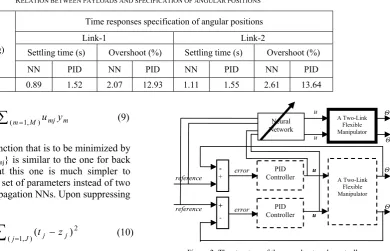
The Neural Network controller based on PID controller has been used for control of a two- link flexible manipulator systems. The block diagram of a Neural Network controllers based on PID controllers is shown in Figure 2.
Figure 2: The structure of the neural network controller.
IV.RESULT AND DISCUSSION
A step signal with amplitude of 0.4 rad is used as an input position in radian applied at the hub of link-1 of the manipulator. The same form of signal with amplitude of -0.8 rad is used as the input signal for link-2. Three system responses namely the hub angular positions and deflections and end-point acceleration for both links are obtained and evaluated. Moreover, the effects of varying payload on controller performances are also studied. For these investigations, the system without payload, and the system with payloads of 0.05 kg are considered.
The task of the controller is for input tracking capability of the system. The angular position of link-1 and link-2 are fed back to control of a two-link flexible manipulator with varying payload. Figure 3 shows the angular positions of the two-link flexible manipulator without payload for both links. Both using NN based PID control and PID control results show similar results for link-1 and link-2, where steady state angular position levels of 0.4 rad and -0.8 rad were achieved respectively.
The transient response specifications of the angular position for both links are summarised in Table 2. Using NN based PID control, the system exhibits lower settling times and smaller overshoots for both links compared using Z-N PID.
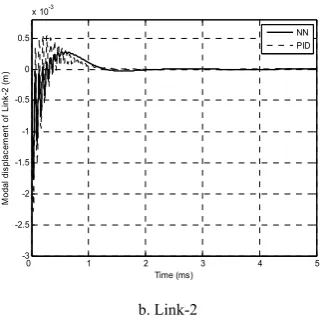
Figure 4 shows results of the deflection responses of link-1 and link-2. It is noted that the magnitudes of vibration of the deflection responses decrease for both links using NN based PID control compared with PID control.
With NN based PID control, the maximum magnitudes of the responses were 0.72 mm and 1.77 mm for link-1 and link-2 respectively. On the other hand with PID control, the maximum magnitudes were 0.92 mm and 2.29 mm.
reference
u u
error
error reference
-
+
+
-
Θ2
Θ1
Θ1
u u
Θ2
Neural Network
PID Controller
PID Controller
A Two-Link Flexible Manipulator A Two-Link Flexible Manipulator TABLE 2.
RELATION BETWEEN PAYLOADS AND SPECIFICATION OF ANGULAR POSITIONS
Payloads (kg)
Time responses specification of angular positions
Link-1 Link-2 Settling time (s) Overshoot (%) Settling time (s) Overshoot (%)
NN PID NN PID NN PID NN PID
0 1 2 3 4 5 0
0.1 0.2 0.3 0.4 0.5 0.6 0.7 0.8 0.9 1
Time (ms)
Li
nk
-1 pos
itio
ns
(
rad)
PID NN
a. Link-1
0 1 2 3 4 5 -1
-0.9 -0.8 -0.7 -0.6 -0.5 -0.4 -0.3 -0.2 -0.1 0
Time (ms)
Li
nk
-2 po
si
tion
s (
rad)
PID NN
b. Link-2
Figure 3: Angular position of the system without load.
0 1 2 3 4 5 -1
-0.8 -0.6 -0.4 -0.2 0 0.2 0.4 0.6 0.8
1x 10
-3
Time (ms)
M
oda
l dis
pla
ce
m
en
t of
Li
nk
-1
(
m
)
NN PID
a. Link-1
0 1 2 3 4 5 -6
-4 -2 0 2 4 6x 10
-3
Time (ms)
M
odal
di
spl
ac
em
ent
of Li
nk
-2 (
m
)
NN PID
b. Link-2
Figure 4: Deflection response of the system without payload.
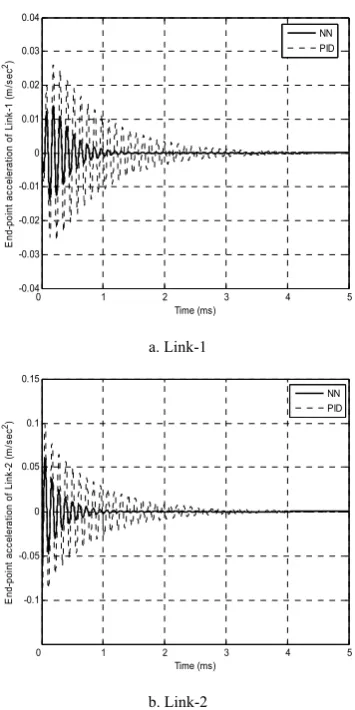
Figure 5 shows the end-point acceleration responses obtained with NN based PID control and PID control exercises. With NN based PID control show that the vibration occurs at -0.05 to 0.05 m/s2 for link-1 and -0.14 to 0.12 m/s2 for link-2. for link-1 and link-2 respectively. Otherwise, the end-point acceleration responses for link-1 and link 2 were obtained at -0.04 to 0.03 m/s2 and -0.07 to 0.08 m/s2 respectively using PID controller.
0 1 2 3 4 5 -0.04
-0.03 -0.02 -0.01 0 0.01 0.02 0.03 0.04
Time (ms)
E
nd
-po
int
ac
ce
ler
at
io
n
of
Link
-1
(
m
/s
ec
2)
NN PID
a. Link-1
0 1 2 3 4 5 -0.1
-0.05 0 0.05 0.1 0.15
Time (ms)
E
nd-poi
nt
ac
cel
er
at
ion
of
Li
nk
-2
(
m
/s
ec
2)
NN PID
b. Link-2
Figure 5: End-point response of the system without payload.
Investigation of the effects of payload on the dynamic characteristics of the system, a two-link flexible manipulator with various payloads was examined. Figure 6 shows the system responses of the flexible manipulator with payloads of 0.05 kg for link-1 and link-2 respectively using NN based PID controller compared PID controller.
0 1 2 3 4 5 0
0.1 0.2 0.3 0.4 0.5 0.6 0.7 0.8 0.9 1
Time (ms)
Li
nk
-1 pos
iti
ons
(
rad)
PID NN
a. Link-1
0 1 2 3 4 5 -1
-0.9 -0.8 -0.7 -0.6 -0.5 -0.4 -0.3 -0.2 -0.1 0
Time (ms)
Li
nk
-2 pos
iti
ons
(
rad)
PID NN
b. Link-2
Figure 6: Angular position of the system with payload 0.05 kg.
The results also show that the transient responses of the system are affected by the variations of payload. Table 2 summaries the settling time and overshoot of the angular position response with payload 0.05 kg using NN based PID control and PID control.
Figure 7 shows the deflection responses for link-1 and link-2 of the two-link flexible manipulator with payloads 0.05 kg respectively using NN based PID control and PID control. It is noted with increasing payloads, the magnitudes of vibration of the deflection increase for both links. However, the magnitudes of vibration of the deflection responses decrease for both links with NN based PID control compared with PID control.
0 1 2 3 4 5
-10 -5 0 5x 10
-4
Time (ms)
M
oda
l dis
plac
em
en
t of
Link
-1
(
m
)
NN PID
a. Link-1
0 1 2 3 4 5
-3 -2.5 -2 -1.5 -1 -0.5 0 0.5
x 10-3
Time (ms)
M
odal
di
spl
ac
em
ent
o
f Li
nk
-2 (
m
)
NN PID
b. Link-2
Figure 7: Deflection responses of the system with load 0.05 kg.
Figure 8 shows the end-point acceleration responses for link-1 and link-2 of the two-link flexible manipulator with payloads 0.05 kg respectively using NN based PID control and PID control.
It is noted with increasing payloads, the magnitudes of vibration of the end-point acceleration increase for both links. However, the magnitudes of vibration of the end-point acceleration decrease for both links with NN based PID control compared with PID control.
0 1 2 3 4 5
-0.06 -0.04 -0.02 0 0.02 0.04 0.06
Time (ms)
E
nd
-po
in
t
ac
ce
le
ra
tion
of
Li
nk
-1
(
m
/s
ec
2)
NN PID
a. Link-1
0 1 2 3 4 5
-0.1 -0.05 0 0.05 0.1
Time (ms)
E
nd
-po
in
t ac
ce
le
rat
ion
of
Link
-2 (
m
/s
ec
2)
NN PID
b. Link-2
V. CONCLUSSION
The development of dynamic model and NN control of a two-link flexible manipulator with varying payload has been presented. A PID controller has, initially, been developed for control of a two-link flexible manipulator with varying payloads. The NN based PID controller is universal and can be adapted for any a nonlinear system.
A NN based PID controller has been implemented for input tracking control of the two-link flexible manipulator. Performances of the control schemes have been evaluated in terms of the input tracking capability of the system with compared PID controller. Simulations of the dynamic model and NN based PID control have been carried out in the time domains where the system responses including angular positions, deflection and end-point acceleration are studied. In term of input tracking, NN based PID has been shown to be more effective technique. These results will be verified on the hardware experimental work for future work.
REFERENCES
[1] Martins J. M., Mohamed Z., Tokhi M. O., Sa da Costa J. and Botto M.
A. Approaches for dynamic modelling of flexible manipulator systems,
IEE Proc-Control Theory and Application, Vol. 150, 401-411. 2003.
[2] Dogan, M., and Istefanopulos, Y. Optimal nonlinear controller design
for flexible robot manipulators with adaptive internal model, IET
Control Theory and Applications, 1, (3), pp. 770-778. 2007.
[3] De Luca A. and Siciliano B. Closed-form dynamic model of planar
multi-link lightweight robots, IEEE Transactions on Systems, Man,
and Cybernetics, Vol. 21, 826-839. 199).
[4] Ahmad, M.A.; Mohamed, Z.; Hambali, N. Dynamic Modelling of a
Two-link Flexible Manipulator System Incorporating Payload, Proceeding of The 3rd IEEE Conference on Industrial Electronics and Applications, 2008, ICIEA 2008, Singapore: 96-101.
[5] Subudhi B. and Morris A. S. Dynamic modelling, simulation and
control of a manipulator with flexible links and joints, Robotics and Autonomous System, Vol. 41, 257-270. 2002..
[6] Shengping, L. Licheng, W. Zhen L. Impact dynamics and control of a
flexible dual-arm space robot capturing an object. Journal Applied
Mathematics and Computation 185. pp. 1149–1159. 2007.
[7] Payo, I., Feliu, V., Cortazar, O.D. Force control of a very lightweight
single-link flexible arm based on coupling torque feedback,
Mechatronics,10.(003). 2008.
[8] Gurses, K., Buckham, B.J., Park, E.J. Vibration control of a
single-link flexible manipulator using an array of fiber optic curvature
sensors and PZT actuators, Mechatronics 19, 167–177. 2009.
[9] Tian L., and Collins C.. A dynamic recurrent neural network based
controller for a rigid-flexible manipulator system, Mechatronics, vol. 14, pp. 471-490. 2004.
[10] Gutierrez, L. B. Lewis, F. L. and J. Andy Lowe. Implementation of a
Neural Network Tracking Controller for a Single Flexible Link :
Comparison with PD and PID Controllers. IEEE Transaction on
industrial electronics. 45(2): 307-318.1998.
[11] M. Khairudin, Z. Mohammed, RBFNN Control of A Two-Link
Flexible Manipulator Incorporating Payload. Volume 8 Nomor 2,
August 2010, Indonesia.
[12] Tian. L. Collins, C. Adaptive Neuro-Fuzzy Control of a Flexible
Manipulator. Mechatronics. 15: 1305–1320. 2005.
[13] Subudhi B., and Morris AS. Soft Computing Method Applied to
Control of a Flexible Manipulator. Applied Soft Computing. 9: