University of New Orleans University of New Orleans
ScholarWorks@UNO
ScholarWorks@UNO
University of New Orleans Theses and
Dissertations Dissertations and Theses
5-14-2010
Understanding the Socialization Experiences of New Technical
Understanding the Socialization Experiences of New Technical
Faculty: A Transition from Industry to the Technical College
Faculty: A Transition from Industry to the Technical College
Annette Bordelon Thornton
University of New Orleans
Follow this and additional works at: https://scholarworks.uno.edu/td
Recommended Citation Recommended Citation
Thornton, Annette Bordelon, "Understanding the Socialization Experiences of New Technical Faculty: A Transition from Industry to the Technical College" (2010). University of New Orleans Theses and Dissertations. 1152.
https://scholarworks.uno.edu/td/1152
This Dissertation is protected by copyright and/or related rights. It has been brought to you by ScholarWorks@UNO with permission from the rights-holder(s). You are free to use this Dissertation in any way that is permitted by the copyright and related rights legislation that applies to your use. For other uses you need to obtain permission from the rights-holder(s) directly, unless additional rights are indicated by a Creative Commons license in the record and/ or on the work itself.
Understanding the Socialization Experiences of New Technical Faculty: A Transition from Industry to the Technical College
A Dissertation
Submitted to the Graduate Faculty of the University of New Orleans
in partial fulfillment of the requirements for the degree of
Doctor of Philosophy In
Education Administration
The Department of Educational Leadership, Counseling, and Foundations
by
Annette Bordelon Thornton
B. A., University of New Orleans, 1995 M. Ed., University of New Orleans, 2001
ACKNOWLEDGMENTS
This journey has not been without it challenges. It is through perseverance, love, and encouragement of my family and friends that I have succeeded. Special thanks to my husband Michael who has always stood by me and shared my vision of life. To my
mother who taught me the value of love, education, hard work, and the ability to think for myself. To my brother Charlie who devoted many nights to help me format my
manuscript. To my dear friend Barbara Johnson, Ph.D. who encouraged me to be a Ph.D. when I didn’t think I could.
Many thanks to the doctoral committee composed of Marietta Del Favero, Ph.D.,
major professor, Andre Perry, Ph.D., Lorelei Cropley, Ph.D., and Barbara Johnson, Ph.D. (Northern Illinois University). I would also like to acknowledge Mike Paulsen, Ph.D.
and Amy Wells, Ph.D.. I thank each of the above mentioned individuals for the
important role they played in my education. Finally, I would like to thank Lauren White, editor of this manuscript.
The University of New Orleans has been my academic home for thirty years. I was awarded a Bachelor’s of Art in Psychology (1995), a Master’s Degree in Higher
Education Administration (2001) and a Doctorate of Philosophy in Education
Administration (2010). It was here that Barbara Johnson, Ph.D. and Mike Paulsen, Ph.D. taught me the importance of leaving a positive legacy.
TABLE OF CONTENTS
LIST OF FIGURES ... viii
LIST OF TABLES... ix
ABSTRACT... x
CHAPTER I Introduction ... 1
The Problem Statement... 10
Purpose Statement... 12
Research Questions... 12
Significance of the Study ... 13
Definition of Terms... 15
Overview of Methodology... 16
Organization of the Study ... 16
Conclusion ... 17
CHAPTER II A Review of the Literature... 18
History of Vocational Education ... 18
History of the Louisiana Technical College System... 20
Mission of the Vocational Technical College... 23
Vocational Technical Faculty Who Teach at Technical Colleges ... 24
Profile of National Two-Year Faculty ... 25
Profile of the Louisiana Technical College Faculty ... 26
Louisiana Vocational Technical Faculty Credentialing... 27
Teaching Performance ... 27
Instructional Development... 28
Instructional Management ... 29
Classroom Management... 29
Student Guidance and Advising Activities ... 30
College and/or Community Service... 30
Professional Activities, Leadership and Service... 31
Vocational Technical Faculty and Academic Work ... 32
College Teaching ... 33
Skills Required for College Teaching... 33
Teaching Effectiveness Practices... 34
Role Identity... 37
Socialization... 40
Faculty Socialization... 40
Anticipatory Socialization ... 40
Organizational Socialization... 41
Comparison of the Theoretical Models of Organizational Socialization... 42
Basic Socialization Assumptions... 45
Socialization Tactics ... 46
Collective verses Individual Socialization... 47
Formal verses Informal Socialization ... 48
Fixed verses Variable Socialization... 50
Serial verses Disjunctive Socialization ... 51
Investiture verses Divesture Socialization ... 51
Research Studies on Socialization Process ... 52
Research Studies Conducted on Four-Year Faculty ... 52
Menges and Associates... 52
Boice... 54
Fink... 55
Olsen and Sorcinelli... 56
Sorcinelli... 57
Research Studies on Two-year Faculty Research... 57
Wallin and Smith... 58
Wallin... 58
Fugate and Amey... 58
Townsend and LaPaglia... 59
Implications of the Socialization Literature... 59
Job Related Stress ... 60
Isolation... 61
Time Management ... 62
Coping With Stress ... 63
Orientation ... 63
Mentoring... 63
Satisfaction in the Teaching Profession ... 64
Conceptual Framework ... 65
Conclusion ... 70
CHAPTER III Methodology... 72
Research Questions... 72
Rationale for Selecting a Phenomenological Qualitative Approach... 73
The Role of the Researcher... 75
Pilot Study... 77
Data Collection ... 78
Site Selection ... 78
Gaining Access ... 78
Selection of Participants ... 79
Identifying Study Participants... 80
The Rationale for Selecting the Interview Data Collection Method... 81
Interview Guide ... 82
The Interview ... 82
Tape Recording... 83
Data Analysis ... 83
Ethical Considerations ... 84
Trustworthiness... 85
Delimitations and Limitations... 86
Research Questions... 88
Mid State Technical College Institutional Description... 89
Mid State Technical College Study Participants ... 90
Southwest Technical College Institutional Description... 91
Southwest Technical College Study Participants ... 92
Northern Technical College Institutional Description... 93
Northern Technical College Study Participants... 94
Participant Interviews and the Context of Their Work Environments ... 95
Participant 1 - “Margie”... 95
Participant 2 - “Tom”... 97
Participant 3 - “Vincent”... 98
Participant 4 - “Maggie” ... 99
Participant 5 - “Donna”... 100
Participant 6 - “Sarah” ... 101
Participant 7 - “Jerry” ... 102
Participant 8 - “Christine”... 103
Participant 9 - “Missy”... 104
Participant 10 - “Kyle”... 106
Emergent Themes ... 107
Collegial Relationships ... 108
Administrative Relationships... 108
Faculty Relationships... 110
Role Identity... 112
Anticipatory Phase ... 114
Faculty Identities... 115
Student Industry Identities ... 116
Teaching... 118
Communication of the Discipline ... 118
Teaching Influences ... 120
Concern for Student Learning... 121
Communication... 122
Job Expectations ... 123
Institutional Knowledge... 124
Stress ... 125
Academic Work ... 125
Isolation... 127
Time Management ... 128
Faculty Socialization Techniques ... 130
New Instructor’s Workshop... 130
Professional Development ... 132
Data Analysis as It Relates to the Conceptual Framework... 134
Motivations for Leaving Industry ... 134
The Conceptual Framework... 136
Conclusion ... 137
Assessing Research Questions... 140
The Socialization of the Vocational Technical Faculty... 140
Collegial Relationships ... 141
Internalizing Normative Differences between Industry and Academe... 141
Interactions with Students... 142
Industry Identity... 143
Faculty Identity ... 143
New Instructor’s Workshop... 144
Professional Development ... 145
The Unique Experiences of New Vocational Technical Faculty... 145
Confirming Commitment as a Product of Socialization ... 149
Implications for Policy and Practices ... 149
Topics for Future Research... 150
Conclusion ... 151
REFERENCES ... 154
APPENDICES ... 163
APPENDIX A: PARTICIPANT CONSENT FORM ... 164
APPENDIX B: INTERVIEW PROTOCOL... 166
APPENDIX C: REQUEST FOR PARTICIPANT LETTER TO THE REGIONAL DIRECTORS ... 170
APPENDIX D: LETTER TO PARTICIPANT... 173
APPENDIX E: CONFIRMATION LETTER FOR PARTICIPANT SCHEDULED INTERVIEW ... 175
APPENDIX F: HUMAN SUBJECT CERTIFICATE... 177
APPENDIX G: INSTITUTIONAL REVIEW BOARD APPROVAL... 179
LIST OF FIGURES
LIST OF TABLES
Table 1: Industry Verses Academe ... 3
Table 2: National Employment Status of Two-Year College Faculty... 25
Table 3: National Gender Statistics of Two-Year College Faculty ... 25
Table 4: National Demographic Statistics of Two-Year College Faculty ... 25
Table 5: Louisiana Employment Status of Vocational Technical Faculty ... 26
Table 6: Louisiana Gender Statistics of Vocational Technical Faculty... 26
Table 7: Louisiana Demographic Breakdown of Vocational Technical Faculty... 26
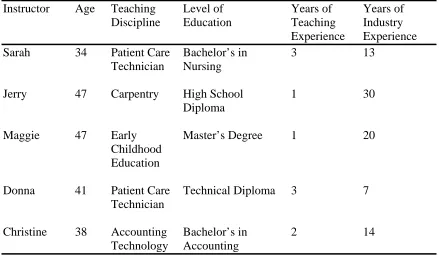
Table 8: Mid State Technical College Vocational Technical Instructors ... 91
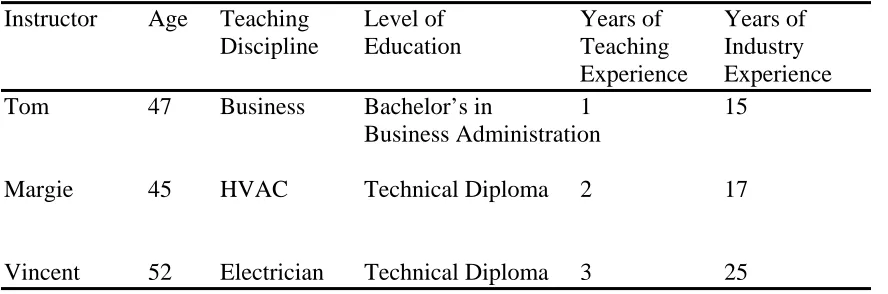
Table 9: Southwest Technical College Vocational Technical Instructors ... 93
Table 10: Northern Technical College Vocational Technical Instructors ... 95
Table 11: Emergent Themes ... 108
ABSTRACT
This phenomenological qualitative research study sought to gain insight into the socialization experiences of new vocational technical faculty. Ten Louisiana vocational technical faculty members were interviewed face-to-face. The interviews were
audio-taped, transcribed, and analyzed to discover how these new vocational technical faculty members transitioned from industry to academe. Data analysis revealed that participants
in the study experienced a similar transitional process into the technical college as two-year and four-two-year faculty into community colleges and universities.
Like their two-year and four-year counterparts, the participants experienced similar
challenges related to their new teaching positions, such as balancing heavy workloads, maintaining industry contacts, and interacting with administration, faculty and students.
Similarly, they tended to value teaching, collegial relationships with other faculty and their interactions with students. However, some of the challenges were unique to their new positions as Louisiana vocational technical instructors. These faculty members
experienced an anticipatory phase that prepared them for the workplace rather than academe. Many of the participants experienced notable levels of stress as they
transitioned from industry to the technical college. The stress seemed to be related to their lack of pedagogical knowledge of teaching and the issues of forging a new academic persona. This research found that new vocational technical faculty members enjoyed
formal professional development activities that were discipline specific and advanced their knowledge of their craft.
conceptualization, and resources that would help the faculty grow and develop as
instructors. Through their shared experiences and stories the researcher identified the needs of this subpopulation and made recommendations for future studies.
CHAPTER I
Introduction
The context of the two-year college has changed dramatically in recent years with reductions in funding, increased emphasis on technology, internationalization of
curriculum, and greater competition for students (Sanford & McCaslin, 2004). The range of courses offered by two-year colleges, and employer expectations of new graduates
have also changed, with higher education being asked to produce a more flexible and higher qualified workforce to respond to changing needs in industry (Watters & Wecks, 1999). Technical colleges focus on maintaining industry-relevant training programs in
technology driven climates of new and emerging occupational areas. Faculty members at technical colleges are now expected to strengthen occupational and technical programs of
the institution with applications of “real world” perspective. Although these industry-based teachers have the technical skills required in the workplace of their particular disciplines, many lack the instructional background and experience that enable them to
manage the college classroom and inspire teaching (Brown, 2000). For the purpose of this research study, new vocational technical faculty members are defined by those in
their first academic appointment, with zero to three years of teaching experience and at least three years of industry experience.
Many research studies examined the work experiences and concerns of new
faculty (Boice, 1992; Fink, 1984; Olsen & Sorcinelli, 1992; Whitt, 1991). These studies have broadly defined the term as those in a new academic appointment, while others
position” (p. xviii) in a postsecondary setting. Further, longitudinal studies by Boice
(1992), Menges and Associates (1999), and Olsen and Sorcinelli (1992) tracked new faculty experiences over the first three years of their academic position.
Many individuals who become vocational technical faculty have been educated
and trained to be successful in their respective fields and have experienced lengthy tenures in industry. A pilot study (Thornton, 2006) revealed that those who were
recruited and hired as vocational technical faculty faced personal and professional challenges in transitioning from industry to the technical college. Individuals in industry have been indoctrinated to focus on product-driven outcomes and profits. However, new
instructors found it difficult to switch from productivity-driven industry models to the learning-centered values of the technical college. Thus, it is important to understand and
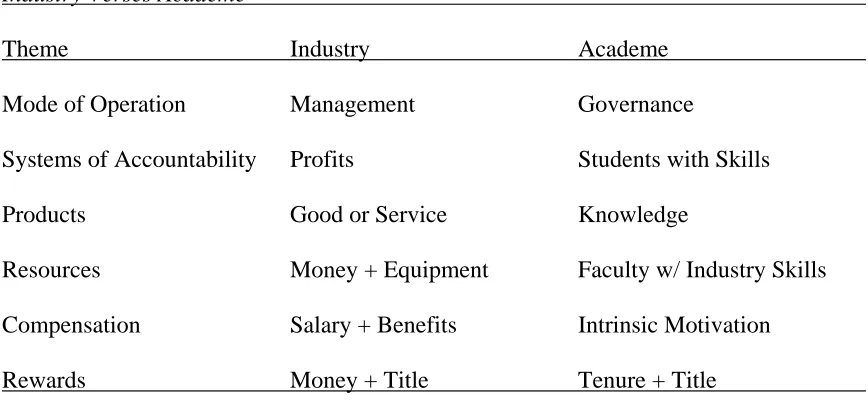
make distinctions in the differences between industry and academe that present the most challenges for vocational technical faculty specifically the modes of operation, systems of accountability, products, resources, compensation, and rewards. Table 1 presents data
Table 1:Industry Verses Academe
Industry Verses Academe
Theme Industry Academe
Mode of Operation Management Governance
Systems of Accountability Profits Students with Skills
Products Good or Service Knowledge
Resources Money + Equipment Faculty w/ Industry Skills Compensation Salary + Benefits Intrinsic Motivation
Rewards Money + Title Tenure + Title
As shown in Table 1, industry and academe are vastly different. Keller (1983) argued that colleges and universities are, “one of the largest industries in the nation but
among the least businesslike and well managed of all organizations” (p. 5). The term, “governance” is a broad concept that reflects the most controversial difference between industry and academe for vocational technical faculty. Birnbuam (1988) defined
governance as “structures and processes through which institutional participants interact and influence each other and communicate with large environments” (p. 4). Management
versus governance is a new way of thinking for the newly hired vocational technical faculty. For example, industry manages their employees, while technical colleges allow vocational technical faculty to share and participate in their governance structure. Del
Favero’s (2006) commentary on the transition from administrator to scholar explains the tension new instructors experience as they shift their attention from organizational
Understanding systems of accountability presents the next obstacle for vocational
technical faculty. Industry and academe track different performance-based outcomes. Besse (1973) explained, “In a business corporation there is always one quantifiable measure of performance ... the rate of earnings on the capital invested” (p. 110). In
contrast, Louisiana vocational technical college faculty measure performance by the quantifiable number of students who graduate and the percentage of students who get job
related placement (http://www.council.org). Performance outcomes, though not easily measured, depend on training individuals who will be competent enough to secure employment after completion of the technical program. Products of industry result in
either a good or a service, whereas products of the technical college can be vague and intangible.
Rice (2001) spoke about the measurable outcomes of a college education. He stated, “Knowledge and understanding are not things we can hold in our hands or observe in its entirety; knowledge and understanding are difficult to measure and even more
difficult to put a price tag on” (p. 9). By comparison, business and industry supply a good or services that can be measured, inventoried, and sold for a profit and thus create
additional financial resources.
A lack of funding and decreased financial resources in two-year colleges have placed a strain on the resources available to vocational technical programs, which are
costly to operate. For example, equipment and software for a drafting class is approximately $3,000.00 per student with an average of 15 students per program
(Thornton, 2006). Without outside funding sources such as grants and industry
Industry usually provides the necessary resources and materials to produce desired
products, whereas vocational technical programs depend on tuition dollars, government subsidy, and outside resources.
Industry compensation far outweighs that of academe. Boice (1992) indicated an
intense competition over new hires between academe and the corporate world to recruit qualified employees. Careers outside of academe are becoming increasingly more
attractive to potential faculty because academe often cannot compete with the monetary compensation and benefits packages offered by industry. Schuster (1990a) suggested that critical faculty shortages should bring an increase of faculty power for newcomers; as
campuses compete for faculty, administrators will inevitably offer concessions, including reduced teaching loads. While Thornton’s (2006) pilot study revealed that vocational
technical faculty wanted to be compensated for their time and efforts, monetary rewards were not their primary reason for securing a teaching career. Participants in the pilot study expected that their new career would afford them more job flexibility and personal
free time.
The workload of vocational technical faculty is very different from their work in
industry. While the vocational technical faculty envisioned more job flexibility and personal time, the 1999 National Study of Postsecondary Faculty, published by the U.S. Department of Education’s National Center for Education Statistics, found that fulltime
faculty members work about 55 hours a week and part-time faculty work nearly 40 hours a week. As new Louisiana vocational technical faculty, 70% of their 40 hour work week
marketable skills (http://www.ltc.edu). The remaining 30% of vocational technical
faculty time is allocated toward teaching related activities such as course preparation, academic advising, grading, industry visits, committee assignments, and credentialing. Often, these other duties spill over into the personal time of the vocational technical
faculty creating frustration and a source of stress over their academic work (Boice, 1992; Menges, 1999).
Most new Louisiana vocational technical faculty hold appropriate industry-based certifications, though some lack the academic credentials needed to be instructors at the technical college and, as a condition of employment, understand that they must obtain an
associate’s degree in technical education. In addition to the associate degree, new Louisiana vocational technical faculty must pass the National Occupation Competency
Testing Institute (NOCTI) test in their craft or trade, and obtain industry based
certification (LTC 145.10.2.2). While some of the courses offered through the associate degree could be an invaluable resource full of teaching strategies and course preparation
information to help new instructors cope with their new positions, many of the courses are poorly attended (Thornton, 2006).
The difference between industry and academe is further complicated by the transition of new vocational technical faculty as evidenced in the literature on new faculty relative to the difficulties they face in learning their roles as instructors. Boice
(1992) suggested that the challenges faced by new faculty are not unexpected. Reports by new faculty of feeling overloaded, unsupported, and uninformed may be as old as
relationships with business and industry, and community involvement. Like all new
college faculty, (Boice, 1992; Menges, 1999) the transition of new vocational technical faculty from industry to academe is marked by a period of adjustment and socialization.
The socialization literature has been key to understanding the transition of faculty
for example, the way in which new Louisiana vocational technical faculty adjust to their academic roles. Scholars have defined socialization in a variety of contexts. Merton
(1957) defined socialization as a process through which individuals conform to the norms and values needed to function in a given society. Austin (2002) defined socialization as, “a process through which an individual becomes part of a group, organization, or
community” (p. 96). Tierney and Bensimon (1996) described faculty socialization as a “rite of passage” (p. 77) where instructors become inclusionary members of the post
secondary institution. Brim (1966) suggested that socialization is more than the acquisition of skills, values, and knowledge, but rather a process that incorporates both cognitive and affective maturation that results in “the developments of commitment to
and identification with a particular profession” (p. 5). Cohen and Brawer (1972) defined the transition to the role of instructor as one where the individual must be able to identify
as a human being and to define his/her position in terms of the educational system. The literature on role identity is key to our understanding of the transition of new faculty, that is, how new Louisiana vocational technical faculty adjust to their new roles
as instructors. For clarity, it is important to view the new role specifically in terms of, “the teacher as a person and the teacher as a practitioner in the discipline of instruction”
Colbeck (2008) speculated that when two or more contrasting identities try to make
meaning of their new environments, an individual is likely to experience stress. The role identity literature implied that adaptation to one’s sense of self is more likely to occur when one is transitioning to a new role (Cast, 2003; Ibarra, 1999). Furthermore, literature
suggests that the instructor’s “teaching self” evolves and is shaped by the cultural and institutional environments in which that individual teaches. In turn, socialization into
academe will establish the norms and expectations for future professional behavior. For vocational technical faculty, the transition from industry to academe may be more challenging than that of other higher education faculty. Graduate training, while
inadequate in many ways and absent in most vocational technical faculty, does allow students to anticipate what the life and work of a faculty member is about. Some studies
(Austin, 2002; Tierney, 1997; Tierney & Bensimon, 1996; Tierney & Rhoads, 1994) have examined the graduate school experience as a key part of the socialization process. For four-year faculty, the anticipatory socialization phase begins to prepare students to
acquire the norms and culture associated with their disciplines and career expectations (Tierney & Rhoads, 1994). Murray and Cunningham (2002) argued that graduate
preparation for most faculty members is inadequate for teaching in the community and technical college system. Murray and Cunningham’s argument suggested that graduate schools train researchers, not teachers. They also asserted that, “Effective teaching
requires sufficient knowledge of both the discipline and pedagogy” (p. 252). Thornton (2006) found that this subpopulation of faculty had a dissimilar anticipatory phase than
When one thinks about the anticipatory stage in its broadest sense, it is usually in
terms of job expectations and perceptions formed before an individual takes the teaching position. For the purpose of this research, the anticipatory phase considered that new Louisiana vocational technical faculty form their expectations and perceptions about their
new teaching career from their own student experiences, through mentorship from their instructors, and the new hire interview experience. Though pedagogical training may be
limited, new vocational technical faculty members continue to emerge from their industrial backgrounds and find their way to the technical college. Their initial faculty experiences begin to define expectations and provide understanding of their new roles as
instructors.
Discussions specific to socialization rarely deal with the development of diverse
faculty roles. As I drew on personal observations, many newcomers who began their teaching careers at a technical college became instructors, while others floundered and misunderstood the complexities of their new roles as faculty members. Many experience
lengthy tenures as instructors, while others return to industry. Olsen and Einwohner (2001) suggested that, “A teacher’s sense of effectiveness, satisfaction, and commitment
are all elements of his or her teaching identity” (p. 404). The identity and socialization literature stress the importance of understanding how faculty view their respective roles and responsibilities in order to meet their own needs and the needs of the college.
Murray and Cunningham (2002) asserted that individuals whose expectations are met tend to have higher job satisfaction. Furthermore, those with higher job satisfaction are
committed to the organization, and have longer tenures (Blau, 1987; Meglino, Ravlin, &
Adkins, 1989; Schneider, 1987; Smart, Elton, & McLaughlin, 1986).
Many researchers and practitioners (Baldwin, 1979; Boice, 1992; Feldman, 1981) have asserted that if colleges are serious about retaining faculty, administrators and
policymakers must develop an understanding of how new faculty members conceptualize their new roles, how faculty are socialized into the profession, and how faculty develop
professionally over the course of their careers. Organizational theorists have shown evidence that positive faculty socialization experiences are directly related to long-term job satisfaction and productivity (Van Maanen & Schein, 1979).
This study sought to understand the socialization experiences, role
conceptualization, and resources that would benefit the new Louisiana vocational
technical instructors as they transitioned from industry to technical college. Two-year postsecondary institutions strive to meet high accountability standards, maintain teaching standards, meet the diverse student needs, and adapt to the economic workforce demands
of the future.
The Problem Statement
Generally, vocational technical faculty have the technical expertise required to be successful in industry, but past industry experiences have not prepared them for the job responsibilities as vocational technical college instructors. The non-degreed vocational
technical faculty members are particularly unique in that the majority of these individuals are recruited directly from business and industry with generally little or no formal
pedagogical aspects of teaching and student learning as they are in their own disciplines.
In contrast, Olsen (1991) stated, “Industrial/business experience continues to be seen as essential, whereas knowledge of teaching is seen only as desirable” (p. 341). Thornton’s (2006) pilot study revealed that many new vocational technical faculty experience
notable levels of stress as they try to learn their new roles as instructor.
Some researchers have noted other sources of stress for new faculty; these include
poorly prepared students, cumbersome bureaucratic rules, high self-expectations, unclear expectations, and inadequate salaries (Brown et al., 1986; Gmelch, Lovrich, & Wilke, 1984; Smith, Anderson, & Lovrich, 1995). Olsen and Sorcinelli (1992) confirmed that
teaching is conflict ridden and time consuming. Thornton (2006) found some of the new instructors in her study felt inadequate as teachers and consequently planned to leave
their teaching positions to return to industry.
Issues of faculty recruitment and retention are major concerns for technical colleges. Berry, Hammons, and Denny (2001) found that 51% of the Chief Academic
Officers queried expressed difficulties in recruiting fully prepared faculty members. The ability to offer and deliver high quality instructional programs is directly related to
locating and recruiting talented individuals to fill vacant faculty positions. New vocational technical faculty represent an important population whose transitional experiences should be understood so the administration can assist them in adapting to
their new roles as instructors.
If new Louisiana vocational technical faculty members are to find a balance
information is needed on the socialization experience of vocational technical faculty in
order to understand how these instructors make the transition from industry to educators, how they conceptualize their roles as instructors, and what resources and strategies simultaneously interact to explain the socialization of new vocational technical
instructors.
Purpose Statement
This study provided insight on the transition of vocational technical faculty by enhancing our understanding of influences on their socialization process. The study examined new vocational technical faculty members perceptions of their socialization
experience and what is needed for an effective transition from industry to academe. Findings provided contributions to both theory and practice within vocational technical
education. This research study focused on the new vocational technical faculty members’ interpretations of meaning of their teaching roles and the experiences that facilitated their transition from industry to technical college.
Research Questions
The primary research question guiding this research study was:
1.) What experiences do vocational technical faculty members perceive are important to their transition from industry to the technical college?
This study also addressed the following secondary research questions:
2.) How do vocational technical faculty members conceptualize their roles as instructors?
Significance of the Study
A recent search of educational databases yielded little research specific to vocational technical faculty. Thus, this research study sought to address this void in the literature and provide insight into the socialization experiences of the new faculty
members in the technical college system.
According to the Bureau of Labor Statistics (2006), there are 109,360 individuals
who teach at technical colleges throughout the United States. Vocational technical faculty members represent 40% of all two-year college faculty. While new vocational technical faculty encountered challenges adapting to their new roles as educators, most
instructors found teaching diverse student populations who attend technical colleges as the most challenging issue (Waiwaiole & Noonan-Terry, 2008). Furthermore, the
nontraditional two-year college student is older, has other responsibilities, and may experience academic learning challenges (Van Ast, 1992). Thirty-seven percent of college students will enroll in technical colleges to complete the occupational technical
certificate, diploma, or associate degrees, while 36% of vocational technical students simply want to take a course that will increase their career opportunities (Brown, 1999).
According to Tinto (1993), some students are more likely to be in school because of employer inducements and contractual agreements between institutions and employers. The National Center for Education Statistics (NCES) claims that 11.5% of the students in
postsecondary vocational programs held baccalaureate degrees or higher (Vocational Education in the United States: Toward the Year 2000, 2000). With varied interests in
of ill-prepared and diverse academic levels of students made it more difficult for
instructors to find satisfaction in effecting student achievement (Cohen & Brawer, 2003). The importance of vocational technical faculty must not be underestimated. The benefits of a college education are clear. Technical colleges need competent vocational
technical faculty members who are able teach diverse student populations in a complex college environment. By understanding which environmental experiences are pivotal in
shaping new faculty members’ views, orientation programs could be created that enable them to have successful careers and thereby remain with these colleges (Baldwin & Blackburn, 1981). Cross and Angelo (1989) believed the most direct and promising way
to improve learning is to improve teaching.
This study sought to provide a contribution to both literature and practice in
vocational technical education. Findings of the study identified important elements of the socialization needs of new vocational technical faculty as they transitioned from industry to the technical college. Through an understanding of how vocational technical faculty
conceptualized their roles as faculty and become competent instructors, orientation programs can be designed and implemented.
This research inquiry provided guidance to technical college administration in the establishment of practices and procedures for incorporating new vocational technical faculty members into the academic community. Procedures based on a better
understanding of the socialization needs of this unique subgroup of faculty could be a first step toward improving job satisfaction and retention issues faced by vocational
faculty members strategies for transitioning from industry to technical college. If the
faculty members experience a smoother transition from industry to their new academic roles, they could experience higher levels of job satisfaction and increased levels of productivity.
Definition of Terms
Anticipatory Phase – to acquire the norms and culture associated with their
disciplines and career expectations (Tierney & Rhoads, 1994).
Identity – self-awareness, of personality and individuality (Cohen & Brawer, 1972, p. 1).
Louisiana Community and Technical College System – two-year postsecondary institutions of higher education in Louisiana focusing on vocational technical education.
New Vocational Technical Faculty – A faculty member who has four or more years of industry experience, has transitioned from industry to technical college, and has zero to three years of teaching experience at a vocational technical institution or
community college.
Organizational Socialization –is more than the acquisition of skills, values and
knowledge, but rather a process that incorporates both cognitive and affective maturation that results in “the developments of commitment to and identification with a particular profession” (Brim, 1966, p. 5).
Productivity – a vocational technical college measure of student graduates and job
related placement (http://www.council.org).
Overview of Methodology
This research study focused on new Louisiana vocational technical college faculty
and what they perceived as needed for their effective transition from industry to teaching in a technical college setting. A phenomenological, qualitative study was used to gain an
understanding of their transitional experiences. The data collection process involved 10 face-to-face interviews. Participants were selected using a purposive method and identified based on the years of industry experience and zero to three years of teaching
experience. Interviews were audio-tape recorded, transcribed, and analyzed for emerging themes.
Organization of the Study
Chapter I provided an overview of the study, including defining the basic differences between industry and academe. Chapter II identifies literature on
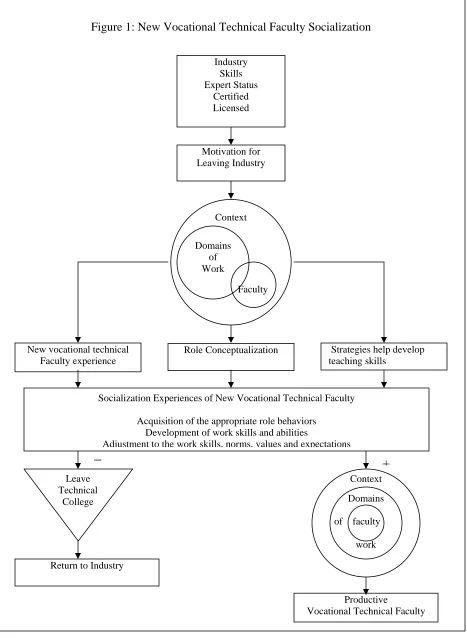
organizational socialization, college teaching, role identity, and new faculty. The conceptual framework presented in this chapter provides a graphic representation of the
socialization process of new vocational technical faculty using a combination of literature and faculty experiences. Chapter III describes the qualitative phenomenology research method used to investigate the focus of the study. Specifically, a brief background of the
researcher’s role, the setting of the institution, and participant selection are presented. The focus of chapter IV is the presentation and analysis of the findings. Data was
results of the research and presents implications for policy and practice as well as
recommendations for future research.
Conclusion
It is through the socialization process that new vocational technical faculty
members learn the expectations of their new teaching roles and discover what it means to teach in their respective academic disciplines at two-year postsecondary technical
colleges. An understanding of the socialization process can inform administrators and senior faculty how to implement programming that will allow new vocational technical faculty to adopt and adjust to their multi-faceted roles in their academic organizations.
This research study contributed to the scholarly knowledge base on faculty. The study also explored the experiences new vocational technical faculty perceived to be important
to help ease their transition from industry to technical college. Moreover, this inquiry provided understanding of how new Louisiana vocational technical faculty conceptualize their roles as instructors. The study provided strategies and or resources needed to help
CHAPTER II
A Review of Literature
National trends have indicated that states vary in the structure of governance of two-year postsecondary institutions. According to Public Affairs Research Council of
Louisiana (2009) there are three types of systems commonly used to classify higher education governance structures are consolidated, coordinating, and planning (p. 4).
Louisiana is classified as a coordinating governance structure where vocational technical education is within the community college system; other states have separate vocational technical institutions responsible for remediation and trades. For the purpose of this
study, the literature on community and technical college faculty provided the foundational knowledge on this population.
The chapter begins with a historical overview of vocational technical education, the history of the Louisiana Community and Technical College System, and a national profile of this professoriate. This chapter provides an examination of organizational
socialization literature as it applies to new college faculty. Operational definitions of socialization with theoretical assumptions of socialization lay the foundation for this
research study. Examinations of the socialization process revealed the influences on the new college faculty role identity.
History of Vocational Education
Community and technical colleges have served the nation for more than 100 years and carried out a number of complex and competing focuses. Two-year institutions have
been responsible for missions that center on the needs of transfer, vocational,
course of their history, two-year institutions have become increasingly diverse in the
students they serve and the programs offered (Cohen & Brawer, 2003). The history of vocational education is important to this research as it helps form an understanding of why there is little literature specifically centered on the vocational technical education or
the vocational technical faculty that serve these postsecondary institutions. Vocational education was always a component of the community college until recent times.
Therefore, it is important to look at the origin of vocational education in conjunction with community colleges.
Joliet Community College in Illinois, founded in 1901, is the oldest existing
public two-year college in the United States. According to the American Association of Community Colleges (1995) a lack of academic preparation of many university students
forced William Harper, president of the University of Chicago, and other educational leaders to advocate for a separate year institution. During the early years, the two-year institutions focused on a transfer mission, which emphasized a responsibly to bridge
the local high school with the university (http://www.jjc.ccil.us/admin/history.htlm). Gradually, as economic and political circumstances exerted greater influence,
vocational education emerged. Crosby Eells (1931) and Leonard Koos (1924) were adamant supporters of the vocational mission, which took two-year postsecondary institutions beyond their transfer education mission. They suggested that vocational
education should prepare young adults for immediate employment in semiprofessional occupations. In 1948, the United States President’s Commission on Higher Education
What became known as “The Truman Commission Report” popularized the term
“community college.” The report made bold statements in support of vocational education in junior colleges as a means of expanding educational access. From 1901 to 2001, more than 100 million people have been educated by community colleges in the
United States (AACC, 2001b). “The community college movement began the great transformation into a learning society in which each person who wishes to do so can
study almost any subject in almost any geographical community” (Deegan, 1985, p. vii). The importance of community colleges rose drastically after World War II. Jesse Bogue (1950) advocated an extension of education to address the requirements of life and
work through vocational education. Bogue introduced the continuing education component, offering students the opportunity for part-time education as the need arose
for possible job advancement and technological developments.
Gleazer (1980) urged community colleges to establish community-based learning centers and move beyond conventional curriculum offerings to address citizens’ needs for
career development and lifelong learning. Today, community colleges fulfill a wide range of learning needs for individuals, employers, and community organizations through
customized training and workforce development (Dougherty & Bakia, 1999, Jacobs, 2000; Warford & Flynn, 2000).
History of the Louisiana Technical College System
The history of the technical colleges was deeply rooted in “trade schools” concepts. Louisiana’s present day Technical College System began with the
system’s course offerings to include training in automotive mechanics and woodworking
(http://www.ltc.edu/technical_education.asp).
In 1936, a second trade school was built in Shreveport, Louisiana. When the Louisiana Legislative Act 14 was passed in 1938, five schools were constructed in
Winnfield, Crowley, Lake Charles, Opelousas, and Natchitoches. The War Production Training Program of 1940 provided funding for two more schools to be erected in
Monroe. Louisiana Legislative Act 109, passed in 1942, authorizing a tenth school in the statewide system to be built in Cottonport; it was completed after World War II, in 1947 (http://www.ltc.edu/technical_education.asp).
The system expanded in the early 1950s, after the Vocational Education Act of 1946 was passed. From 1950 to 1957, another 17 schools were constructed (including
the Teche Area Campus), bringing the cumulative total of state operated post-secondary technical schools to 27 (http://www.ltc.edu/technical_education.asp).
Between 1958 and 1973, system expansion slowed considerably with only six
additional schools constructed. However, expansion increased with the passage of Acts 208 and 209 of the Louisiana Legislature in 1973. Act 208 provided for a comprehensive
statewide system of career education from elementary through post-secondary levels of education. From 1974 to 1987, an additional 22 campuses (including Lafayette Campus, Charles B. Coreil Campus, Evangeline Campus, and Gulf Area Campus) were added to
the system. This legislation also led to consolidation of historically black technical schools with other technical institutions in Opelousas, Monroe, and Natchitoches. The
Act 506 of the 1998 Legislative session required a reorganization of the Louisiana
Community and Technical College Systems (LCTCS). The Board of Supervisors was created in 1998 by Section 7 of Act 170, which is regulated by the Louisiana Board of Regents for Higher Education. The 38 campuses were placed under a regional
management system.
Since the late 1980s, there has been a decrease in the number of post-secondary
state-operated technical institutions; currently there are 38 campuses in the system. The number of occupational program offerings grew from 10 in the 1940s, to approximately 88 today. Enrollment statewide grew from 60 students in 1931, to 932 students in 1943.
By 1973, enrollment had increased to 12,543 for the 23 schools built between 1950 and 1973, with an estimated total enrollment for the 33 schools in the system of 15,000. In
the Fall 2008, Louisiana Community and Technical College System served over 59,430 daytime, extension (evening), and industry students (Louisiana Board of Regents- Fall 1999 to Fall 2008 Statewide Student Profile System). From 1999 to 2008, The Louisiana
Community and Technical College System awarded 42,516 certificates, technical diplomas, and associate degrees (Louisiana Board of Regents – Statewide Completer
System).
Technical education is distinguished from other forms of postsecondary education by its emphasis on occupational skills training and employability. Technical education
programs are usually offered as a sequence of courses supplemented by work-based training, such as internships or apprenticeships. According to the U. S. Department of
“Agriculture and Natural Resources, Architecture and Construction, Arts,
Audiovisual Technology and Construction, Business and Administration,
Education and Training, Finance, Government and Public Administration, Health Sciences, Hospitality and Tourism, Human Services, Information Technology,
Law and Public Safety, Manufacturing, Retail, Wholesale and Service, Scientific Research and Engineering, and Transportation, and Distribution and Logistics.”
Based on popular industry trends and current job markets, many of the highly sought after educational programs of the Louisiana College System include Accounting Technology, Culinary Arts, Carpentry, Early Childhood Development, Industrial
Instrumentation, Industrial Maintenance, Medical Office Systems, Patient Care Technology, Process Technology, Practical Nursing, and Welding.
(http://www.ltc.edu/curriculum/ProgramDirectory.asp).
The two-year college system has experienced a 16.3% increase in enrollment during spring 2010 semester; up from 58,454 students in the spring of 2009 to 67,862
students in the spring 2010 (
http://www.businessreport.com/news/2010/feb/12/la-community-and-technical.htlm). Today, the Technical College System of Louisiana is a
statewide technical education system consisting of multicultural population
encompassing much diversification in the way of ideas, traditions, values, skills, and arts (http://www.ltc.edu).
Mission of the Vocational Technical College
Wonacott (2003) delineated how vocational technical education has evolved over
elaborated that vocational education has expanded to an education that encompasses
technical preparation as well as academics. “Since the 1990’s, the community college curriculum has become more complex, outcome based, and articulated internally with high school’s and four year colleges and required the integration of workplace basics
with competitive academic preparation” (Sanford & McCaslin, 2004, p. 11). Thus, the mission of the technical colleges is education that emphasizes lifelong learning offering
career paths that extend from entry-level jobs to professional employment (Bragg, 2001). According to the American Association of Community Colleges (2000)
“Community colleges – broadly based and interwoven with community networks – have
the opportunity and the obligation to lead transformation that will meet the requirements of a citizenry engaged in lifelong learning” (p. 35). Louisiana’s technical colleges and
their vocational technical faculty are vital to the economy of the state. Vocational
technical faculty members teach in complex postsecondary institutions with missions that respond to local industry needs and an open admission policy that invites diverse students
to seek technical education.
Vocational Technical Faculty Who Teach at Technical Colleges
Vocational technical faculty perform many of the same responsibilities that other college and university faculty must perform. During the 2006-2007 academic year, the National Center for Education Statistics study reported 1,045 two-year institutions
nationwide which hire more than a quarter million faculty members to teach 6.2 million students each year (http://www.nces.ed.gov/programs/coe/2008/analysis/sa_tables.asp).
describe the demographics of faculty members who teach in two-year technical
institutions.
Profile of National Two-Year Faculty
According to the Digest for Education Statistics, in 2008, out of 1,371,390
postsecondary faculty members, 358,925 were two-year faculty members. This group represents 26% of the total instructional faculty employed by colleges and universities
nationwide. The demographic breakdown of the 358,925 instructional faculty and staff in public two-year colleges are as follows: 31% were employed as fulltime faculty and 69% were employed part-time (Table 2); there were equal representations of male (47%) and
female (53 %) faculty teaching at the community colleges (Table 3). The 2007 National Study of Postsecondary Faculty found that 78% of the professorate nationwide were
White/Caucasian, 8% were African American, 5% were Hispanic/Latino, 3% were Asian American, 0.6 % were American Indian/Alaska Native, 0.4% identified themselves as nonresident alien, and less than 5% identified themselves as other (Table 4).
Table 2: National Employment Status of Two-Year College Faculty
National Employment Status of Two-Year College Faculty
Population Fulltime Part-time
Two-Year College Faculty 31 % 69 %
Table 3: National Gender Statistics of Two-Year College Faculty
National Gender Statistics of Two-Year College Faculty
Male Female
47% 53 %
Table 4: National Demographic Statistics of Two-Year College Faculty
National Demographic Statistics of Two-Year College Faculty
Caucasian African Hispanic Asian American Alien Other
American Latino American Indian
Profile of the Louisiana Technical College Faculty
According to the Integrated Post-secondary Education Data System (IPEDS) Human Resources Spring 2006 Report, there are 623 vocational technical faculty
members teaching for the two-year vocational technical colleges in Louisiana. The IPEDS data on vocational technical faculty for the state of Louisiana generally mirrored
the national two-year faculty population and of the 623 faculty members listed on the report, 61% were employed as fulltime faculty and 39% were employed part-time (Table 5). Similar to the national average at the time, Louisiana faculty had equal representation
of males (316) and females (307) teaching at the vocational technical colleges (Table 6). IPEDS reported 75% of the vocational technical faculty were White/Caucasian, 20%
were African American, 1% were Hispanic, 1% were Asian American, 1% were American Indian, and 2% identified themselves as other (Table 7).
Table 5: Louisiana Employment Status of Vocational Technical Faculty
Louisiana Employment Status of Vocational Technical Faculty (n=623)
Fulltime Part-time
Louisiana Faculty 61 % 39 %
Table 6: Louisiana Gender Statistics of Vocational Technical Faculty Louisiana Gender Statistics of Vocational Technical Faculty (n=623)
Male Female
316 307
Table 7: Louisiana Demographic Breakdown of Vocational Technical Faculty Louisiana Demographic Breakdown of Vocational Technical Faculty (n=623)
Caucasian African American Hispanic/Latino Asian American Other
Louisiana Vocational Technical Faculty Credentialing
The new Louisiana vocational technical faculty are given the rank of instructor and generally have minimal credentials of a high school diploma or General Education Diploma (GED), and technical diploma (LTC policy 145.3.1), or the equivalent of four
years full-time work experience in the field (LTC policy 145.3.3.3), qualifications for mandatory program accreditation (LTC policy 145.3.3.4), and licensure or certification
for the program area (LTC policy 145.3.3.5). An instructor hired with a high school diploma, is responsible for developing a professional development plan that includes an Associate Degree from a nationally accredited college or university (LTC policy
145.3.3.2). The primary duties of a vocational technical instructor include teaching performance (LTC policy 145.41), instructional development (LTC policy 145.4.2),
instructional management (LTC policy 145.4.3), classroom management (LTC policy 145.4.4), student guidance and advising activities (LTC policy 145.4.5), college and/or community service (LTC policy 145.4.6) and professional activities, leadership and
service (LTC policy 145.4.7) (http://www.ltc.edu).
Teaching Performance
Teaching performance can be one of the most complex aspects of a vocational technical faculty career (LTC 145.4.1). These highly trained industry experts provide
students with the instruction necessary to be successful in the workforce. Most vocational faculty members are well versed in their discipline, but often lack the
focus on job skills. Each program utilizes those methods with resources that the
instructor finds effective, appropriate, and relevant to industry standards. Instructors supplement instruction with video, overhead projectors, computerized training devices, training software, mockups and demonstration models, on-campus live-work projects,
and computer assisted instruction. The emphasis in all programs is the development of the skills needed to perform the task assigned. As such, the majority of instructional time
in the technical programs is spent in job-skill development and work ethics. Instructional Development
Vocational technical faculty are also responsible for developing instructional approaches to course content which is developed through statewide curriculum
committee meetings (LTC 145.4.2). Curriculum guides offer vocational technical instructors course content and course objectives. McQuary (2001) explained that
curriculum guides provide a basis for “competency-based applied learning which contributes to an individual’s academic knowledge, problem-solving skills and occupational specific skills necessary for economic independence” (p. 1). While
McQuary (2001) found curriculum guides a necessity in occupational education, Clark (1987) expressed concern that two-year faculty members have little autonomy over their work. Cohen and Brawer (2003) and Grubb (1999) agreed that community and technical
faculty have little control over the selection of courses they teach.
The two-year college prides itself on being community-centered and adapting its
course offerings to the changing needs of the area in which it is located. “Local
greater extent than they do programs offered in the university” (Cohen & Brawer, 1972,
p. 21). Gleazer (1980) suggested that two-year colleges symbolize what the community wants to become.
Instructional Management
Instructional management (LTC 145.4.3) is another aspect of technical faculty
work. The vocational technical college accountability system states that all faculty members must maintain an active occupational advisory committee
(http://www.council.org). Industry is responsible for reviewing the program content, cost, equipment, and current salaries for entry level positions. Curriculum can change based on advise contributions of the occupational advisory committee. Participating in
curriculum changes may be seen as an academic freedom experienced by faculty of four-year institutions. The accountability also includes the maintenance of student records
such as grades, attendance, placement, completion, internships, and licensure statistics. Programs are required to have 55% student completion rate and 75% student graduation rate. If a program falls below these standards for three consecutive years the program is
in danger of closure. Classroom Management
Classroom management (LTC 145.4.3) is crucial to the technical classroom. Classrooms and laboratories are setup up to exhibit industry-like environments. Students
are expected to dress as they would in industry, and conduct themselves professionally as they would experience in today’s workplace. Vocational technical faculty members are required to instruct students on the safety regulations, teamwork, and work ethics. In a
they also played an important role in contributing to the students’ personal growth and
moral development.
Student Guidance and Advising Activities
Another time-consuming aspect of the vocational technical faculty involves
student advising activities (LTC 145.4.5). Vocational technical faculty make student schedules, track progress, and advise students on professional career attainment. Career
preparation and academic counseling are imperative to student success. “Faculty members act as students’ mentors, tutors, academic advisors, personal counselors, and occasionally, personal friends” (Olsen & Einwohner, 2001, p. 413). Even after a student
has been placed in industry, vocational technical faculty members are responsible for follow-up employee evaluations. Every effort is made to ensure employer satisfaction.
Vocational technical faculty members are also required to maintain student enrollment numbers. Therefore, vocational technical faculty members participate in college and/or community service activities such as student recruitment, career fairs,
college nights, and articulation agreements with local high schools. It is not uncommon for the vocational technical faculty to facilitate workshops and engage in customized
industry training courses.
College and/or Community Service
One important type of faculty service is “internal,” that is, responsibilities carried out within the sphere of the institution’s own campus operations and activities, including
was just as important as teaching. New Louisiana vocational technical faculty believe
that networking with community and industry members keep them familiar with industry knowledge, which in turn helps them to better prepare students for the workplace.
New vocational technical faculty members are also expected to help students
develop, not only academically, but to also develop potential leadership qualities that will be an asset to industry. Therefore, as advisors to student organizations, vocational
technical faculty help students plan activities that focus on community service and job fairs.
Professional Activities, Leadership and Service
Professional development activities (LTC 145.4.7) help establish credibility in
technical programs (Sanford & McCaslin, 2004). Professional development activities “enable faculty members to obtain and enhance job-related skills, knowledge, and
awareness” (Alstete, 2000, p. iii). Membership in professional organizations helps establish and maintain the college-industry link. Industry visits establish rapport and develop relationships that will support programs with student placements and possible
industry donations. Accreditation standards also mandate that programs have student graduates and job placements in the 60th percentile (http://www.council.org).
The Committee on Occupational Education, the accrediting agency for the
vocational technical college system, and the Louisiana Legislature rely on the college to maintain strong relations with industry. Industry contacts are crucial to the survival of a
latest technology, current standards, and updated practices. Vocational technical faculty
programs are reviewed and evaluated annually by industry.
Vocational technical faculty members arrange student internships and job placements upon graduation. The Committee on Occupational Education also believes
that for students to be successful in industry, each semester students attend field trips to local businesses. Field trips are part of the students’ socialization process to their
discipline. Industry representatives inform the students of what traits and skills are considered assets to their company.
Vocational Technical Faculty and Academic Work
Vocational technical faculty members perform many of the same responsibilities of other college and university faculty. Baker, Roueche, and Gillet-Koram (1990)
pointed out that two-year faculty are charged with student recruiting, orienting, assessing, advising, placing, managing, tutoring, counseling, graduating, and job placing.
According to the Occupational Outlook Handbook 2006-2007, two-year faculty must
prepare lessons, grade papers, attend faculty meetings, and keep abreast of the
developments in their field of expertise. At community and technical colleges, there are
no expectations of scholarly publication, but the amount of time spent teaching averaged about 70% of their work week, in both year one and year three of the new faculty
member’s appointment (Menges, 1999). New Louisiana full-time vocational technical
faculty members are responsible for 30 contact hours of classroom teaching per week at the technical college. This concept is difficult for other higher education institutions to
facilitators of learning. Courses are taught to mastery levels of learning, as students need
them, regardless of where they are in the curriculum. Faculty members allocate 10 hours a week to office hours that may be used for advising students or course preparation (LTC IS100.50).
College Teaching
College teaching has been the topic of research interests for the past decade
(Boyer, 1990). While some researchers focused their attention to the definitions of college teaching others researched the practices that promoted learning (Astin, 1993; Chickering & Gamson, 1999; Pascarelli & Terenzini, 1991; Knowles, 1980). Effective
teaching involves bridging the gap between theory and practice, using effective communication skills, and utilizing prior experiences of one’s field of expertise and
knowledge (Wentworth, Pinnegar, & Coombs, 1997; Sanford, 1999). For the purpose of this research study, good teaching is defined by constructs that create meaning through student learning and the goal of instruction is taught to a mastery level for each course
objective (Feldmen & McPhee, 2008). As instructors begin to teach, they develop enduring sets of assumptions, attitudes, values, and behavioral patterns that constitute
their own teaching style.
Skills Required for College Teaching
The teaching role is the primary educational mission of the technical colleges.
“Those entering the teaching profession without prior instructional experience, had immediate needs for the development of teaching skills” (Fugate & Amey, 2000, p. 7).
Here, you have to have the expertise to make sure students do not leave the
classroom until they get it… You have to understand [the student] social background, their psychological background and all that, and deal with it
differently than just meeting a whole bunch of people and assuming that they are
all the same (p. 7).
New approaches to effective teaching include emphasis on pedagogy and the learning
needs of the students.
Teaching Effectiveness Practices
The literature on effective college teaching is vast. For the purpose of this
research study, I addressed the constructs of adult learning theories and the implications of pedagogical processes that identify instructional dimensions important to effective
teaching as presented in the vocational technical classroom.
Knowles (1980) coined the term “andragogy” and conceptualized the thinking of adult learning, curricula, and teaching methods that distinguished adult education from
that of the education of children. Knowles introduced four assumptions of andragogy and as an individual matures:
1) Their self-concept moves from one of being a dependent personality toward being a self directed learner; 2) They accumulate a growing reservoir of experience that becomes an increasingly rich resource for learning; 3) Their
readiness to learn becomes oriented increasingly to the developmental tasks of their social roles; and 4) Their time perspective changes from one of postponed
orientation toward learning shifts from one of subject-centeredness to one of
performance-centeredness (p. 45).
Knowles’ framework allowed instructors to create classroom environments that were conducive to adult learning.
In 1987 Arthur Chickering and Zelda Gamson introduced, “seven principles for good practice in undergraduate education.” Good practices encouraged: (1)
student-faculty contact, (2) cooperation among students, (3) active learning, (4) prompt feedback, (5) emphasized time on task, (6) high expectations, and (7) respects for diverse talents and ways of learning. These principles were drawn from broad review of the higher
education literature and were an attempt to provide guidelines about effective teaching practices.
McKeachie (1986) believed two principles of learning held consistently. Active participation is better than passive learning and meaningful learning is more effective than rote memorization.
Cross (1976) suggested that self-pacing, active participation, clear and explicit goals, small lessons, and feedback are basic principles upon which all individualized
education is based. Cross believed that mastery of learning depended on the ordering of learning sequences so that students master each step as they proceed.
Glaser (1982) suggested (a) knowledge may be specific to the field of study
where knowledge is acquired and (b) domain specific knowledge we have acquired may influence appreciably the way in which we acquire new knowledge, solve problems and
Pratt and Paterson (2007) categorized teaching into five perspectives: (1)
transmission, (2) apprenticeship, (3) developmental, (4) nurturing, and (5) social reform. Pratt and Paterson believed that the apprenticeship is one familiar to those working in skilled-based learning programs. The goal of the instruction is to help the learner
develop a new identity by becoming a proficient member of a professional community. While the above mentioned theorists suggested practices that would be conducive
to student learning environments, the faculty socialization literature would suggest that college teaching is still a considerable challenge for many new faculty members. College teaching is highly challenging, intellectually demanding, and emotionally rewarding. In
most teaching positions, one misconception that affects new vocational technical faculty is the idea that most of their time will be spent teaching. The reality of this profession is
that many new faculty members find much of their time is spent on course preparation, college paperwork, grading school work, administrative duties, and committee
assignments.
One of the most challenging aspects of technical education is directly related to diverse student populations. According to Brawer and Cohen (1972), two-year college
students vary in age, life experiences, college expectations, and degrees of academic preparation. While this diversity adds to the richness of the learning experience in the college classroom, many new vocational technical faculty members find it a demanding
teaching environment and find it difficult to meet the learning needs of their students. In the broadest sense of diversity, the two-year students are more likely to need