University of New Orleans University of New Orleans
ScholarWorks@UNO
ScholarWorks@UNO
University of New Orleans Theses and
Dissertations Dissertations and Theses
1-20-2006
Multi-Reference Pseudo-Random Phase-Encoded Joint Transfrom
Multi-Reference Pseudo-Random Phase-Encoded Joint Transfrom
Correlation
Correlation
Edward Mwatibo University of New OrleansFollow this and additional works at: https://scholarworks.uno.edu/td
Recommended Citation Recommended Citation
Mwatibo, Edward, "Multi-Reference Pseudo-Random Phase-Encoded Joint Transfrom Correlation" (2006). University of New Orleans Theses and Dissertations. 1033.
https://scholarworks.uno.edu/td/1033
This Thesis is protected by copyright and/or related rights. It has been brought to you by ScholarWorks@UNO with permission from the rights-holder(s). You are free to use this Thesis in any way that is permitted by the copyright and related rights legislation that applies to your use. For other uses you need to obtain permission from the rights-holder(s) directly, unless additional rights are indicated by a Creative Commons license in the record and/or on the work itself.
MULTI-REFERENCE PSEUDO-RANDOM PHASE-ENCODED JOINT TRANSFORM CORRELATION
A Thesis
Submitted to the Graduate Faculty of the University of New Orleans
in partial fulfillment of the requirements for the degree of
Master of Science in
Engineering
by
Edward Mwatibo
M.S. University of New Orleans, 2005
DEDICATION
I give my sincere love and thanks to my whole family especially my dear wife and my children,
for their endless love, unlimited caring, and understanding. I also highly appreciate the help extended by
ACKNOWLEDGMENTS
I would first like to express my gratitude to my advisor, Dr. Abdul Rahman Alsamman, for
giving me this opportunity to study with him. I appreciate his insightful guidance, patience,
encouragement, understanding and support during this research. I would also like to thank the other
members of my committee, Dr. Dimitrios Charalampidis and Mr. Kim Jovanovich, for the assistance
TABLE OF CONTENTS
LIST OF FIGURES ...iv
LIST OF TABLES ...vii
ABSTRACT ...viii
1 INTRODUCTION...1
1.1 Problem Description...2
1.2 Thesis Organization...2
2 OPTICAL PROCESSING ...4
2.1 Basic Optical Components ...4
2.2 Matched Filter Correlator...7
2.3 Joint Transform Correlator ...9
2.4 Fourier Plane Image Subtraction...13
2.5 Binary JTC ...15
2.6 Fringe-Adjusted JTC ...15
2.7 Phase-Encoded JTC ...17
3 RANDOM PHASE MASK...22
3.1 M-sequence...22
3.2 Two Dimensional Arrays ...26
3.2.1 Shift and add property...27
3.2.2 Array Auto-Correlation...30
3.2.3 Array Cross-Correlation ...30
3.3 Random Phase Mask Algorithm ...30
3.4 Comparison of Different encoding levels ...32
4 MULTI-REFERENCE PHASE ENDODED JTC...38
4.1 Multi-Reference Phase Encoded JTC Using Phase SLM Only ...42
4.2 Comparison of Correlation Output Results...46
4.3 Performance Evaluation...50
4.3.1 PSR /PCE Ratios for Different SLM Size ...51
4.3.2 PSR /PCE for varying SLM Size and Varying Joint Input Image...55
4.3.3 PSR /PCE for varying No of Input Images...59
4.4 Spatially Efficiency Evaluation...63
4.4.1 Comparison of Correlation Outputs ...63
5 CONCLUSION...67
6 REFERENCES ...69
LIST OF FIGURES
Figure 2-1: A Matched Filter based Correlator...8
Figure 2-2: Joint Transform Correlator ...10
Figure 2-3: Joint Input Image...11
Figure 2-4: Correlation Output ...12
Figure 2-5: JTC Employing Fourier Plane Image Subtraction...14
Figure 2-6: Fringe-Adjusted JTC ...17
Figure 2-7: Correlation output of a Phase Encoded JTC ...19
Figure 2-8: Phase Encoded JTC...21
Figure 3-1: Generalized Generator...23
Figure 3-2: Addition of Two Sequences ...28
Figure 3-3: Example of m-array...29
Figure 3-4: Formulation of Random Phase Mask ...32
Figure 3-5: Histogram of binary encoding (m=2)...33
Figure 3-6: Histogram of ternary encoding (m=3)...34
Figure 3-7: Histogram of level five encoding (m=5)...34
Figure 3-8: Correlation Outputs for Image created with a Random phase mask (m=2)...35
Figure 3-9: Correlation Outputs for Image created with a Random phase mask (m=3)...36
Figure 3-10: Correlation Outputs for Image created with a Random phase mask (m=5)...36
Figure 3-11: Correlation Outputs for Image created with a Random phase mask ...37
Figure 4-1: Multi-Reference Phase Encoded JTC ...40
Figure 4-2: Joint Input Image...41
Figure 4-3: Output of JTC...41
Figure 4-4: Joint Input Image...43
Figure 4-5: Correlation Output of Modified JTC ...44
Figure 4-6: Multi-reference Phase Encoded JTC Using Phase SLM Only...46
Figure 4-7: Joint Input Image Correlation Outputs...47
Figure 4-8: First Reference Image Correlation Outputs ...48
Figure 4-9: Second Reference Image Correlation Outputs...49
Figure 4-10: Image of a Rose Flower ...50
Figure 4-11: Peak to Side lobe ratio estimation...50
Figure 4-12: PSR Vs SLM SIZE ...52
Figure 4-13: PCE Vs SLM Size ...52
Figure 4-14: Correlation Output Using Different SLM Size But Same Joint Input Image (a)128 x 128 (b) 256 x 256 ...53
Figure 4-15: Correlation Output Using Different SLM Size But Same Joint Input Image (a)512 x 512 (b) 1024 x 1024 ...54
Figure 4-16: PCE Vs Ratio of Joint Image to SLM Size...55
Figure 4-17: PSR Vs Ratio of Joint Image to SLM Size...56
Figure 4-19: Correlation Output Using Different SLM Size and Joint Input Image Size but Same
Image to SLM Size Ratio (a)64 x 64 / 512 x 512 (b) 128 x 128 / 1024 x 1024 ...58
Figure 4-20: PSR Vs No of Images...60
Figure 4-21: PCE Vs No of Images ...60
Figure 4-22: Correlation Output - One Reference Image...61
Figure 4-23: Correlation Output – Two Reference Images ...61
Figure 4-24: Correlation Output – Three Reference Images ...62
Figure 4-25: Correlation Output – Four Reference Images...62
LIST OF TABLES
ABSTRACT
We propose and demonstrate the superiority of using a phase SLM only in a multi-reference phase
encoded joint transform correlator(JTC) compared to an ordinary JTC. Maximal length sequences are
shifted to form two dimensional orthogonal arrays referred as m-arrays. The phase mask is used in one
step to encode multiple reference images and at the same time eliminate false correlation peaks through
power spectrum dispersion. A theoretical model of the implemented JTC is mathematically expressed
and explained in this thesis. Basic performance criteria, PSR (peak to side lobe ratio) and PCE (peak to
correlation energy), are used for comparative analysis, and their relationship to joint input image size and
1 INTRODUCTION
The development of optical components during the twentieth century has led to many advances
in the design of optical processing systems, which are used as data processing systems and to
complement computerized systems. The popularity of optical processing is mainly due to their
processing capabilities and immense parallelism.
Fourier optical signal processing is one of the oldest forms of optical signal processing, with a
history dating back to 1893 [1]. Its foundation is based on the ability of a lens to perform
two-dimensional (2D) Fourier transform. Since their introduction, optical processing systems have
successfully been utilized in a variety of areas including radar signal processing, optical pattern
recognition and target tracking.
There are two commonly used optical correlation techniques: The first is matched spatial filtering
optical correlation, developed by Vander Lugt [2] in 1964, and the second is the joint transform
correlation (JTC) proposed by Weaver and Goodman [3] in 1966. For real time applications, JTC is
preferred over Vander Lugt correlator because it does not require complex filtering or precise
alignment, but it suffers strong zero order term and has overlapping correlation peaks. To reduce these
effects, an increase in displacement between the images is required or an optical stop is introduced at
the center of the output plane, thus leading to a more inefficient use of the spatial area of the optical
beam.
Different architectures [4] have since been proposed to improve the JTC optical correlators in
performance and discrimination ability, especially in the presence of multiple input images. These
(JPS), like binary JTC [5], amplitude-modulated filter based JTC [6], and chip-encoded JTC [7] and
fringe-adjusted JTC [8]. Other methods that have been implemented to improve correlation
discrimination by reducing extraneous peaks include Fourier plane image subtraction [9] and phase
encoding input JTC technique [10, 11]. These systems are considerably more complex in design. None
of the proposed techniques in literature have attempted to improve the spatial inefficiency of the JTC
system.
1.1 P
ROBLEMD
ESCRIPTIONIn this thesis, we introduce a phase encoded JTC system that employs Pseudo-random phase
masks to encode multiple reference images in a JTC system. The phase masks are generated using
maximal length sequences (M-sequences), which are Pseudo-random sequences that are easy to
generate and have low autocorrelation and cross correlation side lobes. The system will be designed to
make exploit the parallelism inherent in the optical system and to multiplexing many reference images in
phase such that multiple correlations can be performed at the same time. A reference-encoding method
will be utilized to considerably simplify the architecture of the proposed system. The random phase
mask is used to improve the spatial efficiency by eliminating the spatial displacement between the input
and reference images. The actual phase encoding process is performed electronically a prior thus
removing the need for online encoding.
1.2 T
HESISO
RGANIZATIONChapter 2 provides a brief overview of optical processing and its advantages. It also includes a
summary of the main optical components and a description of the variant JTC architecture. Chapter 3
been used to create two-dimensional M-sequence arrays used for phase-encoding. Chapter 4 describes
the implementation details for the modified phase encoded JTC and investigates the effect of image size
and SLM size on the correlation output. Chapter 5 presents computer simulated results of the proposed
system. Finally, Chapter 6 concludes the thesis by summarizing the major results, analyzing some of the
2 OPTICAL PROCESSING
Compared to their electronic counterparts, optical system possess: a higher degree of
parallelism, a faster processing speed that is more suited for real time applications, immune to
electromagnet interference, and provide low-loss transmission with large bandwidth[12].
2.1 B
ASICO
PTICALC
OMPONENTSA vast development in optoelectronic devices in the last century has enabled the creation of
optical data processors. These devices are the fundamental key in the integration between electronics
and optical technology. Table 2-1 groups different optical components into four major categories: signal
generators, signal modulators, signal detectors and signal steering devices.
Category Device
Signal Generator LED (Light emitting diode)
VCSEL(Vertical cavity surface emitting laser)
Signal Modulator LCD (Liquid crystal display)
AOSLM (Acousto optic spatial light modulator)
EOLM (Electro optical light modulator)
Signal Detector CCD (Charged coupled device)
CMOS (Complementary metal-oxide semiconductor) detector
Signal Steering Device Mirrors
Prisms
Table 2-1: Examples of Opto-electronic Devices
All four categories (generation, modulation, steering and detection) are operative in the joint
transform correlation process.
• Signal generators
Light sources, which come in a huge array of sizes, shapes, and colors, are selected depending
on response speed required, bandwidth to be achieved and the type of application to be used
in. In optical processing, Laser diodes and LED (light emitting diodes) are the main types of
lighting sources used.
• Signal modulators: these devices are also known as spatial light modulators (SLMs).
The SLM is an opto-electronic input device that plays an important role in an optical processing
system by controlling light on a pixel-to-pixel basis. The SLM accepts the input data (pattern
information) from a digital input (host computer) and converts coherent light input from a laser
source into output data. Commercially, SLMs are classified using the following criteria [13]:
addressing methods; coherent light requirement; modulation scheme; quality of the input; setup
and hold time; other specifications include size, power consumption and range of temperature.
For a phase-only mode, the SLM encodes the input light beam with a phase such that it
produces the desired input data, which can be expressed as
( ) 0
( ) ( ) i r (1)
A r = A r eψ
where A r0( ) is the complex amplitude of the beam incident on the SLM [14].
Although the use of SLMs increases the overall flexibility, they have the following disadvantages;
The most commonly used SLM types are Liquid Crystal Television (LCTV), Magneto-optic
SLM (MOSLM), and Deformable Mirror Device (DMD) [15].
• Signal steering devices 1. Mirrors
Optical beam steering is commonly accomplished via the use of mirrors and prisms. This kind of
combination tends to increase the size, weight and complexity of the optical system. Mirrors and
prisms control direction of light through reflection and refraction respectively.
2. Beam Splitters (BS)
Beam splitter is an optical device that is used to split a beam of light into two or more light
beams. It consists of partially transparent mirror (half–silvered) which allows part of the beam
light to reflect off while the other part goes through it. It is also referred to as Beam Combiner
when used to combine multiple beams into a single beam.
3. Lenses
Optical signal processing has relied heavily on the Fourier transform property of a lens, which
was discovered a century ago by German scientist E. Abbe [16]. Both the 2 D Fourier and its
inverse transform are performed by a converging lens, which also captures as much of the
source light beam as possible and transforms it into a collimated output.
• Signal detectors
Charged Coupled Device (CCD) Detector
W.S. Boyle and G.E. Smith of the Bell Laboratory [17] invented the Charged Coupled Device
(CCD) known as a square–law device in 1969. This device, which converts incident light into
The interface between the optical and electronic system in a JTC is provided by a combination
use of SLMs and CCDs. This opto-electronic interaction forms the basis of hybrid operation,
enabling an optimal achievement in terms of performance, speed and cost.
2.2 M
ATCHEDF
ILTERC
ORRELATORThe fundamental theory of optical spatial filtering was introduced by Cheatham, Kohlenberg and
O’Nell [18]. Since then significant progress has been made in spatial filtering with Vander Lugt [2]
presenting an optical correlator using complex spatial filtering 1964. His system performed a correlation
between two functions f x y( , ) and h x y( , )and is based on the correlation theorem and the Fourier
transform property of a lens and coherent light.
The correlation theorem states that convolution operation between two functions f x y( , ) and h x y( , ) in
the spatial domain is equivalent to a simple multiplication in frequency domain.
{
}
( , ) ( , ) ( , ) ( , ) ( , ) (2)
F u v = ℑ f x y ⊗h x y =F u v H u v
where ⊗ is a symbol for convolution operation.
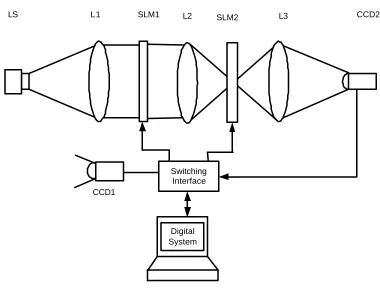
Figure 2-1 shows a matched based correlator that utilizes the correlation property to perform
the correlation between two images. This type of correlator requires a priori fabrication of the complex
valued matched filter and initial transformation of the reference image.
Correlation output C x y( , )is obtained when the system is online
{
}
1
( , ) ( , ) ( , ) (3)
C x y = ℑ− F u v H u v∗
where ℑ−1
( , )
f x y and h x y( , ) performed optically and multiplied together. H u v*( , )is a complex conjugate
function expressed in terms of magnitude and phase and represents a matched filter.
( , )
( , ) ( , ) . i u v (4)
H u v = H u v eφ
Through CCD1, the input scene is captured and uploaded to SLM1 by the switching interface
while lens L1 collimates the coherent light provided by the light source LS. The image loaded on SLM1
is modulated onto the beam and Fourier transformed by lens L1 while the prior computed matched filter
is loaded on SLM2 through the switching interface.
Switching Interface
Digital System
L1 SLM1 CCD2
LS L2 SLM2 L3
CCD1
Figure 2-1: A Matched Filter based Correlator
Although the matched spatial filter produces the highest signal-to-noise ratio in the image plane
1) It requires a priori fabrication of a complex matched filter used in the Fourier plane.
2) It requires accurate alignment along the optical axis and close positioning between the filter and the
Fourier transform of the input.
3) It is difficult to implement in real time.
4) It requires a second SLM to display phase information, thus an extra cost.
In an effort to improve the spatial filter based correlator, Vander lugt [20] and Cai [21] studied
the effects of misalignment of optical setup, while Montes-Usategui [22] presented an automated
iterative process to correct some of the misalignment that occurs during operations. Davis [23] and
Juvells [24] used divergent lens and photographic teleobjective respectively between the scene and the
filter in an attempt to reduce the correlation setup size.
2.3 J
OINTT
RANSFORMC
ORRELATORWeaver and Goodman [3] originally proposed the joint transform correlator (JTC) for optically
convolving two functions. This technique has shown remarkable promise for real-time applications like
optical pattern recognition and tracking application. A JTC can be summarized as a two-staged Fourier
transform operation attained on the simple principle of a lens focusing a beam of coherent light that has
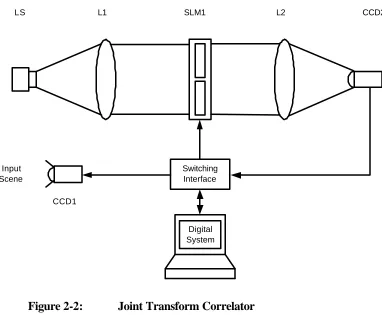
been modulated with images [3]. To explain the basic theory of optical correlation, a simplified JTC is
setup up as shown in Figure 2-2. In this approach, light from a coherent source LS is collimated by lens
Switching Interface
Digital System
L1 SLM1 L2 CCD2
LS
CCD1 Input
Scene
Figure 2-2: Joint Transform Correlator
On SLM1, both the input target imaget x y( , )captured using CCD1 and the reference image
( , )
r x y downloaded from the digital system are placed side to side with a separation (
y
on both sides) as expressed in the following equation:0 0
( , ) ( , ) ( , ) (5)
f x y =r x y−y +t x y+y
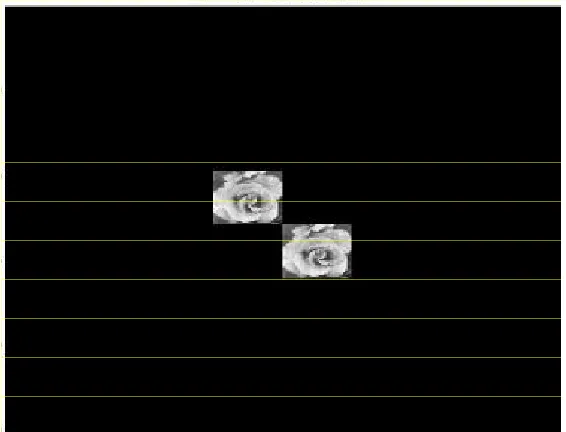
A physical separation (2 y) between the reference object and the target object is required (as shown in
Figure 2-3) because of the existence of zero-order spectra. This requirement hampers the utilization
efficiency of the input spatial domain and lowers the diffraction efficiency of the correlation peaks. Lens
L2 Fourier transforms the input joint input image f x y( , ) to form
{
}
0 0
( , ) ( , ) ( , )exp[ ] ( , )exp[ ]
( , ) exp[ ( , )]exp[r ] ( , ) exp[ ( , )]exp[t ] (6)
F u v f x y T u v jyv R u v jyv
R u v φ u v jy v T u v φ u v jy v
= ℑ = − + −
where R(u,v) and T(u,v) represent the magnitude whileφr(u,v)and φt(u,v) are the phases for the
reference and target images respectively. The frequency-domain variables are mutually independent and
are represented by uandv.
Figure 2-3: Joint Input Image
The Joint Power Spectrum (JPS) which defines the intensity of the Fourier Transform is
captured by a square law detector CCD2, and is expressed mathematically as
2 ( , ) ( , )
2 2 2 2
( , ) ( , ) 2 ( , ) ( , ) cos[ ( , ) ( , ) 2 ] (7) 0
G u v F u v
R u v T u v R u v T u v φr u v φt u v vy
=
= + + × − +
To obtain the final correlation outputc(x,y), the JPS is inversely Fourier Transformed as
shown in Figure 2-4, giving the following equation
( , ) ( , ) ( , ) ( , ) ( , )
( , 2 ) ( , 2 ) ( , 2 ) ( , 2 ) (8)
C x y r x y r x y t x y t x y
r x y y t x y y r x y y t x y y
∗ ∗
∗ ∗
= ⊗ + ⊗
where Crr( , )x y :Autocorrelation of the reference image (zero-order),C x ytt( , ): Autocorrelation of the
test image (zero-order), C x ytr( , −2 )y : Cross correlation of the reference image and the test image located at displacement 2y (first-order), Crt( ,x y+2 )y : Cross correlation of the reference image and the test image located at displacement 2y (first-order) and ⊗stands for a correlation operation while * denotes the complex conjugates.
Figure 2-4: Correlation Output
As mention earlier, classical JTC is associated with a high zero order peak, which causes
an overlap with the desired cross-correlation whenever there is noise or distortion. In real
implementation, zero order peaks cause strong spurious reflections that over saturates the output
detector [25]. To alleviate these limitations, a binary JTC is used where the joint power spectrum (JPS)
is binarized based on a hard clipping nonlinearity at the Fourier plane to only two values, +1 and -1,
2.4 F
OURIERP
LANEI
MAGES
UBTRACTIONA Fourier plane image subtraction technique [9] helps eliminate the false alarms that are
generated automatically in a JTC when multiple targets or multiple reference objects are present in an
input scene. To implement the technique a modified JPS can be obtained by subtracting both the
input-scene-only power spectrum I u v( , )2 recorded by displaying the input scene at the input plane in the
absence of the reference image and the reference-image-only power spectrum R u v( , )2 recorded by
displaying only the reference image. Since the JPS F u v( , )2 is normally recorded by displaying both
the reference image and the input scene in the input plane SLM, the modified JPS obtained using the
Fourier plane image subtraction technique can be expressed as
[
]
[
]
2 2 2
0 1
0
( , ) ( , ) ( , ) ( , )
2 ( , ) ( , ) cos ( , ) ( , ) 2 2 ( , ) ( , )
cos ( , ) ( , ) 2 (9)
n
i tt r i i
i
r n
P u v F u v T u v R u v
T u v R u v u v u v ux vy vy R u v N u v
u v u v vy
φ φ φ φ = = − − = − − − − + × − −
∑
This equation (9) clearly indicates that the subtraction operation eliminates the false alarms
generated by similar input scene images. It also eliminates the cross correlation terms between other
objects that are present in the input scene. From the above discussion, we see that Fourier plane image
subtraction technique involves multiple processing steps and thus not suitable for real time applications
where processing speed is a key factor. Furthermore, it still requires the use of large SLM to
accommodate the displacement between the images. The technique can be implemented either optically
or electronically.
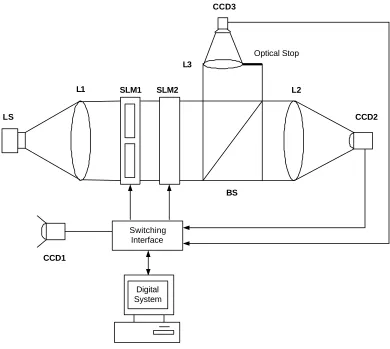
Figure 2-5 illustrates the architecture of a JTC employing Fourier subtraction technique, where
system. Light from light source LS is collimated by lens L1 and passed through SLM1 and SLM2
(phase only SLM), where it is modulated with input information and phase encoded. In the initial
operation, the phase only SLM2 is clear, and light passes without being encoded. Beam splitter BS
splits the beam of light into two: one through L2 and the other through L3. The Fourier transform of the
joint input image is performed by lens L3, captured and downloaded to the digital system by CCD2. An
optical stop is setup up on the vertical beam path to block the transmission of reference image and allow
only the light modulated with test images pass to L3. In the next operation, SLM2 is set as a phase only
SLM representing the negative values while lens L2 performs the inverse Fourier transform which is
captured by CCD1 as the correlation output.
Switching Interface
L1 SLM1 L2
CCD2 LS
Digital System
CCD1
SLM2 L3
CCD3
Optical Stop
BS
2.5 B
INARYJTC
Proposed by Javidi and Kuo, [26] binary JTC is superior to classical JTC in terms of
correlation peak intensity, correlation width, and discrimination sensitivity [25], but is noted to have
lower system processing speed due to the intensive computation required by Fourier plane binarization
process. In this process the JPS is binarized into two values (+1 and -1) based on a hardcliping
nonlinearity before the inverse transformation process. The threshold for binarization is set by making
the histogram of the pixel values of JPS and selecting the median [8].
2 2 1 ( , )
( , ) (10)
1
T if F u v F u v
otherwise
+ ≥
= −
The architecture of the binary JTC is similar to the architecture of the classic JTC shown in
Figure 2-2. The SLM1 is used to display both the input signal and the threshold Fourier transform
interference intensity which is the JPS captured by camera CCD2 and binarized by the digital system.
The correlation output is computed by the lens L2 and read out at CCD2.
2.6 F
RINGE-A
DJUSTEDJTC
The fringe adjusting technique was proposed by Alam and Karim [8,10] in order to improve
coloration discrimination. In this technique, the JPS is multiplied by a real valued filter referred to as
FAF (fringe adjusted filter) before applying an inverse Fourier transform to yield the correlation output.
( , ) 2
( , )
(11) ( , ) ( , )
FAF u v
B u v H
A u v R u v
=
where A u v( , )and B u v( , )may be constants or functions of v. While A u v( , )is used to overcome the
pole and suppress noise, B u v( , )is used to control the optical gain. By multiplying, the JPS With the
FAF then the modified JPS mentioned earlier is obtained
[
]
2 2 2 0 2 ( , ) ( , )( , ) ( , ) ( , ) ( , ) cos ( , ) ( , ) 2
( , ) (12)
( , ) ( , )
FAF
r r
G u v F u v H
R u v T u v R u v T u v u v u v vy
B u v
A u v R u v
φ φ
= ×
+ + − +
=
+
when B u v( , )=1 and R u v( , )2 ? A v( ) then equation (14) can be simplified as
2
( , ) ( , ) (13)
FAF u v
H ≈ R u v −
and the modified JPS is given by the approximation of equation (12)
[
0]
( , ) 2 2cos r( , ) r( , ) 2 (14)
G u v = + φ u v −φ u v + vy
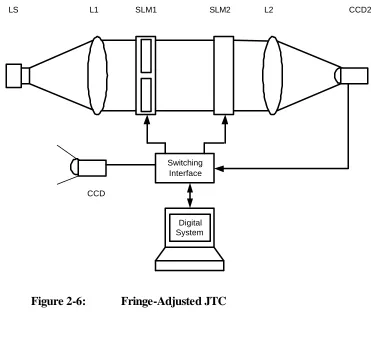
Although FJTC suffers from false alarms in the presence of multi-target, it does not require high
computations as binary JTC or produce high order harmonics as in a classical JTC [3]. To illustrate the
fridge adjusting techniques, the opto-electronic system is setup as in
Figure 2-6. In this fringe-adjusted architecture, the SLM2 is initial set to a transparent mode to allow
CCD2 to capture the JPS. On the next operation, SLM2 is loaded with the fridge-adjusted filter from
the digital system. Lens 2 performs inverse Fourier transform of product of input image and the
Switching Interface
Digital System
L1 SLM1 L2 CCD2
LS SLM2
CCD
Figure 2-6: Fringe-Adjusted JTC
2.7 P
HASE-E
NCODEDJTC
When the input scene consists of multiple images, the JPS is cluttered with correlation and
autocorrelation peaks that distort each other and are hard to distinguish from one another. The Fourier
plane image subtraction technique mentioned earlier is one of the method used eliminate the zero-order
peak. The phase encoding technique is simpler method that can be employed to achieve the same
effects without the need for digital computation and extra processing steps. The phase mask in this
technique can be represented by [8, 27]
[
]
( , )u v exp jψ( , )u v (15)
Φ =
0 1
( , ) ( , ) ( , ) ( , ) (16)
N
i i i
i
f x y r x y y t x y y ϕ x y
=
= + +
∑
− ⊗where ϕi( , )x y is the spatial domain transformation of the phase mask. At the correlation output, the
JPS captured is
[
]
[
]
[
]
{
}
[
]
{
}
2 2 0 1 2 2 1 * 0 1 0( , ) ( , ) exp ( , ) exp( ) ( , ) exp ( , ) exp( ) ( , )
( , ) ( , )
( , ) ( , ) exp ( , ) ( , ) ( ) ( , )
( , ) ( , ) e x p ( , ) ( , ) ( )
n
i i ti i
i n
i i n
i t ti i i
i
i t ri i
i
F u v T u v u v juy R u v u v juy u v
T u v R u v
T u v R u v u v u v jv y y u v
T u v R u v u v u v jv y y
φ φ φ φ φ φ φ = = = = + − × = + + × − + + × Φ + − + − +
∑
∑
∑
[
]
{
}
[
]
{
}
1 * 1 1 * 1 1 ( , )( , ) ( , ) exp ( , ) ( , ) ( ) ( , ) ( , )
( , ) ( , ) exp ( , ) ( , ) ( ) ( , ) ( , )
(17) n i i k n n
i k ri rk i k k i
i k
i k n n
i k ri rk i k k i
i k
u v
R u v R u v u v u v jv y y u v u v
R u v R u v u v u v jv y y u v u v
φ φ φ φ = ≠ = = ≠ = = × Φ + × − − − ×Φ × Φ + × − + + − × Φ × Φ
∑
∑ ∑
∑ ∑
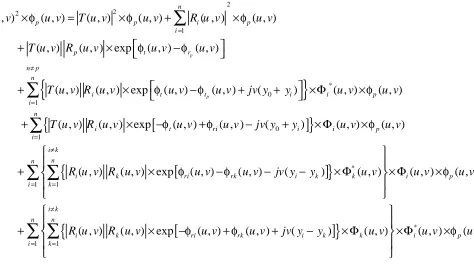
When JPS is multiplied by the same phase maskΦ( , )u v , the cross correlation between the reference image and the test image is preserved while all other peaks are scattered in all directions and
{
}
2 2 2 1 * 0 1 ( , ) ( , ) ( , ) ( , ) ( , ) ( , )( , ) ( , ) exp ( , ) ( , )
( , ) ( , ) exp ( , ) ( , ) ( ) ( , ) ( , )
( , ) ( , ) exp ( , ) ( , )
p
p
n
p p i p
i
p t r
n p n
i t t i i p
i
i t ri
F u v u v T u v u v R u v u v
T u v R u v u v u v
T u v R u v u v u v jv y y u v u v
T u v R u v u v u v
φ φ φ φ φ φ φ φ φ φ = ≠ = × = × + × + × − + × − + + ×Φ × + × − + −
∑
∑
[
]
{
}
[
]
{
}
[
]
{
}
0 1 * 1 1 1 1 ( ) ( , ) ( , )( , ) ( , ) exp ( , ) ( , ) ( ) ( , ) ( , ) ( , )
( , ) ( , ) exp ( , ) ( , ) ( ) ( , ) n
i i p
i i k
n n
i k ri rk i k k i p
i k
i k n
i k ri rk i k k
i k
jv y y u v u v
R u v R u v u v u v jv y y u v u v u v
R u v R u v u v u v jv y y u v
φ φ φ φ φ φ = ≠ = = ≠ = = + × Φ × + × − − − × Φ × Φ × + × − + + − ×Φ
∑
∑ ∑
∑
* ( , ) ( , ) (18) ni u v φp u v
×Φ ×
∑
To avoid affecting the overall speed of the phase encoded JTC, the phase masks are
computed a priori and stored with the reference images in the digital system.
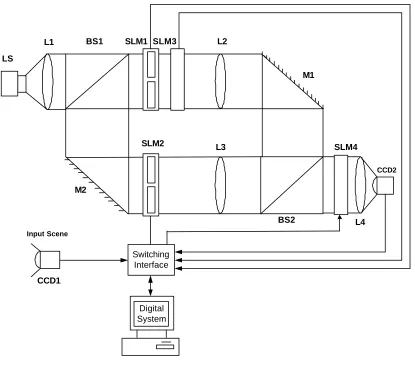
Figure 2-8 shows the architecture of a phase-encoded JTC, which is simple and cost effective
to implement. The laser beam from source LS is split into two beams by beam splitter BS1 after
being collimated by lens L1. At SLM1 the horizontal beam is modulated with input scene image
captured by CCD1and loaded through the digital system switch to the upper part of the SLM3,
which is a phase only SLM that is loaded via digital system with the spatial domain phase mask
from the computer. The mirror M1 steers the Fourier transform of the phase encoded input
scene performed by L2 into BS2. The vertical light from BS1 is steered by mirror M2 into
SLM2, where it is modulated with the reference image that was loaded from the computer to
the lower half of the SLM. BS2 combines the Fourier transform of the reference image
performed by lens L3 and the Fourier transform of the phase-encoded input performed by L2.
The Fourier domain version of the phase mask is downloaded to a phase only SLM4 such that
the combined beam traveling through it is multiplied by the phase mask in Fourier domain. Lens
L4 performs the inverse Fourier transform on the combined beam leaving SLM4. The power
Switching Interface
L1 SLM1 L2
CCD2
LS
Digital System
CCD1
SLM3
BS2 L3
L4 SLM4 M1
M2
SLM2 BS1
Input Scene
3 RANDOM PHASE MASK
This section provides a short overview of the theory and application of Pseudo-random
sequences, focusing mainly on how M-sequences are used to generate two dimensional array
orthogonal phase masks. Pseudo-random sequences are defined as deterministic sequence of integers,
which have been chosen in some methodical manner, but appear to be random [29].
3.1 M-
SEQUENCEIn creating a phase mask, M-sequence is the preferred Pseudo-random sequence due to ease
of generation. Maximal length sequences (M-sequences) have been utilized widely in numerous modern
communications since first introduced by Zierler in 1967 [30] and their theoretical foundations were
greatly expanded by Golomb [31]. For randomness, the following properties must be satisfied [32]:
• Balance: – the number of ones (high state) in one period must be equal to the number of zeros (low state), or the difference of the number of ones (xn−1) and zeros 1
(xn− −1)should not be more than one.
• Run Property: – defined as a maximal string of consecutive identical symbols (zeros or ones) in the sequence. For M-sequence in a period, half of the runs have a length 1, one quarter have
length 2, one eighth of length 3.
A linear feedback shift register with a generating polynomial g x( ) in which a coefficient arises
from the Galois field [32] can be used generate M-sequence. Finite (Galois) fields are fields with only a
finite number of elements that are closed under operations of addition, subtraction, multiplication, and
division by non-zero elements. These fields exist only when the elements are N
p where P is a prime and
N any positive integer.
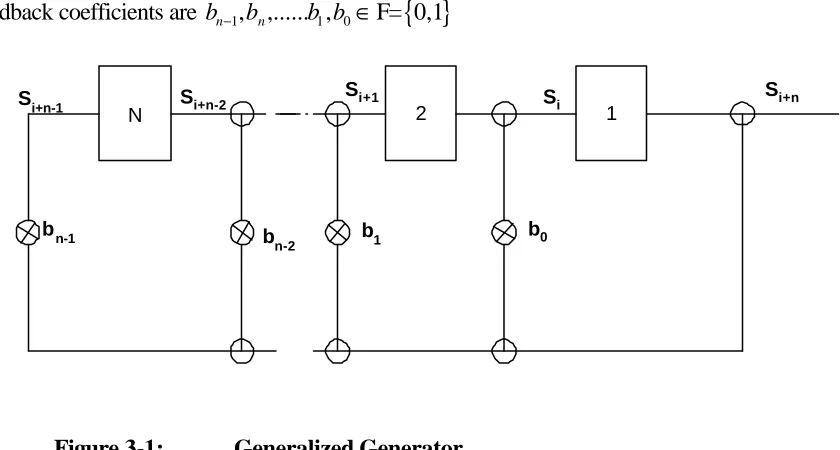
Figure 3-1 is simple set up of shift registers whose contents modified at every step by a binary –
weighted value of the output stage. Considering the initial state of the registers and the feedback
arrangement, the LSFR method generates a sequence {b} that satisfies linear recursion formula.
1
1 i n .... 0 (19)
i n n i
S+ =b S− + − + +b S
where feedback coefficients are bn−1,bn,... ,b b1 0∈F= 0,1
{ }
1 2
N
bn-1 b
n-2 b1
b0
Si+n-1 Si+n-2 Si+1 S
i Si+n
Figure 3-1: Generalized Generator
The succession state of the LFSR form a purely period sequence of period length d ≤2k −1
where k is the order of the shift register sequence. To derive the characteristic polynomial of shift
0
( ) i i (20)
i
G x b x
∞ =
=
∑
where x is an indeterminate
( )
G x reflects the properties of the sequence {b} and represent its terms in correct order
0 0 0 0 1 1 0 0 ( ) ... (21) k i j i j i j
k
j i j
j i j
j i
k
j j i
j j i
j i
G x a b x
a x b x
a x b x b x b x
∞ − = = ∞ − − = = ∞ − − − − = = = = = + + +
∑ ∑
∑ ∑
∑
∑
Thus(
1)
1 1 ( ) ... ( ) k j j j j j
G x a x b x− − b x− − G x
=
=
∑
+ + + and(
1)
1 1
1 ...
( ) (22)
1
k j j
j j
j
k j
j j
a x b x b x
G x a x − − − − = = + + = −
∑
∑
In equation (21) G x( )can be separated into
(
b x−j −j+ +... b x−1 −1)
which are terms for initial state and feedback coefficient1 k
j j= a
∑
. The denominator1
1 k j j
j= a x
−
∑
is independent of the initial state thus forb (values of 0 and 1 equation (21) can be expressed as
1
( ) (23)
1 k k j j j a G x a x = = −
∑
If you let1
2 1
1 2 1
2 1
1 2 1
( ) 1
1 ...
1 ... (mod2). (24)
k j j j k k k k k k k k
f x a x
a x a x a x a x
a x a x a x a x
= − − − − = − = − − − − − ≡ + + + + +
∑
If we assume akis non-zero (i.e. ak =1 ) and the characteristic polynomial f x( ) is expressed in th k
degree to be
1
1 1
( ) k k k ... 1 (25)
For a given initial state
0 1
( ) (26)
( )
i i i
G x b x
f x
∞ =
= =
∑
As earlier stated sequence {b} generated from LSFR is periodic at length d ≤2k −1
Suppose the sequence {b} have a period length of d
1 1
0 1 1 0 1 1
2 1
0 1 1
1 2 3
0 1 1
1
0 1 1
1
( . . . ) ( . . . )
( )
( . . . ) . . .
( . . . )(1 . . .)
( . . . )
(27) (1 ).
d d d
d d
d d
d
d d d d
d d d
d
b b x b x x b b x b x
f x
x b b x b x
b b x b x x x x
b b x b x
x − − − − − − − − − − = + + + + + + + + + + + + = + + + + + + + + + + = −
Sincef x( ) is characteristic polynomial it divides by 1 d x
− and the quotient can be expressed as
1
0 1 . . . 1 (28)
d d x x β β β − − + + + then 1
0 1 1
1 2
0 1 1
1 1
0 1 1 0 1 1
0
. . . 1
( ) 1
( . . . )(1 . . . )
( . . . ) ( . . . ) . . .
( ) (29)
d d d
d d d
d
d d d
d d
i i i
x x
f x x
x x x x
x x x x x
G x b x
β β β β β β β β β β β β − − − − − − − − ∞ = + + + = − = + + + + + + = + + + + + + + + = =
∑
This shows that for a sequence {b} with a period length d, the equating coefficients are similar to the
powers of x.
Table 3.1 contain M-sequence feedback sets for LFSR [33].
Shift Register length, n Possible Feedback Taps
2 [2,1]
3 [3,1]
4 [4,1]
5 [5,2], [5,4,3,2], [5,4,2,1]
6 [6,1], [6,5,2,1], [6,5,3,2]
7
[7,1], [7,3], [7,3,2,1], [7,4,3,2], [7,6,4,2], [7,6,3,1],[7,6,5,2],
[7,6,5,4,2,1], [7,5,4,3,2,1]
8
[8,4,3,2], [8,6,5,3], [8,6,5,2], [8,5,3,1], [8,6,5,1],[8,7,6,1],
[8,7,6,5, 2,1], [8,6,4,3,2,1]
Table 3-1: Polynomial Roots
3.2 T
WOD
IMENSIONALA
RRAYSTwo-dimensional arrays can be implemented using the following methods.
• Folding Array: - Mac Williams and Sloane [34] and Green [35] used this method to create a matrix of the same periodic autocorrelation as the M-sequence. To implement a 2D array, a sequence of
length pq is remapped into array of areapqwith p and qbeing co-primes.
based on the concept that all accumulated cyclic shifts between rows separated by distance d are
different (Distinct sums property) [35].
• Product array: – a 2D array is created by multiplying two sequences r and s of lengths p and q element by element. If the two sequences r and s are equal (r=s) then operation can be reduced to a shift-and-add operation. In 1991, Kuo and Rigasi [36] used this method to create
m-arrays, which have found applications in coded aperture imaging, pattern synchronization, code
division and image multiplexing.
3.2.1 Shift and add property
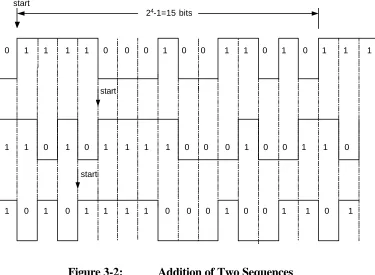
When an M-sequence is shifted in time and added (modulo 2) to a non-shifted version of the
same sequence, an identical sequence shifted by certain number of bits is the result as shown in Figure
3-2.
(31)
i j k
u + u =u
For 0<i j k, , < −2n 1 and
u
k is the shifted M-sequence (by k positions) while u is the original M-sequence.For example:
4
3
111100010011010 101011110001001 010111100010011 u
u u
⊕
0 1 1 1 1 0 0 0 1 0 0 1 1 0 1 0 1 1 1
1 1 0 1 0 1 1 1 1 0 0 0 1 0 0 1 1 0
1 0 1 0 1 1 1 1 0 0 0 1 0 0 1 1 0 1 24-1=15 bits
start
start
start
Figure 3-2: Addition of Two Sequences
A shift
i
to the left is equivalent of (2n− −1 i)position shifted to the left, thus the following equation(2 1)
(32)
n i i
u =u± −
for 0≤ <i 2n−1
Using the above theory a two dimensional m-array can be constructed from two M-sequence [a] and
[b].where [ ] [ , ...,0 1 1]
a
n
a = a a a − and [ ] [ , ...,0 1 1]
b
n
b = b b b − to form [M] as in equation (33)
0 0 0 1 0 1
1 0 1 1 1 1
1 0 1 1 1 1
. . .
. . .
. . . .
[ ] (33)
. . . .
. . . .
. . .
b
b
a a a b
n
n
n n n n
a b a b a b
a b a b a b
M
a b a b a b
Since every row and column is a modulo-2 addition of an sequence, the m-array consists of
M-sequences and their complement, thus preserving all their properties as shown in Figure 3-3. In addition,
there is more freedom in selecting the size of the array.
For example:
4
3
111100010011010 101011110001001 010111100010011 u
u u
⊕
⊕
1 0 1 0 1 1 1 1 0 0 0 1 0 0 1
1
0
1
0
1
0 0 0 0
1 1 1
0
1 1
0
1 0
1
0
1
0 0 0 0
1 1 1
0
1 1
0
1 0
1
0
1
0 0 0 0
1 1 1
0
1 1
0
1 0
1
0
1
0 0 0 0
1 1 1
0
1 1
0
0 1
0
1
0
1
1 1 1
0 0 0
1
0 0
1
0 1
0
1
0
1
1
1 1
0 0 0
1
0 0
1
0 1
0
1
0
1 1
1
1
0 0 0
1
0 0
1
1 0
1
0
1
0 0 0
0
1 1 1
0
1 1
0
0 1
0
1
0
1 1 1 1
0
0 0
1
0 0
1
0 1
0
1
0
1 1 1 1
0
0
0
1
0 0
1
1 0
1
0
1
0 0 0 0
1 1
1
0
1 1
0
1 0
1
0
1
0 0 0 0
1 1 1
0
1 1
0
0 1
0
1
0
1 1 1 1
0 0 0
1
0
0
1
1 0
1
0
1
0 0 0 0
1 1 1
0
1
1
0
0 1
0
1
0
1 1 1 1
0 0 0
1
0 0
1
3.2.2 Array Auto-Correlation
The cyclic auto correlation
Θ
AA i j( , ) of two-dimensional m-array is expressed as( , )
( , 0 )
(0, )
(0,0)
1, 0 & 0
, 0
(34)
, 0
, 0
A A i j
A A i b
AA j a
AA a b
for i j
n for i
n for i
n n for i
Θ = ≠ ≠ Θ = − ≠ Θ = − ≠ Θ = ≠
By definition, it measures how an array matches a copy of itself as the copy is shifted and mathematical
proven in [36].
3.2.3 Array Cross-Correlation
The cyclic cross correlation ΘAA i j'( , )between two different two-dimensional m-arrays
[ ]
A
and
[ ']
A
can be expressed as'( , ) '( ) '( ) (35)
AA i j aa i bb j
Θ = Θ Θ
where
[ ']
A
is a m-array generated by[ ']
a
and[ ']
b
[37] and measures how the interferencebetween the two different arrays.
3.3 R
ANDOMP
HASEM
ASKA
LGORITHMIn this section, we describe a step-by-step procedure to design an optical phase mask. The
steps involves designing an M-sequence from a LFSR and using it to generate a two dimensional
orthogonal array which is converted to phase mask. These steps are summarized in Figure 3-4.
Input: A sequence ai ≡(a a0i, 1i,...aiN−1)
Output: Random Phase Mask
1. Generate M-sequence
a
i≡
(
a a
0i,
1i,...
a
iN−1)
2. Generate shifted sequences
a
i≡
(
a a
0i,
1i,...
a
iN−1)
where i=1,2,...N−1 for N is the length of the sequence code.
3. For 0≤ ≤ −i N 1 choose two sequence codes A and B (
A
≠
B
) from0 1 1
(
,
,...
)
i i i i
N
a
≡
a a
a
− and create a two vectors [A] and [BT]where T represents transpose.
4. Using modulo 2 additions, add bit by bit the two vectors to form a matrix M.
5. create a matrix consisting of
(
N
+ ×
1) (
N
+
1)
zeros and add two the matrix M to form apadded M matrix.
6. For
M
=
(
m
i j,)
wherei
= =
j
N
+
1
Convert 1 and 0 to respective phase angles (1 forLFSR
m sequense Shifted
m sequense
Modulo 2 Addition
N X N Array
Random Phase Mask
Conversion
Figure 3-4: Formulation of Random Phase Mask
3.4 C
OMPARISON OFD
IFFERENT ENCODING LEVELSHistograms have been widely used to represent, analyze, and characterize images. They are
easy to compute and represent the approximations of the probability density functions of random
variables whose realization is the particular set of pixel values found in the images. In order to investigate
the effects of varying levels of phase encoding of the phase masks implemented with maximal length
sequence, we first analyze the histograms of images phase encoded with different levels: binary (2),
M-sequence is represented by equationn=mx−1, where m (m = 2, 3, 5) is the level of encoding selected. From the figures below (Figure 3-5, Figure 3-6, Figure 3-7), several observations can be
made about the distribution of the phases in the encoded image. As we increase the number of levels
(m), the peak height of the histograms increase and the curve smoothens. Figure 3-7 (m=5) offers best
results compared to the other two encoding levels (m= 2, 3).This implies that when the reference image
is encoded into more phase mask thus more pixels, it offers better results. In addition, we note that
when identical images are multiplied with different randomized phase masks, their histograms plots are
of Gaussian shape but of different heights.
Figure 3-6: Histogram of ternary encoding (m=3)
Figure 3-7: Histogram of level five encoding (m=5)
Next, we consider the influence of the phase encoding levels on the performance of the phase
encoded JTC. Using the selected three levels (m = 2, 3, 5) to create different phase masks, the
correlation output of the phase encoded JTC binary encoded phase mask. The presence of two peaks
at the correlation output deviates from the expected results. The presence of a conjugate cross
correlation peak in the output plane confirms the inability of binary two phase to disperse all undesired
peaks. From this, we can infer that a phase mask created from a binary
M-sequence is not suitable for encoding images in the JTC system.
Through comparison, level- 5 encoding represented by correlation output in
Figure 3-10 has a better correlation output compared to binary and ternary encoding. The correlation
peaks are distinguished clearly and their intensity height increases as the number of levels were increased
(from 2, 3, and infinity for rand sequence). Figure 3-11 shows the correlation output when phase mask
is created from a random sequences (Matlab rand function was used to create the Pseudo random
sequence).
Figure 3-8: Correlation Outputs for Image created with a Random phase
Figure 3-9: Correlation Outputs for Image created with a Random phase mask (m=3)
Figure 3-10: Correlation Outputs for Image created with a Random phase
4 MULTI-REFERENCE PHASE ENDODED JTC
This section presents an analysis of the multi-reference phase encoded JTC and sheds light on
the implemented multi-reference phase encoded JTC using a phase only SLM. The goal of the section
is to mathematical express the mentioned architectures and compares their results.
Using a multiple reference image in the input joint image to correlate with a single test image in a single
step, Alsamman [37] presented a multiple reference phase encoded JTC that takes advantage of the
massive parallelism of optical systems to increase the processing power of the JTC. In this technique,
reference images are phase encoded using Pseudo-random sequences, hence removing extraneous
peaks from correlation plane as well as improving the spatially efficiency of the JTC system.
In a classical JTC, a minimum SLM size of 2N X 2N is required to correlate two N X N
images. This is because of the displacement (2y0) required between the reference image and the test
image to avoid zero order term in the correlation output dominating and overshadowing the cross
correlation terms. A displacement of distance(2y0)at the input plane results in double distance (4y0
between the cross correlation terms) at output plane. In order to obtain large displacement without
increasing the sizes of the SLM, small images are used which result to a lower discrimination power at
correlation output plane. The use of large SLM size vastly increases the overall cost of the JTC while
increasing the overall system size.
In the multi-reference phase encoding technique, every reference image is multiplied with a
phase mask defined as
[
]
( , )u v exp jψ( , )u v (36)
where ψ( , )u v is a random phase distribution between
−
π
andπ
.The joint input image of multi-reference phase encoded JTC represented by the equation below
consists of a reference image ( , )r x yi that has been encoded with phase mask ϕi( , )x y and displayed
side by side with an input test image.
1
( , ) ( , ) ( , ) ( , ) (37)
N
i i
i
f x y t x y r x y ϕ x y
=
= +
∑
⊗Using light from source LS and collimated by lens L1, the joint input image is displayed on
SLM1 (Figure 4-1). The converging lens L2 is used to obtain the Fourier transform of joint input image
and the JPS captured by the CCD device and routed to SLM1 through the digital interface as shown on
Figure 4-1
[
]
[
]
[
]
{
}
[
]
{
}
2 2 1 2 2 1 * 1 1( , ) ( , ) exp ( , ) ( , )exp ( , ) ( , )
( , ) ( , )
( , ) ( , ) exp ( , ) ( , ) ( , )
( , ) ( , ) exp ( , ) ( , ) ( , )
( , ) ( , ) exp ( , )
n
i i ti
i
n
i i n
i t ti i
i n
i t ri i
i
i k ri
F u v T u v u v R u v u v u v
T u v R u v
T u v R u v u v u v u v
T u v R u v u v u v u v
R u v R u v u v
φ φ φ φ φ φ φ φ = = = = = + × = + + × − ×Φ + − + ×Φ + ×
∑
∑
∑
∑
[
]
{
}
[
]
{
}
* 1 1 * 1 1 ( , ) ( , ) ( , )( , ) ( , ) exp ( , ) ( , ) ( , ) ( , )
(38)
i k n n
rk k i
i k
i k n n
i k ri rk k i
i k
u v u v u v
R u v R u v u v u v u v u v
To obtain results for a particular reference image, its corresponding phase mask is displayed on
SLM2 and correlated through lens L2. The same process can be achieved by multiplying the JPS
digitally with the phase mask
Switching Interface
Digital System
L1 SLM1 L2 CCD
LS SLM2
Phase Only
Figure 4-1: Multi-Reference Phase Encoded JTC
Figure 4-2 shows the joint input image with two reference image of size 256 X 256 pixels
phase encoded with a phase mask created from five level maximal length sequences
(M-sequences). The shift and add method described in chapter three was used to create an m-array
which was translated into a phase mask of size 256 X 256. In Figure 4-2 below only the test image can
clearly be identified, as the phase encoded reference images pixels are scattered by the phase mask in
all directions and appear as noise. Figure 4-3 represents the correlation output achieved using a
Figure 4-2: Joint Input Image
4.1 M
ULTI-R
EFERENCEP
HASEE
NCODEDJTC U
SINGP
HASESLM O
NLYIn this thesis, we further improve the performance of the multi-reference phase encoded JTC
by converting both the reference and target image into phase information before applying operations
similar to multi-reference phase encoded JTC discussed earlier. From the previous phase encoding
technique, we have seen that Fourier plane image subtraction technique results are attained using a
random phase mask generated from two-dimensional M-sequence array. The advantage of this method
is that the same effects are achieved with less digital computation and without extra processing steps
[37]. Phase encoding technique has also been successful used in the field of information security as in
optical authenticity verification [38] and in storing encrypted information holographical [39].
In the initial stage, all images are encoded with a phase expression forming a phase only
representation. Target image and reference image are converted into the following expressions
( , ) exp[ { ( , )}] (39)
pt x y = jA t x y
( , ) exp[ { ( , )}] (40)
pr p q = jA r x y
where A is phase depth (2 )π
The technique of transforming intensity images into phase function has been previous used in pattern
recognition pattern [38,39]. The joint input image used in this system consists of target image placed
side by with multiplexed references images as expressed below equation and shown in Figure 4-4:
1
( , ) ( , ) ( , ) ( , ) (41)
N
i i
i
pf x y pt x y pr x y ϕ x y
=
= +
∑
⊗where ϕi( , )x y is the spatial domain transformation of the phase mask that is expressed as
[
]
( , )u v exp jψ( , )u v (36)
Φ =
Different shifts of M-sequence are used to create orthogonal phase masks that are used multiplied with
every reference image in Fourier domain.
Figure 4-4: Joint Input Image
The JPS collected by CCD at the correlation output can be expressed as
[
]
[
]
[
]
{
}
[
]
{
}
2 2 1 2 2 1 * 1 1( , ) ( , ) exp ( , ) ( , ) exp ( , ) ( , )
( , ) ( , )
( , ) ( , ) exp ( , ) ( , ) ( , )
( , ) ( , )exp ( , ) ( , ) ( , )
( , ) ( , ) n
i i ti
i
n
i i n
i t ti i
i n
i t ri i
i
i k
PF u v PT u v u v PR u v u v u v
PT u v PR u v
PT u v PR u v u v u v u v
PT u v PR u v u v u v u v
PR u v PR u v
φ φ φ φ φ φ φ = = = = = + × = + + × − ×Φ + − + ×Φ + ×
∑
∑
∑
∑
[
]
{
}
[
]
{
}
* 1 1 * 1 1exp ( , ) ( , ) ( , ) ( , )
( , ) ( , ) exp ( , ) ( , ) ( , ) ( , ) (42) i k
n n
ri rk k i
i k
i k n n
i k ri rk k i
i k
u v u v u v u v
PR u v PR u v u v u v u v u v
![Table 3.1 contain M-sequence feedback sets for LFSR [33].](https://thumb-us.123doks.com/thumbv2/123dok_us/8937562.1848380/37.612.60.547.99.417/table-contain-m-sequence-feedback-sets-lfsr.webp)