The efficacy of using play therapy in children with
behavior disorders: A meta-analysis overview
Hidayat, Dede R.
Universitas Negeri Jakarta, Indonesia ([email protected])
Prabowo, Arga S.
Universitas Negeri Jakarta, Indonesia ([email protected])
Cahyawulan, Wening
Universitas Negeri Jakarta, Indonesia ([email protected])
Fitriyani, Hilma
Universitas Negeri Jakarta, Indonesia ([email protected])
Received: 29 December 2015 Revised: 12 April 2016 Accepted: 1 May 2016
Available Online: 29 June 2016 DOI: 10.5861/ijrsp.2016.1404
ISSN: 2243-7681 Online ISSN: 2243-769X
OPEN ACCESS
Abstract
This study was a meta-analysis of the effect of play therapy that is used to overcome the
problems of behavior disorders in children. Meta-analysis was performed using Cohen's effect
size in 4 experimental research results obtained through EBSCOhost electronic journals,
Proquest, and Google scholar. The study involved 98 participants in dealing with internalizing
behavior problems and externalizing behavior problems. Participants in the study were
divided into experimental group and control group. The calculations show the great effect size
(d = 0.59). It shows that the play therapy provides a great influence in reducing behavioral
disorders in children. While play therapy provides a great influence in dealing with
internalizing behavior problems (d = 0.60) and externalizing behavior problems (d = 0.58).
The efficacy of using play therapy in children with behavior disorders: A meta-analysis
overview
1. Introduction
Emotional and behavioral disorder is one of the most frequent disorders experienced by children and adolescents. Mental Health America (in Ojiambo & Bratton 2014) reported that estimated one in five children experience emotional stress problems and less than one-third receive appropriate treatment to address the problem. From all children who experience clinical disorders listed in the recovery program, one-third to half reported experiencing behavioral disorders (Krattochwill & Mary Morris, 2014). Even in the non-clinical population, found that 50% or more of children aged 4 to 5 years have shown some of the symptoms of external behavioral disorders that can develop into permanently behavioral disorders (Campbell, Coie, & Reid in Yanti, 2005). This phenomenon is common in many countries. Epidemiological studies in several countries such as Canada and New Zealand showed about 5 -7 % of children have behavioral disorders (Grainger in Yanti, 2005).
Counseling Services is a way of handling children who have behavioral disorders. Robinson (Yusuf & Nurihsan, 2009), states that counseling is all forms of relationship between two people, in which a client is assisted to be better able to adapt effectively to itself and its environment. One technique that can be used in counseling to cope with behavioral disorders is Play Therapy.
Play therapy is a way to help children with problems to cope with distress, using games as a medium for communication between children and therapist. Slavin (2006) states that play is important for children because it can train language skills, cognitive, social skills and other contributions to the development of personality. Playing also makes the child uses his imagination to be someone else. Playing helps children to transform the mind of a concrete object into abstract object. Play therapy is considered as a therapy that is possible to be used on children in an effort to cope with behavior disorders. The use of indirect methods such as games is considered effective.
2. Literature Review
Behavioral disorder itself covers a fairly wide range, starting from the behavior of aggression or hyperactivity to withdraw behaviors (withdrawal) or the inability to build friendships (Epstein & Cullinan in Slavin, 2006). In essence, behavioral disorders shown in prolonged period can lead to indications of emotional shocks. Quay and Werry (1996) noted four general categories of behavioral disorders, namely conduct disorder, anxiety-withdrawal, immaturity (immaturity) and disruption of social aggression (socialized - aggressive disorder). Children with conduct disorder are often characterized by inability to obey the rules, bullies, selfish, jealous, destructive, disrespectful, fighting and vandals. Quay and Werry also noted that conduct disorder, anxiety-withdrawal, immaturity (immaturity) represent forms of maladaptive behavior disorders or circumstances that became the source of the next individual difficulties (Slavin, 2006).
excessive emotional control, including social withdrawal, demanding attention, feeling worthless or inferior, and dependence (Achenbach & Edelbrock, 1978; McCulloch, Wiggins, Joshi, & Sachdev, 2000 in Guttmannova & Cali, 2007). Externalizing problems is the behavior that is characterized by the inability to control emotions, including difficulties in interpersonal relationships and break the rules, looks like irritability and bellicosity (Achenbach & Edelbrock, 1978; Hinshaw, 1992 in Guttmannova & Cali, 2007).
Play therapy is a way to help children with problems to cope with distress, using games as a medium for communication between the child and the therapist. The Association for Play Therapy (1997) defines Play therapy is as follows: “The systematic use of a theoretical model to establish an interpersonal process where in trained play therapists uses the therapeutic powers of play to help clients prevent or resolve psychosocial difficulties and achieve optimal growth and development”. Based on the understanding that it can be used as the basis of some basic concepts of Play therapy, among others:
Play therapy is built on a systematic theoretical foundation. In this regard, Play therapy is built based on various theories of psychology and counseling that have been established, such as the theory of psychoanalytic theory, Client-Centered, Gestalt, cognitive-behavioral, Adlerian, and so on. How to construct and implementation of the theory in the context of Play therapy is described in another section.
Play therapy emphasizes the power of the game as a tool to assist clients who require assistance. The purpose of the use of Play therapy is to assist the client in order to prevent and address the psychological issues as well as helping to achieve growth and development in accordance with the development tasks optimally.
According to Cattanach (2003), play therapy is based on four basic concepts, namely:
Play is how children understand the world of children,
Aspect in the development of children's play activities is a great way to discover and explore their identity,
Kids can experiment with a wide selection of imaginative and avoid such consequences when in real world,
Game in the right circumstances can be meaningful as physical activity as well as therapy. The use of games in child counseling conducted by a variety of reasons.
Axline (in Thompson et al., 2004) revealed that the use of play therapy is done on the grounds that the play is a natural medium that is used by children to express themselves. Meanwhile, Ginon (in Thompson et al., 2004) states: "A child's play is his talk and toys are his words," As such, play can help the efforts to establish a relationship with the child, building a child's concentration, improve the health and development of children.
3. Method
3.1 Samples
Sample studies in the meta-analysis are the individual who is at the stage of development of children, as follows:
Table 1
Sample Characteristics
Year Researcher Sample
Total Characteristics
2002 Packman 24 Pre-Teens
Based on the five researches, which is a comparative experimental study, the meta-analysis conducted with calculating Cohen’s effect size, as follows:
Specification:
: Cohen’s effect size
: average posttest experimental group
: average posttest control group
: (Hartung et al., 2008)
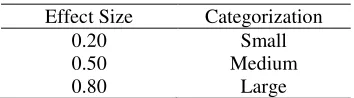
Furthermore, based on the results of the effect size it will be categorized as follows:
Table 2
Cohen’s effect size Categorization
Effect Size Categorization
0.20 Small
0.50 Medium
0.80 Large
3.2 Selection Criteria
Meta-analysis in this research is based on four studies on play therapy in dealing with behavioral disorders. Fourth was reached through access to international journals services like EBSCOhost, Proquest, and Google scholar. These studies focus on play therapy intervention in dealing with behavioral disorders in children. This study used a meta-analysis of the results of existing studies, that is:
Research with the title: Effects of group activity play therapy on problem behaviors of preadolescent Ugandan orphans, by: Deborah Ojiambo and Sue C. Bratton.
Research with the title: Effectiveness of group play through cognitive-behavioral therapy method on social adjustment of children with behavioral disorder, by: Ahmadi Nasab Maryam, Mohammadi Alizei Mona, and Mazloomi Akram.
Research with the title: Group activity therapy with learning disabled preadolescents exhibiting behavior problems, by: Jill Packman.
Research with the title: Effect of Adlerian play therapy on reducing students disruptive behaviors, by: Kristin K. Meany-Walen, Sue C. Bratton, and Terry Kottman
These four were chosen to form study conducted meta-analysis by considering some of the similarities it has, among others:
Subjects were individuals in the development phase of the child's age.
The fourth study using an experimental method using the experimental group and the control group.
3.3 Dependent Variables and Measurement of Effect Size
Effect size calculations performed on the measurement of behavioral disorders, both the internalizing behavior problems and externalizing behavior problems.
4. Analysis of Effect Size
Before performing further analysis of the behavior disorders and play therapy used, first we will see the effect size obtained from each study were used in this meta-analysis.
Table 3
Overall Data Effect Size
Year Researchers N Experiment Group Control Group Spooled Effect Size
N Posttest SD N Posttest SD 2002 Jill Packman 24
Internalizing Problems - 12 47.38 11.46 12 48.42 9.50 10.08 0.10 Exernalizing Problems - 12 48.69 12.53 12 53.58 11.87 11.68 0.42 2013 Ojiambo & Bratton 60
Internalizing Problems - 30 49.63 7.45 30 58.73 10.13 8.74 1.04 Externalizing Problems - 30 53.70 7.55 30 61.07 8.63 7.97 0.92 2014 Meany-Walen et al. 58 27 64.22 5.83 31 67.55 8.66 7.35 0.45 2014 Maryam et al. 40 20 134.35 3.91 20 137.95 7.80 6.01 0.60
Total 98 397.97 48.73 427.30 56.59 3.54
Average 49,00 66.33 8.12 71.22 9.43 0.59
Based on the results of the effect size calculations showed that in the case studies Jill Packman on internalizing problems in children shows the small effect size (d = 0.10), while in the case of externalizing problems show the medium effect size (d = 0.42). Research conducted by Ojiambo and Bratton in the case of internalizing problems demonstrate the great effect size (d = 1.04), while the case externalizing problems demonstrate the great effect size (d = 0.92). Research conducted by Meany-Walen et al. showed the medium effect size (d = 0.45). Recent research conducted by Mary shows the large effect size (d = 60).
Overall the average effect size of 0.59, which means play therapy interventiond undertaken a considerable influence in dealing with behavioral disorders in children. Based on the results of measurements of the effect size of the internal behavior problems (internalizing Behavior Problem), obtained the following data:
Table 4
Effect Size Internalizing Behavior Problem
Year Internalizing Problems N Experiment Group Control Group Spooled Effect Size N Posttest SD N Posttest SD
2002 Jill Packman 24 12 47.38 11.46 12 48.42 9.50 10.08 0.10 2013 Ojiambo & Bratton 60 30 49.63 7.45 30 58.73 10.13 8.74 1.04 2014 Maryam et al. 40 20 134.35 3.91 20 137.95 7.80 6.01 0.60
Average 0.58
Cali, 2007).
Table 5
Effect size externalizing Behavior Problem
Year Researchers N Experiment Group Control Group Spooled Effect Size N Posttest SD N Posttest SD
2002 Jill Packman 24 12 48.69 12.53 12 53.58 11.87 11. 68 0.42 2013 Ojiambo & Bratton 60 30 53.70 7.55 30 61.07 8.63 7.97 0.92 2014 Meany-Walen et al. 58 27 64.22 5.83 31 67.55 8.66 7.35 0.45
By measuring the effect size in the area of externalizing behavior problems, obtained a coefficient of 0.60. This indicates that the play therapy has a considerable influence on the change in behavior of children in the area of externalizing behavior. This area includes the behavior of the inability to control emotions, including difficulties in interpersonal relationships and break the rules, looks like irritability and quarrelsome or interfere with their peers.
5. Discussion
The value of the effect size of studies used in this meta-analysis indicates the success of the play therapy in an effort to cope with behavioral disorders of children. Factors that influence the success of the play therapy are:
5.1 Form of intervention
Play therapy intervention in the form of group activity provides an opportunity for individuals to practice directly confront social environment in a smaller scope. Intervention is flexible, giving opportunities for children to participate and make a change in the activity. The approach chosen in accordance with the achievement to be achieved, such as the application of Adlerian therapy that provides an opportunity for children to experience a sense of power and control and gain support and appreciation from their counselor, until they no longer needed the opportunity to seek attention in the classroom to get what they want.
5.2 Grouping
For the convenience of the interaction in the group, some things considered, namely: gender (grouped in the same gender), the number of small groups, the difference in age, children / students do not come from the same class
5.3 Consideration of the uniqueness and task progress
Play therapy is carried out by considering the uniqueness of the social (cultural background of the child), emotional and cognitive development.
5.4 Implementing activities
The therapists were chosen are those who have been involved in the play therapy training, regular work with children and the implementation therapy by following the recommended procedures of each form of play therapy. To maintain compatibility between the implementation and procedures, supervision is done periodically, including the use of tape.
5.5 The place and the material game
6. Conclusion
Based on a meta-analysis study that has been done, play therapy has a considerable influence on the change in behavior of children who have behavioral disorders. Specifically, Play therapy is effective in dealing with internal and external behavioral disorders in children because it makes children actively involved in therapy. Practically, Play therapy can certainly be used by the guidance and counseling teacher in schools or counselors at other institutions, particularly in Indonesia to intervene children who deal with behavioral disorders.
7. References
Card, N. A. (2012). Applied meta-analysis for social science research. New York: The Guilford Press. Cattanach, A. (2003). Introduction to play therapy. New York: Brunner and Routledge.
Cohen, J. (1988). Statistical power analysis for the behavioral sciences (2nd ed.). New York, NY: Academic Press.
Geldard, K., & Geldard, D. (2012). Counselling children: A practical introduction [Konseling Anak-Anak Sebuah Pengantar Praktis Edisi Ketiga] (3rd ed).Jakarta: Indeks.
Hartung, J., Knapp, G., & Sinha, B. (2008). Statistical meta-analysis withapplications. New Jersey: John Wiley & Sons. http://dx.doi.org/10.1002/9780470386347
Maryam, A. N., Mona, A. M., & Akram,M. (2014). Effectiveness of group play therapy through
cognitive-behavioral method on social adjustment of children with behavioral disorder. Kuwait Chapter
of Arabian Journalof Business and Management Review, 3(12), 356-362.
http://dx.doi.org/10.12816/0018839
Meany-Walen, K. K., Brattom, S. C., & Kottman, T. (2014). Effect of Adlerian play therapy on reducing students’ disruptive behaviors. Journal ofCounseling & Development, 92, 47-56.
http://dx.doi.org/10.1002/j.1556-6676.2014.00129.x
Ojiambo, D., & Bratton, S. C. (2014). Effect of group activity play therapy on problem behaviors of preadolescent Ugandan orphans. Journal ofCounseling & Development, 92, 355-365. http://dx.doi.org/10.1002/j.1556-6676.2014.00163.x
Packman, J., & Bratton, S. (2003). A school-based group play/activity therapy intervention with learning disabled preadolescents exhibiting behavior problems. International Journal of Play Therapy, 12, 7–29. http://dx.doi.org/10.1037/h0088876
Slavin, R. (2006). Educational psychology: Theory into practice (10th ed.). Boston: Allyn & Bacon.