University of New Orleans University of New Orleans
ScholarWorks@UNO
ScholarWorks@UNO
University of New Orleans Theses and
Dissertations Dissertations and Theses
12-20-2009
Examination of Faculty Expectations of Technical College
Examination of Faculty Expectations of Technical College
Administrators as an Important Factor in High Performing
Administrators as an Important Factor in High Performing
Environments
Environments
Phyllis A. Dupuis
University of New Orleans
Follow this and additional works at: https://scholarworks.uno.edu/td
Recommended Citation Recommended Citation
Dupuis, Phyllis A., "Examination of Faculty Expectations of Technical College Administrators as an Important Factor in High Performing Environments" (2009). University of New Orleans Theses and Dissertations. 1099.
https://scholarworks.uno.edu/td/1099
This Dissertation is protected by copyright and/or related rights. It has been brought to you by ScholarWorks@UNO with permission from the rights-holder(s). You are free to use this Dissertation in any way that is permitted by the copyright and related rights legislation that applies to your use. For other uses you need to obtain permission from the rights-holder(s) directly, unless additional rights are indicated by a Creative Commons license in the record and/ or on the work itself.
Examination of Faculty Expectations of Technical College Administrators as
an Important Factor in High Performing Environments A Dissertation
Submitted to the Graduate Faculty of the
University of New Orleans
In partial fulfillment of the
requirements for the degree of
Doctor of Philosophy
In
Educational Administration
By Phyllis A. Dupuis
B.S., University of Louisiana at Lafayette, 1979
M.Ed., University of Louisiana at Lafayette, 1982
M.Ed. +30, University of Louisiana at Lafayette, 1997
ii
Table of Contents
List of Figures ... v
List of Tables ... vi
Abstract ... vii
Chapter 1 Introduction ... 1
Influences on Faculty Expectations in Higher Education ... 6
An Applied Approach ... 11
Statement of the Problem ... 14
Research Questions ... 16
Significance of the Study ... 17
Overview of Methodology ... 21
Organization of Manuscript ... 23
Chapter 2 Literature Review ... 25
Introduction ... 25
Higher Education and Workforce Training in Louisiana ... 27
LCTCS System Organization ... 31
Technical Training – A Historical Perspective ... 32
Post-Secondary Technical Education in Louisiana ... 32
Community and Technical Colleges in Louisiana ... 34
Institutional Governance and Management ... 36
Role of Faculty in Governance/Management ... 36
Community College Governance ... 41
The Structure of Governance/Management ... 43
Political Influence on Governance ... 46
The Integration of Role Expectations and Institutional Management/Governance ... 48
An Educational or Business Approach to Management ... 49
Organizational Disposition of Faculty and Administrators ... 50
The Effect of Management and Leadership on Expectations ... 52
Introduction... 52
Management, Administration, and Institutional Effectiveness ... 54
Faculty-Administrator Relationships ... 57
A Taxonomy of Managerial Roles ... 61
Interpersonal Roles ... 64
Informational Roles ... 65
Decisional Roles ... 67
A Summary of the Literature ... 71
Chapter 3 Methodology ... 73
iii
Pilot Study ... 75
The Research Study ... 78
Technical College Settings ... 78
Conceptual Framework ... 79
Research Questions ... 79
Qualitative Research Design ... 81
Rationale ... 81
Type of Approach - Phenomenology ... 82
Phenomenological Researcher’s Role ... 82
Limitations of the Study ... 83
Ethical Considerations and Researcher Bias ... 84
Research Plan ... 86
Gaining Entry into a Research Relationship and Participant Selection ... 86
Gaining Access ... 86
Sampling Procedures and Securing Participants ... 87
Collection of Data ... 88
Interview Protocol ... 88
The Setting ... 89
Establishing a Research Relationship and Participant Profile ... 89
Institutional Expectations ... 90
Data Analysis ... 90
Coding Procedures... 91
Field Reflections ... 91
Document Analysis ... 92
Trustworthiness ... 93
Credibility ... 93
Confirmability ... 94
Transferability ... 95
Dependability ... 95
Chapter 4 Findings ... 97
Technical College Faculty Participants ... 98
Participant 1: Adam ... 100
Participant 2: Bob ... 101
Participant 3: Claire ... 102
Participant 4: Dawn ... 103
Participant 5: Erin ... 105
Participant 6: Fred ... 106
Participant 7: Ginger ... 107
Participant 8: Howard ... 108
Participant 9: Ian ... 109
Participant 10: Jane... 110
Participant 11: Kerri ... 111
Identifying Themes ... 112
iv
Student-oriented role ... 114
Community-oriented role ... 115
Faculty-oriented role ... 117
Administrative-oriented role ... 120
Attributes-oriented role... 122
Preparation ... 123
Personal and Professional Behavioral Characteristics ... 124
Management Styles ... 130
A Comparison of Institutional and Faculty Expectations ... 135
Summary ... 143
Chapter 5 Discussion, Conclusions, and Recommendations ... 144
Overview of the Study ... 145
Themes Related to Faculty Expectations of Administrator Roles ... 146
Faculty-Oriented ... 146
Administrative-Oriented ... 148
Student-Oriented ... 149
Community-Oriented ... 149
Attributes-Oriented ... 150
Aligning Faculty Expectations with Mintzberg’s Taxonomy of Managerial Roles 150 Expectations in a High Performing Environment ... 152
The Influence of Faculty Expectations on the Structure of Administrator Roles .. 157
Faculty Expectations of the Role of Technical College Administrators ... 159
Conclusions ... 161
Recommendations for Further Study ... 164
Implications of the Study ... 165
REFERENCES ... 168
APPENDICES ... 176
Appendix A – Informed Consent Form ... 177
Appendix B – Participant Introductory Letter ... 179
Appendix C – Sample Gatekeeper Letter ... 180
Appendix D – Interview Protocol ... 181
Appendix E – IRB Certificate ... 182
Appendix F – Campus Dean Job Description ... 184
Appendix G – Definition of Terms... 186
v
List of Figures
vi List of Tables
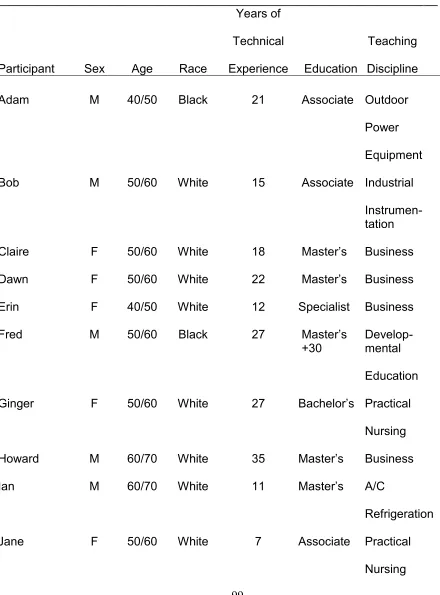
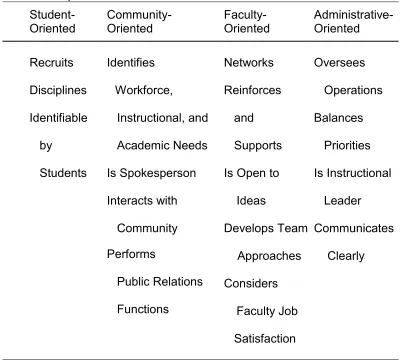
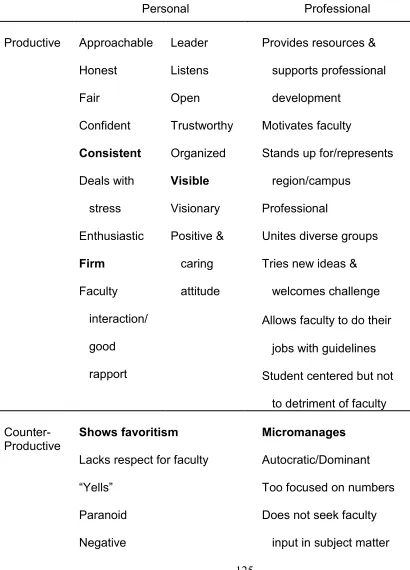
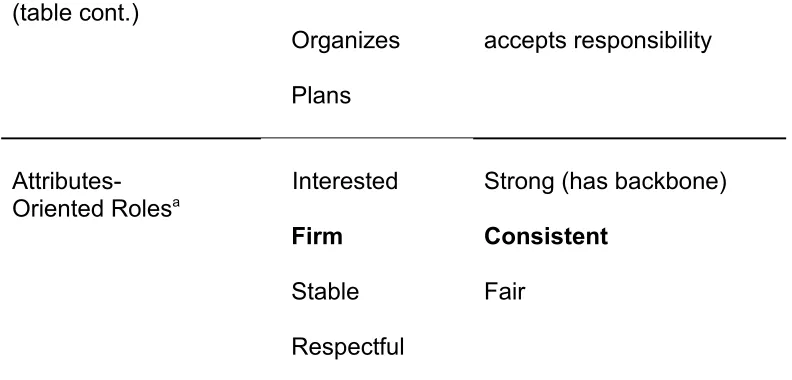
Table 1: Demographic Data on Study Participants ... 99 Table 2: Themes Expressed as Roles of Administrators ... 114 Table 3: Themes – Personal and Professional Behavioral Characteristics
of Administrators ... 125 Table 4: Themes – Expectations of Administrator Management Styles/Skills
Categorized by Study Themes ... 130 Table 5: Institutional Expectations Compared to Faculty Expectations of Technical
vii Abstract
Popular thought supports the notion that faculty expectations of technical college
administrators appear to be linked to the success or failure of an institution at
accomplishing its mission. These expectations provide the basis for the development of
relationships that foster the growth of technical training and thus the growth of a skilled
workforce. Faculty members in technical colleges are responsible for training individuals
to meet business and industry needs. Administrators are responsible for efficiently
achieving the institution’s mission of workforce development. Unknown faculty
expectations may inhibit the ability of administrators to achieve the institution’s mission in
an efficient manner.
This project is an exploratory qualitative study of faculty expectations of technical
college administrators in a high performing environment. The result of this study increases
the administrators’ understanding of expectations associated with their role and facilitates
the development of an effective workforce training agenda. Five major themes related to
expectations of administrator roles emerged from participant interviews: student-,
community-, faculty-, administrative-, and attributes-oriented roles as necessary for
achieving outcomes in a high performing technical college environment. Study findings
reveal major differences in faculty expectations and institutional expectations of the role of
technical college administrators. The necessity for reconciliation of these differences in
expectations is examined as it relates to the success of high performing institutions.
Potential contributions of this study to post-secondary technical and community
colleges are numerous. Through the use of Mintzberg’s Taxonomy of Managerial Roles
viii
college faculty members, this study seeks to contribute to the training/development of
technical and community college administrators, provide a summary of faculty
expectations of technical college administrators, identify professional development
opportunities to assist faculty in clarification of administrator roles, provide insight into the
behaviors deemed necessary for campus administrators to be considered successful,
increase faculty job satisfaction and improve morale by providing an opportunity for
communication and feedback, and provide insight to current and future leadership
development programs and processes.
Keywords: Educational Administration, Faculty Expectations, Administrator Roles, High
1
Chapter 1 Introduction
An administrator in an educational setting is typically assigned a litany of duties and
responsibilities. Student enrollment, fiscal responsibility and operational budgets,
institutional and program growth, and facility maintenance and improvement are some of
the measures by which higher education administrators are evaluated by upper
management. Expectations from upper management are communicated to administrators
through the job/position description; however, having served eighteen years in various
administrative capacities, this researcher has rarely been privy to information about what
faculty expects of administrators and of the roles to which they have been assigned. The
irony of this situation is that faculty members hold the key to institutional performance by
facilitating improved student enrollment, practicing fiscal responsibility, fostering
institutional and program growth, and supporting facility enhancement.
In order for educational administrators to increase levels of performance, they must
relate desired outcomes to desired performance and communicate the connection to
faculty. The likelihood of faculty striving for institutional improvement may hinge upon the
notion that individuals determine their work effort based on what they expect will maximize
personal outcomes (Vroom, 1964). Simultaneously, the administrator must understand
faculty member needs and goals and assist individuals to achieve them (Ast, 1999).
Expectations and resulting outcomes are directly related to faculty members’ desire for job
satisfaction. The focus of this study is to explore faculty expectations and communicate
actual accounts from faculty describing their expectations of administrators. Faculty
2
may be used to enhance faculty job satisfaction and to improve institutional efficiency and
effectiveness, as well as institutional outcomes.
For the purposes of this study, administrators are defined as the supervisor at the
campus level. This person is titled Dean, Assistant Dean, and/or campus coordinator
depending on the institution. Additionally, role expectations refer to ideals that individuals
hold for those who are in positions of influence. A classic definition of role is
“complementary expectations” surrounding an individual in his/her interaction with others
(Getzels & Guba, 1955). This study considers the interaction of faculty and administrators
and the development of faculty expectations of the role of administrators. In addition to
being a deterrent to performance, role ambiguity is stressful and disagreeable and
frequently leads to subordinate dissatisfaction (House, 1996). Reducing role ambiguity
can be accomplished by utilizing feedback to build a mutual understanding of the roles in
question. Participant feedback resulting from this study will help to define the role of the
administrator. Expectations and related roles are also affected by culture and climate and
vary across organizations and types of institutions (Peterson & White, 1992).
Faculty experiences are founded in the culture of an industry-related background
which is required as a condition of employment within the community and technical college
system (Levin, Kater & Wagoner, 2006). As a result, individuals serving as faculty
members within the community and technical college system have specific expectations
concerning the role of supervisors in business that spill over into the educational
environment. Faculty expectations of educational administrators, however, are frequently
not communicated to administrators and are often plagued by a lack of clarity. Faculty
3
community and technical college faculty is influenced by numerous extraneous factors
including personal, business, and industry experiences. This makes the role and function
of administrators important because, as described in the job or position description,
administrators create the “reality” that faculty view in daily operations. Reality as it exists
in a technical college educational setting is different from the traditional higher education
setting. For the purposes of this study, traditional higher education is defined as a “senior
institution” (Cohen & Brawer, 2003). These institutions are typically four year colleges and
universities that have historically offered degrees that result in professional careers.
These institutions may also offer terminal degrees.
Traditional higher education faculty members frequently operate under a collegial
organizational system (Birnbaum, 1988). The notion of an integrated technical and
academic approach to education founded in business and industry practices, however,
distinguishes community and technical college faculty from other post-secondary faculty
(Levin, Kater & Wagoner, 2006). Administrator differences also exist between community
and technical colleges and universities. Marcy (2008) reports that the position of president
of a modern college is political and not corporate in nature. This concept revolves around
the idea that university presidents lead diverse groups often with competing goals and are
responsible for hard to measure institutional results. Marcy proposes that university
leaders operate within a multifaceted political system much like the President of the United
States. Community and technical college faculty and administrators are bound to
institutional specific expectations related to workforce development. These expectations
are similar to the corporate organization’s focus which is centered on market returns,
4
colleges must have strong “bureaucratic” and “market” approaches that enable the college
environment to be “responsive” and “adaptable” to all stakeholders (p. 272). The “market”
approach used in the technical college system also impacts the mode of operation of
institutions. The approach is narrow in focus and produces efficient and effective methods
of preparing individuals for the workforce. The charge of preparing the workforce
frequently requires that the administrator operate the educational institution much like a
business with quantifiable outcomes. Though faculty members understand the
bureaucratic approach applied in business, their expectations of administrations in
education are unknown and remain unknown without a process for communication and
feedback.
Community and technical college faculty members and administrators operate
within a system that includes realities, expectations, perceptions, needs (economic and
social), and other influences specific to the community and technical college environment.
For example, an economic downturn frequently results in the abrupt layoff of skilled labor.
Individuals affected by the layoff may turn to technical colleges for immediate re-training in
new or expanding industries that may have minimal reaction to the current economic
conditions. Technical colleges are continuously expected to provide up-to-date training
that is available and accessible and to prioritize training to keep pace with cyclical
economic conditions. Technical college faculty members, closely aligned with business
and industry perspectives, provide information to link business and industry needs with
institutional performance. Administrators, charged with maximizing performance, need
5
The information provided in this study will assist administrators and faculty to
examine expectations which affect performance and thus assist in setting institutional
priorities. The efforts to maximize access to information in order to establish priorities can
range from a conceptual approach often associated with liberal arts education, to a
structured approach directly related to workforce application and associated with technical
training (Moylan, 1995). Expectations are frequently present in establishing priorities,
regardless of the approach. Allen (2003) finds that the inclusiveness of a “collegial”
approach in higher education institutions fosters a willingness to contribute information that
may result in more positive interaction resulting in the potential for improved relationships
between faculty and administrators. This relationship helps to build harmony which
increases the understanding of decisions and fosters a commitment to the institution and
to its performance. Allen proposes that the organization is treated as a “symbiotic
community” (p. 86). This symbiotic co-existence can be facilitated by dialogue between
faculty and administrators. Dialogue centered on faculty expectations is the focus of this
study.
An examination of specific themes commonly found in college settings such as
culture, climate, governance, management, role, and mission coupled with a historical
perspective of post-secondary education will facilitate the identification of faculty
expectations of administrators and of the corresponding role of administrators. Likewise,
evolving themes impact faculty and as the institutional systems adapt, so do faculty.
These changes and adaptations are also reflected in the expectations of faculty and their
6
Influences on Faculty Expectations in Higher Education
The study of issues related to college faculty and administrators has centered on
the relationship between faculty and administrators. The circumstances surrounding the
relationship influence the expectations that faculty members develop as a result of their
experiences. Influences that impact expectations are as varied as the institutions within
which they exist. These influences perpetuate varied concepts: faculty and administrator
cooperation is imperative for institutional direction (Del Favero, 2003, p. 904); agreement
of purpose and culture is stronger in liberal colleges and less so in community colleges
(Peterson & White, 1992, p. 196); change requires collaboration throughout the institution,
especially from faculty (Kezar & Eckel, 2002, p. 448); hierarchal models of management
exclude the understandings of faculty (Kezar, 2000, p. 725); faculty-administrator tension
is both cultural and structural in nature (Del Favero & Bray, 2005, p. 56); empowerment
allows teachers to take responsibility and authority for decisions (Miller & Miller, 2001, p.
182); professionals (including faculty) are at their best when treated as such (Collins,
2002, p. 3); administrative authority restricts faculty autonomy as a response to
accountability (Ikenberry, 1971, p. 422); teacher and administrator emotional experiences
may be of inverse proportionality (Beatty, 2000, p. 336); leadership and identity is not what
role we have but what we do and are able to do (Gunter, 2003, p. 264); within institutions
there is disagreement between faculty and administrators or leaders on objectives and
how to achieve them (Birnbaum, 1988, p. 134); administrator behavior is appropriate to the
point that it facilitates subordinate performance (House, 1996, p. 348); the drive for
economic efficiency has reduced support for teacher professional development
7
Tierney (1999) indicates institutions that focus on high performance must strive
toward inspiring faculty productivity. The opportunity for faculty to provide feedback on
expectations of administrators is a process that may prove motivating for faculty and have
a positive impact on institutional outcomes. In the formal hierarchal governance
relationship, superiors expect specific performance from administrators while subordinates
may have different expectations (Beatty, 2000; Komives, Lucas & McMahon, 1998). The
position of administrator within a formal organizational structure dictates that the
administrator reconciles the objectives and goals set forth by upper management with the
wants and needs of faculty.
The interaction between faculty and administrators is key to the communication of
expectations, determines the teaching and learning environment, and provides the
foundation for some form of shared governance that will impact an administrator’s and
institution’s success or failure (Del Favero, 2003). Interaction may result in communication
of faculty expectations to administrators and in reconciling faculty expectations with the
assigned role of the administrator. The process of reconciliation involves communication
vital to the success of the administration, faculty, and institution at achieving the college’s
mission.
The workforce development mission of community and technical colleges
necessitates consideration of the concepts of effective performance as viewed from a
business and industry perspective. These business perspectives exert some influence on
the relationships between faculty and administrators and are directly linked to the scope of
8
Relationships and related themes evolve from institutions where faculty and
administrators operate in a specific post-secondary environment. Each theme is a part of
the institutional system and acts as an influence on the role of administrators and what
others expect of those involved in management and/or administrative positions.
Overarching themes considered influential in this study include but are not limited to
educational culture and the environment/climate specific to an institution and/or system,
structure of governance and the management implications inherent in the type of
governance present within an institution, human interaction and the assumptions that are
present in situations involving human dynamics, and the role and mission of educational
institutions in the higher education environment.
Expectations are defined as “something expected; to expect is to look forward to
the probable occurrence or appearance, to consider likely or certain” (American Heritage,
1982). Faculty expectations of administrators describe what is expected of those serving
in the capacity of an administrator and what faculty consider probable or likely to occur
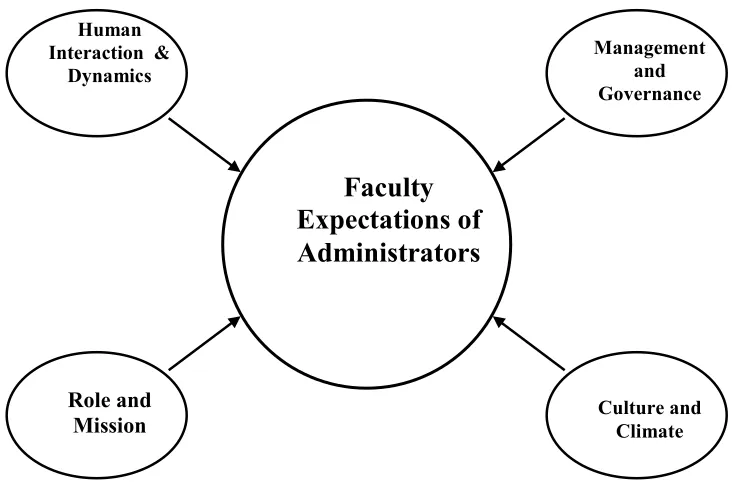
with regard to the behavior of those in administrative positions. Each theme within an
educational system exerts some influence on faculty expectations as illustrated in Figure
1; therefore, expectations cannot be considered in a vacuum but must be considered
within a system. Figure 1 illustrates themes that impact faculty expectations of
9
The theme of management and governance and its impact on relationships and
expectations has long been a topic of study in higher education (Del Favero & Bray, 2005;
Kezar & Eckel, 2002; Leslie, 2003; Peterson & White, 1992). Leslie (2003) posits that
faculty and administrators operate from “differing bases of authority.” He proposes that
both sides must find a balance in order to foster institutional productivity. A dialogue on
expectations of technical college administrators provides a foundation upon which to build
a functional relationship between faculty and administrators that will have institutional
benefits.
The interaction between faculty and administrators around themes such as
management and governance, institutional culture, and human dynamics impacts
relationships and expectations and ultimately plays a part in defining the role of
administrators. The theme of management and the related concept of leadership may be
Faculty
Expectations of
Administrators
Management and Governance Human
Interaction & Dynamics
Role and
Mission Culture and Climate
10
viewed as two dimensions of the approach to accomplishing the mission or purpose of an
organization (Leslie, 2003). Leslie proposes that leading addresses the emotional need
for association and support among institutional members, while managing or governing
tackles the requirement that work be completed. Considering both aspects of
management and leadership as part of an administrator’s responsibility points to the need
for recognition of similar and yet contradictory roles. Even though both concepts impact
the systemsutilized by key players such as faculty and determine the institution’s culture,
this study has primarily taken into account the concept of management as it relates to
expectations.
When considering the theme of institutional culture, Peterson and White (1992)
propose that the dynamics of culture is typically embedded within an institution and
provide “meaning” to life and work. Additionally, the authors agreed on the unity and
purpose of institutional culture to be the least clear in two year community colleges or
larger public institutions thus setting the stage for differences among stakeholders.
Closely tied to management and governance and institutional culture is the concept of
human dynamics as a factor in the formation of perceptions and expectations.
Levin, Kater, and Wagoner (2006) report that community college faculty members
are impacted to a greater degree by the human dynamics of managerial and
political-economic factors when compared to their university equivalent (p.5). The technical
college scope and mission related to rapid response to specific industry needs creates the
necessity for a high performing environment that also must respond rapidly to managerial
and political-economic factors. Because individuals within higher education organizations
11
(Birnbaum, 1988), various perspectives must be considered when linking management
and governance attributes to the culture that exists within community and technical
colleges and that ultimately form the perceptions and expectations of key players. Within
community and technical colleges, the themes that influence faculty expectations of
administrators (see Figure 1) create the environment for interaction and produce realities
and experiences specific to those institutions. Expectations emerge and evolve as do
faculty and administrator interactions.
An Applied Approach
Although employment requirements are typically a prerequisite for hire within
technical training systems, Bartlett (2002) reported that 45.9% of respondents who
employed technical instructors indicated that no specific standards were in place for the
employment of post-secondary career and technical educators. The study also indicated
that administrators, therefore, had no standards to utilize in the hiring process. The author
points to the fact that this lack of standards leads to a wide variety of backgrounds for
secondary educators in technical fields. The range extends from no formal
post-secondary education or degree to a terminal degree. The variety in levels of educational
preparation contributes to the broad range of faculty expectations that exist within
technical colleges including faculty expectations of administrators.
As a result of their training and experiences, technical college faculty members
approach the educational environment in a manner similar to that found in the business
world. Schuster and Finkelstein (2006) indicate that when compared to traditional four
year institutions, technical college faculty members frequently show more commitment to
12
Additionally, this type of educational environment is focused on a hands-on approach that
is specific in nature and is responsive to identified business and industry needs. When
compared to the mission of the technical college, the liberal arts university environment is
rooted in a broader approach to teaching and learning that is grounded in “higher order
scholarship” and whose faculty members and administrators are charged with being
responsive to wide-ranging, societal needs (Cohen & Brawer, 2003) or to the notion that
the academic institution’s purpose is not to “create product” but to “embody ideas”
(Birnbaum, 2004).
Technical college faculty approach teaching and learning in an applied and
practical manner and are likely to be more tuned in to the corporate approach to daily
operations. This approach as described by Moylan (1995) is one in which “knowledge is
more quantifiable and manipulatable in pieces that can be separated, packaged and sold,
and used as discrete items” (p.54). Easterby-Smith (1987) describes this approach to
instruction as the “normative view.” Utilizing this perspective, subject matter is logically
approached with precise answers and real life situations in a manner that can be
quantified. Technical college faculty are less prone to adopt the theoretical constructs of
the academic community such as those associated with research, teacher preparation
programs, and the peer review process and are likely to adopt an outcomes approach to
teaching and learning similar to that used in business and industry (Bartlett, 2002). This
approach specifies mastery of workplace competencies and ultimate employment in the
shortest possible time.
The cultural ramifications of the corporate approach in higher education are
13
professionals” and Magner (1999) describes administrators as “overly business-oriented.”
The exaggerated corporate influence of business and industry in the community and
technical college environment creates unique expectations between faculty and
administration worthy of exploration. Institutions operating under the “lean and mean”
concept of corporate America are likely to center on efficient processes, focused, effective,
and timely instruction, and potentially harsh consequences for those who fall short of
identified goals and objectives (Moylan, 1995). Similar expectations may exist in the
university setting; however, the expectations found at the technical college level are
frequently tied to economic conditions and are beyond the ability of faculty, administrators,
or institutions to manipulate. An example of this situation would be that technical college
performance is based on completion and placement (employment) rates. Completion at
the technical level can include earning a credential along a continuum from certificate to
associate degree. Production of trained employees is considered the desired result, a
result similar to that found in business. University performance is based on retention,
graduation rates, and time to degree. Education for a broader societal benefit and the
greater good is the focus; a result less related to the concept of production as is found in
business (Cohen & Brawer, 2003).
Yielder and Codling (2004) consider the corporate influence by contrasting
institutional management in the traditional academic university with the “polytechnic”
(vocational/technical education) training centers. The authors contend that senior
management in the university setting rise to that level as a result of academic
accomplishments. Administrators from the vocational/technical setting are typically
14
having ascended the ranks. This critical difference in contemporary educators dictates the
role expectations of persons occupying positions of institutional importance, thus faculty
expectations of the role of administrators are likely to be impacted.
Yielder and Codling also propose that management rooted in academia is vested in
the person while management rooted in market sector training is vested in the position.
This stark contrast between the university (academia) focused on the person is markedly
different from the approach to management in the vocational/technical (market sector)
system focused on the position. The role or function of the technical college administrative
position then assumes a posture of primary importance to faculty. The numerous studies
conducted of higher education faculty do not address expectations, nor the apparent
differences in administrator roles in post-secondary technical colleges or in related
expectations of leaders in market sector training institutions (Ast, 1999; Birnbaum, 2004;
Miller, 2003; Pfnister, 1970; Pope & Miller, 2000; Williams, Gore, Broches & Lostoski,
1987). These training institutions infuse a corporate approach into their educational
operations where market criteria and revenue generation gain prominence, and employer
demands and workforce preparation supersede traditional educational, social, and
scholarly functions (Rhoades, 2005, p. 4).
Statement of the Problem
Technical colleges are faced with the dilemma of determining the most efficient and
effective manner to accomplish the mission of workforce development. Technical college
administrators are charged with providing timely workforce training that is responsive to
the real-time requirements of business and industry. These administrators are responsible
15
and providing a holistic approach to the college experience. As the need increases for
technical colleges to address the growing shortage of technically skilled workers, technical
college administrators must acknowledge their roles as prescribed by upper management
and explore expectations as espoused by faculty. The exploration of expectations is
particularly significant in a high performing environment. This process involves educating
faculty about administrator roles and receiving feedback from faculty on their expectations
of administrators. This study has collected feedback from actual faculty and includes an
analysis of data related to expectations.
Administrators need all stakeholders to be engaged in order to deliver on the
institution’s mission. Faculty involvement is mandatory to move the workforce training
agenda forward. Unknown expectations of faculty challenge the administrator’s ability to
develop an effective and efficient workforce training agenda. This problem can be
addressed by exploring and communicating faculty expectations of administrators to
stakeholders and incorporating expectations in accomplishing the institution’s role, scope,
and mission.
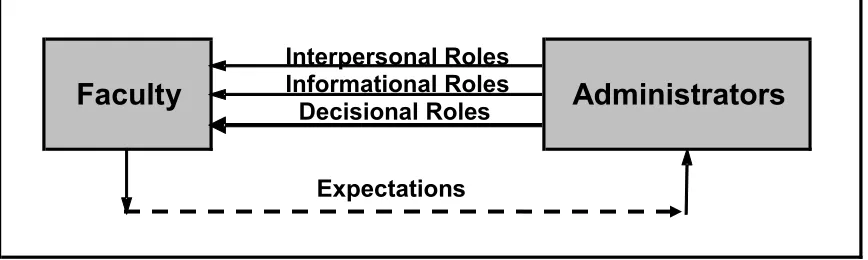
In this study, Mintzberg’s Taxonomy of Managerial Roles (Mintzberg, 1973) is the
conceptual framework used to categorize and describe faculty expectations. Mintzberg’s
Taxonomy of Managerial Roles contains three broad categories and related subcategories
to quantify behavioral characteristics of administrators that determine expectations.
Interpersonal, informational, and decisional roles are categories broad enough to consider
the overarching systems found within institutions, while the subcategories are specific to
operational processes. The taxonomy enables the researcher to reconcile the
16
faculty. The goal of the reconciliation process is the development of a comprehensive,
efficient, and effective performance plan for accomplishing the institution’s mission of
meeting business and industry needs.
Research Questions
The primary research question of this study is: What are faculty expectations of the
role of technical college administrators? Secondary questions include: (a) How do faculty
expectations align with the roles found in the conceptual framework of Mintzberg’s
Taxonomy of Managerial Roles? Mintzberg’s Taxonomy of Managerial Roles (Mintzberg,
1973) includes the spectrum of work typically performed by an individual in an
administrative position. The taxonomy provides a framework for reflection by
administrators on the similarities and differences between what is typical of an
administrative function as prescribed by upper management versus expectations
expressed by faculty. The taxonomy is broad enough to accommodate varied opinions but
also provides a structure within which to categorize expectations. (b) What administrative
role category do faculty expectations deem to be more crucial to institutional success and
how do these compare to institutional expectations of the administrator? Job descriptions
identify functions of a specific position. These functions are prescribed by upper
management based upon what is considered important for institutional success. Faculty
expectations of administrators may or may not parallel the role as described in the job
description. Once faculty expectations were categorized into roles, a comparison of the
job description and faculty expectations helped to inform administrators about the
relationship between what supervisors want and what faculties expect. Information about
17
subordinates. (c) How do faculty expectations influence the structuring of administrator
roles? These questions seek to address specific issues and challenges faced by technical
college faculty and administrators and provide information that will assist in dealing with
those issues and result in improved institutional performance.
Significance of the Study
Faculty members expect to have their opinions heard on significant institutional
matters including those that impact performance. Faculty satisfaction and motivation are
also directly linked to improved performance (House, 1996). A 2004 survey of Louisiana
Technical College (LTC) faculty indicated that changes within the community and technical
college system have prompted uncertainty and ambiguity in the institution’s role, scope,
and mission as attained by faculty, staff and administrators. Additionally, the national push
surrounding increased accountability and performance in higher education further
supports the need for communication and feedback from faculty. The focus of this study
provides information about faculty expectations of administrators and enables
administrators to incorporate the feedback into institutional operations. The result
increases administrator knowledge of expectations, faculty satisfaction, and faculty and
institutional efficiency and productivity.
Since approximately 1930, technical colleges have operated in a very structured
manner; and the role, scope, and mission of the colleges and of their administrators were
clear. In 1999, forty-two Louisiana technical college campuses were transitioned from the
Board of Elementary and Secondary Education to the Louisiana Community and Technical
College System (LCTCS). Since becoming a part of the LCTCS, the role of technical
18
had a director responsible for daily operations and for campuses that were operated
autonomously. Since 1999, administrator roles have broadened to include partnerships
with academia in higher education and a quasi-decentralized approach utilizing regional
directors charged with administering multiple campuses. Additionally, many administrators
have recently retired from the system and many are eligible to retire in the next five to ten
years. This exodus of administrators requires sharing information with and training of
various technical college system individuals who may assume future administrator roles. It
is important to define faculty expectations of technical college administrators and
communicate these expectations to the next generation of administrators and faculty.
These future administrators will directly impact the continuously changing direction of
technical college education in the state of Louisiana and shape the evolving workforce
training agenda for decades.
For almost ten years, the only constant within technical colleges has been change.
As a result, turmoil and unrest among and between faculty and administration have
plagued the system. During the tenure of the LCTCS, five system presidents have
occupied the central office. Over the ten year span, technical colleges have been
organized in a decentralized and then centralized manner and have recently reverted to a
quasi-decentralized mode of operation. Could these efforts be the result of unmet,
unclear, or a lack of communication of expectations?
Conflicting expectations between technical college administrators and faculty
provide the basis for challenges in developing a consistent, effective, and efficient
workforce training agenda. For example, administrators expect faculty to function in the
19
practice utilized by faculty may also impact the learning process (Del Favero, 2002). As a
result, faculty point to policies and practices that inhibit the development of a cohesive
workforce training agenda. Ast (1999) describes nine workplace factors that put
community college faculty at risk of poor performance. Some of these factors are
particularly applicable to this study: (a) little voice in college decision making, (b) lack of
support for professional growth, (c) lack of support for instruction, and (d) teacher
evaluation process. Ast proposes that feedback from faculty is essential for productivity
and output. Communication of faculty expectations as they relate to the administrator’s
role in decision making, professional growth, instruction, and evaluations provides
essential feedback for administrators to utilize in setting institutional priorities and
improving performance.
In the realm of post-secondary education, faculty and administrators share a
responsibility to work collaboratively to develop the potential for students to learn and
succeed. Tierney (1999) suggests that broader participation by institutional constituents
leads to improved performance by focusing on results. Seeking the optimum level of
collaboration, cooperation, efficiency, and effectiveness provides the impetus for this study
which includes feedback concerning faculty expectations of administrators and results in
successfully addressing the needs of business and industry.
Components of a pilot study conducted by this researcher in 2004 and in 2007
indicated that technical college faculty members have expectations that may contribute to
the development of a comprehensive workforce training agenda. Participants in the study
identified expectations of administrators and the roles deemed necessary for peak
20
Additionally, in 2004 the state’s technical college faculty senate conducted a
statewide survey centered on the organization of campuses and management to achieve
the mission of workforce development. The statewide survey empowered faculty to
provide broad comments applicable to all individuals in supervisory positions; however, an
analysis of initial responses indicates that the survey enabled participants to air concerns
without the opportunity to explore specific expectations. The survey provided an overview
of what faculty thought were strengths and weaknesses of the LTC administrative
structure but was limited in its scope to seek in-depth feedback on what faculty expected
of administrators. The researcher’s pilot study provided a glimpse of a greater sense of
urgency to explore in-depth expectations of faculty and indicated the desire of faculty to
express their expectations in an effort to improve technical training, job satisfaction,
employee morale, and student success.
The pilot study also revealed that consistency between the job description as
prescribed by management and the expectations as professed by faculty had not been
explored. Administrator duties specified in job or position descriptions delineate specific
administrator responsibilities as viewed by the organization. The content of job
descriptions is frequently developed by upper management, communicated upon
employment, and used in the evaluation process.
The role of an educational administrator, however, encompasses factors and
situations far beyond those listed in a job description. Beatty (2000) asserts that leaders
are responsible for the “emotional management” of themselves and others within the
organization. Birnbaum (2000) suggests that administrators must deal with management
21
(2003) indicate that managers must be politicians in order to garner support from external
stakeholders. These factors are typically not specified in a job description, yet are often as
real as the requirement that the administrator manage the budget of the institution or
improve enrollment and institutional growth. Technical college faculty members frequently
do not have information about the role of administrators. These roles, however, as
prescribed in the job description are often cited as necessary components of a profile of
successful administrators (Blatt, 2002; Fiedler & Chemers, 1974; Harris, 2002; Marcy,
2008; Maxwell, 1998; Pope & Miller, 2000; Vincent, 2004). Faculty members are not
afforded an opportunity to comment on duties and responsibilities that they consider
important to institutional success. To date, there has been no mechanism to process or
retrieve information on technical college faculty expectations of administrators.
The stability and future of technical colleges may be dependent upon exploring
faculty expectations of the administration of technical college campuses and applying
these expectations to campus operations in an effort to cultivate greater collegiality. This
qualitative study has assimilated information from faculty that will add to the limited
research on technical colleges and relates a perspective from faculty that may help ensure
the efficient and effective administration of community and technical college education.
Overview of Methodology
As stated by Creswell (2002), “qualitative research is used to study research
problems requiring an exploration and understanding of a central phenomenon” (p.50).
This methodology allows the researcher to talk with participants and collect views from
their perspective. Expectations are personal and individual and, therefore, subjective in
22
questions that were exploratory in nature. The qualitative approach is suited to this type of
investigation by allowing follow-up and/or probing inquiry.
Phenomenology is a qualitative research method that focuses on understanding the
essence of experiences about a phenomenon. This research design involves viewing the
person as important to the world and to one’s environment and utilizes the phenomenon of
faculty expectations as the unknown factor to be explored. This study incorporated the
qualitative phenomenological research method in order to investigate the phenomenon of
faculty expectations of technical college administrators.
Faculty members within technical colleges have had similar experiences with
regard to the mission of workforce development. The process of educating individuals for
the world of work has created common ground from which to study expectations. The
phenomenology research design involves multiple individuals who have participated in a
similar process (Schram, 2003) and, therefore, is suited to this study.
The design also facilitates the development of propositions which enhance the
study and provide insight for stakeholders. Louisiana Technical College faculty senate
officers have been interviewed and asked to describe their expectations of technical
college administrators and their assigned roles. Individual interviews have been used to
gather descriptions of expectations. The identification and grouping of themes associated
with the interviews have been examined to address the questions in this study.
It is imperative that the next generation of technical college administrators consider
expectations as defined by faculty and begin the process of incorporating those into viable
management practices. The survival of technical education in the state of Louisiana may
23
challenge is how to use the expectations identified by faculty and how administrators can
manage those expectations for employee job satisfaction and institutional success.
Organization of Manuscript
Chapter One identified the primary questions addressed in this study. An
evaluation of specific aspects of post-secondary education that impact expectations was
considered. Specific themes operating within the community and technical college
environment and impacting the institutions were defined. These themes included:
governance and management, culture and climate, human interaction and dynamics, and
institutional role and mission. The influence of expectancy theory and its relationship to
performance and outcomes was also considered. Specific segments of the study were
introduced including the problem statement and significance. The scarcity of information
on technical college faculty makes this study significant particularly when considered as a
means to Louisiana’s economic prosperity. The conceptual framework and methodology
for conducting the study were also introduced.
Chapter Two focuses on literature which contributes to the development of faculty
expectations, faculty/administrator relationships, management, and governance. This
chapter details Mintzberg’s Taxonomy of Managerial Roles and provides a conceptual
framework which utilizes interpersonal, informational, and decisional roles to inform the
study.
Chapter Three describes the use of the qualitative phenomenological approach to
acquire information from participants and to identify themes and sub-themes particularly
24
Chapter Four describes the findings of the study. Findings have been analyzed and
themes have been identified. A description of how themes have been coded and
categorized using the conceptual framework in order to discern patterns within participant
responses is also included. Themes have been organized as per the interview questions
and categorized as those related to: roles, personal and professional behavioral
characteristics, and management styles. Specific examples of faculty input were used to
illustrate themes.
Chapter Five presents a discussion of the research findings, implications of the
findings and suggestions for additional research. This study has provided a wealth of
information for me as an administrator. It has also provided the venue to open a dialog
about expectations of administrators from the perspective of faculty and upper
25
Chapter 2 Literature Review
Introduction
The literature provided in this section supports the notion that faculty-administrator
relationships and the link between job performance and expected outcomes influence
expectations. Similarly, leadership theories and the application of these concepts to
management, institutional effectiveness, and to the administrative environment provide the
background for positive or negative faculty expectations. While faculty members perceive
their roles differently, they all have expectations of the role of administrators. A gap in the
literature exists specific to faculty expectations of the role of administrators in a technical
college institutional context. Studies of administrators in higher education institutions tend
to focus on the traditional university setting; a setting or system that is in many aspects
distinct from the community and technical college system. This study explores faculty
expectations of administrators in technical colleges and analyzes the cultural implications
in a high performing environment. The results of the study provide practical information for
use by leaders to assist in improving administrator performance, faculty motivation and
satisfaction, and institutional success. The results include a comparison of administrator
job descriptions with the expectations of faculty, who represent one group of institutional
stakeholders, with the goal of improving administrator performance as evidenced by
institutional efficiency and effectiveness.
For the purpose of this study, the technical college institutional context described
will be referred to as an adaptive system and considered specific to the technical college
environment. Adaptive systems in technical colleges are influenced by factors such as
26
workforce related culture and climate, and a role and mission reflected in efficient and
effective institutions that foster faculty-administrator relationships and provide the basis
upon which specific role expectations are founded.
Rummler and Brache (1995) propose that all organizations operate within a
“systems” approach. Three types of systems are described by the authors: traditional
(vertical) view of an organization; systems (horizontal) view of an organization; and an
adaptive systems view of an organization. The adaptive system has at its core the
process of adapting to its environment. Rummler and Brache indicate that the “key
variable in an organization’s ability to effectively and speedily adapt is its management”
(p.12). In the community and technical college context, adaptive systems refer to the
totality of factors that impact the relationship between technical college faculty and
administration. In community and technical colleges, these factors change and adapt to
changes in the environment that are directly linked to business and industry.
House (1996) indicates that follower characteristics are directly related to the
manner in which an administrator and the corresponding environment are interpreted.
Faculty expectations are borne out of particular experiences and environments. These
experiences and environments vary between and among institutions and collectively
impact specific role expectations. This literature review will analyze research that focuses
on factors that affect technical college faculty expectations. This study examines
administrators from Louisiana Technical Colleges, a division of the Louisiana Community
and Technical College System (LCTCS), from the perspective of faculty. The absence of
literature on technical college faculty expectations of the role of administrators causes
27
Higher Education and Workforce Training in Louisiana
Workforce training and the need for skilled workers have burgeoned in a post
hurricane rebuilding environment. In addition to the flurry of construction activity created
by the rebuilding effort, Louisiana is the number one producer of oil and the number two
producer of natural gas in the country (Louisiana Mid-Continent Oil & Gas Association
Website, 2006). Because of the downturn in economic conditions and expanded
workforce needs, technically skilled workers are a necessity for the state’s growth and
development. The implications for faculty and administrators of Louisiana’s community
and technical colleges are numerous. The context of these implications has prompted this
study in an attempt to critically address faculty and administrator relationships as they
relate to faculty expectations of the role of administrators and indirectly to management as
a means of addressing institutional efficiency and effectiveness in meeting workforce
needs.
The year 2006 ushered in profound changes for community and technical colleges
within the Louisiana Community and Technical College System (LCTCS). The institutions
that comprise this system serve as the primary providers of customized workforce training
for the state of Louisiana. In the fall of 2006, LCTCS enrolled 46,780 students in areas of
training focused on its mission of workforce development (LCTCS Website, 2007). The
Louisiana Technical College (LTC) constitutes one division of LCTCS, however; this
division is the largest with a fall 2006 enrollment of 15,055 students and employment of
467 individuals (LCTCS Website, 2007).
Technical colleges have a distinct culture that centers on the mission of workforce
28
management and governance. Peterson and White (1992) describe the differences
between faculty and administrator beliefs about their organizations related to a distinction
in culture and climate. In this study, climate is a consideration based upon the current and
immediate dimension of the institution. Culture is based on deeply embedded values,
beliefs, and assumptions (p. 181). The culture of community and technical colleges
focuses on addressing the needs of business and industry. This culture also impacts
faculty and administrator relationships and lends itself to the gap between “administrator
work” and “faculty needs” (Del Favero, 2002). Del Favero describes administrator work as
operational activities and decision making that facilitates the academic work involved in an
educational setting. Faculty needs revolve around work associated with a specific
discipline and are far removed from the managerial culture negotiated by administrators.
Faculty needs, performance, and motivation are also linked to individual factors
such as personality, knowledge, experience, skills, etc. Vroom (1964) indicates that
individuals can be motivated to peak performance if they believe that: there is a positive
relationship between effort and achievement; desired achievement will yield a reward; the
reward will address an expressed need; and the drive to fill the need is adequate to make
the effort attractive. Vroom’s Expectancy Theory (1964) provides insight into motivation
and coupled with the study of faculty expectations help administrators to determine how to
improve faculty performance and ultimately institutional efficiency and effectiveness.
Prior to 1999, technical colleges were governed by the Board of Elementary and
Secondary Education (BESE) and were often considered an extension of the high school.
Recent induction of technical colleges into higher education has provided for sweeping
29
become more focused on advanced level skills training that includes an academic element
and learning is measured by mastery of industry-based competencies as evidenced by
successful completion of regional and/or national certification exams. Faculty are required
to obtain national credentials in their specific occupational field, additional academic
training is a requirement for many for continued employment, and curriculum has been
modified to include more academic content. These and other higher education parameters
have restricted the autonomy previously in place at technical college campuses and
increased uncertainty for faculty. Under the auspices of the academic community,
technical colleges are expected to incorporate a distinct academic component to teaching
and learning while addressing the immediate needs of business and industry.
Historically, technical colleges have been able and expected to respond quickly to
business and industry needs with minimal consideration of the academic implications. For
example: A welding student would master specific welding competencies as prescribed by
industry and not be required to enroll in related English and mathematics courses.
Employment was immediate and specific to an industry. In contrast, under the auspices of
higher education, students are required to possess basic academic skills in addition to
mastery of industry standards. As a division of the LCTCS, technical college faculty
members are now charged with providing instruction in both academic and technical skills
areas. These changes in the approach to technical college teaching have modified
administrator expectations of faculty. Faculty members are expected to participate in
curricular development and include related academic modifications which may or may not
involve formal preparation or training. The changes, however, have also had an effect on
30
In addition to determining instructional effectiveness as it relates to business and
industry needs, administrators are expected to evaluate the ability of faculty to infuse
workplace skills into the curriculum and simultaneously communicate the need for
increased academics to constituents. Both of these scenarios involve the utilization of
managerial roles, specifically interpersonal roles as defined by Mintzberg (1973).
Interpersonal roles are linked to the establishment of interpersonal relationships which
frequently impact expectations of administrators and faculty. Mintzberg proposes that
interpersonal roles are directly related to the administrator’s status and perceived authority
of administrators among faculty. This role provides a foundation upon which faculty and
administrator expectations are developed (Mintzberg, 1973).
Recently, faculty members have been some of the most vocal in calling for
modifications within the technical college system. The outcry for change is often centered
on the perceived flaws of the environment centered on management and governance
within the system. Various questions are associated with the environment and related
faculty expectations of the role of administrators within the LCTCS. What expectations do
faculty members have of college administrators? Is discontent among faculty a bonafide
justification for dramatic changes within a college system? Is this a recent phenomenon;
and if so, what has occurred to stimulate the outcry for change? These questions are
interrelated and delve into various facets of the current LCTCS climate.
The increasing shortage and resulting importance of technically trained individuals
call for swift action to educate administrators on the expectations of faculty in order to
address issues of efficiency and effectiveness. Faculty, operating at the basic level with
31
administrators to address issues related to workforce needs facing the region, the state,
and the nation. Faculty knowledge of the role of administrators is also essential to
increase the likelihood of successful collaboration. Informed administrators and faculty are
better able to respond to the training needs of the state and to forge a collaborative
workforce centered foundation. Mintzberg (1973) posits that information is crucial to the
collaborative management and efficiency of an organization and proposes that
informational roles are key to the development of such a level of collaboration.
LCTCS System Organization
The development of the LCTCS is considered to be in its “infancy” when compared
to other higher education institutions within Louisiana. While the system currently has
seven community colleges, two technical community colleges and 38 technical college
campuses, it continues to strive towards the initial “charges” made by the Governor in
1999. The development of six new community colleges and the expansion of two
technical colleges to technical community colleges have provided challenges and
opportunities. Funding for campuses has been challenging while responsiveness to
business needs has created numerous opportunities.
Perhaps the biggest change has been experienced by the state’s technical
colleges. These colleges have evolved from an extension of high schools in 1930 to a
member of the higher education environment in 1999. The cyclical growth of campuses
and the political influence exercised over the campuses has created a tumultuous
evolution. Additionally, the campuses have evolved from autonomous units to one
comprehensive college to eight interrelated regions. The environmental implications of
32
from decentralized to centralized and to a quasi-decentralized organization provide the
backdrop for administrator and faculty relationships. The historical process culminates in
experiences and environments that directly impact expectations.
Technical Training – A Historical Perspective
Post-Secondary Technical Education in Louisiana
An understanding of the evolution of post-secondary education in Louisiana is
important in order to understand faculty expectations of the role of technical college
administrators. Historically, education in Louisiana has been riddled with challenges when
compared to the educational systems of other states. It is common to find the state’s
educational achievements among the lowest in the nation. Louisiana students’ American
College Test (ACT) composite test scores are below the national average and rank 46 of
50 when compared to other states (ACT Website, 2007). In a similar measure of poor
performance, Louisiana ranks 35th in high school graduation (Manhattan Institute for Policy
Research Website, 2007). Over several decades, educational system reforms have been
proposed to address these and related issues. Louisiana officials pledged to increase
educational options for students and fill the void for the high school dropout or the high
school graduate who does not wish to attend a 4-year college or university (Louisiana
Board of Regents, 2001).
The cyclical nature of the economy has fueled the instability of many Louisiana
colleges. The downturn of oil production in the late 1980s, in the mid 1990s, and again in
2008 decreased funding which prompted layoffs and general cutbacks of operations in
Louisiana’s system of higher education. The 2005 hurricane season also prompted