EFL Learners' Language Proficiency
Azizullah Mirzaei
aAssistant Professor, Shahrekord University, Shahrekord, Iran
Masoud Rahimi Domakani
bAssistant Professor, Shahrekord University, Shahrekord, Iran
Zari Shakerian
cM.A. in TEFL, Shahrekord University, Shahrekord, Iran
Received 8 January 2011; revised 5 July 2011; accepted 6 August 2011
Abstract
Considering the future of the application of a dual explicit-implicit learning system
to the L2 theory and research, Ellis (2006) argues that further investigation of the
distinction is useful for modeling, understanding, and measuring second language
proficiency. This study explored the differential accessibility of EFL learners'
explicit and implicit grammatical knowledge to their language proficiency. The
participants were 160 EFL graduate and undergraduate students at Shahrekord
University (Iran). A test battery including a timed grammaticality judgment test
a
Email address
: [email protected]
Corresponding address
: Department of English, Shahrekord University,
Shahrekord, Iran
b
Email address
: [email protected]
c
Email address
: [email protected]
(GJT), an untimed GJT, and a TOEFL was used to gather the data. A set of
correlation coefficients was computed to explore the contributions of implicit and
explicit grammatical knowledge to the TOEFL and its sub-components. The results
showed that there was no statistically significant correlation between the EFL
learners' implicit grammatical knowledge and their TOEFL (sub-components)
scores, but there was a strong relationship between the EFL learners' explicit
grammatical knowledge and their general proficiency. A medium relationship also
existed between the explicit knowledge and the TOEFL sub-components. Then, a
Standard Multiple Regression demonstrated that explicit knowledge better
predicted the EFL learners' general L2 proficiency. The results suggest that
learning explicit grammatical knowledge is necessary in EFL contexts and needs
much more consideration when the primary focus is on the cognitive academic
language proficiency or skills.
Keywords:
Implicit/explicit grammatical knowledge;
General language
proficiency; Differential accessibility
Introduction
The development and assessment of L2 learners' grammatical knowledge have
always been one of the major concerns of second or foreign language teaching
though it has also been associated with its own ebbs and flows once being the
center of all pedagogical activities and once the target of criticisms. Even recent
models of communicative competence or language ability could not wholly jettison
the concept and have incorporated 'grammatical competence' (Canale, 1983;
Canale & Swain, 1980) as one of the essential components of their models or
subsumed it under 'organizational competence' as one of the two building-blocks of
any learner's language competence (Bachman, 1990; Bachman & Palmer, 2010).
Grammatical knowledge has recently been probed and discussed in terms of two
types of knowledge, implicit and explicit. The distinction of implicit and explicit
grammatical knowledge and their differential roles and contributions to the second
language development have been an interesting source of attention and a fruitful
area of inquiry for some second language acquisition (SLA) researchers (e.g. Elder
& Ellis, 2009; Ellis, 2004, 2005, 2006; Green & Hecht, 1992; Philp, 2009). For
Instance, Ellis (2006) found that difficulty of grammatical structures varied
according to whether one is considering implicit or explicit knowledge of grammar.
He observed that those structures that are easy in terms of implicit knowledge may
be difficult in terms of explicit knowledge and vice versa. He then concluded that
measures of both implicit and explicit grammatical knowledge might have
differential contributions to the development and assessment of general L2
proficiency.
It is also argued that, in EFL (English as a Foreign Language) settings, different
L2 learners with idiosyncratic characteristics, different goals of learning, and
varying levels of L2 motivation become engaged in different types of learning
pathways and pedagogical activities. For instance, in some settings, the L2
education they receive is mostly based upon traditional, descriptive, deductive
grammatical instructions and less on providing the learners with opportunities to
use the language in social interactions in and out of the classroom. Still, in other
settings, the instruction the learners receive has recently adopted more elements of
the ‘focus-on-form’ (FonF) approach. That is, the learners are primarily engaged in
task-based, meaning-focused pedagogical activities and are provided with
form-focused instruction and explicit grammatical information either when the
instructors notice a gap in the learners’ L2 (grammatical) knowledge or when the
learners report difficulties with one or more grammatical structures comprehending
or producing the second language. The outcome of such pedagogical variations
within educational contexts could be that different learners develop different types
and levels of L2 grammatical knowledge that contribute differently to their general
language proficiency.
The importance of the implicit-explicit distinction for language learning,
knowledge and instruction has been reiterated in the recent collection of papers
edited by Ellis et al. (2009). Further investigation of different aspects of the
distinction will provide the basis for re-examining the nature of the relationship
between implicit and explicit knowledge and general proficiency and will be
illuminating for both SLA and the teaching and testing practice. This study was an
attempt to discern whether Iranian EFL students' implicit and explicit grammatical
knowledge accounts differentially for the development of the learners' language
proficiency and their performance on different sub-components of a measure of
general language proficiency.
Literature Review
The distinction between implicit and explicit learning and knowledge has
originated in cognitive psychology. In the first place, there has for long been much
controversy in cognitive psychology over whether human cognition should be
envisioned in the form of a unitary knowledge source capable of achieving
different learning outcomes (Shanks, 2003) or as multiple, differentiated learning
systems (Reber, 1976; Anderson, 1983; Anderson & Lebiere, 1998; Hazeltine &
Ivry, 2003). In the second place, the controversy took a different form and direction
within the camp of the proponents of distinct learning systems as how to theorize
about the interplay between the functionally and neurally separate learning
systems. Among different models of multiple learning systems in cognitive
psychology, Anderson’s (1983, 1985) as well as Anderson and Lebiere’s ACT-R
model has over the years been highly influential in shaping and directing L2 theory
and research. Specifically, the ACT-R model’s argument for a dual knowledge
system consisting of declarative knowledge (i.e., knowing
that
something is the
case) and procedural knowledge (i.e., knowing
how
to do something) that are
stored differently has been the impetus to the SLA studies dealing with
implicit-explicit knowledge sources. The ACT-R model of human architecture posits a dual
long-term memory system (declarative vs. procedural), besides the short-term
working memory, that is at work processing, storing, and retrieving information. In
this model, practice or repeated activation plays a central role in automatization
and preceduralization of declarative knowledge.
As noted above, inspired by the ACT-R model, cognitive psychologists (e.g.,
Wallach & Lebiere, 2003; Hazeltine & Ivry, 2003) argue for a hybrid learning
system consisting of distinct implicit and explicit learning mechanisms. According
to Ellis et al. (2009), the advocates of the existence of a dual learning system make
a distinction between implicit and explicit learning in two principal ways. First,
they believe that implicit learning continues without any demands on central
attentional resources. N. Ellis (2008) argues that "generalizations arise from
conspiracies of memorized utterances collaborating in productive schematic
linguistic constructions" (p. 7). Thus, the resulted knowledge is subsymbolic,
which reflects statistical sensitivity to the structure of the learned material. But,
explicit learning involves memorization of a series of successive facts and makes
heavy demands on working memory. So it takes place consciously while resulting
in symbolic knowledge; that is, it is represented in an explicit form. Second, in
implicit learning, learners are unaware of the learning taken place, though this
learning is evident in their behavioral responses. The learners thus, cannot
verbalize what they have learned. But in explicit learning, learners are aware of
what they have learned; so, they can verbalize what they have learned (Ellis et al.).
Ellis et al. (2009) add that this evident controversy in cognitive psychology is
reflected in SLA as well. One clear example is found in the critiques against
Krashen's (1981) distinction between 'acquisition' (which is defined as the
subconscious internalization of grammatical rules which occurs due to the
comprehending input which is beyond the learners' existing level of knowledge)
and 'learning' (that is the conscious formulation of the explicit grammatical rules).
At first, it was criticized hard because the distinction was not falsifiable. For
example, McLaughlin (1978) asserts that Krashen could not give adequate
definitions of what he meant by 'subconscious' and 'conscious' and he could not set
a way for independently determining whether a specific process involves learning
or acquisition. Schmidt (1990, 1994, 2001) argues that consciousness is a useful
construct if one can carefully deconstruct it into several meanings. He
conceptualizes consciousness in terms of the binary cognitive constituents and the
related learning systems of intentionality (incidental vs. intentional learning),
attention (attended vs. unattended learning), awareness (implicit vs. explicit
learning), and control (automatic vs. controlled processing). Schmidt (1994, 2001)
has re-affirmed the value of 'consciousness' for understanding the nature of second
language learning. His reinstatement of the concept has greatly influenced SLA
theories and research. He maintains that Krashen may be initially right in making a
distinction between implicit and explicit processes. However, this distinction is
simplistic since Krashen failed to deconstruct consciousness into intentionality,
attention, awareness, and control (Schmidt, 1994).
Much earlier than Ellis et al. (2009), N. Ellis (1994) edited another collection of
papers in which the importance of the implicit/explicit distinction for both L1 and
L2 learning was affirmed. He used research in both cognitive psychology and
language learning to explain the issues facing researchers to spell out, for example,
which aspects of L2 can be learned implicitly, which mechanisms of explicit
learning are available to the learner, how necessary the explicit knowledge is for
the acquisition of an L2, how best the instruction can aid L2 acquisition, and so on.
Thus, instead of dismissing the distinction between implicit and explicit
learning/knowledge, SLA researchers have focused on identifying the processes
involved in the two types of learning, on their interaction, and on how they can be
externally manipulated through instruction. Thus, while the doubts still remain,
especially in cognitive psychology, on the legitimacy of a dual learning system,
Ellis assumes that a distinction can be made between the implicit and explicit
learning of an L2 and between implicit and explicit L2 knowledge (N. Ellis, 1994).
Both Schmidt (1994) and Ellis et al. (2009) maintain that implicit/explicit learning
and implicit/explicit knowledge are related but distinct concepts which need to be
separated. In this sense, implicit/explicit learning refers to the processes involved
in learning, and implicit/explicit knowledge refers to the products of learning. For
example, there is the possibility that learners reflect on knowledge that they have
acquired implicitly without metalinguistic awareness and subsequently develop an
explicit representation of it. There is also another possibility that explicit learning
of one linguistic feature may result in the incidental implicit learning of some other
features. In the case of SLA, researchers have examined the kinds of knowledge
resulted from the conditions in favor of one or other type of learning, that is, either
exploring the actual involved processes or the products of learning.
Definitions of Explicit and Implicit Knowledge
In Ellis's (2004) view, it is better to see these two types of knowledge as
dichotomous. He argues that where representation is concerned, these two types of
knowledge are separate. Thus, in performing different tasks, it is likely that
learners draw differentially on different (implicit or explicit) knowledge sources.
Ellis then enumerates the key characteristics of explicit L2 knowledge with
referring to implicit knowledge.
Explicit knowledge is conscious. Contrary to implicit L2 knowledge which is
completely tacit, explicit knowledge is conscious, that is, learners know what they
know, they are consciously aware of some L2 aspects or features. Thus, conscious
awareness must be distinguished from intuitive awareness. According to
Karmiloff-Smith (1979), a kind of distinction must be made between metalinguistic
data and epilinguistic data. Intuitive awareness (or in Karmiloff-Smith's terms,
epilinguistic behavior) is available in the learners' intuition ability to recognize
instantly that one sentence is ungrammatical. Conscious awareness (or
metalinguistic behavior) is present when learners can recognize why a sentence is
ungrammatical.
Explicit knowledge is declarative. It is composed of some facts about L2 which
are concerned with both rule-based knowledge and knowledge of fragments.
Explicit knowledge of an L2 is therefore encyclopedic in nature (Ellis, 2006).
These language facts are only loosely connected; it means that they do not
constitute a system in the similar way that the implicit knowledge of proficient L2
users does. To a great degree, the L2 declarative facts may be stored separately
which can be easily accessed on distinct information units (Ellis, 2004).
L2 learners' declarative rules are often imprecise and inaccurate. As Ellis (2006)
argues, implicit knowledge, after being established in a learners' interlanguage, is
highly systematic in contrast to the explicit knowledge which is imprecise,
inaccurate, and inconsistent. Explicit knowledge may be less structured than
implicit knowledge as well and thus held with less certainty.
The development of a learners' explicit knowledge can take place on two planes.
It means that explicit knowledge can grow in breadth when the learner accumulates
more declarative facts about the language. It can also advance in depth when the
learner refines the existing explicit knowledge to make it more precise and accurate
and to apply it more consistently across different contexts and languages (Ellis,
2004). Some SLA researchers (e.g., Butler, 2002; Green & Hecht, 1992; Sorace,
1985) have pointed to a relationship between the quality of learners' explicit
knowledge and their overall proficiency, but one cannot interpret this relationship
as demonstrating that explicit knowledge promotes the implicit knowledge
development (Bialystok, 1994).
Explicit knowledge is generally accessible through controlled processing. This
characteristic is in contrast with the automatic processing which characterizes the
use of implicit knowledge. One of the mostly agreed views on uses of explicit
knowledge is editing or monitoring production, a process which is just in those
types of language use which allow sufficient time to learners to access the relevant
declarative facts. It is the reason why explicit knowledge may not be readily
present in spontaneous language use where the learners have little opportunity for
on-line planning. Thus, L2 learners' grammatical accuracy will be significantly less
in oral and written tasks when they are not given time to plan on-line. This is while
learners in the careful planning conditions can obviously monitor their productions
and use their explicit knowledge (Ellis, 2006).
As Ellis (2004) discusses, some learners can possibly proceduralize their
explicit knowledge and access it for a rapid on-line processing in the same way as
they access their implicit knowledge. According to DeKeyser (2003), the
proceduralized explicit knowledge can be considered equivalent to implicit
knowledge functionally. Hulstijn (2002) adopts a different position arguing that
although practice may somehow make the execution of algorithmic rules faster,
there must still be a distinction between the accessibility of implicit knowledge and
the automatized explicit knowledge. In a similar vein, N. Ellis (1994) argues that
sufficient practice or repeated activation can facilitate the automatiztion of the
language sequences that are triggered and then constructed by the use or
application of the declarative rules, and that the declarative rules will never become
automatic themselves.
Any language task that a learner finds difficult may naturally result in an
attempt to exploit explicit knowledge. According to Lantolf (2000), in sociocultural
theory, explicit knowledge may be considered as a tool learners' use to reach
self-control in linguistically demanding situations. According to this theory, explicit
knowledge might appear in private speech which learners use to solve a problem. It
means that if one asks learners to make or justify grammaticality judgments in a
think-aloud or dynamic or problem-solving task, they try to access their declarative
information if they lack sufficient confidence to make such a judgment intuitively
(Ellis, 1991; Goss, Ying-Hua, & Lantolf, 1994).
Explicit knowledge is potentially verbalizable and stable because it is
declarative in nature. Ellis (2004) further believes that an important point that
should be regarded is that verbalizing a rule or feature does not entail the use of
metalanguage. According to James and Garett (1992, as cited in Ellis, 2004, p.
239), one can talk about language in a standard received language using much
extensive metalanguage or in a non-technical way using just commonly-used
words. Although metalanguage is not a necessary component of explicit
knowledge, it seems to be very closely related. So, there is the possibility that if
one can learn more metalanguage, his or her explicit knowledge will grow further,
because an access to linguistic labels may sharpen one's understanding of linguistic
constructs.
Linguistic knowledge is learnable at any age (Ellis, 2004). Ellis (2006) holds
that whereas explicit knowledge is learnable at any age, implicit knowledge is not.
Similarly, Bialystok (1994, as cited in Ellis, 2004, p. 240) claims that explicit
knowledge can be learned at any age but there are some age-related limitations or
universal constraints on the ability of adult learners to completely learn an L2
implicitly because there have been only a few learners who have achieved
native-speaker proficiency. Ellis (2004) adds that the constraints on learners' ability to
learn implicit facts about a language are of a different order. They may be related
to individual differences in their analytical skills which they need to memorize,
deduce, and induce those facts. However, it would be possible that one can teach
many learners a great amount of declarative information about a language.
Relationship between Implicit and Explicit Knowledge
Ellis (2005) argues that acquisition of an L2 includes the development of implicit
knowledge, but there is not an agreement on how this is achieved and on the role of
explicit knowledge. Traditionally, the relationship between the two types of
knowledge has been discussed in terms of various 'interface' positions in Applied
Linguisitcs. First, the non-interface position, researchers like Krashen (1981) and
Hulstijn (2002) believe that implicit and explicit L2 knowledge involve different
acquisitional mechanisms which are stored in different parts of the brain, (Paradis,
1994, as cited in Ellis, 2005, p. 144). They are accessed for performance by
different processes automatic versus controlled processes (Ellis, 1993). This
position has a pure form which rejects both the possibility that explicit knowledge
directly transforms into implicit knowledge and also the possibility that implicit
knowledge becomes explicit. This position has also a weaker form which asserts
that the possibility of transformation of implicit knowledge into explicit can be
recognized through conscious reflection on and through the analysis of the output
generated by implicit knowledge (Bialystok, 1994, as cited in Ellis, 2005, p. 144).
Second, the strong-interface-position researchers (e.g., Sharwood Smith, 1981;
DeKeyser, 1998) claim that explicit knowledge can be derived from implicit
knowledge and also explicit knowledge can be converted into implicit knowledge
through practice. According to this position then learners can first learn a rule as a
declarative fact and then it will convert into an implicit representation through
practicing the use of this rule, but it does not include loss of the original explicit
representation.
Furthermore, the weak-interface position can be explained in three versions and
all of them assert that there is the possibility of explicit knowledge becoming
implicit but they impose some limitations on the time and the way this can take
place (Ellis, 2005; Ellis et al., 2009). Ellis maintains that in the first version explicit
knowledge can convert into implicit knowledge through practice, but it can take
place only if the learner is developmentally ready to acquire the linguistic form.
This version draws on notions of learnability (Pienemann, 1989) in accordance
with the developmental sequences in the process of L2 acquisition. The second
version argues that explicit knowledge indirectly contributes to the implicit
knowledge acquisition through promoting some possible processes that are
assumed to play a part in language development, for instance, making relevant
features salient and helping learners ‘notice the gap’ between the input and their
developing linguistic competence. The last version claims that learners can use
their explicit knowledge in producing output that can in turn serve as 'auto-input' to
their implicit learning mechanisms (Ellis, 2005; Ellis et al., 2009).
In a study on metalinguistic knowledge and language use in acquisition poor
environments, Sorace (1985) investigated the development of metalinguistic
knowledge and the relationship between knowledge and use of language on two
groups of Italian students. She concluded that despite the lack of spontaneous
practice of language, formal mastery of linguistic structures lead to the subjects'
systematic application in a limited range of functions.
Green and Hecht (1992) also conducted a study on implicit and explicit
grammar. They explored L2 learners and native speakers' performance on both
general language proficiency tests and grammaticality judgment tests. The results
of the study suggested that the ability of L2 learners for correcting the errors
seemed to be considerably higher than their ability to verbalize the violated rules.
Also, the learners who had learned the rules in the classroom performed relying on
implicit knowledge and then they used their conscious rules. The researchers found
that explicit rules of L2 learners constituted only a subset of their available implicit
knowledge. Thus, they concluded that both learning explicit knowledge and using
language communicatively may help individuals to develop the implicit rule
system.
Additionally, Hu (2002) conducted a study of some Chinese learners of English
to examine to what extent the explicit knowledge of the learners was available to
use in the spontaneous writing. He found that when the learners used their correct
metalinguistic knowledge, they were more accurate in the prototypical use of the
six structures, and when they were aware of the need to attend to specific forms,
they made fuller use of the metalinguistic knowledge. The results showed that the
learners used the metalinguistic knowledge in the writing tasks.
As to the utility of the implicit/explicit distinction for explaining L2
grammatical knowledge and modeling general L2 proficiency, Ellis (2006)
examined the extent to which the L2 proficiency can be properly understood in
terms of the distinction of implicit and explicit grammatical knowledge. His
findings first indicated that there exists a relationship between grammar scores and
general proficiency scores. However, as far as the distinction is concerned, the
implicit and explicit measures of the same structure were not both equally
correlated with proficiency. That is, the implicit measures of one set of structures
and the explicit knowledge of another set were found to relate to the IELTS
measures. He thus concluded that the learning difficulty of the grammatical
structures included in his study varied depending on whether one considers implicit
or explicit knowledge of the structures.
A few other researchers (e.g., Han & Ellis, 1998; Elder & Ellis, 2009; Philp,
2009) have similarly shown interest in probing the relationship between the
measures of implicit and explicit grammatical knowledge and different measures of
general language proficiency currently used in different settings. Han and Ellis
found that learners’ scores on implicit and explicit grammatical knowledge
correlated highly with their scores on the SLEP (i.e., Secondary Level English
Proficiency Test) and the TOEFL (i.e., Test of English as a Foreign Language).
Elder and Ellis’s correlational analyses also demonstrated that the measure of
explicit grammatical knowledge was only related to the L2 proficiency measures of
both computer-based and internet-based TOEFL, whereas both implicit and explicit
knowledge measures were found to be related to the IELTS, which is generally
assumed to be more communicative. Although these studies seem to offer clear
grounds to assume that grammar is an important component of any model of L2
proficiency and that the implicit/explicit distinction is equally important for
understanding the nature of proficiency and the ability to measure it, it still needs
further investigation why different measures of proficiency engage different types
of grammatical knowledge or involve differential amounts of these types of
knowledge (Elder & Ellis). Further research is thus needed to explore this issue in
different ESL/EFL contexts using different measures of implicit and explicit
knowledge as well as different measures of L2 general proficiency also including a
variety of learner factors such as starting age of instruction, length of instruction,
length of years in an English-speaking country, type of instruction, and L2 use.
This line of research helps see different findings in perspective and assess the
importance and usefulness of the implicit/explicit distinction for modeling L2
learners’ language proficiency, as argued by Ellis (2006) and Elder and Ellis.
The Study
As noted earlier, the present study focused on the differential accessibility of
implicit and explicit L2 grammatical knowledge of EFL learners to their general
language performance and the sub-components of their general L2 proficiency. The
study addressed the following research questions.
1. Is there any significant relationship between the implicit and explicit
grammatical knowledge of EFL learners and their general L2 proficiency?
2. Is there any significant relationship between the implicit and explicit
grammatical knowledge of EFL learners and their sub-components of the general
L2 proficiency?
3. Which type of grammatical knowledge, implicit or explicit, can significantly
predict the general L2 proficiency of the EFL learners?
Participants
The participants in this study were 160 graduate and undergraduate students (76
male and 84 female), who were studying English as a foreign language (EFL) at
Shahrekord University, Iran (aged 18 to 30). A total of 50 EFL learners were
selected for test development and evaluation, 10 EFL learners participated in a
pilot study, and the sample that was selected for the main part of the study (data
collection) was made up of 100 EFL students from different semesters of study. All
these students were native speakers of Persian, and none of them had any
experience of being in an English-speaking country. They had already studied
English as part of their curriculum in their secondary school and high school in Iran
before they entered university. The rationale behind sampling students from
different educational levels (B.A. and M.A.) was to ensure that they had different
L2 proficiency levels and the sample sufficiently represented the population of
EFL students in that area of the country. The demographic information of the
participants was also elicited through adding a part to the beginning of the tests.
This part included their age, semester, gender, and a code or number that was
supposed to be consistently used on all papers.
Instrumentation and Data Collection
The battery of tests that was used to elicit the data for the study is as follows: (i)
Timed Grammaticality Judgment Test (Timed GJT), (ii) a Parallel Untimed
Grammaticality Judgment Test (Untimed GJT), and (iii) the ETS TOEFL. It is
worth noting that the tests were administered in a fixed sequential order to all the
participants.
(i) The Timed GJT was administered to measure the implicit grammatical
knowledge of the participants with twenty test items. The test was developed to
assess the students' implicit knowledge of twenty English grammatical structures
embedded in some contextualized minidialogues. It was designed originally
following Ellis's (2004, 2006, 2009) guidelines receiving expert judgments and
going through development and validation processes that will be explained below.
The final draft was administered through the computer screen using timed
power-point slides. The participants were required to select the correct sentence from
among the two parallel grammatical and ungrammatical sentences within the time
limit of 10 seconds for each slide. This time limit was set for each sentence based
on a pilot test administration, by timing some students' performance on the
sentences, calculating an average response time for each sentence, which was 10
seconds for each slide. The reliability of the test was estimated through the
Cronbach’s Alpha, which was found to be 0.69.
(ii) The Untimed GJT used the same L2 structures as the content or stimuli but
had different prompt and response attributes with no time limit. This test was also
administered to measure the explicit grammatical knowledge of the participants.
The test was delivered in the written form. The participants were required to
identify and correct the error in an ungrammatical sentence, and then explain the
grammatical rule that was violated in each item. As to the scoring procedure for
each item, a half point (0.05) was assigned to the identification and the correction
part and another half point for the explanation section of the test takers’ responses.
The reliability of the test was estimated through the Cronbach’s Alpha, which was
rather high, i.e., 0.80. Also to ensure the inter-rater consistency of the rule
explanation part, the ‘adjusted’ inter-rater reliability estimate (using the
Spearman-Brown Prophecy formula) for the two raters was satisfactory (i.e., 0.93)
considering their depth of grammatical knowledge as advanced L2 users and the
standardization meetings that had been held between them before the ratings.
The construct validity of these two tests was estimated through a Principal
Components Analysis (PCA). After checking the initial Eigenvalues, the Screeplot,
and the Parallel Analysis (using Monte Carlo PCA), it seemed optimal to retain a
two-factor solution. This two-component solution explained a total of 45% of the
variance, with Component 1 contributing 22% and Component 2 contributing 23%.
To aid in the interpretation of these two components, Oblimin rotation was
performed. The rotated solution revealed the presence of a simple structure
(Pallant, 2007), with both components showing a number of strong loadings. The
interpretation of the two components showed 20 items loading on Component 1
and 20 items loading on Component 2. The results of this analysis supported the
use of the implicit knowledge test items and the explicit knowledge test items as
independent instruments to tap into separate constructs.
(iii) An ETS TOEFL was also administered to measure the general L2
proficiency of the EFL learners. The test was composed of 140 items in three
sections: (i) listening comprehension section with 50 test items; (ii) structure
section with 40 items; and (iii) reading comprehension section with 50 items. The
reliability estimate for the TOEFL was 0.88 using Cronbach’s Alpha.
At first, the students were required to complete the Timed GJT, which was
intended to measure the students’ implicit grammatical knowledge. Then, the
Untimed GJT was delivered to the students to measure their explicit grammatical
knowledge of English. At last, the students' overall L2 proficiency was measured
by administering the TOEFL test.
Results
The first research question addressed the relationship between the implicit and
explicit grammatical knowledge of EFL learners and their general L2 proficiency.
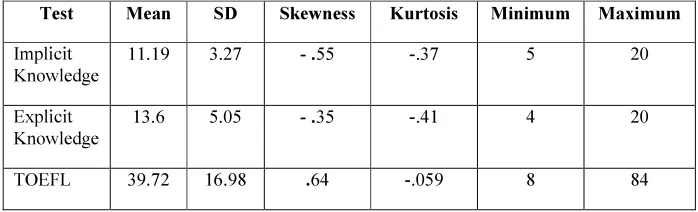
To begin with, the descriptive statistics of the three tests shown in Table 1
demonstrate that the distribution values of the test scores (i.e., skewness and
kurtosis) are within the normal range of ± 1.5 proposed by Kinnear and Gray
(1999).
Table 1
Descriptive statistics of the test scores
Test Mean SD Skewness Kurtosis Minimum Maximum
Implicit Knowledge
11.19 3.27 - .55 -.37 5 20
Explicit Knowledge
13.6 5.05 - .35 -.41 4 20
TOEFL 39.72 16.98 .64 -.059 8 84
The relationship between the participants' implicit and explicit grammatical
knowledge (as measured by the Timed and Untimed Grammaticality Judgment
Tests) and their general L2 proficiency (measured by the TOEFL) was investigated
through computing the Pearson product-moment coefficients using the SPSS 17.
The correlation results are shown in Table 2.
Table 2
Correlations between implicit/explicit knowledge and general L2 proficiency
Tests Correlation Sig. (2-tailed) N
Implicit Knowledge & General L2 Proficiency
0.11 0.274 100
Explicit Knowledge & General L2 Proficiency
0.519** .000** 100
**. Correlation is significant at the 0.01 level (2-tailed).
Table 2 indicates that there is no relationship between the scores of the EFL
learners' implicit knowledge test and their general L2 proficiency scores, r = 0.11,
n = 100, p
0.05, but there is a strong relationship between the scores of the EFL
learners' explicit knowledge test scores and their general L2 proficiency scores, r =
0.519, n = 100, p
0.0005. The results imply that the grammatical explicit
knowledge helps to explain nearly 35 per cent of the variance in students' scores on
the TOEFL.
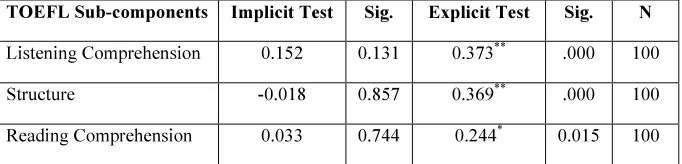
Table 3
Correlations between implicit and explicit grammatical knowledge and the sub-components of TOEFL
TOEFL Sub-components Implicit Test Sig. Explicit Test Sig. N
Listening Comprehension 0.152 0.131 0.373** .000 100
Structure -0.018 0.857 0.369** .000 100
Reading Comprehension 0.033 0.744 0.244* 0.015 100 **. Correlation is significant at the 0.01 level (2-tailed).
*. Correlation is significant at the 0.05 level (2-tailed).
Table 3 shows the results of the Pearson product-moment coefficients for the
relationship between EFL students' implicit and explicit grammatical knowledge
and the sub-components of their general L2 proficiency. This table shows that there
is no relationship between the EFL learners' scores on the implicit grammatical
knowledge test and their scores on the sub-components of the general L2
proficiency: listening comprehension (r = 0.152, n = 100, p > 0.05, structure (r = -
0.018, n = 100, p > 0.05), and reading comprehension (r = - 0.018, n = 100, p >
0.05). The results of the relationship between explicit knowledge test and the
sub-components of the TOEFL in this table show that there is a medium relationship
between the explicit grammatical knowledge test and the listening comprehension
section of the TOEFL (r = 0.373, n = 100, p
0.0005); between the explicit
grammatical knowledge test and the structure section of the TOEFL (r = 0.369, n =
100, p
0.0005); and between the explicit knowledge test and the reading
comprehension section of the TOEFL (r = 0.244, n = 100, p
0.05).
Considering the third research question, a Standard Multiple Regression was
run to assess the ability of two independent variables (implicit and explicit
grammatical knowledge) to predict the general L2 proficiency scores of EFL
students, as the dependent variable (Table 4). The required preliminary analyses
were conducted to ensure no violation of the assumptions of normality, linearity,
multicollinearity, and homoscedasticity (Pallant, 2007).
Table 4
The results of model summaryof standard multiple regression analysis Model R R Square Adjusted R Square Std. Error of the Estimate
1 0.538 0.289 0.275 14.46
a. Predictors: (Constant), Explicit Knowledge, Implicit Knowledge b. Dependent Variable: General L2 Proficiency
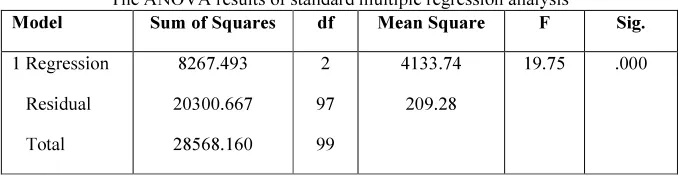
Table 5
The ANOVA results of standard multiple regression analysis
Model Sum of Squares df Mean Square F Sig.
1 Regression Residual Total
8267.493 20300.667 28568.160
2 97 99
4133.74 209.28
19.75 .000
According to Table 5, 29 per cent of the variance in participants’ general L2
proficiency is explained by the model as a whole including both explicit and
implicit L2 grammatical knowledge. So, it is a respectable model which can predict
the results. Further, the ANOVA results in Table 5 demonstrate that the model
reached the statistical significance (Sig. = .000, p
0.0005) and can explain a
significant part of the variance in the dependent variable.
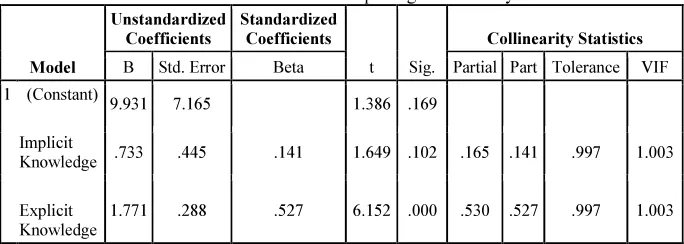
Table 6
The results of standard multiple regression analysis
Model
Unstandardized Coefficients
Standardized Coefficients
t Sig.
Collinearity Statistics
B Std. Error Beta Partial Part Tolerance VIF
1 (Constant)
9.931 7.165 1.386 .169
Implicit
Knowledge .733 .445 .141 1.649 .102 .165 .141 .997 1.003
Explicit Knowledge
1.771 .288 .527 6.152 .000 .530 .527 .997 1.003
Dependent Variable: General L2 Proficiency
Table 6 depicts which independent variable (i.e., explicit and implicit
grammatical knowledge) contributed more significantly to the dependent variable
(general L2 proficiency). An inspection of the beta column related to the explicit
and implicit knowledge indicates that the beta value (0.527) of explicit L2
grammatical knowledge was significantly higher than that of the implicit
grammatical knowledge. Therefore, it is argued that the participants' explicit L2
grammatical knowledge has made a significantly higher contribution to the
dependent variable in the model, that is, their general language proficiency. Further
investigation of the table implies that if the participants’ explicit L2 grammatical
knowledge test scores increase by one standard deviation (i.e., 5), their general L2
Proficiency scores would be likely to increase by 0.527 SD units (i.e., 2.635), but
the EFL learners' implicit grammatical knowledge could not predict their general
L2 proficiency.
Discussion
As
mentioned above, this study probed the relationship between EFL learners'
implicit and explicit grammatical knowledge and their general L2 performance.
The results revealed that there was no relationship between the implicit
grammatical knowledge of EFL learners and their general L2 proficiency. In other
words, in the EFL context under study, the EFL students' implicit grammatical
knowledge does not play a significant part in their performance on the TOEFL as
the measure of general L2 proficiency. This finding ran counter to the rather strong
relationship that Elder and Ellis (2009) found between a measure of implicit
knowledge and the test takers' performance on the IELTS as one of the three
measures of general L2 proficiency they used in their study. Yet, this finding here
was in a way similar to Elder and Ellis's finding, as far as the TOEFL (both
computer-based and internet-based) scores are concerned; that is, even in their
study, EFL students' implicit L2 grammatical knowledge was not very strongly
correlated with their scores on the TOEFL. Furthermore, the correlation analysis of
the relationship between the implicit grammatical knowledge of EFL learners and
the sub-components of their general L2 proficiency indicated no meaningful
relationship. In Elder and Ellis' study, implicit knowledge correlated with all four
language skills, and even more strongly with the oral IELTS.
However, the learners' performance on the measure of explicit L2 grammatical
knowledge was significantly correlated with their performance on the TOEFL. This
finding thus supports the earlier findings of Ellis (2006) as well as Elder and Ellis
(2009) that there was a fairly strong relationship between the explicit grammatical
knowledge of L2 learners and their general language proficiency. Moreover, this
study showed a nearly respectable relationship between explicit grammatical
knowledge of EFL learners and the TOEFL sub-components. That is, those L2
learners who had performed better on the explicit grammatical knowledge test had
also performed well on the listening comprehension, structure, and reading
comprehension sub-tests. These findings were to some extent similar to the
findings of a study by Macrory and Stone (2000). They investigated some students
from British secondary schools and found a significant relationship between their
explicit knowledge about the French perfect tense and their ability to use the tense
in an informal interview and in their free written production. They concluded that
the learners who had a nearly good explicit knowledge of this perfect tense also
performed well in the productive skills under study. Partially similar to this finding,
Ellis and Elder and Ellis found that the learners’ explicit knowledge was strongly
related to written IELTS.
It stands to reason that the type of proficiency test (TOEFL as opposed to
IELTS) plays a pivotal role in explaining such contradictory findings obtained
when examining the involvement of the implicit or explicit grammatical knowledge
in the L2 learners' performance on general proficiency instruments. In other words,
it can be argued that TOEFL is a monologic test allowing more for monitoring and
thus the implication of explicit grammatical knowledge, whereas IELTS is more
interactional or communicative and is presumed to bring much more to bear on the
learners’ implicit knowledge. Therefore, TOEFL, despite its renewed design and
form, is still generally envisioned to tap primarily into the cognitive academic
language proficiency and in turn encourage the use of explicit knowledge (Elder &
Ellis, 2009).
The last finding of this study was that, in comparison to the L2 learners' implicit
grammatical knowledge, the participants' explicit grammatical knowledge was a
better predictor of their general proficiency in an EFL context. It suggests that the
EFL learners' scores on the measures of explicit grammatical knowledge can be
proportionately used to predict their scores on the general L2 proficiency.
Considering the accessibility of the explicit knowledge to the learners’ general
proficiency, the results corroborated with the conclusion made by Ellis (2006) and
Elder and Ellis (2009) that knowledge of grammar serves as a powerful predictor
of general proficiency. The results, however, did not confirm the researchers’
finding that L2 learners' implicit knowledge is also implicated in language
proficiency since the learners’ implicit grammatical knowledge did not
significantly contribute to their performance on the TOEFL. Elder and Ellis further
argue that implicit and explicit knowledge of different rather than the same
structures functions as predictors of overall proficiency. Still, when it comes to the
components of the IELTS, it is either the explicit feature or the implicit feature that
emerged differentially as significant predictors of receptive vs. productive skills or
input vs. output processing, respectively. Despite these apparently irreconcilable
findings, it is suggested that the use of other measures of implicit knowledge such
as ‘elicited oral imitation test’ and observation of real-time oral output by future
research might help portray the accessibility of implicit knowledge to language
proficiency more clearly.
A final point in order, as noted earlier, different competing 'interface positions'
have been adopted in the field of SLA on the role of explicit and implicit
knowledge in L2 acquisition and have been explored by different researchers (Ellis,
2004, 2005; Hu, 2002; DeKeyser, 1997; Bialystok, 1982). It seems that the results
of the present study imply that the knowledge more accessible to EFL learners in
their L2 use and processing, especially in their general language proficiency and
input processing, is fundamentally explicit in terms of its origin or architecture.
Even though this issue needs further investigation, the findings are apparently in
line with the weak interface position versions that argue for the possibility of
knowledge transfer from one system to the other while putting some restrictions on
when and how it can take place (Ellis, 2005).
As to the pedagogical implications of the study, the findings recognize the
importance of explicit knowledge in language learning especially in EFL settings.
This recognition in turn motivates a renewed interest in explicit instruction
embedded within a FonF pedagogical milieu, where meaning and form receive
collateral momentum. Learners' errors while communicating to perform tasks or
play roles should occasionally trigger the teachers' explicit reformulations and
explanations of correct grammatical structures and helping the learners notice the
gap in their grammatical knowledge (Ellis, 1990, 1991; N. Ellis, 2001, 2002). In
other words, if the students' scores on explicit grammatical knowledge increase,
their scores on (the oral and written skill components of) the TOEFL as well as the
written IELTS will increase as well. It may be argued that, the most important
insight that can be gained from this study is that, a balanced approach needs to be
adopted by L2 teachers in English classrooms between the time devoted to the
development of L2 learners' explicit grammatical knowledge through teaching
explicit rules and the time specialized to the real communicative use of L2, which
can help the development of both the EFL learners' implicit knowledge and their
general L2 proficiency.
Conclusion
This study is added to the growing body of L2 research on the relationship between
the L2 learners' implicit and explicit grammatical knowledge and their general
language proficiency. The results indicated that the EFL learners' scores on the
measure of explicit grammatical knowledge correlated significantly with their
scores on the TOEFL, whereas their scores on the measure of implicit grammatical
knowledge were not significantly related to their TOEFL scores. Furthermore, no
relationship was found between the L2 learners' implicit grammatical knowledge
and their performance on the TOEFL components, but a significant relationship
was found between the explicit grammatical knowledge of the learners and their
performance on all the language proficiency components. In short, it was found
that the learners' explicit grammatical knowledge could better predict their
performance on the TOEFL and its components. The findings indicated that there
are clear reasons for believing that grammar is an important component of any
model of L2 proficiency and that the implicit/explicit distinction may also be
important for understanding the nature of proficiency and the ability to measure it
(Ellis, 2006).
Notes on Contributors:
Azizullah Mirzaei
is assistant professor of Applied Linguistics (AL) at Shahrekord
University.
He
has
published/presented
papers
in (inter)national
journals/conferences. He co-authored a chapter on Assessing SL Pragmatics in
The Cambridge Guide to SL Assessment. His research interests include: AL, ILP,
Language Testing and Assessment, and Teacher Education.
Masoud Rahimi Domakani
is assistant professor of AL at Shahrekord University,
Iran. He has published and presented some papers in (inter)national journals and
conferences. His research interests include: UG and SLA, Sociolinguistics, and
Teacher Education.
Zari Shakerian
received her M.A. in TEFL from Shahrekord University in 2011.
Her research interests include: AL, a dual implicit-explicit learning system, and
Discourse Analysis.
References
Anderson, J. (1983).
The architecture of cognition
. Cambridge, MA: Harvard
University.
Anderson, J. (1985).
Cognitive psychology and its implications. New York, NY:
Freeman.
Anderson, J., & Lebiere, C. (1998).
The atomic components of thought
. Mahwah,
NJ: Erlbaum.
Bachman, L. F. (1990).
Fundamental consideration in language testing
. Oxford:
Oxford University Press.
Bachman, L. F., & Palmer, A. S. (2010).
Language Assessment Practice
. Oxford:
Oxford University Press.
Bialystok, E. (1982)
.
On the relationship between knowing and using forms.
Applied Linguistics
,
3
(3), 181-206.
Bialystok, E. (1994). Analysis and control in the development of second language
proficiency.
Studies in Second Language Acquisition, 16
(2)
,
157-168.
Butler, Y. (2002). Second language learner' theories on the use of English articles:
an analysis of the metalinguistic knowledge used by Japanese students in
acquiring the English article system.
Studies in Second Language Acquisition,
24,
451-480.
Canale, M. (1983). From communicative competence to language pedagogy. In J.
Richards & R. Schmidt (Eds.).
Language and Communication
(pp. 2-27).
London: Longman.
Canale, M., & Swain, M. (1980). Theoretical bases of communicative approaches
to second language teaching and testing.
Applied Linguistics, 1
(3),
1–47.
DeKeyser, R. (1997). Beyond explicit rule learning: automatizing second language
morphosyntax.
Studies in Second Language Acquisition,
19
(2),
195 – 221.
DeKeyser, R. (1998). Beyond focus on form: cognitive perspectives on learning
and practicing second language grammar. In C. Doughty & J. Williams (Eds.),
Focus on Form in Second Language Acquisition
(pp. 42-63). Cambridge:
Cambridge University Press.
DeKeyser, R. (2003). Implicit and explicit learning. In C. Doughty & M. Long
(Eds.),
Handbook of second language acquisition
. Malden, MA: Blackwell.
Elder, C., & Ellis, R. (2009). Implicit and explicit knowledge of an L2 and
language proficiency: Applying the measures of implicit and explicit L2
knowledge. In R. Ellis et al. (Eds.),
Implicit and explicit knowledge in second
language learning, teaching, and testing
(pp. 167-193). UK: Multilingual
Matters.
Ellis, N. (2001). Memory for language. In P. Robinson (Ed.),
Cognition and second
language instruction
(pp. 33-68). Cambridge: Cambridge University Press.
Ellis, N. (2002). Frequency effects in language processing: a review with
implications for theories of implicit and explicit language acquisition.
Studies
in Second Language Acquisition, 24
(2)
,
143- 88.
Ellis, N. (2008). Implicit and explicit knowledge about language. In J. Cenos & N.
Hornberger (Eds.),
Encyclopedia of Language and Education
, (pp. 119-131).
New York: Springer.
Ellis, R. (1990).
Instructed second language acquisition: learning in the classroom
.
Oxford: Oxford University Press.
Ellis, R. (1991). Grammaticality judgments and second language acquisition.
Studies in Second Language Acquisition, 13
(2)
,
161 – 186.
Ellis, R. (2004). The definition and measurement of L2 explicit knowledge.
Language Learning, 54
(2)
,
227 -275.
Ellis, R. (2005). Measuring implicit and explicit knowledge of a second language:
a psychometric study.
Studies in Second Language Acquisition, 27
(1)
,
141-172.
Ellis, R. (2006). Modeling learning difficulty and second language proficiency: the
differential contributions of implicit and explicit knowledge.
Applied
Linguistics
,
27
(3), 431-463.
Ellis, R., Loewen, Sh., Elder, C., Erlam, R., Philp, J., & Reinders, H. (2009).
Implicit and explicit knowledge in second language learning, teaching, and
testing
. UK: Multilingual Matters.
Goss, N., Ying-Hua, Z., & Lantolf, J. (1994). Two heads may be better than one:
mental activity in second language grammaticality judgments. In E. Tarone, S.
Gass, & A. Cohen (Eds.),
Research Methodology in Second Language
Research
(pp. 263-268). Hillsdale, NJ: Lawrence Erlbaum.
Green, P., & Hecht, K. (1992). Implicit and explicit grammar: an empirical study.
Applied Linguistics, 13
(2)
,
168-184.
Han, Y., & Ellis, R. (1998). Implicit knowledge, explicit knowledge, and general
language proficiency.
Language Teaching and Research, 2
(1)
,
1-23.
Hazeltine, E., & Ivry, R. (2003). Neural structures that support implicit sequence
learning. In L. Jimenez (Ed.),
Attention and implicit learning
(pp. 71-108).
Philadelphia, PA: John Benjamins.
Hu, G. (2002). Psychological constraints on the utility of metalinguistic knowledge
in second language production.
Studies in Second Language Acquisition, 24
(3)
,
347-386.
Hulstijn, J. H. (2002). Towards a unified account of the representation, processing
and acquisition of second language knowledge.
Second Language Research,
18
(3)
,
193 – 223.
James, C., & Garett, P. (1992).
Language awareness in the classroom
. London:
Longman.
Karmiloff-Smith, A. (1979). Micro- and macro-developmental changes in language
acquisition and other representation systems.
Cognitive Science, 3
(2)
,
91-118.
Kinnear, P. R., & Gray, C. D. (1999).
SPSS for Windows made simple (3rd ed.).
Hove: Psychology Press.
Krashen, S. (1981).
Second language acquisition and second language learning
.
Oxford: Pergamon.
Lantolf, J. (2000). Second language learning as a mediated process.
Language
Teaching, 30
(2)
,
79-98.
McLaughlin, B. (1978). The monitor model: some methodological considerations.
Language Learning, 28
(2)
,
30-332.
Macrory, G., & Stone, V. (2000). Pupil progress in the acquisition of the perfect
tense in French: the relationship between knowledge and use.
Language
Teaching Research
,
4
(1), 55-82.
Pallant, J. (2007).
SPSS: survival manual, a step by step guide to data analysis
using SPSS for windows
(3rd ed.).
Open University Press: Mc Graw Hill
Companies.
Paradis, M. (1994). Neorolinguistics aspects of implicit and explicit memory:
implications for bilingualism and second language acquisition. In N. Ellis
(Ed.),
Implicit and explicit language learning
(pp. 393-419). London:
Academic Press.
Philp, J. (2009). Pathways to proficiency: learning experiences and attainment in
implicit and explicit knowledge of English as a second language: Applying the
measures of implicit and explicit L2 knowledge. In R. Ellis et al. (Eds.),
Implicit and explicit knowledge in second language learning, testing and
teaching
(pp. 194-215). UK: Multilingual Matters.
Pienemann, M. (1989). Is language teachable? Psycholinguistic experiments and
hypotheses.
Applied Linguistics, 10
(1), 52-79.
Reber, A. (1976). Implicit learning of synthetic learners: The role of instructional
se.
Journal of Experimental Psychology, Human Learning and Memory, 2
(1),
88-94.
Schmidt, R. (1990). The role of consciousness in second language learning.
Applied Linguistics, 11
(2)
,
129 – 158.
Schmidt, R. (1994). Deconstructing consciousness in search of useful definitions
for applied linguistics.
AILA Review, 11,
11-26.
Schmidt, R. (2001). Attention. In R. Robinson (Ed.),
Cognition and second
language instruction.
Cambridge: Cambridge University Press.
Shanks, D. (2003). Attention and awareness in “implicit” sequence learning. In L.
Jimenez (Ed.),
Attention and implicit learning
(pp. 11-42). Philadelphia, PA:
John Benjamins.
Sharwood Smith, M. A., (1981). Consciousness-raising and second language
acquisition theory.
Applied Linguistics, 2
(2), 68 – 159.
Sorace, A. (1985). Metalinguistic knowledge and language use in acquisition-poor
environments.
Applied Linguistics, 6
(3), 239 – 254.
Wallach, D., & Lebiere, C. (2003). Implicit and explicit learning in a unified
architecture of cognition. In L. Jimenez (Ed.),
Attention and implicit learning
(pp. 215-252). Philadelphia, PA: John Benjamins.
Appendices
Appendix A: Implicit Grammatical Knowledge Test
University:
……….
Major:
………...
Semester:
………
Age:
…..
Gender:
………..
Instruction
: Choose the correct choice (either
a
or
b
) within the fixed time limit
set for each slide (i.e., 10 seconds).
1) A. How’s the whether there?
B………...
a) It’s nice.
b) It’s a nice whether.
2)
a) They seldom don’t go to the movies.
b) They seldom go to the movies.
3)
a) Why is Tom not worried?
b) Why is Tom no worried?
Example:
A. What do you usually do on Fridays? B. ……….
a) I often going to the cinema.
b) I often go to the cinema.