*Corresponding authors: Hossein Namdar Areshtanab, Email:[email protected] Introduction
Professional identity development is one of the fundamental concerns of nursing education.1 It has become one of the most important challenges in nursing education and providing nursing services due to the attempts to prepare nurses for professional roles in a changing healthcare environ ment.2 The university and students are at the core of scientific and practical elements of professional development. Although nursing schools have increasingly grown, these have not improved.3 Recent studies indicate the insufficiency of nursing educational systems, especially in terms of professional identity development among nurses.1,3,4
Professional identity development is a difficult process, because it consists of several factors such as: body of knowledge, professional authority, community sanction, code of ethics, social culture, gender, work experience, teamwork skills, professional knowledge, learning a workplace, and interaction and background awareness of the profession.5 A study demonstrated that a necessary part of a nurse’s professional identity forms during the education and studentship period. If it has been integrated into first years of a person’s career, its effects will last until the end of
professional activity.6
As one of the main objectives of nursing education is creating a professional identity whose members could be successful and independent based on their own know-ledge, attitude and abilities, an educational system evaluation is valuable in terms of identifying effective components of professional identity and describing them to nursing students. Building up a positive professional identity is crucial in attracting and retaining quality nurses; it also helps students confirm their career choice early in their program.7 It emphasizes the ethical nature of the professional culture that ultimately leads to quality future practice.8 Holding a positive nursing image helps sustain motivation and retention in the nursing program.9 Professional identity is foundational to the assumption of various nursing roles. Also, a profes sional identity with an inherent ethical virtue contributes much to quality nursing practice.10
Although there are several studies in this field, none of them studied the role of nursing curriculum components on professional identity. Besides, the majority of studies are conducted in western societies that differ in terms of
doi:10.5681/rdme.2014.009 http://journals.tbzmed.ac.ir/rdme
Professional Identity Development in Nursing Students: Eisner’s
Evaluation Model
Original Research
Laleh Hosseini Shahidi1, Maryam Vahidi2, Behrooz Mahram3, Hossein Namdar Areshtanab1*, Nazila Zarghi4
1 Department of Postgraduate, Nursing and Midwifery Faculty, Mashhad University of Medical Sciences, Mashhad, Iran 2 Nursing and Midwifery Faculty, Tabriz University of Medical Sciences, Tabriz, Iran
3 Education and Psychology Faculty, Ferdowsi University of Mashhad, Mashhad, Iran 4 Nursing and Midwifery Faculty, Mashhad University of Medical Sciences, Mashhad, Iran
Article History:
Received: 8 Dec 2013 Accepted: 21 Feb 2014 ePublished: 29 May 2014 Keywords:
Curriculum, Nursing Student, Professional Identity
Introduction: Professional identity development is one of the main concerns of nursing education. This study aimed to evaluate effective educational components on nursing students’ professional identity using Eisner’s model of criticism and connoisseurship.
Methods: Eisner’s Criticism and Connoisseurship Model were used for a qualitative evaluation of the nursing education system. This model includes four steps of descriptive, interpretative, evaluative and thematic evaluation. Data were collected by semi-structured interview and observation. Participants were 15 students and faculty members of Mashhad University of Medical Sciences, Iran, who were selected by purposive sampling. Data were analyzed by Eisner’s model.
Results: Four major themes included student admission, educational system defects, reality shock, and self-esteem. These themes that emerged from educational evaluation are effective in developing the professional identity of Iranian nursing students.
Conclusion: It seems that changing the admission process, presenting the nursing discipline to students as much as possible, creating a more realistic education, making an exclusive body of knowledge, and following successful role models are helpful in students’ professional identity development.
Abstract Article info
cultural and social backgrounds from Eastern societies. Additionally, sociocultural content could influence nursing students’ perception of their professional nursing identity.11 On the other hand, a qualitative evaluation of the educational system is conducive to a more profound understanding and insight of pro fessional identity. In qualitative evaluations, the value of evaluation is related to individuals, and educational phenomena are considered to be a whole and viewed holistically. Besides, it pays more attention to humanistic interaction and quality of education rather than outcomes.7
One of the most comprehensive models for qualitative evaluation is Eisner’s model of Criticism and Connoisseurship by which the evaluator reviews the educational curricula critically. In this model, an expert evaluator searches critically the institution, curriculum, product and/or activities. From this point of view, evaluation is an artistic work which could depict the significant qualities of the curriculum.8-10 The educational expert, who has organized his previous experiences by his perceptive sensitivity, could present evaluations which no one could achieve to such a result. As to the Eisner, good appraisal and awareness of the situational quality of education is accompanied with experts’ individual observations and group ideas.8-11 In a critical appraisal of education, evaluators should focus on questions about educational aca demic experience and quality of educational environment.
The Eisner, evaluation process has been founded on educational criticism and educational connoisseurship; the former is the art of exposure and the latter is the art of assessment and evaluation.9 Criticism is conducive to a new understanding of the subject rather than a focus on negative aspects; educational criti cism revealed the quality of education and changing students’ behaviors.8,12,13 Mahram studied the evolutional trend of students by comparing them in three sections of first, second, fourth and last terms of their education. In this study, Eisner‘s Model was used for identifying the role of curricular compo nents in these changing terms.8-10 Analyzing effective components of nursing identity could be helpful in understanding the present existing reality, because professional identity and its effective components are necessary to identify and interpret nurses’ behaviors.4
This study aimed to evaluate effective edu cational components on nursing students’ professional identity using Eisner’s model of criticism and connoisseurship.
Materials and Methods
A qualitative approach was used for this evaluative study using criticism and connoisseurship of Eisner. It qualitatively describes educational experiences and seeks the educational events, state of students’ and faculty members’ participation, and their reaction to the phenomena. This model focuses on the four steps of description, interpretation, evaluation and themes.8,9,14 The descriptive aspect of educational criticism describes the existing situation of the educational curriculum, student, faculty member and educational environment
from the expert’s viewpoint in order to depict the present educational process. While description focuses on “what it is”, interpretation emphasizes “why” and “how”, i.e. why and how phenomena occurred. The interpretative aspect tries to understand meanings and concepts, as well as the importance of several social activities and interpreting educational activities. Educational connoisseurs are not only interested in a clear description of the student’s experiences, but they also seek a description of their meaning; this aim is achieved by studying internal factors of nursing education context. Interpretation also could present potential outcomes of the curriculum. In fact, several “understandings” which are a result of describing conditions are the first step for interpretation, which decodes the internal messages of the educational system by describing, discovering, paraphrasing, and reconstructing. The evaluation step judges educational criteria and compares the present situation with the ideal one.8,9,11,13,14 The thematic step means a generalization of finding. Although, in qualitative ap proaches, generalization is not considered, as to the Eisner, in similar educational condition, findings could generalize.9,14
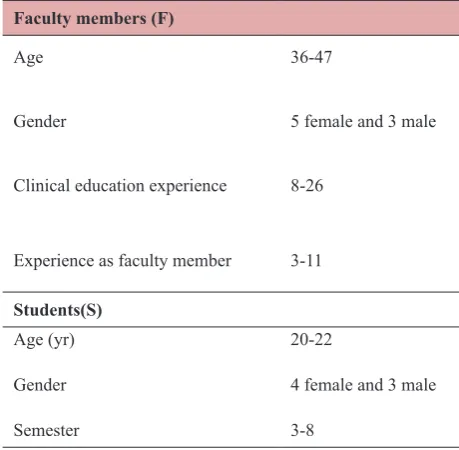
Participants included eight masters of nursing students and seven teachers in the Nursing and Midwifery School (Table 1) who were selected through purposive sam pling in 2010-2011.
Table 1.Summary of participants’ profile Faculty members (F)
Age 36-47
Gender 5 female and 3 male
Clinical education experience 8-26
Experience as faculty member 3-11
Students(S)
Age (yr) 20-22
Gender 4 female and 3 male
Semester 3-8
Unstructured observation occurred in the form of observer as clinical and theoretical environment. Eisner (1994) proposed structural corroboration, consensual validation and referential adequacy for findings accreditation that were used in the present study. Structural corroboration is integration of the evidence and reasons of evaluator and presenting an integrated image of situation, .i.e. triangulation of data collection. In this direction, several sources of observation, interview and literature/documents review have been used. Referential adequacy creates consensus between audiences, at the time of pre senting criticism by the evaluator, which could be done be group discussion and a check by the members.8 It was used for readers’ understanding development and put him in observed context of longtime contact with participants and observation of environment as the same time with data analysis.8,9,11,13,14
Results and Discussion
Data analyses in this model are extended to description, interpretation evaluation and thematic steps.
Description
Although some students recognize the nursing discipline through society and their relatives, most of them select it with little insight and information, but more importantly, ignoring their own interests and capabilities. As a result, they lack enough motivational capabilities despite increased growth in students’ admission, and the quality of nursing services has decreased. Based on documents, Mashhad School of Nursing and Midwifery was successful in presenting scientific knowledge and skills, but it has not helped in nursing professional identity development. Inconsistency between theoretical acquired knowledge and the real, clinical environ ment results in developing insufficient knowledge, preventing professional development and cultivating unprofessional nursing students. So far, theoretical and clinical education is based on standards and ideals which mislead nursing students; on the other hand, uncertain nursing tasks and workplace power imbalance are among the other contributing factors in professional development depreciation. According to studies and observations, the School of Nursing and Midwifery showed no development in creating positive self-esteem, which is necessary for professional development.
Interpretation
The process of admission into the educational system plays an important role in decreasing nursing professional development. The national exam tests only the theoretical knowledge of students and their talent for education, while both the educational condition and working situation of nursing is different from other disciplines. Recent studies have focused on some personal and psychological characteristics for nursing besides their talents.15 Although there is no difference between students who select nursing and students who select other disciplines, nursing students should be admitted based on their interests and capabilities.
The present admission process ignores students’ interests and capabilities, so these students who lack interest and capability who select nursing for either an educational degree or financial support fail in acquiring a professional identity.16,17
“People select nursing with no insight, interest or study about nursing positions and tasks; they select it only to enter university”. (F)
“Some students regretted selecting nursing. They said that they did not know and selected nursing blindly”. (F) “Students lack insight and understanding of nursing; they just would like to be admitted. When they started, they faced problems due to their lack of interest and incompatibility of nursing with their morals.”(F)
Nursing students’ beliefs confirmed these themes:
“People are introduced to nursing with no morale compatibility”. (S)
Three students out of five selected nursing because one of their family members was a nurse:
“I made some studies about nursing, as one of our relatives was a nurse; I knew this discipline in some extent”. (S) The problem of identification in male students is more revealed, because they consider nursing to be a career, a financial support and a job with different social class, while female students are admitted more due to their interest, insight, and higher compatibility with nursing.18 Sadio et al. (2003) showed that male nurses had lower professional identity than females.19 It seems the alternative motivation for many males in selecting the discipline is one of the other contributing factors for professional development. From the males’ point of view, good marketing and being close to medicine were their main motivations:
“Nursing attracts people because its em ployment is high”. (S)
“When I started nursing, I focused just on marketing; I would like to start working after graduation, I had no insight except this”. (S)
“My greatest motivation for selecting nursing was its closeness to medicine which will help us face problems in the future”. (S)
From the females’ point of view, the criteria for selecting nursing (after national exam score), were feasibility of professional knowledge in the future and the nurturing (or feminine) nature of the discipline. Their score was considered as a criterion for selecting discipline:
“I thought that I should select a discipline which could be feasible in my future life and I could apply it”.(S)
“Nursing care is compatible with feminine morale”.(S)
throw a shadow on nursing students’ edu cation and give no help for preparing them for their independent professional roles.16 In other study focused on the role of nursing schools in profes sional insight and identity development.12 “Students have the same insights of com mon people at their entrance, and our edu cation does no help for changing this in sight”. (F)
Students confirmed faculty members’ idea:
“No help was given to me for changing my insight to positive and forming my profes sional identity”. (S)
Or “school made us ready scientifically, just to be a nurse,
but nobody said who I am and what I am doing and what my roles are”. (S)
“School could grant scientific expectation and necessary
basic science, but it could not form nursing identity”. (S)
In fact, a task oriented paradigm which avoids holistic and humanistic clinical nursing, under the care of education, is conducive to more detachment from ideal conditions. Undoubtedly, to be a career nurse is one of the nursing students’ goals after graduation. Nowadays, expectations of graduates have been more due to more the complexity of nursing profession.24 So, it is necessary to match curricula with professional needs. For recognizing each scientific discipline, it is necessary to learn the historical process and its evaluations and education.17,21 Informing students of discipline history and background is one of the methods for professional identity acquirement which is ignored or paid little attention to in nursing curricula In “History of Nursing”, it should be noted that just one of the participants (a student) stated that there is no course for nursing history, identity, role and tasks of nursing within a community. It is presented to all disciplines at the beginning in order to familiarize them with their discipline and its importance, but unfortunately, we were not told what nursing and their futures are”. Nursing students’ clinical experience is the other important aspect of their professional identity.21,25 According to the literature, professional identity is formed in context and nursing care conditions, clinical tasks, and interactions with others.26 Students, especially after their first clinical experience, familiarized themselves with professional realities, and a professional identity is integrated in clinical practice. They experience several problems in transition to the clinical step.26 Students are confused between what they learn and what they are asked; they experience a stressful envi ronment.27 Clinical environment is regarded as crucial for perception and nursing education outcomes, because received negative experiences decreases students’ learning opportunities and results in negative feelings which have an effect on their future work.26
“There is a big gap between students’ expectations and imagination of clinical conditions and reality, which
leads to frustration and finally a negative effect on their
professional identity”. (F)
“Students are frustrated, especially in the lower terms, because courses are different from their expectations”. (F)
Students also said:
“When I was studying, I thought my education certainly
affected on my work, but when I started working, I realized that my knowledge has no relation to my work; my work is just IV line, serum therapy etc…”. (S) “The nurse did not pass a 4-year program just for physician’s order administrations there is no consistency between our education and our work. This was the most important factor which spoiled my professional identity which I acquired; this was not my expectation of nursing and all my efforts”. (S)
Furthermore, unclear tasking, role overlaps and inequality in the nursing workplace are the other contributing factors for the gap between theory and practice and students’ professional identity depreciation. Professional identity has a close relationship with professional roles, so that clear tasks for members of the profession leads to a positive feeling of professional identity.28 One of the faculty members said: “Nursing tasks are not distinguished; the nurse does not know where his position in this system is and what his tasks are. So, some problems arise in professional recognition.”
Power relations in healthcare systems’ dominance of medicine and organizational decision-making also lead to a decline in students’ professional identity.24 One of the faculty members pointed out to ine quality in clinical settings:
“Instructors and students regard them selves as strangers and feel they are unin vited. There is a different position for nursing student with others e.g., some devices are given to medical students but not to nursing students”.
According to one of students:
“Nursing students are even different in their uniform/ clothing with medical stu dents. Why? Physician could dress as they wish, but it is not true for nurses. These affect on me negatively”.
Self-esteem affects satisfaction capability and self efficacy.28 Signs of low self-esteem are witnessed in nursing students, and they are related to a lack of a body of knowledge and nursing image.7,20
“Knowledge and capability of nurses play an important role in forming professional identity; if a nurse could care well, she could change the community insight”.(F)
“A nurse’s insight to his scientific and clinical capabilities
has the greatest effect on professional identity; if we do not change our insight, the situation does not get better, and we still do not accept ourselves. Problem is not what the idea of physician, patient and his family is, the problem is our idea about us”. (F)
According to participants, both faculty members and students, the most important effect on professional identity is related to self-esteem, but just one of faculty members stated:
“The insight of community or nursing im age is more important”. (F)
Students’ responses indicated the importance of a body of knowledge in forming professional identity.
Some students attributed this feeling to effective nursing care that could have an effect on their professional identity.
“In some cases, I saw a nurse who could save patient’s life, and it caused to higher self-concept, to be helpful for my community”. (S)
Students reach higher self-esteem through the modeling of faculty members, successful members of their profession and interaction between other students and clinical nurses. Low teacher self-esteem has a negative influence on student self-esteem and consequently, students’ professional identity.29 It should be noted that students faced confusion in finding a role model or professional identity model. The academic image presented by faculty members is based on nursing theories, nursing processes and special care of patient which are propagated by textbooks and literature. This image is in opposition with the carrier image faced clinically.30
“Faculty members were models whose words and behaviors were greatly effective on our professional identity”. (S) “I, as a student, focus on my professor’s words, when he does not believe in his own discipline, I got this model as well”. (S)
Faculty members confirmed students’ role modeling. “Sometimes faculty members who do not accept nursing are a negative model for students”. (F)
To students, the role of positive models was obvious:
“When I saw an expert professor, he affects my identity”. (S)
“When they started, they were like me and now they are here”. (S)
“The scientific level of some faculty members helps me
to understand nursing is not just what is implemented in hospital”. (S)
Evaluation
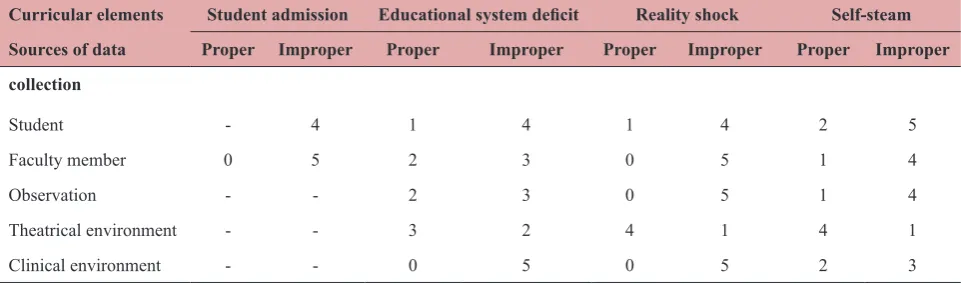
Observation of the physical environment of nursing school (such as in classrooms, auditoriums, conference hall, skill labs, etc.) and clinical centers for nursing education, as well as the findings of other data sources such as interviews and available documents, revealed shortcomings and deficits of facilities and spaces in comparison with other schools, especially the school of medicine. It should be remembered that applying modern educational approaches was the most positive aspect of the nursing school, and credit is due to efforts of directors and faculty members. (Consistent with sources of data collection) (Table 2)
Thematic step
The thematic step means creating a generalization of the findings. Although in qualitative approaches generalization is often not considered with regard to the Eisner, in similar educational conditions, findings could be generalize.9,14 Students’ admitted to nursing programs in our country face challenges compared to programs in other countries. In countries with advanced nursing education systems, students are admitted after getting their entrance score for each school (each school has a special entrance condition and score) submitting a related portfolio, and completing
an entrance interview.
Then, the interview score and other condi tions are considered for admission.17
Although the related papers of those countries indicate the insufficiency of interviews in prevent ing student failure and future unemployment (and tend to focus on the standardization of admission criteria), in doing further research in this field, our country’s situation should be studied so that no certain criteria is considered for admission except national exam raw scores. In fact, nurses seek advancement, progress and change along with their new role more than other professions.31 As a result; nursing students expect a proper and flexible education for satisfying present and future community needs. Current examples of problems in forming a nursing professional identity are: student confusion in coping with clinical roles, estrangement between nursing students and instructors and lack of belonging to clinical environment.32 Many nursing students suffer from ambivalence between work and uncertain professional roles.23 There is ambivalence between what is considered real nursing care and actual nursing care in a real clinical environment.20 Though nursing is well known as a helpful, independent profession across the world, still we witness poor nursing image, lack of self-esteem and negative community insights to nursing.33
Thematic step: Students are admitted by a concentrated approach in all Iranian schools of nursing based on raw national exam scores. Since syllabuses, time budgeting, organization of credits, clinical ap proaches, ethics and regulation, and faculty member recruitment systems are similar to other schools of nursing across the country (Iran), we expect to generalize findings of this study. The present study revealed four main effective curricular themes on professional identity development: admission, frustration, reality shock and self-esteem. One of the effective components on professional identity (the admission process in the nursing education system, with lateral themes of gender-oriented admission) was signified. It was a novel finding because it has not been reported by any other qualitative study. Around half of students do not fit well with the nursing profession in terms of the most dominant characteristics; most of them start with not enough insight and information. They not only are not able to act properly, but also face psycho logical pressure.34 It is believed that a lack of criteria for admission could hurt the professional future of the nursing discipline. It seems nursing education curricula has failed to introduce the nursing discipline and the process of creating a positive professional identity.
The other theme of the study is the frustration of educational systems for introducing the nursing discipline with lateral themes of consistency between education and clinic, and informing students of the history of the discipline. They were in agreement with previous studies.6,12,26
were also confirmed these findings; however, a common concept was supported by different key words.17,26,33,36 Regarding the self-esteem with lateral themes of nursing image, body of knowledge and role modeling was similar to different studies, in which students’ self-esteem and capability was considered necessary in providing services and nursing care based on her diagnosis for the client’s need.37 Knowledge and applying it in a clinical setting is considered a characteristic of a capable nurse with vast professional qualities.22,37 Obviously, professional identity is formed gradually and is due to interaction with
a community; profession and professional behavior alone could not be considered enough for professional identity development. On the other hand, professional members’ insight and beliefs alone are not effective on professional development, but beliefs and behavior of nurses and their reactions could be also helpful in forming a professional identity. The community’s negative attitude towards the nursing profession is one of the causes of nursing students leaving the nursing discipline.17
Table 2. Frequency of the state (properness) of students’ professional identity development by sources of data collection Curricular elements Student admission Educational system deficit Reality shock Self-steam Sources of data Proper Improper Proper Improper Proper Improper Proper Improper collection
Student - 4 1 4 1 4 2 5
Faculty member 0 5 2 3 0 5 1 4
Observation - - 2 3 0 5 1 4
Theatrical environment - - 3 2 4 1 4 1
Clinical environment - - 0 5 0 5 2 3
Conclusion
Evaluation of curriculum in Mashhad School of Nursing and Midwifery using Eisner’s model of criticism and connoisseurship showed, despite efforts and advances, Iranian nursing education is far from creating the ideal professional identity and is still in the process of reaching a positive identity. First, the student admission process should be revolutionized where students are admitted with consideration to personal characteristics, fitness to the nursing field, and are given enough interest and information before beginning their nursing education. Hence, applying personality tests as well as talents for nursing education are necessary. It is nec essary to interview after acquiring the score for student selection of the other challenges ahead of Iranian nursing education, another is the inability of students to apply their acquired knowledge, and unfamiliarity with the trends of the discipline. Therefore, it is necessary to revise educa tional content so that it could be matched with students’ needs and to be helpful for introducing the discipline.
Acknowledgements
Special thanks to the Mashhad School of Nursing and Midwifery, faculty members, nursing students, and others who helped us to perform this study.
Competing interests
The authors declare that there is no conflict of interests.
References
1. Nasrabadi AN, Emami A, Yekta ZP. Nursing experience in Iran. Int J Nurs Pract 2003;9:78-85.
2. Nikbakht Nasrabadi A, Emami A. Perceptions of nursing practice in Iran. Nurs Outlook 2006;54:320-27.
3. Hages JS, Kosier BE. Professional nursing practice: Concept and perspectives. 5 ed. USA: Julie Levin Alexander publish; 2006.
4. Dimitriadou A, Sapountzi-Krepia D, Psychogiou M, Konstantinidou-Straykou A, Peterson D, Benos A. The identity of the nursing staff in northern greece. Health Science Journal 2008;2(4):206-218.
5. Shaw K, Timmons S. Exploring how nursing uniforms influence self image and professional identity. NursTimes 2010;106:21-3.
6. Serra MN. Learning to be a nurse. Professional identity in nursing students. Educ Sci J 2008;5:65-76.
7. Polifko KA. Concept of the nursingprofession. USA: Thomson Delmar Learning Co; 2007.
8. Eisner E. The educational imagination: On the design and evaluation of school programs. New Jersey: Prentice Hall; 1994.
9. Mahram B, Saketi P, Masodi A, Mehr Mohamadi M. [Role of hidden curricular elements in scientific professional identity student: Case study]. Journal of Curriculum Studies 2006;1:997-1000.
10. Eisner EW. On the uses of educational connoisseurship and criticism for evaluating classroom life. Teachers College Record1977;78:345-58.
11. Vars GF. Educational connoisseurship, criticism and the assessment of integrativeStudies. Issues In Integrative Studies 2002;20:65-76.
L. Developing professional identity in nursing academics: The role of communities of practice. Nurse Educ Today 2009;29:607-11.
13. Yuksel I. How to conduct a qualitative program evaluation in the light of eisner’s educational connoisseurship and criticism model. Turkish Online Journal of Qualitative Inquiry 2010;1:78-84.
14. Mahram B, Kazemi S. An investigation of the performance of administrators as a component of hidden curriculum in values education. Journal of Curriculum Studies(JCS) 2010;5:129-52.
15. Janhonen S, Sarja A. Emerging identity of finnish nurse teachers: Student teachers’ narratives in a group exam. Nurse Educ Today 2005;25:550-5.
16. Meleis AI. Theoretical nursing development and progress. 4 ed 4. USA: Lippincott Williams and wilkins; 2005. 17. Brodie DA, Andrews GJ, Andrews JP, Thomas GB, Wong
J, Rixon L. Perceptions of nursing: Confirmation, change and the student experience. Int J Nurs Stud 2004;41:721-33. 18. Valizadeh L, Ghiasvandian S, Abedi HA, Zamanzadeh V. [Challenges and Solutions of MSc Education in Nursing: A Qualitative Study]. Iranian Journal of Medical Education 2012;8(11): 1010-23.
19. Sadayo I, Hiroko T, Yoshiko M, Ryuko S. Factors influencing nursing teachers’ professional identity. Journal of Japan Academy of Nursing Education 2003;12:1-9. 20. Hendel T, Gefen-Liban D. Getting ready for the future:
assessing and promoting graduate students’ organizational values. Nurse Educ Today. 2003;23:482-91.
21. Kittrell CK. Professional nursing: Concepts& challenges. 4th ed. USA: W.B. Saunders Co;2005.
22. Adib Haj Bagheri M, Salsali M, Ahmadi F. [The concept of professional power in nursing]. FEYZ 2004;8(1):9-19. 23. Memarian R, Salsali M, Vanaki Z, Ahmadi F, Hajizadeh
E. [Factors affecting the process of obtaining clinical competency]. Journal of Zanjan University of Medical Science 2006;14(56):40-9.
24. Rahimaghaee F, Dehghan Nayeri N, Adib Hajbagheri M. [First exposure to clinical practice: An alive experience of female nursing students]. FEYZ 2009;13(2):130-9.
25. Mahdipour Zarea N, Erteghaei V, Fathi Azar S, Safaian A, fallah E. [The factors involved in integrating theory and practice in nursing from the nurse teachers and students points of view, Tabriz, 2002]. Journal of Babol University of Medical Sciences 2003;5(Suppl. 2):24-8.
26. Andrews GJ, Brodie DA, Andrews JP, Hillan E, Gail Thomas B, Wong J, Rixon L. Professional roles and communications in clinical placements: A qualitative study of nursing students’ perceptions and some models for practice.Int J Nurs Stud 2006;43(7):861-74.
27. Sharif F, Masoumi S. A qualitative study of nursing student experiences of clinical practice. BMC Nurs 2005;4:6. 28. Ohlén J, Segesten k. The professional identity of the
nurse: Concept analysis and development. J Adv Nurs 1998;28:720-7.
29. Huston C. Professional issues in nursing: Challenges andopportunities. 2 ed. USA: Lippincott Williams and wilkins Co; 2010.
30. Adams K, Hean S, Sturgis P, Clark JM. Investigating the factors influencing professional identity of first-year health and social care students. Learning in Health and Social Care
2006; 5:55-68.
31. Crawford P, Brown B, Majomi P. Professional identity in community mental health nursing: A thematic analysis. Int J Nurs Stud 2008;45 :1055-63.
32. Adriani R, Salsali M, Mohamadi I. [Professional, communications role in shaping the public image of nursing.The first international congress on professional communication in medical centers]. Mashhad: Razavi Hospital; 2011.
33. Holmström I, Larsson J. A tension between genuine care and other duties: Swedish nursing students’ views of their future work. Nurse Educ Today 2005;25:148-55.
34. McAllister M, John T, Gray M. In my day: Using lessons from history, ritual and our elders to build professional identity. Nurse Educ Pract 2009;9:277-83.
35. Adib Hajbaghery M, Dianati M. [The Compatibility of Students’ Personality for Studying Nursing and Working in their Profession]. Iranian Journal of Medical Education 2005; 4(12): 5-10.
36. Jahanpour F, Sharif F, Salsali M, Kaveh MH, Williams LM. Clinical decision-making in senior nursing students in Iran. I Int J Nurs Pract 2010;16(6):595-602.