RESEARCH
Users’ involvement in mental health
services: programme logic model of an
innovative initiative in integrated care
Carolane Tremblay
1,2, Valérie Coulombe
3and Catherine Briand
1,2*Abstract
Background: Collaboration and partnership are key issues for modern health systems seeking to implement quality integrated care that meets the needs of the population. The Carrefour Communautaire-Institutionnel-Usagers (Connect-ing Community organisations-Institutions-Users, CCIU), involv(Connect-ing community- and institution-based mental health workers, carers and users, is an innovative normative integrated care group (group for shared values, culture and vision) established by the Canadian Mental Health Association-Montreal Branch. A programme evaluation approach was used to conduct a logic analysis of the CCIU in order to understand the relationships between its resources, activi-ties and outcomes, build a common understanding and, allow for its replication.
Methods: Five steps were involved in the creation of a programme logic model. A non-exhaustive literature search for similar initiatives, a review of documents related to the CCIU process and direct observations led to the devel-opment of a first model. Then, following a participatory and reflexive process, this model was validated with CCIU participants.
Results: A comprehensive model and a simplified model were created. Participants’ experiential knowledge and scientific knowledge helped to identify the essential components of the successful operation of the CCIU. Conclusions: The CCIU, with its eight essential components, including relations based on equality and mutual respect, corresponds to an essential step in normative integration and integrated care that lead to improved quality services.
Keywords: Mental health services, Shared values, Integrated care, Partnership, Users’ involvement, Carers’ involvement, Programme logic model
© The Author(s) 2017. This article is distributed under the terms of the Creative Commons Attribution 4.0 International License (http://creativecommons.org/licenses/by/4.0/), which permits unrestricted use, distribution, and reproduction in any medium, provided you give appropriate credit to the original author(s) and the source, provide a link to the Creative Commons license, and indicate if changes were made. The Creative Commons Public Domain Dedication waiver (http://creativecommons.org/ publicdomain/zero/1.0/) applies to the data made available in this article, unless otherwise stated.
Background
Collaboration and partnership are key issues for modern health systems seeking to implement quality integrated care that meets the needs of the population [1, 2]. The concept of Integrated Care is defined by Kodner and Spreeuwenberg [3, p. 3] as a practice that aims.
“To create connectivity, alignment and collaboration between the cure and the care sectors […] to enhance
quality of life, consumer satisfaction and system effi-ciency for patients with complex, long term prob-lems cutting across multiple services, providers and settings”.
It involves notions of patient-centred care, inter-profes-sional working, shared decision-making, integrated deliv-ery networks, and different levels of integration (clinical, organisational, normative, etc.) [2, 4].
In the area of mental health where users have complex and long-term problems, several initiatives (stemming from policies, demands, etc.) support an integrated— and collaborative—care practice and promote the active involvement of users in the development and organisa-tion of services [5–12]. In several countries, including
Open Access
*Correspondence: [email protected]
1 Centre for Studies on Rehabilitation, Recovery and Social Inclusion,
Centre de recherche de l’Institut universitaire en santé mentale de Montréal, Montréal, QC, Canada
Canada, the United States, Great Britain and Australia, the need to involve users and their carers in the reform of mental health services and the implementation of inte-grated care is now widely endorsed [11, 13–20]. In par-ticular, in Canada (including the province of Quebec), government policies have identified, among their priori-ties and strategic directions, expanding the role of users and all partners in the various decision-making levels and structures [16, 21].
However, this new way of thinking and organising ser-vices gives rise to numerous challenges, in particular regarding the notion of normative integration (shared values, culture and vision) [2]. The different philosophies and ideologies guiding stakeholders make collabora-tive partnerships difficult. The challenging partnership between users and other stakeholders in the system as well as between the stakeholders within the same local network (in particular, between community and institu-tional stakeholders) remains a highly prevalent issue [7, 22]. Stakeholders within the same mental health services network have difficulty working together. Despite politi-cal will and recommendations in favour of networking and integrated care [17, 22–24], stakeholders have little space for discussing shared issues (including integrated care) and building a common vision of services. Moreo-ver, they have even fewer means to really involve users and carers in the planning and organisation of services.
Thus, in Canada, the Canadian Mental Health Associa-tion-Montreal Branch (CMHA-Montreal), a community organisation dedicated to mental health promotion and prevention of mental illness, has set up an innovative initiative called the Carrefour Communautaire- Institu-tionnel-Usagers (Connecting Community organisations-Institutions-Users, hereafter the CCIU) (formerly called Carrefour Communautaire-Institutionnel, Connecting Community organisations-Institutions, the CCI) [25]. The CCIU is mandated to promote the participation of users and carers in the planning, organisation and evalu-ation of mental health services in order to improve ser-vices and coordinate care by providing a forum where ideas can be exchanged and freely expressed [26]. The main goals of the CCIU involve: (1) forging connections and sharing viewpoints among the stakeholders in order to develop better knowledge and a better understanding of lived experience, in particular that of users and carers (2) sharing information regarding the settings and organ-isations that the participants are involved in, and (3) pro-moting users’ involvement in the organisation of services and better services by considering the advantages of inte-grated care (in particular the notion of normative and horizontal integration) [2, 27].
The CCI emerged in 1998 out of a will to forge connec-tions between mental health workers from community
organisations and institutional settings. However, over time, it became necessary to involve users and carers in the dialogues. In fact, users’ involvement is, in our view, one of the means—certainly an essential step—to openly support the notion of integrated care. Thus, in 2009, the CCIU was created, formalising the presence of these four types of actors (community and institutional stakehold-ers, usstakehold-ers, carers) and enabling them to exchange ideas on various topics related to mental health (between 15 and 20 participants per meeting). Participation is volun-tary with great concern for a representative group of all actors. Importance was given to having an equal number of participants from diverse backgrounds in the forum: a minimum of 50% of users and carers is thus required. To date, the CCIU has been evaluated through internal sur-vey only. It has never been systematically evaluated based on a logic analysis of its components so as to gain a more accurate understanding of how it operates.
Purpose
This article aims to present the results of the logic analy-sis of the CCIU, undertaken in order to understand how this initiative operates, i.e. the relationships that exist between its resources, activities and short-term, interme-diate and long-term outcomes. Programme logic analy-sis is a component of evaluative research that assesses the relationship between the different components of the intervention implemented [28, 29]. Modelling is per-formed to identify and put forward a graphic presenta-tion of the mechanisms of acpresenta-tion used to achieve the programme’s goals. In this project, the CCIU is the pro-posed programme.
Methods
The logic analysis of the CCIU was conducted in five steps, as suggested by McLaughlin and Jordan [30, pp. 61–72], including, among other things, a review of the grey and scientific literature as well as direct observations and feedback from CCIU participants. These five steps are described in detail as follows:
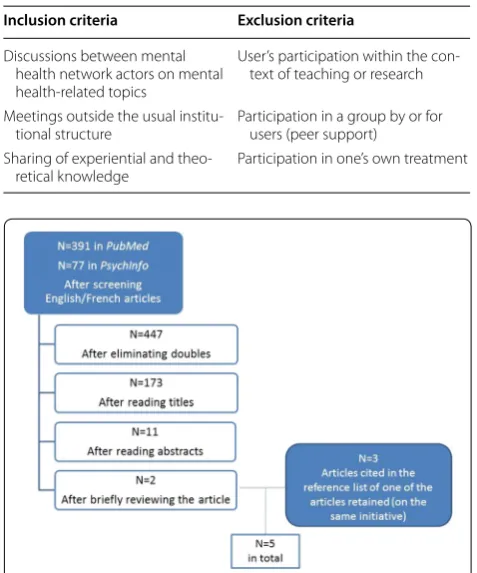
1. Collecting the relevant information Important data used to describe and understand the CCIU were col-lected in three ways. First, the documentation pro-duced by the CMHA-Montreal was reviewed (pre-vious meeting reports, conference presentations, internal documents, presentation booklet, annual evaluation reports). Second, direct observations were carried out by one of the authors of this arti-cle (CT) who participated in the CCIU meetings over the course of 1 year. Third and lastly, a non-exhaus-tive review of the literature was conducted to deter-mine whether or not initiatives that are similar to the CCIU existed, using PubMed and PsychInfo (selecting the keywords “user* involvement” OR “user* partici-pation” AND “mental health services”). In order to be included in our exploratory review, the articles had to pertain to specific criteria for inclusion or exclusion (Table 1; Fig. 1).
2. Clearly defining the problem to be solved by the pro-gramme The issue addressed by the CCIU and the context of its existence were defined in collaboration with the CMHA-Montreal. Thus, throughout this process, six meetings were held between the research team and the CMHA-Montreal (excluding the meet-ings with CCIU participants). These meetmeet-ings helped to better coordinate the goals and guidelines of the project as pursued by the CMHA-Montreal and the research team, and to validate their understanding of the model, its goals and its mode of operation. 3. Defining the elements of the model in a table All the
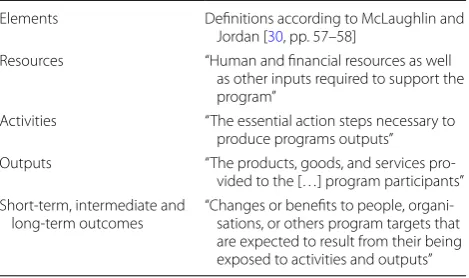
elements relating to the CCIU were classified in a table according to the following categories: resources, activities, outputs, short-term outcomes, intermedi-ate outcomes, and long-term outcomes (the usual variables in a process of programme logic analysis) (Table 2).
4. Developing the model A first outline of the pro-gramme’s logic model was developed. CMapTools software (http://cmap.ihmc.us/) was used for the graphic presentation.
5. Validating the model with stakeholders The CCIU participants validated the model in two stages. A first validation was conducted in April 2013 with a subgroup of four participants: one institution-based mental health worker, one staff member from the CMHA-Montreal, one user and one carer (theoreti-cal sampling). This validation led to the creation of an intermediate logic model. This version was used for a second validation with the 16 CCIU participants who were present at the meeting in May 2013 (including the CMHA-Montreal staff members), which allowed us to gain a more in-depth understanding of the pro-gramme. A comprehensive logic model and a simpli-fied logic model resulted from this participatory con-struction process.
The choice of this participatory methodology was based on the CCIU’s values and principles. Participa-tory construction process allowed sharing ideas within the group, building a common understanding of the programme and identifying next steps for the develop-ment of the CCIU and the achievedevelop-ment of its objectives (strategic assessment approach, which is driven through dialogues with programme staff and participants [30]). A participatory construction process meets the concept of co-production (particularly the following principles: taking an assets-based approach and building on peo-ple’s existing capabilities) which is now current in the literature in health’s field [31]. Also, logic model allowed validating mechanisms of action with other similar ini-tiatives and scientific literature and put forward a graphic
Table 1 Inclusion and exclusion criteria Inclusion criteria Exclusion criteria
Discussions between mental health network actors on mental health-related topics
User’s participation within the con-text of teaching or research
Meetings outside the usual
institu-tional structure Participation in a group by or for users (peer support) Sharing of experiential and
theo-retical knowledge Participation in one’s own treatment
representation of the programme (policy-scientific approach and elicitation method, which consists of gen-erating assumptions that have been made about how the programme is supposed to work and producing compre-hensive model [30]).
Ethics, consent and permissions
Given the nature of the study (logic analysis of a pro-gram), no individual data of participants were considered. They were involved as stakeholders in building a com-mon understanding of the programme and not as sub-jects of study. Despite this, all the CCIU participants, the stakeholders involved in the validation of the model and the direction of the CMHA-Montreal agreed (informal agreement) to participate in the study and publication.
Results—description of the practice
First, the literature review helped to identify two initia-tives that met the research criteria: Trialogues and Men-tal health forums [6, 32]. Only Trialogues turned out to be relevant to this project. A consultation of the refer-ence lists of the articles yielded 3 additional articles relat-ing to Trialogues [33–35]. Initiated in Germany (where they are known as Psychosis Seminars) and extended to other countries in Europe (Austria, Ireland, etc.), Tria-logues allow groups of 10–60 people to exchange ideas on various topics relating to care experience, recovery, crisis management, and so on [6, 35]. Similar to the CCIU, Tri-alogues, established in recent years, provide a forum for dialogue between users, carers and mental health work-ers, outside institutional walls and on an equal footing [6, 33, 34]. However, the two initiatives appear to differ insofar as the participation of CCIU members appears to extend over a longer term [36], which could likely to result in differences regarding group dynamics and changes in perceptions and attitudes. The similarities and differences between the Trialogues and the CCIU are based on the retrieved literature review and the present study.
Second, the logic analysis helped to identify (1) the CCIU’s specific resources, activities and outputs, (2) its short-term, intermediate and long-term outcomes and, (3) the essential components that account for the achievement of its goals.
CCIU’s resources, activities and outputs
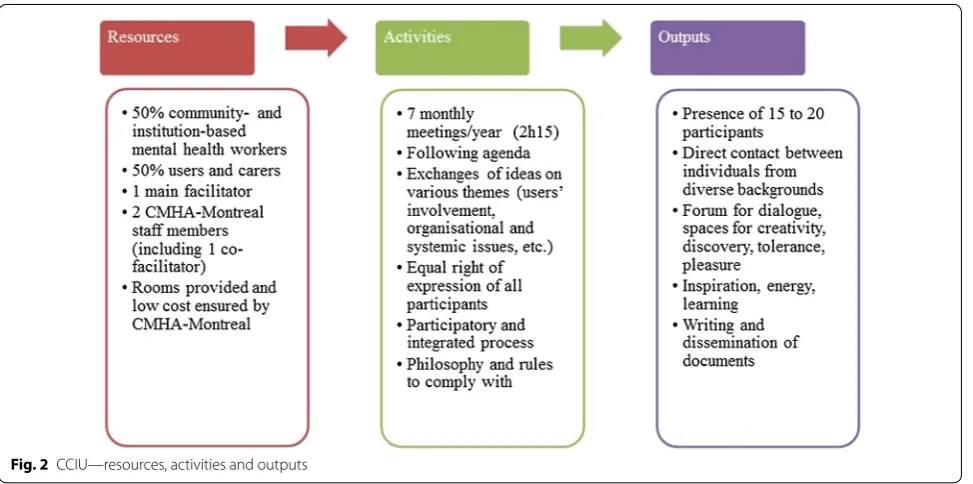
The CCIU is a programme that initiates activities requir-ing resources and entailrequir-ing outputs (see Fig. 2). At any one meeting, it calls for between 15 and 20 participants who are actively involved in the mental health network: institution-based mental health workers, mental health workers from community organisations, users and car-ers. Their participation outside the confines and func-tions of their respective organisafunc-tions is voluntary and/ or personal. This is meant to reduce the barriers that may be induced by the hierarchical relations that usually exist in organisations or systems. This voluntary partnership, which is intrinsically motivated, fosters collaboration and the sharing of common values and visions. Since par-ticular attention is paid to the principle of parity (at least 50% users and carers), a balance of power and influence is aimed at. Compliance with these group norms and rules is ensured through the participation of two staff members from the CMHA-Montreal (one of whom co-facilitates the sessions). Since this organisation has credibility and is recognised for its leadership role in the mental health network, and plays no part in issues related to services offered or advocacy, it can monitor the norms and rules implemented by the CCIU in a neutral and rigorous way. It covers the low annual costs generated by the CCIU and also provides rooms for the meetings.
The CCIU holds seven monthly meetings per year, each lasting 2 h and 15 min, drawing on the knowledge of each participant. The meetings proceed according to a pre-established agenda. The CCIU’s philosophy (open-mindedness, freedom of expression, active listening, respect, and conviviality) is promoted by the main facili-tator (and co-facilifacili-tator) who leads and structures the meetings. This philosophy and some others group rules (e.g., avoiding discussions on territorial and budgetary rivalries, importance attached to process rather than out-comes) foster respect for the equal right of expression of all participants and the implementation of a participatory and integrated approach. The whole group is responsible for choosing the content of the meetings, self-evaluation mechanisms used and strategy developments during the year.
Once the group dynamics have been established, these combined elements allow the participants to exchange and, share ideas and experiences on a theme. Between 15 and 20 participants attend each session (for a total of approximately 30 different participants per year) and
Table 2 Definitions of the elements of a logic analysis
Elements Definitions according to McLaughlin and Jordan [30, pp. 57–58]
Resources “Human and financial resources as well as other inputs required to support the program”
Activities “The essential action steps necessary to produce programs outputs” Outputs “The products, goods, and services
pro-vided to the […] program participants” Short-term, intermediate and
participants can renew their participation from year to year. This direct contact with other individuals from different backgrounds who have diversified knowl-edge (experiential, theoretical) helps to gradually set up forums for dialogue within the group: spaces for discov-ery, tolerance, creation, pleasure, and so on. Each individ-ual derives personal outputs from it, such as inspiration, energy and learning. The CMHA-Montreal is responsi-ble for coordinating the meetings, drafting documents related to the project (reports, conference presentations) and disseminating information to ensure the follow up and continuity of the meetings.
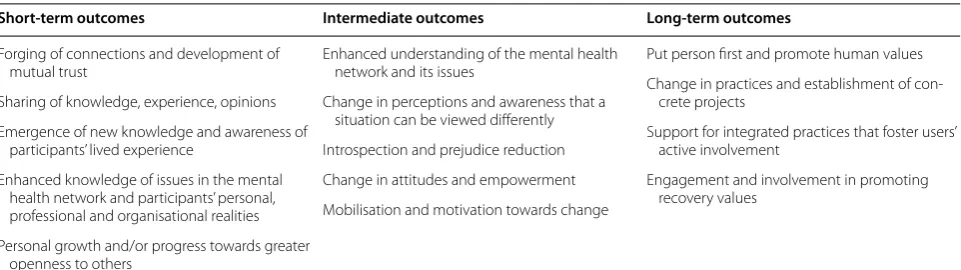
CCIU’s short‑term, intermediate and long‑term outcomes Outcomes were identified following the logic analysis. Table 3 presents those derived from the analysis of the participants’ discourse. In the short term, the partici-pants forged connections with one another, learned to trust each other, developed a sense of group belonging and discovered common ground. They shared their expe-riential knowledge, scientific knowledge and opinions through discussions on various themes (users’ involve-ment, available resources and services, new intervention approaches, thoughts on different issues, joint projects). Thus, they cultivated their understanding of different viewpoints. They exchanged information about events in the mental health network. Together, they explored obstacles, needs, advantages, stories of success and desired changes with regard to users’ involvement in the network and truly integrated care. As the meetings pro-gressed, their motivation to continue participating in
the meetings increased. The CCIU was an experience in itself, within which each individual developed and shared lived experience. This experience was lived differently by the participants and involved a process of working on themselves and reaching out to others.
In the intermediate term, the participants developed a better and more nuanced understanding of the mental health network, complex situations and the realities expe-rienced by the other participants, who all got involved to improve services. This may have led to greater intro-spection. Antagonism and prejudice between commu-nity-based mental health workers and institution-based mental health workers, users and carers were reduced. A change could be seen in their attitudes. Individuals came together and a common language emerged between them. These elements helped to develop arguments pro-moting an integrated approach that encourages shared philosophies and the involvement of users and carers in decision making. Several participants became agents of change by sharing their lived experience within the CCIU and what they had learned in their settings. As the group achieved a degree of maturity, it started consider-ing actions that could be implemented to have a greater impact on the mental health network by promoting the involvement of users and carers as well as collaborative and recovery-oriented approaches to services. The group became a community-based support for collaborative action [37].
Over the long term, the individuals involved could put the person first, regardless of her roles and the settings she came from, and promote human values. Changes in
the participants’ practices were envisaged, such as setting up projects aimed at eliminating gaps and at collaboration among stakeholders, participating in a societal transforma-tion process, and promoting recovery-oriented services (recovery-oriented services promote self-management of illness and shared decision-making, recruiting peer sup-porters among the medical staff, advocacy and combating stigma, and increased involvement of the people concerned in decisions related to system planning [38–42]). These prospects gradually led some participants to support inte-grated care practices (such as joint planning, shared deci-sions and priorities and interorganisational working) and promote recovery values (active involvement of users and carers, etc.). There was also a desire to replicate the CCIU process in various territories. Thus, a number of initiatives were led by the participants and the CMHA-Montreal.
CCIU’s essential components
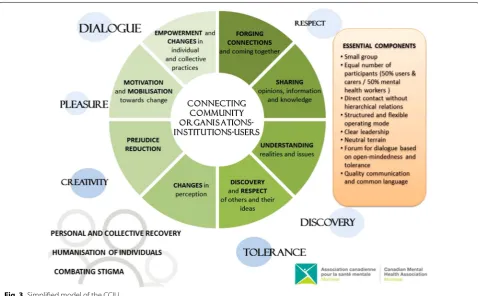
A reflexive process conducted with the participants and an analysis of notions related to group theories helped to identify eight essential components of the CCIU that contributed to the emergence of the outcomes men-tioned above. These results are reflected in the simpli-fied model (Fig. 3).
• The type of group, described as circumscribed or optimal, allows for interactions between a small number of individuals with a common target [43, 44].
• An equal number of participants from different
backgrounds allows for the same amount of speaking time to be accorded to different types of knowledge and makes it easier for participants to speak up [43].
• Direct contact without hierarchical relations
between the participants can lead to a change in attitudes since this strategy is conducive to preju-dice reduction [45–47].
• The CCIU’s structure is based on precise group
rules and a philosophy and values of
open-mind-edness and mutual respect. This operating mode, which is both structured and flexible, is consid-ered to be an essential component of the success of meetings and facilitates the integration of new members with those who have been attending the meetings for a long time [44].
• The quality of the leadership of the CCIU’s facilita-tor and co-facilitafacilita-tor, as well as the coordination by CMHA-Montreal, were highlighted by the majority of participants. The leader plays a major and impor-tant role with regard to the meetings’ content, links with the participants and group dynamics [48]. Among other things, this individual facilitates the members’ participation and helps to objectify and clarify some interventions [44].
• The place where the meetings are held, which is out-side the participants’ workplaces and care settings, described as neutral terrain, is crucial to the success-ful operation of the group. Indeed, holding meetings within the usual institutional structures or only in hospital settings would probably bring about barri-ers preventing the sharing of lived experience [49].
• Based on the richness of the discussions within the CCIU, it can be affirmed that the group is a forum for dialogue where open-mindedness and toler-ance prevail [43], which is consistent with the way the participants described themselves (“participa-tory,” “tolerant” and “free”). Dialogue, considered to be a key aspect of the CCIU, allows for exchanges of ideas on an equal footing and brings about changes. For some participants, the CCIU was the only forum in which they felt able to speak freely within the mental health network and, probably, the only forum in which they could learn to express their ideas.
• The common language that is created between the
participants is equally important since effective and quality communication is essential in a group pro-cess and for group cohesion [43]. The group
dynam-Table 3 Short-term, intermediate and long-term outcomes as reported by the participants
Short‑term outcomes Intermediate outcomes Long‑term outcomes
Forging of connections and development of mutual trust
Sharing of knowledge, experience, opinions Emergence of new knowledge and awareness of
participants’ lived experience
Enhanced knowledge of issues in the mental health network and participants’ personal, professional and organisational realities Personal growth and/or progress towards greater
openness to others
Enhanced understanding of the mental health network and its issues
Change in perceptions and awareness that a situation can be viewed differently Introspection and prejudice reduction Change in attitudes and empowerment Mobilisation and motivation towards change
Put person first and promote human values Change in practices and establishment of
con-crete projects
Support for integrated practices that foster users’ active involvement
ics, described as “harmonious and welcoming,” aptly illustrate the energy that exists within the CCIU [44].
Discussion
The goals of the CCIU are to forge connections between the different stakeholders in the mental health net-work, allow them to exchange ideas and opinions as well as share information regarding organisational and systemic work values and philosophies in order to pro-mote integrated care—in particular, normative integra-tion and greater involvement of users and their carers in the organisation and planning of services [2]. The logic analysis showed that various mechanisms have been used to achieve these goals. First, by forging connec-tions between individuals who voluntarily attended the meetings, mutual trust has gradually been built and the resulting openness to others has led to better knowledge and understanding of individual and collective realities as well as a better understanding of the frames of refer-ence (recovery model of care, integrated care, etc.) [2]. These elements have led to changes in perceptions and attitudes and have helped to gradually reduce prejudice and encourage, among all the CCIU participants, per-sonal introspection and shared values and philosophies that have led to mobilisation towards changes in practice.
Since the CCIU—in its current form involving 50% users and carers—is a relatively recent initiative (2009), it is dif-ficult to demonstrate and evaluate the concrete changes in practice and the actual projects engaged in by the ticipants outside the CCIU. Nevertheless, several par-ticipants consulted for this logic analysis agreed that the CCIU has enabled them to gradually progress towards these changes in practice. The CCIU also further help participants to implement concrete projects to reduce the gaps between the values of community organisations and institutions as well as between service providers and users. Moreover, the CCIU has allowed them to gradu-ally get involved in collaborative and recovery-oriented services by promoting truly integrated care and the active involvement of users and carers in the planning and organisation of mental health services.
This article brought out the essential components of the implementation of an initiative that promotes users and carers’ involvement. This partnership is a form of norma-tive integration which is designed to be flexible so it can be adapted to other local conditions and settings, based on the stakeholders involved [1]. In particular, the follow-ing characteristics of the CCIU should be emphasised: the small number of participants, the fact that at least half of the participants are users and carers, the absence of hierarchical relations between the participants, and
direct contact between mental health workers, users and carers. Moreover, the following major elements need to be maintained: precise group rules that promote mutual respect and help to move beyond discussions on financial and power issues. The leadership of the CMHA-Montreal in coordinating and facilitating the CCIU also appears to be an essential component in the achievement of its goals. Several participants also referred to the impor-tance of holding meetings outside their work settings so that a forum for dialogue and free speech can be created, supporting the emergence of a common language and fostering effective communication between the different stakeholders in the mental health network. The CCIU makes it possible to work on perceptions and attitudes and to develop a holistic view of services and shared val-ues, an initial form of integrated care. This initiative also support users and carers implication in the mental health network by a better understanding of experiential knowl-edge contribution.
This logic analysis allowed the CMHA-Montreal to document the activities, mechanisms of actions and short-term and intermediate outcomes observed among the participants. More than that, the use of a strategic assessment approach allowed, as expected, the creation of a common understanding of the CCIU for the participants. The constructive process makes it possible for the participants to communicate, share their ideas and visions, and identify the impact of their participation in the group. A second phase of system-atic evaluation of the effects of the CCIU experience is currently being conducted to document its outcomes in the participants’ practice settings and support the introduction of integrated care [24]. Some evalua-tion quesevalua-tions emerge of this logic modeling: How the CCIU has an impact on the development of a mutual trust? At which level participants reduce their preju-dices and false perception? How many participants integrate in their organisation and practice an active involvement of users?
The CCIU’s future prospects are structured around the following main objectives: (1) documenting outcomes outside CCIU sessions in the different participants’ net-works and; (2) setting up similar initiatives in Montreal and elsewhere in Quebec (Canada). Consequently, efforts are ongoing to disseminate the CCIU initiative among various integrated service networks in Quebec in order to promote its implementation in mental health networks (see Fleury [50] for the concept of integrated service net-works). Implementation guides (tool kits) describing the resources needed and the components that are essential to its smooth operation have been developed and the model has been the subject of several conference pres-entations. A promotion committee has also been set up,
composed of CCIU members, which represent a concrete outcome, in order to promote the approach among man-agers and clinicians in the various local mental health networks.
Limitations
This analysis contains some limitations. First, despite several meetings with the CMHA-Montreal and the CCIU participants as well as participant observation car-ried out over the course of 1 year, additional meetings over a longer period of time would have allowed for the process to be deepened, in particular to identify long-term outcomes through qualitative and mixed methods approaches [4]. Moreover, although logic analysis was an essential step in the evaluation of this programme, it would be useful in the future to link it with a more sys-tematic analysis of its real effects. Logic analysis helps, on one hand, to enhance the understanding of a programme and, on the other hand, to identify the mechanisms of action and outcomes. However, it does not make it pos-sible to draw conclusions regarding its effectiveness.
Conclusions
This logic analysis helped to better understand the mech-anisms of action, the essential components and the out-comes of the CCIU. It allowed us to document a highly promising integrated care initiative that integrates users and carers in its forum for dialogue. This analysis enabled the CMHA-Montreal to develop tools to promote this initiative in the mental health networks and to pursue a programme evaluation process aimed at strengthening its outcomes. Evaluative participatory research is also one of the means used to co-construct an explanation, enable dialogue and foster cohesion among a group of stake-holders [51, 52]. Logic modelling of the CCIU helped to identify the key elements explaining the changes in per-ceptions and attitudes as well as the common vision of services acquired by its participants, thus contributing to practices centred on collaboration, partnership and qual-ity care. Therefore, this approach constitutes an essential step leading to integrated care.
Abbreviations
CCI: Carrefour Communautaire-Institutionnel (Connecting Community Organi-sations-Institutions); CCIU: Carrefour Communautaire-Institutionnel-Usagers (Connecting Community Organisations-Institutions-Users); CMHA-Montreal: Canadian Mental Health Association-Montreal Branch.
Authors’ contributions
Author details
1 Centre for Studies on Rehabilitation, Recovery and Social Inclusion, Centre de
recherche de l’Institut universitaire en santé mentale de Montréal, Montréal, QC, Canada. 2 Occupational Therapy Program, School of Rehabilitation,
Univer-sité de Montréal, Montréal, QC, Canada. 3 Canadian Mental Health
Association-Montreal Branch, Montréal, QC, Canada.
Acknowledgements
Not applicable.
Competing interests
The authors declare that they have no competing interests.
Availability of data and materials
No data or material is available for sharing.
This is a qualitative research where all the data analyzed are already made available in the manuscript. The raw data are not scientific interests.
Consent for publication
Our article no reports an individual participant’s data in any form. Not applicable.
We confirm that each author have approved the manuscript for submission.
Ethics approval and consent to participate
Our article no reports an individual participant’s data in any form. All the CCIU participants, the stakeholders involved in the validation of the model and the direction of the CMHA-Montreal consented to the study and the publica-tion. We have the consent form of Valerie Coulombe the manager of CCIU (program evaluated and reported in the article).
Funding
No sources of funding were used for this study. This study is an initiative of a non-profit community organisation.
Received: 14 June 2016 Accepted: 12 December 2016
References
1. Nicholson C, Jackson C, Marley J. A governance model for integrated primary/secondary care for the health-reforming first world—results of a systematic review. BMC Health Serv Res. 2013;13(528):1–12.
2. Valentijn P, Schepman S, Opheij W, Bruijnzeels M. Understanding integrated care: a comprehensive conceptual framework based on the integrative functions of primary care. Int J Integr Care [serial online]. 2013;13(22):1–12. http://www.ijic.org. Accessed 29 May 2014. URN:NBN:NL:UI:10-1-114415.
3. Kodner DL, Spreeuwenberg C. Integrated care: meaning, logic, applications, and implications—a discussion paper. Int J Integr Care [serial online]. 2002;2:1–6. http://www.ijic.org. Accessed 12 Jan 2014. URN:NBN:NL:UI:10-1-100309.
4. Shaw S, Rosen R, Rumbold B. What is integrated care? An overview of integrated care in the NHS. 2011. http://www.nuffieldtrust.org.uk/sites/ files/nuffield/publication/what_is_integrated_care_research_report_ june11_0.pdf. Accessed 28 May 2014.
5. Hussain M, Seitz D. Integrated models of care for medical inpatients with psychiatric disorders: a systematic review. Psychosomatics. 2014;55:315– 25 (article in press).
6. Amering M, Mikus M, Steffen S. Recovery in Austria: Mental Health Tria-logue. Int Rev Psychiatry. 2012;24(1):11–8.
7. Wallcraft J, Amering M, Freidin J, Davar B, Froggatt D, Jafri H, Javed A, Katontoka S, Rja S, Rataemane S, Steffen S, Tyano S, Underhill C, Wahlberg H, Warner R, Herrman H. Partnerships for better mental health worldwide: WPA recommendations on best practices in working with service users and family carers. World Psychiatr Assoc. 2011. http://www.wpanet.org/ detail.php?section_id=7&content_id=1056. Accessed 12 Dec 2013.
8. Pomey M-P, Ghadi V. La participation des usagers au fonctionnement des établissements de santé: une dynamique encore à construire. [Users’ participation in the operation of healthcare institutions: dynam-ics that remain to be built]. Santé société et solidarité. 2009;2:53–61. (in French).
9. Chamberlin J. User/consumer involvement in mental health service delivery. Epidemiologia e Psichiatria Sociale. 2005;14(1):10–4.
10. Chamberlin J. Citizenship rights and psychiatric disability. Psychiatr Reha-bil J. 1998;21(4):405–8.
11. Wallcraft J, Bryant M. Policy paper 2: The mental health service user movement in England. London: The Sainsbury Centre for Mental Health; 2003. http://www.centreformentalhealth.org.uk/pdfs/policy_paper2_ser-vice_user_movement.pdf. Accessed 16 Feb 2014.
12. Campbell P. From Little Acorns—The mental health service user movement. In: Bell A, Lindley P, editors. Beyond the Water Towers: the unfinished revolution in mental health services 1985–2005. London: The Sainsbury Centre for Mental Health; 2005. p. 73–82. http://www.centre-formentalhealth.org.uk/pdfs/mental_health_service_user_movement. pdf. Accessed 16 Feb 2014.
13. World Health Organization. Mental health action plan 2013–2020. Geneva: World Health Organization; 2013.
14. World Health Organization. Division of Mental Health; WHO initiative of sup-port to people disabled by mental illness. Consumer involvement in mental health and rehabilitation services. Geneva: World Health Organization; 1989. 15. World Health Organization, Division of Mental Health WHO initiative of
support to people disabled by mental illness. Initiative of support to peo-ple disabled by mental illness. Geneva: World Health Organization; 1988. 16. Mental Health Commission of Canada. Changing directions, changing
lives. The mental health strategy for Canada. Calgary: Mental Health Com-mission of Canada; 2012. http://strategy.mentalhealthcommission.ca/ pdf/strategy-text-en.pdf. Accessed 12 Dec 2013.
17. Adams N, Daniels A, Compagni A. International pathways to mental health transformation. Int J Mental Health. 2009;38(1):30–45. 18. Mental Health Foundation. Crossing boundaries improving integrated
care for people with mental health problems. UK: Mental Health Founda-tion; 2013.
19. Commonwealth of Australia. Fourth National Mental Health Plan: an agenda for collaborative government action in mental health 2009–2014. Commonwealth of Australia; 2009.
20. Health ACT. ACT Mental Health services plan 2009–2014. Canberra: Minister for Health, ACT Government; 2009.
21. Ministère de la Santé et des Services sociaux. Plan d’action en Santé Men-tale 2005–2010. La force des liens.[Mental Health Action Plan 2005–2010. Connecting power]. Québec: Ministère de la Santé et des Services sociaux; 2005. (in French).
22. Mental Health Europe. New report: mapping exclusion—institutional and community-based services in the mental health field in Europe. Open Society Foundations and Mental Health Europe; 2012.
23. Thornicroft G, Tansella M. Better mental health care. Cambridge: The University Press; 2009.
24. Ministère de la Santé et des Services sociaux. Cadre de référence pour les réseaux locaux de services de santé et de services sociaux. [Reference framework for local networks of health services and social services]. Québec: Ministère de la Santé et des Services sociaux; 2004. (in French).
25. Canadian Mental Health Association-Montreal Branch. Mission et valeurs. [Mission and values]. [webpage on the internet]. 2014. http://acsmmon-treal.qc.ca/qui-nous-sommes/mission-et-valeurs/. Accessed 22 Feb 2014. (in French).
26. Canadian Mental Health Association-Montreal Branch. Présentation du programme CCIU. [Presentation of the CCIU programme]. [webpage on the internet]. http://acsmmontreal.qc.ca/presentation-du-programme/. Accessed 22 Feb 2014. (in French).
27. Canadian Mental Health Association-Montreal Branch. Planification Stratégique 2010–2015. [2010–2015 strategic planning] Canadian Mental Health Association-Montreal Branch; 2010. (in French).
• We accept pre-submission inquiries
• Our selector tool helps you to find the most relevant journal • We provide round the clock customer support
• Convenient online submission • Thorough peer review
• Inclusion in PubMed and all major indexing services • Maximum visibility for your research
Submit your manuscript at www.biomedcentral.com/submit
Submit your next manuscript to BioMed Central
and we will help you at every step:
29. Contandriopoulos A-P, Champagne F, Denis JL, Avargues MC. Evaluation in the health sector: concepts and methods. Revue d’Épidémiologie et de Santé Publique. 2000;48(6):517–39.
30. McLaughlin JA, Jordan GB. Using Logic models. In: Wholey JS, Hatry HP, Newcomer KE, editors. Handbook of practical program evaluation. San Francisco: Jossey-Bass; 2010. p. 55–80.
31. Slay J, Stephens L. Co-production in mental health: a literature review. London: New Economics Foundation; 2013.
32. Hodge S. Participation, discourse and power: a case study in service user involvement. Crit Soc Policy. 2005;25(2):164–79.
33. Amering M. Trialog—an exercise in communication between consumers, carers and professional mental health workers beyond role stereotypes. Int J Integr Care [serial online]. 2010;10:35–36. http://www.ijic.org. Accessed 12 Jan 2014. URN:NBN:NL:UI:10-1-100726.
34. Amering M, Hofer H, Rath I. The, “First Vienna Trialogue”—experiences with a new form of communication between users, relatives and mental health professionals. In: Lefley HP, Johnson DL, editors. Family interven-tions in mental illness: international perspectives. Westport: Praeger; 2002. p. 105–24.
35. Bock T, Priebe S. Psychosis seminars: an unconventional approach. Psychi-atr Serv. 2005;56(11):1441–3.
36. Mac Gabhann L, Mc Gowan, P, Ni Cheirin L, Amering M, Spencer A. Men-tal Health Trialogue Network Ireland: transforming dialogue in menMen-tal health communities. Dublin: Dublin City University; 2012. http://www. trialogue.co/#/international-space/4560172123.
37. Bayliss E, Bonds D, Boyd C, Davis M, Finke B, Fox M, Glasgow R, Good-man R, Heurtin-Roberts S, Lachenmayr S, Lind C, Madigan E, Meyers D, Mintz S, Nilsen W, Okun S, Ruiz S, Salive M, Stange K. Understanding the context of health for persons with multiple chronic conditions: moving from what is the matter to what matters. Ann Fam Med. 2014;12(3):260–9.
38. Slade M, Leamy M, Bacon F, Janosik M, Le Boutillier C, Williams J, Bird V. International differences in understanding recovery: systematic review. Epidemiol Psychiatr Sci. 2012;21(4):353–64.
39. Piat M, Sabetti J. Recovery in Canada: toward social equality. Int Rev Psychiatry. 2012;24(1):19–28.
40. Shepherd G, Boardman J, Slade M. Implementing recovery: a new frame-work for organisational change. London: Sainsbury Centre for Mental Health; 2009.
41. Shepherd G, Boardman J, Slade M. Making recovery a reality. London: Sainsbury Centre for Mental Health; 2008.
42. Davidson L, Tondora J, O’Connell MJ, Kirk T Jr, Rockholz P, Evans AC. Creat-ing a recovery-oriented system of behavioral health care: movCreat-ing from concept to reality. Psychiatr Rehabil J Summer. 2007;31(1):23–31. 43. Landry S. Travail, affection et pouvoir dans les groupes restreints. [Work,
affection and power in small groups]. Québec: Presses de l’Université du Québec; 2007. (in French).
44. St-Arnaud Y. Les petits groupes: participation et animation. [Small groups: participation and facilitation]. Montréal: Les Éditions de la Chenelière inc.; 2008. (in French).
45. Corrigan PW, Wassel A. Understanding and influencing the stigma of mental illness. J Psychosoc Nurs Ment Health Serv. 2008;46(1):42–8. 46. Corrigan PW, Watson AC. Understanding the impact of stigma on people
with mental illness. World Psychiatry. 2002;1(1):16–20.
47. Pettigrew TF, Tropp LR. A meta-analytic test of intergroup contact theory. J Pers Soc Psychol. 2006;90(5):751–83.
48. Anzieu D, Martin, J-Y. La dynamique des groupes restreints. [Small group dynamics]. Paris: Quadridge/Presses Universitaires de France; 2007. (in French).
49. Ruszniewski M, Rabier G. Le groupe de parole à l’hôpital. [Hospital-based support groups]. Paris: Dunod; 2012. (in French).
50. Fleury M-J. Quebec mental health services networks: models and imple-mentation. Int J Integr Care [serial online]. 2005;5(1):1–12. http://www.ijic. org. Accessed 16 Feb 2014. URN:NBN:NL:UI:10-1-100369.
51. Cousins JB, Chouinard JA. Participatory evaluation up close. Charlotte: Information Age Publishing, Inc.; 2012.