R E S E A R C H
Open Access
Effect of a mobile app intervention on
vegetable consumption in overweight
adults: a randomized controlled trial
Sarah Mummah
1,2*, Thomas N. Robinson
1,3, Maya Mathur
1, Sarah Farzinkhou
1, Stephen Sutton
2†and Christopher D. Gardner
1†Abstract
Background:Mobile applications (apps) have been heralded as transformative tools to deliver behavioral health interventions at scale, but few have been tested in rigorous randomized controlled trials. We tested the effect of a mobile app to increase vegetable consumption among overweight adults attempting weight loss maintenance. Methods:Overweight adults (n=135) aged 18–50 years with BMI=28–40 kg/m2near Stanford, CA were recruited from an ongoing 12-month weight loss trial (parent trial) and randomly assigned to either the stand-alone, theory-based Vegethon mobile app (enabling goal setting, self-monitoring, and feedback and using“process motivators” including fun, surprise, choice, control, social comparison, and competition) or a wait-listed control condition. The primary outcome was daily vegetables servings, measured by an adapted Harvard food frequency questionnaire (FFQ) 8 weeks post-randomization. Daily vegetable servings from 24-hour dietary recalls, administered by trained, certified, and blinded interviewers 5 weeks post-randomization, was included as a secondary outcome. All analyses were conducted according to principles of intention-to-treat.
Results:Daily vegetable consumption was significantly greater in the intervention versus control condition for both measures (adjusted mean difference: 2.0 servings; 95% CI: 0.1, 3.8,p=0.04 for FFQ; and 1.0 servings; 95% CI: 0.2, 1.9; p=0.02 for 24-hour recalls). Baseline vegetable consumption was a significant moderator of intervention effects (p=0.002) in which effects increased as baseline consumption increased.
Conclusions:These results demonstrate the efficacy of a mobile app to increase vegetable consumption among overweight adults. Theory-based mobile interventions may present a low-cost, scalable, and effective approach to improving dietary behaviors and preventing associated chronic diseases.
Trial registration:ClinicalTrials.gov NCT01826591. Registered 27 March 2013.
Keywords:mHealth, Smartphone, Mobile, Digital, Diet, Nutrition, Vegetables, Behavior change, User-centered design, Design thinking
* Correspondence:[email protected]
†Equal contributors
1
Department of Medicine, Stanford University School of Medicine, Stanford, CA, USA
2Department of Public Health and Primary Care, University of Cambridge, Cambridge, UK
Full list of author information is available at the end of the article
Background
Greater consumption of vegetables and fruits is associated with reduced risks of cardiovascular disease, stroke, can-cer, and all-cause mortality [1, 2]. It has been suggested that these protective effects are greater for vegetables than for fruits [1] and follow a dose-response relationship [1–3] with benefits seen in up to 7+ servings daily [1]. However, despite current United States Department of Agriculture (USDA) recommendations to consume 5–6 servings of vegetables per day [4], United States (U.S.) adults consume an average of just 1.7 (SE = 0.03) servings of vegetables (excluding fried potatoes) each day [5]. Behavioral inter-ventions to increase vegetable and fruit consumption have led to modest increases in daily intake [6], but typical face-to-face approaches often cannot be realistically im-plemented at the population level [6], particularly given the high cost of most current strategies [7] (e.g., time de-mands, the need for trained staff, etc.) [8].
Mobile applications (apps) present a promising means for delivering scalable behavioral interventions due to their increasing ubiquity, ability to reach individuals at nearly any time or place, and potential to deliver timely feedback, personalization, and interactivity to maximize intervention effectiveness [9]. The availability of health-promoting mobile apps has dramatically increased in re-cent years [10]. However, most mobile health apps have yet to undergo evaluation in randomized trials or incorp-orate theory-based strategies known to drive changes in health behaviors [11–13]. Among published mobile app trials, most are feasibility and pilot studies with small sample sizes [14]. Only one published study [15] sought to assess the efficacy of a stand-alone mobile app for increasing vegetable consumption, in which real-time goal setting, self-monitoring, and feedback were tested among low-income racial/ethnic-minority girls; this pilot study showed non-significant small to moderate effects and called for larger-scale testing of similar pro-grams. Thus, the existing evidence has yet to establish whether a mobile app can increase vegetable consump-tion. More broadly, investigators have called for both theory-informed development and rigorous evaluation of mobile-based interventions [16, 17] using larger sample sizes [14].
A recent pilot study [18] we conducted demonstrated preliminary evidence of the efficacy of Vegethon, a stand-alone, theory-based mobile app, in increasing vegetable consumption among overweight adults [19]. While many public health interventions focus on anticipated long-term health benefits (e.g., reduced risk of cardiovascular dis-ease) to motivate behavior change, Vegethon focuses on making the process of behavior change itself (e.g., in-creasing vegetable consumption) intrinsically reward-ing, through the use of process motivators [20] such as fun, surprise, choice, control, and competition [19].
This approach has been introduced as a more effective strategy for designing public health interventions to motivate behavior change [20, 21]. The present study aimed to rigorously assess the efficacy of the Vegethon mobile app among a larger sample of overweight adults attempting weight loss maintenance.
Methods
Study design
A randomized controlled study design was used, with a 1:1 allocation ratio of intervention to wait-listed control (8-week delay). The study was conducted at a single re-search site in Stanford, California.
Study sample
Participants were overweight adults, recruited in two co-horts from an ongoing 12-month weight-loss trial based at Stanford University (parent trial), in which individuals were 18–50 years of age, had baseline body mass index (BMI) of 28–40 kg/m2, were non-diabetic and non-hypertensive, had no cancer or heart, renal, or liver disease, and lived in the geographic area surrounding Stanford. We chose to de-sign and test Vegethon among participants in a weight loss trial because they had already demonstrated motivation to alter their eating behaviors and because the parent trial provided a resource-efficient way of testing an innovative mobile intervention in the setting of a weight loss program. The added eligibility criterion for cohort 1 was ownership of an iPhone and for cohort 2 was ownership of an iPhone or Android phone (as the app became available on An-droid during the course of the study). This study was implemented during months 5–7 (i.e., the weight loss maintenance phase) of the 12-month parent trial. Parent trial participants were randomized to either a low-fat or a low-carbohydrate diet for 12 months and attended 22 evening classes led by a health educator, in which they were taught how to adhere to their assigned diets. Both parent trial treatment groups were encouraged to eat whole, unprocessed foods and to increase their vegetable intakes in their daily diets. Parent trial participants who chose to concurrently participate in the present study were newly randomized to receive the mobile app or to be placed on a wait-listed control condition. As a result, any potential effects of the parent trial interventions on vegetable consumption were randomly distributed across both intervention and control conditions in the present Vegethon study.
Randomization and blinding
assignment groups as well as cohorts, diet group, and health educator within the parent trial. Because the randomized parent trial was underway at the time of the present study, cohort, diet group, and health educa-tor were treated as existing strata, within which partici-pants were assigned to a mobile intervention through a balanced, randomized procedure, using blocks of size 4. This assignment procedure was preferable to simple randomization because it ensured balance in mobile intervention, cohort, diet group, and health educator at any given sample size of this trial. The allocation sequence was stored electronically and concealed from participants, staff, and researchers who had contact with participants. Enrollment and communication with participants was performed by a research assistant who did not play a role in randomization or data analysis. Study staff and researchers who performed data collection (i.e., dietary recall assessors) and analysis were blinded to condition assignment. While participants could not be blinded, they were not told their condition assignment (i.e.,“intervention” or “control”) and were instead informed they would be assigned to use the app at parent trial month 5 or 7.
Procedures
During a pre-randomization orientation session, partici-pants were instructed that the mobile app was intended to support them in increasing their vegetable consumption, and that it was ideally to be used for at least 1–2 min per day. Participants completing a baseline questionnaire were randomized. Those allocated to the intervention condition completed a short online tutorial that described the mo-bile app and its use. To prevent contamination among conditions, the app was not freely accessible via the App Store or Google Play and was made available to interven-tion participants through the distribuinterven-tion of single-use registration codes.
The user-centered, theory-based development and final version of Vegethon were shaped by extensive formative research and the Vegethon pilot study [18] and have been described in detail elsewhere [19]. Vegethon was a stand-alone mobile app that enabled goal-setting and self-monitoring of vegetable consumption. Participants set goals for daily quantity (i.e., servings) and variety (i.e., types) of their vegetable consumption and used the central app feature,Select Veggies, to tap on any of 30 different vegetable icons (e.g., spinach, beets) to swiftly record the types and servings of vegetables they consumed each day. Non-starchy vegetables with low energy density and high nutrient density were targeted to facilitate weight loss and weight maintenance while maximizing diet quality and nutrient adequacy in the context of the parent trial. Seven ongoing challenges were included that ranged from easy to difficult to per-form (e.g., Breakfast Champ: Eat any vegetable before
11 am). A leaderboard engaged users in competition against“other Vegethoners”who were“most similar”to them. Just-in-time prompts to log vegetables before go-ing to sleep were delivered most evengo-ings at 9 p.m. through push notifications.
Overall, the app focused on making theprocess of be-havior change rewarding [20] (e.g., the fun of receiving a surprise vegetable challenge; the pride in surpassing a peer’s vegetable score). This process motivation strategy stands in contrast to strategies focusing on the eventual outcomes of behavior change (e.g., avoidance of a heart attack) that are often too far in the future to motivate and sustain day-to-day behavior changes [20]. As Robin-son has described [20], this process motivation approach is grounded in Bandura’s Social Cognitive Theory [22], which specifies that behaviors are driven by the reciprocal interactions between personal, behavioral, and environ-mental influences. Vegethon was therefore designed to influence users’thoughts and beliefs about eating vege-tables, provide opportunities for feedback on their be-haviors, and create a social environmental that promoted increasing vegetable intake. Vegethon aimed to maximize the four key processes identified by Social Cognitive Theory: attentional, retention (memory), production, and motivational. For example, attention was maximized through prompts, reminders, and a colorful, playful, inter-active user interface; retention was promoted through reminders, repetition, memorable graphics and content; production (promoting the transition of thoughts into action) was supported through instructions and tips and by prompting cognitive and behavioral rehearsal with feed-back; and motivation for change was maximized through internal and social comparisons, goals, and feedback.
Measures
per day [25]. All 28 questions on vegetable consumption were included from the Harvard FFQ, supplemented by 12 further questions on the consumption of additional vegetables targeted by the intervention. Daily vegetable in-take was calculated for each participant following an established method [26] in which the daily frequency of consumption for each vegetable item was multiplied by the number of servings represented by the specified por-tion size and subsequently combined to yield total daily vegetable servings. Vegetable subgroups were defined a
priori based on established criteria [27] and included green leafy vegetables, cruciferous vegetables, dark yellow vegetables, tomatoes, other vegetables, and beans. All sub-groups excluding beans were combined to yield overall vegetable consumption (primary outcome), and assessed individually as secondary outcomes. Beans, not targeted by the intervention, was included as a comparison meas-ure to detect possible global vegetable reporting bias.
Secondary measures of vegetable consumption were also derived from 24-h dietary recalls at baseline and 5 weeks post-randomization, administered by trained, certified, and blinded interviewers using Nutrition Data System for Research (University of Minnesota Nutrition Coordinating Center) [28, 29]. Three unannounced 24-h recalls were attempted on nonconsecutive days (2 week-days, 1 weekend) over 2 weeks at each of two time points, for a total of 6 recalls per participant. Average daily servings of four subgroups (dark green vegetables, deep yellow vegetables, tomato, and other vegetables) were combined to yield overall vegetable consumption. Beans was a comparison measure.
App usage was measured using inbuilt software. App usability and satisfaction were assessed using a 21-item questionnaire, administered 8 weeks post randomization to the intervention condition only, and adapted from similar surveys used by King et al. to assess user accept-ability of mobile health (mHealth) interventions [30]. Participants were asked to rate their level of agreement or disagreement with each statement on a 5-point Likert-type scale.
Statistical analysis
A priorisample size estimation determined that a sample size of n= 128, or 64 per group, would provide at least 80% power to detect a medium effect size of Cohen’s d = 0.5 (one-half standard deviation) [31]. Each analysis used a two-sided alpha = 0.05 threshold for statistical sig-nificance. To assess the effect of app assignment on partic-ipants’ all-vegetable consumption as measured by FFQ (primary outcome), we fit a linear mixed-effects model to which each subject contributed two observations (at base-line and 8 weeks post-randomization) over the study period. The model contained main effects of app interven-tion status (an indicator of whether an individual was
assigned to the app at the time of observation), time (baseline or 8 weeks post-randomization), sex, parent trial diet group assignment (low-carbohydrate or low-fat), par-ent trial health educator (4 categories), and parpar-ent trial co-hort group (2 categories). The main effect of app was the primary effect of interest. To account for correlated obser-vations within subjects, the model also included random intercepts by subject, as well as random slopes over time by subject. We assumed normally distributed error terms. An analysis following intention-to-treat principles was used with multiple imputation for missing data. Five imputed datasets were created using the chained equa-tions method and pooled estimates using Barnard-Rubin adjusted degrees of freedom.
We conducted several pre-specified secondary analyses. We refit the primary analysis model, using alternative sec-ondary outcome measures: [1] all-vegetable consumption as measured by 24-h recalls; [2] each of 5 vegetable sub-groups as measured by FFQ; and [3] each of 4 vegetable subgroups as measured by 24-h recalls. We also per-formed pre-specified analyses of four potential moderators of treatment effects, baseline vegetable consumption, sex, diet group, and health educator, by adding app by possible moderator interaction terms to the model. When a statis-tically significant interaction was identified, it indicated a possible effect moderator, and the main effect coefficient in the model was re-examined after centering the variables [32]. To investigate the possibility of a dose-response rela-tionship between the amount of app usage and changes in vegetable consumption, we used the Spearman rank cor-relation coefficient that does not assume normal distribu-tions. Data were collected in 2014–2015 and analyzed in 2015–2016. All primary and secondary analyses followed intention-to-treat principles. Stata (v14.1, StataCorp LP, Texas) and SPSS Statistics software (v22, IBM, New York) were used.
Results
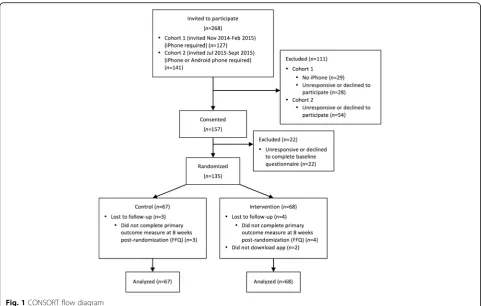
(9%) downloaded it after 1–5 weeks, and 2 (3%) did not download it. In addition, 51 (75%) used the app to log vegetables at least once, while 17 (25%) did not use the app to log.
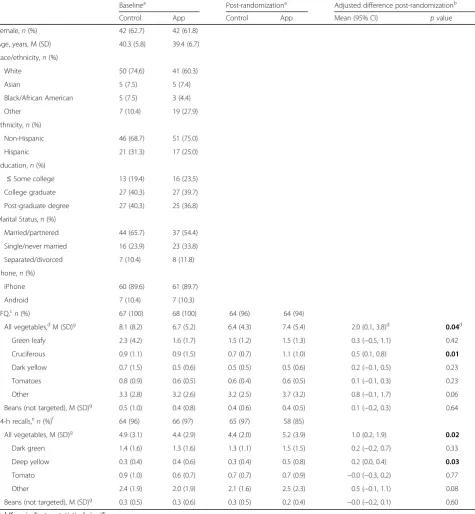
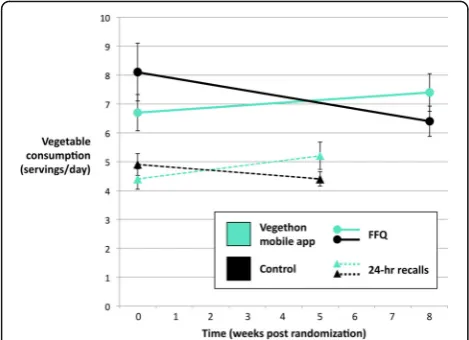
Primary and secondary outcome measures of daily vege-table consumption at baseline and post-randomization and adjusted group differences are reported in Table 1. Changes in daily consumption of all vegetables are pre-sented in Fig. 2. Daily consumption of all vegetables was significantly greater in the intervention versus control condition for both measures (adjusted mean difference: 2.0 servings; 95% CI: 0.1, 3.8,p= 0.04, Cohen’s d = 0.18 for FFQ; and 1.0 servings; 95% CI: 0.2, 1.9; p = 0.02, Cohen’s d = 0.20 for 24-h recalls). There was significantly greater consumption of cruciferous vegetables for FFQ (0.5 servings; 95% CI: 0.1, 0.8;p= 0.01) and of deep yellow vegetables for 24-h recalls (0.2 servings; 95% CI: 0.0, 0.4;
p= 0.03). There were trends towards greater consumption of other vegetables for both measures (0.8 servings; 95% CI: -0.1, 1.7; p= 0.06 for FFQ; and 0.5 servings; 95% CI: -0.1, 1.1;p= 0.08 for 24-h recalls). Consumption of beans, a vegetable not targeted by the intervention, was not sig-nificantly different between the conditions (0.1 servings; 95% CI: -0.2, 0.3; p= 0.64 for FFQ; and −0.0 servings; 95% CI: -0.2, 0.1;p= 0.60 for 24-h recalls).
Baseline vegetable consumption was found to be a sig-nificant moderator of intervention effects (p= 0.002), in
which the effect of the app on vegetable consumption increased as baseline vegetable consumption increased. It has been widely acknowledged in the statistical litera-ture that ignoring a strong interaction can potentially lead to biased estimates of the main effect of treatment and to reduced power [32]. Indeed, when the model was refit including the app by baseline vegetable consumption interaction coefficient, we found substantially greater ef-fect sizes for all vegetables (adjusted mean difference be-tween treatment and control: 3.1 servings; 95% CI: 1.6, 4.6;p< 0.0005), including green vegetables (0.9 servings; 95% CI: 0.3, 1.4; p = 0.004) cruciferous vegetables (0.7 servings; 95% CI: 0.4, 1.0;p< 0.0005), dark yellow vegeta-bles (0.3 servings; 95% CI: 0.1, 0.6;p= 0.01), tomatoes (0.3 servings; 95% CI: 0.1, 0.4;p= 0.001), and other vegetables (1.1 servings; 95% CI: 0.4, 1.9;p= 0.002).
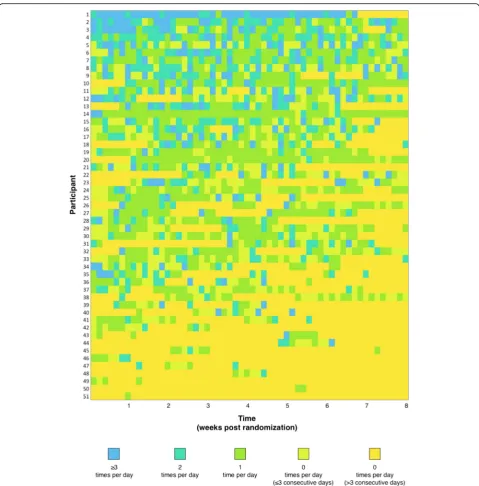
Among the 51 (75%) intervention participants who used the app to log, participants logged their vegetable consumption 0.8 ± 1.1 times per day (mean ± SD). Daily frequency of vegetable logging over the course of the 8-week intervention period is presented in Fig. 3. There was a downward trend in frequency of logging behavior over time, from 0.9 ± 1.3 times per day dur-ing week one to 0.4 ± 0.8 times per day durdur-ing week eight (mean ± SD). There was wide variation in logging frequency between individuals, ranging from 1.4 ± 1.2 to 0.2 ± 0.6 times per day in the upper and lower
tertiles, respectively (mean ± SD). App usage was weakly correlated with changes in vegetable consumption (Spearman’s rank correlation coefficient: 0.05). However,
among the subgroup of intervention participants above the 50th percentile of vegetable consumption at baseline (i.e., those who benefited most from the app), there was a
Table 1Baseline characteristics, primary and secondary outcome measures for vegetable consumption, and group differences
Baselinea Post-randomizationa Adjusted difference post-randomizationb
Control App Control App Mean (95% CI) pvalue
Female,n(%) 42 (62.7) 42 (61.8)
Age, years, M (SD) 40.3 (5.8) 39.4 (6.7)
Race/ethnicity,n(%)
White 50 (74.6) 41 (60.3)
Asian 5 (7.5) 5 (7.4)
Black/African American 5 (7.5) 3 (4.4)
Other 7 (10.4) 19 (27.9)
Ethnicity,n(%)
Non-Hispanic 46 (68.7) 51 (75.0)
Hispanic 21 (31.3) 17 (25.0)
Education,n(%)
≤Some college 13 (19.4) 16 (23.5) College graduate 27 (40.3) 27 (39.7)
Post-graduate degree 27 (40.3) 25 (36.8)
Marital Status,n(%)
Married/partnered 44 (65.7) 37 (54.4)
Single/never married 16 (23.9) 23 (33.8)
Separated/divorced 7 (10.4) 8 (11.8)
Phone,n(%)
iPhone 60 (89.6) 61 (89.7)
Android 7 (10.4) 7 (10.3)
FFQ,cn(%) 67 (100) 68 (100) 64 (96) 64 (94)
All vegetables,dM (SD)g 8.1 (8.2) 6.7 (5.2) 6.4 (4.3) 7.4 (5.4) 2.0 (0.1, 3.8)d 0.04d Green leafy 2.3 (4.2) 1.6 (1.7) 1.5 (1.2) 1.5 (1.3) 0.3 (−0.5, 1.1) 0.42
Cruciferous 0.9 (1.1) 0.9 (1.5) 0.7 (0.7) 1.1 (1.0) 0.5 (0.1, 0.8) 0.01
Dark yellow 0.7 (1.5) 0.5 (0.6) 0.5 (0.5) 0.5 (0.6) 0.2 (−0.1, 0.5) 0.23
Tomatoes 0.8 (0.9) 0.6 (0.5) 0.6 (0.4) 0.6 (0.5) 0.1 (−0.1, 0.3) 0.23
Other 3.3 (2.8) 3.2 (2.6) 3.2 (2.5) 3.7 (3.2) 0.8 (−0.1, 1.7) 0.06
Beans (not targeted), M (SD)g 0.5 (1.0) 0.4 (0.8) 0.4 (0.6) 0.4 (0.5) 0.1 (−0.2, 0.3) 0.64 24-h recalls,en(%)f 64 (96) 66 (97) 65 (97) 58 (85)
All vegetables, M (SD)g 4.9 (3.1) 4.4 (2.9) 4.4 (2.0) 5.2 (3.9) 1.0 (0.2, 1.9) 0.02 Dark green 1.4 (1.6) 1.3 (1.6) 1.3 (1.1) 1.5 (1.5) 0.2 (−0.2, 0.7) 0.33
Deep yellow 0.3 (0.4) 0.4 (0.6) 0.3 (0.4) 0.5 (0.8) 0.2 (0.0, 0.4) 0.03
Tomato 0.9 (1.0) 0.6 (0.7) 0.7 (0.7) 0.7 (0.9) −0.0 (−0.3, 0.2) 0.77
Other 2.4 (1.9) 2.0 (1.9) 2.1 (1.6) 2.5 (2.3) 0.5 (−0.1, 1.1) 0.08
Beans (not targeted), M (SD)g 0.3 (0.5) 0.3 (0.6) 0.3 (0.5) 0.2 (0.4) −0.0 (−0.2, 0.1) 0.60
Boldface indicates statistical significance
a
Sample sizes (n) for baseline and post-randomization values reported represent complete data
b
Main effect of app from linear mixed model, using an intention-to-treat analysis with multiple imputation for missing data
cMeasured at baseline and 8 weeks post-randomization
dPrimary outcome defined
a priori
e
Measured at baseline and 5 weeks post-randomization
fCompleted at least one recall
larger correlation between app usage and changes in vegetable consumption (Spearman’s rank correlation coefficient: 0.2).
Participants who used the app at least once (n = 51) reported positive experiences with the intervention, in-cluding strongest agreement with the statements:“ Vege-thon has made me aware of how few vegetables I eat”;“I have found Vegethon easy to use”; and “Vegethon has helped me track my vegetable consumption” (4.1 ± 1.0, 3.8 ± 1.1, and 3.7 ± 1.1 [mean ± SD], respectively, on a 1–5 scale, with 5 = strongly agree and 1 = strongly dis-agree). They reported strong disagreement with the statements:“There has been too little training on how to use Vegethon”;“Overall, Vegethon was distracting”; and
“Overall, using Vegethon required too much of my time” (2.1 ± 1.1, 2.3 ± 1.2, and 2.3 ± 1.1 [mean ± SD], respectively).
Discussion
The theory-based Vegethon mobile app intervention led to significantly greater daily consumption of vegetables among overweight adults attempting weight loss main-tenance. Participants randomized to receive the Vegethon app reported consuming an average of two more servings per day than controls, measured with the FFQ after 8 weeks. Participants randomized to receive the Vegethon app also reported consuming an average of one more serv-ing per day than controls when measured with 24-h diet-ary recalls after 5 weeks, a seconddiet-ary measure of vegetable consumption. The consistency of these results using two different measures of daily vegetable consumption assessed at two time points during the study lends further credibility to the study’s findings. Differences were not observed between groups in reported con-sumption of beans, a vegetable type not targeted by the
intervention. This finding suggests the observed effects are unlikely to be explained by a differential social de-sirability bias leading to an over-reporting of all vegeta-bles by participants who received the intervention. This stand-alone mobile app was evaluated in the context of an intensive weight loss trial in which consumption of high quality whole foods and vegetables was empha-sized. The efficacy of the app beyond the effect of the parent weight loss intervention may suggest a poten-tially high degree of potency of the mobile app inter-vention or a synergistic effect between the two. These effects may be due to the advantages inherent to mobile-based interventions, including timely feedback, personalization, and daily interaction [9], as well as the theory-based nature of the intervention. This is the first study to demonstrate in a rigorous randomized con-trolled trial the efficacy of a stand-alone mobile app in increasing vegetable consumption.
Baseline vegetable consumption was a significant moderator of intervention effects, in which the effect of the mobile app on vegetable consumption was greatest among those who reported greater consumption of veg-etables at baseline. This finding can inform future stud-ies of Vegethon, and possible other interventions to increase vegetable intake, to test this observation dir-ectly by stratifying randomization on baseline vegetable consumption or by designing and testing different in-terventions for different groups defined by their prior vegetable consumption. Examination of the patterns of change over the course of the study suggests that, over-all, the mobile app increased and maintained higher vegetable consumption in the intervention condition, compared to a reduction in vegetable consumption in the control condition (Fig. 2). This pattern may be ex-plained because participants received the mobile app 5–7 months into a weight control program in which they had already made changes to their diets, including their vegetable intakes. It also highlights the import-ance of using a randomized controlled design to evalu-ate the efficacy of behavior change interventions, as an observational study of the mobile app may have been misleading, missing the large effect. After finding that baseline vegetable consumption moderated the impact of the intervention, an exploratory analysis including the baseline vegetable consumption by app interaction in the model showed even larger effects sizes, with significant increases in consumption of all vegetables, including green vegetables, cruciferous vegetables, dark yellow vegetables, tomatoes, and other vegetables. Fu-ture studies can be designed to account for the effect moderation of baseline vegetable intake. Given the im-proved health outcomes associated with greater vege-table consumption, we believe the observed effect sizes would be of clinical significance.
The intervention achieved reasonably high rates of en-gagement and was found to be easy and enjoyable to use. App usage showed a weak dose-response relation-ship with overall treatment effect but was more strongly associated with changes in vegetable consumption among the subgroup of participants who reported consuming more vegetables at baseline. This finding suggests that the effect of the mobile app is tied not only to frequency of use but also to individual participant characteristics.
The results of this study indicating the efficacy of the Vegethon intervention confirm those of the earlier Vegethon pilot study [18], in which increases in daily vegetable consumption among overweight adults were similarly observed. Effect sizes were substantial but smaller than those observed in the initial pilot study, as is typical when larger, more definitive trials follow small pilot studies [33]. However, they compare favorably with the only other known randomized study of a mobile app
targeting vegetable consumption [15]. The theory-driven nature of the app, including goal-setting and self-monitoring behavior widely acknowledged to be critical components of behavioral mHealth interventions [11], may have led to greater behavioral changes than observed previously. These increases in vegetable consumption were observed among participants who already had a rela-tively high baseline vegetable consumption compared to the U.S. national average [5], due in part to their concur-rent participation in a weight loss trial emphasizing healthier eating including vegetable consumption. Further studies are indicated to examine the effect of Vegethon and similar technologies among populations with lower vegetable consumption who are not concurrently enrolled in a weight loss trial. Overall, these findings align with those found in other investigations of mobile apps to change health behaviors, in which acceptability and initial efficacy has been similarly demonstrated [14].
These results warrant further research, as increases in vegetable consumption may lead to changes in overall diet composition and weight loss, even in the absence of specific guidance to decrease consumption of other foods [34]. For example, in a study among overweight adults by Norman et al., [35] a short message service (SMS) intervention that increased vegetable consump-tion led to weight loss. Such intervenconsump-tions that focus on the inherent benefits of the target behavior itself (e.g., increasing vegetable consumption) may lead to more sustained behavior changes than those focusing on longer-term goals (e.g., weight loss) [20]. Given the high and growing prevalence of overweight in the United States, and the fact that people in higher weight categories are more likely to develop chronic diseases associated with excess weight, strategies to reduce modifiable risk factors including diet among overweight adults are needed [36]. This study demonstrating the efficacy of a mobile app to increase vegetable consumption among motivated over-weight adults presents one such possible strategy that war-rants further investigation. Further trials of theory-driven mobile technologies to more effectively produce health behavior changes are called for.
Among the strengths of this research were the theory-based development of the app, the rigorous methods and randomized controlled study design, the use of state-of-the-art FFQ and 24-h dietary recall outcome measures, high retention rates for the primary outcome measure, and substantial sample size in comparison to most mHealth studies. This study used multiple methods of assessing vegetable consumption, which has been rec-ommended to inform a more complete understanding of true intake [24]. Participants enrolled in the evaluation of this mobile intervention were concurrently enrolled in a weight loss trial. Generalizability of these findings to other samples that are not enrolled in a weight loss trial
and/or motivated to use a mobile app to increase their vegetable consumption is unknown. Although comparable to many nutrition intervention studies, the 8-week study duration provides an assessment only of relatively short-term intervention effects. A longer trial is warranted to determine whether the observed effects increase, decrease, or are sustained over time, and whether there are effects on weight and other associated health benefits. As with all dietary assessment methods, there are inherent limitations to the adapted Harvard Food Frequency Questionnaire and 24-h recall measures including reliance on self-report. However, our finding that the differences in vegetable con-sumption between groups did not generalize to beans, a vegetable group not targeted by the intervention, lends support to the validity of the findings.
Conclusions
These data show that a theory-based mobile app in-creased vegetable consumption among overweight adults attempting weight loss maintenance. Policy makers should consider the development and implementation of theory-based mobile apps as a low-cost, scalable, and effective intervention to support dietary behavior changes among overweight adults.
Abbreviations
App:Mobile application; BMI: Body mass index; FFQ: Food Frequency Questionnaire; mHealth: mobile health; SMS: Short message service
Acknowledgements
The authors would like to thank Katherine Dotter, RDN, Dustin Yoder, Ryan Swanson, Jae Berman, RDN, Victoria Ding, MS, Haley Schmoyer, Chelsea Camara, and the team at Vendus Product Labs for their contributions to the development of Vegethon and to the design and implementation of the study. We would also like to thank the participants and staff of the Stanford DIETFITSparent trial.
Funding
This research was supported by a Gates Cambridge Scholarship awarded to SAM, Award Number R01DK0091831 from the National Institute of Diabetes and Digestive and Kidney Diseases (NIDDK) of the National Institutes of Health (NIH) awarded to CDG, an unrestricted gift from the Nutrition Science Initiative (NuSI) awarded to CDG, and a grant from the Stanford Child Health Research Institute awarded to TNR. This work was also supported by the Stanford Clinical and Translational Science Award (CTSA) to Spectrum (UL1 TR000093). The CTSA program is led by the National Center for Advancing Translational Sciences (NCATS) at the NIH. The funders had no role in study design, data collection and analysis, decision to publish, or preparation of the manuscript.
Availability of data and materials
The datasets used and/or analyzed during the current study are available from the corresponding author on reasonable request.
Authors’contributions
Ethics approval and consent to participate
This research was approved by the Panel on Human Subjects in Medical Research (#22305) at Stanford University, Stanford, CA, USA. All participants provided written informed consent.
Consent for publication Not applicable.
Competing interests
The authors declare that they have no competing interests.
Publisher’s Note
Springer Nature remains neutral with regard to jurisdictional claims in published maps and institutional affiliations.
Author details
1Department of Medicine, Stanford University School of Medicine, Stanford, CA, USA.2Department of Public Health and Primary Care, University of Cambridge, Cambridge, UK.3Department of Pediatrics, Stanford University School of Medicine, Stanford, CA, USA.
Received: 26 November 2016 Accepted: 7 August 2017
References
1. Oyebode O, Gordon-Dseagu V, Walker A, Mindell JS. Fruit and vegetable consumption and all-cause, cancer and CVD mortality: analysis of health survey for England data. J Epidemiol Community Health. 2014;68(9):856–62. 2. Dauchet L, Amouyel P, Dallongeville J. Fruit and vegetable consumption and
risk of stroke: a meta-analysis of cohort studies. Neurology. 2005;65(8):1193–7. 3. Wang X, Ouyang Y, Liu J, et al. Fruit and vegetable consumption and
mortality from all causes, cardiovascular disease, and cancer: systematic review and dose-response meta-analysis of prospective cohort studies. BMJ (Clinical research ed). 2014;349:g4490.
4. U.S. Department of Agriculture and U.S. Department of Health and Human Services. Dietary guidelines for Americans, 2010. http://health.gov/ dietaryguidelines/dga2010/DietaryGuidelines2010.pdf (accessed September 19 2015).
5. Casagrande SS, Wang Y, Anderson C, Gary TL. Have Americans increased their fruit and vegetable intake? The trends between 1988 and 2002. Am J Prev Med. 2007;32(4):257–63.
6. Thomson CA, Ravia J. A systematic review of behavioral interventions to promote intake of fruit and vegetables. J Am Diet Assoc. 2011;111(10):1523–35. 7. Cobiac LJ, Vos T, Veerman JL. Cost-effectiveness of interventions to promote
fruit and vegetable consumption. PLoS One. 2010;5(11):e14148. 8. Pomerleau J, Lock K, Knai C, McKee M. Interventions designed to increase
adult fruit and vegetable intake can be effective: a systematic review of the literature. J Nutr. 2005;135(10):2486–95.
9. Klasnja P, Pratt W. Healthcare in the pocket: mapping the space of mobile-phone health interventions. J Biomed Inform. 2012;45(1):184–98. 10. Stephens J, Allen JK, Dennison Himmelfarb CR.“smart”coaching to
promote physical activity, diet change, and cardiovascular health. The Journal of cardiovascular nursing. 2011;26(4):282–4.
11. Azar KMJ, Lesser LI, Laing BY, et al. Mobile applications for weight management: theory-based content analysis. Am J Prev Med. 2013;45(5):583–9.
12. Riley WT, Rivera DE, Atienza AA, Nilsen W, Allison SM, Mermelstein R. Health behavior models in the age of mobile interventions: are our theories up to the task? Translational behavioral medicine. 2011;1(1):53–71.
13. Pagoto S, Schneider K, Jojic M, DeBiasse M, Mann D. Evidence-based strategies in weight-loss mobile apps. Am J Prev Med. 2013;45(5):576–82. 14. Payne HE, Lister C, West JH, Bernhardt JM. Behavioral functionality of mobile
apps in health interventions: a systematic review of the literature. JMIR mHealth and uHealth. 2015;3(1):e20.
15. Nollen NL, Mayo MS, Carlson SE, Rapoff MA, Goggin KJ, Ellerbeck EF. Mobile technology for obesity prevention: a randomized pilot study in racial- and ethnic-minority girls. Am J Prev Med. 2014;46(4):404–8.
16. Breton E, Fuemmeler B, Abroms L. Weight loss—there is an app for that! But does it adhere to evidence-informed practices? Translational behavioral medicine. 2011;1(4):523–9.
17. Helander E, Kaipainen K, Korhonen I, Wansink B. Factors related to sustained use of a free mobile app for dietary self-monitoring with photography and peer feedback: retrospective cohort study. J Med Internet Res. 2014;16(4):e109. 18. Mummah S, Mathur M, King AC, Gardner CD, Sutton S. Mobile technology
for vegetable consumption: a randomized controlled pilot study in overweight adults. JMIR Mhealth Uhealth. (in press)
19. Mummah SA, King AC, Gardner CD, Sutton S. Iterative development of Vegethon: a theory-based mobile app intervention to increase vegetable consumption. The international journal of behavioral nutrition and physical activity. 2016;13:90.
20. Robinson TN. Stealth interventions for obesity prevention and control: motvating behavior change. In: Dubé L, Bechara A, Dagher A, et al., editors. Obesity Prevention: The Role of Brain and Society on Individual Behavior. New York: Elsevier Inc; 2010. p. 319–27.
21. Robinson TN. Save the world, prevent obesity: piggybacking on existing social and ideological movements. Obesity. 2010;18(S1):S17–22. 22. Bandura A. Social foundations of thought and action. Englewood Cliffs, NJ:
Prentice-Hall; 1986.
23. Willet WC. Nutritional epidemiology. New York: Oxford University Press; 1990. 24. Resnicow K, Odom E, Wang T, et al. Validation of three food frequency
questionnaires and 24-hour recalls with serum carotenoid levels in a sample of African-American adults. Am J Epidemiol. 2000;152(11):1072–80. 25. Harvard School of Public Health. Nurses Health Study II Questionnaire. 2003.
http://www.channing.harvard.edu/nhs/questionnaires/pdfs/NHSII/2003.PDF (accessed September 19 2015).
26. Park SK, Tucker KL, O'Neill MS, et al. Fruit, vegetable, and fish consumption and heart rate variability: the veterans administration normative aging study. Am J Clin Nutr. 2009;89(3):778–86.
27. Liu S, Manson JE, Lee IM, et al. Fruit and vegetable intake and risk of cardiovascular disease: the Women's health study. Am J Clin Nutr. 2000;72(4):922–8.
28. Feskanich D, Sielaff BH, Chong K, Buzzard IM. Computerized collection and analysis of dietary intake information. Comput Methods Prog Biomed. 1989;30(1):47–57.
29. Johnson RK, Driscoll P, Goran MI. Comparison of multiple-pass 24-hour recall estimates of energy intake with total energy expenditure determined by the doubly labeled water method in young children. J Am Diet Assoc. 1996;96(11):1140–4.
30. King AC, Hekler EB, Grieco LA, et al. Harnessing different motivational frames via mobile phones to promote daily physical activity and reduce sedentary behavior in aging adults. PLoS One. 2013;8(4):e62613. 31. Cohen J. A power primer. Psychol Bull. 1992;112(1):155–9.
32. Kraemer HC, Wilson GT, Fairburn CG, Agras WS. Mediators and moderators of treatment effects in randomized clinical trials. Arch Gen Psychiatry. 2002;59(10):877–83.
33. Ioannidis JP. Contradicted and initially stronger effects in highly cited clinical research. JAMA. 2005;294(2):218–28.
34. Mytton OT, Nnoaham K, Eyles H, Scarborough P, Ni MC. Systematic review and meta-analysis of the effect of increased vegetable and fruit consumption on body weight and energy intake. BMC Public Health. 2014;14:886. 35. Norman GJ, Kolodziejczyk JK, Adams MA, Patrick K, Marshall SJ. Fruit and
vegetable intake and eating behaviors mediate the effect of a randomized text-message based weight loss program. Prev Med. 2013;56(1):3–7. 36. Must A, Spadano J, Coakley EH, Field AE, Colditz G, Dietz WH. The disease
burden associated with overweight and obesity. JAMA. 1999;282(16):1523–9.
• We accept pre-submission inquiries
• Our selector tool helps you to find the most relevant journal
• We provide round the clock customer support
• Convenient online submission
• Thorough peer review
• Inclusion in PubMed and all major indexing services
• Maximum visibility for your research
Submit your manuscript at www.biomedcentral.com/submit