Http://www.ijetmr.com©International Journal of Engineering Technologies and Management Research [53]
EXTERNAL RADIATION SIMULATION OF LINAC TO DETERMINE
EFFECTIVE DOSE IN ORGANS USING MONTE CARLO METHOD
Evi Setawati*1, Muchammad Azam1, Ngurah Ayu Ketut Umiati1, Hammam Oktajianto1 *1
Physics Department, Faculty of Sciences and Mathematics (FSM), Diponegoro University (UNDIP), Semarang, Indonesia
Abstract:
The Linear particle accelerator (LINAC) is a tool for radiation therapy that can emit photons and electrons. Radiation of X-ray photons and LINAC electrons is obtained from the interaction of electrons fired into the target plate (tungsten). This radiation can not only affect the target organ but can also affect unwanted organs around the exposure area. Radiation irradiation effects on the organs in the exposure area can be known through simulation of LINAC and phantom radiation processes. Simulation and calculation using Monte Carlo method. This program is operated by MCNPX software. Phantom geometry uses the phantom ORNL MIRD, whereas linac geometry consists of linac blankets, tungsten plates and collimators. Radiation from linac is directed to the left lung as a target and from the simulation results of traces of radical particles shows that radiation emission from linac there are some scattering, but scattering this does not have a significant impact because the amount is not too large. Radiation effect on the organs is indicated by the effective dose quantities in which the left lung has a greater effective dose than the surrounding organs. While the right lung gets a large enough effect from other organs around the target organ. This is because the organ is located close to the target organ and has a smaller type of meeting of the other organs. Not so with the ribs, although it is the first organ exposed to radiation. Radiation that concerns the ribs has no significant effect. This is because of the enormous type of meeting. The effects of radiation on organs are not only influenced by the size of the meeting of organ types but also influenced by the weight factor.
Keywords: Linac; X-Ray; Electron; MCNPX; ORNL MIRD Phantom, Effective Dose.
Cite This Article: Evi Setawati, Muchammad Azam, Ngurah Ayu Ketut Umiati, and Hammam Oktajianto. (2017). “EXTERNAL RADIATION SIMULATION OF LINAC TO DETERMINE EFFECTIVE DOSE IN ORGANS USING MONTE CARLO METHOD.” International Journal of Engineering Technologies and Management Research, 4(10), 53-60. DOI: https://doi.org/10.29121/ijetmr.v4.i10.2017.106.
1. Introduction
Http://www.ijetmr.com©International Journal of Engineering Technologies and Management Research [54]
electrons for the purpose medical in radiation therapy. Linac technology is often used in a variety of treatments in order not to damage healthy tissue around the cancer.
Radiation of X-ray photons obtained by linac comes from the interaction of electrons with X-ray producing target plate. The electrons are accelerated through the waveguide accelerator which is then directed towards the target. The resulting X-rays will be used for the treatment of cancer tissue (Kunovic, 2015). Radiation from X-rays can affect unwanted organs around the exposure area. Radiation effects can be detected by simulating the process of interaction of X-ray radiation with the organs surrounding the exposure area.
Monte Carlo N-Particle (MCNP) is one of the computer simulation programs to simulate the process of charged particles and photons interacting with the material they are subjected to (Monte Carlo, 2000). This program is usually used to simulate the state of a nuclear reactor, but can also be used to simulate the interaction of particles with human organs (Oktajianto, 2016). MCNP can be used to accumulate doses inside organs by modeling a phantom geometry (Kristic, 2014). Monte Carlo linac simulations are influenced by the degree of geometry accuracy used in modeling (Rodriguez, 2015).
The equivalent dose in tissues or organs adjacent to the neutron radiation-free therapeutic area may reach 10% of the total peripheral dose, for the specific accelerator characteristics studied (Carinou et al., 2005)
Detailed characteristics of particles in the periphery of a 6 MV photon beam resulting from the exposure of a water phantom were analyzed. The characteristics at the periphery were determined with respect to particles’ origin and charge, using Monte Carlo simulations. Results showed that in the peripheral regions, the energy fluence and the mean energy distribution of particles are independent of depth, and the majority of charged particles originate in the irradiated volume. The results are used to examine out-of-field dosimetry factors (M. Atarod et al 2013).
Monte Carlo has its own advantages in computational engineering, especially Monte Carlo N transport particle code (MCNP) plays an important role in complex geometry simulations and Calculation of radiation dosage by simulating the behavior of subatomic particles. Now days is not an accessory day but it turns out to be an important prerequisite for radiation physicists, as it is universally accepted that Monte Carlo is needed for better dose distribution measurements.(Poonam and Velayudham, 2011).
This paper describes an external radiation simulation from LINAC to determine the effective dose of the organ. The organs used are modeled by phantom ORNL MIRD. While the simulation detail is done using Monte Carlo method with MCNPX software.
2. Materials and Methods
Http://www.ijetmr.com©International Journal of Engineering Technologies and Management Research [55]
Figure 1: Phantom ORNL MIRD form of external and internal Organ parts (M. Cristy, 1980)
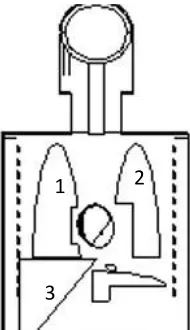
The complete phantom geometry is modeled using the MCNP visual editor as shown in Fig. 2. In Figs. 3, 4 and 5 shows the organs that are the object of dosing calculation ie the lungs, liver, stomach, thymus gland and ribs. The phantom body tissue density of MCNP is divided into three parts: soft tissue density, bone tissue and cardiac tissue. Right lung organ geometry, left lung, liver, stomach, thymus gland and ribs are modeled with volumes of 2890 cm3, 1810 cm3, 1560 cm3, 1830 cm3, 176 cm3 and 606 cm3, respectively, on the human body.
Http://www.ijetmr.com©International Journal of Engineering Technologies and Management Research [56]
Figure 3: Right lung (1), left lung (2), and Liver (3) seen from the front
Figure 4: MCNP model of phantom organ viewed from above; Liver (1) and Stomach (2)
Figure 5: MCNP model of phantom organ seen from the left side; Liver (1), Thymus gland (2) and Rib (3)
The next step is to model the simple linac geometry assumed to be 50 cm x 50 cm and the length of the 150 cm linec tube (Clarke, 2007).
Linac is placed as far as 100 cm from the surface of the body (leading to the left lung). The electron source is simulated with 25 MeV energy defined by the SDEF card and fired to the target to produce X-ray radiation. The energy of the absorbed radiation of sellorgan (right, left
1 2
3
Http://www.ijetmr.com©International Journal of Engineering Technologies and Management Research [57]
lung, thymus gland, liver, stomach and rib) in MCNP simulation is obtained by using Tally 8. The result of absorption energy of Tally 8 (E) organ will get big absorbency dose of organs using equation 1
D=E/m (1)
D is the absorbent dose of the organ (Gy), and the mass organ (kg). To know the effect of radiation on an organ then use another quantity that is effective dose of Dt. The effective dose is obtained from the result of the factor of the weight of the organ (wt) with the absorbent dosage and in the calculation of the effective dose; this study also considers the radiation weight factor (wr) as in equation 2 below (Wiryosimin, 1995).
𝐷𝑡 = 𝑤𝑡∑ 𝑤𝑟 𝐷 (2)
3. Results and Discussions
The radiation emitted by the linac comes from the electron interactions that affect the target plate. The interaction can be a collision between source electrons with electrons making up the target plate or occurring bremstakhlung. The resulting radiation is called the external X-ray radiation and some electrons emitted from the Compton Effect. This radiation is used to control the condition of internal organs or for the treatment of cancer cells. This radiation energy is not only accepted by the target organ (target area) but also about other organs around the target area. The simulation of the external radiation interaction process on the target area can determine how much the dose will be received and the magnitude of the radiation effect.
MCNP simulates the radiation process to obtain doses in organs. Radiation from the linac is directed to the target organ of the left lung region. Figures 6 and 7 show a trace simulation of the radiation particles from the linac.
Http://www.ijetmr.com©International Journal of Engineering Technologies and Management Research [58]
Figure 7: Traces of radiation particles of external radiation processes from linac to phantom; X-rays (green) and electrons (pink)
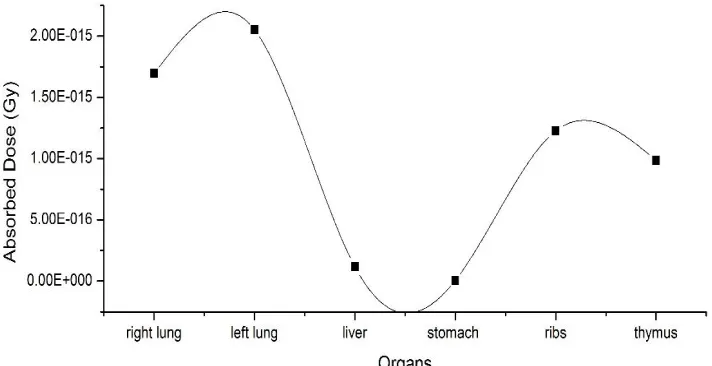
From the simulation of particle traces in Figs. 6 and 7 shows that although radiant energy has been directed mostly to the chest area (center), but there is still scattered radiant energy radiation. The magnitude of radiation scattering does not have a major impact on the organs outside the target area. The large absorption dose in the target organs of the left lung and some of the surrounding organs (right lung, thymus gland, liver, stomach and ribs) are shown in the graph of Figure 8.
Figure 8: The absorbent dose in the left, right lung, Liver, stomach, thymus gland and ribs.
Http://www.ijetmr.com©International Journal of Engineering Technologies and Management Research [59]
Figure 9: Effective dose on the left lung, right, liver, stomach, thymus gland and ribs.
The results of effective dose calculations show that the radiation resulted in significant effects on the target organs of the left lung.Sedangkan the right lung get a big enough effect from other organs around the target organ.This is because the organ is located close to the target organ and has a type of meeting which is smaller than the other organs. Not so with the ribs, although it is the first organ exposed to radiation. Radiation on the ribs does not have a significant effect and almost reaches zero. This is because the meeting is a very large type. Large effective doses are not only influenced by the size of the target type meeting but also influenced by the weight factor.
4. Conclusions and Recommendations
From the results of this study can be concluded that Monte Carlo linac simulations with Phantom can be used in knowing the biological effects of radiation on organs based on the large effective dose of the organ. The biggest effective dose occurs in the left lung organ which is the target organ, while other organs in around the left lung such as the right lung, liver, stomach, thymus gland and ribs have a smaller effective dose. The magnitude of the impact of radiation on an organ depends on the position of the organ from the direction of the coming radiation, the period of the organ type and its weight factor. The linac simulation along with the phantom can be used to analyze the effect of external radiation on the organ in the exposure area before treatment.
Acknowledgements
PeopleThe authors thanks to Directorate for Research andCommunity Service of DiponegoroUniversity that has provided fund for this research via the PNBP program 2017, which was administered under the scheme of Diponegoro University Budget Spending Program (DIPA) No. DIPA –275-74/UN 7.5.1/PG/2017.
References
Http://www.ijetmr.com©International Journal of Engineering Technologies and Management Research [60]
[3] Oktajianto, H. and Setiawati, E., Monte Carlo Simulation in Internal Radiotherapy of Thyroid Cancer. International Journal Engineering Technology and Management Research.vol2 iss9 , September 2016, page 16-24
[4] Monte Carlo Team. 2000. MCNP A General Monte Carlo N-Particle Transport Code Version 5 Volume I: Overview and Theory. Los Alomos National Laboratory.
[5] Krstic and Dragana, 2014. MCNP Sinulation of the Dose Distribution in Liver Cancer Treatment for BNC Therapy. Central European Journal of Physics.
[6] Maldovan, Iulik.,Bolyai and Emanuel. 2008. Monte Carlo Method For Radiological X-ray Examinations. Nuclear Medicine. Romania.
[7] Rodriguez, Miguel. ET all. 2015. A Geometrical Model for the Monte Carlo Simulation of the TrueBeamLinac.Physics in Medicine and Biology.http://dx.doi.org/10.1118/1.4916686.
[8] M. Cristy. 1980. Mathematical Phantom Representing Children of Various Ages for Use in Estimates of Internal Dose. Oak Ridge National Laboratory.
[9] Clarke, Shaun. ET all. 2007. Monte Carlo Simulation for linac standoff Integrogation of Nuclear Material. Nuclear Science and Technology Division. USA.
[10] Wiryosimin, S, 1995. MengenalAsasProteksiRadiasi. InstitutTeknologi Bandung.
[11] R. H. Clarke. 2011. Evaluation of ICRP Recommendations 1977, 1990 and 2007. Nuclear Energy Agency (NEA).
[12] M. Atarod, P.Shokrani, A.Azarnoosh , Out-of-field beam characteristics of a 6 MV photon beam: Results of a Monte Carlo study ,Applied Radiation and Isotopes 72 (2013) 182–194)
[13] Poonam and VelayudhamRamasubramanian, Evolution of Computational Techniques
Implementing Monte Carlo in Radiotherapy,2011, Archives of Applied Science Research, 2011, 3 (3):436-442
*Corresponding author.