Journal of Innovation in Health Informatics Vol 23, No 4 (2016)
INNOVATION IN
HEALTH INFORMATICS
Health information exchange as a complex
and adaptive construct: scoping review
Ather Akhlaq
Department of Health and Hospital Management, Institute of Business Management, Korangi Creek, Pakistan Centre for Medical Informatics, Usher Institute of Population Health Sciences and Informatics, Medical School, University of Edinburgh, UK
Aziz Sheikh
Centre for Medical Informatics, Usher Institute of Population Health Sciences and Informatics, Medical School, University of Edinburgh, UK
Claudia Pagliari
Edinburgh Global Health Academy and Centre for Medical Informatics, Usher Institute of Population Health Sciences and Informatics, Medical School, University of Edinburgh, UK
ABSTRACT
Objective To understand how the concept of Health Information Exchange (HIE)
has evolved over time.
Methods Supplementary analysis of data from a systematic scoping review of
definitions of HIE from 1900 to 2014, involving temporal analysis of underpinning themes.
Results The search identified 268 unique definitions of HIE dating from 1957
onwards: 103 in scientific databases and 165 in Google. These contained con -sistent themes, representing the core concept of exchanging health information electronically, as well as fluid themes, reflecting the evolving policy, business, and organisational and technological context of HIE (including the emergence of HIE as an organisational ‘entity’). These are summarised graphically to show how the concept has evolved around the world with the passage of time. The term HIE emerged in 1957 with the establishment of occupational HIE, evolving through the 1990s with concepts such as electronic data interchange and mobile computing technology; then from 2006 to 2010, it largely aligned with the US government’s health information technology strategy and the creation of HIEs as organisational entities, alongside the broader interoperability imperative, and continues to evolve today as part of a broader international agenda for sustainable, information-driven health systems.
Conclusions The concept of HIE is an evolving and adaptive one, reflecting
the ongoing quest for integrated and interoperable information to improve the effi -ciency and effectiveness of health systems in a changing technological and policy environment.
Keywords: health information exchange, definition, scoping review, eHealth
Systematic review
Cite this article: Akhlaq A, Sheikh A, Pagliari C. Health information exchange as a complex and adaptive construct: scoping review. J Innov Health Inform. 2016;23(4):633–683.
http://dx.doi.org/10.14236/jhi.v23i4.889
Copyright © 2016 The Author(s). Published by BCS, The Chartered Institute for IT under Creative Commons license http://creativecommons.org/ licenses/by/4.0/
Author address for correspondence Dr. Ather Akhlaq
Assistant Professor of eHealth, Health and Hospital Management, Institute of Business Management, Karachi, Pakistan
Email: [email protected] Accepted November 2016
on September 12, 2020 by guest. Protected by copyright.
Journal of Innovation in Health Informatics Vol 23, No 4 (2016)
Akhlaq et al. Health information exchange as a complex and adaptive construct 634
INTRODUCTION
Policymakers, health care professionals, industry groups and researchers recognise health information exchange (HIE) as a vital component of the solution to the current problems posed by disparate and fragmented health systems and non-interoperable technologies.1,2
HIE is not a new concept, but an evolving one, which to some extent ‘reinvents itself’ every 2.5 years due to the advancement in technology and changing of the regulatory environment.3,4
The report ‘Evolution of State Health Information Exchange’ prepared for The Agency for Healthcare Research and Quality yielded many significant findings about various HIE projects in terms of their designs and goals, stages of development and specific future barriers to deployment.3 The authors noted that no two HIE projects were similar, as the projects differ vastly with regard to stakeholders engaged, available finance, choice of technology, deployment strategy and community background.3 This variability makes it difficult to track the development of HIE due to variability of the HIE definitions and HIE models deployed.4 As described else -where in this issue (see Part 1 of the review), we undertook a detailed scoping review of existing definitions of HIE in order to develop an evidence-based concept map that may be help -ful for HIE stakeholders and for improving clarity and compa-rability in the published literature. This paper describes the components of the analysis oriented around time to assess and map the evolution of HIE concepts.
METHODS
In this part of the review, the included definitions were the -matically analysed to understand changing concepts and perspectives of HIE over time and in different global regions. First, definitions were sorted according to the year of publica -tion. Second, definitions were thematically analysed accord -ing to their chang-ing contexts with the passage of time.
RESULTS
Corpus of Definitions
As noted in our Part 1 of the scoping review paper, the 268 unique definitions eligible for inclusion dated back to 1957.5 Many definitions used terms synonymous with, or closely equivalent to, HIE, such as ‘Electronic Data Interchange’.6–8 ‘Clinical Information Exchange’,9–14 ‘Healthcare Information Exchange’,15–20 ‘Clinical Health Information Exchange,21,22 ‘Clinical Document Exchange’,23 ‘Medical Data Exchange’24 and ‘Information Exchange’.25 Most of the definitions (n = 240) were from the United States. Other contributing countries were the United Kingdom (UK) (n = 5),10,26–29 Australia (n = 3),8,30,31 the Netherlands (n = 3),7,32,33 Canada (n = 2),34,35 Germany (n = 1),19 Denmark (n = 1),36 New Zealand (n = 1),37 Sweden/ Finland (n = 1),38 Israel (n = 1),39 Switzerland (n = 1),40
Portugal (n = 1)41 and the European Union (n = 1).42 The origins of seven definitions were unclear.
Changing definitions over time and different
national perspectives
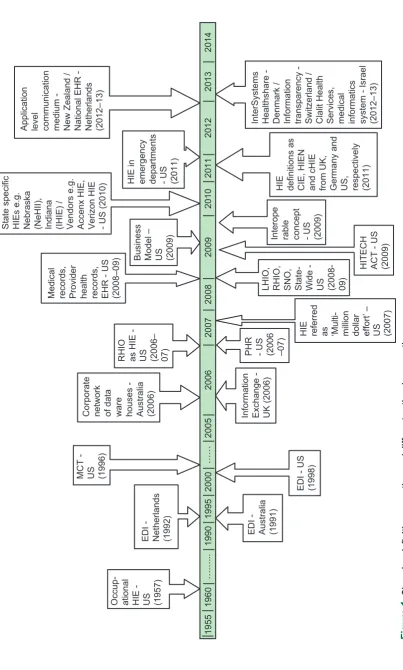
Figure 1 illustrates a timeline of the included definitions. The concept of HIE evolved with the rise in occupational health problems in the United States when Byers in 1957 recog -nised the need for a central coordinating organisation. Early ‘occupational HIE’ aimed to collect, collate and disseminate all types of information related to occupational health prob -lems.43 In the early 1990s, references to Electronic Data Interchange (EDI) systems for transferring data between General Practitioners (GPs), hospitals and various other stakeholders to enhance quality of care appeared in the lit -erature from Australia (1991),8 the Netherlands (1992)7 and the United States (1998).6 In 1996, the term mobile comput -ing technology (MCT) began to be used in the United States to describe clinical information exchange between older car -diac surgery patients at home and health care providers to give additional information of patients’ recovery to providers after surgery.44
Varying conceptual starting points: In 2006, a report from Australia defined HIE as the corporate network of data ware -houses of the health department that contains data on sur-gical procedures, international classification of diseases, diagnostic codes, record episodes, information and diagno -ses and some demographic items.30 Again in 2006, the first definition from the UK defined HIE as a process in terms of ‘information exchange’ between patients and health profes -sional to achieve shared decision making.26
HIE as an organisational entity. Between 2006 and 2007, the terms HIEs and regional health information organisa-tions (RHIOs) were being used interchangeably in the United States to facilitate the flow of clinical information45,46 in parallel with the concept of linking patients’ health records across organisations,47 including medical records,20 pro-vider health records48 and HER.49 Between 2008 and 2009, the concept of an HIE as an organisational entity was becoming common in the United States, using location-spe -cific names such as local health information organisations (LHIOs), RHIO and sub-network organisations (SNO) and ‘state-wide’, all serving the purpose of overseeing and gov -erning the exchange of health information among different health care stakeholders.50
Funding environment: The funding environment for enabling and sustaining HIE is emphasised in a number of definitions. In 2007, a US definition described HIE as a ‘mul -timillion dollar effort’ and insisted on establishing a reason to sustain the effort (HIE).51 In the same year, the business case for investment in HIE was argued in terms of its potential to create productive efficiencies for the provider community.45 Another US definition from 2009 defined it as ‘a business offering services to generate revenue that must exceed its expenses and should provide services according to the expectations of stakeholders’.52
on September 12, 2020 by guest. Protected by copyright.
http://informatics.bmj.com/
Journal of Innovation in Health Informatics Vol 23, No 4 (2016)
Figure 1.
Changing definitions over time and different national perspectives
Occup- ational HIE - US (1957) EDI - Netherlands (1992) MCT - US (1996)
Corporate networ
k
of data ware houses
-Australia (2006) RHIO as HIE - US (2006– 07) Medical records, Provider healt
h
records, EHR - US (2008–09)
Busines
s
Model – US (2009) State specific HIEs e.g. Nebraska (NeHII), Indiana (IHIE) / Vendors e.g. Accenx HIE, Verizon HIE - US (2010)
HIE in emergenc
y
departments - US (2011) Application level communication medium
-New Zealand
/
National EHR
-Netherlands (2012–13) InterSystems Healthshare
-Denmark
/
Information transparency
-Switzerland
/
Clalit Healt
h
Services, medical informatics system - Israel (2012–13)
HIE definitions as CIE, HIEN and cHIE from UK, Germany and US, respectively (2011)
Interope rable concept - US (2009)
HITECH ACT - US (2009)
LHIO, RHIO, SNO, State- Wide - US (2008- 09)
HIE referred as ‘Multi- million dollar effort’ – US (2007) PHR - US (2006 –07)
Information Exchange
-UK (2006)
EDI - US (1998)
EDI - Australia (1991)
1955
1960
……...
1990
1995
2000
……
2005
2006
2007
2008
2009
2010
2011
2012
2013
201
4
on September 12, 2020 by guest. Protected by copyright.
Journal of Innovation in Health Informatics Vol 23, No 4 (2016)
Akhlaq et al. Health information exchange as a complex and adaptive construct 636
Interoperability agenda. References to the term ‘interoper-ability’ became more common in 200953 in a US definition of HIE along with the term ‘standardised electronic exchange’, recognising the need to manage incompatibilities between systems and software.54
Influence of the US policy/incentives environment: 48 definitions appeared during 2009–2010, all from the United States, with the exception of two from Canada, illustrating the increasing importance of HIE in North America for the two con-secutive years after the enactment of the Health Information Technology for Economic and Clinical Health (HITECH) Act in 2009 and the associated attention from researchers, acade -micians and vendors in United States. Along with the general definitions of HIE, a number of HIE definitions are specifically associated with certain states’ and vendors’ names, for exam -ple, Nebraska Health Information Initiative (NeHII),55 Indiana HIE (IHIE),56 South Carolina HIE (SCHIEx),57 and New York Clinical Information Exchange (NYCLIX),12 whereas ven-dors involved were Accenx Exchange,58 Centricty HIE59 and Verizon HIE.60
Global dispersion of the concept: By 2011, the concept of HIE dispersed to the other parts of the world and the lit-erature included definitions from Germany, UK and Finland/ Sweden. We see slight modifications of the term HIE such as Healthcare Information Exchange Network in a definition from Germany,19 Clinical Information Exchange in defini -tions from the UK10 and United States12 and Clinical HIE in a definition from the United States.22 A definition from the UK stressed the accomplishment of HIE through policy, infrastructure and system of care. Moreover, it further says to acquire and build computing applications and make use of financial and clinical incentives to sustain clinical informa -tion exchange. Several defini-tions dating from 2011 focused on the use of HIE in emergency departments, for supporting access to patient records for the purposes of out-of-hours medical care.
As the topic of HIE gained momentum, more countries, states and vendors came out with definitions in 2012–2013. New Zealand referred to it as an ‘application-level communi-cation medium’ to exchange health information.37 Denmark, a global leader in software for connected care, has aligned the concept of HIE very much with the vendor system procured for national use, InterSystems HealthShare™.36 A definition from the Netherlands referred to HIE as national Electronic Health Records (EHR)32 while a definition from UK referred to it as ‘nationally accessible electronic records’.61 A definition from Switzerland aligns the concept of HIE with the benefits and challenges it generates, such as greater care coordina -tion through transparency, balanced by risks of greater dis -closure and the need to change the habits and practices of patients and health professionals.62 Finally, a definition from Israel identifies ‘Clalit Health Services’ as an HIE entity, which uses a single medical informatics system to exchange health information between a national network of hospitals and com -munity care.39
DISCUSSION
The analysis has revealed the emerging nature of the field and the changing relevance of HIE to different stakeholders and contexts.
The majority of the definitions originated in the United States, no doubt reflecting the considerable investments in HIE that have characterised the government’s HITECH Act,63,64 which aims to accelerate the adoption of interoperable health infor -mation systems and integrate the health care delivery systems for the benefit of patients. This has fuelled a growth in interest in HIE amongst health care professionals, providers, payers, technology companies, policy makers and researchers.
With respect to international variations, the related terms, HIE, Clinical Information Exchange, Healthcare Information Exchange, EDI and Clinical Health Information Exchange were used mostly in the United States, whereas in the UK only HIE and Clinical Information Exchange terms were typi-cally used when referring to the exchange of health informa-tion. HIE and EDI were preferred in publications emanating from the Netherlands, and our review found one definition on Healthcare Information Exchange Network from Germany.19
Although the term EDI was used more in the contexts of exchanging business information using a standard format, our review found two definitions of EDI, dating back to 19927 and 1998,6 that fit our inclusion criteria as describing HIE.
Organisations exchanging health information were also known by different names, such as LHIO, RHIO and SNO.50 In some cases, the terms HIE and RHIO were used inter -changeably13,34,45,65,66 although RHIO typically referred to an infrastructure that enabled HIE within the health care admin -istrative regions.39,67
The origins of various definitions lie in a range of con -texts, reflecting the importance of HIE for various purposes across the health industry, for example, occupational health HIE, community HIE and HIE for public health. Most of the definitions prioritise regional or national perspectives, although a few make reference to the value of HIE on a global level.55,68,69 At the macro level, natural disasters and viral outbreaks present requirements for global monitoring or coordinated international responses, for which effective HIE is essential. For example, this was demonstrated in the aftermath of Hurricane Katrina, where health care organisa -tions throughout the region and nationwide exchanged health information in order to take care of inhabitants displaced by the storm.70 The value of HIE in managing the recent Ebola crisis has also been described.71
Strengths and limitations
Strengths of the review include searching from 1900 to 2014, analysing a large corpus of HIE definitions and using academic databases and grey literature to find HIE defini -tions. Moreover, including reference of each source docu -ment and the given appendix (see Appendix A) ensured rigour of the findings.
on September 12, 2020 by guest. Protected by copyright.
http://informatics.bmj.com/
Journal of Innovation in Health Informatics Vol 23, No 4 (2016)
REFERENCES
1. Brailer DJ. Interoperability: the key to the future health care system.
Health Affairs-Millwood VA Then Bethesda MA 2005;24:W5.
2. Hripcsak G, Kaushal R, Johnson KB, Ash JS, Bates DW, Block
R, et al. The United Hospital Fund meeting on evaluating
health information exchange. Journal of Biomedical Informatics 2007;40(6):S3–10.
3. Rosenfeld S, Koss S, Caruth K and Fuller G. Evolution of State
Health Information Exchange/a Study of Vision, Strategy, and Progress. Rockville, MD: AHRQ Publication, 2006, no. 06-0057.
4. Callan K, Fuller JC, Galterio L, Just BH, Reich KA, Steigerwald
C et al. Tracking HIE’s Ever Evolving Operational Models:
Emerging health information exchange market still sorting
out its business and governance models. Journal of AHIMA
2014;85(10):36–40.
5. Byers DH. Occupational health information exchange. Public
Health Reports 1957;72(12):1077.
6. Braithwaite WR (Ed). The Federal Role in Setting Standards
for the Exchange of Health Information. Proceedings of Pacific Medical Technology Symposium, 1998. IEEE.
7. Hasman A, Ament A, Arnou P and Van Kesteren A.
Inter-institutional information exchange in healthcare. International Journal of Bio-Medical Computing 1992;31(1):5–16.
8. Regan B. Computerised information exchange in health care.
The Medical Journal of Australia 1991;154(2):140.
9. HealtheLink. About HEALTHeLINK. Available at: http://
wnyhealthelink.com/WhatWeDo/HEALTHeLINKNews/ WyomingCountyCommunityHealthSystemJoinsHEALTHeLINK. Accessed 20 January 2014.
10. Payne TH, Detmer DE, Wyatt JC and Buchan IE.
National-Scale clinical information exchange in the United Kingdom: les
-sons for the United States. Journal of the American Medical
Informatics Association 2011;18(1):91–98.
11. Grinspan ZM, Berg L, Onyile A, Kaushal R and Shapiro J. Medical
information fragmentation for people with epilepsy in new york
city differs by type of visit. Epilepsy Currents 2013;13:315.
However, we recognise the considerable progress that many countries across Europe, New Zealand, Australia, Israel and elsewhere have made in implementing national and regional health information infrastructures to support HIE, which are not fully reflected in the corpus of HIE definitions. Extending the search to related terms such as ‘national health information infrastructure’ would no doubt uncover additional definitions, and authors in the future may wish to extend the review to capture broader aspects of health informatics.
Implications for research, practice and
policy
Governments become more attuned to what other countries are doing, and with major eHealth technology businesses globalis -ing, we might expect the language of HIE to coalesce around a set of concepts. The priority according to different issues within HIE discussions may also change as more countries become involved in HIE; for example, personal health insurance and reimbursement are major issues in the United States, but in the UK and some other countries, health care is free to citizens at the point of care and funded through national taxation.
Although HIE is still in infancy, it has been on a promis -ing track due to evolv-ing technology and grow-ing models
of value-based payment which propose the design and functions of HIE initiatives.72 Apart from improved care and coordination, further research is required to explore the new evolving functionalities of HIE such as the avail-ability of clinical data for public health surveillance and constructing longitudinal consumer-accessible personal health records.72
CONCLUSIONS
HIE remains an evolving concept, which due to its complex -ity presents challenges for developing concrete and shared definitions. It will continue to evolve mainly due to change in technology, stakeholders engaged and different paradigms of health care in different countries. In addition, the growing health care challenges around the world, such as Zika, will trigger further research to develop effective HIEs with new designs and services.
Funding
We would like to thank the Higher Education Commission, Pakistan, and The University of Edinburgh for providing funds for this review.
12. Onyile A, Shapiro JS and Kuperman G. Patient crossover rates
vary by disease in a health information exchange. Annals of
Emergency Medicine 2011;58(4):S294–5.
13. Onyile A, Vaidya SR, Kuperman G and Shapiro JS. Geographical
distribution of patients visiting a health information exchange
in New York City. Journal of the American Medical Informatics Association 2013;20:e125–30.
14. Hazamy PA, Haley V, Tserenpuntsag B and Tsivitis M. Using
remote access to audit hospital data submitted to NHSN for reporting of hospital acquired infections in New York State. American Journal of Infection Control 2013;41(6):S76.
15. Infor_Clover. Infor Cloverleaf Hosted Healthcare Information
Exchange. Available at: http://www.infor.com/product_sum
-mary/healthcare/cloverleaf-hies/. Accessed 12 December 2013.
16. Merrill M. Georgia Cancer Coalition uses HIE to share
evidence-based medicine 2009. Available at: http://www.
healthcareitnews.com/news/georgia-cancer-coalition-uses-hie-share-evidence-based-medicine. Accessed 05 January 2014.
17. SanDiegoHIE. San Diego Regional Healthcare Information
Exchange. Available at: http://www.sandiegobeacon.org/san-diego-beacon-community. Accessed 20 January 2014.
18. SafeNet. What You Need to Know About Securing Healthcare
Information Exchanges. 2010. Available from: www.safenet-inc.
com/. Accessed 26 December 2013.
19. Birkle M, Schneider B, Beck T, Deuster T, Fischer M, Flatow F
et al. Implementation of an open source provider organization registry service. Studies in Health Technology and Informatics 2011;169:265–69.
20. Cannoy SD. Consumer Empowerment in Healthcare Information
Exchange: An Investigation Using the Grounded Theory Approach. Greensboro, NC: The University of North Carolina at Greensboro, 2008.
21. Utah. Utah Statewide Clinical Health Information Exchange
2011. 2011. Available from: file:///C:/Users/s1220258/
Downloads/cHIE_LegReport2011_final.pdf. Accessed 27
December 2013.
on September 12, 2020 by guest. Protected by copyright.
Journal of Innovation in Health Informatics Vol 23, No 4 (2016)
Akhlaq et al. Health information exchange as a complex and adaptive construct 638
22. StateUtah. Utah Clinical Health Information Exchange.
2011. Available from: http://www.nascio.org/awards/
nominations2011/2011/2011UT3-nascio%20cHIE%20 2011%20r2.pdf. Accessed 27 December 2013.
23. Iatric. Clinical Document Exchange. Available at: http://www.
iatric.com/ClinicalDocumentExchange. Accessed 15 January 2014.
24. Cisco. Cisco Medical Data Exchange Solution. Available at:
http://www.cisco.com/web/strategy/healthcare/medical_data_ exchange_solution.html. Accessed 15 Februray 2014.
25. MHiE. Physician Information Exchange. Available at: http://
www.memorialhermann.org/healthcare-professionals/physi-cian-information-exchange. Accessed 15 January 2014.
26. Bugge C, Entwistle VA and Watt IS. The significance for deci
-sion-making of information that is not exchanged by patients
and health professionals during consultations. Social Science & Medicine 2006;63(8):2065–78.
27. Greenhalgh T, Morris L, Jeremy C, Wyatt JC, Thomas G and
Gunning K. Introducing a nationally shared electronic patient record: case study comparison of Scotland, England, Wales and
Northern Ireland. International Journal of Medical Informatics 2013;82(5):e125–38.
28. Boyle T. Privacy Lessons Learned from an Operational Health
Information Exchange. Clearwater, FL: FairWarnings, Inc., 2011.
29. Excelicare. One of the world’s leading Health Information
Exchange (HIE) applications. Available at: http://www.axsys.
co.uk/excelicare-clinical-portal/. Accessed 15 January 2014.
30. Barton MB, Gabriel GS, Frommer MS, Holt PE and Thompson
JF. Surgical procedures for melanoma in public and private New
South Wales hospitals, 2001–2002. ANZ Journal of Surgery
2006;76(5):318–24.
31. CSC. Health Information Exchange: CSC. Available at: http://
www.isofthealth.com/en-au/Solutions/ANZ%20HIE.aspx.
Accessed 26 December 2013.
32. Delfan A. Regional Health Information Exchange (RHIE).
Thesis. 2013. http://repository.tudelft.nl/islandora/object/
uuid:a54a370f-3a45-461e-83a0-d4a008114d89/datastream/ OBJ/download. Accessed 27 December 2013.
33. forcare. Software solutions for Health Information Exchanges.
Available at:
http://www.forcare.com/solutions/health-informa-tion-exchanges-hie/. Accessed 29 December 2013.
34. Rebryna R. EHR arithmetic: Extracting positives from nega
-tives. The Santa Barbara County care data exchange project. Healthcare Quarterly 2009;7(4):82–85.
35. Sicotte C and Pare G. Success in health information exchange
projects: Solving the implementation puzzle. Social Science and Medicine 2010;70(8):1159–65.
36. InterSystem. Denmark Selects InterSystems HealthShare for
Countrywide Health Information Exchange 2012. Available
at:
http://www.ehealthnews.eu/intersystems/2936-denmark- selects-intersystems-healthshare-for-countrywide-health-infor-mation-exchange. Accessed 20 February 2014.
37. HISO. Health Information Exchange Architecture Building
Blocks, Overview and Glossary (HISO 10040.0). Health
Information Standards Organization, 2012.
38. Mäenpää T, Asikainen P, Gissler M, Siponen K, Maass M,
Saranto K et al. Outcomes assessment of the regional health
information exchange. Methods of Information in Medicine 2011;50(4):308–18.
39. Frankel M, Chinitz D, Salzberg CA and Reichman K. Sustainable
health information exchanges: the role of institutional factors.
Israel Journal of Health Policy Research 2013;2(1):21.
40. Geissbuhler A. Lessons learned implementing a regional health
information exchange in Geneva as a pilot for the Swiss national
eHealth strategy. International Journal of Medical Informatics 2013;82(5):e118–24.
41. Alert. Alert® Health Information Exchange. Available at: http://
www.alert-online.com/hie. Accessed 08 Januray 2014.
42. Codagnone C. Benchmarking deployment of eHealth among
general practitioners II. 2013. Available at: https://ec.europa.
eu/digital-single-market/en/news/benchmarking-deployment-ehealth-among-general-practitioners-2013-smart-20110033.
Accessed 27 December 2013.
43. Byers DH. Occupational-Health Information Exchange. Public
Health Reports 1957;72(12):1077–78.
44. Gassert CA. Defining information requirements using holistic
models: introduction to a case study. Holistic Nursing Practice 1996;11(1):64–74.
45. De Brantes F, Emery D, Overhage J, Glaser J and Marchibroda
J. The potential of HIEs as infomediaries. Journal of Healthcare
Information Management: JHIM 2007;21(1):69.
46. Carter P, Lemery C, Mikels D, Bowen R and Hjort B. Privacy
and security in health information exchange. Journal of AHIMA 2006;77(10):64A–64C.
47. Kijsanayotin B, Speedie SM and Connelly DP. Linking Patients’
Records across Organizations While Maintaining Anonymity. AMIA Annual Symposium Proceedings,2007, p. 1008.
48. HIECC/SEPAP. Meaningful Health Information Exchange.
2009. HIECC/SEPAP. Meaningful Health Information Exchange 2009. Available from: http://www.fhin.net/pdf/hiecc/Apr1709/
MeaningfulHIEforDiscussion040609.pdf. Accessed 28
December 2013.
49. HITECH. HITECH Act. 2009.
50. Amatayakul M. HIEs: survival of the fittest: an estimated 130
health information exchange (HIE) organizations exist
today--and many of these fledgling HIEs are at risk (INSIDE IT) 2008. Available at: http://www.highbeam.com/doc/1G1-192352076.
html. Accessed 22 December 2014.
51. Johnson KB and Gadd C. Playing smallball: Approaches to
evaluating pilot health information exchange systems. Journal of Biomedical Informatics 2007;40(6):S21—26.
52. IHIE. Nationwide Health Information Network (NHIN) Trial
Implementations. Indiana Health Information Exchange, 2009.
Available from: http://www.healthit.gov/sites/default/files/indi
-ana_business_plan_nhin_final.pdf. Accessed 28 December 2013.
53. Dimitropoulos L and Rizk S. A state-based approach to privacy and security for interoperable health information exchange. Health Affairs 2009;28(2):428–34.
54. NCHICA. Healthcare Information Exchange (HIE):
Considerations for Engaging North Carolina Consumers.
2009. NCHICA. Healthcare Information Exchange (HIE): Considerations for Engaging North Carolina Consumers 2009 [Available from: http://www.nchica.org/GetInvolved/CACHI/ The%20Future%20of%20Healthcare%20Information%20 Exchange%20in%20North%20Carolina%20HA.pdf. Accessed 28 December 2013.
55. AxolotlCorp. NeHII Completes Demonstration of Statewide Health Information Exchange 2009. Available at: http://finance. paidcontent.org/paidcontent/news/read?GUID=9343105. Accessed 10 January 2014.
56. Stoten S. Health policy issue with the electronic health record.
Online Journal of Nursing Informatics 2009;13(2):1–14. 57. Lee L, Whitcomb K, Galbreth M and Patterson D. A strong
state role in the HIE. Lessons from the South Carolina Health Information Exchange. Journal of AHIMA / American Health Information Management Association 2010;81(6):46–50; quiz 1. 58. Accenx. Accenx: A rapid, cost-effective on-ramp to Health
Information Exchange: Healthcare Informatics 2009. Available
at http://www.healthcare-informatics.com/article/accenx-rapid-cost-effective-ramp-health-information-exchange. Accessed 10 January 2014.
on September 12, 2020 by guest. Protected by copyright.
http://informatics.bmj.com/
Journal of Innovation in Health Informatics Vol 23, No 4 (2016)
59. Centricity. GE Healthcare to Grow its Health Information
Exchange Services by Joining Global eHealth Leader 2009. Available at:
http://www.ehealthserver.com/ge/245-
ge-healthcare-to-grow-its-health-information-exchange-services-by-joining-global-ehealth-leader. Accessed 15 February 2014.
60. Mearian L. Verizon creates medical information exchange
cloud 2010. Available at: http://www.computerworld.com/s/
article/9179182/Verizon_creates_medical_information_
exchange_cloud. Accessed 20 February 2014.
61. Greenhalgh T, Morris L, Wyatt JC, Thomas G and Gunning
K. Introducing a nationally shared electronic patient record: case study comparison of Scotland, England, Wales and
Northern Ireland. International Journal of Medical Informatics 2013;82(5):e125–138.
62. Geissbuhler A. Lessons learned implementing a regional health
information exchange in Geneva as a pilot for the Swiss national
eHealth strategy. International Journal of Medical Informatics 2013;82(5):e118–124.
63. Jha AK. Meaningful use of electronic health records: the road
ahead. JAMA 2010;304(15):1709–10.
64. Blumenthal D and Tavenner M. The “meaningful use” regulation
for electronic health records. New England Journal of Medicine 2010;363(6):501–4.
65. Foundation R. Health Information Exchange–An Introduction.
Available from: http://www.rchnfoundation.org/?p=1757.
Accessed 15 December 2013.
66. PCmag. Definition of:HIE. Available at: http://www.pcmag.com/
encyclopedia/term/61628/hie. Accessed 26 December 2013.
67. Stoten S. Health policy issue with the electronic health record.
Online Journal of Nursing Informatics 2009;13(2):2.
68. Gartner. Health Information Exchange (HIE). Available at: http://
www.gartner.com/it-glossary/hie. Accessed 08 January 2014.
69. OnePartnerHIE. What Is an HIE?: One Partner HIE. Available
at: http://www.onepartnerhie.com/About/WhatisanHIE.aspx.
Accessed 10 January 2014.
70. Acker B, Birnbaum C, Braden J, Carlisle V, Claybrook D,
Demster B et al. HIM principles in health information exchange. Journal of AHIMA/American Health Information Management Association 2007;78(8):69.
71. Loonsk JW. What Ebola tells us about health IT outbreak needs
2014. Available at: http://www.govhealthit.com/news/what-ebola-tells-us-about-health-it-outbreak-needs. Accessed 28 December 2013.
72. Mahajan AP. Health information exchange—Obvious choice or
pipe dream? JAMA Internal Medicine 2016;176(4):429–30.
73. 1stProvidersChoice. Healthcare Information Exchange—
Certified EMR Software, Leading Fully Certified EMR Software
already ready for the Heathcare Information Exchange.
Available at: http://www.1stproviderschoice.com/emr-health-care-information-exchange.php. Accessed 26 December 2013.
74. 4Med. What Is HIE and HIPAA Compliance?. Available at:
http://www.4medapproved.com/hit108.php. Accessed 16 December 2013.
75. Abhyankar S, Lloyd-Puryear MA, Goodwin R, Copeland S,
Eichwald J, Therrell BL et al. (Ed). Standardizing Newborn
Screening Results for Health Information Exchange. AMIA Annual Symposium Proceedings, 2010. American Medical
Informatics Association.
76. Adler-Milstein J, Bates DW and Jha AK. A survey of health
information exchange organizations in the United States:
implications for meaningful use. Annals of Internal Medicine 2011;154(10):666–71.
77. Adler-Milstein J, DesRoches CM and Jha AK. Health infor
-mation exchange among US hospitals. American Journal of
Managed Care 2011;17(11):761.
78. Adler-Milstein J and Jha AK. Sharing clinical data electronically:
a critical challenge for fixing the health care system. Journal of
the American Medical Association 2012;307(16):1695–96.
79. Adler-Milstein J, Ronchi E, Cohen GR, Winn LAP and Jha AK.
Benchmarking health IT among OECD countries: better data
for better policy. Journal of the American Medical Informatics
Association 2013;21(1):111–16.
80. AlaskaeHealth. What is health information exchange?: Alaska
eHealth Network. Available at: http://ak-ehealth.org/for-patients/what-is-health-information-exchange/. Accessed 30 December 2013.
81. Afzal S. The Role of Health Information Exchange in Driving
toward Interoperability. Maryland’s Health Information
Exchange, SOA in Healthcare Conference, 2011.. Chesapeake
Regional Information System for our Patients.
82. AHA. Health Information Exchange Projects What Hospitals
and Health Systems Need to Know. Available from: http:// www.aha.org/content/00-10/AHARHIOfinal.pdf. Accessed 29 December 2013.
83. AHIMA. HIE. Available at: http://www.ahima.org/resources/hie.
aspx. Accessed 15 December 2013.
84. Altman R, Shapiro JS, Moore T and Kuperman GJ. Notifications
of hospital events to outpatient clinicians using health informa-tion exchange: a post-implementainforma-tion survey. Informatics in Primary Care 2012;20(4):249–55.
85. AMA. Health Information Technology: American Medical
Association. Available at: https://www.ama-assn.org/ama/pub/
advocacy/topics/health-information-technology.page. Accessed
20 December 2013.
86. Ancker JS, Edwards AM, Miller MC and Kaushal R. Consumer
perceptions of electronic health information exchange. American Journal of Preventive Medicine 2012;43(1):76–80.
87. ArkansasOHIT. State Health Alliance for Records Exchange (SHARE). Available at: http://ohit.arkansas.gov/share/Pages/ default.aspx. Accessed 27 December 2013.
88. Aspelin M. What Is a Health Information Exchange (HIE)?
An Introduction to HIEs. Available at: http://markaspelin.com/ health-information-exchange-hie-primer-hies/. Accessed 05 January 2014.
89. Bostick R, Crayton G, Fishman E, Elaine P and Vern S. Sustaining Health Information Exchange: A State Toolkit. NGA Centre for Best Practices, 2011.
90. Bouhaddou O, Bennett J, Teal J, Pugh M, Sands M, Fontaine
F et al. (Eds). Toward a Virtual Lifetime Electronic Record: The
Department of Veterans Affairs Experience with the Nationwide
Health Information Network. AMIA Annual Symposium Proceedings, 2012: American Medical Informatics Association.
91. Bredfeldt C. PS2-10: Economic impact of electronic health infor
-mation exchange. Clinical Medicine & Research 2013;11(3):152. 92. Bresnick J. Does HIE cause more confusion than it prevents?
2013. Available at:
http://ehrintelligence.com/2013/05/21/does-hie-cause-more-confusion-than-it-prevents/. Accessed 22
December 2013.
93. CareAccord. Health Information Exchange in Oregon [cited 15 December 2013]. Available at: https://www.careaccord.org/hie-in-oregon/overview.shtml. Accessed 29 December 2013. 94. Carter P, Lemery C, Mikels D, Bowen R and Hjort B. Privacy
and security in health information exchange. Journal of the American Health Information Management Association 2006;77(10):64A–C.
95. CDC. Health Information Exchange a Key Concept for Biosurveillance. Available from: https://spaces.internet2.edu/ download/attachments/12876/NCPHI-RHIE-CDC-HIE-View-FCC-version1a.pdf?api=v2. Accessed 29 December 2013. 96. Cerner. Clinical Exchange Platform. Available from: https://
store.cerner.com/items/28. Accessed 10 January 2014.
on September 12, 2020 by guest. Protected by copyright.
Journal of Innovation in Health Informatics Vol 23, No 4 (2016)
Akhlaq et al. Health information exchange as a complex and adaptive construct 640
97. Chaudhary O. Developing the foundation for syndromic sur
-veillance and health information exchange for Yolo County,
California. Online Journal of Public Health Informatics 2012;4(2).
98. CIisco. Cisco Medical Data Exchange Solution. Available at:
http://www.cisco.com/web/strategy/healthcare/medical_data_ exchange_solution.html. Accessed 15 February 2014.
99. CitiusTech. Health Information Exchange | HIE Reporting -
Overview. Available at: http://www.citiustech.com/markets/hie. aspx. Accessed 15 December 2013.
100. Kibbe D. Responses to ““Meaningful Use”: a pivotal definition
for new-wave medical records systems” [03 Februrary 2009 (2014)]. Available at: http://e-patients.net/archives/2009/05/
meaningful-use-a-pivotal-definition-for-new-wave-medical-re
-cords-systems.html
101. Livingood WC, Coughlin S and Remo R. Public Health and
Electronic Health Information Exchange: A Guide to Local Agency Leadership. Jacksonville, FL: The Institute for Public Health Informatics and Research, Duval County Health Department.
102. Clemens NA. Privacy, consent, and the electronic mental
health record: The person vs. the system. Journal of Psychiatric Practice® 2012;18(1):46–50.
103. ClinicalConnect. ClinicalConnect: a secure health information
exchange. Available at: http://www.clinicalconnecthie.com. Accessed 15 January 2014.
104. CORHIO. HIPAA and Health Information Exchange. Colorado
Regional Health Information Organization.
105. Daurio NR, Fielding M and Cholewka PA. Implementation of an
enterprise-wide Electronic Health Record: a nurse-physician partnership. Studies in Health Technology and Informatics 2009;146:263.
106. Deas TM Jr and Solomon MR. Health information exchange:
foundation for better care. Gastrointestinal Endoscopy
2012;76(1):163–68.
107. Dobbs D, Trebatoski M and Revere D. The Northwest Public
Health Information Exchange’s accomplishments in
connect-ing a health information exchange with public health. Online
Journal of Public Health Informatics 2010;2(2).
108. Downing GJ, Zuckerman AE, Coon C and Lloyd-Puryear MA
(Ed). Enhancing the quality and efficiency of newborn screen
-ing programs through the use of health information technology.
Seminars in Perinatology; 2010;34:156–62.
109. Dullabh P and Hovey L. Large scale health information exchange:
implementation experiences from five States. Studies in Health
Technology and Informatics 2012;192:613–17.
110. Initiative eHealth Information Exchange: from Start up to
Sustainability. Foundation for eHealth Initiative, 2007`. eHealth
-Initiative. Available from: http://www.hci3.org/sites/default/files/ files/HRSA%20CCBH%20Final%20Report%20Revised.pdf. Accessed 25 December 2013.
111. INITIATIVE e. 2011 Report on Health Information Exchange:
The Changing Landscape. 2011. Available from: http://www. ehidc.org/resource-center/publications/view_document/116- survey-2011-survey-report-on-health-information-exchange-faqs-data-exchange. Accessed on 26 December 2013.
112. 360 eP. Patient FAQ 2011. Available at: http://www.ohii.ca.gov/
calohi/. Accessed 20 January 2014.
113. Emdeon. Health Information Exchange. Available at: http://
www.emdeon.com/hie/. Accessed 26 December 2013.
114. Finn N. Health information exchange: a stepping stone toward
continuity of care and participatory medicine. Journal of Participatory Medicine 2011;3:e47.
115. FloridaHIE. The Florida HIE. Available at:
https://www.florida-hie.net/. Accessed 20 December 2013.
116. FloridaHIN. Florida Health Information Exchange Overview.
Available at: http://www.fhin.net/content/floridaHie/. Accessed 17 December 2013.
117. Frisse ME. Health information exchange in Memphis: Impact on
the physician-patient relationship. The Journal of Law, Medicine & Ethics 2010;38(1):50–57.
118. Frisse ME, Johnson KB, Nian H, Davison CL, Gadd CS Unertl
KM et al. The financial impact of health information exchange on
emergency department care. Journal of the American Medical Informatics Association 2012;19(3):328–33.
119. Furukawa MF, Patel V, Charles D, Swain M and Mostashari F.
Hospital electronic health information exchange grew substan
-tially in 2008–2012. Health Affairs 2013;32(8):1346–54.
120. Office USGA. Electronic Personal Health Information Exchange
Health Care Entities’ Reported Disclosure Practices and Effects on Quality of Care 2010. Available at: http://www.gao.gov/new. items/d10361.pdf. Accessed 08 January 2014.
121. Gadd CS, Ho Y-X, Cala CM, Blakemore D, Chen Q, Frisse ME et
al. User perspectives on the usability of a regional health infor
-mation exchange. Journal of the American Medical Informatics Association 2011;18(5):711–16.
122. Gaebel H. What Is an HIE? 2010. Available at: https://himsshie.
pbworks.com/w/page/4775490/HIEDefinition. Accessed 12 January 2014.
123. Genes N, Shapiro J, Vaidya S and Kuperman G. Adoption of
health information exchange by emergency physicians at three
urban academic medical centers. Applied Clinical Informatics
2011;2(3):263.
124. GeorgiaGov. HIV Health Information Exchange (HIE). Available
at: http://dph.georgia.gov/hiv-health-information-exchange-hie.
Accessed 16 December 2013.
125. Grannis SJ, Stevens KC and Merriwether R. Leveraging health
information exchange to support public health situational
awareness: the Indiana experience. Online Journal of Public Health Informatics 2010;2(2).
126. Grossman JM, Kushner KL, November EA and Lthpolicy PC.
Creating Sustainable Local Health Information Exchanges: Can Barriers to Stakeholder Participation Be Overcome?
Washington, DC: Center for Studying Health System Change, 2008.
127. GulfCoastHIE. What Is HIE?. Available at http://www.gulfco
-asthie.com/. Accessed 25 December 2013.
128. Haggstrom DA and Doebbeling BN. Quality measurement
and system change of cancer care delivery. Medical Care 2011;49:S21–27.
129. Halamka JD. Health information exchange for emergency
department care is on the right trajectory. Annals of Emergency Medicine 2013;62(1):25–27.
130. Hall C. What Is a Health Information Exchange? 2009. Available
at: http://www.cap.org/apps/docs/committees/informatics/ Health_Information_Exchange.pdf
131. Harris. Health Information Exchange Connect community.
Provide access. Create collaboration. Harris Healthcare Solutions. Available at: http://healthcare.harris.com/solutions/ hie-health-information-exchange.aspx Accessed 20 December 2013.
132. HC. HIE FAQ: Greater Houston Health Connect. Available
at: http://ghhconnect.org/index.html#/what-is-an-hie----faq/.
Accessed 15 December 2013.
133. HealthCareIT. Health Information Exchange (HIE). Available at:
http://www.healthcareitnews.com/directory/health-information-exchange-hie. Accessed 22 December 2013.
134. HealthInsight. Public Perception and Utah’s Clinical Health
Information Exchange 2011–2012. Available from: http://health
-insight.org/Internal/docs/chie_consumer_focus_groups_report.
pdf. Accessed 27 December 2013.
135. HealthIT. Health Information Exchange (HIE). Available at:
http://www.healthit.gov/HIE. Accessed 10 January 2014.
136. HealthLeaders. Kentucky selects ACS to develop health
information exchange 2009. Available at: http://www.
on September 12, 2020 by guest. Protected by copyright.
http://informatics.bmj.com/
Journal of Innovation in Health Informatics Vol 23, No 4 (2016)
healthleadersmedia.com/content/TEC-239380/Kentucky-selects-ACS-to-develop-health-information-exchange.html.
Accessed 05 January 2014.
137. HealthUnity. Solutions/Statewide HIE. Available at: http://healt
-hunity.com/Solutions.mvc.aspx/StatewideHIE. Accessed 18 December 2013.
138. Hersh W. A stimulus to define informatics and health informa
-tion technology. BMC Medical Informatics and Decision Making 2009;9(1):24.
139. Herwehe J, Wilbright W, Abrams A, Bergson S, Foxhood J,
Kaiser M et al. Implementation of an innovative, integrated
electronic medical record (EMR) and public health informa
-tion exchange for HIV/AIDS. Journal of the American Medical
Informatics Association 2012;19(3):448–52.
140. HHS. National Biosurveillance Strategy for Human Health
V2.0. Washington, DC: U.S. Department of Health and Human
Services, 2010.
141. HIEanwers. Health Information Exchange Models. Available
at: http://www.hieanswers.net/hie-fundamentals/hie-models/.
Accessed 20 December 2013.
142. HIE_Bridge. Health Information Exchange. Available at: http://
www.hiebridge.org/. Accessed 09 January 2014.
143. HIE_Neveda. Health HIE Neveda. Available at: http://www.
healthienevada.org/. Accessed 17 December 2013.
144. HIE O. Summary of Law on Health Information Exchanges.
2014 Contract No.: 15 January. Available from: http://www. clinisync.org/public/images/stories/Summary_of_New_ Law_on_Health_Information_Exchanges.pdf. Accessed 27 December 2013.
145. HIMSS. Health Information Exchanges Part 2: Putting the HIE
into Practice.
146. Committee H. HIE Implications in Meaningful Use Stage 1
Requirements. Healthcare Information and Management Systems Society (HIMSS), 2010.
147. Arizona. Frequently Asked Questions: Health Information
Newtwork of Arizona. Available at: http://www.hinaz.org/patient-faq#hie. Accessed 26 December 2013.
148. HINAz. What Is Health Information Exchange?: Health
Information Network of Arizona. Available at: http://www.hinaz. org/what. Accessed 04 Jnauary 2014.
149. Hincapie AL, Warholak TL, Murcko AC, Slack M and Malone
DC. Physicians’ opinions of a health information exchange. Journal of the American Medical Informatics Association 2011;18(1):60–65.
150. IHS. Health Information Exchange (HIE) Indian Health Service.
Available at: http://www.ihs.gov/hie/index.cfm?module=dsp_ hie_faq. Accessed 20 December 2013.
151. HIXNY. HIXNY achieves strategic interoperability with commu
-nity practices. Available at: http://www.intersystems.com/library/
library-item/healthcare-information-xchange-of-new-york-hixny-
leverages-intersystems-healthshare-to-increase-provider-adop-tion-community-engagement/. Accessed 20 January 2014.
152. HRSA. What Is Health Information Exchange? U.S. Department
of Health and Human Services, Health Information Technology and Quality Improvement. Available at: http://www.hrsa.gov/ healthit/toolbox/RuralHealthITtoolbox/Collaboration/whatishie. html. Accessed 15 January 2014.
153. HT. Health Information Exchange (HIE). Available from: http://
www.cctheart.com/HTPN_HIE_Education.pdf. Accessed 25 December 2013.
154. ICA. ICA and AlliedHIE Launch National Health Information
Exchange ICA; 2012. Available at: http://www.icainformatics.
com/2012/05/ica-and-alliedhie-launch-national-health-informa
-tion-exchange/. Accessed 10 January 2014.
155. IGI Global What Is Health Information Exchange (HIE).
IGI Global. Available from: http://www.igi-global.com/
dictionary/health-information-exchange-hie/12859. Accessed 27 December 2013.
156. ILHIE. Illinois HIE Strategic & Operational Plan. 2010. Available
from: http://www.hie.illinois.gov/assets/hiesop.pdf. Accessed 25 December 2013.
157. Assembly IG. (20 ILCS 3860/) Illinois Health Information
Exchange and Technology Act. Available at: http://www.ilga.gov/ legislation/ilcs/ilcs3.asp?ActID=3267&ChapterID=5. Accessed 08 Janauary 2014.
158. Infor_IBM. IBM Enterprise Master Person Index (EMPI).
Available at: http://www.infor.com/product_summary/health
-care/empi/. Accessed 04 January 2014.
159. iNexx. Available at:
http://www.inexx.com/health-information-exchange-primer.html. Accessed 10 January 2014.
160. InspiraHN. Health Information Exchange (HIE). Available
at: http://www.inspirahealthnetwork.org/?id=5253&sid=1.
Accessed 15 December 2013.
161. InteliChart. Health Information Exchange (HIE): Inteli Chart.
Available at: http://www.intelichart.com/information-exchange-overview. Accessed 10 January 2014.
162. America IoMCoQoHCi. Crossing the Quality Chasm: A New
Health System for the 21st Century. Washington, DC: National Academies Press, 2001.
163. Morrissey J. Health information exchange. AHA 2011;85(2):22–7.
164. Joshi JK. Clinical value-Add for Health Information Exchange
(HIE). The Internet Journal of Medical Informatics 2010;6(1).
165. Johnson KB and Gadd C. Playing smallball: approaches to
evaluating pilot health information exchange systems. Journal of Biomedical Informatics 2007;40(6):S21–6.
166. Jones SS, Friedberg MW and Schneider EC (Eds). Health
Information Exchange, Health Information Technology Use,
and Hospital Readmission Rates. AMIA Annual Symposium Proceedings, 2011. American Medical Informatics
Association.
167. Kaelber DC and Bates DW. Health information exchange
and patient safety. Journal of Biomedical Informatics 2007;40(6):S40–45.
168. Karl ES. What’s in a name? Breaking down health information
exchange, one definition at a time. Journal of American Health
Information Management Association 2012;83(6):62–63.
169. KC. Health Information Exchange (HIE): Kane County Health
Department. Available at: http://kanehealth.com/hie.htm. Accessed 30 December 2013.
170. Kern LM and Kaushal R. Health information technology and
health information exchange in New York State: new initia-tives in implementation and evaluation. Journal of Biomedical Informatics 2007;40(6):S17–20.
171. Kern LM, Dhopeshwarkar R, Barrón Y, Wilcox A, Pincus H and
Kaushal R. Measuring the effects of health information technol
-ogy on quality of care: a novel set of proposed metrics for elec
-tronic quality reporting. Joint Commission Journal on Quality
and Patient Safety 2009;35(7):359–69.
172. KeyHIE. Better Outcomes Start with Better Information.
Available at: http://www.keyhie.org/providers/benefits_over
-view.html. Accessed 29 December 2013.
173. Kijsanayotin B, Speedie SM and Connelly DP (Eds). Linking
Patients’ Records across Organizations While Maintaining
Anonymity. AMIA Annual Symposium Proceedings, 2007.
174. KLAS. Health Information Exvhange (HIE) 2014. Available
at: http://www.klasresearch.com/segment/198. Accessed 20 December 2013.
175. Kongstvedt PR. Essentials of Managed Health Care. Burlington,
MA: Jones and Bartlett, 2012.
176. Kralewski JE, Zink T and Boyle R. Factors influencing electronic
clinical information exchange in small medical group practices.
The Journal of Rural Health 2012;28(1):28–33.
on September 12, 2020 by guest. Protected by copyright.
Journal of Innovation in Health Informatics Vol 23, No 4 (2016)
Akhlaq et al. Health information exchange as a complex and adaptive construct 642
177. Kuperman GJ. Health-information exchange: why are we doing
it, and what are we doing? Journal of the American Medical
Informatics Association 2011;18(5):678–82.
178. Block P. Introduction to Health Informatics. Available at: http://
www.philblock.info/hitkb/h/health_informatics.html. Accessed 25 December 2013.
179. Lee L, Whitcomb K, Galbreth M and Patterson D. A strong
state role in the HIE. Lessons from the South Carolina Health Information Exchange. Journal of American Health Information Management Association 2010;81(6):46–50; quiz 1.
180. Liu S. Enabling electronic healthcare information exchange. IT
Professional 2007;9(6):17–23.
181. Lloyd-Puryear MA and Brower A. Long-Term follow-up in new
-born screening: a systems approach for improving health out
-comes. Genetics in Medicine 2010;12:S256–60.
182. LMO. What Is HIE?: Liquid Medical Office, Inc. Available at:
http://www.liquidemr.com/HIE/WhatisHIE.html. Accessed 15 December 2013.
183. Lobach DF, Kawamoto K, Anstrom KJ, Kooy KR, Eisenstein
EL, Silvey GM et al. (Eds). Proactive Population Health
Management in the Context of a Regional Health Information
Exchange Using Standards-Based Decision Support. AMIA
Annual Symposium Proceedings, 2007. American Medical
Informatics Association.
184. Loonsk JW. Not All Health Information Exchange Is Created
Equal 2010. Available at: http://www.collaborativegov.org/not-all-health-information-exchange-is-created-equal/. Accessed 20 December 2013.
185. Lori H. What Is HIE? A Federal and State Perspective. Object
Health LLC.
186. Louisiana. What Is the Louisiana Health Information Exchange?.
Available at: http://www.lhcqf.org/lahie-about. Accessed 10 February 2014.
187. Luo JS. Electronic health information exchange: Key trends to
watch. Primary Psychiatry 2006;13(5):19.
188. MaineGov. Maine’s Health Information Exchange (HIE).
Available at: http://www.maine.gov/dhhs/oms/HIT/hie.htm. Accessed 24 December 2013.
189. marchcarson100. 2011. Available at: http://mandmhitech.blog.
com/2011/05/26/healthcare-information-exchange-definition-of-an-hie/. Accessed 2014.
190. Marchibroda JM. Health Literacy, eHealth, and Communication:
Putting the Consumer First: Workshop Summary. Institute of
Medicine (US) Roundtable on Health Literacy, Washington (DC): National Academies Press (US), 2009.
191. Matthews T, Leroy L and Rowland T. Indiana and Ohio Health
Information Exchanges Connect for Nation’s First Live, Multi-Region Clinical Information Exchange 2009. Available
at:
https://mpcms.blob.core.windows.net/bd985247-f489- 435f-a7b4-49df92ec868e/docs/4879a229-9f98-4018-ae15-ca2bb448c34a/ihie-hb-hl-connection-press-release-final.pdf. Accessed 10 January 2014.
192. McIlwain J and Lassetter K. HIE: decision support. Building sus
-tainable HIEs. In the aftermath of Hurricane Katrina, the need for a true health information exchange in Mississippi cannot be
denied. Health Management Technology 2009;30(2):8.
193. Merrill JA, Deegan M, Wilson RV, Kaushal R and Fredericks
K. A system dynamics evaluation model: implementation of health information exchange for public health reporting. Journal of the American Medical Informatics Association 2013;20(e1):e131–38.
194. The Mental Health Information and Primary Care Integration Act
of 2011 (2011). Available at: http://www.dcbehavioralhealth.org/
news/thementalhealthinformationprimarycareintegrationact.
Accessed 28 December 2013.
195. MHiE. Physician Information Exchange. Available at: http://
www.memorialhermann.org/healthcare-professionals/
physician-information-exchange/. Accessed 29 December 2013.
196. Michigan Health Information Technology Commission. 2007–
2008 Report to the Michigan Legislature. 2008.
197. Minnesota. Health Information Exchange (HIE) Minnesota
Department of Health. Available at: http://www.health.state. mn.us/e-health/hie.html. Accessed 10 December 2013.
198. Minnesota. A Practical Guide to Understanding HIE, Assessing
Your Readiness and Selecting HIE Options in Minnesota.
Available at: http://www.health.state.mn.us/divs/hpsc/ohit/hie
-guidance/intro.html#hie. Accessed 10 December 2013.
199. MobileMD. MobileMD Health Information Exchange. Available
at:
http://usa.healthcare.siemens.com/infrastructure-it/health-care-it/care-coordination-connectivity/mobile-md-hie-hs/ mobilemd-hie-hs. Accessed 15 December 2013.
200. MobileMD_Siemens. MobileMD HIE. Available at: http://usa.
healthcare.siemens.com/infrastructure-it/healthcare-it/care-coordination-connectivity/mobile-md-hie-hs. Accessed 15 December, 2013.
201. Moore J. Definition of HIE: What’s Yours? Boston: Chilmark
Research, 2011.
202. Moore T, Shapiro JS, Doles L, Calman N, Camhi E, Check T
et al. (Eds). Event Detection: A Clinical Notification Service
on a Health Information Exchange Platform. AMIA Annual Symposium Proceedings, 2012. American Medical Informatics
Association.
203. mhhealthcare. Available at: http://blog.mhhealthcare.
com/tag/himss-health-information-exchange/%20-%20 sthash.88sUavsh.dpuf.
204. Morrissey J. HIE: Which way will you go? Hospital and Health
Networks 2013;87(2);22–3.
205. Mosby’s Medical Dictionary. Health care information exchange:
Elsevier; 2009 [Available from: http://medical-dictionary.thefree
-dictionary.com/health+care+information+exchange. Accessed
25 December 2013.
206. Mount_Sinai. Mount Sinai Health Information Exchange
(HIE). Available at: http://www.mountsinai.org/ms-connect/
mount-sinai-health-information-exchange-hie. Accessed 21 Deecmber 2013.
207. MSV. Health Information Exchange (HIE): Medical Society of
Virginia. Available at: http://www.msv.org/MainMenuCategories/ MemberCenter/Knowledgebase/HIT/HIE.aspx. Accessed 20 December 2013.
208. MTBC. HIE, the future of electronic medical records? Available
at:
http://www.mtbc.com/learningcenter/index.php/hie-the-future-of-electronic-medical-records/. Accessed 25 December 2013.
209. Munoz RT, Fox MD and Gomez MR. Presumed consent models
and health information exchanges: Hard nudges and ambiguous
benefits. The American Journal of Bioethics 2013;13(6):14–15.
210. Murphy K. Health Information Exchange 2012. Available
at:
http://ehrintelligence.com/glossary/health-information-exchange/. Accessed 05 January 2014.
211. Murphy K. Maine HIE puts focus on population health 2012.
Available at: http://ehrintelligence.com/2012/09/04/maine-hie-puts-focus-on-population-health/. Accessed 22 December 2013.
212. Myers JJ, Koester KA, Chakravarty D, Pearson C, Maiorana A,
Shade SB et al. Perceptions regarding the ease of use and use
-fulness of health information exchange systems among medical
providers, case managers and non-clinical staff members work
-ing in HIV care and community sett-ings. International Journal of Medical Informatics 2012;81(10):e21–29.
213. Magnus M, Herwehe J, Andrews L, Gibson L, Daigrepont N, De
Leon JM et al. Evaluating health information technology: pro
-vider satisfaction with an HIV-specific, electronic clinical man
-agement and reporting system. AIDS Patient Care and STDs 2009;23(2):85–91.
on September 12, 2020 by guest. Protected by copyright.
http://informatics.bmj.com/