https://doi.org/10.5194/gi-7-331-2018
© Author(s) 2018. This work is distributed under the Creative Commons Attribution 4.0 License.
Mars submillimeter sensor on microsatellite:
sensor feasibility study
Richard Larsson1,6, Yasuko Kasai1, Takeshi Kuroda1, Shigeru Sato1, Takayoshi Yamada1, Hiroyuki Maezawa2, Yutaka Hasegawa3, Toshiyuki Nishibori4, Shinichi Nakasuka5, and Paul Hartogh6
1National Institute of Information and Communications Technology, Tokyo, Japan 2Osaka Prefecture University, Osaka, Japan
3Institute of Space and Astronautical Science, Japanese Aerospace Exploration Agency, Tokyo, Japan 4Research and Development Directorate, Japanese Aerospace Exploration Agency, Tokyo, Japan 5Tokyo University, Tokyo, Japan
6Max Planck Institute of Solar System Research, Göttingen, Germany Correspondence:Richard Larsson ([email protected])
Received: 5 October 2017 – Discussion started: 22 December 2017
Revised: 29 November 2018 – Accepted: 30 November 2018 – Published: 14 December 2018
Abstract.We present a feasibility study for a submillimeter instrument on a small Mars platform now under construc-tion. The sensor will measure the emission from atmospheric molecular oxygen, water, ozone, and hydrogen peroxide in order to retrieve their volume mixing ratios and the changes therein over time. In addition to these, the instrument will be able to limit the crustal magnetic field, and retrieve temper-ature and wind speed with various degrees of precision and resolution. The expected measurement precision before spa-tial and temporal averaging is 15 to 25 ppmv for the molec-ular oxygen mixing ratio, 0.2 ppmv for the gaseous water mixing ratio, 2 ppbv for the hydrogen peroxide mixing ratio, 2 ppbv for the ozone mixing ratio, 1.5 to 2.5 µT for the mag-netic field strength, 1.5 to 2.5 K for the temperature profile, and 20 to 25 m s−1for the horizontal wind speed.
1 Introduction
We are building a submillimeter sensor intended to fly on a microsatellite platform in Mars orbit. The goal is to launch in 2024, and the main scientific target is to measure changes in Martian molecular oxygen over time. The sensor is based on a previous proposal of a more advanced version of the instru-ment by Kasai et al. (2012), and our working name for the sensor and platform is the Terahertz Experiment (TEREX). As both Urban et al. (2005) and Kasai et al. (2012) have
pre-viously suggested, the advantages of submillimeter technol-ogy for Martian remote sensing is that the radiation at sub-millimeter frequencies is mostly unaffected by atmospheric dust content, and that the radiation observed is passively emitted by the target atmospheric gases. The sensor will be able to measure molecular oxygen, gaseous water, hydrogen peroxide, ozone, the temperature field, the wind field, and the strongest crustal magnetic fields. These observations are pos-sible from radiation emitted from within dust storms and are independent of the local time.
volume mixing ratio must increase over some altitude range. However, our sensor will not be able to confirm these mea-surements because the altitude range of Sandel et al. (2015) is above our reach. Instead, the instrument we describe here will be able to see if the increases observed at 90 km are re-flected near the surface and provide a constraint on the alti-tude range at which the relative oxygen concentration starts increasing. Another of the key features of Mars that our sen-sor can help with is measuring some aspects of dust-storm-induced chemistry. Dust storms can have large electric fields, which means that there will be a large increase in hydrogen peroxide when these storms are active (as suggested in the work of, e.g., Delory et al., 2006; Atreya et al., 2006). Since submillimeter waves are barely affected by atmospheric dust, the instrument will be able to sense hydrogen peroxide pro-duction inside the dust cloud.
This paper is dedicated to showing a feasibility study we performed to test the sensor design of TEREX. There will be other papers about the mission to describe the details of the orbit insertion and retention, and to give a broader scien-tific overview of the mission as a whole. This paper shows the forward simulations of the expected observations and the error estimations from a simple retrieval setup. The next sec-tion describes the method we used to set up our simulasec-tions – it also discusses some of the limitations that we have en-countered. After the description of our method, we show our results, discuss their consequences, and give our concluding remarks.
2 Method
This section goes through the basic assumptions we made to perform the simulations. This includes orbit considerations, sensor design, spectroscopic modeling, and retrieval proce-dure.
2.1 Orbit
The submillimeter sensor will be carried to Mars on a satel-lite weighing less than 100 kg. Such a small satelsatel-lite needs special means to enter orbit. The selected method to achieve orbit is to use the atmospheric drag to perform aerocapture. Aerocapture has never been attempted successfully before – as far as we are aware – so the final orbital parameters are to some extent uncertain. A future work will discuss the or-bit insertion and retention in details. For this work, we have opted to work simply with two sets of observations taken from an orbit with the Kepler element’s semi-major axis of 6150 km and eccentricity of 0.5. This gives a periareion alti-tude of 400 km and an orbit time of 5 h and 20 min. We will show simulated observations as well as estimated errors for retrieved atmospheric quantities in limb-scanning mode near the periareion and in nadir-staring mode near the apoareion. The final orbit could differ from the one above, but the
fea-sibility of the sensor is not strictly dependent on the details of the orbit. As long as the periareion is not too high, it will merely affect its spatial resolution.
2.2 Sensor
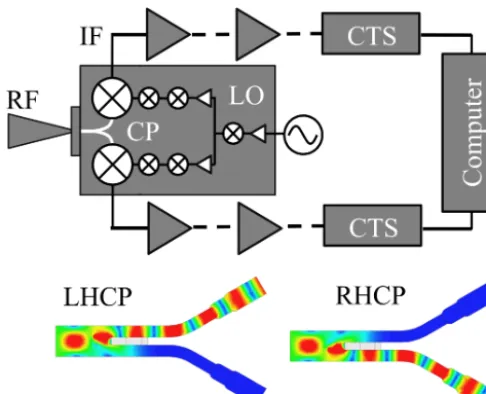
The sensor is also limited in mass and power budget by the small scale of the platform itself. We will, for instance, not be able to change the local oscillator to be sensitive to different ranges than those selected on the design board. A schematic sketch of the instrument can be seen in Fig. 1. The spec-trometer we plan to use is the chirp transform specspec-trometer designed for the Jupiter icy moon explorer’s submillimeter wave instrument, with 10 000 channels over a 1 GHz range (for examples on this type of spectrometer, see, e.g., Hartogh and Hartmann, 1990; Hartogh, 1997; Hartogh and Oster-schek, 1995; Villanueva and Hartogh, 2004; Villanueva et al., 2006; Paganini and Hartogh, 2009). The local oscillator will be at 481.15 GHz with a central intermediate frequency of 6 GHz. There will be no suppression of either of the side-bands, so the measured radiation will be between 474.65– 475.65 and 486.65–487.65 GHz. The system noise tempera-ture is expected to be about 2000 K in double-sideband mode. The antenna is planned to be 30 cm large and made of carbon fiber reinforced plastic. This achieves a 10 km vertical foot-print at orbit altitudes below about 400 km, with a resolution half-width of about 0.14◦. A lower system noise would im-prove all results presented below, though the quoted number is as good as we expect the instrument will be at time of flight.
We plan to use two identical receiver systems with the same setups but fed different states of polarization. The po-larization states will be separated using a feed horn antenna. This way, if one of the receiver chains experiences techni-cal issues, we can use the other to keep measuring the at-mosphere. In addition, while both chains work, we can mea-sure the magnetic field. Molecular oxygen is affected by the Zeeman effect (Zeeman, 1897), so it is possible to sense the strongest crustal magnetic field through the state of polariza-tion (for more details, please see Larsson et al., 2013, 2014, 2017, 2018).
Figure 1.Sketch of sensor electronics design. The radio frequency (RF) between 474.65–475.65 and 486.65–487.65 GHz enters from the left in the figure and is split by a circular polarizer (CP) into left-handed, and right-handed, circular polarization (LHCP, RHCP) as demonstrated in the colored plots above. The signal is then mixed with the signal of a local oscillator at 481.15 GHz, to lower the frequency to a measurable range. At an intermediate frequency of 6 GHz, the chirp transform spectrometer turns this analog signal into a digital signal that is fed into a computer for preparations and to be sent back to Earth.
2.3 Forward model
We use the Atmospheric Radiative Transfer Simulator (ARTS; Eriksson et al., 2011; Buehler et al., 2018) for all for-ward simulations. ARTS is a fully three-dimensional model with full polarization capabilities that has been used in nu-merous studies. Please see the two cited articles, other arti-cles citing them, and the source code – available via a copy-left license at http://www.radiativetransfer.org/ (last access: 10 December 2018) – to understand the radiative transfer method of ARTS in more detail. All of the data used in this study can be found via the aforementioned link.
The standard scenario atmosphere is from daytime simu-lations by Laboratoire de Météorologie Dynamique’s global circulation model (Forget et al., 1999) for a solar angle of 0◦. The temperature and volume mixing ratio profiles for key species are shown in Fig. 2. The magnetic field is set to a constant 1 µT throughout the transfer, pointing along the line of sight of the transfer. We expect there to be large variations in some gases (i.e., gaseous water, ozone, and hydrogen per-oxide) and in the strength of the magnetic field. In order to demonstrate how the error estimation changes as the forward model scenario changes, we perform the simulations at a 100 times lower volume mixing ratio of these gases and of the magnetic field. In this reduced case, we still keep the temper-ature and molecular oxygen mixing ratios the same as in the
standard scenario. We do not set the wind speed in any sce-nario but perform retrievals of it from analytical expressions of its Jacobian.
A spectroscopic suite suitable for Mars was developed by Buehler et al. (2018), which we use for our simulations. It computes pressure broadening and shifting per atmospheric species rather than from a predefined atmospheric composi-tion. We also use the carbon dioxide collision-induced ab-sorption from Gruszka and Borysow (1997) as the continua shown in Fig. 3. These continua are key to low-altitude limb measurements and are the main reason we are focusing on the 400 GHz range rather than higher frequencies. Note that the continua are effectively twice as strong as normal since we will not suppress the lower or upper sidebands. A big prob-lem with these continua is that they are only defined down to a temperature of 200 K. For lower temperatures, we simply extrapolate to these using the Gruszka and Borysow (1997) code by ignoring the warnings. Despite these issues, we still choose to include the continua since ignoring a potential 20– 120 K signal would be catastrophic for the science of the mis-sion. Clearly, the carbon dioxide continua have to be studied more for Mars atmospheric conditions since their influence is notably strong. Even if our extrapolation is the cause of most of the absorption that we see (because of some model artifact at lower temperatures), it is necessary to confirm that this is the case and to limit the influence of the continua. 2.4 Error analysis
We use the optimal estimation method described by Rodgers (2000) to predict at what level of precision and resolution we will be able to measure atmospheric parameters. This is done by assuming a linear error. Errors tend to be linear near the target even if the retrieval process or underlying physics is non-linear. The computed error is from
ex=SaJ>
JSaJ>+Se −1
ey=
Figure 2.Temperature and volume mixing ratio profiles used in the simulations.
Figure 3.Limb pencil view simulation of Mars considering only the carbon dioxide continua. Pencil tangent altitudes are indicated by the legend. The increase in the signal at higher altitudes and higher frequency is probably a consequence of the extrapolation of the model parameters.
each altitude level is from a standard deviation of the molec-ular oxygen mixing ratio of 100 ppmv, of the gaseous water mixing ratio of 1 ppmv, of the hydrogen peroxide and ozone mixing ratios of 10 ppbv, of the magnetic field strength of 10 µT, of the temperature of 10 K, and of the wind speed of 100 m s−1. These numbers were chosen because they are the closest order of magnitude standard deviations that produce a clear measurement response for each model parameter in the limb-scanning simulations at 1 s integration time. For some of these parameters, we will discuss what happens to the er-ror estimations by increasing the standard deviation by 1 or-der of magnitude. The measurement response is defined as
r=SaJ>
JSaJ>+Se −1
Ju=
S−1a +J>S−1e J−1J>S−1e Ju=Au, (2) whereuis a vector of ones, andAis the averaging kernel. We define a clear measurement response as max(r) >0.8. The trace ofAgives the degrees of freedom of the retrieval system.
Note that the shape of the averaging kernels gives the al-titude range where the measurements are sensitive to the at-mospheric parameters, a combination of the instrument’s sta-tistical and physical vertical resolution. The degrees of free-dom of the averaging kernel give a rough estimation of how
many distinct parameters can be set over the entire profile altitude range, given the statistical constraints. A reduction in the degrees of freedom by, e.g., assuming a larger statis-tical correlation distance or by integrating the signal over a wider vertical slice of the atmosphere, should be followed by an increase in the precision of the retrieved parameter at the cost of a loss in vertical resolution. It is also possible to increase the precision of the retrieved model parameters by increasing the integration time to reduce the measurement noise. This has the cost of reducing the spatial resolution ei-ther vertically or horizontally. We will not consider this type of reduced resolution in this work, partly because such a re-duction can be done by averaging measurements a posteriori so long as the original data are available in a high time reso-lution. The only test of resolution versus precision we make in this work is one where we vary the a priori correlation dis-tance. Although a very crude estimation, it serves the purpose of finding a limit to the precision.
3 Results and discussion
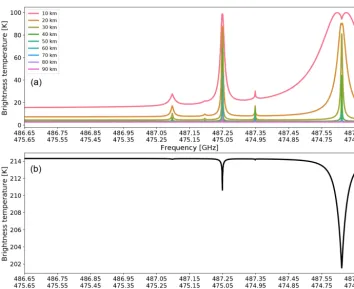
Figure 4.Simulated signal for the sensor. The signal unit is in Planck-equivalent brightness temperature as expected with the sensor calibrated to have half of its measured signal from each sideband. Panel(a)shows the simulated limb-scanning geometry for several tangent altitudes (used in later figures). The legend contains the tangent altitudes. Panel(b)shows the simulated nadir-staring mode signal (also used in later figures).
at 400 km for the presented signal and for a signal with 100 times less gaseous water, hydrogen peroxide, and ozone, and with a 100 times weaker magnetic field. The error estima-tions are from a 1 s long integration time per tangent altitude with all tangent profile used to make up the inputs to Eq. (1) for the error estimations. The next subsection also presents nadir-staring error estimations. We set the integration time to 1 h in nadir-staring mode to reduce the signal-to-noise ratio. 3.1 Modeled sensor signal
The simulated signal from 486.65 to 487.65 GHz and from 475.65 to 474.65 GHz is shown in Fig. 4. The signal shows two hydrogen peroxide absorption lines at 475.20 and 487.20 GHz, a single molecular oxygen absorption line at 487.25 GHz, a single ozone absorption line at 487.35 GHz, and a single gaseous water absorption line near the edge at 474.69 GHz. The limb view signal from molecular oxygen is saturated at the lowest tangent altitude (peaks of 95 K in the double-sideband view), but its signal is more reduced at higher altitudes. The gaseous water signal is also saturated at lower tangent altitudes but weakens greatly at higher tangent altitudes. The ozone signal is weak, about 5 K in strength at low altitudes, due to Ozone’s consistently high mixing ra-tio at higher altitudes. The hydrogen peroxide signal is also
weak, but much stronger than the ozone signal, at 10 K at low altitudes, but its strength decreases more rapidly at higher al-titudes.
3.2 Error estimations
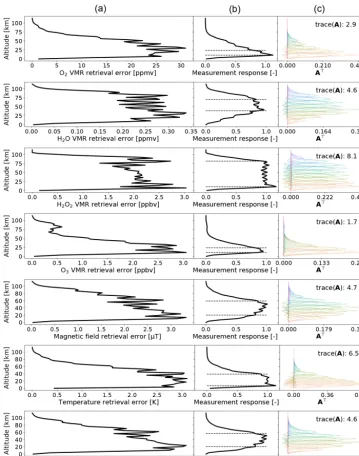
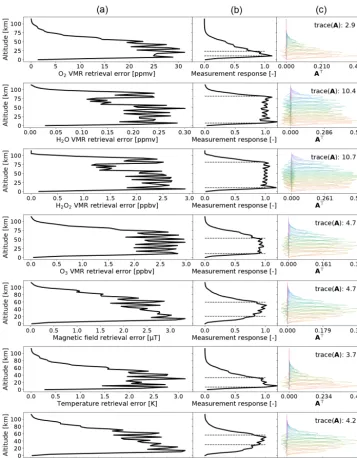
The estimated errors on the forward model parameters for limb-scanning observations are shown in Fig. 5 for a single second of integration time pointing at each of the tangent altitudes of Fig. 4. In addition to the signal in Fig. 4, we also present a case in Fig. 6 where the gaseous water, the hydrogen peroxide, and the ozone volume mixing ratios, as well as the magnetic field strength, are reduced by a factor of 100. Below, for simplicity, the atmosphere with less water is called “dry” and the atmosphere with more water is called “wet”. The estimated errors on the forward model parame-ters for nadir-staring mode are shown in Fig. 7 for a full 1 h of integration time.
For Figs. 5, 6, and 7:
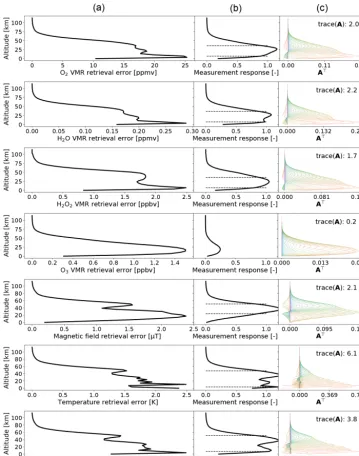
Figure 5.Forward model parameter error estimations for the atmosphere of Fig. 2 in limb-scanning mode with 1 s integration time at each of the tangent altitudes of Fig. 4. By columns, column(a)shows the total error estimations and these errors, column(b)shows the measurement response by the solid line with the dashed lines marking the 0.8 level, column(c)shows the transpose of the averaging kernel, color coding its columns and showing its trace or the degrees of freedom of the setup. The rows show the forward model parameters whose retrieval are being simulated, with the top row showing molecular oxygen, the second row showing gaseous water, the third row showing hydrogen peroxide, the fourth row showing ozone, the fifth row showing magnetic field, the sixth row showing temperature, and the last row showing wind speed.
about 15 ppmv. Molecular oxygen is not expected to change at short timescales, so either scenario is good for the purpose of the mission to place a constraint on our knowledge of molecular oxygen variations. Longer inte-gration times in limb-scanning mode, or staring at lower altitudes, could be useful for limiting the vertical profile of the molecule better, especially at lower altitudes. For
instance, the very near-surface error achieves good mea-surement response by merely increasing the integration time to 2 s staring every 10 km from 5 to 35 km. – In terms of gaseous water, reducing the gaseous water
Figure 6.Same as Fig. 5 but with gaseous water, hydrogen peroxide, and ozone lowered by a factor of 100 to the atmosphere of Fig. 2 and a magnetic field strength of 10 nT. Also, molecular oxygen is left out of this figure because it is not affected by the change.
range of good measurement response from 40 to 70 km for a wet atmosphere and from 10 to 80 km in a dry at-mosphere. In nadir-staring mode, the measurement re-sponse is good, from 10 to 40 km, with similar levels of error to those estimated for the limb-scanning mode. To have a good measurement response near the surface for a single profile in a wet atmosphere, the a priori standard deviation of water can be increased by an or-der of magnitude, which yields an error estimation of about 3 ppmv and good measurement response from the ground to 40 km (not shown).
Figure 7.Same as Fig. 5 but for nadir-staring mode and for 1 h of integration time.
– In terms of ozone, the instrument is not sensitive to ozone in nadir-staring mode. In limb-scanning mode, the error is expected to be about 2 ppbv. For the wet atmosphere, the good measurement response range is limited to 10 to 30 km. The dry atmosphere offers a much greater responsive measurement range from 10 to 60 km. The wet atmosphere scenario has about 50 ppbv in an altitude range around 50 km, so an error at 2 ppbv is good enough to see variations at high altitudes. Closer to the surface, the ozone mixing ratio increases to above 100 ppbv, but our instrument will only be sensitive for a single profile measurement at those altitudes if the at-mosphere is dry and we keep the current constraints. It
is possible to improve the sensitivity, e.g., by increasing the standard deviation of ozone in the a priori matrix by 1 order of magnitude. Doing that, the estimate error in-creases to about 25 ppbv and near-surface altitudes have good measurement response.
subsequent orbits can be used to limit the strength of the magnetic field more strongly. The sensor measures circular polarization, so only when the magnetic field is pointing at the sensor will there be a strong signal. For nadir-staring mode, this limits us to the stronger mag-netic field areas, which cover a relatively small area. So, to achieve the error here, many subsequent orbits must observe the area. For limb-scanning mode, com-bining the measurements above a single tangent profile from different azimuth angles will improve the preci-sion even more than shown in our figures. Finally, the molecular oxygen profile in our simulations consists of almost 50 % less molecular oxygen than has previously been measured because these are produced by the cir-culation model. A 40 % increase in molecular oxygen in our simulations means that the estimated error is re-duced by about a third of the error estimates given here. – In terms of temperature, in limb-scanning mode, the temperature error estimated for a single profile is about 2 to 2.5 K, with good measurement response from 10 to 40 km. In nadir-staring mode, the temperature error esti-mation is about 1.5 K, with good measurement response from the ground to 50 km.
– In terms of wind speed, the wind speed error is esti-mated from 20 to 25 m s−1depending on atmospheric wetness, for good measurement response at an altitude range of approximately 20 to 60 km. In nadir-staring mode, wind speed errors are about 20 m s−1, with a good measurement response from 10 to 60 km. The ver-tical wind speed will not be this strong along the path of observations in nadir-staring mode, so attempting to retrieve the wind parameter with our instrument in nadir observations will not be useful.
3.3 On vertical resolution versus precision
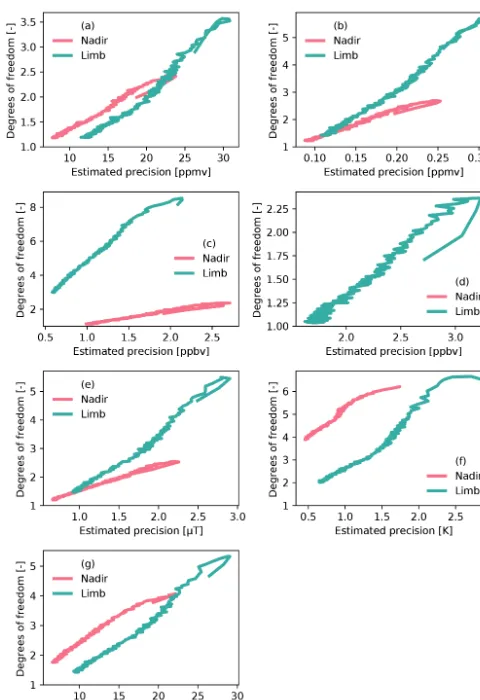
An estimation of the vertical resolution versus precision can be had by letting the correlation distance increase to large distances. In Fig. 8, we let the correlation distance vary from a diagonal a priori matrix to 1000 km for both nadir-staring and limb-scanning simulations. The figure shows the degrees of freedom of the averaging kernel at these different corre-lation distances versus the precision in the range where the measurement response is above 80 %. This way, the figure indicates that what we are trading for increased precision is lower degrees of freedom. Lower correlation distances tend to have more degrees of freedom. Since we discuss the uncor-related case in precious subsection, we limit the discussion below to longer correlation distances, where the degrees of freedom are reduced. These represents a scenario where we assume that the state of the atmosphere at one level is highly correlated with that at every other level. This is a somewhat crude way to reduce the degrees of freedom of the problem,
Figure 8.Estimated precision versus degrees of freedom (DOFs) by increasing the correlation distance all the way to 1000 km (not shown). Panel(a)is for molecular oxygen. Panel(b)is for gaseous water. Panel(c)is for hydrogen peroxide. Panel(d)is for ozone. Panel(e)is for the magnetic field strength. Panel(f)is for the tem-perature. Panel(g)is for the wind speed. The legends indicate the observation strategy as used for Figs. 5 or 7. The estimated preci-sions are the mean over the range of max(r) >0.8, so the ozone panel lacks a line for nadir-staring mode since it is never sensitive at the a priori standard deviations presented in the subsection on er-ror analysis. Note that the solid line goes from shorter correlation distance tending towards higher degrees of freedom to longer cor-relation distances tending towards lower degrees of freedom. The “hook” that appears on the right-hand side of some of the lines is from correlation distances much shorter than the antenna resolution.
The limb-scanning mode retains more than 1 degree of free-dom. For ozone, limb-scanning mode errors remain at about 2 ppbv in the highly correlated state, as its degrees of freedom are low to begin with for the uncorrelated a priori covariance matrix. The magnetic field in the highly correlated state has limb-scanning mode estimated errors at 1 µT and in nadir-staring mode at 0.5 µT. Since the magnetic field is highly correlated with vertical distance, these numbers might better represent the precision at which we can retrieve the magnetic field strength from a single profile than the errors estimated in the previous subsection. The temperature error estimation in the highly correlated case retains degrees of freedom in both nadir-staring and limb-scanning modes, meaning the re-trieval system does not allow the trade that we are after. The errors are expected to be about 0.5 K. The wind speed errors are expected to be around 5 to 10 m s−1in the highly corre-lated case.
4 Conclusions
We present a feasibility study for a submillimeter instru-ment on a small Mars mission currently under construction. The instrument will be able to measure several atmospheric species crucial for understanding Martian molecular oxygen, gaseous water, hydrogen peroxide, and ozone at low errors. In addition to these, the instrument will be able to limit the crustal magnetic field and get the meteorological parame-ters of temperature and wind speed. The expected measure-ment errors before spatial and temporal averaging are 15 to 25 ppmv for the molecular oxygen mixing ratio, 0.2 ppmv for the gaseous water mixing ratio, 2 ppbv for the hydrogen per-oxide mixing ratio, 2 ppbv for the ozone mixing ratio, 1.5 to 2.5 µT for the magnetic field strength, 1.5 to 2.5 K for the temperature profile, and 20 to 25 m s−1for the horizon-tal wind speed. These error ranges are well within the range needed to push the boundary of Mars knowledge.
Data availability. The data, the model, and related tools used in this study can be examined by subversion and/or git via http://www. radiativetransfer.org (last access: 13 December 2018). The data are in the subversion repository https://arts.mi.uni-hamburg.de/svn/rt/ arts-xml-data/trunk/ (last access: 13 December 2018) and the model is in the subversion repository https://arts.mi.uni-hamburg.de/svn/ rt/arts/trunk (last access: 13 December 2018).
Author contributions. RL prepared the manuscript with input from all co-authors. He also performed the underlying forward simula-tions and retrievals. YK initiated the concept as the leader of the project. TK provided to discussions about the Martian atmosphere. SS manages the general sensor design process. TY helped with discussions on the forward simulations and provided insights on electro-chemistry of hydrogen peroxide. HM helped with the gen-eral backend designs. YH provided the polarization feedhorn
de-sign. TN contributed with the antenna dede-sign. SN provides towards the platform design. PH provided expertise on the chirp transform spectrometer.
Competing interests. The authors declare that they have no conflict of interest.
Acknowledgements. Richard Larsson was funded by DFG project HA3261/9-1 in the later parts of the study, after the initial review.
Edited by: Maria Genzer
Reviewed by: two anonymous referees
References
Atreya, S., Wong, A.-S., Renna, N., Farrell, W., Delory, G., Sent-man, D., Cummer, S., Marshall, J., Rafkin, S., and Catling, D.: Oxidant Enhancement in Martian Dust Devils and Storms: Impli-cation for Life and Habitability, Astrobiology, 6, 439–450, 2006. Buehler, S. A., Mendrok, J., Eriksson, P., Perrin, A., Larsson, R., and Lemke, O.: ARTS, the Atmospheric Radiative Transfer Simulator – version 2.2, the planetary toolbox edition, Geosci. Model Dev., 11, 1537–1556, https://doi.org/10.5194/gmd-11-1537-2018, 2018.
Carleton, N. P. and Traub, W. A.: Detection of molecular oxygen on Mars, Science, 177, 988–992, 1972.
Delory, G., Farrell, W., Atreya, S., Renna, N., Wong, A.-S., Cum-mer, S., Sentman, D., Marshall, J., Rafkin, S., and Catling, D.: Oxidant Enhancement in Martian Dust Devils and Storms: Storm Electric Fields and Electron Dissociative Attachment, Astrobiol-ogy, 6, 450–462, 2006.
Eriksson, P., Jiménez, C., and Buehler, S. A.: Qpack, a general tool for instrument simulation and retrieval work, J. Quant. Spectrosc. Ra., 91, 47–64, https://doi.org/10.1016/j.jqsrt.2004.05.050, 2005.
Eriksson, P., Buehler, S. A., Davis, C. P., Emde, C., and Lemke, O.: ARTS, the atmospheric radiative transfer simulator, Version 2, J. Quant. Spectrosc. Ra., 112, 1551–1558, 2011.
Forget, F., Hourdin, F., Foumier, R., Hourdin, C., and Talagran, O.: Improved general circulation models of the Martian atmosphere from the surface to above 80 km, J. Geophys. Res., 104, 155–175, 1999.
Gruszka, M. and Borysow, A.: Roto-Translational Collision-Induced Absorption of CO2 for the Atmosphere of Venus at Frequencies from 0 to 250 cm−1, at Tem-peratures from 200 to 800 K, Icarus, 129, 172–177, https://doi.org/10.1006/icar.1997.5773, 1997.
Hartogh, P.: High-resolution chirp transform spectrom-eter for middle atmospheric microwave sounding, https://doi.org/10.1117/12.301141, 1997.
Hartogh, P. and Hartmann, G. K.: A high-resolution chirp transform spectrometer for microwave measurements, Meas. Sci. Technol., 1, 592 pp., available at: http://stacks.iop.org/0957-0233/1/i=7/a= 008 (last access: 10 December 2018), 1990.
atmospheric trace gases, Proc. SPIE, 2583, 2583–2583–8, https://doi.org/10.1117/12.228573, 1995.
Hartogh, P., Jarchow, C., Lellouch, E., Val-Borro, M., Rengel, M., Moreno, R., Medvedev, A., Sagawa, H., Swinyard, B., Cavalié, T., Lis, D., Błe¸cka, M., Banaszkiewicz, M., Bockelée-Morvan, D., Crovisier, J., Encrenaz, T., Küppers, M., Lara, L., Szutowicz, S., Vandenbussche, B., Bensch, F., Bergin, E. A., Billebaud, F., Biver, N., Blake, G., Blommaert, J., Cernicharo, J., Decin, L., En-crenaz, P., Feuchtgruber, H., Fulton, T., de Graauw, T., Jehin, E., Kidger, M., Lorente, R., Naylor, D., Portyankina, G., Sánchez-Portal, M., Schieder, R., Sidher, S., Thomas, N., Verdugo, E., Waelkens, C., Whyborn, N., Teyssier, D., Helmich, F., Roelf-sema, P., Stutzki, J., LeDuc, H., and Stern, J.: Herschel/HIFI ob-servations of Mars: first detection of O2at submillimetre wave-lengths and upper limits on HCl and H2O2, Astron. Astrophys., 521, L49, https://doi.org/10.1051/0004-6361/201015160, 2010. Kasai, Y., Sagawa, H., Kuroda, T., Manabe, T., Ochiai, S., Kikuchi,
K., Nishibori, T., Baron, P., Mendrok, J., Hartogh, P., Murtagh, D., Urban, J., von Schéele, F., and Frisk, U.: Overview of the Martian atmospheric submillimetre sounder FIRE, Planet. Space Sci., 63-64, 62–82, 2012.
Larsson, R., Ramstad, R., Mendrok, J., Buehler, S. A., and Kasai, Y.: A Method for Remote Sensing of Weak Planetary Magnetic Fields: Simulated Application to Mars, Geophys. Res. Lett., 40, 5014–5018, 2013.
Larsson, R., Buehler, S. A., Eriksson, P., and Mendrok, J.: A treat-ment of the Zeeman effect using Stokes formalism and its im-plementation in the Atmospheric Radiative Transfer Simulator (ARTS), J. Quant. Spectrosc. Ra., 133, 445–453, 2014. Larsson, R., Milz, M., Eriksson, P., Mendrok, J., Kasai, Y.,
Buehler, S. A., Diéval, C., Brain, D., and Hartogh, P.: Martian magnetism with orbiting sub-millimeter sensor: simulated re-trieval system, Geosci. Instrum. Method. Data Syst., 6, 27–37, https://doi.org/10.5194/gi-6-27-2017, 2017.
Larsson, R., Lankhaar, B., and Eriksson, P.: Updated Zeeman effect splitting coefficients for molecular oxygen in plane-tary applications, J. Quant. Spectrosc. Ra., 224, 431–438, https://doi.org/10.1016/j.jqsrt.2018.12.004, 2018.
Mahaffy, P. R., Webster, C. R., Atreya, S. K., Franz, H., Wong, M., Conrad, P. G., Harpold, D., Jones, J. J., Leshin, L. A., Manning, H., Owen, T., Pepin, R. O., Squyres, S., Trainer, and Team, M. S.: Abundance and Isotopic Composition of Gases in the Martian Atmosphere from the Curiosity Rover, Science, 341, 263–266, 2013.
Paganini, L. and Hartogh, P.: Analysis of nonlinear effects in mi-crowave spectrometers, J. Geophys. Res.-Atmos., 114, D13305, https://doi.org/10.1029/2008JD011141, 2009.
Rodgers, C. D.: Inverse methods for atmospheric sounding: Theory and practice, vol. 2, World Scientific Publishing Co. Pte. Ltd., 2000.
Sandel, B., Gröller, H., Yelle, R., Koskinen, T., Lewis, N., Bertaux, J.-L., Montmessin, F., and Quémerais, E.: Altitude profiles of O2 on Mars from SPICAM stellar occultations, Icarus, 252, 154– 160, https://doi.org/10.1016/j.icarus.2015.01.004, 2015. Urban, J., Dassas, K., Forget, F., and Ricaud, P.: Retrieval
of vertical constituents and temperature profiles from pas-sive submillimeter wave limb observations of the Martian at-mosphere: a feasibility study, Appl. Optics, 44, 2438–2455, https://doi.org/10.1364/AO.44.002438, 2005.
Villanueva, G. and Hartogh, P.: The High Resolution Chirp Trans-form Spectrometer for the Sofia-Great Instrument, Exp. Astron., 18, 77–91, https://doi.org/10.1007/s10686-005-9004-3, 2004. Villanueva, G. L., Hartogh, P., and Reindl, L. M.: A digital
dis-persive matching network for SAW devices in chirp trans-form spectrometers, IEEE T. Microw. Theory, 54, 1415–1424, https://doi.org/10.1109/TMTT.2006.871244, 2006.