Research Article
The Effect of Polymorphisms of Estrogen Receptor
β
RS1271572
to the Incidence of Epithelial Ovarian Carcinoma
Pengaruh Polimorfisme Reseptor Estrogen
βRS1271572
Terhadap Kejadian Karsinoma Epitel Ovarium
Dwi S. Indrasari, Rizal Sanif, Yusuf Effendi, Irsan Saleh
Department of Obstetrics and Gynecology Medical Faculty of Sriwijaya University/
Dr. Mohammad Hoesin Hospital Palembang
INTRODUCTION
Ovarian cancer is the most common gynecological malignancy, with over 5,000 new cases diagnosed every year in the UK and 22,000 in United States. Malignant neoplasm of the ovaries occur at all ages and the incidence rates increase dramatically with age. Starting from women aged 40-44 years, which has a rate of 15.7 per 100,000, and increased to a rate of 54 per 100,000 in women 75-79 years old. The rate increase to more than doubles after the age of 50 years, while one third of the case was found in women over 65 years old.1-6
The highest incidence was found in Norwegia (15.3/100,000), while the lowest incidence was found in Japan (3.2/100,000). In the Southeast Asia region, including Indonesia, the incidence rate is 6.6%. Data from 2006-2008 in Department of Pa-thology Medical Faculty University of Sriwijaya Palembang demonstrated that ovarian cancer ac-counts for 12% of all gynecological malignancy, while in 2007 the incidence decereased until 7% and in 2008, ovarian cancer accounts for 10% of all gynecological malignancies.7,8
Abstract
Objective: To determine the effect of polymorphism of estrogen re-ceptor β to the risk of epithelial ovarian carcinoma at Dr. Mohammad Hoesin Hospital Palembang
Methods: This population-based case control study included 40 women with epithelial ovarian carcinoma and 40 controls, from January 2010 until December 2011. Data analysis was performed by Chi Square test.
Results: Distribution of estrogen receptor beta genotypes, both GT and TT (wild type-mutant and mutant), among case subjects was significantly higher than control (24 subjects {60%} vs. 5 subjects {12.5%}). The genotype effect was statistically significant for rs1271572 (OR=2.636; p=0.039) with Chi Square analysis. Whereas the allotype effect was also statistically significant (OR=1.949; p= 0.047).
Conclusion: Polymorphism of estrogen receptor β may play a role in the risk of epithelial ovarian carcinoma at Dr. Mohammad Hoesin Hospital Palembang.
[Indones J Obstet Gynecol 2012; 36-1:32-6]
Keywords: epithelial ovarian carcinoma, polymorphism of estrogen receptor β, risk factor of ovarian carcinoma
Abstrak
Tujuan: Mengetahui adanya pengaruh polimorfisme rs1271572 gen reseptor estrogen β pada kejadian karsinoma ovarium epitel di Rumah Sakit Dr. Mohammad Hoesin Palembang.
Metode: Penelitian ini merupakan desain studi kasus control dengan subjek 40 kasus dan 40 kontrol. Penelitian dimulai Januari 2010 sam-pai Desember 2011. Analisis data menggunakan uji Chi Square.
Hasil: Dari hasil penelitian didapatkan distribusi genotip polimor-fisme rs1271572 gen reseptor estrogen β ,di mana genotip GT dan TT (wild type-mutan dan mutan) lebih banyak terdapat pada kelompok kasus yaitu 24 kasus (60%) dan 5 kasus (12,5%), sedangkan pada kelompok kontrol, yang terbanyak adalah genotip GG (wild type) de-ngan 20 subjek (50%). Pengaruh polimorfisme gen reseptor estrogen
β pada kejadian karsinoma ovarium epitel berdasarkan genotipnya dari analisis statistik dengan uji Chi Square, didapatkan nilai p=0,039 dan Odd Ratio 2,636. Sedangkan dari analisis statistik terhadap pe-ngaruh polimorfisme reseptor estrogen β berdasarkan allotipenya di-dapatkan nilai p=0,047 dan Odd Ratio=1,949.
Kesimpulan: Polimorfisme gen reseptor estrogen β mempengaruhi
terjadinya karsinoma ovarium epitel di Rumah Sakit Dr. Mohammad Hoesin Palembang.
[Maj Obstet Ginekol Indones 2012; 36-1:32-6]
Kata Kunci: faktor risiko karsinoma ovarium, karsinoma ovarium epitel, polimorfisme gen reseptor estrogen β
Epithelial ovarian tumor consist of serous, muci-nous, endometrioid, clear cell, and mixed epithelial type. Epithelial type is the most common type found in ovarian cancer, which accounts for 85%-90%.6-8 Based on the theory, etiology of ovarian cancer con-sist of incessant ovulation hypothesis, gonadotropin hypothesis, androgen hypothesis, progesteron hy-pothesis, parity, pill contraception, tubal ligation, menopausal hormonal replacemant therapy, and hereditary factors. One of these that also affect the incidence of ovarian cancer is involvement of estro-gen receptor, both the alpha and beta receptor. Thus, polymorphism of estrogen receptor gene may play a role in the development of ovarian can-cer.6,9,10
Endogenous and exogenous estrogen play a role in ovarian carcinogenesis. Estrogen effects are me-diated by two estrogen receptors, estrogen recep-tor alpha (ERα) and estrogen receptor beta (ERβ).
Both ER subtypes are present in ovarian surface epithelial cells, and reponsive to the estrogen. 9,10
Ovarian carcinoma is the most complex form of all of malignancy, both hystopathologically and im-muno hystochemically. Many researchers try to de-termine the factors that may play a role in ovarian carcinogenesis. One of those is polymorphism of es-trogen receptor gene. Lurie et al (2008) demon-strated the effect of polymorphism of estrogen re-ceptor gene to the risk of epithelial ovarian cancer and found that there is effect polymorphism of es-trogen receptor β to the risk of epithelial ovarian
carcinoma.10,11
ERβ is the predominant type in the normal
ovary. It has been shown that it plays a role incellu-lar proliferation and apoptosis. This polymorphism of ERβ will altered the function of ERβ in cellular
regulation. A loss of ERβ expression could thus
con-stitute a crucial step in ovarian carcinogenesis, al-though the precise mechanism of ERβ role in
ovar-ian carcinogenesis remains to be undetermined.5,6 Lurie et al found that there is an association be-tween polymorphism of ERβ rs1271572 and the
risk of developing invasive ovarian carcinoma.10-12 That, combined with the fact that there is no pre-vious finding about polymorphism of ERβ in Dr.
Mohammad Hoesin Hospital Palembang, caused the researcher to be interested in this finding.
METHODS
This study was a case control study, held in Obstet-rics and Gynecology Department at Dr. Mohammad
Hoesin Hospital, Palembang, in collaboration with Palembang Distric Laboratory, South Sumatera, In-donesia, from January 2010 until December 2011. Subject of this study was women diagnosed with epithelial ovarian carcinoma admitted to the ob-stetric and gynecology ward in Dr. Mohammad Hoesin hospital, Palembang.
Inclusion criterias were women diagnosed with epithelial ovarian carcinoma, proven by histopatol-ogy examination, agree for blood examination and signing the informed consent form. The control group consists of patients diagnosed with no neo-plasm, who were willing to be the subject of the study and signing the informed consent form.
Patient meeting the inclusion criteria received counseling and a questionnaire. The blood sample was taken and placed in reaction glass which was already filled with 3 cc ethylene diamine tetraacetic (EDTA). Then, the glass was placed at maximum temperature 40° Celcius until the PCR was done, followed by DNA extraction.
To determine the polymorphism of estrogen re-ceptor β, the allele was analyzed with PCR method followed with sequencing. This study determined the polymorphism of estrogen β gene receptor at 5’ region (rs1271572) using a pair of primary nu-cleotide forward TGCCAGCGACACACTCT and re-verse AGGCCTTTCGCGTTAGATCA resulting 700 bp. Amplification with PCR method was done at thermal cycle DNA branded ICycler BIO-RAD Labo-ratories GB programmed for two step cycle based on modified Yaich method at a temperature of 95° Celcius denaturation for 5 minutes, followed by 30 cycles of denaturation at a temperature of 94° Cel-cius for 60 seconds, annealing at a temperature of 66° Celcius for 60 seconds and extension at a tem-perature of 72° Celcius for 60 seconds. Recently performed final extension cycle for 6 minutes at a temperature of 72° Celcius.
DNA sequencing was performed to confirm the presence of allele polymorphism. DNA sequencing was performed in the laboratory of molecular bi-ology Eijkman Jakarta. All data were analyzed us-ing SPSS 16.0 for Windows.
RESULT
(43 years). We found that 67.5% of the subjects in the cases group are in ≥ 43 year age range. Largest proportion of parity in the case is nulliparous of 37.5%. History of hormonal contraceptive use in the case of 40.0% where as in the control group by 52.5%. There is 62.5% subjects with meno-pausal status at the case group which is the largest percentage, while there were 55.0% subject in the control group not menopause yet. In the case group, found that 2.5% of the subjects had a family history of ovarian cancer while in the control group it was 10% of the subject.
To assess the polymorphism of β estrogen recep-tor, alleles analyzed by PCR (Polymerase Chain Re-action) and followed by DNA sequencing to confirm the presence of allele polymorphism. From the DNA sequencing, individuals with no polymorphisms in
β estrogen receptor gene showed with wild-type
al-lele with GG genotype. The existence of polymor-phisms in β estrogen receptor gene is indicated by changes in G to T. Subject who have a homozygous mutant allele with the TT genotype while in indi-viduals with wild-type and mutant alleles (het-erozygous) with GT genotype. At electroperogram of DNA sequencing, interpretation is peaks consist of four colors representing each nucleotide that is green for adenine (A), red for thymine (T), blue for cytosine (C), and black for guanine (G).
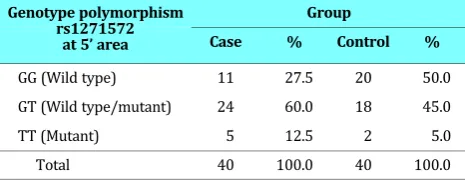
There were 60% subject at case group with GT genotype while there were 45% at the control group. Case group had 12.5% with TT genotype while control group had 5% of it.
Table 1. Distribution of genotype polymorphism rs1271572 at 5’area receptor β estrogen gene
Genotype polymorphism rs1271572
at 5’ area
Group
Case % Control %
GG (Wild type) 11 27.5 20 50.0
GT (Wild type/mutant) 24 60.0 18 45.0
TT (Mutant) 5 12.5 2 5.0
Total 40 100.0 40 100.0
Statistical analysis Chi Square test found a sig-nificant effect of genotype polymorphism rs1271572 in the area of 5’ estrogen receptor β gene on the incidence of epithelial ovarian carcinomas (p=0.039) with the odds ratio of 2.63.
Table 2. Effect of genotype polymorphism rs1271572 on 5’ area estrogen receptor β gene to the incidence of epithelial ovarian carcinomas.
Genotype polymorphism rs1271572
on 5’ area
Group
Case % Control %
TT + GT 29 72.5 20 50.0
GG 11 27.5 20 50.0
Total 40 100.0 40 100.0
Chi Square test, p = 0.039; OR = 2.636; 95% CI (1.04-6.68)
T allotype (mutant) is higher in case group (42.5%) while in control group (27.5%).
Table 3. The effect of allotype polymorphism rs1271572 in 5’ area estrogen receptor β gene to the incidence of epithel-ial ovarian carcinoma.
Allotype polymorphism rs1271572
in 5’ area
Group
Case % Control %
T (Mutant) 34 42.5 22 27.5
G (Wild type) 46 57.5 58 72.5
Total 80 100.0 80 100.0
Chi Square test, p = 0.047; OR = 1.949; 95% CI (1.01-3.77)
There are 16 subjects in case group who use hormonal contraceptive and there are 21 subjects in control group. From 16 subjects in case group, majority of women has T allotype, it’s about 46.9% while G allotype is 71.4% found in control group.
Table 4. The effect of allotype polymorphism rs1271572 estrogen receptor β gene in 5’ area to the incidence of epi-thelial ovarian carcinoma based on hormonal contraceptive use
Allotype polymorphism rs1271572
in 5’ area
Group
Case % Control %
T (Mutant) 15 46.9 12 28.6
G (Wild type) 17 53.1 30 71.4
Total 32 100.0 42 100.0
Chi Square test, p = 0.105; OR = 2.206; 95% CI (0.84-5.78) (b) GT on case 6
Figure 1. DNA sequencing.
DISCUSSION
The incidence rate of epithelial ovarian carcinoma increase dramatically with age. The age group 40-44 years, which has a rate of 15.7 cases per 100,000, and the rate more than doubles after the age of 50 yeras to about 35 cases per 100,000.
The case subjects in this finding, majority of women is nulliparous. McGowan et al reported in his study that 197 women with ovarian cancer found the nulliparous had a 2.45 times increased risk of malignant ovarian tumor compared with the parous women (with parity 3 or more).
Based on histrory of hormonal contraceptive use, percentage of contraceptive use is higher in control group, it’s about 21 subjects (52%) than case group, it’s about 16 subjects (40%). Many of studies report that pill contraceptive use can de-crease risk of ovarian carcinoma.
Majority of case subjects in this researchis post-menopausal women, it’s about 25 subjects (62.5%) Based on the theory more than 80% epithelial ovarian carcinoma is found in postmenopause. While in premenopausal women, malignant ovar-ian tumor is found only 7%. Based on the theory, menopause itself did’nt affect ovarian cancer, but the study report that there is association between use of hormonal replacement therapy during menopause in long period (more than 10 years) with the increase of ovarian cancer risk. Although in this study, all of menopausal subjects, there is no subject who use hormonal replacement therapy. History of familial ovarian carcinoma is found only 2.5% in case group, while the higher percentage is 10% found in control group. The majority of he-reditary ovarian cancer is caused by mutation of BRCA1 and BRCA2 genes, also in breast cancer.
Result of allele analysis with PCR method (Po-lymerase Chain Reaction) followed with DNA se-quence, found polymorphism of estrogen receptor
β rs1271572 which is shown there is transition
al-lele GT. Where as the reference of nucleotide se-quence is taken based on data from National Cen-ter for Biotechnology Information(NCBI) for SNPs rs1271572: TTAGGCACAGATGTGACACTGGGGGG[G/T] TCTCACAATGGCCTGTGGGTCACAT. From this sequence found three genotype such as GG (wild type), GT (wild type-mutant), and TT (mutant).
Based on the genotype distribution from the re-sult of allele analysis through DNA sequence found 60% subjects in case group with GT genotype,
while control group is 45%. For TT genotype, there is 12.5% in epithelial ovarian carcinoma group and 5% in control group. While the control group has higher proportion for GG genotype (wild type).
In epithelial ovarian carcinoma group found that there is significantly differentiation in percentage between GT and TT (wild type-mutant and mutant) compared to GG (wild type), it’s about 72.5% for genotype polymorphism, while only 27.5% for nor-mal genotype. From the result of Chi Square test statistically found that there is effect of genotype polymorphism ERβ rs1271572 significantly to the
risk of epithelial ovarian carcinoma with p value = 0.039 and OR=2.636. Result of analysis statistically based on allotype to determine the effect to the risk of epithelial ovarian carcinoma that also show the significantly result with p value = 0.047 dan OR = 1.949.
The effect of rs1271572 polymorphism suggest the result of previous finding which also suggest the similar result. From 10 case control studies found that there is association TT genotype rs1271572 with risk of ovarian cancer. Estrogen receptor β is
the predominant type in the normal ovary. Estrogen interact with their receptors to mediate various sig-naling pathways and biologic activity of estrogen play a role to affect the growth and cell differentia-tion as well as funcdifferentia-tion of reproductive tissue. The role of estrogen receptor β itself is in regulation of
cancer cells that play a role of regulation cellular proliferation (antiproliferative), cell motility, and as cell apoptosis. However, with there is this polymor-phism may alter the role of regulation in cellular proliferation which will affect transcription process become abnormal and then as antiapoptotic cell.
Based on hormonal contraceptive use, the effect of allotype polymorphism rs1271572 itself to the risk of epithelial ovarian carcinoma found statistic analysis with Chi Square test show that there is no effect significantly with p value=0,105. In the study by Lurie et al found there is association between polymorphism rs1271572 to the risk of ovarian cancer in women who never use hormonal contra-ceptive with p value = 0.04.
CONCLUSION
In this study found there is significantly effect be-tween polymorphism rs1271572 in 5’ region estro-gen receptor β to the incidence of epithelial ovarian
REFERENCES
1. MacDonal ND, Rosenthal AN, Jacobs IJ. Screening for ovar-ian cancer. Ann Acad Med Sin 1998; 27: 676-82.
2. The American College of Obstetricians and Gynecologist. Ovarian cancer. ACOG International Bulletin Number 250. August 1998. In: Compedium of selected publikankertions 2001. Washington: Am College Obstet Gynecol 2001; 9-671.
3. Berek JS. Ovarian cancer. In: Berek JS. Novak’s gynecology. 13th ed. Philadelpia: Lippincott Williams & Wilkins, 2002; 1245-68.
4. Look KY. Epidemiology, etiology, and screening of ovarian cancer. In: Rubin SC. Ovarian cancer. 2nd ed. Philadelphia:
Lippincott Williams and Wilkins, 2001; 167-80.
5. Disaia PJ, Creasman WT. Epithelial ovarian cancer. In: Clin Gynecol Oncol. 5th ed. St. Louis Missouri 1997: 282-343.
6. Ozols RF, Rubin SC, Thomas GM, Robboy SJ. Epithelial ovar-ian cancer. In: Hoskin WJ, Perez CA, Young RC, et al. Prin-ciples and Practice of Gynecologic Oncology. 4th ed.
Lippin-cott Williams & Wilkins. Philadelphia, 2005.
7. Gershenson DM. Advances in the management of early-stage epithelial ovarian cancer. In: Perry MC. Annual meet-ing educational book. 37th ed. Alexandria, 2001.
8. Deroo BJ, Korach KS. Estrogen receptors and human dis-ease. J Clin Invest 2006; (3):116
9. Aurelie B, Pascale H, Nathalie B, Dionyssios K, Francoise V, Pascal P, Gwendal L. Involvement of estrogen receptor β on ovarian carcinogenesis. Cancer Research 2004 August [cited 2004; 15(64): 1-9.
10. Galina L, Lynne RW, Pamela JP, Katharine EM, Michael EC, Keith YT, Marc TG. Genetic polymorphisms in the estrogen receptor beta (ESRβ) gene and the risk of epithelial ovarian carcinoma. Cancer Causes Control 2008; 15(20): 1-9. 11. Lurie G, Wilkens LR, Thompson JT, Shvetsov YB, Matsuno
RK. Estrogen receptor beta rs1271572 polymorphism and invasive ovarian carcinoma risk: pooled analysis within the ovarian cancer association consortium. Plos One 2011; 6(6): 1-6.