Conclusions
S.E. Jorgensen and R. Costanza
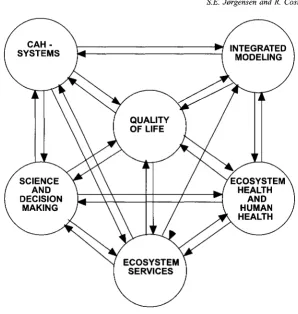
At first glance it seems difficult to draw conclusions based on the 12 preceding chapters that are the result of the EcoSummit workshop. The chapters are written in very different styles and their conclusions focus on a very wide spectrum of problems, which seem not to have much to do with each other. If we step back, however, it becomes clear that the six themes are very interrelated. Quality of life is of course dependent on the distribution of wealth and resources, but it is also dependent on human health, which again is dependent on ecosystem health. Assessment of ecosystem health requires a profound knowledge of ecosystems, which are complex adaptive, hierarchical systems. They cannot be overviewed unless we are able to develop integrated models, and an integrated model of an ecosystem cannot be developed unless we know the properties of ecosystems, i.e., CAHSystems. Quality of life is also dependent on a proper appreciation and use (not abuse) of ecosystem services. This is consistent with the definition of ecotechnology (Mitsch and Jorgensen, 1989): the design of human society with its natural environment for the benefit of both. Science is a prerequisite for our understanding of nature: How do ecosystems work? What do we understand by quality of life? Which factors influence human health? Decisions should always be taken on the basis of the best available scientific knowledge. Science, therefore, inevitably underlies all environmental decisions. So, all six themes are closely interrelated with all the other five themes directly and indirectly, forward and backward (fig. 1). We cannot look at any one of the themes separately, but need to integrate all six themes into a more comprehensive understanding of the environment, our impact on the environment and how to achieve a high quality of life in the framework of our society and our environment.
There has been an ongoing debate about which ecosystem theories are useful and are based on good science. It was proposed in 1992 (Jorgensen, 1992), that we have a pattern of almost consistent theories. This was reconfirmed at the EcoSummit: a pattern of something resembling an identifiable "CAHS Theory" is taking form. The various possible goal fijnctions or orientors: exergy
max-Understanding and Solving Environmental Problems in the 21st Century Edited by R. Costanza and S.E. Jergensen
Fig. 1. All the six themes are interrelated both forward and backward.
imization, maximum power, maximum entropy production, minimum specific entropy production (to mention a few) are for the most part consistent - not necessarily in all phases of ecosystem development but in some contexts. Only exergy maximization and maximum power seem to be applicable for all forms of growth and development and in all phases, but the other orientors are important to understand the reactions of ecosystems in all detail and in all phases. A number of different complementary approaches are needed to explain all aspects of structure, organization, and dynamics of CAHSystems. This is not surprising. For example, light, which is a much simpler phenomenon than an ecosystem, requires two different explanations to cover all the observations: waves and particles.
can facilitate and inform our environmental decisions - decisions about the use of ecological services, the influence of ecosystem health on our health and quality of life. The integrated models would also be improved because they would reflect the system properties of ecosystems and social systems, which again would imply better decisions.
The application of integrated modeling has accelerated in the last decade. Particularly, integration of hydrology and ecology and ecology and economics have been reflected in modeling, but there are still extremely few models concerned with integrated ecological-economic-social systems. More modeling effort with a simultaneous focus on ecological, economic, and social problems is urgently needed because most problems of mankind today involve all three types of problems at the same time. Any decision, for example, concerning a major construction work, a dam, a bridge, or an important building, will obviously have impacts on the environment, on the economy, and on the social structure. We probably have sufficient modeling experience to develop models integrating all three systems, but it is currently difficult to establish, fund, and maintain an interdisciplinary team with sufficient expertise in all types of problems. In addition, progress is slow because there is not sufficient experience with this type of modeling yet. The first fiiUy integrated models will probably fail, as was also the case when the first generation of more comprehensive ecological models were developed three decades ago. Many mistakes were made at first, but learning and understanding flowed from those mistakes.
A decade later, around 1980, the field of ecological modeling was maturing and reliable models could be developed, provided the experience gained was used properly (which was not always the case, of course). The conclusion is therefore, that we should get started on development of models integrating ecological, economic, and social problems, and accept that the initial models will give at best only some coarse qualitative or semi-qualitative results.
embracing the democratic process. Since we do not have a clear idea how to do this, we must start to make experiments and not get stuck in the present rigid system. The structure of today's society offers many new possibihties. For example, the Internet offers the potential for contact with a large segment of the population about a focal problem very rapidly.
Ecosystem health has been an important environmental concept for the last ten years (Costanza et al., 1992). When the concept was introduced, the idea was to get a list of important ecological indicators that could be utilized to assess ecosystem health. We do not have such a list today that can be used in all situations, but we do have sufficient experience to be able to use ecological indicators to come up with a reasonably good assessment of the health of an ecosystem. The same list of indicators is not used by everybody dealing with this assessment problem, but all medical doctors also do not use exactly the same indicators for assessment of human health. There is, however, a certain consensus on the underlying information of all the proposed indicators. It has also been agreed that we need - as for human health - several indicators at the same time to get a sufficiently comprehensive image of ecosystem health.
One of the main focuses in this field of applied ecology is the interrelationship between ecosystem health and human health. There is no doubt that they are intricately interdependent, but how strong and with what implications for human health in a specific situation? These tangible questions cannot yet be answered properly, at least not quantitatively. It is therefore the hope that in the future we can develop a more complete picture of the interactions between ecosystem health and human health. The discussion about this topic at the EcoSummit meeting may enhance our effort in this direction.
and how to restore a contaminated ecosystem. There are also several proposals for a set of basic principles for ecological engineering. The pattern and spectrum of ecosystem theories, needs, however, to be utilized better in the development of ecological engineering principles and in setting up guidelines for practical use of ecotechnology. Moreover, a far more advanced integration of ecological economics and ecological engineering seems necessary to ensure better planning and implementation of ecological engineering projects in the future.
"Quality of life" has strong interrelationships with the other five themes, and it is perhaps the topic requiring most integration. It is also the most "political" of the six themes, which is emphasized by the heading: "Quality of Life and the Distribution of Wealth and Resources", Finally, it is probably also the most difficult of the six themes for scientists to discuss.
Not surprisingly, a major obstacle to a good quality of life for all humans on earth is the unfair present distribution of wealth and resources. The biased view of the developed world makes it very difficult to find a solution of this problem. There are obviously many initiatives that we could take to adjust this unfair distribution of wealth and resources, mainly between the developed and the developing countries, but also between the poorest and the richest in each country. The solutions are rooted in ecological economics: use of green taxes, industrial ecology, a more complex and complete national accounting system that incorporates ecological, economic, and social sustainability. All these initiatives require, however, political decisions, again linking back to the science and decisionmaking theme.
All six themes contributed to a very successful and fruitfiil discussion at the EcoSummit. New ideas and thoughts came up and were discussed. A good overview of the state of the art and the trends of the six themes were presented for all participants at the meeting. Discussion of all six themes, and even to a greater extent the integration of the six themes, requires a very interdisciplinary approach, which was the very basis for the EcoSummit. Without the simultaneous presence of the readers of the five journals and the members of the five societies participating in the EcoSummit, the results achieved would not have been possible. The most important outcome for the individual participants at the conference (and hopefully for the readers of this book) may be the clear vision of the very wide perspectives of our research problems in all the applied disciplines of ecology (systems ecology, ecological and environmental modeling, assessment of ecosystem health, ecological engineering, and ecological economics) and the growing importance of creating the transdisciplinary "hard problem science" necessary to address them.
References
Jorgensen, S.E., 1992, Integration of Ecosystem Theories: A Pattern. (Kluwer Academic, Dordrecht). Second edition: 1997, 388 pp.