SPECIAL SECTION: FORUM ON VALUATION OF ECOSYSTEM SERVICES
The value of ecosystem services: putting the issues in
perspective
Robert Costanza
a,b,*, Ralph d’Arge
c, Rudolf de Groot
d, Stephen Farber
e,
Monica Grasso
f, Bruce Hannon
g,h, Karin Limburg
1,i, Shahid Naeem
j,
Robert V. O’Neill
k, Jose Paruelo
l, Robert G. Raskin
m, Paul Sutton
n,
Marjan van den Belt
oaDepartment of Zoology,Center for En6ironmental Science,Uni6ersity of Maryland,Box
38,Solomons,MD20688,USA bInstitute for Ecological Economics,Uni6ersity of Maryland,PO Box
38,Solomons,MD20688,USA cDepartment of Economics(emeritus),Uni6ersity of Wyoming,Laramie,WY,82070,USA dCenter for En6ironment and Climate Studies,Wageningen Agricultural Uni6ersity,PO Box9101,
6700HB Wageningen,The Netherlands
eGraduate School of Public and International Affairs,Uni6ersity of Pittsburgh,Pittsburgh,PA15260,USA fInstitute for Ecological Economics,Uni6ersity of Maryland,PO Box38,Solomons,MD20688,USA
gDepartment of Geography,Uni6ersity of Illinois,Urbana,IL61801,USA hNCSA,Uni6ersity of Illinois,Urbana,IL61801,USA
iInstitute of Ecosystem Studies,Millbrook,NY,USA
jDepartment of Ecology,E6olution and Beha6ior,Uni6ersity of Minnesota,St.Paul,MN55108,USA kEn6ironmental Sciences Di6ision,Oak Ridge National Laboratory,Oak Ridge,TN37831,USA
lDepartment of Ecology,Faculty of Agronomy,Uni6ersity of Buenos Aires,A6.San Martin4453,1417Buenos Aires,Argentina mJet Propulsion Laboratory,Pasadena,CA91109,USA
nDepartment of Geography,National Center for Geographic Information and Analysis,Uni6ersity of California at Santa Barbara, Santa Barbara,CA93106,USA
oEcological Economics Research and Applications,PO Box1589,Solomons,MD20688,USA
Accepted 5 January 1998
Keywords: Ecosystem services; Global valuation; GNP
1. Introduction
How do we develop meaningful indicators of ecosystem services when we have no markets for
* Corresponding author.
1Present address: Department of Systems Ecology, Univer-sity of Stockholm, S-106 91 Stockholm, Sweden.
them? This is an important problem that has been hidden by the elegance and availability of other aggregate measures designed to address the com-pletely different problem of measuring human production and accounting income (Daily, 1997). Why would one want to measure the aggregate value of ecosystem services, whether at local, re-gional, national or global scales? This is a reason-able and necessary exercise to the extent that human welfare depends on whether these services improve or deteriorate. We may have more houses, but if that means we have fewer trees and less viable forests, something is seriously wrong with an ac-counting system that only adds up houses and presumes that this is a full measure of welfare change. It is also necessary in order to address the question of what is the optimum ‘scale’ or size of the economy relative to the ecological life support system (Daly, 1992). To address this question one must be able to directly compare the value of ecosystem services lost with the value of other economic services gained (Daly, 1998), something that other methods to assess the importance of ecosystem services (i.e. the ‘ecological footprint’ (Rees and Wackernagel, 1994)), for all their heuris-tic value, cannot do.
The purpose of our global valuation exercise (Costanza et al., 1997a) was simply to begin the exercise of measuring the aggregate value of ecosys-tem services. The results illustrated that even using admittedly narrow and imperfect conventional eco-nomic methods, the aggregate value of these ser-vices was in the same order of magnitude as global GNP.
We freely admitted the study’s many shortcom-ings, including (a) it assumed too much homogene-ity in natural capital forms and economic contexts; (b) it was partial and static rather than general equilibrium and dynamic; and (c) the studies from which the shadow values were taken differed widely in their theoretical and practical relevance. Far from invalidating the results, however, these short-comings merely beg for further attention to the question. It is a well-accepted method in science to make an initial ‘first-approximation’ to a complex problem and allow the results to determine whether it is worth investing the effort to do more elaborate studies. The study also raised other questions, as
pointed out in the commentaries in this forum (and elsewhere). Below we briefly address some of the major (or at least most frequent) of these.
2. Should we value ecosystem services at all?
The idea that ecosystem valuation is something that we just should not do keeps coming up. While we can certainly appreciate the many sides of this argument, ultimately, we agree with Herendeen (1998) that: ‘‘the argument that we lose our souls by economically pricing the environment is silly’’ and ultimately counterproductive. As we (authors) said in the paper, we (humans — both as a society and as individuals) are forced to make choices and trade-offs about ecosystems every day. These imply valuations. To say that we should not do valuation of ecosystems is to simply deny the reality that we already do, always have and cannot avoid doing so in the future. For example, we may, by political decision, value a natural area and limit economic use of it accordingly. This decision is made on the basis of values which we hold for natural areas, not market prices. But the decision will result, through the market, in a different set of prices for many things, as well as an implicit economic value for the natural area, implied by the political decision. We accept this as reasonable. We do not have to know the implied price ex ante to act on values. But it is still interesting to know what prices are implied by our choices. They may be higher or lower than we would have guessed, and can serve as a cross check on the reasonableness and consistency of our political decisions.
Unfortunately, many seem to be in deep denial on the issue of ecosystem valuation, guaranteeing, as Herendeen (1998) says: ‘‘the continuation of two cultures and the costs of continued blind economic growth.’’ Or, as Daly (1998) put it, ‘‘If we are to avoid uneconomic growth we must be sure that the value of the natural capital services sacrificed as a result of human expansion is not greater than the value of the services gained for the expanded manmade capital.’’
clear — and as many of the commentaries in this forum reiterate from various perspectives). In a related paper in Gretchen Daily’s recent edited book on ecosystem services, which we refer to in
theNaturepaper (Costanza and Folke, 1997), we
lay out the limitations of conventional approaches and how we might proceed to improve on them. To summarize the paper’s argument: ‘‘Valuation ultimately refers to the contribution of an item to meeting a specific goal. A baseball player is valu-able to the extent he contributes to the goal of the team’s winning. In ecology, a gene is valuable to the extent it contributes to the goal of survival of the individuals possessing it and their progeny. In conventional economics, a commodity is valuable to the extent it contributes to the goal of individ-ual welfare as assessed by willingness to pay. The point is that one cannot state a value without stating the goal being served. Conventional eco-nomic value is based on the goal of individual utility maximization. But other goals, and thus other values, are possible. For example, if the goal is sustainability, one should assess value based on the contribution to achieving that goal — in addi-tion to value based on the goals of individual utility maximization, social equity or other goals that may be deemed important. This broadening is particularly important if the goals are poten-tially in conflict. Ecological economics is built on the three integrated goals of sustainable scale, social fairness and economic efficiency. Ulti-mately, valuation has to address all three of these goals.’’
Our Nature paper represented a status report
and synthesis which indicated that even using crude first estimates from the literature, partial equilibrium analysis, and basically limiting the study to the economic efficiency goal, the total is still very significant. This merely opens the door for more and better research and valuations that go further to address the problems and limitations we identify and clearly acknowledge.
The denial of valuation is not really necessary for another reason, however, because, as we point out in the paper, the exercise of valuation does not preclude or supersede other ways of ap-proaching the problem. But one has to communi-cate with people in the language they understand
(while also perhaps teaching them a new lan-guage), and utilize the tools at hand (while at the same time developing new, more appropriate tools). Ecological economics is transdisciplinary and conceptually and methodologically pluralistic (although this way of thinking is difficult to sus-tain given our generally monistic training). Some have obviously interpreted our Naturepaper as a retreat to and acceptance of conventional eco-nomics. This is not the case. It is rather an acceptance of pluralism and a robust conclu-sion — arrived at even using admittedly limited, conventional tools: that ecosystem services are ‘‘big potatoes’’ and we had better get busy and pay more attention to them — from many differ-ent conceptual and methodological perspectives at once.
3. Aggregate value of ecosystem services and global ‘GNP’
One more detailed argument is that the total value of ecosystem services cannot exceed GNP2
(Ayres, 1998). This is not correct. GNP picks up only marketed goods and services. We argue clearly in our paper that ecosystems provide REAL income (contributions to human welfare), much of which never enters any market. The point of our paper is to estimate that income, which has no direct relationship with current, incomplete GNP. If this income WERE to be internalized (e.g. via ecotaxes) the structure (and probably the magnitude) of GNP would be very different, as we also clearly state in the paper, and ecosystem services would be a component of this revised GNP.
Another way of looking at this is to think of two planets. The two planets are identical except
the first planet ingeniously prices all of its resources inclusive of ecosystem services at their marginal value to the global economy. All externalities, common property resource problems, etc. have been solved with infinitesimal transactions costs. The second planet prices all of their ecosystem services at zero, and this induces ineffcient prices throughout their economy. The first planet is obviously more efficient in terms of basic economic principles, but unfortunately, we currently live on something more approximating the second planet. Our analysis estimates the value to the global economy of ecosystem services on the second planet. It turns out to exceed the second planet’s GNP at existing prices. This is not surprising given the distorted price structure on planet 2 (Norgaard et al., 1998). However, this result does not in any way interfere with the logical existence of the first planet. If the second planet charged the same ecosystem prices as the first, it would become identical to the first. Therefore, it is incorrect to allege that the value of ecosystem services on the second planet cannot exceed the incomplete and distorted GNP on the second planet, when in fact it is the more comprehensive and efficient ‘GNP’ on the first planet that cannot be exceeded by the value of ecosystem services.
A third way of looking at these issues is to include ecosystem services (E), in both consumer utility and producer production functions, assume typical optimization conditions and solve for ‘shadow values’. Letting these values of ecosystem services equalp, the aggregate value of ecosystem services is simplypE. There is no a priori reason to expect the aggregate value of these services to be less than or greater than the aggregate value of other human-made services, such as labor and capital.
4. Marginal vs. total values
Another more detailed argument is the difficulty of aggregating marginal values to get a global total (Ayres, 1998; Daly, 1998). Ecosystem services are obviously a ‘limitational’ input to human wel-fare — without them there would be no welwel-fare, as we clearly point out in the paper. But labor and
manufactured capital are also ‘limitational’ in the same sense. What we have done is estimate the equivalent of a ‘price’ (p) or marginal value per ha of each ecosystem and multiply by the quantity of each ecosystem service currently provided (E). This is identical to what is done in GNP accounting to get the total value of marketed products. One can argue that this has nothing to do with real welfare (a point we make in the paper and have argued ourselves elsewhere on several occasions — cf. Costanza et al., 1997b), — but that argument ap-plies equally well to all macroeconomic accounting. One can also argue that the value of any major component of the economy (say agriculture) is infinite in the limit (just as ecosystem services are) because, without them (i.e. agriculture), there would be no economy. At the current margin, however, we can assume that the ‘sum of the marginals equals the total’. To move very far away from the current margin, as we point out in the paper, we need to use dynamic, adaptive, non-lin-ear models which can simulate the way the whole system would adapt and how all values would change, also taking account of the possibility of thresholds and irreversibilities. This estimation of the conditions on ‘planet 1’ above is a major research challenge for the coming years.
5. Biophysical values vs. monetary values
Table 1
NPP and value of ecosystem services for major biomes
NPP* (g m−2year−1)
Biome Area (e6 ha) Value ($ ha−1year−1)
125 $252
Open ocean 33 200
1500
180 $22 832
Estuaries
200
Seagrass/algae beds 2000 $19 004
62
Coral reefs 1000 $6075
360
2660 $1610
Shelf
400
Lakes/rivers 200 $8498
2000
1900 $2007
Tropical forest
2955
Temperate/boreal forest 1000 $302
3898
Grass/rangelands 800 $232
3000
165 $9990
Tidal marsh/mangroves
Swamps/floodplains 165 3500 $19 580
* NPP from Bolin et al. (1977), pp. 25 and 132. All other data from Costanza et al. (1997a).
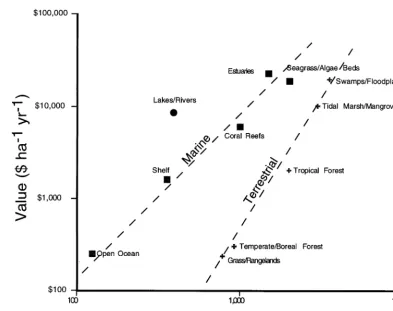
Another interesting way to look at this issue is to compare the per ha economic values from our
Nature paper with the solar energy captured per
unit area by each biome. We suppose that most economists and many ecologists would not expect to see much of a correlation between these
ables. However, Table 1 and Fig. 1 show some interesting patterns. The measure of solar energy captured in this case is net primary production (NPP) at the ecosystem level (from Whittaker and Likens 1975; Whittaker 1975; as summarized in Bolin et al., 1977). What one sees are strikingly good correlations for terrestrial and marine sys-tems separately (R2:0.98, significant at the 0.01
level), with lakes/rivers as a significant outlier (note the logarithmic axes for both variables). Given the differences between terrestrial and marine systems, this is not too surprising.
Lakes/rivers show significantly higher value per ha than predicted from their NPP, perhaps indi-cating the fact that many of their relevant services (like drainage and transport) are not related to primary production. But for the other systems, NPP appears to be highly correlated with the value of ecosystem services we estimated, within the categories of terrestrial and marine systems.
6. Conclusions
OurNaturepaper was a synthesis study. It was
an attempt to synthesize existing information to address a new and important question, and to stimulate additional research and debate. We think we succeeded in that goal, and that both the importance of the question and the limitations of our initial stab at it have been well recognized. Now it is time to take the next steps. We encour-age all those concerned with ecosystem services and the sustainability of the planet to actively participate, and we look forward to seeing the results in these pages in the future.
References
Ayres, R.U., 1998. Comment: the price-value paradox. Ecol. Econ., 25, 17 – 19.
Bolin, B., Degens, E.T., Kempe, S., Ketner, P., 1977. The global carbon cycle. SCOPE 13. John Wiley, New York. Costanza, R., Neill, C., 1981. The energy embodied in the
products of the biosphere. In: Mitsch, W.J., Bosserman, R.W., Klopatek, J.M. (Eds.), Energy and Ecological Mod-eling. Elsevier, New York, pp. 745 – 755.
Costanza, R., Hannon, B.M., 1989. Dealing with the mixed units problem in ecosystem network analysis. In: Wulff, F., Field, J.G., Mann, K.H. (Eds.), Network Analysis of Marine Ecosystems: Methods and Applications. SpringerVerlag, Heidelberg, pp. 90 – 115.
Costanza, R., Folke, C., 1997. Valuing ecosystem services with efficiency, fairness and sustainability as goals. In: Daily, G. (Ed.), Nature’s Services: Societal Dependence on Natural Ecosystems. Island Press, Washington, DC, pp. 49 – 70. Costanza, R., Farber, S.C., Maxwell, J., 1989. Valuation and
management of wetlands ecosystems. Ecol. Econ. 1, 335 – 361.
Costanza, R., d’Arge, R., de Groot, R., Farber, S., Grasso, M., Hannon, B., Naeem, S., Limburg, K., Paruelo, J., O’Neill, R.V., Raskin, R., Sutton, P., van den Belt, M., 1997a. The value of the world’s ecosystem services and natural capital. Nature 387, 253 – 260.
Costanza, R., Cumberland, J.C., Daly, H.E., Goodland, R., Norgaard, R., 1997b. An Introduction to Ecological Eco-nomics. St. Lucie Press, Boca Raton, p. 275.
Daily, G. (Ed), 1997. Nature’s Services: Societal Dependence on Natural Ecosystems. Island Press, Washington, DC, 392 pp.
Daly, H. E., 1992. Allocation, distribution, and scale: toward an economics that is efficient, just, and sustainable. Ecol. Econ. 6, 185 – 194.
Daly H.E., 1998. The return of Lauderdale’s paradox. Ecol. Econ., 25, 21 – 23.
Herendeen, R.A., 1998. Monetary-costing environmental ser-vices: nothing is lost; something is gained. Ecol. Econ., 25, 29 – 30.
Norgaard, R.B., Bode, C., The Values Reading Group, 1998. Next, the value of God, and other reactions. Ecol. Econ., 25, 37 – 39.
Rees, W.E., Wackernagel, M., 1994. Ecological footprints and appropriated carrying capacity: measuring the natural cap-ital requirements of the human economy. In: Jansson, A.M., Hammer, M., Folke, C., Costanza, R. (Eds.), In-vesting in Natural Capital: The Ecological Economics Ap-proach to Sustainability. Island press, Washington, DC, pp. 262 – 390.
Templet, P., 1998. The Neglected benefits of protecting ecolog-ical services. Ecol. Econ., 25, 53 – 55.
Whittaker, R.H., 1975. Communities and Ecosystems, 2nd edn. Macmillan, Toronto, 385 pp.
Whittaker, R.H., Likens, G.E., 1975. The biosphere and man. In: Leith, H., Whittaker, R.H. (Eds.), Primary Productivity of the Biosphere. Ecological Studies 14. Springer-Verlag, Berlin, pp. 305 – 328.
.