Volume 2, Issue 5, May 2013
Page 371
A
BSTRACTThe last three to four decades has witnessed giant strides in the development of digital communication systems, motivated by
the information revolution and convergence of computer communication, mobile communication and internet. The tremendous acceleration towards the convergence of communication and internet is bringing the advancement of digital communication to its extreme capacity. A performance comparison of Rayleigh fading channels in M-PAM and Rectangular QAM schemes is provided and the scheme which produces the lowest Bit Error Rate (BER) is computed in this paper. The most efficient modulation technique is evaluated in terms of the production of the lowest Bit Error Rate and such a type of scheme can be implemented to obtain a versatile digital communication system.
Keywords: Digital, Rayleigh, M-PAM, QAM, BER
1.
I
NTRODUCTION TODIGITALCOMMUNICATIONSYSTEMSDigital Communication Systems are becoming increasingly attractive because of the ever-growing demand for data communication and because digital transmission offers data processing options and flexibilities which are not available with analog transmission. A digital system is often treated in the context of a satellite communications link. Sometimes the treatment is in the context of a mobile radio system, in which case signal transmission typically suffers from a phenomenon called fading [6]. In general, the task of characterizing and mitigating the degradation effects of a fading channel is more challenging than performing similar tasks for a non fading channel. The principle feature of a digital communication system (DCS) is that during a finite interval of time, it sends a waveform from a finite set of possible waveforms, in contrast to an analog communication system, which sends a waveform from an infinite variety of waveform shapes with theoretically infinite resolution. In a DCS, the objective is to determine from a noise-perturbed signal with waveform from the finite set of waveforms was sent by the transmitter. An important measure of system performance in a DCS is the probability of error (PE).
The primary advantage with the digital communication system is the ease with which digital signals, compared with analog signals are regenerated. The shape of the waveform is affected by two basic mechanisms, firstly, as all transmission lines and circuits have some non ideal frequency transfer function, there is a distorting effect in the ideal pulse and secondly unwanted electrical noise or other interference further distorts the pulse waveform. Both of these mechanisms cause the pulse shape to degrade as a function of line length [1]. During the time that the transmitted pulse can still be reliably identified, the pulse is amplified by a digital amplifier that recovers its original ideal shape. The pulse is thus “reborn” or regenerated. Circuits that perform this function at regular intervals along a transmission system are called regenerative repeaters.
Digital circuits are less subject to distortion and interference than are analog circuits. Because binary digital circuits operate in one of two states- fully on or fully off- to be meaningful, a disturbance must be large enough to change the circuit operating point from one state to another. Such two-state operation facilitates signal regeneration and thus prevents noise and other disturbances from accumulating in transmission. Analog signals, however, are not two-state signals; they can take an infinite variety of shapes. With analog circuits, even a small disturbance can render the reproduced waveform unacceptably distorted [2]. Once the analog signal is distorted, the distortion cannot be removed by amplification. Because accumulated noise is irrevocably bound to analog signals, they cannot be perfectly regenerated. With digital techniques, extremely low error rates producing high signal fidelity are possible through error detection and correction but similar procedures are not available with analog.
Performance Comparison of Multipath
Rayleigh Fading Channels using M-PAM and
Rectangular QAM Schemes in Digital
Communication Systems
Mr.P.Sunil Kumar1, Dr.M.G.Sumithra2 and Ms.M.Sarumathi3
1
Volume 2, Issue 5, May 2013
Page 372
There are two important advantages to digital communications. Digital circuits are more reliable and can be produced at a lower cost than analog circuits. Also, digital hardware lends itself to more flexible implementation than analog hardware. The combining of digital signals using time-division multiplexing is simpler than the combining of analog signals using frequency division multiplexing. Different types of digital signals can be treated as identical signals in transmission and switching- a bit is a bit. Also, for convenient switching, digital messages can be handled in autonomous groups called packets. Digital techniques lend themselves naturally to signal processing functions that protect against interference and jamming, or that provide encryption and privacy. Also, much data communication is from computer to computer, or from digital instruments or terminal to computer. Such digital terminations are naturally best served by digital communications links. Digital systems tend to be very signal-processing intensive compared with analog [3]. Also, the digital systems need to allocate a significant share of their resources to the task of synchronization at various levels. With analog systems, on the other hand, synchronization often is accomplished more easily. One disadvantage of the digital communication system is non graceful degradation. When the signal-to-noise ratio drops below a certain threshold, the quality of service can change suddenly from very good to very poor. In contrast, most analog communication systems degrade more gracefully.2.
A
REVIEW
ON
MULTIPATH
PROPAGATION
Although the line-of-sight propagation uses a direct path from the transmitter to receiver, the receiver can also pick up reflected signals. Probably the simplest case is reflection from the ground. If the ground is rough, the reflected signal is scattered and its intensity is low in any given direction. If, on the other hand, the reflecting surface is relatively smooth- a body of water, for instance- the reflected signal at the receiver can have strength comparable to that of the incident wave, and the two signals will interfere [4]. Whether the interference is constructive or destructive depends on the phase relationship between the signals, if they are in phase, the resulting signal strength is increased, but if they are 180 degrees out of phase, there is partial cancellation. When the surface is highly reflective, the reduction in signal strength can be 20 dB or more. This effect is called fading. The exact phase relationship depends on the difference, expressed in wavelengths, between the lengths of the transmission paths for the direct and reflected signals. In addition, there is usually a phase shift of 180 degrees at the point of reflection. If the transmitter and receiver locations are fixed, the effect of reflections can often be reduced by carefully surveying the proposed route and adjusting the transmitter and receiver antenna heights so that any reflection takes place in wooded areas or rough terrain, where the reflection will be diffuse and weak. Where most of the path is over a reflective surface such as desert or water, fading can be reduced by using either frequency diversity or spatial diversity. In the former method, more than one frequency is available for use; the difference, in wavelengths, between the direct and incident path lengths will be different for the two frequencies. In spatial diversity there are two receiving antennas, usually mounted one above the other on the same tower. The difference between direct and reflected path length is different for the two antennas [5]. The multipath propagation in the mobile environment is a different scenario. In an environment where both the transmitter and receiver are fixed, it is often possible to position the antennas in such a way as to reduce, if not eliminate, the effects of multipath interference. In the usual wireless situation, however, the transmitter, the receiver, or both, are in constant motion, and the multipath environment is therefore in a constant state of flux. The luxury of carefully sited, directional antennas does not exist. In addition, the mobile and portable environment is often much cluttered with the potential for multiple reflections from vehicles and buildings. There may also be places where the direct signal may actually allow communication to take place. At such times a reflected signal may actually allow communication to take place where it would otherwise be impossible
Rayleigh fading occurs when there are multiple indirect paths between the transmitter and receiver and no distinct dominant path, such as a Line of Sight (LOS) path. This represents a worst case scenario. Fortunately, Rayleigh fading can be dealt with analytically, providing insights into performance characteristics that can be used in difficult environments, such as downtown urban meetings.
In mobile radio channels, the Rayleigh distribution is usually used to describe the statistical time varying nature of the envelope detected at the receiver for a flat faded environment. The Rayleigh probability density function (pdf) for a distributed envelope r(t) can be expressed as follows
22 2
2
exp
)
(
r
r
r
p
for0
r
}
0
{
)
(
r
p
forr
0
Volume 2, Issue 5, May 2013
Page 373
3.
M-PAM
AND
RECTANGULAR
MODULATION
SCHEMES
In analog modulation, we can modulate either a continuous carrier or a pulse carrier by the input analog signal. The former is called CW modulation and the latter is known as Pulse Modulation. Pulse Modulation techniques like pulse amplitude modulation (PAM), Pulse Width Modulation (PWM) or Pulse Position Modulation (PPM) are analog modulation techniques as the amplitude, width or position of the transmitted carrier pulses vary continuously in accordance with the variation of the input signal [9]. Multiplying the carrier phase with the input signal also frequently translates the spectrum of the input signal, thereby giving rise to pulse modulation. Actually a pulse modulated signal contains the sampled values of the source signal in one of the three parameters of the carrier pulse: either amplitude or frequency or phase. However these sample values are not quantized, so these modulations are termed analog modulation [8]. Now, if a PAM signal is first quantised and then converted to a digital code, we get a complete digital signal. This signal is called pulse coded modulated signal and the process is known as Pulse Coded Modulation (PCM). The advantage of PCM over analog pulse waveform, rather it lies in the presence or absence of the pulse or to which side of a threshold value the pulse amplitude lies. Thus, the noise immunity of a PCM signal is much more than any analog pulse modulation signal. PCM can also be used for baseband transmission of the signal.
In digital PAM, the signal waveforms may be represented as follows
T
t
M
m
t
f
t
g
A
t
s
e
t
g
A
t
s
c m m t f j m m c
0
,
,...,
2
,
1
,
2
cos
)
(
)
(
]
)
(
Re[
)
(
2
where {Am,
1
m
M
}
denote the set of M possible amplitudes corresponding to M=2k possible k-bit blocks or symbols. The signal amplitudes Am take the discrete values asM
m
d
M
m
A
m
(
2
1
)
,
1
,
2
,...,
where 2d is the distance between adjacent signal amplitudes. The waveform g(t) is a real-valued signal pulse whose shape influences the spectrum of the transmitted signal, as we shall observe later. The symbol rate for the PAM signal is R/k. This is the rate at which changes occur in the amplitude of the carrier to reflect the transmission of new information. The time-interval Tb=1/R is called the bit interval and the time interval T=k/R=kTb is called the symbol interval.
The M PAM signals have energies represented as follows
T
m
m
s
t
dt
0 2
)
(
T g m mm
A
g
t
dt
A
0 2 2 2
2
1
)
(
2
1
where
gdenotes the energy in the pulse g(t). Clearly, these signals are one-dimensional (N=1), and, hence, arerepresented by the general form as expressed in the given mathematical expression
)
(
)
(
t
s
f
t
s
m
mwhere f(t) is defined as the unit-energy signal waveform given as the following expression
t
f
t
g
t
f
c g
(
)
cos
2
2
)
(
g m mA
s
2
1
, m=1,2,3... MDigital PAM is also called amplitude-shift keying (ASK). The mapping or assignment of k information bits to the M=2k possible signal amplitudes differ by one binary digit and this mapping is called as Gray encoding. It is important in the demodulation of the signal because the most likely errors caused by noise involve the erroneous selection of adjacent amplitude to the transmitted signal amplitude [7]. In such a case, only a single bit error occurs in the k-bit sequence. The carrier-modulated PAM signal represented by 1111 is a double-sideband (DSB) signal and requires twice the channel bandwidth of the equivalent low pass signal for transmission. Alternatively, we may use single-sideband (SSB) PAM, which has the representation (lower or upper sideband).
M
m
e
t
g
j
t
g
A
t
s
m(
)
Re{
m[
(
)
ˆ
(
)]
j2 fct},
1
,
2
,....,
where
g
(
t
)
Volume 2, Issue 5, May 2013
Page 374
QAM : The bandwidth efficiency of PAM/SSB can also be obtained by simultaneously impressing two separate k-bit symbols from the information sequence {an} on two quadrature carriers cos2
f
ct
and sin2
f
ct
. The resultingmodulation technique is called quadrature PAM or QAM, and thus the corresponding signal waveforms may be expressed as
M
m
e
t
g
jA
A
t
s
m(
)
Re[(
mc
ms)
(
)
j2fct],
1
,
2
,
3
...
t
f
t
g
A
t
f
t
g
A
t
s
m(
)
mc(
)
cos
2
c
ms(
)
sin
2
cwhere
A
mcandA
msare the information-bearing signal amplitudes of the quadrature carriers and g(t) is the signal pulse. Alternatively, the QAM signal waveforms may be expressed as follows)
2
cos(
)
(
)
(
]
)
(
Re[
)
(
2 m c m m t f j j m mt
f
t
g
V
t
s
e
t
g
e
V
t
s
m c
Where
V
m
A
mc2
A
ms2 andtan
(
/
).
1mc ms
m
A
A
From this expression, it is apparent that the QAM signal waveforms may be viewed as combined amplitude and phase modulation. In fact, we may select any combination of M1-level PAM and M2-phase PSK to construct an M=M1M2 combined PAM-PSK signal constellation. If M1=2n and M2=2m, the combined PAM-PSK signal constellation results in the simultaneous transmission of m+n=log M1M2 binary digits occurring at a symbol rate R/(m+n). As in the case of PSK signals, the QAM signal waveforms may be represented as a linear combination of two orthogonal signal waveforms, f1(t) and f2(t), i.e.,)
(
)
(
)
(
t
s
1f
1t
s
2f
2t
s
m
m
mt
f
t
g
t
f
c g
(
)
cos
2
2
)
(
1
t
f
t
g
t
f
c g
(
)
sin
2
2
)
(
2
4.
PERFORMANCE COMPARISON OF RAYLEIGH FADING CHANNELS USING M-PAM
AND RECTANGULAR MODULATION SCHEMES
RANDOM INTEGER GENERATOR: The random integer generator generates random uniformly distributed integers in the range [0, M-1], where M is the M-ary number.
INTEGER TO BIT CONVERTER: In the integer to bit convertor unit, a vector of integer-valued or fixed valued type is mapped to a vector of bits. The number of bits per integer parameter value present in the integer to bit convertor block defines how many bits are mapped for each integer-valued input. For fixed-point inputs, the stored integer value is used. This block is single-rated and so the input can be either a scalar or a frame-based column vector. For sample-based scalar input, the output is a 1-D signal with ‘Number if bits per integer’ elements. For frame-sample-based column vector input, the output is a column vector with length equal to ‘Number of bits per integer’ times larger than the input signal length.
DIFFERENTIAL ENCODER: Differential encoder differentially encodes the input data. The differential encoder object encodes the binary input signal within a channel. The output is the logical difference between the current input element and the previous output element.
CONVOLUTIONAL INTERLEAVER: This block permutes the symbols in the input signal. Internally, it uses a set of shift registers. The delay value of the kth shift register is (k-1) times the register length step parameter. The number of shift registers is the value of the rows of shift registers parameter.
M-PAM MODULATOR BASEBAND: This block modulates the input signal using the pulse amplitude modulation method. The block only accepts integers as input.
M-PAM DEMODULATOR BASEBAND: This block demodulates the input signal using the pulse amplitude modulation method. For sample-based input, the input must be a scalar. For frame-based input, the input must be a column vector.
RECTANGULAR QAM MODULATOR BASEBAND: This block modulates the input signal using rectangular amplitude modulation method. The M-ary number must be an integer power of two.
RECTANGULAR QAM DEMODULATOR BASEBAND: This block demodulates the input signal using the rectangular quadrature amplitude modulation method. The M-ary number must be an integer power of two.
Volume 2, Issue 5, May 2013
Page 375
CONVOLUTIONAL DEINTERLEAVER: The Convolutional deinterleaver block recovers a signal that was interleaved using the Convolutional interleaver block.DIFFERENTIAL DECODER: The differential decoder block decodes the binary input signal.
BIT TO INTEGER CONVERTER: The bit to integer converter maps a vector of bits to a corresponding vector of integer values. The number of bits per integer parameter defines how many bits are mapped for each output.
ERROR RATE CALCULATION: The error rate calculation is done by computing the error rate of the received data by comparing it to a delayed version of the transmitted data.
Fig. 1. Simulink Scenario for Performance Analysis of Rayleigh fading channels in M-PAM scheme
Fig. 2. Simulink Scenario for Performance Analysis of Rayleigh fading channels in Rectangular QAM scheme
Volume 2, Issue 5, May 2013
Page 376
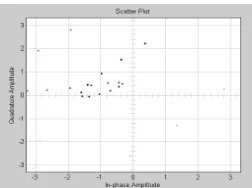
Fig. 3. Eye diagram for the Performance Analysis of Rayleigh fading channels in M-PAM schemeFig. 4. Scatter Plot for the Performance Analysis of Rayleigh fading channels in M-PAM scheme
Fig. 5. Signal Trajectory for the Performance Analysis of Rayleigh fading channels in M-PAM scheme
Fig. 6. Eye diagram for the Performance Analysis of Rayleigh fading channels in Rectangular QAM scheme
Fig. 7. Scatter plot for the Performance Analysis of Rayleigh fading channels in Rectangular QAM scheme
Volume 2, Issue 5, May 2013
Page 377
Table 1: Bit Error Rate Analysis of Rayleigh fading channels in 4-PAM schemeSNR (decibels)
Bit Error Rate -15 0.4836
0 0.4480 15 0.3332
Table 2: Bit Error Rate Analysis of Rayleigh fading channels in 8-PAM scheme
SNR (decibels)
Bit Error Rate -15 0.4776
0 0.3096 15 0.2643
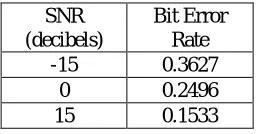
Table 3: Bit Error Rate Analysis of Rayleigh fading channels in 16-QAM scheme
SNR (decibels)
Bit Error Rate -15 0.3627
0 0.2496 15 0.1533
Table 4: Bit Error Rate Analysis of Rayleigh fading channels in 64-QAM scheme
SNR (decibels)
Bit Error Rate -15 0.3195
0 0.1194 15 0.1154
Table 5: Bit Error Rate Analysis of Rayleigh fading channels in 128-QAM scheme
SNR (decibels)
Bit Error Rate -15 0.02098
0 0.02897 15 0.02697
5.
C
ONCLUSIONAn introduction to the digital communication systems followed by a review on Rayleigh fading channels is provided. It is apparent from Tables 1,2,3,4 and 5 that when Signal to Noise Ratio increases then the Bit Error Rate gradually decreases. Comparing the Bit Error Rate of tables 1, 2, 3,4 and 5, it is observed that 128 QAM modulation scheme produces a very low bit error rate when the Signal to Noise ratio is varied and is thus considered to be the most ideal and versatile method which could be applicable to the digital communication systems. The eye diagram pattern, signal trajectory and scatter plot are also provided for the scenario. Future works may include the effective use of different modulation schemes in the Simulink scenario to produce a very low bit error rate.
References
[1.]G.P.Agrawal. Nonlinear Fiber Optics, 2nd edition. Academic Press, San Diego, CA, 1995.
Volume 2, Issue 5, May 2013
Page 378
[3.]M.Patzold, Mobile Fading Channels, Wiley, NewYork, 2002[4.]T.S.Rappaport, Wireless Communications-Principles and Practise, 2nd ed., Prentice-Hall, Englewood Cliffs, NJ,2001
[5.]Korn, I., Digital Communications, Van Nostrand Reinhold Company, Inc., New York, 1985.
[6.]Viterbi, A.J., Principles of Coherent Communications, McGraw-Hill Book Company, NewYork, 1966.
[7.]Ziemer, R.E., and Peterson, R.L., Digital Communications and Spread Spectrum Systems, Macmillan Publishing Company, Inc., NewYork, 1985.
[8.]Couch, L.W.II, Digital and Analog Communication Systems, Macmillan Publishing Company, NewYork, 1983. [9.]Prabhu , V.K., and Salz, J., “ On the performance of Phase-Shift Keying Systems,” Bell Syst. Tech. J., vol.60,
Dec.1981, pp.23
AUTHOR
P. Sunil Kumar, received B.E in Electronics and Communication Engineering from Coimbatore Institute of Engineering and Technology, Coimbatore in 2012 and is currently pursuing M.E (Communication Systems) in Bannari Amman Institute of Technology in Sathyamangalam, Tamil Nadu, India. His areas of interest are MIMO-OFDM and Cognitive Radio Networks. He has published 10 technical papers in National and International Conferences and 9 technical papers in International journals.
M.G. Sumithra, received B.E. in Electronics and Communication Engineering from Govt. College of Engineering, Salem, India and in 1994 she received the M.E degree in Medical Electronics from College of Engineering, Guindy, Anna University, Chennai, India in 2001.Later she receive her Ph.d in information and communication engineering speech signal processing from Anna University, Chennai in 2011. She is currently working as a Professor in the Department of ECE, Bannari Amman Institute of Technology at Sathyamangalam, Tamilnadu, India. Her areas of interest are Signal Processing and Biomedical Engineering. She has published 45 technical papers in National and International conferences and one technical paper in National and 40 technical papers in International Journals.