Causal Learning via Manifold Regularization
Steven M. Hill∗ [email protected]
MRC Biostatistics Unit University of Cambridge Cambridge, CB2 0SR, UK
Chris J. Oates∗ [email protected]
School of Mathematics, Statistics and Physics Newcastle University
Newcastle-upon-Tyne, NE1 7RU, UK
Duncan A. Blythe [email protected]
Sach Mukherjee∗ [email protected]
German Center for Neurodegenerative Diseases 53127 Bonn, Germany
Editor:Peter Spirtes
Abstract
This paper frames causal structure estimation as a machine learning task. The idea is to treat indicators of causal relationships between variables as ‘labels’ and to exploit available data on the variables of interest to provide features for the labelling task. Background scientific knowledge or any available interventional data provide labels on some causal relationships and the remainder are treated as unlabelled. To illustrate the key ideas, we develop a distance-based approach (based on bivariate histograms) within a manifold regularization framework. We present empirical results on three different biological data sets (including examples where causal effects can be verified by experimental intervention), that together demonstrate the efficacy and general nature of the approach as well as its simplicity from a user’s point of view.
Keywords: causal learning, manifold regularization, semi-supervised learning, interven-tional data, causal graphs
1. Introduction
Causal structure learning is concerned with learning causal relationships between variables. Such relationships are often represented using directed graphs with nodes corresponding to the variables of interest. Consider a set ofp variables or nodes indexed by V ={1, . . . , p}. The aspect we focus on in this paper is to determine, for each (ordered) pair (i, j)∈V×V, whether or not nodeiexerts a causal influence on nodej. In particular, our focus is on the binary ‘detection’ problem (of learning whether or not nodei exerts a causal influence on node j) rather than estimation of the magnitude of any causal effect.
Methods for learning causal structures can be usefully classified according to whether the graph is intended to encode direct or total (ancestral) causal relationships. For example
∗. These authors contributed equally to this work.
c
if variable A acts on B which in turn acts on C, A has an ancestral effect on C (via B). Here, the graph of direct effects has edges A → B → C, while the graph of total or ancestral effects has in addition the edge A → C. Methods based on (causal) directed acyclic graphs (DAGs) are a natural and popular choice for causal discovery (Spirtes et al., 2000; Pearl, 2009). The PC algorithm (Spirtes et al., 2000) is an important example of such a method. Using a sequence of tests of conditional independence, the PC algorithm estimates an underlying causal DAG. Due to the fact that the graph may not be identifiable, the output is an equivalence class of DAGs (encoded as a completed partially directed acyclic graph or CPDAG). Here the estimand is intended to encode direct influences. IDA (Intervention calculus when the DAG is Absent; Maathuis et al., 2009) uses the PC output to bound the quantitative total causal effect of any node i on any other node j. These estimated effects can be thresholded to provide a set of edges. FCI (Fast Causal Inference; Spirtes et al., 2000) and RFCI (Really Fast Causal Inference; Colombo et al., 2012) consider a type of ancestral graph as estimand and allow for latent variables. Greedy Interventional Equivalence Search (GIES; Hauser and B¨uhlmann, 2012) is a score-based approach that allows for the inclusion of interventional data.
Methods for learning causal structures (such as those above) are often rooted in data-generating causal models. In a quite different vein, there have been some interesting recent efforts in the direction of labelling pairs of variables as causal or otherwise, such as in Lopez-Paz et al. (2015) and Mooij et al. (2016). These approaches are ‘discriminative’ in spirit, in the sense that they need not be rooted in an explicit data-generating model; rather the emphasis is on learning how to tell causal and non-causal apart. Our work is in this latter vein. We address a specific aspect of causal learning—that of estimating edges in a graph encoding causal relationships between a defined set of vertices—but via a machine learning approach that allows the inclusion of any available information concerning known cause-effect relationships. The output of our method is a directed graph that need not be acyclic (see Spirtes, 1995; Richardson, 1996; Hyttinen et al., 2012, for discussion of cyclic causality) and whose edges may encode either direct or total/ancestral relationships, as discussed below. The main differences between our work and previous work on labelling causal pairs (Lopez-Paz et al., 2015; Mooij et al., 2016) are the specific methods and associated theory that we put forward, the manifold regularization framework, and the empirical examples.
Note also that in our approach the causal status of multiple pairs is coupled via the learning scheme: loosely speaking (see below for technical details), it is the position of a test pair on a classification manifold (relative to other pairs) that determines its status.
Our approach differs in several ways from graphical model-based methods. In our ap-proach, the same framework can be used to estimate either direct or ancestral causal rela-tionships, depending on the precise input (we show real data examples of both tasks below). This is because the classifier can be agnostic to the label semantics: provided the Bayes’ risk for the label of interest is sufficiently low, these labels can in principle be learned. In con-trast to much of the literature, our approach does not try to provide a full data-generating model of the causal system but instead focuses on the specific problem of learning edges encoding causal relationships. As we see in experiments below, this can lead to good em-pirical performance, but the output is in a sense less rich than a full causal model (see the Discussion). Our work is motivated by scientific problems where good performance with respect to this narrower task can be useful in reducing the hypothesis space and targeting future work.
The remainder of the paper is organized as follows. We first introduce some notation and discuss in more detail how causal learning can be viewed as a semi-supervised task. We then discuss a specific instantiation of the general approach, based on manifold regularization using a simple bivariate featurization. Using this specific approach—which we call Manifold Regularized Causal Learning (MRCL)—we present empirical results using three biological data sets. The results cover a range of scenarios and include examples with explicitly interventional data.
2. Methods
2.1. Notation
LetV ={1, . . . , p}index a set of variables whose mutual causal relationships are of interest. Let G denote a directed graph with vertex set V and edge set E; where useful, we use V(G), E(G) to denote its vertex and edge sets and A(G) to denote the corresponding p×p binary adjacency matrix. To make the connection between causal relationships and machine learning more transparent, we introduce linear indexing by [k] of the pairs (i, j)∈V×V. Where needed, we make the correspondence explicit, denoting by (i[k], j[k]) the variable pair corresponding to linear index [k] and by [k(i, j)] the linear index for pair (i, j). Suppose A is the adjacency matrix of the unknown graph of interest. Let y[k]∈ {−1,+1} be a binary variable (for convenience mapped onto{−1,+1}) corresponding to the entry (i[k], j[k]) inA; thesey[k]’s are the labels or outputs to be learned. Available data are denotedD. Available a prioriknowledge about causal relationships between the variablesV is denoted Φ.
2.2. Causal Semantics
Given data D and background knowledge Φ we aim to construct an estimate ˆG, the latter being a directed graph that need not be acyclic. The information in Φ guides the learner. Two main cases arise, both of which we consider in experiments below:
ˆ
G are intended to describe such effects. This means that an edge (i, j)∈E( ˆG) is interpreted to mean that node iis inferred to be a causal ancestor of node j.
• Direct effects. Here, Φ contains information on direct effects (relative to the variable setV) and the edges in the estimated graph ˆGare intended to describe direct effects. Then, an edge (i, j)∈E( ˆG) is interpreted to mean that i is inferred to be a direct cause ofj (relative to the variable set V).
Our immediate motivation comes from the experimental sciences and we focus in par-ticular on causal influences that can, at least in principle, be experimentally verified (even in the presence of latent variables) and where causal cycles are possible (as is often the case in biology or economics, see e.g., Hyttinen et al., 2012). Accordingly, we do not demand acyclicity. In our empirical work in biology, the nature of the underlying chemical/physical systems means that there are many small magnitude causal effects that are essentially ir-relevant in the scientific context and this is a characteristic of many problem settings in the natural and social sciences. This motivates a pragmatic approach assuming that estimated graphs are not very dense or fully connected nor necessarily transitive1.
2.3. Semi-Supervised Causal Learning
With the notation above, the task is to learn the y[k]’s using D and Φ. This is done using a semi-supervised estimator ˆy[k](D,Φ) (we make the connection to semi-supervised learning explicit shortly). For now assume availability of such an estimator (we discuss one specific approach below). Then from the ˆy[k] we have an estimate of the graph of interest
as ˆG(D,Φ) = (V, E( ˆG(D,Φ))) (recall that the vertex set V is known) with the edge set specified via the semi-supervised learner as
(i, j)∈E( ˆG(D,Φ)) ⇐⇒ yˆ[k(i,j)](D,Φ) = 1. (1)
Background knowledge Φ could be based on relevant science or on available interven-tional data. For example, in a given scientific setting, certain cause-effect information may be known from previous work or theory. Alternatively, if some interventional data are avail-able in the study at hand, this gives information on some causal relationships. Whatever the source of the information, assume that it is known that certain pairs (i, j) are either causal pairs (positive information) or not causal pairs (negative information). Using the notation above, this amounts to knowing, for some pairs [k], the value of y[k]. In semi-supervised learning terms, the pairs whose causal status is known correspond to the labelled objects and the remaining pairs are the unlabelled objects.
For each pair [k], some of the data, or some transformation thereof will be used as predictors or inputs, denote these generically as g[k](D). That is, g[k] is a featurization of
the data, with the featurization specific to variables (i[k], j[k]). Let K be the set of linear indices (i.e., [k] ∈ K is a variable pair), L ⊂ K be the variable pairs with labels available
(via Φ) and U =K \ Lbe the set of unlabelled pairs. LetyL be a binary vector comprising themL=|L|available labels andyU be an unknown binary vector of lengthmU =|U |. The
available labels are determined by the background information Φ and we can write yL(Φ) to make this explicit. A semi-supervised learner gives estimates for the unlabelled objects, given the data and available labels. That is, an estimate of the form ˆyU(g(D),yL(Φ)). With these in hand we have estimates for all labels and therefore for all edges via (1).
Formulated in this way, it is clear that essentially any combination of featurization g and semi-supervised learner could be used in this setting. Below, as a practical example, we explore graph-based manifold learning (following Belkin et al., 2006) combined with a simple bivariate featurization.
2.4. A Bivariate Featurization
For distance-based learning, we require a distance measure between objects (here, variable pairs) [k],[k0]∈ K. The simplest candidate distance between variable pairs [k],[k0] is based only on the bivariate distribution for the variables comprising the pairs (we make this notion precise below). Proofs of propositions appearing in this Section are provided in Appendix A.
2.4.1. Distance between variable pairs
Let Z denote the p-dimensional random variable whose n realizations z(l), l = 1, . . . , n, comprise the data set D. Assume Z ∈ Zp = [zmin, zmax]p and that Zp is endowed with
the Borel σ-algebra Bp = B(Zp). Let P be the set of all twice continuously differentiable probability density functions, generically denoted π, with respect to Lebesgue measure Λ2
on (Z2,B2). Let Π[k] be the bivariate (marginal) distribution for componentsi[k], j[k]∈V
of Z.
Assumption 1 Each Π[k] admits a density function π[k]∈ P.
If available, the densities π[k], π[k0] could be used to define a distance between the pairs [k],[k0]. Let dP : P × P → [0,∞) denote a pseudo-metric2 on P. Since we do not have
access to the underlying probability density functions, we construct an analogue using the available data D. Let Sn := [zmin, zmax]2n denote the space of possible bivariate samples
(the sample size isn) and S[k]∈ Sn denote the subset of the data for the variable pair [k].
That is, S[k]={(z(i[lk)], z(jl[)k])}l=1,...,n ⊂ Z2.
Let κ : Sn → P be a density estimator (DE). We consider sample quantities of the
form dS = dP ◦(κ×κ). That is, given data S[k], S[k0] ∈ Sn on two pairs [k],[k0], the DE is applied separately to produce density estimates κ(S[k]) and κ(S[k0]), that are compared using dP to give dS(S[k], S[k0]) =dP(κ(S[k]), κ(S[k0])). This construction ensures thatdS is a pseudo-metric without assumptions on the DEκ:
Proposition 1 Assume that dP is a pseudo-metric on P. Then dS is a pseudo-metric on Sn. If, in addition, κ is injective and dP is a metric onP, then dS is a metric on Sn.
2.4.2. Choice of distance
For semi-supervised learning we need a notion of distance under which causal pairs are relatively ‘close’ to each other. For a measurable space X equipped with a measure ρ we let kfkLq(ρ):= RX |f|qdρ
1
q <∞. The notion of distance that we consider is
dP(π,π) :=˜ kπ−π˜kL2(Λ 2).
The right hand side exists since the integrand is continuous on a compact set and thus bounded. This can be contrasted with the kernel embedding that was proposed for super-vised causal learning in Lopez-Paz et al. (2015).
Proposition 2 dP is a metric on P.
The main requirement that we have of the DE is that it provides consistent estimation in thek · kL2(Λ
2)norm whenπ ∈ P. Specifically, consider a sequenceS
(n) inS
nindexed by the
numbernof data points. In particular, suppose thatS(n) is built fromnindependent data points whose distribution is Π (the shorthand notation S(n) i.i.d.∼ Π will be used). Let π be the density function for Π. Thenκ is said to be “consistent” ifkπ−κ(S(n))kL2(Λ
2)=oP(1) holds for S(n) i.i.d.∼ Π whenever π∈ P.
Proposition 3 Suppose κ is consistent and that Π,Π˜ admit densitiesπ,π˜∈ P. Then, for
S(n) i.i.d.∼ Π, S˜(n) i.i.d.∼ Π˜, where S(n) and S˜(n) are not necessarily independent, we have that
dS(S(n),S˜(n)) =dP(π,π) +˜ oP(1).
Thus dS approximates the idealized metric dP in the limit of draws from Π and ˜Π. Note
that, in our intended use case, theS(n) and ˜S(n) will correspond to bivariate scatter plots
S[k], S[k0] generated from the same underlying z(l), l = 1, . . . , n, and hence S(n) and ˜S(n) will not be independent.
For the experiments in this paper, motivated by computational ease, we used a simple bivariate histogram as the DE κ. To this end, partition Z2 into an M ×M regular grid
whose (m1, m2)th element is denotedBm1,m2. The standard bandwidth notationh=M −1
will also be used. For a scatter plotS∈ Sn, letxm1,m2 denote the number of elements that belong to the setBm1,m2. Then the histogram estimator is
κ(S)(z0) =
M
X
m1,m2=1
xm1,m2 n
1 h2I[z
0 ∈
Bm1,m2], z 0 ∈ Z
2. (2)
This DE is consistent in the sense of Proposition 3. Indeed:
Proposition 4 Let the bandwidth parameterh of the histogram estimatorκ be chosen such that nh2 → ∞. Then κ is consistent. Moreover, an optimal choice of h n−1/4 leads to
kπ−κ(S(n))kL2(Λ
2)=OP(n
−1/4) whenever S(n) i.i.d.∼ Π and π∈ P.
We note that this histogram DE is not rate optimal for the classP (for comparison, ker-nel DEs attain a rate ofOP(n−2/3) over the same classP of twice continuously differentiable
2.4.3. Implementation of the DE
The above arguments support the use of a bivariate histogram to provide a simple featur-ization for variable pairs. In practice, for all examples below, the data were standardized, then truncated to [−3,3]2, following which a bivariate histogram with bins of fixed width 0.2 was used. The dimension of the resulting feature matrix was then reduced (to 100) using PCA.
2.5. Manifold Regularization
Recall that the goal is to estimate binary labels yU for a subset U ⊂ K of variable pairs given available dataD and known labels yL(Φ) for a subsetL=K \ U (these are taken to be obtained from available interventional experiments and/or background knowledge). For any two pairs [k],[k0]∈ K, we also have available a distancedS(S[k], S[k0]). This is a task in semi-supervised learning (see e.g., Belkin et al., 2006; Fergus et al., 2009) and a number of formulations and methods could be used for estimation in this setting. Here we describe a specific approach in detail, using manifold regularization methods discussed in Belkin et al. (2006).
Let x[k] denote a vector whose entries are the bin-countsxi,j, 1≤i, j≤M, appearing
in (2), for scatter plotS[k]. LetX =
×
1≤i,j≤M[0, n] and note thatx[k]∈ X. Then we makethe observation that, for the histogram estimator,
dS(S[k], S[k0])∝ kx[k]−x[k0]k2.
This perspective emphasizes thatg[k](D) =x[k]is the featurization that underpins this work,
and that the classification task can be considered as the construction of a map c : X → {−1,+1}. To develop an approach to semi-supervised classification in the manner of Belkin et al. (2006), letρX be a reference measure onX and letK:X ×X →Rbe a Mercer kernel;
i.e., continuous, symmetric and positive semi-definite. The reproducing kernel Hilbert space, HK, associated toK can be defined via the integral operator ΣK :L2(ρX)→L2(ρX) where
ΣKf(x) =
Z
K(x,x˜)f(˜x)dρX(˜x).
From the fact that K is a Mercer kernel it follows that ΣK is self-adjoint, positive
semi-definite and compact. In particular, ΣαK is well-defined for α ∈ (0,∞). The reproducing
kernel Hilbert space is defined asHK = Σ 1 2
KL2(ρX) and its norm iskfkHK :=kΣ
−12 K fkL2(ρ
X); c.f. Corollary 4.13 in Cucker and Zhou (2007).
Recall that mL = |L| is the number of available labels and mU = |U | the number of
unlabelled pairs. Letm=mU+mL(=|K|) be the total number of pairs. Using the distance
functiondS we first define an m×msimilarity matrix W with entries
W[k],[k0]= exp
− 1
2σ21kx[k]−x[k0]k
2 2
(3)
where σ1 > 0 must be specified. The squared-exponential form is motivated by an
exploited in Section 2.5.1. We will use a partition of the matrix corresponding to the sets U,L as follows
W=
WLL WLU WU L WU U
where we have assumed, without loss of generality, that the variable pairs are ordered so that the labelled pairs appear in the first mL places, followed by the mU =m−mL unlabelled
pairs. Correspondingly let
y=
yL yU
∈ {−1,+1}m
denote a label matrix, where +1 indicate those pairs [k] for whichy[k]= 1. The vector yU
is unknown and is the object of estimation.
Let D be the m×m diagonal matrix with diagonal entries D[k],[k] =
P
[k0]∈KW[k],[k0]. DefineL=D−W(i.e., the un-normalized graph Laplacian; all matrices withO(m2) entries are denoted as bold capitals to emphasize the potential bottleneck that is associated with storage and manipulation of these matrices). Let
f =
fL fU
∈Rm
be a vector corresponding to a classification functionf :X →Revaluated at themvariable pairs K, with the superscripts indicating correspondence with the labelled and unlabelled pairs. Intuitively, we want the sign off to agree with the known labelsyLand also to take account of the manifold structure encoded inL.
In this work we consider a classifier of the form ˆc(x) = sign( ˆf(x)) where ˆf arises from theLaplacian-regularized least squares method
ˆ
f = arg inf
f∈HK
kyL−fLk2 2
mL
+λ1 f>Lf
m +λ2kfk
2
HK, (4)
following Section 4.2 of Belkin et al. (2006). Here the first term relates the known labels to the values of the functionf. The second term imposes ‘smoothness’ on the label assignment in the sense of encouraging solutions where the labels do not change quickly with respect to the distance metric. The third term is principally to ensure that the infimum remains well-defined and unique in the situation where there is insufficient data for the first penalty alone to be sufficient (see Remark 2 in Belkin et al., 2006).
2.5.1. Consistency of the Classifier
As explained in Remark 5, the use of a squared-error loss function in a classification context is somewhat unnatural. It is therefore incumbent on us to establish consistency of the proposed method.
To this end, we exploit the specific form of the similarity matrix used in (3). Indeed, if we re-write
f>Lf
m =
1 2m
X
[k],[k0]∈K
(f(x[k])−f(x[k0]))2W[k],[k0] (5)
then it can be established (under certain regularity conditions) that, if input data x are independently drawn from ρX, then (5) converges to the quantity R f(x)∆Mf(x)dρ2X(x)
(up to proportionality), a smoothness penalty based on weighted Laplace-Beltrami operator ∆M on the manifold M induced by ρX (Grigor’yan, 2006). The convergence occurs as
m, σ12md+2→ ∞ (Theorem 3.1 of Belkin and Niyogi, 2008).
This convergence of the graph Laplacian to the Laplace-Beltrami operator underlies existing consistency results for semi-supervised regression (e.g., Cao and Chen, 2012) and is exploited again to establish the consistency of our classifier ˆc(x) = sign( ˆf(x)) in Ap-pendix B. In summary, the ability to assign the correct label to an unlabelled pair [k]∈ L depends on both the intrinsic predictability of the label as a function of the scatter plotS[k],
as quantified by the Bayes risk, and the smoothness of the Bayes classifierfρ as quantified
by the largest value α ∈ (0,1] such that Σ−
α
2
K fρ ∈L2(ρX); see Corollary 9 in Appendix B
for full detail.
2.5.2. Implementation of the Classifier
Given training labels yL, label estimates ˆyU = sign(ˆfU) are obtained by minimizing the objective function described above, as explained in Equation 8 in Belkin et al. (2006). This gives
ˆ
fU =KU,K
ImL 0
0 0
KK,K+λ2mLIm+
λ1mL
m2 LKK,K
−1
yL 0
(6)
whereKU,K is themU×m kernel matrix based on the unlabeledU and totalK data, KK,K
is the m×m kernel matrix based on the total data K and Im denotes an m-dimensional
identity matrix.
Here ˆyU provides a point estimate for the unknown labels while ˆfU is real-valued and can be used to rank candidate pairs if required. The linear system in (6) can be solved at a naive computational cost of O(m3). Computation for large-scale semi-supervised learning has been studied in the literature (see e.g., Fergus et al., 2009) and a number of approaches could be used to scale up to larger problems, but were not pursued in this work.
For experiments reported below we employed a similarity matrix (with length scale σ1
as in (3)) and a kernel
K(x,x0) = exp
− 1 2σ2
2
whose length-scale parameterσ2 was set equal toσ1 in the absence of prior knowledge about
the manifold M. The scale σ1 was set to the average distance to the nearest 50 points in
the feature space (in practice estimated via a subsample).
The two penalty parameters in (4) were set to small positive values (λ1 =λ2 = 0.001;
we found results were broadly insensitive to this choice). Following common practice we worked with the normalized graph Laplacian ˜L:=D−12LD−
1
2 in place of L(see Remark 3 of Belkin et al., 2006).
3. Empirical Results
We tested our approach using three data sets with different characteristics. The key features of each data set are outlined below, with a full description of each data set appearing in the respective subsection. In all cases performance was assessed using either held-out interventional data or scientific knowledge.
• D1: Yeast knockout data. Here, we used a data set due to Kemmeren et al. (2014), previously considered for causal learning in Peters et al. (2016); Meinshausen et al. (2016). The data consist of a large number of gene deletion experiments with corresponding gene expression measurements.
• D2: Kinase intervention data from human cancer cell lines. These data, due to Hill et al. (2017), involve a small number of interventions on human cells, with corresponding protein measurements over time.
• D3: Protein data from cancer patient samples. These data arise from The Cancer Genome Atlas (TCGA) and are presented in Akbani et al. (2014). There are no interventional data, but the data pertain to relatively well-understood biological processes allowing inferences to be checked against causal scientific knowledge.
An appealing feature of MRCL is the simplicity with which it can be applied to diverse problems. In each case below, we simply concatenate available data to form the data set D and available knowledge/interventions to form Φ, then directly apply the methods as described.
3.1. General Problem Set-Up
literature itself is in effect an encoding of extensive interventional experiments combined with biochemical and biophysical knowledge. This gives information on direct edges and here the edges learned are intended to represent direct causes (relative to the set of observed variables). Within the semi-supervised set-up, a subset of pairs were labelled at the outset and the remaining pairs were unlabelled. All empirical results below are for unlabelled pairs; that is, in all cases assessment is carried out with respect to causal (and non-causal) relationships that were not used to train the models.
3.2. Data Set D1: Yeast Gene Expression
Data. The data consisted of gene expression levels (log ratios) for a total of ptotal = 6170
genes. Some of the data samples were measurements after knocking out a specific gene (in-terventional data) and the other samples were without any such intervention (observational data), with sample sizes of nint = 1479 and nobs = 153 respectively. Each of the genes intervened on was one of theptotal genes. Lett(l) be the index of the gene targeted by the
lth intervention. That is, thelthinterventional sample was an experiment in which genet(l) was knocked out. LetT ={t(1), . . . , t(nint)}be the subset of genes that were the target of an interventional experiment.
Problem set-up. Our problem set-up was as follows. We sampled a subset C ⊂ T of the genes that were intervened upon, with |C| = 50, and treated this as the vertex set of interest (i.e., settingV =Candp=|C|= 50). The goal was to uncover causal relationships between thesep variables.
Since by design interventional data were available for all variables j∈C, we used these data to define an interventional ‘gold standard’. To this end we used a robustz-score that considered the change in a variable of interest under intervention, relative to its observational variation. Let Zijint denote the expression level of gene j following intervention on gene i. For any pair of genes i, j∈C we say that gene i has a causal effect on gene j if and only if ζij = |Zijint−Mjobs|/IQRobsj > τ, where Mjobs is the median level of gene j (calculated
using half of the observational data samples; the remaining samples were used as training data—see below), IQRobsj the corresponding inter-quartile range and τ = 5 was a fixed threshold. That is, we say there is an (experimentally verified) causal relationship between geneiand genej if and only ifζij> τ. An absence of causal effects precludes estimation of
true positive rates; hence we sampledC subject to a sparsity condition (that at least 2.5% of gene pairs show an effect).
LetA(C) be ap×pbinary matrix encoding the causal effects as described in the foregoing (i.e., A(C)ij = 1 indicates that ihas an experimentally verified causal effect on j). Then,
given data on genesC, we set up the learning problem as follows. We treated a fraction ρ of the entries in A(C) as the available labels Φ. Thus, herem = p2 = 2500, mL = bρ mc
and mU = m−mL. Using these labels and data on the variables C, we learned causal
data that was used to obtain the ground-truth matrixA(C). The total amount of training data is denoted by ntrain = nobstrain +ninttrain. We considered ntrain = 200,500 and 1000
(corresponding to ninttrain= 124,424 and 924 respectively, sampled at random).
Results. We compared the proposed Manifold Regularized Causal Learning (MRCL) ap-proach with the following apap-proaches:
• Penalized regression with an`1penalty (Lasso; Tibshirani, 1996). Each variablej ∈C
was regressed on all other variablesi∈C, i6=j to obtain regression coefficients. This is not a causal approach as such, but is included as a simple multivariate baseline.
• Intervention-calculus when the DAG is absent (IDA; Maathuis et al., 2009, 2010). A lower bound for the total causal effect of variable i on variable j was estimated for each pairi, j ∈C, i6=j.
• The PC algorithm (PC; Spirtes et al., 2000). This provides a CPDAG estimate for the variablesC.
• GIES (GIES; Hauser and B¨uhlmann, 2012). This provides an essential graph estimate for the variablesC, and allows inclusion of interventional data in a principled manner.
As simple baselines, we also included Pearson and Kendall correlation coefficients ( Pear-son and Kendall) and, following a suggestion from a referee, a simple k-nearest neighbor approach based on the featurization introduced above (k-NN).
We note that the causal methods compared against here differ in various ways from MRCL in the nature of their inputs and outputs and should not be regarded as direct competitors. Rather, the aim of the experiments is to investigate how MRCL performs on real data, whilst providing a set of baselines corresponding to well-known causal tools and standard correlation measures.
For the methods resulting in a score sij for all pairs i, j ∈ C, i 6= j (i.e., correlation
or regression coefficients, total causal effects, or, for MRCL, the real-valued ˆf in (6)), the scores were thresholded and pairs (i, j) whose absolute values of the score fell above the threshold were labelled as ‘causal’. Varying the threshold and calculating true positives and false positives with respect to the binary unseen entries in the matrix A(C) resulted in a receiver operating characteristic (ROC) curve.
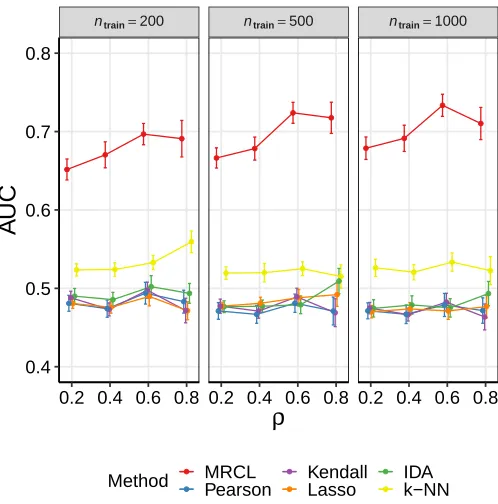
Figure 1 shows the area under the ROC curve (AUC) as a function of the proportion ρ of entries in A(C) that were observed, for the three sample sizes. Results were averaged over 25 iterations. MRCL showed good performance relative to the other approaches for all 12 considered combinations of ntrain and ρ (for the other methods shown in Figure 1, any
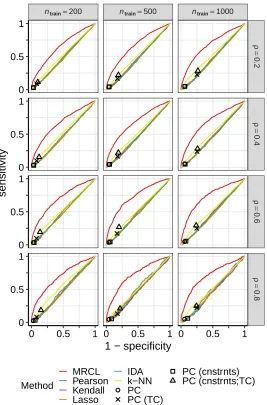
variation in performance with ρ was solely due to the changing test set as these methods do not use the background knowledge Φ). Results for PC, which provides a point estimate of a graphical object, are shown as points on the ROC plane for the 12 different regimes in Appendix C (Fig. 6). We considered also the transitive closure (motivated by the na-ture of the experimental data) and exploiting the background information Φ via additional constraints. MRCL performs well relative to the other methods in all regimes (see also the Discussion).
● ● ● ● ● ● ● ● ● ● ● ● ● ● ● ● ● ● ● ● ● ● ● ● ● ● ● ● ● ● ● ● ● ● ● ● ● ● ● ● ● ● ● ● ● ● ● ● ● ● ● ● ● ● ● ● ● ● ● ● ● ● ● ● ● ● ● ● ● ● ● ●
ntrain=200 ntrain=500 ntrain=1000
0.2 0.4 0.6 0.8 0.2 0.4 0.6 0.8 0.2 0.4 0.6 0.8 0.4 0.5 0.6 0.7 0.8
ρ
A
UC
Method ●●
●
●
●
● MRCL
Pearson KendallLasso IDAk−NN
Figure 1: Results for data set D1 (yeast data), random sampling. Area under the ROC curve (AUC; with respect to causal relationships determined from unseen in-terventional data), as a function of the fractionρ of labels available (labels were sampled at random). Results are shown for three training data sample sizesntrain.
Results are mean values over 25 iterations and error bars indicate standard error of the mean. Additional results for the PC algorithm appear in Appendix C (see text for details).
contrast, in some settings it may be relevant to predict the effect of intervening on variable i, without knowing the effect of intervening onionanyother variable. For this setting, the unlabelled set should comprise entire rows of the causal adjacency matrix A(C). Figure 2 considers this case. To ensure a sufficient number of rows were non-empty, we imposed the additional restriction on the gene subset C that at least half of the rows had at least one causal effect. Results for PC are shown in Appendix C (Fig. 7) as points on the ROC plane. As for the random sampling case above, MRCL offers an improvement over the other methods. k-NN also performs well relative to the other approaches here.
● ● ● ● ● ● ● ● ● ● ● ● ● ● ● ● ● ● ● ● ● ● ● ● ● ● ● ● ● ● ● ● ● ● ● ● ● ● ● ● ● ● ● ● ● ● ● ● ● ● ● ● ● ● ● ● ● ● ● ● ● ● ● ● ● ● ● ● ● ● ● ●
ntrain=200 ntrain=500 ntrain=1000
0.2 0.4 0.6 0.8 0.2 0.4 0.6 0.8 0.2 0.4 0.6 0.8 0.4 0.5 0.6 0.7 0.8
ρ
A
UC
Method ●●
●
●
●
● MRCL
Pearson KendallLasso IDAk−NN
Figure 2: Results for data set D1 (yeast data), row-wise sampling. As Figure 1, except the subset of labels available to the learner were obtained by sampling entire rows of the causal adjacency matrix. As before, a proportion ρ were sampled. The remaining rows were then used as test data. Additional results for the PC algorithm appear in Appendix C (see text for details).
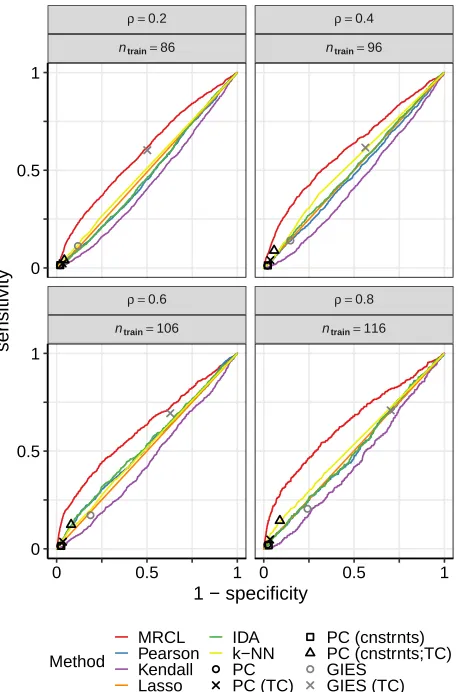
from those above, with sample size dependent on ρ, and for MRCL, D now includes data that was used to obtain background information Φ (train/test validity is preserved since it remains the case that all testing is done with respect to entirely unseen interventions). Results appear in Figure 3, with PC and GIES shown as a points on the ROC plane. MRCL appears to offer an improvement relative to the other methods (see also the Discussion). Note that GIES is not directly applicable to the random sampling setting above since it requires the interventional data with respect to all other variables (and not just a subset thereof).
3.3. Data Set D2: Protein Time-Course Data
● ●
●
●
●
●
●
●
ρ =0.6
ntrain=106
ρ =0.8
ntrain=116
ρ =0.2
ntrain=86
ρ =0.4
ntrain=96
0 0.5 1 0 0.5 1
0 0.5 1
0 0.5 1
1 − specificity
sensitivity
Method ● ●
MRCL Pearson Kendall Lasso
IDA k−NN PC PC (TC)
PC (cnstrnts) PC (cnstrnts;TC) GIES
GIES (TC)
Figure 3: Results for data set D1 (yeast data), comparison including GIES, row-wise sam-pling. ROC curves are shown with respect to causal relationships determined from unseen interventional data. “TC” indicates use of a transitive closure oper-ation and “cnstrnts” indicates that the background informoper-ation Φ was included via input constraints. Results for PC and GIES are shown as points on the ROC plane. Note that due to the nature of input required by GIES the data matrices in this example differ from the row-wise sampling example in Figure 2 (see text for details). Results are averages over 25 iterations.
in detail in Hill et al. (2017) and were also previously used in a Dialogue for Reverse Engineering Assessments and Methods (DREAM) challenge on learning causal networks (Hill et al., 2016).
MCF7 UACC812
BT20 BT549
MRCL
PearsonKendallLasso IDA
k−NN MRCL
PearsonKendallLasso IDA
k−NN 0.00
0.25 0.50 0.75
0.00 0.25 0.50 0.75
A
UC
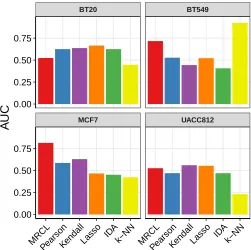
Figure 4: Results for data set D2 (protein time course data). Each panel is a different cell line, with its own training and (interventional) test data. AUC is with respect to an entirely held-out intervention. See text for details.
standard for each cell line c. For each cell line c, we formed a data matrix Zc consisting
of all available data for the p = 35 proteins except for one of the intervention regimes. The intervention regime not included was a kinase inhibitor targeting the protein mTOR. This intervention was entirely held out and used to provide the test labels. As background knowledge Φcwe took as training labels causal effects under the other interventions. With
this set-up, the task was to determine the (ancestral) causal effects of the entirely unseen intervention. Note that each cell line c was treated as an entirely different data set and task, with its own data matrix, background knowledge and interventional test data.
3.4. Data Set D3: Human Cancer Data
Data. The data consisted of protein measurements forp= 35 proteins measured inn= 820 human breast cancer samples (from biopsies). The data originate from The Cancer Genome Atlas (TCGA) Project, are described in Akbani et al. (2014) and were retrieved from The Cancer Proteome Atlas (TCPA) data portal (Li et al., 2013, https://tcpaportal.org; data release version 4.0; Pan-Can 19 Level 4 data). Data for many cancer types are available, but here we focus on a single type (breast cancer) to minimize the potential for confounding by cancer type. It is at present difficult to carry out interventions in biopsy samples of this kind. However, we focused on the same 35 proteins as in data setD2, whose mutual causal relationships are relatively well-understood, and used a reference causal graph for these proteins based on the biochemical literature (as reported in Hill et al., 2017).
Problem set-up. We formed a data set D consisting of measurements for the p = 35 proteins for three different sample sizes: (i) ntrain = 200, (ii) ntrain = 500 or (iii) all
ntrain = 820 patient samples. For (i) and (ii) patient samples were selected at random.
We then used a random fractionρof the reference graph as background knowledge, testing output on the (unseen) remainder.
Results. Figure 5 shows AUCs (with respect to the held-out causal labels) as a function of the proportionρof causal labels that were observed, for each of the methods and for the three sample sizes. Results were averaged over 25 iterations. MRCL performed well relative to the other methods, with performance improving withρ. Results were qualitatively similar for the three sample sizes, with increases in AUC for ntrain= 820 and ntrain = 500 relative
to ntrain = 250. Results for PC are shown in Appendix C (Fig. 8) as points on the ROC
plane.
4. Discussion
In this paper, we showed how a key aspect of causal structure learning can be framed as a machine learning task. Although many available approaches, including those based on DAGs and related graphical models, offer a well-studied framework, we think it may be fruitful to revisit some questions in causality using machine learning tools.
● ● ● ● ● ● ● ● ● ● ● ● ● ● ● ● ● ● ● ● ● ● ● ● ● ● ● ● ● ● ● ● ● ● ● ● ● ● ● ● ● ● ● ● ● ● ● ● ● ● ● ● ● ● ● ● ● ● ● ● ● ● ● ● ● ● ● ● ● ● ● ●
ntrain=200 ntrain=500 ntrain=820
0.2 0.4 0.6 0.8 0.2 0.4 0.6 0.8 0.2 0.4 0.6 0.8 0.4 0.5 0.6 0.7 0.8
ρ
A
UC
Method ●●
●
●
●
● MRCL
Pearson KendallLasso IDAk−NN
Figure 5: Results for data set D3 (human cancer data). Data are protein measurements from breast cancer patient samples from The Cancer Genome Atlas (TCGA). AUC is with respect to a reference graph based on the (causal) biochemical liter-ature. Results are mean values over 25 iterations and error bars indicate standard error of the mean. See text for details. Additional results appear in Appendix C.
be important to carry out similar analyses in other contexts, in order to better understand the extent to which our findings generalize to other scientific settings.
An open question from a theoretical point of view is to understand conditions on data-generating processes needed to permit a discriminative approach as pursued here and we think this will be an interesting direction for future work. One point of view—analogous to that used in practical applications of classification—is to estimate the risk of the learner and thereby report an estimate of (causal) efficacy without having to directly consider requirements on the underlying system. We think this approach is acceptable when some causal information is available, since one can then empirically test problem-specific efficacy (as in our examples above). This then gives confidence with respect to generalization to new interventions on the system of interest (but does not address the broader theoretical question).
that can be used to guide decisions or future experimental work. The main disadvantage relative to methods rooted in DAGs and related graphical models is the lack of a full causal model. Albeit under relatively strong assumptions, DAG-based models, once estimated, can be used to shed light on a huge range of questions concerning causal relationships, including direct and ancestral effects, and details of post-intervention distributions. In contrast, our approach in itself provides only estimates of binary causal relationships. That said, given the efficacy and simplicity of our approach, we think it would be fruitful to consider coupling it to established causal tools in a two-step approach, with our methods used to learn an edge structure in a data-driven manner and this structure used to inform a full analysis in a second step. Such an approach would require some care to avoid bias, and sample splitting techniques that have been studied in high-dimensional statistics could be relevant (Wasserman and Roeder, 2009; St¨adler and Mukherjee, 2017).
5. Code Availability
All computational analysis was performed in R (R Core Team, 2018). Source code for MRCL and scripts to generate the empirical results presented in Section 3 are available at https://github.com/Steven-M-Hill/MRCL.
Acknowledgments
The authors are grateful to the Editor and Reviewers for their constructive feedback on an earlier version of the manuscript. The authors are grateful to Umberto No`e for in-put on the empirical work and to Oliver Crook for feedback on an earlier version of the manuscript. This work was supported by the UK Medical Research Council (University Unit Programme number MC UU 00002/2). CJO was supported by the ARC Centre of Excellence for Mathematics and Statistics, Australia, and the Lloyd’s Register Founda-tion programme on data-centric engineering at the Alan Turing Institute, UK. The re-sults shown here are in part based upon data generated by the TCGA Research Network: https://www.cancer.gov/tcga.
Author contributions: CJO, DB and SM developed methodology based on original ideas by SM. SMH performed the computational work and CJO contributed theory. CJO and SM wrote the paper with input from SMH and DB.
Appendix A. Proof of Results in the Main Text
In this appendix we provide proofs for the theoretical results in the main text.
Proof [Proposition 1] Given S, S0 ∈ Sn, we obtain from the pseudo-metric properties of
dP each of (i) positivity dS(S, S0) = dP(κ(S), κ(S0)) ≥ 0, (ii) pseudo-identity dS(S, S) =
dP(κ(S), κ(S)) = 0, (iii) symmetry dS(S, S0) = dP(κ(S), κ(S0)) = dP(κ(S0), κ(S)) =
dS(S0, S) and (iv) the triangle inequality dS(S, S00) =dP(κ(S), κ(S00))≤dP(κ(S), κ(S0)) +
Suppose now that κ is injective and dP is a metric on P. Then if it holds that
dS(S, S0) = dP(κ(S), κ(S0)) = 0, it follows that κ(S) = κ(S0) which (from assumption
onκ) impliesS=S0 inSn. Thus under these additional assumptions, dS is a metric onSn.
Proof [Proposition 2] The non-negativity, symmetry and sub-additivity properties of dP
are clear, so all that remains is to establish thatdP(π, π0) = 0 impliesπ=π0. From the
defi-nition ofP, bothπandπ0 are continuous onZ2. The result is then immediate from the fact that, sinceπandπ0 are continuous andZ2 is compact, then
R
Z2|π(z
0)−π0(z0)|2dΛ
2(z0) = 0
implies π and π0 must be identical as functions onZ2.
Proof [Proposition 3] Observe that, using Prop. 2 for sub-additivity of the metric dP,
dS(S(n),S˜(n)) = dP(κ(S(n)), κ( ˜S(n)))
≤ dP(κ(S(n)), π) +dP(π,π) +˜ dP(˜π, κ( ˜S(n)))
= dP(π,π) +˜ kπ−κ(S(n))kL2(Λ
2)+kπ˜−κ( ˜S
(n))k L2(Λ
2)
Since κ is consistent we have kπ−κ(S(n))k2 = oP(1) and kπ˜−κ( ˜S(n))k2 = oP(1). This
completes the proof.
Proof [Proposition 4] This proof extends the simpler proof given for the univariate case in Theorem 6.11 of Wassermann (2006). For convenience, and without loss of generality, we suppose that Z2 = [0,1]2. It will be convenient in this section to re-assign the notation z
as a dummy variable inZ2 (instead of inZp). Let pi,j =
Z
Bi,j
πdΛ2
be the probability mass assigned to
Bi,j =
zmin+ (zmax−zmin)
i−1
M , zmin+ (zmax−zmin) i M
×
zmin+ (zmax−zmin)
j−1
M , zmin+ (zmax−zmin) j M
,
so that, from binomial properties, the mean and variance of the histogram estimator κ(S(n))(z) at the point z∈ Z2 are
m(z) = pi,j h2
v(z) = pi,j(1−pi,j) nh4 .
Letb(z) =m(z)−π(z) denote the bias of the histogram estimator. The mean square of the errorπ(z)−κ(S(n))(z) at a point z0 ∈ Z2 can be bias-variance decomposed:
The aim is to obtain independent bounds on both the bias and variance terms next.
To bound the bias term, Taylor’s theorem gives that, for z,z0 ∈Bi,j,
π(z0) =π(z) + (z0−z)>· ∇π(z) +1 2(z
0−
z)> Ri,j(z) (z0−z) (7)
where the remainder term satisfies
kRi,j(z)kmax ≤ sup
z00∈B
i,j
k∇∇>π(z00)kmax (Taylor)
≤ sup
z00∈Z 2
k∇∇>π(z00)kmax < ∞ (continuous on compact domain).
Here kMkmax = max{Mi,j} and ∇∇>π denotes the Hessian, which exists since π is twice
continuously differentiable inZ2. Thus for z∈Bi,j, integrating (7):
Z
Bi,j
π(z0)dΛ2(z0) =h2π(z) +h2
h 2
2i−1 2j−1
−z
· ∇π(z) +Ei,j(z)
where the new remainder term can be bounded:
|Ei,j(z)| =
1 2
Z
Bi,j
(z0−z)>Ri,j(z) (z0−z)dΛ2(z0)
≤ 1
2 Z
Bi,j
kz0−zk22dΛ2(z0)× sup
z00∈Z 2
k∇∇>π(z00)kmax (8) ≤ 8h4 sup
z00∈Z 2
k∇∇>π(z00)kmax =: Ch4
where the constant C is independent of z and i, j. The number 8 (which is not sharp) is obtained from trivial but tedious computation of the integral in (8) and bounding each term in the result. Now, forz∈Bi,j, the bias is expressed using (7) as
b(z) = 1 h2
Z
Bi,j
π(z0)dΛ2(z0)−π(z)
=
h 2
2i−1 2j−1
−z
· ∇π(z) + 1
Now we integrate this expression over x∈Bi,j:
Z
Bi,j
b2dΛ2 =
Z Bi,j h 2 2i−1 2j−1
−z
· ∇π(z) + 1
h2Ei,j(z)
2
dΛ2(z)
≤ Z Bi,j h 2 2i−1 2j−1
−z
· ∇π(z) 2
dΛ2(z)
+2 Z Bi,j h 2 2i−1 2j−1
−z
· ∇π(z)
1
h2|Ei,j(z)|dΛ2(z)
+ Z
Bi,j
1
h4Ei,j(z) 2dΛ
2(z)
≤ Z Bi,j h 2 2i−1 2j−1
−z
· ∇π(z) 2
dΛ2(z)
+2Ch2 Z Bi,j h 2 2i−1 2j−1
−z
· ∇π(z)
dΛ2(z) +C2h2
To bound these integrals we use Cauchy-Schwarz:
Z Bi,j h 2 2i−1 2j−1
−z
· ∇π(z) 2
dΛ2(z) ≤
Z Bi,j h 2 2i−1 2j−1
−z 2 2
k∇π(z)k2 2dΛ2(z)
≤ h
2
2 Z
Bi,j
k∇π(z)k2
2dΛ2(z) (9)
and Z Bi,j h 2 2i−1 2j−1
−z
· ∇π(z)
dΛ2(z) ≤
Z Bi,j h 2 2i−1 2j−1
−z 2
k∇π(z)k2dΛ2(z)
≤ √h 2
Z
Bi,j
k∇π(z)k2dΛ2(z). (10)
Both expressions in (9) and (10) are finite since the integrand is continuous and the domain is compact. The total integrated bias is thus bounded as
Z
Z2
b2dΛ2 ≤
h2 2
Z
Z2
k∇π(z)k22dΛ2(z) +C2h2+O(h3)
To bound the variance term, from the integral form of the mean value theorem we have that, for somezi,j ∈Bi,j,
pi,j =
Z
Bi,j
The application of the integral form of the mean value theorem is valid sinceπis continuous on Z2. Then:
Z
Z2
v2dΛ2 = M X i,j=1 Z Bi,j vdΛ2 = M X i,j=1 Z Bi,j
pi,j(1−pi,j)
nh4 dΛ2
= 1
nh2 −
1 nh2
M
X
i,j=1
p2i,j
= 1
nh2 −
h2 n
M
X
i,j=1
π(zi,j)2
= 1
nh2 −
1 n
Z
X2
π2dΛ2+o(1)
= 1
nh2 +O
1 n
Putting this all together to obtain a bound:
Ekπ−κ(S(n))k2L2(Λ 2) =
Z
X2
b2dΛ2+
Z
Z2
vdΛ2 (Fubini)
≤ h
2
2 Z
Z2
k∇π(z)k22dΛ2(z) +C2h2+O(h3) +
1 nh2 +O
1 n
(11)
whereEdenotes expectation with respect to sampling of the dataS(n)∼Π. From inspection
of (11), the estimator error vanishes provided that h is chosen such that nh2 → ∞. Since convergence in expectation implies convergence in probability, we have established that kπ−κ(S(n))kL2(Λ
2)=oP(1). The bandwidthh
∗, which minimizes the upper bound in (11),
is
h∗ = 1 n1/4
2 R
Z2k∇π(z)k
2
2dΛ2(z) + 2C2
!1/4
and with this choice we have thatEkπ−κ(S(n))k2L2(Λ
2) =OP(n
−1/2). Forh =h∗ we have
thus established thatkπ−κ(S(n))kL2(Λ
2)=OP(n −1/4).
Appendix B. Consistency of the Classifier
Let X be the compact metric spaceX =
×
1≤i,j≤M[0, n] from the main text, where n (the number of points in each scatter plot) is fixed. Let Y = R, so that {−1,+1} ⊂ Y. Thissection studies the performance of the classifier ˆc :X → {−1,+1}, ˆc(x) = sign( ˆf), where ˆ
f is the Laplacian-regularized least squares method from (4) in the main text, trained on labelled data{(x[k], y[k]) : [k]∈ L}and unlabelled data{x[k]: [k]∈ U }, wherex[k]∈ X and y[k]∈ Y. To this end, we must establish a context in which the data pairs (x[k], y[k]) can be
ρX, ρY and conditionalρY|X. In this theoretical investigation we suppose that all data are
generated independently fromρX,Y, with the values{y[k]: [k]∈ U }being withheld.
For a generic classifier c:X → {−1,+1}, define the misclassification rate
R(c) = 1 2
Z
|y−c(x)|dρX,Y(x, y).
This is minimized by cρ(x) := sign(fρ(x)) where fρ:X → Y is the (typically unavailable)
regression function
fρ(x) =
Z
ydρY|X(y|x).
Thus the quantityR(cρ) captures the intrinsic difficulty of the classification task. A classifier
ˆ
cis said to beconsistent (either in expectation, with high probability, etc.) ifR(ˆc)→ R(cρ)
in the limitmL→ ∞ of infinite labelled data (with convergence either in expectation, with
high probability, etc.). Our consistency argument is based around the following straight-forward bound:
Lemma 6 Fix >0 and let X :={x∈ X :|fρ(x)|< }. Then
R(ˆc)≤ R(cρ) +ρX(X) +
1 2k
ˆ
f−fρkL1(ρ X),
where ρX(X) denotes the ρX-measure of the set X.
Proof For all x∈ X,y∈ Y, we have that
|y−sign( ˆf(x))| ≤ |y−sign(fρ(x))|+|sign(fρ(x))−sign( ˆf(x))|
so in particular
R(ˆc)≤ R(cρ) +
1
2ksign(fρ)−sign( ˆf)kL1(ρX). (12) Now,
ksign(fρ)−sign( ˆf)kL1(ρ X)=
Z
X
|sign(fρ)−sign( ˆf)|dρX
| {z }
(∗)
+ Z
X \X
|sign(fρ)−sign( ˆf)|dρX
| {z }
∗∗
.
To bound (∗), we note that the integrand is trivially bounded by 2. To bound (∗∗), we note that if|fρ(x)|> then sign(fρ)6= sign( ˆf) implies that |f(ˆx)−fρ(x)|>2. Thus
(∗) + (∗∗) ≤ 2ρX(X) +
Z
X \X
|fρ(x)−fˆ(x)|
dρX(x) = 2ρX(X) + 1 k
ˆ
f −fρkL1(ρ X)
(13)
Combining (12) and (13) completes the proof.
Theorem 7 Supposefρis non-constant and thatΣ −α
2
K fρ∈L2(ρX) for someα∈(0,1]. Let
θ = (1+α1)(1+s). Take λ1 =mθU and λ2 = mθL. Then there exists a finite constant C such that for any δ ∈(0,1), and for mL, mU sufficiently large, we have with probability at least
1−8δ that
kfˆ−fρkL1(ρ
X)≤Clog
2 δ
m−αθL . (14)
Proof This result is an immediate consequence of Theorem 5.6 in Cao and Chen (2012), whose bound on the L2(ρ
X) error clearly also implies a bound on the L1(ρX) error. In
addition, since our intention in what follows is limited to establishing consistency of the proposed classification method, as opposed to a detailed convergence rate analysis, we have simplified the presentation by stating a slightly weaker but less-verbose upper bound.
Note how the “for mU sufficiently large” condition in Theorem 7 will typically be
au-tomatically satisfied in our context, where the amount of unlabelled data is mU =O(p2).
Thus the content of (14) is control over ˆf−fρas the numbermLof labeled data is increased.
Corollary 8 Under the same assumptions as Theorem 7, we have with probability at least
1−8δ that
R(ˆc)≤ R(cρ) +ρX(X) +
C 2log
2 δ
m−αθL . (15)
Corollary 8 makes explicit how the intrinsic difficulty of the classification task depends on the form of fρ, and in particular the extent to which |fρ(x)| < occurs in X. For
typical regression functionsfρ with simple roots inX, it will hold thatρX(X) =O(). An
assumption of this form can therefore be used to complete a high probability consistency argument:
Corollary 9 (Consistency of the Classifier) Suppose that ρX(X) = O(γ) for some
γ > 0. Under the same assumptions as Theorem 7, there exists a finite constant C˜ such that, with probability at least 1−8δ,
R(ˆc)≤ R(cρ) + ˜C
log
2 δ
1+γγ m−
αθγ
1+γ
L .
In particular, this establishes that the classifier ˆc is (with high probability) consistent.
Proof From the hypothesis, ∃B1, 1 such that ρX(X) ≤ B1γ for all < 1. Thus, for
< 1 the differenceR(ˆc)− R(cρ) can be bounded via (15) as R(ˆc)− R(cρ) ≤ ρX(X) +
C 2log
2 δ
m−αθL
≤ B1γ+
B2
whereB2 = C2 log 2δ
m−αθL . DifferentiatingJ and setting to zero reveals thatJ is minimized over (0,∞) at
∗=
B2
γB1
1+1γ ,
which satisfies∗ < 1 formL sufficiently large (recall thatmL being sufficiently large was
an assumption of Theorem 7). Thus, formL sufficiently large,
R(ˆc)− R(cρ) ≤ J(∗) =
γ−
γ
1+γ +γ
1 1+γ
B
1 1+γ
1 B
γ
1+γ
2
which, upon substitution for B2, yields the required result with the value for the constant
˜
C=γ−1+γγ +γ
1 1+γ
B
1 1+γ
1 C2
Appendix C. Additional Figures
●
●
●
●
●
●
●
●
●
●
●
●
ntrain=200 ntrain=500 ntrain=1000
ρ
=
0.2
ρ
=
0.4
ρ
=
0.6
ρ
=
0.8
0 0.5 1 0 0.5 1 0 0.5 1
0 0.5 1
0 0.5 1
0 0.5 1
0 0.5 1
1 − specificity
sensitivity
Method ●
MRCL Pearson Kendall Lasso
IDA k−NN PC PC (TC)
PC (cnstrnts) PC (cnstrnts;TC)
●
●
●
●
●
●
●
●
●
●
●
●
ntrain=200 ntrain=500 ntrain=1000
ρ
=
0.2
ρ
=
0.4
ρ
=
0.6
ρ
=
0.8
0 0.5 1 0 0.5 1 0 0.5 1
0 0.5 1
0 0.5 1
0 0.5 1
0 0.5 1
1 − specificity
sensitivity
Method ●
MRCL Pearson Kendall Lasso
IDA k−NN PC PC (TC)
PC (cnstrnts) PC (cnstrnts;TC)
●
●
●
●
●
●
●
●
●
●
●
●
ntrain=200 ntrain=500 ntrain=820
ρ
=
0.2
ρ
=
0.4
ρ
=
0.6
ρ
=
0.8
0 0.5 1 0 0.5 1 0 0.5 1
0 0.5 1
0 0.5 1
0 0.5 1
0 0.5 1
1 − specificity
sensitivity
Method ●
MRCL Pearson Kendall Lasso
IDA k−NN PC PC (TC)
PC (cnstrnts) PC (cnstrnts;TC)
References
R. Akbani, P.K.S. Ng, H.M. Werner, M. Shahmoradgoli, F. Zhang, Z. Ju, W. Liu, J.Y. Yang, K. Yoshihara, J. Li, S. Ling, E.G. Seviour, P.T. Ram, J.D. Minna, L. Diao, P. Tong, J.V. Heymach, S.M. Hill, F. Dondelinger, N. St¨adler, L.A. Byers, F. Meric-Bernstam, J.N. Weinstein, B.M. Broom, R.G.W. Verhaak, H. Liang, S. Mukherjee, Y. Lu, and G.B. Mills. A pan-cancer proteomic perspective on The Cancer Genome Atlas. Nature Communications, 5:3887, 2014.
M. Belkin and P. Niyogi. Towards a theoretical foundation for Laplacian-based manifold methods. Journal of Computer and System Sciences, 74(8):1289–1308, 2008.
M. Belkin, P. Niyogi, and V. Sindhwani. Manifold regularization: A geometric framework for learning from labeled and unlabeled examples. Journal of Machine Learning Research, 7:2399–2434, 2006.
Y. Cao and D. Chen. Generalization errors of Laplacian regularized least squares regression.
Science China Mathematics, 55(9):1859–1868, 2012.
D. Colombo, M. H. Maathuis, M. Kalisch, and T. S. Richardson. Learning high-dimensional directed acyclic graphs with latent and selection variables. The Annals of Statistics, 40 (1):294–321, 2012.
F. Cucker and D. X. Zhou. Learning Theory: An Approximation Theory Viewpoint. Cam-bridge University Press, 2007.
R. Fergus, Y. Weiss, and A. Torralba. Semi-supervised learning in gigantic image collections. InProceedings of the 23rd Annual Conference on Neural Information Processing Systems, pages 522–530, 2009.
A. Grigor’yan. Heat kernels on weighted manifolds and applications. Cont. Math, 398: 93–191, 2006.
A. Hauser and P. B¨uhlmann. Characterization and greedy learning of interventional markov equivalence classes of directed acyclic graphs. Journal of Machine Learning Research, 13: 2409–2464, 2012.
S.M. Hill, L.M. Heiser, T. Cokelaer, M. Unger, N.K. Nesser, D.E. Carlin, Y. Zhang, A. Sokolov, E.O. Paull, C.K. Wong, K. Graim, A. Bivol, H. Wang, F. Zhu, B. Afsari, L.V. Danilova, A.V. Favorov, W.S. Lee, D. Taylor, C.W. Hu, B.L. Long, D.P. Noren, A.J. Bisberg, The HPN-DREAM Consortium, G.B. Mills, J.W. Gray, M. Kellen, T. Nor-man, S. Friend, A.A. Qutub, Y. Fertig, E.J. Guan, M. Song, J.M. Stuart, P.T. SpellNor-man, H. Koeppl, G. Stolovitzky, J. Saez-Rodriguez, and S. Mukherjee. Inferring causal molec-ular networks: empirical assessment through a community-based effort. Nature Methods, 13(4):310–318, 2016.
A. Hyttinen, F. Eberhardt, and P. O. Hoyer. Learning linear cyclic causal models with latent variables. Journal of Machine Learning Research, 13:3387–3439, 2012.
P. Kemmeren, K. Sameith, L.A. van de Pasch, J.J. Benschop, T.L. Lenstra, T. Margaritis, E. O’Duibhir, E. Apweiler, S. van Wageningen, C.W. Ko, S. van Heesch, M.M. Kashani, G. Ampatziadis-Michailidis, M.O. Brok, N.A.C.H. Brabers, A.J. Miles, D. Bouwmeester, S.R. van Hooff, H. Bakel, E. Sluiters, L.V. Bakker, B. Snel, P. Lijnzaad, D. van Leenen, M.J.A. Groot Koerkamp, and F.C.P. Holstege. Large-scale genetic perturbations reveal regulatory networks and an abundance of gene-specific repressors. Cell, 157(3):740–752, 2014.
J. Li, Y. Lu, R. Akbani, Z. Ju, P. L. Roebuck, W. Liu, J-Y. Yang, B.M. Broom, R.G.W. Verhaak, D.W. Kane, C. Wakefield, J.N. Weinstein, G.B. Mills, and H. Liang. TCPA: a resource for cancer functional proteomics data. Nature Methods, 10(11):1046–1047, 2013.
D. Lopez-Paz, K. Muandet, B. Sch¨olkopf, and I. Tolstikhin. Towards a learning theory of causation. In Proceedings of the 32nd International Conference on Machine Learning, pages 1452–1461, 2015.
M.H. Maathuis, M. Kalisch, and P. B¨uhlmann. Estimating high-dimensional intervention effects from observational data. Annals of Statistics, 37(6A):3133–3164, 2009.
M.H. Maathuis, D. Colombo, M. Kalisch, and P. B¨uhlmann. Predicting causal effects in large-scale systems from observational data. Nature Methods, 7(4):247–248, 2010.
N. Meinshausen, A. Hauser, J.M. Mooij, J. Peters, P. Versteeg, and P. B¨uhlmann. Methods for causal inference from gene perturbation experiments and validation. Proceedings of the National Academy of Sciences, 113(27):7361–7368, 2016.
J.M. Mooij, J. Peters, D. Janzing, J. Zscheischler, and B. Sch¨olkopf. Distinguishing cause from effect using observational data: methods and benchmarks. Journal of Machine Learning Research, 17(32):1–102, 2016.
J. Pearl. Causality. Cambridge University Press, 2009.
J. Peters, P. B¨uhlmann, and N. Meinshausen. Causal inference using invariant prediction: identification and confidence intervals. Journal of the Royal Statistical Society: Series B, 78(5):947–1012, 2016.
R Core Team. R: A Language and Environment for Statistical Computing. R Foundation for Statistical Computing, Vienna, Austria, 2018. URL https://www.R-project.org/.
T. Richardson. A discovery algorithm for directed cyclic graphs. In Proceedings of the Twelfth International Conference on Uncertainty in Artificial Intelligence, pages 454– 461, 1996.
P. Spirtes, C. N. Glymour, and R. Scheines. Causation, Prediction, and Search. MIT press, 2000.
N. St¨adler and S. Mukherjee. Two-sample testing in high dimensions. Journal of the Royal Statistical Society: Series B, 79(1):225–246, 2017.
R. Tibshirani. Regression shrinkage and selection via the lasso. Journal of the Royal Statistical Society: Series B, 58(1):267–288, 1996.
M.P. Wand and M.C. Jones. Kernel Smoothing. CRC Press, 1994.
J. Wang, T. Jebara, and S.-F. Chang. Graph transduction via alternating minimization. In
Proceedings of the 25th International Conference on Machine Learning, pages 1144–1151, 2008.
L. Wasserman and K. Roeder. High dimensional variable selection. Annals of Statistics, 37 (5A):2178, 2009.