R E S E A R C H A R T I C L E
Open Access
Metabolic profiling detects early effects of
environmental and lifestyle exposure to cadmium
in a human population
James K Ellis
1, Toby J Athersuch
1,2, Laura DK Thomas
3,4, Friederike Teichert
5, Miriam Pérez-Trujillo
7,
Claus Svendsen
6, David J Spurgeon
6, Rajinder Singh
5, Lars Järup
2,3, Jacob G Bundy
1,2and Hector C Keun
1,2*Abstract
Background:The‘exposome’represents the accumulation of all environmental exposures across a lifetime. Top-down strategies are required to assess something this comprehensive, and could transform our understanding of how environmental factors affect human health. Metabolic profiling (metabonomics/metabolomics) defines an individual’s metabolic phenotype, which is influenced by genotype, diet, lifestyle, health and xenobiotic exposure, and could also reveal intermediate biomarkers for disease risk that reflect adaptive response to exposure. We investigated changes in metabolism in volunteers living near a point source of environmental pollution: a closed zinc smelter with associated elevated levels of environmental cadmium.
Methods:High-resolution1H NMR spectroscopy (metabonomics) was used to acquire urinary metabolic profiles from 178 human volunteers. The spectral data were subjected to multivariate and univariate analysis to identify metabolites that were correlated with lifestyle or biological factors. Urinary levels of 8-oxo-deoxyguanosine were also measured, using mass spectrometry, as a marker of systemic oxidative stress.
Results:Six urinary metabolites, either associated with mitochondrial metabolism (citrate, 3-hydroxyisovalerate, 4-deoxy-erythronic acid) or one-carbon metabolism (dimethylglycine, creatinine, creatine), were associated with cadmium exposure. In particular, citrate levels retained a significant correlation to urinary cadmium and smoking status after controlling for age and sex. Oxidative stress (as determined by urinary 8-oxo-deoxyguanosine levels) was elevated in individuals with high cadmium exposure, supporting the hypothesis that heavy metal
accumulation was causing mitochondrial dysfunction.
Conclusions:This study shows evidence that an NMR-based metabolic profiling study in an uncontrolled human population is capable of identifying intermediate biomarkers of response to toxicants at true environmental concentrations, paving the way for exposome research.
Keywords:metabonomics, cadmium, environmental health, exposome, metabolomics, molecular epidemiology
Background
From the point of conception and throughout life, humans experience a broad range of physical, chemical and biological exposures. The health effects of such expo-sures will depend not only on dose but also on their interaction with each other and with the characteristics
of the individual, such as age, sex and genotype. Hence, it is a persistent and significant challenge to understand how specific environmental factors produce effects on human health. Biomarkers already play an important role in characterizing both dose and effect; however, their full potential remains to be explored. Molecular profiling technologies (’-omics’) have been suggested to be an important route to the discovery of novel biomarkers to improve exposure assessment in man [1]. Such techni-ques can also report on the biological consequences of exposure by identifying intermediate biomarkers that * Correspondence: [email protected]
1Biomolecular Medicine, Department of Surgery and Cancer, Faculty of
Medicine, Imperial College London, Sir Alexander Fleming Building, South Kensington, London, SW7 2AZ, UK
Full list of author information is available at the end of the article
both correlate with exposure and predict health end-points, termed a‘meet-in-the-middle’approach [2,3]. Such markers would help to define the mechanism of toxicity and the etiology of disease in the human popula-tion and ultimately could inform follow-up surveillance for communities impacted by environmental pollution. It has been proposed that by combining a wide range of molecular profile data, including parallel assays of mole-cular adducts, metals and other exogenous species, we have the potential to define the molecular imprint of the totality of environmental exposures in an individual’s life-time, the‘exposome’[4,5].
Metabolic profiling allows the study of an individual’s metabolic phenotype [6,7] and represents a systematic and efficient route to intermediate biomarkers. It can detect and classify the consequences of toxicant exposurein vivo [8,9] and the approach readily translates to molecular epi-demiology [10]. Here we use an NMR-based metabolic profiling approach to investigate changes in human sys-temic metabolism from a sample of the population living near a point source of environmental pollution. The site (Avonmouth, UK) was home to one of the world’s largest smelters and large amounts of cadmium (Cd) and other potentially toxic elements were released into the local environment until its closure in early 2003 resulting in the presence of elevated concentrations of metals in air, soil and house dust in the area [11].
Cd is a toxic heavy metal of occupational and environ-mental concern due to its widespread contamination of sites worldwide [12,13] and long biological half-life (10 to 30 years) [14]. Cd exposure is associated with a host of adverse effects [15], including osteoporosis, pulmon-ary dysfunction, hypertension and nephropathy. The kidney accumulates Cd and is the critical organ, particu-larly at environmental levels of exposure, with tubular proteinuria being an early effect of Cd exposure [16]. This proteinuria is usually detected as an increased excretion of low-molecular weight urinary proteins, such as N-acetyl-b-D-glucosaminidase (NAG). There is some evidence to suggest that, following high and/or longed exposure, these pre-clinical changes may pro-gress to renal impairment with a decreased glomerular filtration rate [17-19], and eventually to renal failure [20].
A further concern is cancer risk; Cd is a multi-site carcinogen in both rodents [21] and humans [22] and as such has been classified as a human carcinogen by the International Agency for Research on Cancer [23] and the National Toxicology Program [24]. The mechanism of Cd carcinogenesis is thought to be multi-factorial but is as yet poorly understood. Cd has been shown to pos-sess estrogenic activity [25-27], inhibit mismatch repair [28], alter DNA methylation [29,30] and increase reac-tive oxygen species (ROS) production [31].
The diet is the major source of Cd exposure in the general non-smoking population with around 5% to 10% [32] absorption from the gastrointestinal tract. However, among smokers tobacco is also a significant source of exposure owing to the high rate of absorption from the lungs (10 to 50%) [32]. The low excretion rate of Cd and the resulting long biological half life means that Cd body burden increases slowly with age and appears to accumulate at a higher rate in women compared to men. Urinary-Cd (U-Cd) concentration is mainly influ-enced by the total body burden and is, hence, a marker for long term exposure, but can also increase as kidney damage occurs [14].
It has been well documented that 1H NMR-based metabolic profiling (metabonomics/metabolomics) can detect Cd-induced perturbations of metabolism in ani-mal models [33-35] with renal damage and biochemical changes at concentrations that were considered rela-tively safe in humans by the World Health Organisation [36]. However, there have not been any comparable investigations in human populations. In the present study, we aim to establish that NMR-based metabolic profiling could be used in molecular epidemiology to define the metabolic signatures of exposure to toxicants in the human population and link these to mechanisms of toxicity. We correlated urinary metabolic profiles of individuals living near the Avonmouth site with environ-mental toxicants (U-Cd) and corrected for confounding lifestyle and biological factors, such as age, sex and smoking status (Figure 1).
Methods
Sample collection and epidemiology data
One hundred and eighty adult participants were recruited to the current study as described in Thomaset al.(2009) [37], and 178 samples in total were analyzed by1H NMR spectroscopy. Briefly, each individual was asked to provide one spot morning urine sample; each sample was frozen on the day of collection. Each volunteer completed a life-style questionnaire that provided information on a number of parameters including smoking status (current, past, never), age and sex. Data were anonymized for the present study. U-Cd and U-NAG were previously determined [37] and were both log-normally distributed. Ethical approval for the study was granted by Bristol (UK) South and Central Ethics Committee and all participants provided their written informed consent before data collection.
NMR data acquisition
(16,000 g, ten minutes) to remove suspended particulate matter.
High-resolution 1H NMR spectroscopy experiments were conducted using a Bruker AVANCE 600 spectro-meter (Bruker Biospin, Rheinstetten, Germany) fitted with a flow-injection mode probehead (5 mm FI TXB 1
H-13C/15N-2H Z-GRD H8432/K0201 Z8432/0201, Bru-ker) at a field strength of 14.1 T (600.13 MHz 1H fre-quency). The probe temperature was set to 300 K. Samples were delivered to the probehead in 96-well plates using an automated flow injection system (Bru-ker). Following introduction to the probe, samples were left to equilibrate (three minutes) prior to gradient
shimming using the1H channel to ensure good mag-netic field homogeneity. All liquid sample handling, automation and acquisition were controlled using XWIN-NMR 3.1 software (Bruker) running on a UNIX workstation (Silicon Graphics, USA).
One-dimensional NMR spectra were acquired using a standard pulse sequence using excitation sculpting with gradients to suppress the water resonance [38]. Follow-ing eight dummy scans, each spectrum was acquired into 64 k datapoints over a spectral width of 20 ppm as the sum of 64 transients. The acquisition time was 2.73 seconds, giving a native free induction decay (FID) reso-lution of 0.183 Hz. The relaxation delay was set at two
SELECTION OF KEY METABOLITES
PLS REGRESSION ANALYSIS: U-Cd, sex , age, U-NAG and smoking status
QUANTITATIVE and STATISTICAL ANALYSIS CORRELATION ANALYSIS:
U-Cd, sex , age, U-NAG and smoking status
© Crown copyright 1999
A
B
C
D
citrate creatinine and creatine creatinine
creatine
DMG 3-HV 3-HV
Figure 1Metabolic profiling in molecular epidemiology: a methodology to identify intermediate biomarkers of response to environmental toxicants.A) Map of United Kingdom showing Bristol region. Reproduced from Ordnance Survey map data by permission of the Ordnance Survey©Crown copyright 2010.B) Air Cd concentration around the Avonmouth zinc smelter site (data from Thomaset al.(2009) [37]). Contours represent modeled air Cd concentration (ng/m3). Dotted line represents boundary of Bristol North PCT from where volunteers were recruited.C) Partial1H NMR one dimensional spectrum with key metabolites annotated. 3-HV, 3-hydroxyisovalerate; DMG, dimethylglycine.
seconds. The total acquisition time was approximately six minutes per sample. An apodization function equiva-lent to a line-broadening of 0.3 Hz was applied to each FID prior to Fourier transformation. Assignment of peaks to specific metabolites was based on the addition of known standards to the biological samples, together with published literature [39], on-line metabolomics databases and statistical total correlation spectroscopy (STOCSY) [40]. Additional NMR spectroscopy experi-ments were conducted to assign a doublet at a chemical shift ofδ1.11. A one-dimensional 1H selective TOCSY experiment (See additional file 1, Figure S1) observed three related 1H resonances in the same molecule. Further two-dimensional experiments [See additional file 1, Figure S2] allowed the full1H and13C characteri-zation [See additional file 1, Table S1] of the two dia-stereoisomers of 2,3-dihydroxybutanoic acid [See additional file 1, Figure S3]: 4-deoxy-erythronic acid and 4-deoxy-threonic acid, both of which have previously been identified in human urine [41].
NMR data processing and statistical analysis
Data were imported and manipulated in Matlab (Math-works, Natick, MA, USA) using in-house code for auto-matic phasing, baseline correction, and referencing chemical shifts to the TSP resonance atδ0. To account for variance in dilution of the urine samples each spectrum was subsequently normalized by the median-fold change to a reference spectrum generated by calculation of the med-ian of all spectra at each spectral point [42]. The spectra were analyzed at two resolutions: (1) reduced resolution of 0.01 ppm width (1,127 data points), for partial least squares (PLS) regression analysis; and (2) high resolution (32,697 data points), for covariance/correlation analysis.
For multivariate analysis the reduced resolution data were exported to SIMCA-P+ (Umetrics) with the TSP (δ< 0.15) and residual water (δ4.675 to 4.895) resonances removed. PLS regression analysis was applied to these data to model optimally the association between the metabolic profile and the lifestyle and biological factors (U-Cd, age, sex, U-NAG and smoking status) and to identify individual metabolites significantly contributing to any associations observed. Permutation analysis was carried out for each PLS model to test for validity using 1,000 permutations per test [See additional file 1, Figure S4].
Additionally, we used a variable-wise covariance and correlation based analysis of the high resolution data to assist in the identification of individual metabolites asso-ciated with lifestyle/biological factors. The results were visualized by color-scale projection onto the plots to indi-cate the correlation of metabolites with the individual fac-tors, with red indicating a high correlation and dark blue no correlation. The direction and magnitude of the signals
represent the co-variation of the metabolites with the spe-cific lifestyle factor.
We measured the area under selected spectral peaks for six specific metabolites (3-hydroxyisovalerate (3-HV), dimethylglycine (DMG), citrate, 4-deoxy-erythronic acid (4-DEA), creatinine and creatine) identified from the above analyses. These data were then analyzed by multiple linear regression (MLR) using SPSS (v19, IBM, Armonk, NY, USA) controlling for major confounding factors (age, sex and smoking status). We developed three separate MLR models for citrate. Model 1 excluded individuals who did not answer the question regarding smoking status (n = 3); model 2 additionally excluded all individuals classed as current smokers (n = 32); and model 3 addition-ally excluded current (n = 32) and past smokers (n = 35). Additionally, we used non-parametric tests (Kruskal-Wallis/Mann-Whitney or Spearman’sr) to test for a sig-nificant (P< 0.05) difference or trend, respectively, in the concentration of citrate between the three classes of smo-ker (current-, past-, and never smoked). A normal distri-bution of values in each group in the dataset was observed (P< 0.05, Shapiro-Wilk test).
Quantitation of the urinary biomarker 8-oxo-deoxyguanosine (8-oxodG)
Urinary-8-oxodG (U-8-oxodG) was quantified in samples from the upper and lower 15thpercentile according to U-Cd concentration, as described previously [43]. The U-8-oxodG concentrations were normalized to the creatinine concentration (taken from [37]) and a non-parametric Mann-Whitney test used to test for a significant (P< 0.05) difference between the groups. A non-normal distribution of values in the upper 15thpercentile group was observed (P< 0.05, Shapiro-Wilk test).
Results
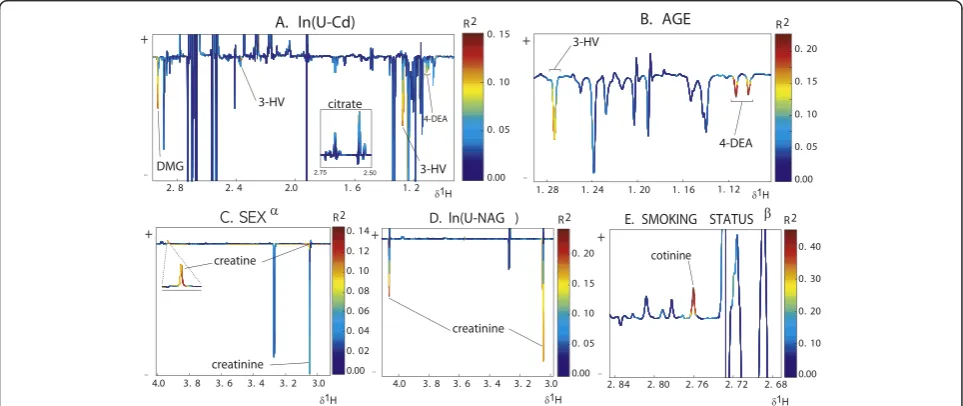
number of urinary metabolites responsible for this asso-ciation, namely: citrate, 3-HV, DMG, creatinine, creatine and 4-DEA. DMG, 3-HV, creatinine and 4-DEA were negatively correlated to U-Cd concentration and citrate was positively correlated.
Since smoking is a major source of cadmium exposure we excluded smokers from PLS modelling to test if the link between metabolite profiles and U-Cd was
independent of smoking status. PLS models with signifi-cant prediction of U-Cd could be generated either with current smokers excluded (Q2 = 0.330,P < 0.001, Table 1) or with both current smokers and past smokers excluded (Q2 = 0.142, P < 0.001, Table 1), suggesting that exposure to Cd from environmental and dietary sources alone may be sufficient to produce detectable metabolic effects.
Table 1 Statistics of multivariate analysis models demonstrating an association between1H NMR spectroscopic data
and several biological and lifestyle factors.
Model Description Y variable Number of LVs R2X Q2Y Significance (Pvalue)
A. PLS ln(U-Cd) 3 0.251 0.237 < 0.01
B. PLS
(current smokers excluded)
ln(U-Cd) 5 0.308 0.330 < 0.001
C. PLS
(past and current smokers excluded)
ln(U-Cd) 1 0.0729 0.142 < 0.001
D. PLS sex 3 0.241 0.104 > 0.05
E. PLS age 2 0.216 0.224 < 0.001
F. PLS ln(U-NAG) 1 0.054 0.162 < 0.001
G. PLS-DA Smoking historya 2 0.194 0.185 < 0.01
a
Smoking history was defined as either 1 = never smoked and past smoker (n = 106) or 2 = current smoker (n = 20), one individual did not complete the lifestyle questionnaire. Spectra that exhibited signs of bacterial contamination, analgesics or ethanol were excluded from these analyses. All variables were mean-centred and scaled to unit variance. NMR data were reduced to 1,127 data points ofδ0.01 resolution. Sample numbers for PLS models: A, D, E and F: n = 127. B: n = 106. C: n = 79. PLS-DA (model G) n = 126. Number of latent variables in a model were auto-fitted in SIMCA-P+. All models were assessed for validity by Y variable permutation analysis (1,000 permutations, see additional file 1 Figure S4). Scores scatter plots for each multivariate model can also be found in additional file 1 (Figure S5). ln(U-Cd), natural logarithm of urinary cadmium; ln(U-NAG), natural logarithm of urinary-N-acetyl-b-D-glucosaminidase; LV, latent variable; n, sample number; PLS, partial least squares; PLS-DA, partial least squares - discriminant analysis. R2
X is the proportion of variance in the X matrix (i.e. spectral NMR data) described by the PLS model. Q2
Y is the ability of the PLS model to predict the Y-score (ln(U-Cd), sex, age, ln(U-NAG) or smoking status) of a novel sample or the“cross-validated goodness-of-fit”.
Figure 2Covariance and correlation between1H NMR one dimensional urine spectra, and population characteristics. The color code
Association between other factors and endogenous metabolism
It has already been shown in this population that U-Cd is significantly associated with age, sex, U-NAG and smoking status [37]. In order to obtain a better understanding of possible causal links and the specificity of the responses to Cd we conducted further pattern recognition analyses to attempt to derive models for these potentially confounding factors. We could predict a statistically significant degree of variation by PLS regression in each of: age (Q2= 0.224, P< 0.001), smoking status (Q2= 0.185,P< 0.01) and U-NAG levels (Q2= 0.162,P< 0.001) from the urinary NMR data (Table 1). Inspection of regression weights for each of these models indicated that several metabolites correlated with U-Cd levels (that is, 3-HV, DMG, 4-DEA and creati-nine) were also associated with these other physiological and lifestyle factors. Further specific metabolite correlates were defined, including cotinine to smoking status and creatine to sex (Figures 2B-2E).
Regression analysis of individual urinary metabolite levels Next we measured the area under selected spectral peaks (the integral) for the six metabolites (3-HV, DMG, citrate, creatinine, creatine and 4-DEA) identified by pattern recog-nition analysis as associated with U-Cd, and analyzed these in more detail by MLR. Samples previously excluded (n = 51) from pattern recognition analysis due to the presence of ethanol or analgesics were evenly distributed across age, smoking status, gender and U-Cd, reducing the likelihood that including these samples would confound the analysis [See additional file 1, Table S2]. Hence we felt it was justi-fied to include these data for individual metabolite analyses to increase power wherever the relevant resonances could be integrated without interference. The integral of each
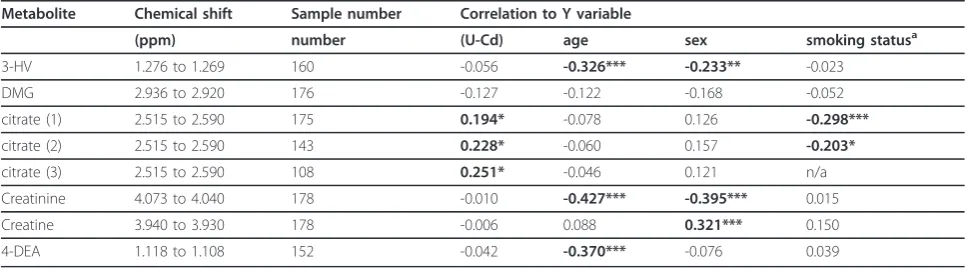
metabolite was regressed as a function of U-Cd, age, sex and smoking status (Table 2). There was a significant asso-ciation between citrate levels and both U-Cd (beta = 0.194, P< 0.05) and smoking status (beta = -0.298,P< 0.001) con-trolling for age and sex. Interestingly, citrate was positively correlated to U-Cd but negatively correlated to smoking status. This suggests that exposure to cigarette smoke via inhalation, although known to significantly increase Cd body burden, may have a different effect than Cd exposure alone via ingestion and/or inhalation (as assessed by U-Cd). Other metabolites showed significant associations to the potential confounding factors but not to U-Cd. 3-HV was negatively associated with age (beta = -0.326,P< 0.001) and sex (beta = -0.233,P< 0.01), and 4-DEA to age only (beta = -0.370,P< 0.001). Creatinine was negatively asso-ciated with age (beta = -0.427,P< 0.001) and sex (beta = -0.395,P< 0.001). Creatine was positively associated with sex only (beta = 0.321,P< 0.001). Again, we excluded smo-kers from the regression models, in order to establish if environmental exposure alone could account for the link between Cd body burden and perturbed endogenous meta-bolism. Citrate levels remained significantly associated with U-Cd while controlling for all other factors with either cur-rent smokers, or curcur-rent and past smokers, removed from the regression model (Table 2; models citrate(2) and citrate (3) respectively).
Interestingly, there was a significant association between smoking status and citrate, even when current smokers were removed, suggesting that there was a meta-bolic difference between those individuals who had never smoked and those who had previously smoked. Normal-ized citrate levels were significantly different between groups (P < 0.05, Kruskal-Wallis test), specifically between current smokers and those who had never
Table 2 Correlation coefficients (standardized beta values) derived from multiple linear regression of key metabolite to lifestyle factors.
Metabolite Chemical shift Sample number Correlation to Y variable
(ppm) number (U-Cd) age sex smoking statusa
3-HV 1.276 to 1.269 160 -0.056 -0.326*** -0.233** -0.023
DMG 2.936 to 2.920 176 -0.127 -0.122 -0.168 -0.052
citrate (1) 2.515 to 2.590 175 0.194* -0.078 0.126 -0.298***
citrate (2) 2.515 to 2.590 143 0.228* -0.060 0.157 -0.203*
citrate (3) 2.515 to 2.590 108 0.251* -0.046 0.121 n/a
Creatinine 4.073 to 4.040 178 -0.010 -0.427*** -0.395*** 0.015
Creatine 3.940 to 3.930 178 -0.006 0.088 0.321*** 0.150
4-DEA 1.118 to 1.108 152 -0.042 -0.370*** -0.076 0.039
a
Smoking status was classified into three classes. 1 = never smoked, 2 = past smoker and 3 = current smoker. Specific exclusions were made for each metabolite identified where coinciding interferences made the relevant resonance unsuitable for integration. All six metabolites were correlated to at least one of the epidemiological factors in either the PLS/PLS-DA regression analysis or the covariance/correlation models. Asterisks denote statistical significance (ANOVA with Bonferroni post-hoc correction): *P< 0.05, **P< 0.01, ***P< 0.001. U-Cd was log normally distributed.
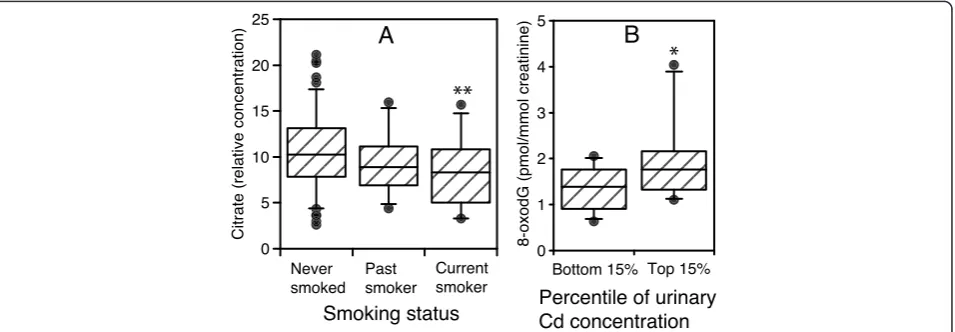
smoked (P< 0.01, Mann-Whitney test). There was also a clear negative trend in citrate levels with smoking status (Spearman’sr= -0.225,P< 0.01), such that ex-smokers had intermediate levels of citrate on average compared to the other two groups (Figure 3A). This suggests that smoking could have induced a long-term change in citrate metabolism or transport, possibly reflecting an effect on mitochondria, which was manifested in decreased urinary citrate levels.
Association of heavy metal exposure and oxidative stress Alterations in citrate levels could imply changes in the consumption of citrate via the Krebs cycle in the mito-chondrion. A perturbation to oxidative metabolism would be expected to lead to a change in ROS production and accompanying oxidative stress. Cd has been shown to increase ROS productionin vivo[31,44] and indirectly damages DNAin vitrovia oxidation by hydrogen perox-ide production [45]. We attempted to define the associa-tion of heavy metal exposure (using U-Cd as an indicator) and the potential for oxidative DNA damage by measuring U-8-oxodG, which is widely used as a bio-marker of oxidative stress [46,47]. We measured U-8-oxodG in a subset of 40 individuals (the upper and lower 15% of volunteers according to U-Cd concentration (Figure 3B)). The mean U-Cd concentration in the lower group was 0.115 ± 0.006 (nmol/mmol creatinine ± stan-dard error of the mean (SEM)) and 0.766 ± 0.052 in the higher group. There was a significant (P< 0.05, Mann-Whitney test) increase in U-8-oxodG concentration (median ± SD) in the individuals in the upper 15th per-centile group (1.77 ± 0.82 pmol/mmol creatinine), com-pared to those in the lower group (1.39 ± 0.45 pmol/ mmol creatinine). This suggests a positive association
between U-8-oxodG and U-Cd, which could be represen-tative of mitochondrial dysfunction and increased ROS production, consistent with our hypothesis.
Discussion
Mechanistic evidence of chemical toxicity is vital to allow accurate risk assessment; in this context, multiple intermediate biomarkers may serve as combinatorial sig-natures of early molecular events of toxicity. Metabolic phenotypes can be used as an information-rich endpoint in molecular epidemiology and can define the interac-tions of lifestyle, environment and genes that determine diseases [10]. We have shown here that metabolic profil-ing can be successfully applied to a human toxicologi-cal/molecular epidemiological study, specifically in a population exposed to Cd pollution derived through environmental exposure, to define associations between the metabolome, lifestyle and exposure data, and other molecular biomarkers of tissue damage.
U-Cd concentration in the majority of individuals liv-ing at the Avonmouth site was within typical estimated levels of a normal population (0.1 to 0.6 nmol/mmol creatinine [16]), and only 25% of individuals had U-Cd levels above 0.5 nmol/mmol creatinine [37] which is the lower limit of potential risk of renal damage suggested by the Scientific Committee on Toxicity, Ecotoxicity and the Environment [48] (CSTEE). The joint FAO/WHO expert committee on food additives (JECFA) concluded that an excess prevalence of tubular renal dysfunction would not be expected below a U-Cd level of 2.5 nmol/ mmol creatinine [49], considerably higher than the range of U-Cd concentrations at which we observed metabolic changes. An NMR-based metabolic profiling approach could complement exposure assessment as it
0 5 10 15 20 25
Citrate (relative concentration)
Smoking status
0 1 2 3 4 5
8-oxodG (pmol/mmol creatinine)
Percentile of urinary Cd concentration
**
*
Bottom 15% Never
smoked
Top 15% Past
smoker
Current smoker
A
B
details actual biochemical disturbance and could aid the determination of the mechanism of action of a chemical toxicant and the etiology of associated disease.
We identified a previously unreported association of urinary citrate to both Cd exposure and smoking. Sur-prisingly, citrate was positively correlated with U-Cd and negatively with smoking status, despite smoking being an important source of cadmium exposure. The increase in urinary citrate levels associated with U-Cd may result from Cd-induced tubule toxicity that affects citrate handling in the kidney [50], although we did not observe a direct association between citrate levels and tubular dysfunction (as represented by U-NAG levels). Smoking may reduce urinary citrate levels due to reduced capacity for oxidative metabolism in mitochon-dria. Chronic smoking is associated with a decrease of complex IV and III activity in the lymphocyte mitochon-drial electron transfer chain, which returns to normal after cessation of smoking [51,52]. There was also a positive association between U-Cd and U-8-oxodG, which is indicative of increased systemic oxidative stress and may also result from mitochondrial dysfunction. Past smokers also had intermediate urinary citrate levels relative to current smokers and those who had never smoked. This observation suggests that it may be possi-ble to monitor biological effects of exposure in indivi-duals who are no longer exposed to the causative agent, whether they be irreversible or slow to return to a‘ nor-mal’metabolic phenotype.
Using a non-targeted approach 3-HV was found to be negatively correlated to U-Cd, age and sex, and DMG negatively correlated to U-Cd and sex. However, after allowing for confounding factors it was not conclusively shown that these two metabolites were associated with U-Cd, possibly due to the limitation of sample numbers. Despite this, correspondence between our observations and other studies of the biochemical effects of Cd sug-gest that these metabolic changes may still be related to the underlying mechanisms of Cd toxicity. Cd inhibits oxidoreductases involved in vitamin D metabolism [53] and 3-HV is a product of the L-leucine mitochondrial catabolic pathway which also involves this class of enzymes. One hypothesis is that reduction in urinary 3-HV could be occurring in parallel to direct mitochon-drial damage [31,54]. Another of the six metabolites identified as correlated to U-Cd, 4-DEA, is also involved in amino acid catabolism: it is a breakdown product of threonine. Threonine deaminase converts threonine to alpha-ketobutyrate, a precursor of isoleucine, and this is further modified by reductases to 4-deoxyerythronic acid and its diastereoisomer 4-deoxythreonic acid [55] (also observed in our study but not correlated to U-Cd).
Our study had several limitations: clearly our observa-tions need to be replicated in other larger cohorts and
we did not have available repeated or alternative biologi-cal specimens from the study participants. Metabolite measurements in blood plasma for instance would pro-vide clarification as to whether the observed associations were systemic in origin or likely to reflect mainly renal effects. A detailed analysis of the contribution of diet and activity to specific metabolite variation was also not possible. These issues are currently being examined in follow-up studies (for example, http://www.envirogen-omarkers.net). In particular it will be important to eval-uate the additional prognostic value of metabolomic measurements compared to established clinical pathol-ogy data and exposure assessment if the metabolites observed here associated with Cd burden are to be con-sidered as valuable biomarkers in the future.
Conclusions
Using an NMR-based approach, we have demonstrated the capacity, in principle, of metabolic profiling to char-acterize the metabolic consequences of exposure to environmental toxicants, such as Cd and tobacco smoke, in a human population. We conclude that meta-bolic profiling has the potential to identify novel bio-markers and molecular signatures of the effects of exposure to many environmental toxicants, and thus improve risk assessment models, ultimately guiding intervention to prevent disease progression. As such, metabolic profiling represents a vital element in future initiatives to define the human exposome. In the longer term, the methods employed in the present Cd exposure study could be used on a broad scale for baseline sur-veys in health impact assessments for development pro-jects, going on to play a central role in monitoring populations living near point sources of pollution such as industrial sites.
Author information
The late Lars Järup MD, PhD was involved in initiating the study and his contributions were instrumental to its success.
Additional material
Additional file 1: Supporting information for metabolite
identification and PLS model validity. The additional file includes NMR spectroscopic data that were acquired to elucidate the structure of an unknown urinary metabolite, details of samples excluded from the multivariate analysis and validation and scores plots of the PLS models.
Abbreviations
3-HV: 3-hydroxyisovalerate; 4-DEA: 4-deoxyerythronic acid; 8-oxodG: 8-oxo-deoxyguanosine; CSTEE: Scientific Committee on Toxicity, Ecotoxicity and the Environment; DMG: dimethylglycine; FAO: Food and Agriculture
Committee on Food Additives; MLR: multiple linear regression; NAG: N-acetyl-β-D-glucosaminidase; NMR: nuclear magnetic resonance; PLS: partial least squares; PLS-DA: PLS-discriminant analysis; ROS: reactive oxygen species; SEM: standard error of the mean; TSP: 3-trimethylsilyl-1-[2, 2, 3, 3, -2H4] propionate; U-Cd: urinary-Cd; U-NAG: urinary-NAG.
Acknowledgements
This work was funded by the NERC Environment and Human Health programme under project grant (NE/E00895X/1) and further supported by the ECMC (C325/A7241), the CEFIC Long Range Initiative Award for Innovative Science 2009 (recipient HCK), the EU-FP6 CarcinoGenomics project (PL037712), the EU-FP7 Envirogenomarkers Project (226756) and MRC-HPA Centre for Environment and Health. The authors would also like to thank Professor Jeremy K Nicholson for valuable discussion during the preparation of this manuscript.
Author details
1
Biomolecular Medicine, Department of Surgery and Cancer, Faculty of Medicine, Imperial College London, Sir Alexander Fleming Building, South Kensington, London, SW7 2AZ, UK.2MRC-HPA Centre for Environment and
Health, Imperial College London, W2 1PG, UK.3Department of Epidemiology
and Biostatistics, School of Public Health, Faculty of Medicine, Imperial College London, London, W2 1PG, UK.4Unit of Nutritional Epidemiology, Institute of Environmental Medicine, Karolinska Institutet, Stockholm, Sweden.5Cancer Biomarkers and Prevention Group, Department of Cancer Studies and Molecular Medicine, University of Leicester, Leicester, LE2 7LX, UK.6Centre for Ecology and Hydrology, Maclean Building, Benson Lane, Crowmarsh Gifford, Wallingford, Oxon, OX10 8BB, UK.7Servei de Ressonància
Magnètica Nuclear, SeRMN, Universitat Autònoma de Barcelona, Barcelona, Spain.
Authors’contributions
HCK, JGB, LJ, CS, DJS and LDKT designed the experiment. JKE, TJA, MPT, JGB and HCK performed the metabonomic experiments, analyzed data and wrote the research article. LDKT and LJ also contributed to the experimental work and the writing of the article. FT and RS performed the 8-oxodG assay and analyzed the associated data. All authors listed here were involved in drafting the manuscript and they have read and approved the final version for publication.
Competing interests
The authors declare that they have no competing interests.
Received: 22 November 2011 Accepted: 19 June 2012 Published: 19 June 2012
References
1. Wild CP:Environmental exposure measurement in cancer epidemiology. Mutagenesis2009,24:117-125.
2. Vineis P, Perera F:Molecular epidemiology and biomarkers in etiologic cancer research: the new in light of the old.Cancer Epidemiol Biomarkers Prev2007,16:1954-1965.
3. Chadeau-Hyam M, Athersuch TJ, Keun HC, De IM, Ebbels TM, Jenab M, Sacerdote C, Bruce SJ, Holmes E, Vineis P:Meeting-in-the-middle using metabolic profiling - a strategy for the identification of intermediate biomarkers in cohort studies.Biomarkers2011,16:83-88.
4. Rappaport SM, Smith MT:Epidemiology. Environment and disease risks. Science2010,330:460-461.
5. Wild CP:Complementing the genome with an“exposome": the outstanding challenge of environmental exposure measurement in molecular epidemiology.Cancer Epidemiol Biomarkers Prev2005, 14:1847-1850.
6. Nicholson JK, Lindon JC, Holmes E:’Metabonomics’: understanding the metabolic responses of living systems to pathophysiological stimuli via multivariate statistical analysis of biological NMR spectroscopic data. Xenobiotica1999,29:1181-1189.
7. Nicholson JK, Connelly J, Lindon JC, Holmes E:Metabonomics: a platform for studying drug toxicity and gene function.Nat Rev Drug Discov2002, 1:153-161.
8. Keun HC:Metabonomic modeling of drug toxicity.Pharmacol Ther2006, 109:92-106.
9. Coen M, Holmes E, Lindon JC, Nicholson JK:NMR-based metabolic profiling and metabonomic approaches to problems in molecular toxicology.Chem Res Toxicol2008,21:9-27.
10. Holmes E, Loo RL, Stamler J, Bictash M, Yap IK, Chan Q, Ebbels T, De IM, Brown IJ, Veselkov KA, Daviglus ML, Kesteloot H, Ueshima H, Zhao L, Nicholson JK, Elliott P:Human metabolic phenotype diversity and its association with diet and blood pressure.Nature2008,453:396-400. 11. Spurgeon DJ, Lawlor A, Hooper HL, Wadsworth R, Svendsen C, Thomas LD,
Ellis JK, Bundy JG, Keun HC, Jarup L:Outdoor and indoor cadmium distributions near an abandoned smelting works and their relations to human exposure.Environ Pollut2011,159:3425-3432.
12. Nriagu JO, Pacyna JM:Quantitative assessment of worldwide contamination of air, water and soils by trace metals.Nature1988, 333:134-139.
13. Nriagu JO:A silent epidemic of environmental metal poisoning?Environ Pollut1988,50:139-161.
14. Jarup L, Berglund M, Elinder CG, Nordberg G, Vahter M:Health effects of cadmium exposure–a review of the literature and a risk estimate.Scand J Work Environ Health1998,24(Suppl 1):1-51.
15. Jarup L, Akesson A:Current status of cadmium as an environmental health problem.Toxicol Appl Pharmacol2009,238:201-208. 16. Jarup L, Hellstrom L, Alfven T, Carlsson MD, Grubb A, Persson B,
Pettersson C, Spang G, Schutz A, Elinder CG:Low level exposure to cadmium and early kidney damage: the OSCAR study.Occup Environ Med2000,57:668-672.
17. Akesson A, Lundh T, Vahter M, Bjellerup P, Lidfeldt J, Nerbrand C, Samsioe G, Stromberg U, Skerfving S:Tubular and glomerular kidney effects in Swedish women with low environmental cadmium exposure. Environ Health Perspect2005,113:1627-1631.
18. Elinder CG, Edling C, Lindberg E, Kagedal B, Vesterberg O:Assessment of renal function in workers previously exposed to cadmium.Br J Ind Med 1985,42:754-760.
19. Elinder CG, Edling C, Lindberg E, Kagedal B, Vesterberg O:beta 2-Microglobulinuria among workers previously exposed to cadmium: follow-up and dose-response analyses.Am J Ind Med1985,8:553-564. 20. Hellstrom L, Elinder CG, Dahlberg B, Lundberg M, Jarup L, Persson B,
Axelson O:Cadmium exposure and end-stage renal disease.Am J Kidney Dis2001,38:1001-1008.
21. Waalkes MP, Rehm S, Cherian MG:Repeated cadmium exposures enhance the malignant progression of ensuing tumors in rats.Toxicol Sci2000, 54:110-120.
22. Huff J, Lunn RM, Waalkes MP, Tomatis L, Infante PF:Cadmium-induced cancers in animals and in humans.Int J Occup Environ Health2007, 13:202-212.
23. International Agency for Research on Cancer (IARC):Monographs on the Evaluation of the Carcinogenic Risks to Humans. Beryllium, Cadmium, Mercury and Exposures in the Glass Manufacturing Industry.IARC Scientific Publications1993, 119-238.
24. U.S. Department of Health and Human Services:National Toxiclogy Program.Tenth Report on CarcinogensResearch Triangle Park, NC; 2000. 25. Johnson MD, Kenney N, Stoica A, Hilakivi-Clarke L, Singh B, Chepko G,
Clarke R, Sholler PF, Lirio AA, Foss C, Reiter R, Trock B, Paik S, Martin MB: Cadmium mimics the in vivo effects of estrogen in the uterus and mammary gland.Nat Med2003,9:1081-1084.
26. Liu Z, Yu X, Shaikh ZA:Rapid activation of ERK1/2 and AKT in human breast cancer cells by cadmium.Toxicol Appl Pharmacol2008,228:286-294. 27. Stoica A, Katzenellenbogen BS, Martin MB:Activation of estrogen
receptor-alpha by the heavy metal cadmium.Mol Endocrinol2000, 14:545-553.
28. Jin YH, Clark AB, Slebos RJ, Al-Refai H, Taylor JA, Kunkel TA, Resnick MA, Gordenin DA:Cadmium is a mutagen that acts by inhibiting mismatch repair.Nat Genet2003,34:326-329.
29. Jiang G, Xu L, Song S, Zhu C, Wu Q, Zhang L, Wu L:Effects of long-term low-dose cadmium exposure on genomic DNA methylation in human embryo lung fibroblast cells.Toxicology2008,244:49-55.
30. Benbrahim-Tallaa L, Waterland RA, Dill AL, Webber MM, Waalkes MP:Tumor suppressor gene inactivation during cadmium-induced malignant transformation of human prostate cells correlates with overexpression of de novo DNA methyltransferase.Environ Health Perspect2007,
31. Oh SH, Lim SC:A rapid and transient ROS generation by cadmium triggers apoptosis via caspase-dependent pathway in HepG2 cells and this is inhibited through N-acetylcysteine-mediated catalase upregulation.Toxicol Appl Pharmacol2006,212:212-223.
32. Godt J, Scheidig F, Grosse-Siestrup C, Esche V, Brandenburg P, Reich A, Groneberg DA:The toxicity of cadmium and resulting hazards for human health.J Occup Med Toxicol2006,1:22.
33. Griffin JL, Walker LA, Troke J, Osborn D, Shore RF, Nicholson JK:The initial pathogenesis of cadmium induced renal toxicity.FEBS Lett2000, 478:147-150.
34. Griffin JL, Walker LA, Shore RF, Nicholson JK:Metabolic profiling of chronic cadmium exposure in the rat.Chem Res Toxicol2001,14:1428-1434. 35. Nicholson JK, Higham DP, Timbrell JA, Sadler PJ:Quantitative high
resolution 1H NMR urinalysis studies on the biochemical effects of cadmium in the rat.Mol Pharmacol1989,36:398-404.
36. Nicholson JK, Kendall MD, Osborn D:Cadmium and mercury nephrotoxicity.Nature1983,304:633-635.
37. Thomas LD, Hodgson S, Nieuwenhuijsen M, Jarup L:Early kidney damage in a population exposed to cadmium and other heavy metals.Environ Health Perspect2009,117:181-184.
38. Hwang TL, Shaka AJ:Water suppression that works - excitation sculpting using arbitrary wave-forms and pulsed-field gradients.J Magn Reson Series A1995,112:275-279.
39. Fan TWM:Metabolite profiling by one- and two-dimensional NMR analysis of complex mixtures.Prog Nucl Magn Reson Spectrosc1996, 28:161-219.
40. Cloarec O, Dumas ME, Craig A, Barton RH, Trygg J, Hudson J, Blancher C, Gauguier D, Lindon JC, Holmes E, Nicholson J:Statistical total correlation spectroscopy: an exploratory approach for latent biomarker
identification from metabolic 1H NMR data sets.Anal Chem2005, 77:1282-1289.
41. Appiah-Amponsah E, Shanaiah N, Nagana Gowda GA, Owusu-Sarfo K, Ye T, Raftery D:Identification of 4-deoxythreonic acid present in human urine using HPLC and NMR techniques.J Pharm Biomed Anal2009,50:878-885. 42. Dieterle F, Ross A, Schlotterbeck G, Senn H:Probabilistic quotient
normalization as robust method to account for dilution of complex biological mixtures. Application in 1H NMR metabonomics.Anal Chem 2006,78:4281-4290.
43. Teichert F, Verschoyle RD, Greaves P, Thorpe JF, Mellon JK, Steward WP, Farmer PB, Gescher AJ, Singh R:Determination of 8-oxo-2’
-deoxyguanosine and creatinine in murine and human urine by liquid chromatography/tandem mass spectrometry: application to
chemoprevention studies.Rapid Commun Mass Spectrom2009,23:258-266. 44. Shih CM, Ko WC, Wu JS, Wei YH, Wang LF, Chang EE, Lo TY, Cheng HH,
Chen CT:Mediating of caspase-independent apoptosis by cadmium through the mitochondria-ROS pathway in MRC-5 fibroblasts.J Cell Biochem2004,91:384-397.
45. Badisa VL, Latinwo LM, Odewumi CO, Ikediobi CO, Badisa RB, Ayuk-Takem LT, Nwoga J, West J:Mechanism of DNA damage by cadmium and interplay of antioxidant enzymes and agents.Environ Toxicol2007, 22:144-151.
46. Evans MD, Dizdaroglu M, Cooke MS:Oxidative DNA damage and disease: induction, repair and significance.Mutat Res2004,567:1-61.
47. Loft S, Hogh DP, Mikkelsen L, Risom L, Forchhammer L, Moller P: Biomarkers of oxidative damage to DNA and repair.Biochem Soc Trans 2008,36:1071-1076.
48. CSTEE:Opinion on the Results of the Risk Assessment of: Cadmium Metal Human Health (CAS no.:7440-43-9, EINECS no.:231-152-8) Cadmium Oxide Human Health (CAS no.:1306-19-0, EINECS no.:215-146-2)2004.
49. JECFA (FAO/WHO):Evaluation of certain food additives and contaminants WHO food additives series, No. 522004.
50. Hamm LL:Renal handling of citrate.Kidney Int1990,38:728-735. 51. Cardellach F, Alonso JR, Lopez S, Casademont J, Miro O:Effect of smoking
cessation on mitochondrial respiratory chain function.J Toxicol Clin Toxicol2003,41:223-228.
52. Miro O, Alonso JR, Jarreta D, Casademont J, Urbano-Marquez A, Cardellach F:Smoking disturbs mitochondrial respiratory chain function and enhances lipid peroxidation on human circulating lymphocytes. Carcinogenesis1999,20:1331-1336.
53. Chalkley SR, Richmond J, Barltrop D:Measurement of vitamin D3 metabolites in smelter workers exposed to lead and cadmium.Occup Environ Med1998,55:446-452.
54. Belyaeva EA, Dymkowska D, Wieckowski MR, Wojtczak L:Mitochondria as an important target in heavy metal toxicity in rat hepatoma AS-30D cells.Toxicol Appl Pharmacol2008,231:34-42.
55. Ballevre O, Prugnaud J, Houlier ML, Arnal M:Assessment of threonine metabolism in vivo by gas chromatography/mass spectrometry and stable isotope infusion.Anal Biochem1991,193:212-219.
Pre-publication history
The pre-publication history for this paper can be accessed here: http://www.biomedcentral.com/1741-7015/10/61/prepub
doi:10.1186/1741-7015-10-61
Cite this article as:Elliset al.:Metabolic profiling detects early effects of environmental and lifestyle exposure to cadmium in a human population.BMC Medicine201210:61.
Submit your next manuscript to BioMed Central and take full advantage of:
• Convenient online submission
• Thorough peer review
• No space constraints or color figure charges
• Immediate publication on acceptance
• Inclusion in PubMed, CAS, Scopus and Google Scholar
• Research which is freely available for redistribution
![Figure 1 Metabolic profiling in molecular epidemiology: a methodology to identify intermediate biomarkers of response toD[37])](https://thumb-us.123doks.com/thumbv2/123dok_us/8915603.1838891/3.595.58.542.87.483/metabolic-profiling-molecular-epidemiology-methodology-identify-intermediate-biomarkers.webp)