Exploiting Class Learnability in Noisy Data
Matthew Klawonn
Rensselaer Polytechnic InstituteDept. of Computer Science Troy, NY 12180 [email protected]
Eric Heim
Air Force Research Laboratory Information Directorate
Rome, NY 13441 [email protected]
James Hendler
Rensselaer Polytechnic InstituteDept. of Computer Science Troy, NY 12180 [email protected]
Abstract
In many domains, collecting sufficient labeled training data for supervised machine learning requires easily accessible but noisy sources, such as crowdsourcing services or tagged Web data. Noisy labels occur frequently in data sets harvested via these means, sometimes resulting in entire classes of data on which learned classifiers generalize poorly. For real world applications, we argue that it can be beneficial to avoid train-ing on such classes entirely. In this work, we aim to explore the classes in a given data set, and guide supervised training to spend time on a class proportional to itslearnability. By focusing the training process, we aim to improve model gen-eralization on classes with a strong signal. To that end, we develop an online algorithm that works in conjunction with classifier and training algorithm, iteratively selecting training data for the classifier based on how well it appears to gen-eralize on each class. Testing our approach on a variety of data sets, we show our algorithm learns to focus on classes for which the model has low generalization error relative to strong baselines, yielding a classifier with good performance on learnable classes.
Many state of the art machine learning models require large amounts of data to avoid overfitting. In constructing large scale data sets, one often turns to accessible sources that can quickly provide vast amounts of data, including
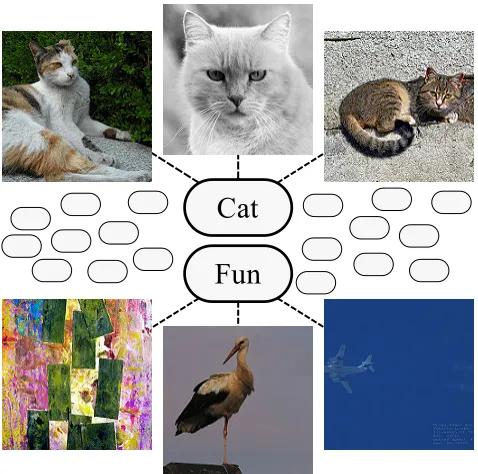
crowdsourcingandWebly supervised learning(scraping data and labels from the Web). Such processes frequently result in data that is noisy. For example, consider a data set of images and tags scraped from Flickr, intended to be used as training data for an image tagger. Tags on Flickr are assigned by users of the site without restriction, and the assignment of tags can range from the very literal to the abstract (see Figure 1 for an example). When attempting to learn an image tagger, training on noisy classes is potentially harmful to model performance on classes with strong signal. Rather than try to achieve moderate performance on all classes at the expense of those with strong signal, the classifier designer may want to avoid noisy classes entirely. With this in mind, in order to develop an accurate classifier in the presence of noisy classes, we hypothesize that not all classes ought to be treated equally during training. Rather, it may be beneficial to focus training on classes for which the model appears capable of achieving a
Copyright © 2019, Association for the Advancement of Artificial Intelligence (www.aaai.org). All rights reserved.
Figure 1: Example of labeled Flickr images. The common features of the “Cat” images suggest that a low generalization error can be achieved for this class, and thus that classifier training may benefit from spending more time on “Cat” im-ages than “Fun” imim-ages.
low generalization error. We call this characteristic of classes appearing in the data setlearnability.
To this end, we seek to develop an algorithm that uses the concept of learnability to focus the training of a classifier on specific classes. Our expectation is that training the model only on instances from learnable classes will yield a more accurate classifier for classes with a strong relationship be-tween instance and label. In this work we propose anonline
algorithm that acts in concert with the stochastic learning algorithm used to train a classifier. Our algorithm assesses which of the classes are most effective in training the model, and then selects instances from those classes to use in update steps for the classifier. We pose this learning scheme as a
we are able to leverage prior MAB work that has developed algorithms with theoretical guarantees on performance. Our MAB algorithm is able to assess the learnability of each class by sampling only from a single class at each time-step. As a result, we are able to efficiently select classes from which to learn, incurring only slight overhead to the normal stochastic training process.
In summary, the contributions of this work are as follows: • We formalize the problem of selecting learnable classes
for a given model and training algorithm.
• We develop a novel online framework that uses existing MAB algorithms to tackle the problem of selecting classes. • We demonstrate the effectiveness of our algorithm on both
synthetic and real-world training data.
Related Work
This work is concerned with the topics of data collection from noisy sources, learning what data to learn from, and Multi-Armed Bandit approaches. We present relevant work from each of these areas.
Data Collection
Collecting sufficient data for training classifiers is a classic problem in machine learning. The Web is the canonical ex-ample of a noisy source of vast amounts of data, and has provided many data sets on which to train models, e.g (Deng et al. 2009; Philbin et al. 2007; Fei-Fei, Fergus, and Perona 2007). When labeling examples in these data sets, techniques like active learning (Settles 2012) can help limit the labeling that needs to be done by humans, only asking for labels on inputs a model cannot predict confidently. Our work is similar to active learning in that we have an algorithm guiding the selection of training data, but differs in the criteria for data selection, and we assume all data has already been labeled by some process.
Techniques that handle noisy data with existing labels range from hand curating the data set (Welinder et al. 2010), to adding model machinery intended to deal with noise (Sukhbaatar et al. 2014), to including examples based on a dynamically calculated majority vote from a crowd (Deng et al. 2009). Most standard noise-handling techniques work at the instance level. Those that work at the label level (Welinder et al. 2010; Garrigues et al. 2017) usually re-move data from a training set without explicitly being in-formed by the training process, but rather characteristics of the data (e.g. not having sufficient quality examples). Another approach is to create new categories that account for some noise (Torresani, Szummer, and Fitzgibbon 2010; Li, Wu, and Tu 2013). Works like (Deng et al. 2009; Krishna et al. 2016) keep track of how difficult a label appears based on crowd agreement (Snow et al. 2008) to include or exclude various examples. In contrast, our work attempts to automatically determine good labels based on model perfor-mance, not data set size or crowd factors.
Learning What to Learn
Previous methods that oversee the data selection process for training classifiers have had a variety of goals. Many models
are interested in minimizing time to convergence. (Graves et al. 2017) present a curriculum learner that generates an ordering of training tasks based on task difficulty, the intuition being that easy examples help models earlier in training, while harder examples are more appropriate later. Our work follows this same core idea, yet the problem we aim to solve is fundamentally different. While they train a model to complete a pre-determined set of tasks, we learn to focus on tasks, i.e classes, that are easiest to learn for a model. Like us, (Ruder and Plank 2017) are interested in manipulating the selection of training examples, though their goal is to choose examples based on suitability for transfer learning. In contrast our approach is more exploratory, as the only criteria for selecting classes is the resultant performance of a given model. Finally, (Fan et al. 2017) propose to supervise model training with a deep reinforcement learning algorithm. However, rather than actively select batches of training data, they train a filter to ignore certain examples within a given mini-batch at each training step.
Multi-Armed Bandits
In our approach, data is selected at each training step using a Multi-Armed Bandit algorithm, a problem first introduced in (Robbins 1952). The original formulation of the problem assumes that the reward for a given decision made by the algorithm is drawn from a fixed distribution every time that decision is made (i.e. a stochastic payoff function). In our setting, rewards are based on the state of a classifier at a given training step, which changes over time. Bandit algorithms developed for such scenarios are calledadversarialMAB algorithms (Auer et al. 1995), and make no assumptions on the payoff structure of decisions. We additionally assume that the class set we are choosing from is large, rendering naive selection strategies ineffective. For these settings, it is common to assume a structure on the decision-space, specif-ically that there exists a means of measuring similarity be-tween decisions (Kleinberg, Slivkins, and Upfal 2013). One such approach is to assume that the reward function changes smoothly over the decision space, i.e that similar decisions will have similar payoffs (Srinivas et al. 2010). We use a time-varying version of this algorithm presented in (Bogunovic, Scarlett, and Cevher 2016).
Exploiting Learnable Classes
MAB Preliminaries
Given a collection of potential decisionsA(calledarmsin MAB nomenclature) and a number of roundsT to choose (“pull”) an arm, an MAB algorithm selects a sequence of armsa1. . . aT, at∈ A. After each round, the algorithm ob-serves a rewardrt(at)associated with the arm choiceat. The goal of a bandit algorithm is to maximizePT
i=1rt, or equiva-lently to minimize cumulative regret. At each roundt, regret is defined as the difference between the reward for the best armrt∗:= supa∈Art(a)and the reward for the arm that was pickedrt(at). The cumulative regretR(T)is defined as the sum of regret at each round:R(T) := PT
t=1r
∗
t −rt(at). Bandit algorithms are designed to minimize R(T). The challenge lies in not knowing the distributions generating rt(at) ∀a ∈ A. In order to balance exploring promising arms with exploiting historically high reward arms, (Auer 2002) propose picking arms with high upper confidence bounds(UCB). The UCB formula is given by
U CB(a) :=µ(a) +β12σ(a)
withµ(a)being the mean reward of arma,σ(a)being the standard deviation of rewards ofa, andβbeing a hyperpa-rameter that weights the exploration term. Intuitively, when an arm is largely unexplored, the uncertainty termβ12σ(a)
will dominate the UCB, leading to an exploratory arm pull. In contrast, a high average reward leads to exploitation. The balance of exploration vs exploitation can be viewed as bal-ancing learning a reward function with using said function to make decisions. Algorithms focused only on exploitation will never learn the reward function, while algorithms focus only on exploration may not make rewarding decisions.
Finding how learnable a class is for a given model in an online fashion fits naturally into the MAB problem setting. Our proposed method proceeds in conjunction with with the stochastic training of a classifier. We treat the selection of ex-amples during training as an arm pull, picking exex-amples that are all labeled with a particular class, and calculate a reward for those examples intended to measure their learnability. In the next section, we formalize our MAB problem setting, define our notion of class learnability, and introduce a reward function for our MAB algorithm based on this definition.
Problem Formulation
In this work, we consider themulti-labelclassification setting where single instances may be members of multiple classes. LetMΘbe a multi-label classifier parameterized byΘ. Let
A(not to be confused withA) be a training algorithm that iteratively updates the parametersΘwith respect to some loss functionL. We assume that we have access to a training setD={(x1, y1). . .(xN, yN)}and a validation setDv = {(x1, y1). . .(xM, yM)}. LetC = (C1, . . . , CO)be the set of classes reflected in the training and validation labels. We denote training and validation subsets whose instances are all labelled as a classCibyDCiandD
v Ci.
We now formalize the notion of class learnability given MΘ,A,L,D, andDv. We base our concept of
learnabil-ity on model generalization. In the case of a learnable class
Ci, we expect thatMΘcan be trained byAonDCito pro-duce a parameterizationΘ∗C
i such thatMΘ ∗
Ci generalizes to out-of-sample instances. In our work, we measure loss on the validation setL(Dv
Ci|Θ
∗
Ci)to approximate how well the model generalizes for Ci. One central assumption of this work is that certain classes inC are more learnable than others, that isL(Dv
Ci|Θ
∗
Ci)will vary over differentCi. This implies an ordering over classes inCdefined as follows:
Ci Cj :=L(DvCi|Θ
∗
Ci)≤L(D v Cj|Θ
∗
Cj)
For given classesCi Cj, the goal of our algorithm is to guideAinto spending more training iterations onCithan Cj. We expect that doing so will not only help improve po-tential generalization on highly ranked classes, but also avoid negative effects that noisy classes may have on a classifier.
In order to effectively find the above ordering on classes, it becomes important to avoid parameterizationsΘwherein L(Dv
Cj|Θ) ≤ L(D v
Ci|Θ) even thoughCi Cj, since this would lead to the class selection algorithm choosing Cj more thanCi. Therefore we aim to train our selection al-gorithm online in lockstep withA, receiving feedback at every iteration in order to find a good ranking as quickly as possible. In order to train our selection algorithm, we measure how the modelMΘ is progressing one step at a
time, using only the information that can be gleaned from the validation subset Dv
Ci. One way to measure learning progress is via self prediction gain (Graves et al. 2017; Oudeyer, Kaplan, and Hafner 2007):
SP G(Ci) :=L(DvCi|Θ)−L(D v Ci|Θ
0) (1)
whereΘare the model’s parameters beforeAupdates them to
Θ0usingDCi. Note that in practice, many training algorithms will use stochastically selectedbatchesfrom a subsetDCi and/or Dv
Ci, but for ease of notation we may refer to the whole set in place of a batch. Self prediction gain can be thought of as measuring how much the loss improves on the validation data after a training update. Intuitively, for a very noisy class, e.g a class with randomly assigned training and validation inputs, in expectation SPG should be zero since MΘis unlikely to learn anything generalizable from training
examplesDCi. For classes with more signal, it is likely that SPG will yield a positive value if the model MΘ can be
trained byAto generalize. Therefore at each training step t, we select a classCtsuch thatDCi andD
v
Ct yield a high expected value of SPG. We now outline the specific bandit algorithm used to select classes per round.
Bandit Supervision
SPG function limits our ability to exploit historically suc-cessful arms. In order to handle large class sets, our bandit assumes a structure on the classes, specifically that there exists a measure of similarity between them. To handle the changing SPG function, we apply a discounting factor that limits the impact of observations made early on in training. Specifically, we utilize the bandit of (Bogunovic, Scarlett, and Cevher 2016), an approach that modelsf via a time varyingGaussian Process.
A Gaussian Process (GP) defines a Gaussian distribution of the target function’s value at each point in the function’s domain. The distribution at a pointxis parameterized by a mean µ(x) and standard deviation σ(x), with µ(x) rep-resenting the expected value of the function at that point. GPs satisfy the need to represent the uncertainty of points in a domain viaσ(x). Further, a GP captures the relation-ship of a target function at different points via a covariance
Σ, with the covariance between two pointsxiandxjgiven byΣ(xi, xj) = k(xi, xj)for some positive definite kernel function k. Intuitively, the kernel measures similarity be-tween two points in the domain, e.g two classes, influencing the GP to predict similar function values for similar points. By modeling the relationship between classes, we alleviate the burden of exhaustively sampling rewards for each class. In our work, we use the word2vec embedding (Mikolov et al. 2016) of a given class (denotedw), combined with the Matern kernel (Mat´ern 2013) to measure similarity between classes. The Matern kernel is a generalization of the Gaus-sian (squared exponential) covariance function, often used because its smoothness can be controlled via a hyperparame-ter. Tunable smoothness is potentially valuable to our work, since natural language similarity can vary significantly de-pending on the domain.
At a training stept, our GP defines a joint Gaussian distri-bution over the rewards of classes known as aprior distribu-tion. This prior is used to forecast the reward for selecting a training classCt. After selection, the SPG for this class is calculated via (1), and this value is added to the history of rewards. Our bandit updates its joint distribution by incorpo-rating the newly observed SPG, thus producing aposterior
distribution. Calculation of the posterior is influenced by two different aspects of each entry in the SPG history: one is the inter-class similarity as defined by the kernel, the other is the time between a historical entry and the most recent observation. We now describe the selection and update steps in detail.
The selection mechanism then follows directly from the concept of upper confidence bounds and estimated priors for µ(x)andσ(x). At timet, we select a classCtaccording to the following UCB equation
Ct= argmax i∈{1,...,N}
µt−1(wi) +β
1
2σt−1(wi)
(2)
wherewiis the word vector associated with classCi. Ob-serving the reward for the chosen classCtis as simple as calculating the loss on a validation setDv
Ctas in (1). After observing a new reward,µandσcan be updated as in (Bo-gunovic, Scarlett, and Cevher 2016):
Algorithm 1Bandit Supervised Learning. We use the default values of (Bogunovic, Scarlett, and Cevher 2016)
Require: Exploration weightingβ, time varying parameter , kernelk
Require: Initial classifier parametersΘ0, loss functionL, training algorithmA
whileMΘhas not convergeddo
Sample classCt(and thuswt) according to (2) Sample training dataDCtand validation dataD
v Ct L1=L(DCvt,Θ)
Θ0←A(Θ, L(DCt|Θ)) L2=L(Xc0t,Θ)
AddL1−L2tor,wttoW Perform Bayesian update as in (3) end while
µt(w) :=kt−1(w)T Kt−1+σf2It−1
−1
rt−1
σ2t(w) :=k(w,w)−kt−1(w)T
Kt−1+σ2fIt−1
−1
kt−1(w)
(3)
In order to perform this update, we have access to the history of class selectionsCt−1up to timet−1, the
corre-sponding vector historyWt−1, and the associated rewards
for these arm pullsrt−1. We then create a matrixKt−1to
be [k(w,w0)]w,w0∈Wt−
1
(1−)|i−j|/2ti,j−1=1 (being the Hadamard product). Intuitively, this matrix compares the vectorswandw0of previously selected classes via the kernelk, while discounting the similarity based upon how far apart in time the two arms were pulled. The time dis-counting is captured via a hyperparameter ∈ [0,1], ap-plied tok, that quantifies how much rewards are expected to change at each step; = 1 indicates that rewards are independent between timesteps, and = 0means there is no variation. Kt−1 is joined with a term σf that models noise produced when sampling from the underlying reward function, and is then used in conjunction with a function
kt−1(w) := [k(wi,w)] t−1 i=1
(1−)(t−i)/2ti=1−1that com-pares historical armswito a given armw, again discounting old arm pulls by.
To select a class in the next round, the updated mean and variance are fed into (2). When our algorithm selects a class to learn based on (2), exploration will dominate if a class has not been recently selectedandno similar classes have been recently selected, sincek(w,w)will surpass the other terms, yielding a high variance. Otherwise, the algorithm will select classes that the modelMΘhas done well on in the past, as
Kt−1+σf2It−1
will become significant. We outline how this process is coupled with the training of our modelMΘin
Alg. 1.
Ranking Classes
usingI = 20. We define convergence to be a sufficiently small change in ranking as measured via the normalized Kendall tau distance(Kendall 1955) given in (5). This dis-tance measures the number of pairwise differences between two rankingsτt−I andτt, computed at roundst−Iandt respectively, the set of which is given by:
Z:={(Ci, Cj) :i < j,
(τt−I(Ci)< τt−I(Cj) ∧τt(Ci)> τt(Cj)) ∨(τt−I(Ci)> τt−I(Cj) ∧τt(Ci)< τt(Cj))}
(4)
whereτt(Ci), τt−I(Ci)are the ranks of classCiat rounds tandt−I. The associated distance counts the number of differences (numerator) and normalizes by the total number of pairs (denominator).
Z(τt−I, τt) :=
|Z|
N(N−1)/2 (5)
A value of zero indicates identical rankings, while a value of one indicates rankings in the opposite order. We consider our models to have converged whenZ(τt−I, τt)≤0.05.
There are many situations in which identifying the ordering on classes can be useful, for example in order to inform downstream processes of a classifier’s capabilities. While recovering the underlying ground truth orderingCiCjis difficult since it requires identifying an ideal set of parameters for each class, we can use the bandit history to give a good approximation, the idea being that the number of times a class was selected for training is a good indicator of the model’s propensity to generalize on said class. For evaluation purposes, we are interested limiting the variability that results from the stochasticity in Alg. 1, and therefore produce an average ranking with information from multiple runs. This ranking is calculated by sorting the classes given the average amount each class was pulled, i.e
CiCj:= 1
S S X
s=1
Ps(Ci)≥ 1
S S X
s=1
Ps(Cj) (6)
forSruns of Alg. 1 andPs(Ci)pulls of armCiin runs. From a data exploration perspective, the average rankings could help in finding potentially noisy labels, or give insights into the limitations ofMΘ. From an evaluation perspective,
rankings can indicate how well the algorithm is working. Ide-ally, there would not be significant variations in the ranking list between runs, as this could indicate thatMΘis too
sus-ceptible to small changes in initial conditions, or simply that our algorithm fails to find a proper ordering of classes. With this definition of an average ranking, we can now evaluate the quality of our bandit algorithm.
Empirical Evaluation
Loosely stated, our bandit supervision has two objectives. The first is to influence the training of a model such that the attention payed to a class reflects the learnability of said class. The second, a result of the first, is to produce a classifier that performs well on learnable classes. The goal of this section
is to evaluate the performance of our bandit on these two objectives. We quantitatively evaluate performance on the first objective by using a clean data set that we pollute with label noise. For the second, we train classifiers on naturally noisier, unaltered data sets and evaluate the classification performance of our model relative to the produced class ordering.
Evaluating Bandit Ordering
Given an existing data set, it is unlikely that the ordering on classesCi Cj will be known a priori. This poses a challenge from an evaluation perspective, since a ranking like that presented in (6) cannot be compared directly to some ground truth. We therefore create a synthetic scenario for testing our bandit algorithm. We start with the Cifar100 data set (Krizhevsky and Hinton 2009), a collection of 50k training images (10k of which we set aside for validation) and 10k test images, each of which are labeled as belonging to one of a hundred classes. We then sample from training images uniformly at random, constructing 100 new subsets of and assign to each of these subsets a new, out of vocabulary label. The out of vocabulary classes are chosen from a list of the 100 most common English words that are disjoint from the original classes. In total, our newly constructed data set contains 400 training examples per original class, and 400 examples per new, noisy class.
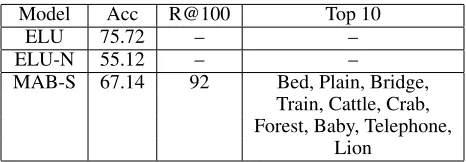
In running our bandit algorithm on this data set, we hope to show that the produced ranking of classes favors the original classes over the new noisy classes. That is, for any original classCiand any noisy classCj, we want our bandit to re-coverCiCj, yielding a ranking with the original classes in the top 100, and noise classes in the bottom 100. In Tab. 1, we show the frequency with which an original class appears in the top 100 classes, ranked as in (6), averaged across ten runs. Additionally, the goal of bandit supervision is to miti-gate negative effects that noisy classes may have on model performance, specifically accuracy on learnable classes. As such, we compare the accuracy of a model trained without bandit supervision (ELU-N) to the same model trained with bandit supervision (MAB-S). Test set accuracy is evaluated on the original classes only, and is presented in Tab. 1. For our classifier, we use the convolutional neural network ar-chitecture presented in (Clevert, Unterthiner, and Hochreiter 2016), which has been shown to achieve state-of-the-art per-formance on Cifar100. We compare to their results that were generated by training only on the original Cifar data (ELU). In training the network with bandit supervision, we notice an interesting trade-off with respect to running time. The online selection mechanism prohibits time saving techniques that are common to training CNNs, such as batch pre-fetching. Therefore, each iteration of our bandit supervised training is slower than an iteration of standard mini-batch stochastic gra-dient descent. However, we also notice our bandit supervised network tends to converge in fewer iterations than the base-lines. The aggregate result is a minimal wall-clock overhead associated with bandit supervision.
Model Acc R@100 Top 10
ELU 75.72 – –
ELU-N 55.12 – –
MAB-S 67.14 92 Bed, Plain, Bridge,
Train, Cattle, Crab, Forest, Baby, Telephone,
Lion
Table 1: “Acc” for each model represents test-set accuracy across the original classes. “R@100” shows the number of original classes appearing in the bandit’s top 100. “Top 10” shows the most learnable classes as decided by the bandit.
do not fully recover the accuracy of the architecture trained on the original, noise free data. Our bandit is also able to correctly rank 92 of the original classes in the top 100. The eight noise classes ranked in the top 100, “write”, “hot”, “word”, “water”, “call”, “sound”, “your”, and “thing”, may have been chosen for a few reasons. Most likely, some are close to original classes in the word vector space, e.g “water” is very similar to the many fish and nature related classes in Cifar100. Depending on the kernel and vector representations, sufficiently high rewards on original classes may artificially prop up a related noisy class in the eyes of the bandit. For a more naturally constructed data set, we suspect classes that are considered similar by the kernel are more likely to share similar rewards.
Exploring Large Tag Sets
In this section we intend to gauge the performance of bandit supervision in the face of more realistic noise. The first “real-world” data set that we investigate is a subset of the YFCC 100M data set (Thomee et al. 2016), a collection of 100 million tagged images and videos gathered from Flickr. In order to create a manageable but informative subset, we first gather tags of interest from the work of (Garrigues et al. 2017), who identify tags commonly searched for by Flickr users. We then construct our data subset by gathering the first million images of YFCC 100M that are labeled with at least one of the tags in our set. In total, our data has 1 million images labeled with 4566 tags.
The classes present in Flickr data vary in learnability be-cause they can be subjectively assigned to examples. We are also interested in learnability variation that is caused by the domain of images itself, i.e images that may be objectively and correctly labeled, yet still yield certain classes that are harder to learn than others. Recipe1m (Salvador et al. 2017) is a data set that fits this description, as it contains over 800k images paired with recipes and ingredients. We use this data to form the task of identifying ingredients given an image of a completed recipe. Many ingredients may be very difficult to identify directly, thereby producing a range of learnability across ingredients. As an example, salt is present in a signifi-cant portion of recipes across many cuisines, and yet is rarely identifiable in an image.
For these data sets, we focus on the performance of models trained by bandit supervision vs. those trained by baseline
approaches. The simplest baseline to which we compare is standard mini-batch gradient descent, where batches are drawn without regard for the labels they contain. A more sophisticated baseline is to choose the target classes given the number of training examples per class, limiting train-ing to the topNmost frequently occurring classes. Conven-tional machine learning wisdom dictates that generalizability improves as training data set size increases (Abu-Mostafa, Magdon-Ismail, and Lin 2012). We hope to see the bandit select classes that do not exactly match those selected by this training-example-count-based heuristic. Instead, the ban-dit’s selections should yield a trained modelMΘwith better
quantitative performance on its chosen labels. In order to measure the performance ofMΘ, we use theper class
F1-Score. Specifically, we calculate true and false positives and negatives for every class across test examples. Given the true and false positives (T PCi,F PCi) and false negatives (F NCi) for a classCi, the recallRCi, precisionPCi, and F1-Score FCi are given by:
RCi =
T PCi T PCi+F NCi
PCi =
T PCi T PCi+F PCi
FCi =
2×RCi×PCi RCi+PCi
(7)
We turn to F1-Score for evaluation because it does not rely on true negatives present in the data, and because it captures both recall and precision. In the data sets we use, true nega-tives far outweigh any other statistic, rendering measures like accuracy uninformative. For fairly comparing our method to baselines, we analyze the per-class performance on the topN classes for each of the training methods, for various values of N. In training on the YFCC 100M subset,N ∈ {100,2048}, while for the Recipe1m data set,N ∈ {100,385}. In both sets of experiments,MΘis the deep convolutional
Class Index
F1-Score F1-Score
Class Index
Figure 2: F1-Score for the top 50 classes across methods. For bandit supervision, class “1” is the class most frequently chosen by the bandit. For frequency based methods, class “1” is the class with the highest number of occurrences.
YFCC Data Recipe 1m Data
Top By Frequency
Travel
Wedding
Art
Music Party
Top By Frequency
Sugar Butter Salt
Olive Oil Water
Top By Bandit
Flute
Folly
Dame
Maroon
Grizzly
Top By Bandit
Soybeans
Tomatillo
Barley
Umeboshi
Ahi
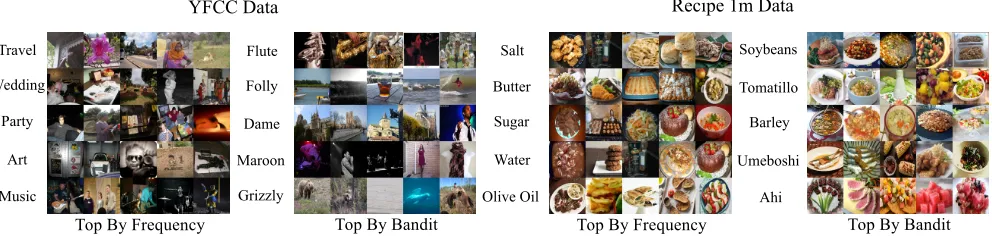
Figure 3: Randomly sampled images from five classes for YFCC and Recipe1m. “Top by Frequency” classes are the five classes with the most training data, “Top by Bandit” are the five chosen for training most frequently by the bandit.
the Flickr tags, we were surprised to see a concept like “folly” ranked so highly by the bandit. Yet randomly sampled images do show similarities in this tag (3/5 displayed are images of water sports). This suggests that strong priors, i.e indications before training of what classes ought to be learnable, may be difficult to come by.
Conclusion and Future Work
In this paper, we motivated and formalized the concept of class learnability, defining it to be an ordering over classes based on potential class generalization error for a given data set. We then developed an online algorithm using existing Multi-Armed Bandit techniques that directs the training of a given classifier, with the intention of focusing on classes as their learnability dictates. We showed that this bandit al-gorithm is capable of identifying learnable classes in a noisy data set, and that focusing on learnable classes yields models with low generalization error relative to simple baselines and data-science inspired heuristics alike. These results were con-sistent across a variety of data sets, each with a unique kind of noise in the data’s labeling.
In the future, we are interested in applying our algorithm to data sets created with a variety of labeling processes. As
an example, one could imagine re-labeling a data set given synonyms of existing classes, thus creating new data parti-tions that may facilitate better classifier performance. We believe that our bandit algorithm would be well suited to explore such a class space, identifying which concepts in a synset produce the best data partitions. Similarly, we suspect that our bandit may be appropriate for exploring fine grained recognition data sets, where there is a hierarchy on classes. In such a scenario, our bandit could act in a curriculum learning capacity, starting training by identifying coarse concepts and progressing towards more fine-grained classes if the model is ready. We also intend to investigate various other ban-dit formulations. As an example, there exist Combinatorial Multi-Armed Bandit algorithms that are capable of selecting acombinationof arms at a given iteration, a technique that may allow for more sophisticated batch selection and more successful optimization of a classifier.
Acknowledgements
References
Abu-Mostafa, Y. S.; Magdon-Ismail, M.; and Lin, H.-T. 2012.
Learning from data, volume 4. AMLBook New York, NY, USA:.
Auer, P.; Cesa-Bianchi, N.; Freund, Y.; and Schapire, R. E. 1995. Gambling in a rigged casino: The adversarial multi-armed bandit problem. InFoundations of Computer Science.
Auer, P. 2002. Using confidence bounds for exploitation-exploration trade-offs. Journal of Machine Learning Re-search3(11):397–422.
Bogunovic, I.; Scarlett, J.; and Cevher, V. 2016. Time-varying gaussian process bandit optimization. InArtificial Intelligence and Statistics.
Clevert, D.-A.; Unterthiner, T.; and Hochreiter, S. 2016. Fast and accurate deep network learning by exponential linear units (elus). InInternational Conference on Learning Repre-sentations.
Deng, J.; Dong, W.; Socher, R.; Li, L.-J.; Li, K.; and Fei-Fei, L. 2009. Imagenet: A large-scale hierarchical image database. InComputer Vision and Pattern Recognition.
Fan, Y.; Tian, F.; Qin, T.; Bian, J.; and Liu, T.-Y. 2017. Learning what data to learn. InInternational Conference on Learning Representations (Workshop).
Fei-Fei, L.; Fergus, R.; and Perona, P. 2007. Learning gen-erative visual models from few training examples: An incre-mental bayesian approach tested on 101 object categories.
Computer vision and Image understanding106(1):59–70.
Garrigues, P.; Farfade, S.; Izadinia, H.; Boakye, K.; and Kalantidis, Y. 2017. Tag prediction at flickr: A view from the darkroom. InACM Multimedia (Workshop).
Graves, A.; Bellemare, M. G.; Menick, J.; Munos, R.; and Kavukcuoglu, K. 2017. Automated curriculum learning for neural networks. InNeural Information Processing Systems.
Kendall, M. G. 1955.Rank Correlation Methods, volume 2. Hafner Publishing Co.
Kleinberg, R.; Slivkins, A.; and Upfal, E. 2013. Bandits and experts in metric spaces.arXiv preprint arXiv:1312.1277.
Krishna, R.; Zhu, Y.; Groth, O.; Johnson, J.; Hata, K.; Kravitz, J.; Chen, S.; Kalantidis, Y.; Li, L.-J.; Shamma, D. A.; Bern-stein, M.; and Fei-Fei, L. 2016. Visual genome: Connecting language and vision using crowdsourced dense image anno-tations. InComputer Vision and Pattern Recognition.
Krizhevsky, A., and Hinton, G. 2009. Learning multiple lay-ers of features from tiny images. Technical report, Citeseer.
Li, Q.; Wu, J.; and Tu, Z. 2013. Harvesting mid-level visual concepts from large-scale internet images. In Computer Vision and Pattern Recognition.
Mat´ern, B. 2013. Spatial variation, volume 36. Springer Science & Business Media.
Mikolov, T.; Sutskever, I.; Chen, K.; Corrado, G. S.; and Dean, J. 2016. Distributed representations of words and phrases and their compositionality. InAdvances in Neural Information Processing Systems.
Oudeyer, P.-Y.; Kaplan, F.; and Hafner, V. 2007. Intrinsic mo-tivation systems for autonomous mental development. IEEE Transactions on Evolutionary Computation11(6):265–286. Philbin, J.; Chum, O.; Isard, M.; Sivic, J.; and Zisserman, A. 2007. Object retrieval with large vocabularies and fast spatial matching. InComputer Vision and Pattern Recognition. Robbins, H. 1952. Some aspects of the sequential design of experiments.Bulletin of the American Mathematical Society
58(5):527–535.
Ruder, S., and Plank, B. 2017. Learning to select data for transfer learning with bayesian optimization. InEmpirical Methods in Natural Language Processing.
Salvador, A.; Hynes, N.; Aytar, Y.; Marin, J.; Ofli, F.; We-ber, I.; and Torralba, A. 2017. Recipe1m: A dataset for learning cross-modal embeddings for cooking recipes and food images. Transactions on Pattern Analysis and Machine Intelligence720(2):619–508.
Settles, B. 2012. Active learning. Synthesis Lectures on Artificial Intelligence and Machine Learning6(1):1–114. Snow, R.; O’Connor, B.; Jurafsky, D.; and Ng, A. Y. 2008. Cheap and fast—but is it good?: Evaluating non-expert anno-tations for natural language tasks. InEmpirical Methods in Natural Language Processing.
Srinivas, N.; Krause, A.; Kakade, S.; and Seeger, M. 2010. Gaussian process optimization in the bandit setting: No regret and experimental design. In International Conference on Machine Learning.
Sukhbaatar, S.; Bruna, J.; Paluri, M.; Bourdev, L.; and Fergus, R. 2014. Training convolutional networks with noisy labels. InInternational Conference on Learning Representations (Workshop).
Thomee, B.; Shamma, D. A.; Friedland, G.; Elizalde, B.; Ni, K.; Poland, D.; Borth, D.; and Li, L.-J. 2016. Yfcc100m: The new data in multimedia research. Communications of the ACM59(2):64–73.
Torresani, L.; Szummer, M.; and Fitzgibbon, A. 2010. Effi-cient object category recognition using classemes. In Euro-pean Conference on Computer Vision.