COPY
Irrigation
Science
© Springer-Verlag 1985
Irrig Sci (1985) 6:149-158
Effect of Drying on Soil Strength
and Corn Emergence *
H. 0. Fapohundal, W. D. Kemper2, and D. F. Heerman3
Department of Agricultural Engineering, University of Ife, I18-Ife, Nigeria
2 Snake River Conservation Research Center, USDA-ARS, Kimberly, ID 83341, USA
3 USDA-ARS, Fort Collins, CO, USA Received September 26, 1984
Summary. Laboratory studies were conducted to evaluate the effects of drying on soil strength and corn emergence (Zea mays L.). Corn was germinated in Billings silty clay under a bank of heat lamps which operated 9, 14, 19, or 24 h per day. Soil strength (modules of rupture), soil moisture content and emer-gence were measured daily.
The relationship of soil strength to corn seedling emergence as influenced by the four light and heat durations and bare and mulched soil surfaces was deter-mined. As soil strength increased emergence decreased until it ceased at soil strengths of about 80 kPa. Strength of this soil had a high negative correlation with soil water content and increased with time. Mulching decreased initial rate of drying, decreased crust strength, and improved corn emergence. The 14-hour light and heat treatment resulted in the highest corn emergence.
Additional Index Words: corn emergence, soil strength, modulus of rupture, soil water content, water and soil surface treatments, bare and mulched soil surfaces
A major factor affecting crop emergence is strength of the surface soil. The modulus of rupture of briquets as described by Richards (1953) has been used as a measure of soil strength by several investigators (e.g. Hanks and Thorp 1956, 1957). Crusts are a major structural feature of soils in many arid regions. Excessive crust strength often decreases or prevents emergence of crops (e.g. Carnes 1934; Hanks
1960).
Crust strength is generally reduced by mulches which cover part or all of the soil surface. Mulches reduce evaporation and maintain higher water contents at the soil surface. Higher water contents reduce crust strength of most soils. Hanks (1960) found decreased emergence when the soil dried and the crust strength increased. He suggested the use of mulches to minimize soil drying, reduce crust strength and enhance emergence. Parker and Taylor (1965), using a penetrometer to measure
150 H.O.Fapohunda et al.
soil strength, found that rate of emergence of grain sorghum was affected by soil strength, soil moisture tension, and soil temperature. They stated that soil tempera-ture did not affect the relation between soil strength and final emergence. Kemper et al. (1975) showed that flooding of freshly cultivated soil saturates the soil and increases its subsequent modulus of rupture more than methods in which substan-tial tension is retained in most of the soil as it is wetted. They presented limited data on corn emergence but their conclusions were tentative.
The objectives of this study were to evaluate the influence of soil moisture on soil strength as affected by mulching and different durations of exposure to light and heat and determine the relationship between soil strength (modulus of rupture) and corn (Zea mays L.) seedling emergence.
Materials and Methods
Billings silty clay loam from near Grand Junction, Colorado, was used. Emergence is commonly restricted on this soil if rains occur soon after seeding and the soil has a few days to dry before the seedlings reach the surface. The sample used had sand, silt and clay contents of 16, 42, and 42% respectively. The soil was contained in three adjacent, water-tight compartments of the tank. Each compartment was 52 cm long, 30.5 cm wide, and 38 cm deep. A 2.5 cm thick layer of clean washed sand formed the bottom layer of the compartments and facilitated free drainage of effluent through an outlet at the bottom. Each compartment was filled with air dried soil (about 0.04 cm' H 2 O cm') to within 7 cm of the top.
Different crust strengths were obtained on this soil in a tank placed under a bank of ten 150-watt heat lamps.
These lamps were located 90 cm above the soil surface in two rows spaced 36 cm apart, with intrarow spacing of 40 cm and provided about 560 W ni -3 irradiation. They were automatically controlled with a time clock. The experiment involves four separate runs with lights on for 9, 14, 19, and 24 h per day respectively.
Twenty corn (hybrid WF9 x 38-11) seeds per soil compartment were evenly spaced and planted at a depth of 5 cm before water application. Trials immediately prior to this study on this batch of seed showed 100% germination.
The arrangement of the soil compartments allowed comparison of bare and mulched soil surfaces as follows:
1. Mulched treatment – corn was planted and 4.6 cm of water was applied by surface flooding. Wheat straw, 3 to 5 cm long was then evenly spread on the soil surface at the rate of 1900 Kg/ha which, according to Slonekar and Moldenhauer (1977), should give about 84% cover.
2. Bare soil treatment –4.6 cm of water was applied by surface flooding after corn planting. Emergence counts, soil modulus of rupture (MR) determinations and volumetric soil water measurements (from MR Cores) were started when the first seedling emerged and made daily during the following week.
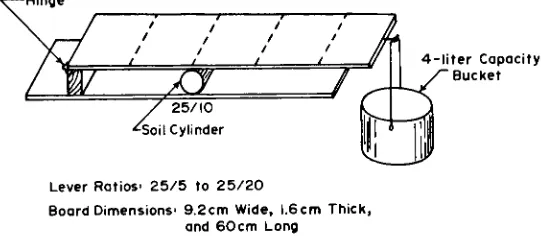
The modulus of rupture technique used was devised by Kirkham et al. (1958) with modifications suggested by Kemper et al. (1975). They produced tensile stresses in cylindrical soil samples by using radially oriented line loading on opposing sides of the sample. Modulus of rupture in kPa was computed as follows:
MR= 20F/ aDL
where F is the breaking force in newtons (newton =10 5 dynes), L is the sample length in cm, and D is the sample diameter in cm.
Hinge
4-liter Capacity Bucket
25/10 Soil Cylinder
Effect of Drying on Soil Strength and Corn Emergence 151
Lever Ratios . 25/5 to 25/20
Board Dimensions , 9.2cm Wide, 1.6cm Thick, and 60cm Long
Fig. 1. Equipment for determining modulus of rupture
fragmented soils contained in the soil compartments. The soil cylinders were removed from the soil tank at the times indicated. Aided by the presence of the aluminum foil linings, the soil cores were usually easily removed from the copper cylinders. They were then placed in the apparatus outlined in Fig. 1 and water was poured into the bucket until the soil core ruptured. The weights of the water and bucket and half the weight of the top board were multiplied by the appropriate lever ratio to calculate the breaking force, F, which ruptured the soil core. The modulus of rupture was calculated from equation (1). Average water contents of the ruptured core samples were then determined. In most cases soil at the top end of the core appeared to be drier than at the bottom end. Water contents measured were averages for these 5 cm long cores.
Results and Discussion
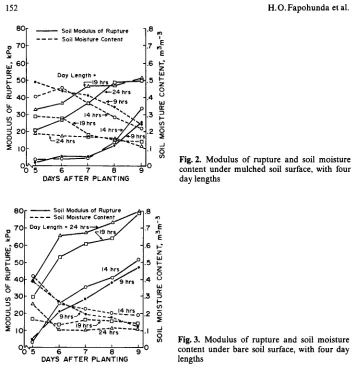
Effects of these average soil water contents and drying time on modulus of rupture are shown in Figs. 2 and 3. Generally, the modulus of rupture increased as water content decreased. The water content of the bare soil decreased faster than the soil under the mulch and higher MR values were measured on the bare soils. Coefficients of variation of the modulus of rupture determinations average about 0.08.
The summation of the surface tension and internal water tension forces pulling the particles together increases as the water content decreases. The direct effect of this cohesive force on the MR is approximated by the terms,
MR
i
=A+B(90-en)
(2)where
(90
is the volumetric water content near saturation at which the sample has a practically negligible modulus of rupture. A is a residual modulus of rupture due to previous bonding by mineral or organic materials, anden
is the water content on the day, n, when the MR is measured.— Soil Modulus of Rupture — — — — Soil Moisture Content
Day Length • 19 hrs ..-• .6 E Ez 1--O .4
I-2 5
.1 3 5
0 5 6 7 8
DAYS AFTER PLANTING
0 80 o 70 W 60 50 a. ct 40 lL 30
n 20
O O
2 10
E
.7 80 Soil Modulus of Rupture .8
— — Soil Moisture Content„,.. on Day Length • 24 hrs
.6 12' z .5 1– z 0 .4 0
2 10
00 5 6 7 8
DAYS AFTER PLANTING
Fig. 3. Modulus of rupture and soil moisture 0 content under bare soil surface, with four day
lengths 0 70 a_ -60 1– 50 a. 7
w 40 0 (.0 30
20
O O
152 H.O.Fapohunda et al.
Fig. 2. Modulus of rupture and soil moisture content under mulched soil surface, with four day lengths
While this was the first documented observation of a curing factor affecting moduli of rupture of soils (Fapohunda 1975), it is similar to increased resistance of soil to compression as a result of ageing as noted by Utomo and Dexter (1981). Kemper and Koch (1966) observed that aggregate stability of soil samples stored under air dry conditions increased about 8% during 8 months of storage. The substantial changes observed in the moduli of rupture in this study occurred within a few days. The rapid reaction as indicated by the sharp changes in the value of moduli of rupture may be due to the higher water contents which were of the order of 10 to 25%, compared to 2 to 5% water content (about one molecular layer of water on mineral surfaces) (Kemper and Koch 1966) in which the slow aggregate stability increases were noted.
Effect of Drying on Soil Strength and Corn Emergence 153
Utomo and Dexter (1981 a) found that "age-hardening" proceeded most rapidly in their soils at water contents near the lower plastic limit and was slower when their soils were wetter or drier than the lower plastic limit. The lower plastic limit of a sample of this Billing's soil which had a texture similar to that of the soil used in this study was about 0.25 cm' of water per cm' of soil. Kemper and Rosenau (1984 and subsequent unpublished data) have found rates of cohesion increase in a sample of this Billings to be greatest when water content was in the middle range and near zero when the soil was saturated or dried over P, 0 5 .
Generalizing from these observations, it appears that the rate of "age-hardening," or rate of modulus of rupture increase (t1MR/ z1T) is related to the water content of the soil in the general manner indicated in Fig. 7. The equation used to generate that line was
(MR)/4 T= C[sin ( et / eo)] 2. (3)
Kemper and Rosenau (1984) suggested a hypothesis based in part on observa-tions of Gifford and Thran (1974), Kemper et al. (1974), and Uehara and Jones (1974) which predicts peaking of the rate of cohesion increase in this manner. The hypothesis involves diffusion of ions or molecules with bonding potential through the solution phase to newly formed points of contact between the soil particles. When water content of a recently disrupted soil is near saturation there are generally a few molecular layers of water held on and between surfaces which prevent new particle-to-particle contacts. As water content decreases, tension in the water increases and pulls the mineral particles toward each other. This causes extremely high pressures on the water molecules in areas of nearest proximity between convex particle surfaces, eventually squeezing those water molecules out and establishing mineral-to-mineral contact.
Once those mineral-to-mineral contacts are formed between convex surfaces there are many positions around the perimeter of that contact where ions or molecules can bond to both surfaces. Since many ionic and molecular sized compo-nents in solution will have lower free energy in these doubly bonded positions, solution in the vicinity of these contacts is depleted of those components. This creates concentration gradients which move those slightly soluble molecular sized components from other parts of the soil solution by diffusion. As this diffusion depletes the concentration of these components in soil solution near edges or convex surfaces of minerals containing these diffusing components the solid phases contribute to the solution phase keeping the components near the equilibrium con-centration. These contributions maintain the concentration gradients of the dif-fusing component as long as there are positions at the particle-to-particle con-tacts where the components can be bonded more strongly than they are bonded on solid phase edges and convex surfaces or in less stable amorphous phases.
As soil water content decreases, the cross section available for solution phase diffusion decreases and the pathway becomes more tortuous, resulting in a reduc-tion of the effective diffusion coefficient and diminished rate of transfer of the bonding molecules to the contact points (Van Schaik et al. 1966).
154 H. O. Fapohunda et al.
loses some of its water, tension develops in the soil water and pulls the particles into contact. However, as soil water contents decrease and diffusion rates become limiting, rate of cohesion increase diminishes.
Integrating the change in modulus of rupture due to ageing (time) from the first day of measurement (5th day after planting) to any of the subsequent days of measurement
n
MR, =
c E
[sin a e,/00]2 . (4)1=5
Adding this effect of ageing to the original modulus of rupture and the effect of water content, the modulus of rupture expected on the nth day would be
MR = MR, + MR, = A + B(00 - e n )+C [sin (n ez/eo] 2 . (5 )
1=5
Assuming ea = 0.5, using equation (5) with the data set for mulched soils (Fig. 2) and instructing a computer to select the A, B, and C coefficients providing the least sum of squares of differences between the measured modulus of rupture values and the values predicted by the equation from the measured set of water contents (0 k ) equation (6) was obtained
MR= 15 + 46 (0.5– e n ) + 8.9 [sin (6.28 0,)] 2 (6)
t=5
where 90% of the sum of squares of deviations from the mean were associated with equation (6).
Doing the same for the data from the bare soils (Fig. 3)
MR= –11 + 192 (0.5– 0„) + 1.0 [sin (6.28 e,)] 2 ( 7)
1=5
where only 81% of the sum of squares of deviations from the mean were associated with equation (7). Regression equations with coefficients drawn from each light period length (i.e., LP = 9, 14, 19, or 24 h of light/day) accounted for much higher percentages of the sums of squares of deviations from the means. This indicated that hours of light per day was a factor, so the factor D (LP) was added to equation (5). Using the computer to find the best fit coefficients, D = 2.0 and
MR = –26 + 68 (0.5 – 00+9.4 t [sin (6.28 ()o] 2 + 2.0 (LP). (8)
t=5
About 95% of the sums of squares of deviations from the means of modulus of rupture of the bare soils were associated with equation (8) and the best fit coefficients of the terms associated with the dryness and age-hardening factors were closer to those obtained using the mulched soils (6) than when the light period (LP) factor was not included (7).
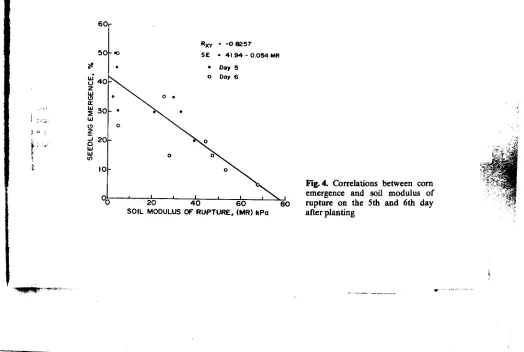
• Day 5 o Day 6
o 40
ce 2 30
z :I- 20
cn
0 •
IO
20 40 60
SOIL MODULUS OF RUPTURE. (MR) kPo 80
Effect of Drying on Soil Strength and Corn Emergence 155
the longer light periods. Average soil temperatures in the top 5 cm of the un-mulched soil could be as much as 10 °C higher when light was furnished for 24 h as compared to 9 h /day. The resulting increase in fluidity of the water would increase diffusion coefficients in the water by about 25%. Higher temperatures would also cause higher respiration rates of the seedlings and microorganisms which could generate more CO2 and solubilize more CaCO3 as Ca(HCO3)2 which may be an
avenue by which CaCO3 can accumulate more rapidly and bond particles together
at their contact points. Further studies will be necessary to identify the actual mechanisms by which longer light periods increase cohesion. However, in this study the straw mulch (at- 84% cover) caused this LP term to be negligible.
The relationship between corn emergence and soil modulus of rupture (mulched and bare soil surfaces and all light durations) is shown in Fig. 4. Corn emergence decreased as modulus of rupture increased (r = 0 .83) . Emergence ceased if the soil strength exceeded about 80 kPa.
Mulching improved corn emergence, apparently by keeping the surface soil moist and thereby suppressing the soil strength (compare Figs. 5 and 6).
Under the applied conditions, 14 h of heat and light per day was near the optimum for corn seedling emergence (Figs. 5 and 6). Longer heat and light durations reduced water content, increased crust strength and reduced corn emergence. Shorter day lengths delayed emergence, probably because temperatures were lower. However, at the 9-hour day length final emergence was near 100%.
Conclusions and Recommendations
In crusting soils of this type, good stands following flood irrigation occur only when the seedlings break the surface before the surface dries and becomes hard.
60
Rxy • -0 6257
50 SE • 41 94 - 0.054 MR
Corn Seedling Emergence ---- Soil Modulus of Rupture Day Length>„/°
14 hrso 9
•
.7
14 hrsi/• / —i 20
D z 9// hrs
'' 10
,...18==...--4,0°'
0 5 6 7 8
DAYS AFTER PLANTING
0
ui ce
50 Ix
40 (r)
30
0
20 2
10
Fig. 6. Corn emergence and soil modulus
0 of rupture on bare soil surface, with four
day lengths
Corn Seedling Emergence ---- Soil Modulus of Rupture Day Length •
14 hrs 100
• 90
• 80
24 hrs
14 hrs,„..."'°
/9 hrs .•
r-,/
005 6 7 8
DAYS AFTER PLANTING cr
(5 70
2 w 60
—
-J• 50
w• 40 N w 30
▪ 20
2 D 10
U
9 100
90
80
70
60
0.1 0.2 0.3 0.4 0.5
SOIL WATER CONTENT, 8 cm 3cm' 3
156 H. O. Fapohunda et al.
Fig. 5. Corn emergence and soil modulus of
rupture on mulched soil surface, and four day lengths
Effect of Drying on Soil Strength and Corn Emergence 157
Corn seedling emergence was restricted when the modulus of rupture of this soil exceeded 40 kPa. Generally, when light periods were 14 h or less per day most of the corn seedlings emerged before moduli of rupture reached these values. When light duration per day exceeded 14 h the moduli of rupture of bare soil exceeded 50 k Pa before most of the corn plants emerged and a major portion of the seedlings were not able to break through the surface. This suggests that early seeding of corn, when day lengths are near 14 h, will result in better stands than late seeding when day lengths are in the 16 to 18 h range.
The straw mulch was effective in delaying the drying and development of moduli of rupture greater than 40 kPa. However, when light periods per day were 19 and 24 h only about half the corn had emerged from these mulched soils when the modulus of rupture became larger than 40 kPa and practically no emergence occured thereafter.
The equations developed to describe the development of strength of crusts in this soil indicate that a second irrigation near emergence time would reverse the increase in strength due to drying, but would not negate the increase in strength due to ageing.
If the methods suggested above do not achieve good emergence through the surface of flooded soils, farmers could often pre-irrigate their soil and plant several days later with equipment which breaks the crust above the seed. It is also often possible (Kemper et al. 1975) to avoid strong crust development by using irrigation methods which do not saturate the soil above the seed, such as trickle and furrow irrigation.
Acknowledgement. The authors express appreciation to John L. Stevens, Computer Specialist, USDA-ARS, Snake River Conservation Research Center, Kimberly, Idaho, for computer processing the statistics in this paper.
References
Blake GR, Gillman RD (1970) Thixotropic changes with aging of synthetic soil aggregates. Soil Sci Am Proc 34:561
Carnes A (1934) Soil crusts – method of study their strength, and a method of overcoming injury to cotton stands. Agric Eng 15:167
Fapohunda HO (1975) Crop seedling emergence as affected by irrigation methods and soil types. Thesis. Colorado State University, Fort Collings, Colorado, USA
Gifford RO, Thran DF (1974) Bonding mechanisms for soil crusts: Part II. Strength of silica cementation. In: Western Regional Research Publication. Cary JW, Evans DD (eds), Chap. 3: Soil Crusts. Arizona Tech. Bull. 214, pp. 28-30, University of Arizona, Tucson, 85721
Hanks RI (1960) Soil crusting and seedling emergence. Trans Int Congr Soil Sci 7 (1): 340 Hanks RJ, Thorp FC (1956) Seedling emergence of wheat as related to soil moisture content,
hulk density, oxygen diffusion rate, and crust strength. Soil Sci Soc Am Proc 20:307 Hanks RJ, Thorp FC (1957) Seedling emergence of wheat, grain sorghum and soybeans as
influenced by soil crust strength and moisture content. Soil Sci Soc Am Proc 21:357 Kemper WD, Koch EJ (1966) Aggregate stability of soils from the Western U.S. and Canada.
USDA Tech Bull 1355
158 H.O. Fapohunda et al. Kemper WD, Evans DD, Hough HW (1974) Crust strength and cracking. ln: Western
Regional Research Publication. Cary JW, Evans DD (eds), Chap 4: Soil Crusts. Arizona Tech. Bull. 214, pp. 31-38, University of Arizona, Tucson, 85721
Kemper WD, Olsen JS, Hodgdon A (1975) Irrigation method as a determinant of large pore persistence and crust strength of cultivated soils. Soil Sci Soc Am Proc 39:519
Kirkham D, DeBoodt M, DeLeenheer L (1958) Modulus of rupture determination on cylindrical core samples. Int. Symp. on Soil Struc, Ghent
Parker JJ Jr., Taylor HM (1965) Soil strength and seedling emergence relations: I. Soil type, moisture tension, temperature planting depth effects. Agron J 57:289
Richards LA (1953) Modulus of rupture as an index of crusting of soil. Soil Sci Soc Am Proc 17:321
Slonekar LL, Moldenhauer WC (1977) Measuring the amounts of crop residue remaining after tillage. J Soil Water Consery 32:231
Uehara G, Jones RC (1974) Bonding mechanisms for soil crusts: Part I. Particle surfaces and cementing agents. In: Western Regional Research Publication. Cary JW, Evans DD (eds), Chap. 3: Soil Crusts. Arizona Tech. Bull. 214, pp. 17-28, University of Arizona, Tucson, 85721
Utomo WH, Dexter AR (1981) Effect of ageing on compression resistance and water stability of soil aggregates disturbed by tillage. Soil Tillage Res 1:127
Utomo WH, Dexter AR (1981 a) Age hardening of agricultural soils. J Soil Sci 32:335