The Thirty-First AAAI Conference on Innovative Applications of Artificial Intelligence (IAAI-19)
Context-Tree Recommendation vs
Matrix-Factorization: Algorithm Selection and Live Users Evaluation
St´ephane Martin,
1Boi Faltings,
2Vincent Schickel
31EPFL, LIA, Switzerland,2EPFL, LIA, Switzerland,3Prediggo SA, Switzerland
[email protected], [email protected], [email protected]
Abstract
We describe the selection, implementation and online eval-uation of two e-commerce recommender systems developed with our partner company, Prediggo. The first one is based on the novel method of Bayesian Variable-order Markov Mod-eling (BVMM). The second, SSAGD, is a novel variant of the Matrix-Factorization technique (MF), which is considered state-of-the-art in the recommender literature.
We discuss the offline tests we carried out to select the best MF variant, and present the results of two A/B tests per-formed on live ecommerce websites after the deployment of the new algorithms. Comparing the new recommenders and Prediggo’s proprietary algorithm of Ontology Filtering, we show that the BVMM significantly outperforms the two oth-ers in terms of CTR and prediction speed, and leads to a strong increase in recommendation-mediated sales. Although MF exhibits reasonably good accuracy, the BVMM is still significantly more accurate and avoids the high memory re-quirements of MF. This scalability is essential for its applica-tion in online businesses.
1
Introduction
Today, recommender systems are essential components of commercial websites. They contribute to the sales effort by guiding the customers to interesting products and by person-alizing the shopping experience. At the same time, the nature of online traffic imposes stringent time limits on the compu-tation of recommendations. Online businesses also expect the systems to serve a large number of customers on afford-able infrastructures. It is thus crucial to develop algorithms that attract the attention of the customers while remaining efficient in computation and memory consumption.
We carried out this work in cooperation with Prediggo SA, a start-up specializing in recommendation- and search-solutions for e-commerce (https://www.prediggo.com/). Its main recommendation algorithm is a particularly efficient and scalable content-based method, theOntology Filtering
(OF). The purpose of this research was to extend Prediggo’s portfolio of solutions with two additional algorithms, imple-mented in Java within its already existing framework, in or-der to benefit from recent advances in recommenor-der system technology.
Copyright c2019, Association for the Advancement of Artificial Intelligence (www.aaai.org). All rights reserved.
The first one is a novel approach based on a Marko-vian algorithm, the Bayesian Variable-order Markov Model (BVMM). The second one, SSAGD, is a variant of Matrix-Factorization (MF). The family of MF algorithms is consid-ered the state of the art in the field of recommendation; they thus offer a solid baseline.
We will start with a description of the three types of al-gorithms. We then describe the offline tests we performed, given the many variants based on MF, to develop the best one for our purpose, resulting in SSAGD. Finally, we discuss the live evaluations we carried in production conditions on the websites of two of Prediggo’s customers. These exper-iments highlight the excellent performance of the BVMM. By contrast, we found MF to obtain smaller CTRs and to be considerably slower as well as memory-greedy.
2
Related Work
2.1
Matrix-Factorization
Matrix-factorization is one of the most widely studied ap-proaches to recommendation and is known to provide a very good accuracy. Many variants of its basic method have been developed since Sarwaret al.’s original proposal (Sarwar et al. 2000), which relied onSingular Value Decompositionto extract vectors of user- and item-latent preferences.
Funk (Funk 2006) pushed the idea further and avoided the roundabout computation of a SVD by directly comput-ing the latent coefficients through regularized gradient de-scent. Paterek (Paterek 2007) examines a number of im-provements over Funk’s regularized factorization. Among them, the asymmetric SVDs, NSVD1 and NSVD2, which appear to work quite well in practice (Pu and Faltings 2013). We discuss the second in Section 3. Paterek also introduced the idea of adding item- and user-biases to the latent vec-tors (Koren, Bell, and Volinsky 2009).
The problem of implicit feedback, particularly relevant in our case, is also tackled in (Oard and Kim 1998) and in (Hu, Koren, and Volinsky 2008). The latter develop a model with an additional array of0/1-variables in order to distinguish between the ratings of the users and the confidence we can have in those ratings. The resulting cost-function forces them to resort to a policy of optimization through Alternat-ing Least Squares. A similar procedure, Alternating-Least-Squares with Weighted-λ-Regularization, dubbed ALSWR, has been proposed by Zhou et al. (Zhou et al. 2008), al-though they apply it on the Netflix Dataset, with explicit rat-ings. Both algorithms are part of the Apache Mahout library (https://mahout.apache.org/), which we used in our prepara-tory tests.
2.2
Ontologies
Just like MF, Ontologies are now widespread tools in the field of recommendation (Ricci et al. 2010,passim), espe-cially in relation withcontent-basedmethods. Noteworthy examples discussed in the literature cover the recommenda-tion of news (IJntema et al. 2010; Cantador, Bellog´ın, and Castells 2008; Frasincar, Borsje, and Levering 2009), multi-media (Juszczyszyn, Kazienko, and Musiał 2010) and com-mercial products (Aciar et al. 2007; Lee et al. 2006).
In particular, Prediggo relies on ontologies learned through an automated process (Schickel-Zuber 2007; Schickel-Zuber and Faltings 2007), which avoids the costly intervention of human experts. (Drumond and Girardi 2008) provides an interesting overview of this topic.
2.3
Context-Trees and Sequential Models
Context-treesare tree-shaped structures used to model sets of sequences. A large number of algorithms relying on such structures exist in the literature (Begleiter, El-Yaniv, and Yona 2004), often in relation with data-compression (Rissa-nen and Langdon 1979; Rissa(Rissa-nen 1983) andarithmetic cod-ing(Rissanen and Langdon 1981; Cleary and Witten 1984). Rissanen’s algorithm Context (Rissanen and Langdon 1979; Rissanen 1983) was among the first applications. Since then, several related methods have been proposed, such as Context-Tree Weighting (Willems, Shtarkov, and Tjalkens 1995), Prediction by Partial Match (Cleary and Witten 1984), Probabilistic Suffix Trees (Bejerano and Yona 2001), etc. Begleiter et al. (Begleiter, El-Yaniv, and Yona 2004) offer a valuable introduction to this topic. Besides data-compression, context-trees have also found use in mu-sicology (Pearce and Wiggins 2003), computational biol-ogy (Bejerano and Yona 2001), and linguistics (Galves et al. 2012). In particular, the Bayesian Variable-order Markov Model (BVMM), introduced first in (Dimitrakakis 2010), has been applied to the recommendation of online news on several news-sites (Garcin et al. 2014).
The notion of sequence, central to the definition of context-trees and present to some extent in all our imple-mentations, has already been noted to be quite relevant for recommendation (Quadrana, Cremonesi, and Jannach 2018). Interestingly, the incorporation of a sequential aspect into an MF-framework by means of time-decaying variables is also applied by Twardowski (Twardowski 2016).
3
Matrix-Factorization
Matrix-factorization (MF) is a popular method of preference extraction that has received numerous applications in the field of recommender systems. It represents an instance of dimensionality reduction (Bobadilla et al. 2013), where the ratings assigned by users to some items are decomposed into vectors of latent values. Those are recombined during the recommendation stage to estimate the scores of the unrated items.
The training data consist of arating-matrixR, in which the valueRu,iat the intersection of theuth row and theith column expresses the utility of itemifor useru. In a typical scenario, only a small number of ratings are known for each user, and the problem is to estimate the unknown values. The items with the highest estimates can then be recommended.
The simplest applications of MF (Sarwar et al. 2000) de-compose the rating-matrix through Singular-Value Decom-position (SVD) and truncate the resulting matrices R = U SV> to keep only theK most important factors. Many refinements over this idea of matrix-decomposition exist in the literature. They typically decompose the originalRinto two matrices of user- and item-preferences,U andV, such that each row vectorUu embeds the tastes of one user u, while each column vectorVicorresponds to an itemi. The productUuViyields an estimate of the utility ofiforu.
The Taste component of Apache Mahout, a project of the Apache Software Foundation, offers several MF-based rec-ommender systems. In order to ease the selection process and, in the end, to only have to implement the most promis-ing algorithms, we fitted three of those into our system: The
RatingSGDFactorizer, described in the Apache docu-mentation as a “Matrix factorization with user and item bi-ases for rating prediction, trained with plain vanilla SGD”, the SVDPlusPlusFactorizer, defined as “SVD++, an enhancement of classical matrix factorization for rat-ing prediction”, with a citation to (Koren 2008), and the
ALSWRFactorizer, which relies on “ Alternating-Least-Squares with Weighted-λ-Regularization” and “also sup-ports the implicit feedback variant of this approach” as in (Hu, Koren, and Volinsky 2008). RSGD thus represents a basic version of gradient-descent factorization, similar to (Funk 2006). The other recommenders are more sophisti-cated methods, which we would expect to perform better.
One problem posed by online traffic, especially for session-based recommenders, is the constantly changing user-base. All we know about a user is the sequence of his actions on the site. At training time, we thus create the rat-ing matrixRby collecting all the sequences of page-views per session logged in the past, and by extracting the sub-sequences of length at most D > 0. Those subsequences constitute the rows ofR, with each element of a row having a value corresponding to its chronological position in the se-quence. We assign a value ofDto the most recently visited product, D−γ to the last but one,D−2γ to the last but two, etc1. The items not mentioned have a value of zero.
1
As a user progresses on a website, the row that matches his browsing history will change. We use a trie to keep track of the advance of each user and to find the corresponding row in the matrix of user-factors. When no row matches his current sequences, we take the row matching the longest suffix ofs. This is similar to the policy applied in a context-tree (Section 5).
Paterek (Paterek 2007) studied several variants of Funk’s gradient descent algorithm (Funk 2006), among which the so-called NSVD2. The underlying idea is to compute a fac-torization ofRthrough regularized gradient descent, and to construct the coefficients of a user’s latent vector as the sums of the corresponding coefficients of the items rated by the user. One advantage of this method is that the vectors of the new users can be deduced from their ratings even if they ap-pear after the training stage.
To account for the sequential nature of the data, we also implemented our own adaptation of NSVD2, the Sequen-tial, Session-based, Asymetric factorization by Gradient De-scent, or SSAGD. Since it follows Paterek’s idea, SSAGD does not need specific user-vectors2. Each time a request for recommendation is received, we create an estimate of the user-vectorUuby filling each dimension with the sum of the corresponding values in the item-matrixV for all the items
iin the browsing historys, weighted according to their posi-tion ins:Uu=Pi∈swiV
>
i . The most recent item receives a weightwofDγ, the last but one a weight of(D−1)γ, the last but two(D−2)γ, etc.
Funk’s implementation (Funk 2006) uses early stopping to avoid overfitting. The Mahout implementations work by reducing the learning rateλafter each iteration. In our case, we found that we obtained better results by reducing the learning rate each time the error rate increases. It is a well-known property of gradient descent that the error curve sometimes experiences bumps or spikes, that suddenly in-crease its value. When that happens, we restore the coeffi-cients to their previous valid values and setλ:= 0.9λbefore the next iteration. Once the error rate becomes too small, we stop the factorization altogether.
4
Ontology Filtering
Ontology Filtering (OF) (Zuber 2007; Schickel-Zuber and Faltings 2007) was originally conceived to pro-vide a theoretically sound basis to the use of ontologies in recommendation. Those ontologies, in the form of directed acyclic graphs, are learned by the system during a training stage run once a day over the updated catalogue. Their graph structure defines a notion of proximity and neighbourhood among the items (Schickel-Zuber and Faltings 2007), with the immediate descendants of the same parent concept ing closest neighbours, the items sharing a grandparent be-ing more removed, etc.
At recommendation time, the browsing behaviour of the users is followed by the system while they navigate on a website. Their actions are stored into session-based profiles, used in conjunction with a Multi-Attribute Utility function
2
The initial rating matrix is constructed as described above, with ratings decreasing with their position in the sequence.
(MAUT), which estimates the utility of a product for a user given his profile. Each time N recommendations are re-quested for a user, a subset of candidates is preselected by picking theM > N nearest ontological neighbours of the item currently considered by the user. This subset is then ranked by MAUT, and the best items can be returned.
5
Bayesian Variable-Order Markov Models
Since Rissanen’s initial proposal (Rissanen and Langdon 1979), context-tree based algorithms have proved well suited to handle problems ofsequence prediction. The do-main of interest of such problems consists of sequencess∈I?, i.e. ordered lists of itemsσ∈I, and their aim is to estimate the probabilityP(σ|s)for anyσto follow a givens. We describe here a particular variant of context-tree model, the Bayesian Variable-order Markov Model (Dimitrakakis 2010), or BVMM, that has turned out to be convenient for the task of recommendation (Garcin et al. 2014).
Given a sequencesand a datasetS made of other pre-viously observed sequences, a rudimentary way to assess the probability ofσto come afterswould be to look into S for the sequences identical to s, and make a count of the itemsσ0, σ1, . . .found after them. One could then esti-mate P(x = σ|s)as ≈ N(σ|s)/PiN(σi|s), withN(x|s) the number of occurrences ofxafters.
It is however possible that the sequenceshas never been observed before, and cannot be found in the dataset. Since the number of sequences is exponential in the number of items, any realistic dataset will be quite sparse when the number of items becomes too big. One solution is then to use the suffixess0∈suff(s)ofsthat have been actually ob-served. Those suffixes, each of which defines acontext, can be naturally arranged into a tree-shaped structure, which also allows for their efficient retrieval. This context-treeforms the basis of a number of algorithms, that vary in the way they select the relevant suffixes and handle the correspond-ing counts of items (Begleiter, El-Yaniv, and Yona 2004).
Since different suffixes of the same sequence can be fol-lowed by different counts of items, the question arises of which should be selected, and how the differences should be resolved. The BVMM proceeds by aggregating the local probabilitiesPsi(σ|si)computed for each suffixsiofsinto
a global probabilityPˆ(σ|s).
We associate to each nodensi aweightwsi, which
rep-resents the probability thatnsi be the right context to
deter-mine the next item, provided no longer suffix is the right one. This weight can be interpreted as a stopping probability in the search for the right suffix. Given a sequences, we imag-ine trying all the known suffixes, starting from the longest and deepest in the tree up to the empty suffix at the root. The global probabilities are then obtained by marginalization3:
ˆ P(σ|s) =
X
si∈suff(s)
πsiPsi(σ|si)
withπsi=wsi Q
−D≤j<i(1−wsj).
3
It can be shown (Dimitrakakis 2010) that, for any itemσ
and any historys, the aggregated probability can be com-puted with the recurrence relation
ˆ
P(σ|si+1) =wsi+1P(σ|si+1) + (1−wsi+1)ˆP(σ|si)
while the weights can be updated according to
wsi,t+1 =wsi,tP(σ|si)/Pˆ(σ|si)
This results in the algorithm outlined in Algo. 1. IfDis the maximum length allowed for the sequences, this algorithm can be updated inO(D)each time aσis observed after a sequence (Dimitrakakis 2010). It also provides the proba-bility of the next item inO(D). If our aim is to select the
N most probable items from a set of sizeS(S N), the recommendation will be inO(SD).
Algorithm 1The BVMM algorithm.
sis the current context
σis the current observed item
Learning stage: Initializeq:= 0
for eachnodenonsfrom the root to the leaf:
pn := probability ofσforn’s expert
q:=wnpn+ (1−wn)q
wn :=wnpn/q Update expert onn
ifsσis not in the treethen
Add a path corresponding tosσ
Recommendation stage: for eachitemσi:
Initializeqi:= 0
for eachnodenonsfrom the root to the leaf:
pn,i:= probability ofσiforn’s expert
qi:=wnpn,i+ (1−wn)qi returnNitems with highest probabilityq
When applied to online recommendation (Garcin, Dim-itrakakis, and Faltings 2013), the items σ represent web-pages, so that each sequence recapitulates the browsing his-tory of a user. Since the catalogue of a webshop changes only slowly, the tree can be updated at relatively distant in-tervals. The visits are logged in a database, and used once a day or a few times a day to update the weights and the experts all at once.
6
Pre-Production Tests
We thus considered six algorithms, three third-party imple-mentations from the Mahout library: RSGD, SVD++, and ALSWR (used in its implicit-feedback variant), and three implementations of our own: OF, BVMM, and SSAGD. To provide a minimal baseline, we included a trivial Random recommender, which picks its recommendations with uni-form probability. The implementation of the modules did not create particular problems. Prediggo’s software, written in Java, already uses a system of interfaces for the various poli-cies, that can be implemented straightforwardly. The Ma-hout libraries were wrapped inside anad hocmodule, while
SSAGD and the BVMM were implemented directly. The rat-ing matrix in SSAGD was a sparse datastructure based on an array of linked lists of cell objects. The factorized vectors were originally arrays of Javadoubles, later changed to arrays offloatsin order to gain space.
In order to reduce their time-complexity and ensure the semantic relevancy of the output, we apply to all our algo-rithms the same prefiltering operation used in OF: an initial set of≈400candidates is selected by looking within the on-tologies for the nearest neigbours of the item currently vis-ited. The main algorithm is then applied on those candidates to extract the final recommendations.
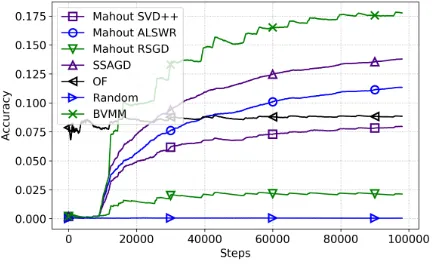
We first tested all seven strategies on a dataset collected from the traffic of one of Prediggo’s clients. Those tests were performed offline by feeding requests for recommendations into the system running on a local machine. The requests reproduced the chronological unfolding of the previously recorded series of 100,000 page-views. In each step, the sys-tem had to returnN = 5recommendations given a visit on a product by a given user.
Every 10,000 steps, the simulation was stopped and the four MF recommenders and the BVMM were updated by launching a new learning stage. Each learning stage used the clicks previously received as training data. The clicks that were to follow were of course not used at that moment. This procedure is different from the more usual method of split-ting the dataset into a training set and a tessplit-ting set, since each slice of data was first used for testing, then lumped into the training set. Since the evaluation was always carried on data yet unknown to the system, it nevertheless always maintains a strict separation of testing and training data.
Figure 1: Offline tests, accuracy over 100,000 page-views.
Several options exist to assess the quality of a sequential recommender (Quadrana, Cremonesi, and Jannach 2018). Since we are interested in determining which of our candi-dates will provide the best CTR when used online, we mea-sure accuracy as the precision overN outputs: We count a hit each time a user visits one of the items recommended in his previous step and a miss each time he does not. We then take the ratio of all the hits over the sum of hits and misses.
Figure 2: Offline tests, recommendation times (top) and learning times (bottom) after100,000page-views.
third. Fig. 2 (top) compares the mean times to compute one recommendation in ms. The three Mahout implementations are the slowest, while the BVMM is the fastest. SSAGD thus stands out as the most interesting in the MF family.
The recommendation times include an overhead covering the system’s common operations. Since the random recom-mender has almost no work to perform on its own, its run-time can be taken as equal to this overhead. The BVMM is very close, due to the many opportunities for optimization (caching, precomputing, etc.) inherent in the algorithm.
The durations of the learning stages after 100,000 page-views (Fig. 2, bottom, in ms.) are also quite different among the algorithms: We had to use a logarithmic scale for the
y-axis, due to the wide differences between the values. The ALSWR in particular suffers from prohibitively high learn-ing times. Its trainlearn-ing over the100,000clicks takes a little less than 10 hours. By contrast, SSAGD needs ≈8 min-utes and the BVMM less than 1 minute. The computation of the ontologies, dependent only on the size of the catalogue, takes around 30 minutes.
Our implementations of MF are conceived to integrate the sequentiality inherent in the data — the fact that the users visit the products in sequence. This is done first, when filling the rating-matrix in the learning stage, by giving higher rat-ings to the most recent items. Then, in the case of SSAGD, by also over-weighting the latent parameters of the most re-cent items when deriving the user-vectors. Our tests showed that after 100,000 steps, SSAGD achieved an accuray of 0.14 with only the first weighting, of 0.105 with only the second, of 0.145 with both, and of 0.077 without any weighting. Ob-viously, both policies contribute to the accuracy.
Our offline tests thus convinced us that the Mahout im-plementations were not suitable for our purpose, since they do not achieve the best accuracy and appear slower than the other algorithms. By contrast, SSAGD is capable of good performance and is reasonably fast. Its close variant NSVD2 is also recognized in the literature as an excellent option (Pu and Faltings 2013). We hence selected it as representative of MF for the online experiments we will now discuss.
7
Live Evaluations
Once the best algorithms were selected, we could start preparing the production version of the new modules and organize two live A/B experiments on the websites of two of Prediggo’s customers. The first one is a retailer of fur-niture, hightech products and home appliances, and oper-ates a high-traffic website with a large catalogue (≈10,000 products). The second, a webshop offering items of youth fashion, manages a smaller site with an average traffic and a more specialized catalogue (≈1000products). The system would be run in the usual conditions used by Prediggo to serve its customers through theSoftware as a Service(SaaS) model. We would rely on Docker to provide a lightweight virtualization, over machines running on Debian.
As the system was set up, we discovered however that the usual amount of memory allocated to each instance would not suffice. The servers were regularly crashing for lack of RAM during the preproduction launches. Earlier exper-iments had shown that the BVMM could run without issues on 5 GB on the same platform as the first experiment, but MF proved too greedy. We had to optimize the code fur-ther and to implement a scheduling algorithm to prevent the learning stages of MF and BVMM to occur at the same time — this is the moment when both consume the most memory. Even then, the learning stage of MF would still overwhelm the system and we had to increase the maximum memory of the JVM to 7 GB in production for the first customer. The maximum memory was left at 4.5 GB for the second.
Figure 3: Online experiments: CTR, speed and sales.
In both experiments, the traffic was split into three buck-ets of comparable size, one for each algorithm.≈34%of the sessions received recommendations selected by the BVMM,
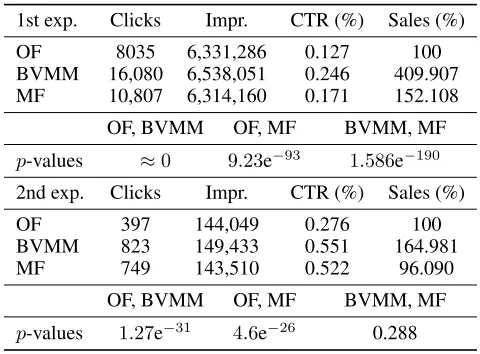
Table 1: Online experiments: Data andp-values.
1st exp. Clicks Impr. CTR (%) Sales (%)
OF 8035 6,331,286 0.127 100 BVMM 16,080 6,538,051 0.246 409.907 MF 10,807 6,314,160 0.171 152.108
OF, BVMM OF, MF BVMM, MF
p-values ≈0 9.23e−93 1.586e−190
2nd exp. Clicks Impr. CTR (%) Sales (%)
OF 397 144,049 0.276 100
BVMM 823 149,433 0.551 164.981 MF 749 143,510 0.522 96.090
OF, BVMM OF, MF BVMM, MF
p-values 1.27e−31 4.6e−26 0.288
7.1
First Experiment
The first experiment lasted from the 14th of March 2018 to the 1st of April 2018 and covered a total traffic made of ≈ 19,000,000 impressions of recommendations. Tab. 1 (top) gives the number of clicks with the CTRs in percent. The threep-values are computed through Fisher’s exact test for each pair of algorithm. The 0-hypothesis is that they have equivalent abilities to attract clicks. The three values are small enough to confirm that this is not the case: The BVMM triggers significantly more clicks than the two oth-ers, while MF surpasses OF.
Tab. 1 also shows the amount of post-view sales (given in percent of OF for reasons of confidentiality). The values represent the aggregates of the purchases made by the users after they have been shown recommendations for the cor-responding products within 24 hours. They should be inter-preted with caution, since recommendations can influence purchase decisions only indirectly, among many other fac-tors. The sample of sales registered during the experiments was also much smaller than the number of clicks, and ex-hibited a high variance. Additionally, the values may partly express the capacity of the recommenders toanticipatethe purchases, not necessarily the capacity tocausethem.
The mean time to generate one recommendation (Fig. 3, middle top) was 2.282 ms for OF, 1.946 ms for the BVMM and 4.39 ms for SSAGD. The BVMM and OF thus appear to lie in the same range of time-complexity, while MF, although still acceptably fast, is clearly slower.
7.2
Second Experiment
The second experiment was started on the 13th of March 2018 and ended on the 30th of the same month. The traffic (≈440,000impressions) and the number of clicks were sig-nificantly smaller than in the first experiment. Nevertheless, thep-values of Tab. 1 (bottom) confirm the superiority of the BVMM to attract clicks over OF. Although the BVMM still obtains a larger CTR, the comparison with MF is less sig-nificant. This might be due to the smaller number of prod-ucts (≈ 1000against ≈ 10,000), which makes the task of
predicting the right items easier and helps the less powerful algorithms. Although this is harder to quantify, the descrip-tions of the products supplied by the second company were also richer and more semantically expressive. This should favour a content-based recommender such as OF.
The differences in time-complexity follow a pattern sim-ilar to the first experiment, although they are less striking. The OF takes 1.014 ms on average to generate one recom-mendation, the BVMM, 0.831 ms and MF, 1.113 ms. The BVMM is still faster, as it was during the offline tests. De-spite the limitations of the post-recommendation sales as a metric, they also point to significant differences among the algorithms, already visible on a relatively small site.
8
Conclusions
We discussed the implementation, testing and online evalua-tion of two recommender systems for e-commerce based on a context-tree model and on sequential matrix-factorization. The tests showed the value of both the BVMM and SSAGD for predicting the behaviour of online users. The BVMM in particular achieves the best CTR while remaining quite efficient. It also clearly increases the sales following a rec-ommendation by up to four times.
This illustrates the importance of modeling the sequen-tial nature of user-preferences. Our sequensequen-tial adaptation of matrix factorization, SSAGD, doubles the accuracy in of-fline tests, while the explicit modeling of sequences by the BVMM increases accuracy even more. We believe that the importance of modeling sequences has been underestimated in the literature and that Markov models such as BVMM de-serve more attention. The present work also suggests that carrying live evaluations systematically would bring more valuable insights and benefits than usually thought.
Significant complexity issues occur in the training of the MF model, which requires a lot of memory, and we had to expend considerable efforts of optimization to avoid crashes. While this problem does not concern the recommendation complexity, as the training stage is run only periodically, it represents a big hurdle in practical settings. Similar issues are likely to arise with neural models, which are slow to train and involve large structures of nodes. Neither OF nor the BVMM manifested a similar weakness. The same diffi-culties have been observed by others and explain the limited adoption of these algorithms by the industry.
The BVMM thus ensures both an excellent performance and the necessary scalability for use on commercial web-sites. It has since then been integrated into Prediggo’s suite of algorithms and is offered to the customers as a standard recommendation strategy. Its performance on other web-shops, with catalogues of≈ 200,000products, and the sub-sequent A/B tests we carried, confirm the results discussed above. On the other hand, the memory issues that plague MF forced Prediggo to leave it out of its product for now.
9
Acknowledgments
References
Aciar, S.; Zhang, D.; Simoff, S.; and Debenham, J. 2007. Informed recommender: Basing recommendations on consumer product re-views.IEEE Intelligent Systems22(3):39–47.
Begleiter, R.; El-Yaniv, R.; and Yona, G. 2004. On prediction using variable order markov models.J. Artif. Int. Res.22(1):385–421. Bejerano, G., and Yona, G. 2001. Variations on probabilistic suffix trees: statistical modeling and prediction of protein families. Bioin-formatics17(1):23–43.
Bobadilla, J.; Ortega, F.; Hernando, A.; and Guti´errez, A. 2013. Recommender systems survey. Knowledge-Based Systems46:109 – 132.
Cantador, I.; Bellog´ın, A.; and Castells, P. 2008. Ontology-based personalised and context-aware recommendations of news items. InProceedings of the 2008 IEEE/WIC/ACM International Confer-ence on Web IntelligConfer-ence and Intelligent Agent Technology - Vol-ume 01, WI-IAT ’08, 562–565. Washington, DC, USA: IEEE Com-puter Society.
Cleary, J., and Witten, I. 1984. Data compression using adaptive coding and partial string matching.IEEE Transactions on Commu-nications32(4):396–402.
Dimitrakakis, C. 2010. Bayesian variable order markov models. In
JMLR.
Drumond, L., and Girardi, R. 2008. A survey of ontology learning procedures.WONTO427:1–13.
Frasincar, F.; Borsje, J.; and Levering, L. 2009. A semantic web-based approach for building personalized news services. Interna-tional Journal of E-Business Research (IJEBR)5(3):35–53. Funk, S. 2006. Netflix update: Try this at home, https://sifter.org/simon/journal/20061211.html.
Galves, A.; Galves, C.; Garc´ıa, J. E.; Garcia, N. L.; and Leonardi, F. 2012. Context tree selection and linguistic rhythm retrieval from written texts.Ann. Appl. Stat.6(1):186–209.
Garcin, F.; Faltings, B.; Donatsch, O.; Alazzawi, A.; Bruttin, C.; and Huber, A. 2014. Offline and online evaluation of news recom-mender systems at swissinfo.ch. InProceedings of the 8th ACM Conference on Recommender Systems, RecSys ’14, 169–176. New York, NY, USA: ACM.
Garcin, F.; Dimitrakakis, C.; and Faltings, B. 2013. Personalized news recommendation with context trees. InProceedings of the 7th ACM Conerence on Recommender Systems, RecSys ’13, 105–112. New York, NY, USA: ACM.
Hu, Y.; Koren, Y.; and Volinsky, C. 2008. Collaborative filtering for implicit feedback datasets. In2008 Eighth IEEE International Conference on Data Mining, 263–272.
IJntema, W.; Goossen, F.; Frasincar, F.; and Hogenboom, F. 2010. Ontology-based news recommendation. InProceedings of the 2010 EDBT/ICDT Workshops, EDBT ’10, 16:1–16:6. New York, NY, USA: ACM.
Juszczyszyn, K.; Kazienko, P.; and Musiał, K. 2010. Agent and Multi-agent Technology for Internet and Enterprise Systems. Berlin, Heidelberg: Springer Berlin Heidelberg. chapter Personal-ized Ontology-Based Recommender Systems for Multimedia Ob-jects, 275–292.
Koren, Y., and Bell, R. 2011.Advances in Collaborative Filtering. Boston, MA: Springer US. 145–186.
Koren, Y.; Bell, R.; and Volinsky, C. 2009. Matrix factorization techniques for recommender systems.Computer42(8):30–37. Koren, Y. 2008. Factorization meets the neighborhood: A multi-faceted collaborative filtering model. InProceedings of the 14th
ACM SIGKDD International Conference on Knowledge Discovery and Data Mining, KDD ’08, 426–434. New York, NY, USA: ACM. Lee, T.; Chun, J.; Shim, J.; and goo Lee, S. 2006. An ontology-based product recommender system for b2b marketplaces. Inter-national Journal of Electronic Commerce11(2):125–155. Oard, D., and Kim, J. 1998. Implicit feedback for recommender systems. Inin Proceedings of the AAAI Workshop on Recommender Systems, 81–83.
Paterek, A. 2007. Improving regularized singular value decom-position for collaborative filtering. InProc. KDD Cup Workshop at SIGKDD’07, 13th ACM Int. Conf. on Knowledge Discovery and Data Mining, 39–42.
Pearce, M., and Wiggins, G. 2003. An empirical comparison of the performance of ppm variants on a prediction task with monophonic music.
Pu, L., and Faltings, B. 2013. Understanding and improving rela-tional matrix factorization in recommender systems. In Proceed-ings of the 7th ACM Conference on Recommender Systems, RecSys ’13, 41–48. New York, NY, USA: ACM.
Quadrana, M.; Cremonesi, P.; and Jannach, D. 2018. Sequence-aware recommender systems.CoRRabs/1802.08452.
Ricci, F.; Rokach, L.; Shapira, B.; and Kantor, P. B. 2010. Recom-mender Systems Handbook. New York, NY, USA: Springer-Verlag New York, Inc., 1st edition.
Rissanen, J., and Langdon, G. G. 1979. Arithmetic coding. IBM Journal of Research and Development23(2):149–162.
Rissanen, J., and Langdon, G. 1981. Universal modeling and cod-ing.IEEE Transactions on Information Theory27(1):12–23. Rissanen, J. 1983. A universal data compression system. IEEE Transactions on Information Theory29(5):656–664.
Sarwar, B. M.; Karypis, G.; Konstan, J. A.; and Riedl, J. T. 2000. Application of dimensionality reduction in recommender system – a case study. InIN ACM WEBKDD WORKSHOP.
Schickel-Zuber, V., and Faltings, B. 2007. Oss: A semantic simi-larity function based on hierarchical ontologies. InProceedings of the 20th International Joint Conference on Artifical Intelligence, IJCAI’07, 551–556. San Francisco, CA, USA: Morgan Kaufmann Publishers Inc.
Schickel-Zuber, V. 2007.Ontology Filtering. Phd. thesis no 3934, Swiss Federal Institute of Technology (EPFL), Lausanne. Twardowski, B. 2016. Modelling contextual information in session-aware recommender systems with neural networks. In Pro-ceedings of the 10th ACM Conference on Recommender Systems, RecSys ’16, 273–276. New York, NY, USA: ACM.
Willems, F. M. J.; Shtarkov, Y. M.; and Tjalkens, T. J. 1995. The context-tree weighting method: basic properties. IEEE Transac-tions on Information Theory41(3):653–664.