ISSN: 2334-2986 (Print), 2334-2994 (Online) Copyright © The Author(s). All Rights Reserved. Published by American Research Institute for Policy Development DOI: 10.15640/jea.v3n1a15 URL: http://dx.doi.org/10.15640/jea.v3n1a15
Zero 2020, the Low Energy Retrofit and Renovation of a Precast Concrete Building in Ireland
Exploring site nZEB Energy Retrofit in Precast Grid Optimized Low Rise ‘60s Buildings
Marc O Riain
1, Dr. Jim Harrison
2, Dr Kevin McCarthney
3Abstract
This paper contextualizes the 1967 design of Regional Technical College (RTC) campuses in Ireland, with reference to the influence of oil crises on early green design and the establishment of a regulatory environment. Variation between NZEB and Passive House low energy strategies are discussed. Design Science and Action research inform solution-oriented methodologies in a pilot retrofit project on 1.5% area of an RTC building. Problem investigation notes previous schemes, stakeholder’s goals, building evaluation and energy performance diagnosis. Environment interaction between context and artifact are discussed. Design validation includes simulated envelope performances, which inform design iterations. Phenomena are evaluated in terms of energy performance during a critical time window. Findings from the design process of the pilot project are presented, outlining its limitations, scalability and commercialization potential.
Keywords-Component: Low energy, retrofit, precast concrete, energy performance
Introduction
Energy inefficient, pre-regulation, precast concrete buildings of the 1960s and ‘70s are found in high value conurbation locations across the UK and Ireland. Where aspects of legislative implementation encourage stakeholders to choose and implement low energy strategies by means of retrofit, occupied structures are challenged by occupancy related dislocation issues, impacting retrofit or replacement strategies. Although low energy replacement methodologies are well established, retrofit methodologies require further research (ASHRAE Vision 2020, 2008).1 In 2010 a cross-disciplinary research project at the Cork Institute of Technology set out to investigate and pilot a design to deliver a site nZEB performance through the retrofit of a 1967 designed precast grid optimized low-rise building. (Figure 1)
Figure 1: Zero2020 Pilot site nZEB Retrofit, Before and After (photos: O’Riain, O’Connell)
1
Department of Architecture, Cork Institute of Technology & Cork Centre for Architectural Education, UCC, Cork, Ireland. Email: [email protected]
2
Department of Architecture, Cork Institute of Technology & Cork Centre for Architectural Education, UCC, Cork, Ireland.
3
Context
Sustainable Architecture developed as a consequence of the green movement in the 1960s. Principally, authors like Carson and Lovelock informed the concept of ‘environmental sustainability’ in public discourse in the 1960s. During the 1973 oil crisis Schumacher offered an economic alternative called ‘sustainable development’ to a world over reliant on a reducing resource, fossil fuels. The Club of Rome (1972) highlighted the World’s diminishing resources and contrasted this with the population explosion. It also postulated a sustainable development feedback loop to mitigate resource depletion. These publications informed legislation governing building design and construction. However, the 1973/74 and 1979 oil crises raised public awareness of energy cost, in turn leading to built-environment legislative change in the UK, which would later inform Irish legislation. The first Zero-Energy House was designed and built by Vagn Korsgaard and Torben Esbensen in Copenhagen in 1974/75, yet the term Net Zero Energy Building (nZEB) still lacks international agreement. (Sartori 2010) 2
Early Green building design lacked a critical understanding of building physics. Early airtight envelopes featuring reduced air changes contributed to Sick Building Syndrome in 1980s green buildings.(McLennan, 2004)3 Sweden and Demark were amongst the first countries to introduce energy standards in construction in the 1980s (Killip 2005).4 Green design included solar architecture, solar power and wind energy in its early developments. The Passive House standard was established by Feist and Adamson in 1988, based on high insulation, zero thermal bridging, low air infiltration, Low U Value glazing and mechanical ventilation.(Passipedia 2013)5 Passive House offers both a benchmark and quantifiable performance in contrast to Green Architecture.
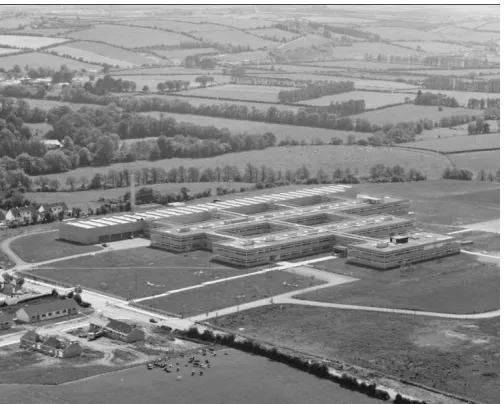
Figure 2: Existing Regional Technical College, Cork. Completed 1974
In 1992 Ireland first enforced national building regulations and in 1997 conservation of fuel in buildings was also regulated. Since the Kyoto Protocol 1997 subsequent EU legislative implements such as DIRECTIVE 2002/91/EC EPD 2002, and the Recast DIRECTIVE 2010/31/EU EPBD 2010, have advanced progressive national targets for energy conservation in buildings. Ireland has transposed some of the provisions of the EPBD 2010 into laws and regulations (for dwellings) and drafted amendments for TGDL 2008 amendments for non-dwellings. They have adopted a methodology for calculating energy in buildings, a definition of nearly zero energy building, the criteria for establishing a cost optimal approach and a roadmap to new Near Zero Energy buildings (nZEBs) by 2020, requiring the reduction of 20% GHGs and 20% energy efficiency saving (on 1990 levels). Although a code of practice for energy retrofit in existing dwellings has been drafted, there are no plans for non-domestic guidelines. New public authority buildings have to achieve near zero energy by 2018. ASHRAEs Vision 2020 report in 2008 highlighted a lack of research on low energy retrofit. This research reports on the existing performance of a precast concrete systemised building and the post retrofit perfotmance of a pilot nZEB retrofit.
Background
Faced with resistance from the University Colleges, the Minister opted to create a new tier of Technical Colleges along the lines of the Polytechnics in the UK, delivering vocationally oriented undergraduate programs, to be called Regional Technical Colleges (RTCs) (Figure 2). These new institutions required new accommodations quickly and in late 1966 the Minister handpicked a design team who had experience with the industrial system (through the design of the ‘Busaras’ Building in Dublin and the ‘Carroll’s’ Cigarette Factory in Dundalk).(Clerkin, 1996)6 The Minister envisioned a common design being rolled out on all sites with a common design team. However, political interference and outrage from regional professional, led to design team fragmentation and the creation of unique design teams at each of the various regional sites, with ARUP remaining the only common practice. The Minister limited the research and tender timeframe for the design team. The new design group, Building Design Associates, travelled to the M&M building (Figure 3) in Birmingham, deciding to use the principles of the tartan grid and modular structural tables for the RTC design. Returning to Ireland they originated an initial design for the Waterford Campus, and piloted test samples for quality.(McSweeney, 1974)7 At this point the design included quality interior finishes such as brick walls and parquet. This design was priced and presented to the funding organisation, the World Bank, and to the Irish Parliament. Again political infighting resulted in a value engineering exercise, and the elimination of quality internal materiality, delivering a 15% cost saving.
Figure 3: M&M Building, Birmingham University, by Phillip Dowson 1965 (Photo: O’Riain 2012)
Problem Investigation: Building Structure and Performance
The project was approved, and a roll out for the design of campuses at Carlow and Waterford proceeded. Subsequently, construction began at 9 sites in 1968/69, with the typology design varying in scale and layout at the different sites. However the core structural, exterior and mechanical design remained constant. The precast structure varied from site to site as co-casting the 4 corner posts compromised the individual table concept reduced flexibility. The non-structural internal walls were bespoke metric 100mm blocks (uncommon in a pre-metric Ireland), separating the 7.2m spaced precast posts, and in turn supporting a 9-panel tartan grid waffle slab with 25mm of Styrofoam, (now thermally drifting) as the sole envelope insulation. External walls had a 100mm block wall to sill, well-ventilated cavity (Part 5.3.3 EN ISO 6946:2007) and modular corrugated aggregate concrete panels to the exterior face with no insulation. The aggregate panels were 1200mm and 600mm panels, causing site warping due to the long spaces and 4 fixing points. Single-glazed milled aluminium modular windows sat on aluminium sills with 100mm opening restrictors, fixed into the cavity line. The lack of insulation (UA 2.4 W/m2K), a well ventilated cavity, modular aggregate panels and the window fixing point led to high winter heat losses, water ingress, condensation and mould growth in poorly ventilated locations from the outset.
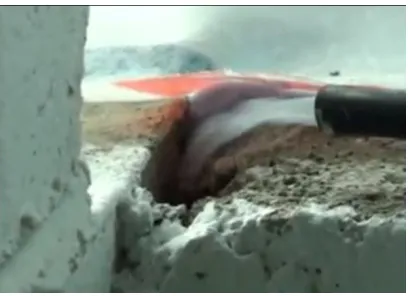
While this is just about adequate for some small offices it is completely inadequate for classrooms with high occupancy densities. The lack of automated control and the lack of a preheating regime (after an unoccupied Sunday) commonly caused radiant temperature asymmetry both in the building and locally in rooms, as heated water travelled around the radiator system. The amount of exposed thermal mass and high air infiltration caused nocturnal cooling of the structure. Winter Internal temperatures rarely achieved 18C before Wednesdays at 12am, with space overheating by Friday evenings as the thermal transmittance of the mass overheated the interior space along with the uncontrolled and constantly engaged heating system.(Figure 4) Academic timetables (September –May) result in high occupancy in the heating season and low occupancy in the cooling season. Cleaning regimes and occupant-related respiration and transpiration vapour to internal spaces caused high levels of room humidity leading to surface condensation, evidenced by black mould growth exposed during renovation. (Figure 5)
Figure 4: Temperature Control sample Room and Post Retrofit Zero2020 Perfornance Comparison (Delaney 2013)
Conversely, the structure’s high glazing factor of 1:1.7 (glazed: solid) causes overheating in the cooling season. Structural air infiltration does unintentionally contribute to nocturnal thermal mass cooling. However summer low occupancy, low wind speeds, and the manually operable window openings effectively reduce the ventilation rates (thus impacting convective heat dissipation). A lack of solar coatings on the plate glass windows contributes to high linear transmittance, while no effective shading mechanism results in high internal heat gains and temperature peaks internally above thermal comfort levels. The building envelope suffers from leaks, mastic decay and spalling.
Pilot Research Methodology
Cork RTC (now Cork Institute of Technology, CIT) where the pilot project (Zero2020) was instigated, is the largest and last common design RTC to be constructed (1974), thus benefiting from lessons learned at various other campuses (where ARUP were involved). Primary research was carried out at multiple other RTC campuses and specifically where renovations were carried out.
Figure 6: Mould Growth on Soffit of Roof Slab. (December 2011, Photo & Image: O’Riain 2012)
The mechancial engineering and architecture research teamadopted a combination of Design Science Methodology and Participatory Action Research in a ‘concrete phenomenalism’ or operation (Piaget 1970)10. In Action Research, the researchers can become active ‘actors’ in the design process, as opposed to independent observers. This offers the researchers the opportunity to gain from experiential learning.(Lewin, 1946)11 The researchers’ aim is to broaden knowledge of low energy retrofit, reflecting stage 1 of Piaget’s model for learning and cognitive development at the initial enactive stage, which is the starting point for action research. This model of design science and ‘action research’ encourages researchers to experiment through intervention and to reflect on the effects of their intervention, the implication of their theories.(Avison et al, 1999)12 The process of design science, which Bilandzic (2011)13 argues can be comfortably integrated with Action Research, is structured as;
Problem investigation,
Treatment design,
Design validation,
Treatment implementation
Implementation evaluation.
Figure 7: Design Science Research Model(Mark Bilandzic, John Venable, 2011)
Figure 8: Retrofit of O Fiaich College, Dundalk 2008. (Photo: Coady Architects)
Treatment Design: Pilot Project
Cork Institute of Technology occupies 24,000m2 of an existing two-storey 1974 precast concrete structure in 4 main 2-storey blocks. The building is low-rise grid optimised modular concrete structure, located in the south of Ireland with a temperate oceanic climate. The pilot project, which examined less than 1.0% of the original building footprint, aims to create a template for a phased full building retrofit; this has been split in 3 phases: Phase 1, the feature of this paper, involves external envelope upgrade and improvements to the energy demand systems; Phase 2 involves measurement and data collections. (For which there is initial reporting) and Phase 3, which involves the introduction of renewable energy systems on site to supplement low energy demand with non-fossil fuel sources. The target for the pilot project is a full calendar year at nearly zero site energy by 2020. The renovated space functions as a test bed for sustainable engineering and architectural research.
Figure 9: Zero2020 Retrofit External Cladding System (O’Riain 2011)
The metered thermal energy use of the existing building is 99 kWh/m2/yr (based on Natural Gas metered data) and the metered electrical energy use is 109 kwh/m2/yr. (2011 BMS metered data) The treatment design (figures 9 & 10) involved a locally-developed bespoke thermally broken curtain wall which featured thermal bridging mitigation, vastly improved air tightness and a natural ventilation solution that is scalable, modular and systemised to precast concrete grid optimised buildings. The retrofit methodology makes minimal structural changes to the existing envelope and all main components were retained as per client delimitations. Existing envelope junctions and service penetrations to the existing building required bespoke air-tightness solutions. In particular the existing well-ventilated cavity had to be isolated from the un-retrofitted structure.
Figure 10: Zero2020 Retrofit External Cladding build up (O’Sullivan, Delaney, O’Riain 2013)
The glazing system incorporates both ergonomically accessible manual and automated insulated opening door sections with external architectural fixed louvres to provide single sided ventilation (giving localised occupant control). Manually adjustable interstitial blinds provide reduced glare and incident solar radiation at low solar altitude angles. The BMS system controls a separate set of high level insulated doors to allow for background ventilation, controlled using a temperature monitoring strategy in summer months with the aim of promoting night purging of the structure. The glazing ratio is reduced from 1:1.7 (glazed: solid) to 1:4 (glazed: solid) significantly reducing solar gain without adversely affecting day lighting performance. A day lighting study was completed to support this decision to reduce the glazing ratio. G Factors are varied on glazing to the south, west and north elevations, in order to moderate solar heat gain. Space heat demand was met through passive gains, low heat loss and the balance supplemented by an isolated low temperature radiator system powered by a Air Source Heat Pump on the flat roof.
Design Validation: Pilot Project
The retrofit space was identified as it had Southwest and North exposed elevations, which could be compared against another baseline building with the similar envelope design and orientation. Control sensors were installed to monitor room temperature. Design validation included the establishment of existing building performance though billed energy, metered data from a BMS, and RET Screen Energy Modelling. Once a design strategy had been established, detailed surveying of the existing structure and pilot openings was undertaken to identify risk areas and confirm any variation in the structural design. IES simulation modelling is used to validate passive solar gains and shading strategies. Therm 6 modelling is used to simulate thermal bridging and U values are calculated for the building envelope and compared to Technical Guidance Documents (TGDL, 2008). Therm modelling informs iterative designs for building junctions and moderates the risk associated with thermal bridging heat loss. This modelling directly informs the design teams decision to insulate the cavity. WuFi is used to simulate hygroscopic transfer and contributes to the decision to choose a low-hygroscopic rain-screen.
Treatment Implementation: Pilot Project
Treatment implementation began in December 2011, after funding was secured and project tendered. The external retrofit element is limited to the inter-semester break with main structural interventions completed within 8 weeks. A pre-retrofit air-tightness test found the building infiltration to be 14.77 m3/ hr /m2@ 35pa. Enabling works included site preparation, pad foundations for the independent thermally broken curtain wall, which completed installation within 2 days. Quad glazed windows were installed in a day, replacing existing aluminium frames (which were recycled) minimising weathering risk. Cavity insulation took 5 hours, whilst monitored with thermal cameras for coverage consistency. Insulation panels and external surface composite cladding were installed over 1 week. A pre-completion air tightness test indicated a performance of 1.94 m3/ hr /m2, resulting in remedial localised sealing. Post interior completion (May 2012). Air tightness was measured at 1.74 m3/ hr /m2@ 50pa. Most internal block walls were retained and thermal mass exposed. Rooms varied in ceiling grid thermal mass exposure for field-testing purposes. An air source heat pump was installed connected to low temperature radiators and controlled by a BMS. Multiple environmental performance sensors were installed with proximity-controlled lighting. Post completion involved snagging and a period of commissioning issues.
Results
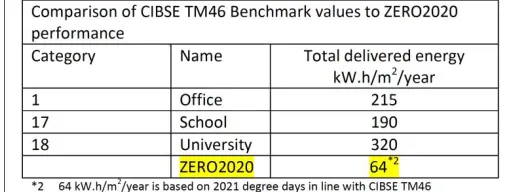
Initially a 5-week period spanning 18th February to 24th March 2013 indicated that for 81% of the time the internal air temperature lay within the 21-23oC comfort range. For 13% of the time the temperature was in the 23oC to 23.5oC range, marginally outside the comfort criteria. High air quality, as defined in EN 13779:2007, was achieved 33% of the time and medium air quality 34% of the time. After a year of free running, the Zero2020 measured energy consumption was 64 kW.h/m2/yr using CIBSE TM 46 methodology. A Building Energy Rating (BER) assessment was completed in order to assess whether the envelope upgrade has improved the asset rating for the footprint covered. The final BER rating was an A3 (pre-retrofit D2) with a delivered annual heating energy load of 6.5 kWh/m2/a(2013). The Heat Pump system had a primary energy consumption of 10.3 kWh/m2/a and the radiator pump consumed 5.7 kWh/m2/a.
Implementation Evaluation: Pilot Project
Following design implementation, reflective practice included recording daily implementation action. A time motion film of the construction process was recorded as part of dissemination, with a daily photographic record, and observation on Zero2020energy.com which provides a key portal for outreach. Data monitoring was initiated on successful completion of commissioning and snagging. A design team survey reflects on the design process. The design appears to be working well with high occupant satisfaction and low levels of thermal discomfort. Space heat demand has reduced by 90%, whilst electrical demand savings are more modest at 50%, possibly because low energy lighting upgrades made prior to retrofit reduced the potential for electrical energy savings. Unregulated electrical loads play a large role in occupant-related electrical energy demand. Passive House EnerPhit standards could not be met due to multiple existing internal wall service penetrations. Initial results would indicate that uncontrolled heat loss through passive ventilation grills does not adversely affect overall space heat demand. It could be possible to achieve Near Zero Energy Retrofit performance through supplemental on-site renewable. However, it is worth noting that renewable strategies should target electrical loads, and further electrical savings could be achieved by targeting the estimated 30% vampire and parasitic loads. Design team interaction, knowledge and fee-related time constraints can contribute to a compromised post occupancy performance, while limited commissioning of services and commissioning refinement, coupled with a lack of user operational knowledge of Building Management Systems can seriously compromise post occupancy energy performance. The pilot project was limited by budget and all not strategies could be accommodated. The size of the sample did not have sufficient scale to deliver significant capital savings in tendering. The air source heat pump was oversized to accommodate additional capacity in stage 2. Commissioning problems also delayed instrumentation data collection and the use of night purge cooling. Initial results do not represent a full year and an annual result may vary from initial findings.
Conclusions
The question of delivering Near Zero Energy Performance through the retrofit of a modular low-rise precast concrete building in Ireland has here been addressed though a design science research methodology involving an artefact or, in this case, a Pilot project. The results have proven positive but highlight areas for refinement. The solution is not limited to one building and is scalable to multiple similar applications; nor is is definitive so that other strategies and approaches might deliver better or worse results. However one thing is clear, the design team’s focus on regulated loads does not capture the total post occupancy energy demand, indicating that significant research is required in small device Load Management. Finding design strategies to address the energy performance gap is important in terms of achieving site nZEB.
Acknowledgment
References
ASHRAE. (2008). ASHRAE Vision 2020, producing Net Zero Energy Buildings. Technology, (January). Retrieved from
http://www.google.ie/url?sa=t&rct=j&q=&esrc=s&source=web&cd=1&ved=0CEwQFjAA&url=http://w ww.ashrae.org/File%20Library/docLib/Public/20080226_ashraevision2020.pdf&ei=Pm0JUIaiKun80QW5tr 2wCg&usg=AFQjCNGDKEt4gCFzo8CKWJ58a_d1TGSEhwTrans. Roy. Soc. London, vol. A247, pp. 529– 551, April 1955. (references)
Sartori, I., Napolitano, A., Marszal, A. J., Pless, S., & Torcellini, P. (2011). Criteria for Definition of Net Zero Energy Buildings.
McLennan, J. F. (2004). The Philosophy of Sustainable Design (pp. 28–29). Bainbridge Island WA: Ecotone. Killip, G. (2005). BUILT FABRIC & BUILDING REGULATIONS, 1–11.
Institute, P. H. (2013). Passive House Definition. Passapedia. Retrieved from
http://passipedia.passiv.de/passipedia_en/basics/the_passive_house_-_definition
Clerkin, P. (1996). Busaras_ The Plan and the modulor system - Irish Architecture Archiseek.pdf. Archiseek.
McSweeney, F. (1974, September). Regional Technical Colleges. IRIS, 2–6. Neary, S., & Ceng, B. E. M. B. A. (n.d.). Building Standards & Regulations.
O’Riain, O Driscoll, D. E. (2013). ‘The Impact of product use within the context of low energy use buildings. In All Ireland Architectural Research Group. Limerick. Retrieved from http://www.phai.ie/seethelight2012/ Kolb, D. A. (2006). Experiential learning : experience as the source of learning and development. New Jersey: Prentice
Hall.
Swann, C. (2002). Action Research and the Practice of Design. Design Issues, 18(1), 49–61. doi:10.1162/07479360252756287
Avison, D. E., Lau, F., Myers, M. D., & Nielsen, P. A. (1999). Action research. Communications of the ACM, 42(1), 94–97. doi:10.1145/291469.291479
Mark Bilandzic, J. V. (2011). Towards Participatory Action Design Research: Adapting Action Research and Design Science Research Methods for Urban Informatics. The journal of Informatics, 7(3). Retrieved from
http://ci-journal.net/index.php/ciej/article/view/786/804