Use of Synchronous Virtual Classrooms: Why, Who, and How?
Florence Martin Associate Professor
Department of Instructional Technology, Foundations, and Secondary Education University of North Carolina at Wilmington
Wilmington, NC 28403 USA [email protected]
Michele A. Parker Associate Professor
Department of Educational Leadership University of North Carolina at Wilmington
Wilmington, NC 28403 USA [email protected]
Abstract
Virtual classrooms allow students and instructors to communicate synchronously using features such as audio, video, text chat, interactive whiteboard, and application sharing. The purpose of the study reported in this paper was to identify why instructors adopt synchronous virtual classrooms and how they use them after their adoption. An electronic survey was administered asking instructors from various institutions to describe their experience adopting a synchronous virtual classroom in either a blended or online course. In describing their reasons for adopting the technology, respondents most frequently cited institutional resource availability, increasing social presence, enhancing student learning, and the availability of technology. Along with audio chat, the features that most influenced the adoption of virtual classrooms and were used most frequently by respondents were the ability to archive conference sessions, see participants through webcams, and use text-based chat interfaces. Open-ended survey responses revealed that instructors used virtual classrooms to promote interactivity, develop community, and reach students at different locations. There were also distinct trends characterizing the demographics of faculty members who reported using virtual classrooms. These findings provide meaningful data for instructors interested in providing synchronous components in their online teaching and for administrators interested in promoting technology-enhanced learning on their campuses.
Keywords: synchronous, virtual classroom, web conferencing, technology adoption, technology uptake, technology use
Introduction
components to their online teaching or administrators interested in promoting technology-enhanced learning on their campuses.
What are Synchronous Virtual Classrooms?
Synchronous virtual classrooms are commonly known as web-conferencing or e-conferencing systems (Rockinson-Szapkiw & Walker, 2009). These systems allow real time communications in which multiple users can simultaneously interact with each other via the Internet to conduct meetings and seminars, lead discussions, make presentations and demonstrations, and perform other functions. Virtual classrooms allow students and instructors to communicate synchronously using features such as audio, video, text chat, interactive whiteboard, application sharing, instant polling, emoticons, and breakout rooms. Adobe Connect, Blackboard Collaborate, WebEx, and Saba Centra are synchronous virtual classrooms prevalent in higher education. Elluminate Live! and Horizon Wimba Classroom were commonly used in higher education before they were purchased by Blackboard.
The features available in a synchronous virtual classroom help the instructor in maintaining interaction during a synchronous session. Martin, Parker, and Deale (2012) studied the importance of interaction within a synchronous virtual classroom. Their results suggested that live communication in a synchronous virtual classroom definitively enhanced interaction. Most virtual classroom technologies have a content frame to share the instructor's files, an electronic/interactive whiteboard for instructors and students to write or draw, breakout rooms for group activities, text chat to interact using words and emoticons, and audio chat to talk via a microphone or telephone with the instructor and other students. Instructors can administer student polls, share their desktop, or have the students share their own desktops through application sharing. Websites can be displayed for students, and, with stable Internet bandwidth, webcams can be used so students and instructors can see each other. The entire virtual classroom session can be archived for later use. In recent versions, students can also download archived class sessions. In some cases, students with audio difficulties can dial in using pre-established telephone numbers. Instructors can even call on students to use the electronic/interactive whiteboard, share their webcam, or speak via the microphone. Cook, Annetta, Dickerson, and Minogue (2011) supported the use of synchronous audio chat and text chat in their study. LaPointe, Greysen, and Barrett (2004) found that audio and visual components in synchronous systems help to bridge cultural differences and create communities of practice.
Reushle and Loch (2008) concluded from their research that web conferencing software enabled instructors and students to engage actively from various locations. In their study, postgraduate education students were connected globally in order to collaborate and communicate via audio, text, video, and shared whiteboard. Reushle and Loch's research also supported web conferencing technology as a student-centered approach that offered more flexibility for student participation. Further, Spann (2012) recommended using virtual classroom technology to combine on-campus and online students in the same synchronous session. As research in the realm of synchronous virtual classrooms improves, the potential reach and effectiveness of this technology increases and offers learners opportunities that are not always available face-to-face (F2F).
Why Synchronous Virtual Classrooms?
Cao, Griffin, and Bai (2009) suggested that synchronous interaction effectively raises student satisfaction. In addition, Motteram (2001) stated that "synchronous tools are more effective for the 'social' side of education" (p. 131). Park and Bonk (2007) listed the major benefits of using a synchronous virtual classroom as: providing immediate feedback, encouraging the exchange of multiple perspectives, enhancing dynamic interactions among participants, strengthening social presence, and fostering the exchange of emotional supports and supplying verbal elements. Lietzau and Mann (2009) found synchronous web-conferencing to be an "enhancement to learning in the online environment" (p. 116). Students believed they learned more and earned higher marks when engaged in synchronous classrooms, which offer them an increased opportunity to interact with faculty and other students (Lietzau & Mann, 2009).
synchronous e-learning and found that in synchronous communication, it was possible to monitor the receiver's reaction to a message, which therefore increases arousal and motivation in the learner. He concluded that synchronous e-learning better supported learners by providing them with social support.
Additionally, synchronous virtual classrooms have an advantage over traditional courses during lecturing. During an interactive synchronous lecture, students can type questions and comments without interrupting the presenter. These questions benefit the students asking them as well as the entire class because every student can see the questions. This builds critical thinking skills by causing them to reflect on the questions and posit answers to them for themselves. It can also draw their attention to material they missed and provide information when the question is answered. Text comments additionally allow students to see the learning status of their peers and gauge their learning comparatively (Marjanovic, 1999). However, this does require the instructor to multitask by monitoring the text chat or being present in the virtual classroom; not every instructor may be capable of multitasking in this manner. According to Marjanovic (1999), students involved in virtual classrooms improved their problem solving skills, critical thinking, and written communication skills. Synchronous virtual classrooms seem as effective as traditional F2F classrooms in meeting the needs of varying levels and types of students, making them a viable and logical choice for the future of education.
Faculty using synchronous virtual classrooms employ a variety of techniques to motivate and instruct students. Clark (2005) posits four routes to engaging online learners: maintain a lively pace, visualize the content, incorporate frequent participant responses, and use small group break-out rooms. His research also proved that shorter time lengths for classes, such as 60 to 90 minutes, yielded better student perceptions and engagement in material than multiple hour-length sessions.
How are Synchronous Virtual Classrooms Used?
Finkelstein (2006) listed five functions that are served by real-time synchronous interaction in a learning environment: instruction, collaboration, support, socialization and informal exchange, and extended outreach. Synchronous virtual classrooms are therefore used in a variety of ways by instructors across the world. Aydin (2008) found that Turkish adult learners mainly had positive attitudes towards online course application through the "visi-class" program, which might be perceived as their willingness and readiness to include technology into language, as exemplified through the online course applications in a distance-mode English Language teacher training program in Turkey. A study by Carbonaro et al. (2008) showed no differences in students' abilities to learn collegiality and teamwork skills between F2F and blended learning environments with synchronous virtual meetings, while using Elluminate Live! as a synchronous tool to develop inter-professional team process skills in health sciences.
Wang (2004) examined the potential of Internet-based desktop video-conferencing in facilitating oral and visual interaction and the results strongly supported the use of videoconferencing for the provision of oral-visual interaction using Microsoft NetMeeting in Language Learning. LaPointe et al. (2004) studied the use of a synchronous audio tool (Speak2Me) for teaching English as a Second Language (ESL) in Taiwan. They found that the audio and visual technology driving the Speak2Me synchronous method of teaching ESL helped to bridge cultural differences and establish tightly knit communities of practice better than asynchronous distance education methods. Shi (2010) investigated the relationship between and among teacher moderating variables and student engagement variables using the LearningByDoing platform. Their analyses showed that both the number of teacher postings and the quality of teacher moderating levels had a significant effect on student intellectual engagement.
Ng (2007) studied the effects of Interwise for online tutoring at The Open University of Hong Kong. Students and tutors were positive about using Interwise for online tutoring. Student–teacher interaction and student–content interaction were both perceived as successful through this platform. Meanwhile, Little, Passmore, and Schullo (2006) researched the use of Elluminate Live! by a group of nursing students. Their study found that learning experiences using synchronous tools improved communication among the nursing students. They reported high levels of satisfaction with the course, as well as strong group cohesion.
Purpose of the Present Study
1) Why are instructors adopting and using synchronous virtual classrooms?
2) Is there an association between the demographic characteristics (e.g., gender, age, rank/position) of faculty and the factors that influence the adoption and use of synchronous virtual classrooms?
3) How often do instructors use the features of synchronous virtual classrooms?
4) How are instructors using the synchronous virtual classroom features?
The results of this study provide meaningful information for instructors considering the addition of synchronous components for their online teaching and for administrators interested in promoting technology-enhanced learning on their own campuses.
Method
Higher education instructors who use synchronous virtual classrooms were invited to participate in a survey via two specific listservs (ITForum and a University listserv) and two LinkedIn groups ("Technology Using Professors" and "Online Faculty"). An e-mail with a hyperlink to the survey and a brief message about its purpose was sent to both the two listservs and the two LinkedIn groups. The online survey was administered using SelectSurvey. Faculty members were informed that their participation was voluntary and anonymous. Data were collected in Fall 2011 and Spring 2013. In all, 79 faculty members successfully responded and completed the survey.
Framework for Adoption Factors
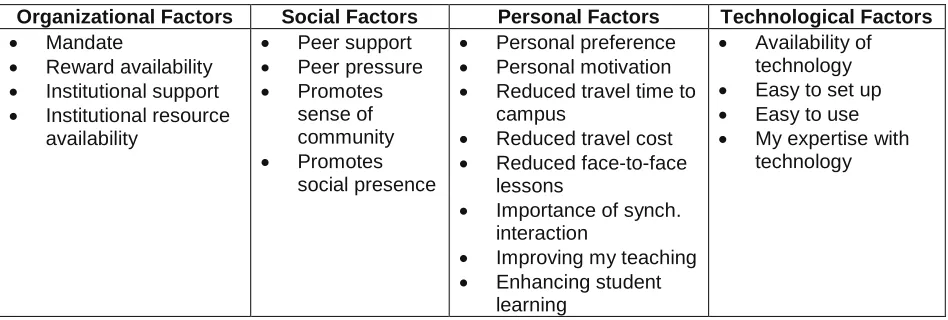
A review of the literature on technology adoption and use was conducted (e.g., Phan & Daim, 2011; Yen, Wu, Cheng, & Huang, 2010). Based on the model used by Yen et al. (2010), factors that may influence the adoption and use of virtual classrooms were identified and used to construct survey questions. Upon completion, the researchers grouped the survey items into four categories: organizational, personal, social, and technological. See Table 1 for a list of the adoption factors, organized under these four headings.
Table 1. Adoption factors
Organizational Factors Social Factors Personal Factors Technological Factors
• Mandate
• Reward availability • Institutional support • Institutional resource
availability
• Peer support • Peer pressure • Promotes
sense of community • Promotes
social presence
• Personal preference • Personal motivation • Reduced travel time to
campus
• Reduced travel cost • Reduced face-to-face
lessons
• Importance of synch. interaction
• Improving my teaching • Enhancing student
learning
• Availability of technology • Easy to set up • Easy to use • My expertise with
technology
Description of Survey
conducted to determine instruction accuracy, word choice precision, and scale. Since there were no revisions to the survey, the data from the pilot study were also included in this study.
The survey was administered again in Spring 2013. Data were analyzed using IBM SPSS Statistics version 19, and descriptive and inferential statistics were reported. In order to determine if the survey was reliable, internal consistency reliability was used. Cronbach's coefficient alpha for organizational factor (four items) is .71, social factor (four items) is .69, personal factor (eight items) is .73, and technological factor (four items) is .71. A Cronbach's coefficient alpha of .70 is the social science standard (Nunnally, 1978).
Survey Respondent Profile
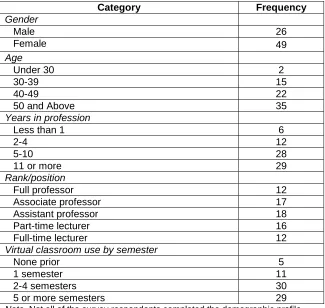
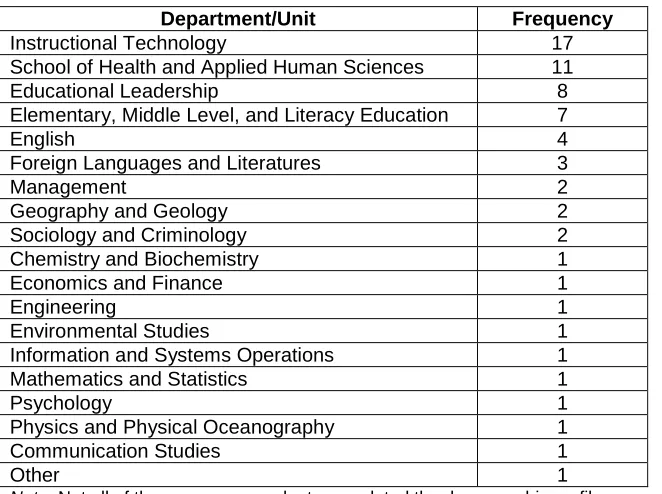
Table 2 presents the profile of the 79 participants who responded to the survey. Most of the respondents were female (n = 49) and the majority (n = 57) had more than 4 years of experience teaching. Respondents were at different ranks (18 assistant professors, 17 associate professors, 12 full professors, 12 full-time lecturers, and 16 part-time lecturers) and most of them had been using virtual classroom technology for at least two semesters (n = 59). The respondents varied in terms of their academic unit, with most of the subjects in Education, ranging from Instructional Technology and Educational Leadership as well as Elementary, Middle Level, and Literacy Education (n = 32), while many of the other respondents were in the School of Health and Applied Human Sciences (n = 11), which can be seen in Table 3.
Table 2. Demographic profile of the respondents and prior virtual classroom use
Category Frequency
Gender
Male 26
Female 49
Age
Under 30 2
30-39 15
40-49 22
50 and Above 35
Years in profession
Less than 1 6
2-4 12
5-10 28
11 or more 29
Rank/position
Full professor 12
Associate professor 17
Assistant professor 18
Part-time lecturer 16
Full-time lecturer 12
Virtual classroom use by semester
None prior 5
1 semester 11
2-4 semesters 30
5 or more semesters 29
Note. Not all of the survey respondents completed the demographic profile.
Table 3. Survey respondents by academic unit
Department/Unit Frequency
Instructional Technology 17
School of Health and Applied Human Sciences 11
Educational Leadership 8
Elementary, Middle Level, and Literacy Education 7
English 4
Foreign Languages and Literatures 3
Management 2
Geography and Geology 2
Sociology and Criminology 2
Chemistry and Biochemistry 1
Economics and Finance 1
Engineering 1
Environmental Studies 1
Information and Systems Operations 1
Mathematics and Statistics 1
Psychology 1
Physics and Physical Oceanography 1
Communication Studies 1
Other 1
Note. Not all of the survey respondents completed the demographic profile.
Table 4. Synchronous virtual classroom platforms used by respondents
Tool Frequency
Horizon Wimba 27
WebEx 20
Adobe Connect 12
Moodle's virtual classroom 7
Elluminate Live! 6
Pearson iLRn 1
JoinNet 1
LifeSize 1
Lingweb 1
Chisimba 1
Note. Not all of the survey respondents completed the demographic profile.
Results
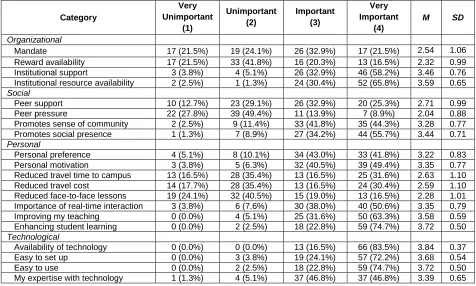
Research Question 1: Why Are Instructors Adopting and Using Synchronous Virtual Classrooms?
Table 5. Factors that influenced faculty adoption and use of the synchronous virtual classroom
Category
Very Unimportant
(1)
Unimportant (2)
Important (3)
Very Important
(4)
M SD
Organizational
Mandate 17 (21.5%) 19 (24.1%) 26 (32.9%) 17 (21.5%) 2.54 1.06
Reward availability 17 (21.5%) 33 (41.8%) 16 (20.3%) 13 (16.5%) 2.32 0.99
Institutional support 3 (3.8%) 4 (5.1%) 26 (32.9%) 46 (58.2%) 3.46 0.76
Institutional resource availability 2 (2.5%) 1 (1.3%) 24 (30.4%) 52 (65.8%) 3.59 0.65
Social
Peer support 10 (12.7%) 23 (29.1%) 26 (32.9%) 20 (25.3%) 2.71 0.99
Peer pressure 22 (27.8%) 39 (49.4%) 11 (13.9%) 7 (8.9%) 2.04 0.88
Promotes sense of community 2 (2.5%) 9 (11.4%) 33 (41.8%) 35 (44.3%) 3.28 0.77
Promotes social presence 1 (1.3%) 7 (8.9%) 27 (34.2%) 44 (55.7%) 3.44 0.71
Personal
Personal preference 4 (5.1%) 8 (10.1%) 34 (43.0%) 33 (41.8%) 3.22 0.83
Personal motivation 3 (3.8%) 5 (6.3%) 32 (40.5%) 39 (49.4%) 3.35 0.77
Reduced travel time to campus 13 (16.5%) 28 (35.4%) 13 (16.5%) 25 (31.6%) 2.63 1.10
Reduced travel cost 14 (17.7%) 28 (35.4%) 13 (16.5%) 24 (30.4%) 2.59 1.10
Reduced face-to-face lessons 19 (24.1%) 32 (40.5%) 15 (19.0%) 13 (16.5%) 2.28 1.01
Importance of real-time interaction 3 (3.8%) 6 (7.6%) 30 (38.0%) 40 (50.6%) 3.35 0.79
Improving my teaching 0 (0.0%) 4 (5.1%) 25 (31.6%) 50 (63.3%) 3.58 0.59
Enhancing student learning 0 (0.0%) 2 (2.5%) 18 (22.8%) 59 (74.7%) 3.72 0.50
Technological
Availability of technology 0 (0.0%) 0 (0.0%) 13 (16.5%) 66 (83.5%) 3.84 0.37
Easy to set up 0 (0.0%) 3 (3.8%) 19 (24.1%) 57 (72.2%) 3.68 0.54
Easy to use 0 (0.0%) 2 (2.5%) 18 (22.8%) 59 (74.7%) 3.72 0.50
My expertise with technology 1 (1.3%) 4 (5.1%) 37 (46.8%) 37 (46.8%) 3.39 0.65
Of the 79 respondents, 56 (70.9%) indicated that the features of the virtual classroom influenced their adoption of the technology. Of the 79, a majority said that archiving the session (59.5%), audio chat (54.4%), and text chat (48.1%) were the features that most influenced their adoption. Emoticons (16.5%) were reported as having the least influence on faculty adoption of virtual classrooms. See Table 6.
Table 6. Features in the virtual classroom that influenced faculty adoption
Feature Frequency
Archiving the session 56 (70.9%)
Viewing the webcam 47 (59.5%)
Text chat 43 (54.4%)
Audio chat 38 (48.1%)
Sharing web links 33 (41.8%)
Guest access 33 (41.8%)
E-board 33 (41.8%)
Polling 30 (38.0%)
Listening to the audio via phone 28 (35.4%)
Downloading the archive 27 (34.2%)
Hand-raising 26 (32.9%)
Application sharing 25 (31.6%)
Breakout rooms 18 (22.8%)
Emoticons 13 (16.5%)
Research Question 2: Is there an association between demographic characteristics of faculty and factors that influence adoption and use of synchronous virtual classrooms?
and very important into one response. The new variables were used in the cross tabulations. Inferential statistics are not reported due to low cell counts and the lack of statistical significance when using the Bonferroni correction for multiple tests. The following summary focuses on trends that relate to the importance of influences rather than what was deemed by respondents to be unimportant.
In summary, more female than male faculty said the organizational, social, personal (with the exception of reduced travel time), and technological items were important in their adoption and use of virtual classrooms. In general, faculty aged 40 and above indicated the organizational, social, personal (with the exception of reduced travel time), and technological items were important. Several exceptions included peer pressure, which faculty below 30 to age 49 thought to be an important influence compared to their older counterparts. More faculty aged 50 and above stated personal preference (46.0%) and reduced F2F lessons (37.5%) were important when compared to other colleagues.
In terms of virtual classroom experience, those with two or more semesters of experience reported the importance of the organizational, social, personal, and technological items more than individuals with one semester of experience. Overall, more faculty with 2 to 4 years of virtual classroom experience said these items were important when compared to those with less or more experience. When compared to groups with different years of professional experience, faculty with 5 to 10 years of experience were the majority in reporting the importance of the organizational, social, personal, and technological items.
More assistant professors thought the organizational, social, personal, and technological items were important in contrast to colleagues of other ranks or positions. More part-time lecturers responded that personal preference (25%) and reduced travel cost (24.2%) were important, whereas more full-time lecturers responded that reduced travel time (23.5%) was important in comparison to other faculty. More part-time lecturers (22.55%) and associate professors (22.5%) said the adoption and use of virtual classroom technology was important to improve their teaching compared to groups of other ranks and position. More associate professors said ease of setup (23.3%) and expertise with technology (24.3%) were important. Assistant and associate professors, 23.0% respectively, said ease of use was important in virtual classroom adoption and use. Interpretation of the results on the association between demographic characteristics and variables investigated is provided in the Discussion section. Additional details for the association between the demographic characteristics of faculty and the variables under investigation are available from the authors upon request.
Research Question 3: How Often Do Instructors Use the Features of Synchronous Virtual Classroom?
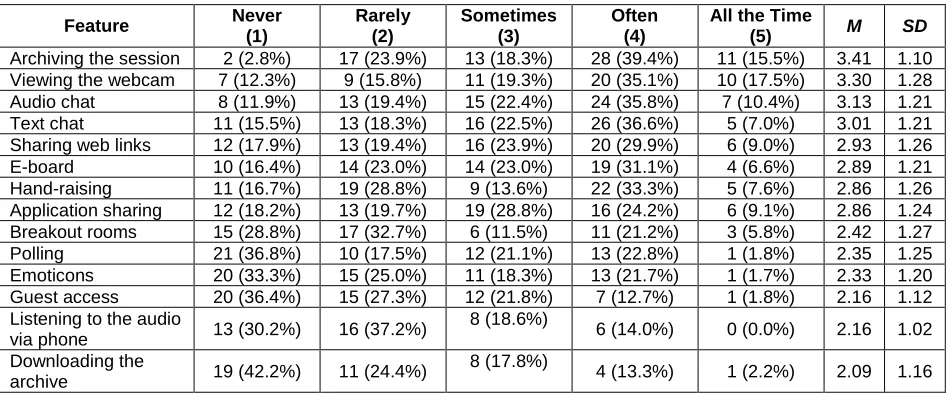
Faculty were asked about the frequency of using synchronous virtual classroom features. Using a Likert scale ranging from 1 (never) to 5 (all the time), archiving the virtual classroom session was the most frequently used feature (M = 3.41), followed by viewing the webcam (M = 3.30), and audio chat (M = 3.13). Listening to the audio via phone (M = 2.16), guest access (M = 2.16), and downloading the archive (M = 2.09) were the least used features unanimously. See Table 7. Interpretation of these results is included in the Discussion section.
Table 7. Respondents' frequency of use of virtual classroom features
Feature Never
(1)
Rarely (2)
Sometimes (3)
Often (4)
All the Time
(5) M SD
Archiving the session 2 (2.8%) 17 (23.9%) 13 (18.3%) 28 (39.4%) 11 (15.5%) 3.41 1.10 Viewing the webcam 7 (12.3%) 9 (15.8%) 11 (19.3%) 20 (35.1%) 10 (17.5%) 3.30 1.28 Audio chat 8 (11.9%) 13 (19.4%) 15 (22.4%) 24 (35.8%) 7 (10.4%) 3.13 1.21 Text chat 11 (15.5%) 13 (18.3%) 16 (22.5%) 26 (36.6%) 5 (7.0%) 3.01 1.21 Sharing web links 12 (17.9%) 13 (19.4%) 16 (23.9%) 20 (29.9%) 6 (9.0%) 2.93 1.26 E-board 10 (16.4%) 14 (23.0%) 14 (23.0%) 19 (31.1%) 4 (6.6%) 2.89 1.21 Hand-raising 11 (16.7%) 19 (28.8%) 9 (13.6%) 22 (33.3%) 5 (7.6%) 2.86 1.26 Application sharing 12 (18.2%) 13 (19.7%) 19 (28.8%) 16 (24.2%) 6 (9.1%) 2.86 1.24 Breakout rooms 15 (28.8%) 17 (32.7%) 6 (11.5%) 11 (21.2%) 3 (5.8%) 2.42 1.27 Polling 21 (36.8%) 10 (17.5%) 12 (21.1%) 13 (22.8%) 1 (1.8%) 2.35 1.25 Emoticons 20 (33.3%) 15 (25.0%) 11 (18.3%) 13 (21.7%) 1 (1.7%) 2.33 1.20 Guest access 20 (36.4%) 15 (27.3%) 12 (21.8%) 7 (12.7%) 1 (1.8%) 2.16 1.12 Listening to the audio
via phone 13 (30.2%) 16 (37.2%)
8 (18.6%)
6 (14.0%) 0 (0.0%) 2.16 1.02
Downloading the
archive 19 (42.2%) 11 (24.4%)
8 (17.8%)
Research Question 4: How are Instructors Using the Synchronous Virtual Classroom Features?
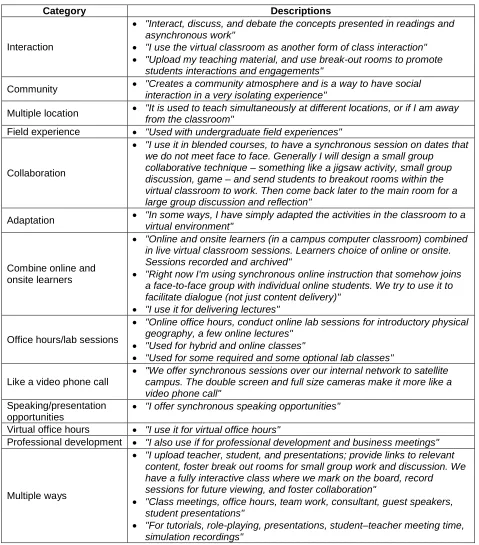
Instructors primarily use the virtual classroom to facilitate instructor–student and student–student dialogue. In each case, the virtual classroom was used for instructional purposes, such as the delivery of course content or conducting office hours. The various purposes were categorized according to a categorical schema developed inductively. For instance, instructors used virtual classroom technology to promote interactivity, develop community, and reach students at different locations. Table 8 provides direct quotes on how respondents use virtual classrooms.
Table 8. Faculty describe their use of virtual classrooms
Category Descriptions
Interaction
• "Interact, discuss, and debate the concepts presented in readings and asynchronous work"
• "I use the virtual classroom as another form of class interaction" • "Upload my teaching material, and use break-out rooms to promote
students interactions and engagements"
Community • "Creates a community atmosphere and is a way to have social interaction in a very isolating experience"
Multiple location • "It is used to teach simultaneously at different locations, or if I am away from the classroom"
Field experience • "Used with undergraduate field experiences"
Collaboration
• "I use it in blended courses, to have a synchronous session on dates that we do not meet face to face. Generally I will design a small group
collaborative technique – something like a jigsaw activity, small group discussion, game – and send students to breakout rooms within the virtual classroom to work. Then come back later to the main room for a large group discussion and reflection"
Adaptation • "In some ways, I have simply adapted the activities in the classroom to a virtual environment"
Combine online and onsite learners
• "Online and onsite learners (in a campus computer classroom) combined in live virtual classroom sessions. Learners choice of online or onsite. Sessions recorded and archived"
• "Right now I'm using synchronous online instruction that somehow joins a face-to-face group with individual online students. We try to use it to facilitate dialogue (not just content delivery)"
• "I use it for delivering lectures"
Office hours/lab sessions
• "Online office hours, conduct online lab sessions for introductory physical geography, a few online lectures"
• "Used for hybrid and online classes"
• "Used for some required and some optional lab classes"
Like a video phone call
• "We offer synchronous sessions over our internal network to satellite campus. The double screen and full size cameras make it more like a video phone call"
Speaking/presentation opportunities
• "I offer synchronous speaking opportunities"
Virtual office hours • "I use it for virtual office hours"
Professional development • "I also use if for professional development and business meetings"
Multiple ways
• "I upload teacher, student, and presentations; provide links to relevant content, foster break out rooms for small group work and discussion. We have a fully interactive class where we mark on the board, record sessions for future viewing, and foster collaboration"
• "Class meetings, office hours, team work, consultant, guest speakers, student presentations"
Discussion
There was a cross-section of respondents in terms of rank, age, and years in the profession. More female faculty responded to the survey, while over half of the entire sample had 5 or more years of experience in the profession and were over 40 years old. Most respondents in this study were from either professional schools or the arts and sciences. Of the latter, the English department was the next most prominent in terms of representation. In comparison to Yohon and Zimmerman (2006), the sample in the present study was more balanced across academic units. Education and health related faculty, who teach courses for students interested in specific careers may be inclined to use virtual classrooms because of the helping nature of these professions, which require interaction with individuals or groups.
Adoption and Use of Virtual Classrooms
In terms of organizational factors, institutions played a large role in adoption through support and resource availability. The technology resource availability and technology support provided were rated high in this category. The organizational factors and technology factors correspond with each other at the institutional level and specifically to the technology adopted. The present study's findings are consistent with those of Baia (2009), who reported that "faculty are committed to acquiring, maintaining, and changing their knowledge as they continue to teach and as new instructional technologies surface" (p. 28). Each of the items categorized as technological factors on the survey were deemed important. Ease of set up and use are important in the acceptance and use of new technologies (van Raaij & Schepers, 2008). If instructors are aware of the ease in which virtual classrooms can be set up and used, they may be more inclined to use this technology to carry out online instruction more effectively.
The availability of technology and expertise with technology also play an important role for faculty adopting virtual classroom technology. However, the synchronous virtual classroom is an easy-to-use tool, and requires minimal training for instructors to begin using. With regard to social factors, peer support and the ability to promote a sense of community were important. In contrast to the organizational and social factors, personal factors were more inclined to influence faculty to adopt synchronous virtual classrooms. For instance, the desire to enhance student learning, improve one's teaching, acknowledge the value of synchronous interaction, and respond to personal motivation were rated as very important. Loch and Reushle (2008) explained that it is important for synchronous technology not to be adopted for the sake of adopting and using technology but because the benefits and pedagogical implications of using it are clearly made aware to the instructors who are adopting them. The personal factors, such as improving one's teaching, enhancing student learning, and improving one's teaching, all address this.
Comparisons were made of how faculty viewed the importance of the organizational, social, personal, and technological items in relation to their demographic characteristics. Like Yohon and Zimmerman (2006), there were distinct differences by demographics among faculty. However, in Yohon and Zimmerman's study, they sought a systematic random sample of their faculty and received 306 completed surveys about adopting information technologies in general. They found statistically significant differences for gender and not for other demographic characteristics, such as the comparison between tenured and tenure track faculty. In this study, the focus is virtual classrooms, and there were 79 respondents. There were differences by gender, age, academic rank and position (professor versus lecturer), years of professional experience, and semesters spent using virtual classrooms in relation to faculty's adoption of virtual classrooms. For instance, mandate at the university, institutional support, institutional resource, promoting social presence, easy to set up, and expertise with technology were more important to female than male instructors. Female instructors also rated a number of personal factors (motivation, reducing travel time/cost, improving teaching, and enhancing student learning) as important in their decision to adopt virtual classrooms.
Based on the results of this study, the following are a few ways to increase synchronous virtual classroom adoption:
1) Provide support for the instructors and students and provide access to synchronous virtual classrooms.
2) Conduct workshops demonstrating the ease of use and set up of synchronous virtual classrooms.
3) Have faculty experts on synchronous virtual classroom technology present/conduct workshops on the use of synchronous virtual classrooms.
4) Advertise to the faculty how synchronous virtual classrooms can contribute to personal factors such as reducing travel time/cost, improving teaching, and enhancing student learning.
5) Have peer support groups available for faculty. This can include separate groups by gender, since female faculty rated personal factors much higher than male faculty.
Use of Virtual Classroom Features
Archiving the session, viewing the webcam, and text chat were features that most influenced virtual classroom adoption (Table 6). Meanwhile, archiving the session, viewing the webcam, audio chat, and text chat were the virtual classroom features used most frequently in the order presented (Table 7). These features, well supported by the extant literature, are often used to enhance student learning. Cook et al. (2011) supported the use of synchronous audio chat and text chat. In some instances, text chat is recommended over audio chat for student learning. Text chat and audio chat are helpful for students to receive immediate feedback from the instructor and their classmates. LaPointe et al. (2004) found that audio and visual technology in synchronous virtual classroom systems bridged cultural differences and created communities of practice. Pattillo (2007) found that synchronous audio conferencing increased communication between instructor and students. Studies have also reported that audio quality is the most critical factor for virtual conferencing (Jennings & Bronack, 2001).
Archiving enables students and instructors to capitalize on various facets of online instruction, including the ability to interact live and record presentations in advance or during live sessions (Martin et al., 2012). Additionally, making recorded course material accessible allows students to review content asynchronously, thus enhancing student understanding and learning. Although there was more variation among the responses about the frequency of using virtual classroom features, this can be due to a variety of factors, such as motivation and target audience. For instance, if virtual conferencing is used for teaching regular university students, the audio and chat features are sufficient. If virtual classroom technology is used solely for distant learners then perhaps more features should be used. Use of the features also depends on instructor familiarity with the features, personal comfort, and the discipline being taught or learned. Additionally, the teaching methods of professors using virtual classrooms may differ.
Cook et al. (2011) believed that audio and text chat features promote interaction, community, and collaboration. Researchers Aydogan, Karakas, Aras, and Ozudogru (2011) stated that learners can access educational materials and interact with each other even when the educator is unavailable, furthering the opportunities for synchronous distance education. Sternberger, Deal, and Fountain (2011) as well as Alexander, Higgison, and Mogey (1999) highlighted that virtual classrooms allow experts to enter the classroom from anywhere in the world, which makes it possible for people to connect from different parts of the globe. This reinforces the idea that virtual classrooms have multiple uses, such as the ability to be accessed simultaneously from different locations, as a tool for collaboration and video calls, and as a platform to deliver and retrieve online lectures.
Implications and Recommendations for Practice
is meant to enhance interaction in online courses; the data in this study recommended the use of synchronous tools for online office hours. Similarly, Li and Pitts (2009) recommended that student– faculty interaction could be improved with online office hours using synchronous tools. Loch and Reushle (2008) explained how synchronous virtual classrooms can also be used to reach a large distance-student population. This might be beneficial for smaller programs that are challenged with recruiting local students and want to reach out to remote areas. It is also important to consider the pedagogical implications of adopting a synchronous virtual classroom. For the foreign language faculty, it may help their learners enhance their speaking skills. For the math faculty, it may help with solving equations and writing formulas on an electronic whiteboard. For the instructional technology faculty, the desktop sharing and demonstration of multimedia applications may be beneficial. Pedagogical implications by content area need to be examined in order to promote effective teaching and learning.
Based on the results obtained from this study, faculty can use synchronous virtual classrooms in the following ways:
1) To discuss and debate the concepts presented in asynchronous course work.
2) To teach course content from different locations.
3) To facilitate dialogue in addition to content delivery.
4) To conduct online office hours and online lab sessions.
5) To bring consultants and guest speakers from different locations.
6) To archive virtual sessions for future viewing by students.
7) To enhance interaction and build a sense of community among students by using breakout rooms.
8) To present course content virtually to students.
Instructors can begin using virtual classrooms for office hours, then optional labs, and eventually for one or two required synchronous class sessions. Virtual classrooms have multiple uses, such as the ability to be accessed simultaneously from different locations, as a tool for collaboration and video calls, and as a platform to deliver and retrieve online lectures. Virtual classroom archives also provide professional development opportunities, both in terms of live virtual training and for self-review, by (re)viewing the archives of previous sessions. Synchronous systems can not only be integrated into online courses, but also into blended courses. Adding two or three virtual sessions enriches the asynchronous course and provides opportunities for students to communicate in real time with their instructor and other classmates. Encouraging instructors to talk to their peers about the use of virtual classrooms exposes fellow instructors to the knowledge of how synchronous technology may benefit them and enhance their instruction.
For university administrators who are considering adopting synchronous virtual classrooms on their campuses, listing the advantages of these tools in online and blended courses and enumerating the different ways virtual classroom technology can be used will be helpful in regard to decision-making. Performing a cost-analysis about how synchronous virtual classroom technology can be cost-effective when compared to video conferencing technology, which can only be used to reach a handful of students at a time, would be beneficial for financial considerations. Finally, increasing awareness in terms of how synchronous virtual classrooms can help their campuses increase their enrollment and reach students from remote locations, while at the same time maintaining high level of interaction within courses, will be crucial for decisions regarding educational platform deployment.
Limitations and Future Research
10 years or a lack of access through their department or university. It is also recommended that researchers use larger sample sizes to examine the relationship among demographic characteristics such as age, years of professional experience, and rank/title.
Future research can ascertain whether faculty members using virtual classroom technology teach at the undergraduate or graduate levels, or some combination of the two. Scholars should also incorporate information about the specific courses taught within virtual classrooms. An examination of virtual classroom use by the same instructors over time could help to demonstrate whether instructional strategies within synchronous online environments diminish, expand, or remain constant over time. The subject of the course and the student audience taught also has an influence on the use and adoption of virtual classroom technologies that should be examined. This study did not analyze the data based on the subject area or propose best practices for specific types of content delivery based on subject area; however, it would benefit instructors and administrators for future studies to address these areas.
References
Alexander, W., Higgison, C., & Mogey, N. (Eds.). (1999). Videoconferencing for teaching and learning: Case studies. Edinburgh, UK: Heriot-Watt University.Retrieved from http://www.icbl.hw.ac.uk/ltdi/ vcstudies/vcstudies-all.pdf
Allen, I. E., & Seaman, J. (with Lederman, D., & Jaschik, S.). (2012). Conflicted: Faculty and online education, 2012. Babson Park, MA: Inside Higher Ed, Babson Survey Research Group, and Quahog Research Group. Retrieved from http://www.insidehighered.com/sites/default/server_files/files/IHE-BSRG-Conflict.pdf
Aydin, B. (2008). An e-class application in a Distance English Language Teacher Training program (DELTT): Turkish learners' perceptions. Interactive Learning Environments, 16(2), 157-168. doi:10.1080/10494820701343900
Aydogan, H., Karakas, E., Aras, F., & Ozudogru, F. (2011). 3D virtual classroom environment for teaching renewable energy production and substation equipment. International Journal of Electrical Engineering Education, 48(3), 294-306. doi:10.7227/IJEEE.48.3.7
Baia, P. L. (2009). The role of commitment to pedagogical quality: The adoption of instructional technology in higher education. Available from ERIC database. (ED504055)
Cao, Q., Griffin, T. E., & Bai, X. (2009). The importance of synchronous interaction for student satisfaction with course web sites. Journal of Information Systems Education, 20(3), 331-338.
Carbonaro, M., King, S., Taylor, E., Satzinger, F., Snart, F., & Drummond, J. (2008). Integration of e-learning technologies in an interprofessional health science course. Medical Teacher, 30(1), 25-33. doi:10.1080/01421590701753450
Clark, R. C. (2005, November). Harnessing the virtual classroom. Training & Development, 59(11), 41-45.
Cook, M., Annetta, L. A., Dickerson, D. L., & Minogue, J. (2011). In-service teachers' perceptions of online learning environments. Quarterly Review of Distance Education, 12(2), 73-79.
Finkelstein, J. (2006). Learning in real time: Synchronous teaching and learning online. San Francisco, CA: Jossey-Bass.
Hinkle, D. E., Wiersma, W., & Jurs, S. E. (2003). Applied statistics for the behavioral sciences (5th ed.). Boston, MA: Houghton Mifflin.
Hrastinski, S. (2008). Asynchronous and synchronous e-learning. EDUCAUSE Quarterly, 31(4), 51-55. Retrieved from http://www.educause.edu/ero/article/asynchronous-and-synchronous-e-learning
Jennings, M., & Bronack, S. C. (2001). The use of desktop video conferencing as a medium for
collaboration between beginning instructional designers and intern teachers. International Journal of Educational Telecommunications, 7(2), 91-107. Available from EdITLib Digital Library. (8473)
LaPointe, D. K., Greysen, K. R. B., & Barrett, K. A. (2004). Speak2Me: Using synchronous audio for ESL teaching in Taiwan. The International Review of Research in Open and Distance Learning, 5(1). http://www.irrodl.org/index.php/irrodl/article/view/166/386
Lietzau, J. A., & Mann, B. J. (2009). Breaking out of the asynchronous box: Using web conferencing in distance learning. Journal of Library & Information Services in Distance Learning, 3(3-4), 108-119. doi:10.1080/15332900903375291
Li, L., & Pitts, J. P. (2009). Does it really matter? Using virtual office hours to enhance student–faculty interaction. Journal of Information Systems Education, 20(2), 175-185.
Little, B. B., Passmore, D., & Schullo, S. (2006). Using synchronous software in web-based nursing courses. Computers, Informatics, Nursing, 24(6), 317-325. doi:10.1097/00024665-200611000-00005
Loch, B., & Reushle, S. (2008). The practice of web conferencing: Where are we now? In R. Atkinson & C. McBeath (Eds.), Hello! Where are you in the landscape of educational technology? Proceedings of the 25th ASCILITE Conference (pp. 562-571). Melbourne, Australia: Deakin University. Retrieved from http://www.ascilite.org.au/conferences/melbourne08/procs/loch.pdf
Marjanovic, O. (1999). Learning and teaching in a synchronous collaborative environment. Journal of Computer Assisted Learning, 15(2), 129-138. doi:10.1046/j.1365-2729.1999.152085.x
Martin, F., Parker, M. A., & Deale, D. F. (2012). Examining interactivity in synchronous virtual
classrooms. The International Review of Research in Open and Distance Learning, 13(3), 228-261. Retrieved from http://www.irrodl.org/index.php/irrodl/article/view/1174/2253
Morrow, J., Phillips, D. J., & Bethune, E. (2007). Teaching and learning: Flexible modes and technology applications. British Journal of Midwifery, 15(7), 445-448. doi:10.12968/bjom.2007.15.7.23799
McBrien, J. L., Jones, P., & Cheng, R. (2009). Virtual spaces: Employing a synchronous online
classroom to facilitate student engagement in online learning. The International Review of Research in Open and Distance Learning, 10(3). Retrieved from http://www.irrodl.org/index.php/irrodl/article/ view/605/1264
Motteram, G. (2001). The role of synchronous communication in fully distance education. Australian Journal of Educational Technology, 17(2), 131-149. Retrieved from http://www.ascilite.org.au/ajet/ ajet17/motteram.html
Ng, K. C. (2007). Replacing face-to-face tutorials by synchronous online technologies: Challenges and pedagogical implications. The International Review of Research in Open and Distance Learning, 8(1). Retrieved from http://www.irrodl.org/index.php/irrodl/article/view/335/764
Nunnally, J. C. (1978). Psychometric theory (2nd ed.). New York, NY: McGraw-Hill.
Page, G. A., Pauli, J., Sturm, C., & Fierstein, M. (2011). Faculty adoption of technology: The use of Elluminate Live. In M. Koehler & P. Mishra (Eds.), Proceedings of Society for Information
Technology & Teacher Education International Conference 2011 (pp. 606-614). Chesapeake, VA: Association for the Advancement of Computing in Education. Available from EdITLib Digital Library. (36339)
Park, Y. J., & Bonk, C. J. (2007). Is online life a breeze? A case study for promoting synchronous learning in a blended graduate course. MERLOT Journal of Online Learning and Teaching, 3(3), 307-323. Retrieved from http://jolt.merlot.org/vol3no3/park.htm
Parker, M. A., & Martin, F. (2010). Using virtual classrooms: Student perceptions of features and characteristics in an online and a blended course. MERLOT Journal of Online Learning and Teaching, 6(1), 135-147. http://jolt.merlot.org/vol6no1/parker_0310.htm
Pattillo, R. E. (2007). Decreasing transactional distance in a web-based course. Nursing Educator, 32(3), 109-112. doi:10.1097/01.NNE.0000270224.38543.2f
Phan, K., & Daim, T. (2011). Exploring technology acceptance for mobile services. Journal of Industrial Engineering and Management, 4(2), 339-360. doi:10.3926/jiem.2011.v4n2.p339-360
Quillen, I. (2010, April 28). E-learning delivery debated. Education Week, 29(30), p. S5. Retrieved from http://www.edweek.org/ew/articles/2010/04/28/30edtech_daily.h29.html
Reushle, S., & Loch, B. (2008). Conducting a trial of web conferencing software: Why, how, and
perceptions from the coalface. Turkish Online Journal of Distance Education, 9(3). 19-28. Retrieved from http://tojde.anadolu.edu.tr/tojde31/articles/article_2.htm
Rockinson-Szapkiw, A. J., & Walker, V. L. (2009). Web 2.0 technologies: Facilitating interaction in an online human services counseling skills course. Journal of Technology in Human Services, 27(3), 175-193. doi:10.1080/15228830903093031
Schumacher, P., & Morahan-Martin, J. (2001). Gender, Internet and computer attitudes and
experiences. Computers in Human Behavior, 17(1), 95-110. doi:10.1016/S0747-5632(00)00032-7
Shi, S. (2010). Teacher moderating and student engagement in synchronous computer conferences. MERLOT Journal of Online Learning and Teaching, 6(2), 431-445. Retrieved from
http://jolt.merlot.org/vol6no2/shi_0610.htm
Spann, D. (2012). 5 innovative ways to use virtual classrooms in higher education. In M. Brown, M. Hartnett, & T. Stewart (Eds.), Future challenges, sustainable futures. Proceedings of the 29th ASCILITE Conference (pp. 864-866). Wellington, New Zealand: Massey University. Retrieved from http://www.ascilite.org.au/conferences/wellington12/2012/images/custom/spann,_david_-_5_ innovatiove.pdf
Spotts, T. H., Bowman, M. A., & Mertz, C. (1997). Gender and use of instructional technologies: A study of university faculty. Higher Education, 34(4), 421-436. doi:10.1023/A:1003035425837
Sternberger, C. S., Deal, B., & Fountain, R. A. (2011).Think globally, learn locally: Multimedia conferencing between two schools of nursing. Nursing Education Perspectives, 32(1), 41-43. doi:10.5480/1536-5026-32.1.41
Thompson, L. F., & Lynch, B. J. (2003). Web-based instruction: Who is inclined to resist it and why? Journal of Educational Computing Research. 29(3), 375-385. doi:10.2190/3VQ2-XTRH-08QV-CAEL
van Raaij, E. M., & Schepers, J. J. L. (2008). The acceptance and use of a virtual learning environment in China. Computers & Education, 50(3), 838-852. doi:10.1016/j.compedu.2006.09.001
Wang, Y. (2004). Supporting synchronous distance language learning with desktop videoconferencing. Language Learning & Technology, 8(3), 90-121. Retrieved from http://llt.msu.edu/vol8num3/wang/ default.html
Yen, D. C., Wu, C.-S., Cheng, F.-F., & Huang, Y.-W. (2010). Determinants of users' intention to adopt wireless technology: An empirical study by integrating TTF with TAM. Computers in Human Behavior, 26(5), 906-915. doi:10.1016/j.chb.2010.02.005
Yohon, T., & Zimmerman, D. (2006). An exploratory study of adoption of software and hardware by faculty in the liberal arts and sciences. Journal of Technical Writing and Communication, 36(1), 9-27. doi:10.2190/8QGV-RYXQ-VY7Q-5RJT
Appendix: Survey Instrument
We are inviting you to participate in a research study that helps us evaluate the adoption of virtual classrooms. Virtual classrooms are online environments that enable students and instructors to interact as if they were face-to-face in a classroom. Virtual classroom is a live, virtual environment with audio, video, application sharing, and content display. Some of the examples are Blackboard Collaborate, Adobe Connect, DimDim, and WebEx. This survey will take about 10 minutes for you to complete. The results of the study will help us understand the adoption and use of the virtual classroom.
during transmission of data due to key logging and other spyware technology that may exist on any computer used by the subject. A copy of this notice will be posted on the select survey site from where you will be linked to take the survey. If you have any questions you can feel free to contact me – Dr. Florence Martin at [e-mail address and phone number].
Click on the "Next" button if you provide your consent.
Thank you for your time,
Dr. Florence Martin
* Asterisks denote mandatory items.
1) At what university or college do you teach? *
2) What is the virtual classroom application that is used in your university or college? (e.g., Wimba, Elluminate Live!, Connect, WebEx, DimDim) *
3) Please rate the following organizational factors in terms of their importance in your decision to adopt the virtual classroom. *
Very Important Important Unimportant Very Unimportant Mandate from the
University/College/Department Reward availability
Institutional support
Institutional resource availability
4) Please rate the following social factors in terms of their importance in your decision to adopt the virtual classroom. *
Very Important Important Unimportant Very Unimportant Peer support
Peer pressure
Promotes sense of community Promotes social presence among students
Peer support
5) Please rate the following personal factors in terms of their importance in your decision to adopt the virtual classroom. *
Very Important Important Unimportant Very Unimportant Personal preference
Personal motivation
Reduced travel time to campus Reduced travel cost
To reduce number of face-to-face lessons
Importance of synchronous interaction
Interested in improving my teaching
6) Please rate the following technological factors in terms of their importance in your decision to adopt the virtual classroom. *
Very Important Important Unimportant Very Unimportant Availability of technology
Easy to set up Easy to use
My expertise with technology
7) Did the features of the virtual classroom influence your adoption? If you selected No to the previous question, please skip to Question 9. *
• Yes • No
8) If Yes, what are the features (tools) in the virtual classroom that influenced your adoption of the virtual classroom? (Select all that apply.)
• Text chat • Audio chat • E-board • Polling • Hand-raising • Emoticons
• Archiving the session • Application sharing • Sharing web links • Breakout rooms • Viewing the webcam
• Downloading the archive as MP3 • Guest access
• Listening to the audio via phone • Other – Please specify:
9) How often do you use the virtual classroom features listed below? *
Never
Rarely (Once or twice
a semester)
Sometimes (3 to 5 times a semester)
Often (5 to 10 times
a semester)
All the Time (More than 10 times a semester) Text chat
Audio chat E-board Polling Hand-raising Emoticons Archiving the session
10) How would you rate the virtual classroom on the following characteristics of innovation? *
Strongly
Agree Agree Disagree
Strongly Disagree Virtual classroom indicates an advantage
over current ways of teaching Virtual classroom is compatible with existing values, needs and experiences Virtual classroom is simple to use Virtual classroom was available for experimentation before adoption Virtual classroom was observable to potential adopters
11) Can you describe how you use virtual classroom in the courses that you teach?
12) How would you classify yourself regarding technology? * • First individuals on campus to adopt an innovation
• Second fastest category of individuals who adopt an innovation • Adopt an innovation after a varying degree of time
• Adopt an innovation after the average member of the society • Last to adopt an innovation
13) I have been teaching at the university level for: * • Less than 1 year
• 2-4 years • 5-10 years • 10-20 years • More than 20 years
14) I have taught using the virtual classroom: * • 1 semester
• 2-4 semesters
• 5 semesters and more • None
15) My title/rank is: * • Professor
• Associate professor • Assistant professor • Full-time lecturer • Part-time lecturer
16) My gender is: * • Male • Female
18) I currently teach in this disciplinary area: * • Accountancy and Business Law • Anthropology
• Art and Art History
• Biology and Marine Biology • Chemistry and Biochemistry • Communication Studies • Computer Science • Creative Writing
• Early Childhood and Special Education • Economics and Finance
• Educational Leadership
• Elementary, Middle Level, and Literacy Education • English
• Environmental Studies • Film Studies
• Foreign Languages and Literatures • Geography and Geology
• History
• Information and Systems Operations
• Instructional Technology, Foundations and Secondary Education • Management
• Marketing
• Mathematics and Statistics • Music
• Philosophy and Religion
• Physics and Physical Oceanography • Psychology
• Public and International Affairs
• School of Health and Applied Human Sciences • School of Nursing
• School of Social Work • Sociology and Criminology • Theatre
• Library • Other
This work is published under a Creative Commons Attribution-Non-Commercial-Share-Alike License