
A Study of Computer Information Systems
Discipline with Layout and Analysis
Mohamed Shenify
1, Hisham Al-Mubaid
2, Sultan Aljahdali
3, and Abdulaziz
Alangari
31Albaha University. Albaha, Saudi Arabia 2Univ. of Houston, Clear Lake, Houston, TX, USA
3Taif University, Taif, Saudi Arabia
[email protected], [email protected], [email protected], [email protected]
Abstract
Computer Information Systems (CIS) is manifesting itself as an important discipline and career path in most universities with excellent career potentials. There is some little misperception and mixing of concepts in CIS with other closely related subjects. This paper is deliberate layout and manifestation of CIS in today’s world of industry and commerce. Specifically, we explain CIS and compare it with other subjects like Computer Science in particular because of the big overlap between these two areas. We will layout the main points and concepts in three dimensions: (1) What is CIS based on how we as faculty and educators understand it. (2) The confusion in CIS, and how people understand it, and think of it. (3) How official sources (AIS, ABET, ACM) explain it. We discuss and reason that CIS programs, which are basically IS programs hosted in computing departments, are not meeting their expectations very well which led to new disciplines developed in the past few years like Data Science, Data Analytics, and Business Intelligence. Finally, we explain and present, an investigation dimension using two methods of investigation to support our findings.
1. Introduction
Computer Information Systems, CIS, is a subject that has stemmed around two decades ago from the Computer Science (CS) to fill certain needs and expectations [1, 2, 4, 6, 13, 14]. The computers and the computing fields have changed the world of business and industry and computers became an integral part of almost all industries. The integration of computers in business and industry can be credited to the advances in the computer as a machine and as a science that resulted from several factors including:
–Speedy computations and high performance due to the advances in the transistors, integrated circuits
Volume 58, 2019, Pages 27–35
and information. –Progress in computer networking and interconnecting computers [4]. These advances can be seen in many fields, for example, look nowadays at the airline industry, financial sector, and the medical field. The ability to collect and process data and information electronically, and in huge volumes, ignited the quest for ways to utilize these humungous volumes of data and information to improve our organization and our life. CIS came about to satisfy certain needs in this direction. Therefore, the science of Information Systems is interested in, and concerned with, utilizing, or maximizing the utilization, of the collected and electronically stored data. We will use the term
information to refer to both data and information as the difference between data and information is not significant for the scope of this paper. The focus of the subjects that are related to CIS like Computer Science, Software Engineering and Computer Engineering, are not really on the aspect of utilizing and collecting data to improve businesses and industries. Thus, the enormous progress in the three dimensions {processor speed/performance; computer networking; storage capacity} ignited the pursuit and search for methods and techniques for keeping up with the huge volumes of accumulated information and utilizing it from within the computer to enhance the various fields of applications in which computers can be used.
Nowadays, Computer Information Systems is establishing itself as one of the most important career fields and academic disciplines with excellent job and career potentials. The paper presents a layout study CIS in today’s world of industry, commerce, and academia to remove any misperception and mixing of concepts in CIS with other closely related subjects. We present and explain two methods for explaining and characterizing CIS. The paper also discusses and reasons that CIS programs, which are basically IS programs hosted in computing departments, are not meeting their expectations very well which led to new disciplines developed in the past few years like Data Science, Data Analytics, Big Data and Business Intelligence.
2. Background and Related Work
The worlds of business, industry, and commerce were the main driving forces for creating and advancing what we now call CIS. In the contrary to CS which was thrived and bloomed from academia, CIS has been significantly driven and thrived by business and industry [10, 11]. The gap between what academia is training CIS graduate and what industry needs has been widening over the years [4]. A panel in the International Conference on Information Systems (ICIS) has reported that there is a disconnect between what industry needs and what academia teaches in the curricula of Management Information Systems MIS [4, 8]. Moreover, there is disruption in student understanding of computing disciplines in general and their understanding can be incomplete and inaccurate. Uzoka et al (2013) reported that students majoring in computing are not always clear about the disciplinary fit of computing tasks [2].
3. Methodology for Portraying and Characterizing CIS
In this section, we will present and explain what CIS is, and how can we characterize and portray CIS using two methods. We will offer examples and applications of CIS from various sources and with multiple facets.
Method (1): A descriptive characterization:-
Computer Science (CS) focuses on writing programs for various business applications, and for various industries, focusing on efficient code – fast algorithms – easy to maintain – less memory usage – multi-platform (portability) – high reliability and high availability – user friendly. This also can be expressed as developing computer solutions (i.e. writing programs) to solve problems [2, 7].
All these CS focus points are not really important from business point of view because hardware is becoming fast and inexpensive and software cannot catch up with hardware. The focus of business is: -increasing profit, - -increasing sale, - reduce cost, and the like; with some other indirect focus points include: - increasing customer satisfaction – increasing employee satisfaction, increase revenue per capita.
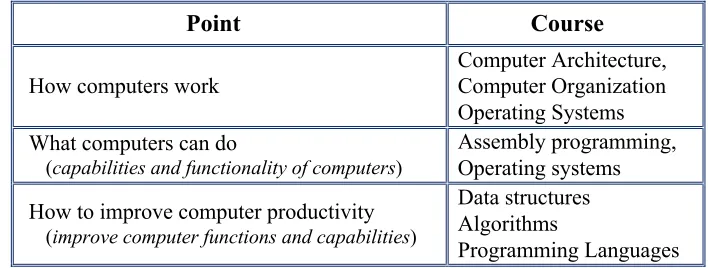
Another source of disconnect emerges from the computer scientist in academia who are driving the discipline of CIS to: aspect of IS development, project management, application development, network and data communication, with little focus on decision Support Systems DSS, data analysis, and analytics. As discussed later in this section, CS is interested in studying the computer as a science from three dimensions: – how computers work; – what are the capabilities of the computer, and – how to improve these capabilities; as follows (see Table 1):
a1– How computers work (Computer Architecture, Operating Systems, Computer Organization, Assembly programming, ..etc)
a2– What are the capabilities and Functionality of computers (i.e., what computers can do). a3– How to improve computer functionality (and capabilities).
These are also illustrated in Figure 5 [15].
Point
Course
How computers work
Computer Architecture, Computer Organization Operating Systems What computers can do
(capabilities and functionality of computers)
Assembly programming, Operating systems
How to improve computer productivity (improve computer functions and capabilities)
Data structures Algorithms
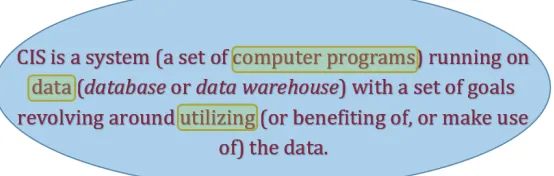
Figure 1: Definition as one view of CIS
Now with the CIS, the interest and the focus is different, see Figure 1. CIS is all about an information system which is a system (a set of computer programs) running on data (database or data warehouse) with a set of goals revolving around utilizing (or benefiting of, or make use of) the data to support organization; and this view is illustrated graphically in Figure 2. The last part, which is utilizing (or
benefiting) from data, can be explain in other words so as to indicate the idea of supporting people and organization. That is, the fact that IS is used to support people and organization is achieved by utilizing and benefiting from data and information; see Figure_1. Moreover, from business point of view ‘supporting people and organization’ means increasing profit and increasing sales.
So, we can divide this simple description into four dimensions: computer, programs, data, and
utilization; as shown in Figure 2. We put the majority of the weight on the last dimension: the utilization of data.
Therefore, CIS is concerned in studying: b1– What is IS (and what is cis). b2– How an IS works.
b3– How to build an IS as a project.
b4– How to benefit from and utilize the data to improve the organization.
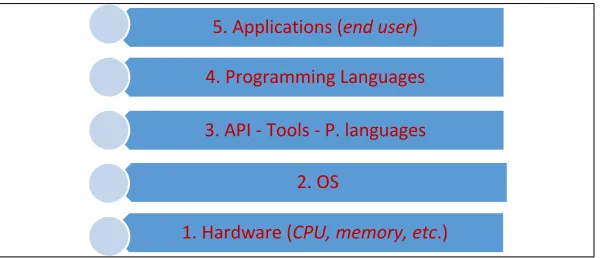
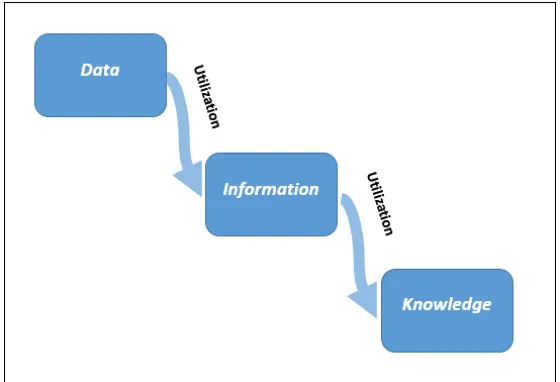
Figure 3 illustrates the focus of CS and CIS on the five-layer model of computing. Also, as shown in Figure 4, the utilization dimension is manifested in converting data into information and then into
knowledge. The ACM IS-2010 model curriculum [8, 9] is the most recent attempt of an official model curriculum of Information system discipline [3, 6, 9]. Figure 6 lists two main focuses for CIS; and for each focus, we list two subjects (can be thought of as two courses) feeding into that focus.
CIS Expectations: most of the IS programs that stemmed for CS departments; hence called CIS, pay great emphasis, or almost all of the attention and emphasis, to the first three points (b1 – b3) with little focus and course work given to b4. This issue has led to having most of the IS graduates, professionals, and practitioners lacking the necessary and the important set of knowledge and skills required for item
Figure 2: The four dimensions of CIS
Figure 3: mainly CS are interested in studying layers 2 – 4, whereas CIS is interested in layer 5
or data analytics, as a discipline (which is attracting more attention nowadays) does not bring any new concepts. The main goal or set of goals for this new discipline, namely data science, is the set of concepts that IS or CIS were supposed to address in the first place; and which we call it item b4 in our approach. So, we can easily reason that CIS is not effectively fulfilling some important part of its expectations.
The industry is in need of data utilization more than software development. The industry is drenched and with the humungous volumes of data accumulated on daily basis without any meaningful real utilization. This corporate industry unutilized data inundation issue derived the need for a completely new subject or discipline that is concerned with dealing with and utilizing data to improve business. We re-phrase and remind that, in our reasoning, we see that an IS can be as simple as a system (or a set of programs) that run on huge volumes of data and organized within a databases and data warehouses.
Method (2):5W1H:-
We apply and examine the well-known 5W1H (5W1H: who, what, where, when, why, how) inquiry approach informally to try to characterize and and manifest CIS as a data analysis topic from another angle. It has been used in journalism for reporting and asking questions and as a method of inquiry [5,
computer
Prorams
Data Utilization
5. Applications (end user)
4. Programming Languages
3. API - Tools - P. languages
2. OS
research, and engineering [16-18]. It basically offers a framework for inquiry and investigation in the direction of determining and manifesting an issue which may very well appeal to some disciplines [12 – 18]. For example, in [12], Shimazu et al (2006) used 5W1H in method for metadata exchange in electronic interdisciplinary contents sharing [12]. Moreover, in [18], Ma and To (2016) proposed a
5W1H model called CA5W1H Onto for mobile crowd sensing in an incentive mechanism for wireless sensor networks [5, 18]. In [2] Yue et al (2017) uses 5W1h-based model for adding one more dimension for understanding five computing disciplines [2]. That model encourages systematic critical thinking and meaningful learning [2].
Question Answer
What T? T is technology and tools and programs: Specification of the program and tools that should be designed and developed. Complete details and requirements for building an IS.
What X?
X is benefits and support: Details of the benefits and support that should be the outcomes of the IS. This requires a clear understanding of how to benefit and support the organization.
Why X?
Why this data analysis is important and should be done: Because data is plenty and in encode useful knowledge discovering that knowledge should support the organization and improve business
How X? How effectively use data to support the organization: this requires effective analysis techniques.
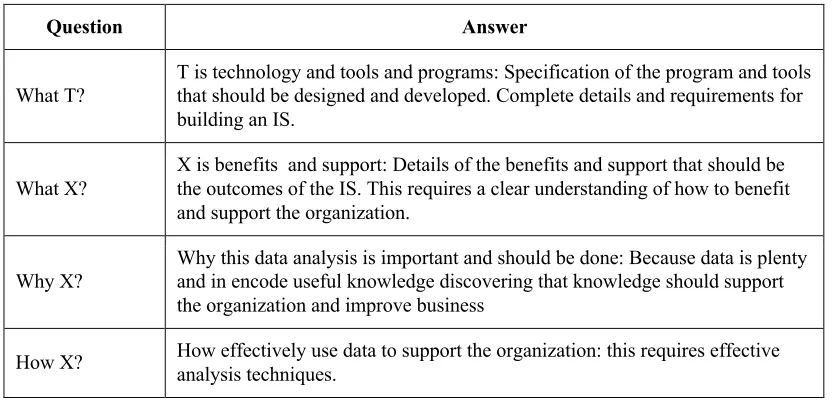
Table 2. More details on the four questions of the 2W1H model adopted in this study
As we explained before, we apply the 5W1H method of inquiry sparsely and informally. From the six questions in this method, we use three questions (2W1H), namely what, why, and how; which are more important than the three excluded questions. That is, the question what will be used to subsume the excluded ones. To explain and understand the nature of IS, and CIS, with a method of inquiry like 2W1H, we employ the three questions in understanding and manifesting the subject. In this paper, CIS is viewed as a subject that is interested in developing computer systems capable of storing and utilizing data to benefit people and organizations. The question is what is CIS? Why we use or need CIS? And how does CIS work? As we can see, these are very broad and they address our goal of characterizing and manifesting CIS. To be more specific we ask the following questions. The first question can be broken into a number of more specific questions as follows: what are the data and information available for us? What programs, technology, and tools should we develop and use? What are the benefits and support for the organization that we should produce? For the why part, we ask a more specific question
4. Conclusion
This paper presents two methods of deliberate analysis and reasoning for manifesting and characterizing of information systems CIS with industry expectations and academia offerings. There is certain gap in understanding the nature of CIS between industry and academia. Also there is some confusion about CIS specially when comparing it with other similar disciplines like Computer Science. As a discipline, CIS is the subject among all branches of computing that is most interested in utilizing data to support organizations and improve our life. In corporate industry lingua this means to increase profitability, improve revenue, enhance customer satisfaction, increase customer retention, increase employee satisfaction, increase customer referral; and all these will and should improve our life. The relatively new subjects of Data Science and Data Analytics nowadays came about to emphasize and corroborate the need for more knowledge and skills in utilizing the huge volumes of data.
Figure 5: Goals of AP Computer Science A as stated by the publisher in their website [15]
Figure 6: The two main focuses in CIS with the four main areas
References:
[1] Association for Information Systems (AIS) https://aisnet.org/
[2] K.B. Yue, H. Al-Mubaid, and W. Wei. An Investigation Dimension for Understanding and Characterizing Computing Disciplines. Proceedings of the 23rd Americas Conference on Information Systems AMCIS-2017.
[3] ACM Digital Library: http://dl.acm.org/
[4] Mills, R., Chudoba, K. & Olsen, D. 2016. IS Programs Responding to Industry Demands for Data Scientists: A Comparison between 2011 – 2016. Journal of Information Systems Education, (27:2), pp. 131-140.
[5] IEEE Xplore Digital Library http://ieeexplore.ieee.org/Xplore/home.jsp
[6] Accreditation Board for Engineering and Technology (ABET): http://www.abet.org/ [7] Computing Research Association (CRA): http://cra.org/
Information Technology Curricula Association for Computing Machinery (ACM) and IEEE Computer Society (IEEE-CS). 2017.
[9] ACM. 2010. IS 2010, Curriculum Guidelines for Undergraduate Degree Programs in Information Systems. ACM and AIS, 2010.
[10] Wil M.P. van der Aalst and Christian Stahl. Modeling Business Processes. Information Systems: Introduction and Concepts, MIT Press 2010.
[11] J. Xu and M. Quaddus, Managing Information Systems. Atlantis Press 2013
[12] Shimazu, K., Arisawa, T., & Saito, I. 2006. “Interdisciplinary contents management using 5W1H interface for metadata,” in Proceedings of the 2006 IEEE/WIC/ACM International Conference on Web Intelligence, Hong Kong, pp. 909-912.
[13] Gupta, B., Goul, M., & Dinter, B. 2015. “Business intelligence and big data in higher education: Status of a multi-year model curriculum development effort for business school undergraduates, MS graduates, and MBAs,” Communications of the Association for Information Systems, (36:23), pp. 449-476.
[14] Computer Information Systems vs Computer Science. GetEducated.
http://www.geteducated.com/careers/521-computer-information-systems-vs-computer-science. Retrieved June 2016.
[15] AP Computer Science Principles including the curriculum framework course. College Board, 2016. http://www.collegeboard.org)
[16] Jabar, M., Ahmadi, R., Shafazand, Y., Ghani, A., & Sidi, F. 2013. “An automated method for requirement determination and structuring based on 5W1H elements,” in Fourth IEEE Control and System Graduate Research Colloquium (ICSGRC), pp. 32-37.
[17] Jeong-Dong, K., Son, J., & Doo-Kwon Baik. 2012. “CA5W1H onto: Ontological context-aware model based on 5W1H,” International Journal of Distributed Sensor Networks.
[18] Ma, P., & Tao, D. 2016. “5W1H model for incentive mechanism in mobile crowd sensing,” in
![Figure 5: Goals of AP Computer Science A as stated by the publisher in their website [15]](https://thumb-us.123doks.com/thumbv2/123dok_us/8876988.1817452/8.612.101.509.355.466/figure-goals-ap-computer-science-stated-publisher-website.webp)
