PARTITIONING A GRAPH INTO MONOPOLY SETS
AHMED MOHAMMED NAJI1, SONER NANDAPPA D1, §
Abstract. In a graph G= (V, E), a setM ⊆V(G) is said to be a monopoly set of G if every vertex v ∈ V −M has, at least, d(v)2 neighbors in M. The monopoly size ofG, denoted bymo(G), is the minimum cardinality of a monopoly set. In this paper, we study the problem of partitioning V(G) into monopoly sets. An M-partition of a graphGis the partition ofV(G) intokdisjoint monopoly sets. The monatic number of G, denoted byµ(G), is the maximum number of sets in M-partition ofG. It is shown that 2≤µ(G)≤3 for every graph Gwithout isolated vertices. The properties of each monopoly partite set ofGare presented. Moreover, the properties of all graphsGhaving µ(G) = 3, are presented. It is shown that every graphGhavingµ(G) = 3 is Eulerian and have χ(G)≤3. Finally, it is shown that for every integerk /∈ {1,2,4}, there exists a graphGof ordern=khavingµ(G) = 3.
Keywords: Vertex degrees, distance in graphs, graph polynomials. AMS Subject Classification: 05C70, 05C07, 05C69.
1. Introduction
The concept of monopoly in a graph was introduced by Khoshkhak K. et al. [10]. Some mathematical properties of monopoly in graphs have been studied in [12], other types of monopoly in graphs have been subsequently proposed by the authors ([13]-[16]). In particular, the monopoly in graphs is a dynamic monopoly (dynamos) that, when colored black at a certain time step, will cause the entire graph to be colored black in the next time step under an irreversible majority conversion process. Dynamos were first intro-duced by Peleg D. [17]. For more details in monopoly and dynamos in graphs, we refer the reader to [2, 3, 7, 11, 19]. In this paper, we focus our attention on the problem of partitioning of the vertex set of a graphGinto disjoint monopoly sets. We denote byM -partition to the -partition ofV(G) intok disjoint monopoly sets. The idea of M-partition ofGclosely related to unfriendly partition [5, 1], and an offensive k-alliances partition [18].
We begin by stating the terminology and notations used through this article. A graph G= (V, E) is a simple graph, that is finite, having no loops no multiple and directed edges. As usual, we denote by n = |V| and m = |E| to the number of vertices and edges in a graph G, respectively. For a vertex v ∈ V, the open neighborhood of v in a graph G, denotedN(v), is the set of all vertices that are adjacent tovand the closed neighborhood of v is N[v] = N(v)∪ {v}. The degree of vertex v in Gis d(v) =|N(v)|, and the degree of a vertex v with respect to a subset S ⊂ V(G) is dS(v) = |N(v)∩S|. We denote by
1 Department of Studies in Mathematics, University of Mysore, Manasagangotri, Mysuru, INDIA. e-mail: [email protected], [email protected];
§ Manuscript received: May 21, 2016; accepted: September 22, 2016.
TWMS Journal of Applied and Engineering Mathematics Vol.7, No.1; cI¸sık University, Department of Mathematics 2017; all rights reserved.
∆(G) and δ(G) to maximum and minimum degree among the vertices of G, respectively.
bxc(dxe) denotes the greatest (smallest) integer number less (greater) than or equal tox. An isolated vertex inGis a vertex with degree zero. As usual,Gdenotes the complement of G, for a subset S ⊆ V, S = V −S and kG denotes the k disjoint copies of G. A k-partite graph is a graph G whose vertex set V(G) can be partitioned into k disjoint sets so that no two vertices within the same set are adjacent. A k-partite graph in which each partite set has the same number of vertices is said to be a balanced k-partite graph. The Friendship graph Fn, for n ≥2, is the graph constructed by joining n copies of K3
graph with a common vertex. A set I ⊆ V is independent if no two vertices in I are adjacent. The independent sets of maximum cardinality are called maximum independent sets. The number of vertices in a maximum independent set is the independence number (or vertex independence number) ofG and is denoted byα(G). For more terminologies and notations in graph theory, we refer the reader to the books [4, 8].
A setD⊆V(G) is called a dominating set of a graphGif every vertexv∈V(G)−D adjacent to some vertex inD. The minimum cardinality of such set is called the domina-tion number ofGand denoted by γ(G). A dominating set of cardinalityγ(G) is called a γ-set for G. A thorough treatment of domination in graphs can be found in the book by Haynes at el. [9]. The domatic numberd(G) of a graphGis the maximum positive integer ksuch thatV(G) can be partitioned intokpairwise disjoint dominating sets. A partition V into pairwise disjoint dominating sets is called a domatic partition. The concept of a domatic number was introduced by E. J. Cockayne at el. [6]. A proper coloring of a graph G is a k-coloring in which each color class is an independent set. The minimum k for which a graph isk-colorable is called its chromatic number and denoted byχ(G) [4].
A pigeonhole principle states that ifnitems are put into m containers, with n > m, then at least one container must contain more than one item. The pigeonhole principle has several generalizations and can be stated in various ways. In a more quantified version: for natural numbersk and m, if n=km+ 1 objects are distributed among m sets, then the pigeonhole principle asserts that at least one of the sets will contain at least k+ 1 objects. For arbitrarynand m this generalizes to k+ 1 =bnm−1c+ 1 [20].
A setM ⊆V(G) is called a monopoly set ofGif for every vertexv∈V(G)−M has at least d(2v) neighbors in M. The monopoly size of G, denoted by mo(G), is the mini-mum cardinality of a monopoly set in G. An M-partition of a graph G is the partition of V(G) intok disjoint monopoly sets. The monatic number of G, denoted by µ(G), is the maximum number of sets in M-partition ofG. The word ”monatic” was created from monopoly and chromatic in the same way the word ”domatic” which created from domi-nation and chromatic. It is shown that 2≤µ(G)≤3 for every graph G without isolated vertices. The properties of each monopoly partite set of G are presented. Moreover, the properties of all graphsGhavingµ(G) = 3, are presented. It is shown that every graphG havingµ(G) = 3 is Eulerian and haveχ(G)≤3. Finally, it is shown that for every integer k /∈ {1,2,4}, there exists a graphGof order n=kwithµ(G) = 3.
The following are some fundamental results which will be required for many of our arguments in this paper:
Theorem 1.1. [8]A graphGis eulerian if and only if every vertex ofGis of even degree.
Proposition 1.1. (a): For any graph G, d(G)≤δ+ 1. (b): d(G)≥2, if and only if G has no isolated vertices. (c): For any treeT with n≥2 vertices, d(T) = 2.
2. Partitioning Vertex Set of a Graph into Monopoly sets
Theorem 2.1. Any non-trivial graph G without isolated vertices has an M-partition.
Proof. Let {X, Y} be a partition of V(G) such that the edge-cut between X and Y has maximum cardinality. Then X and Y are dominating sets. Moreover, for every vertex x ∈ X, has at least d(2v) neighbors in Y, then we have that Y is a monopoly set in G. Analogously, we obtain that X is a monopoly set in G. Hence, {X, Y} is a partition of V(G) into two monopoly sets inG. This complete the proof.
Since any monopoly set M of a graph Gmust be contain every isolated vertices in G, then we have the following result.
Proposition 2.1. Let G be a graph of order n. Then µ(G) = 1, if and only if G having an isolated vertex.
Accordingly to Theorem 2.1 and Proposition 2.1, we obtain the following fundamental result.
Theorem 2.2. For any graph Gwithout isolated vertices, 2≤µ(G)≤3.
Proof. By Theorem 2.1 and Proposition 2.1, we have µ(G) ≥ 2. For the upper bound, since, the M-partition of G is a partition of V(G) into k monopoly subset, it follows by the definition of a monopoly set, every vertexv∈V(G) must be adjacent to, at least, d(2v) vertices in every subset other then its own. If a graphGhasµ(G) =k, then every vertex v∈ V(G) must be adjacent to, at least, (k−1)d(2v) vertices, d(2v) vertices in each partite set of anM-partition. Hence, we have (k−1)d(2v) ≤d(v), this implies that (k−3)d(v)≤0. But sinced(v)>0, for everyv∈V(G), it follows thatk−3≤0. Therefore,µ(G)≤3.
Corollary 2.1. For any graph G,1≤µ(G)≤3.
Theorem 2.3. For any graphGwithout isolated vertices. IfGhas a vertex of odd degree, thenµ(G) = 2.
Proof. Let v ∈ V(G) be a vertex with odd degree. i.e., d(v) = 2k+ 1, for any k ≥ 0. Suppose, to the contrary, thatµ(G) = 3 and let {M1, M2, M3} be the M-partition of G.
Assume, without loss of generality, thatv∈M1. Then by the definition of a monopoly set,
dM2(v)≥
d(v)
2 ≥k+ 1 and also,dM3(v)≥k+ 1. Hence,d(v)≥dM2(v) +dM3(v)≥2k+ 2,
a contradiction. Therefore, by Theorem 2.2,µ(G) = 2.
Corollary 2.2. For any graph G. If G has µ(G) = 3, then every vertex of G is of even degree.
Theorem 2.4. LetG be a graph without isolated vertices and every vertex ofGis of even degree. IfG has a cycle, of orderk≡1,2 (mod 3), as an endblock. Then µ(G) = 2. Proof. LetGbe a graph with a cycle endblockCk, fork≡1,2 (mod 3), and let{v1, v2, ..., vk} be the vertex set of Ck, such that v1 is the cut vertex of G on Ck. Clearly, d(v1) ≥ 4
and d(vi) = 2, for every 2 ≤ i ≤ k. Suppose, to the contrary, that µ(G) = 3 and let
and v2 ∈ M2, then v3 ∈ M3. Furthermore, M1 ={vi :i≡1 (mod 3)}, M2 = {vi :i≡2 (mod 3)} and M3={vi:i≡0 (mod 3)}. Then we have the following two cases.
Case 1: If k≡1 (mod 3), thenvk∈M1 and hence, dM3(v1) = 0, a contradiction.
Case 2: If k ≡2 (mod 3), then vk ∈M2 and hence a gain, dM3(v1) = 0, a
contra-diction.
Therefore,µ(G)6= 3.
Theorem 2.5. For any graph G, µ(G)≤d(G). Furthermore, if∆(G)≤2, thenµ(G) = d(G).
Proof. Clearly, from the definition of the monopoly set that any monopoly set of a graph Gis a dominating set. Then,µ(G)≤d(G). Now, letGbe a graph with ∆(G)≤2. and let D1, D2, ..., Dk be the partition ofG intok dominating set. Since,dDi(v)≥1≥
∆ 2 ≥
d(v) 2 ,
for every vertexv /∈ Di, and for every i= 1,2, .., k, it follows that Di is a monopoly set of G, for every i = 1,2, .., k. Hence, d(G) ≤ µ(G), but we have µ(G) ≤ d(G). Then
µ(G) =d(G).
The converse of Theorem 2.5, is not true. For example, the star graph K1,n, for every
n ≥ 3, has d(K1,n) = µ(K1,n) = 2, but ∆(K1,n) ≥ 3. The following result immediate consequences of Proposition 1.1 and Theorem 2.5.
Corollary 2.3. For any tree T with n≥2 vertices, µ(G) =d(G) = 2.
In the following result, the exact values of the monatic numberµ(G) for some standard graphsG are determined.
Proposition 2.2. .
(1) µ(Pn) = 2, for every n≥2. (2) µ(Cn) =
3, if n≡0 (mod 3); 2, otherwise.
(3) µ(Kn) = 1, for every n≥2. (4) µ(Kn) =
1, ifn= 1; 3, ifn= 3; 2, otherwise. (5) µ(Kr,s) = 2, for 1≤r≤s. (6) µ(Fn) = 3, for every n≥2.
There are Two graphs G1 = (V1, E1) and G2 = (V2, E2) with|V1|=|V2|,|E1|=|E2|
and the sequence degrees Sd(G1) =Sd(G2), where Sd(G) = {d1, d2, ..., dn} and di is the degree of vertex inG. But µ(G1) 6=µ(G2). Figure 1, shows two graphs G1 and G2 with
n1 =n2 = 7,m1=m2 = 9 and Sd(G1) =Sd(G2) ={4,4,2,2,2,2,2}. Butµ(G1) = 3 and
µ(G2) = 2.
v v v
v v v
v v v
v v
v
v v
G1 : G
2 :
A bipartition (V1, V2) of a vertex setV(G) of a graphGis called an unfriendly partition;
if every vertex u ∈ V1 has at least as many neighbors in V2 as it does in V1, and every
vertexv∈V2 has at least as many neighbors in V1 as it does inV2. This type of partition
were defined and studied by Borodin et al. [5] and Aharoni et al. [1]. Clearly, for any graph G, if µ(G) = 2, then the idea of M-partitions of a graph G is closely related to unfriendly partitions. Hence, in the following section, we shall focus our attention on the problem of partitioning a graphGinto three monopoly sets.
3. Properties of the Monopoly Partite sets of GraphsG having µ(G) = 3
In this section, we study the properties of every monopoly partite set of a graph G havingµ(G) = 3, number of edges which incident with every partite set.
Theorem 3.1. For any graph G, if µ(G) = 3, then every partite set in M-partition ofG is an independent set.
Proof. Let G be a graph with µ(G) = 3 and let {M1, M2, M3} be the M-partition of G.
On the contrary, suppose, without loss of generality, thatM1is not an independent. Then
there exists, at least, a vertexv∈M1 such that|N(v)∩M1| ≥1. SinceM2 is a monopoly
set inG andv /∈M2, it follows by definition of a monopoly set that
dM2(v) =|N(v)∩M2| ≥
d(v)
2 . (1)
Similarly,
dM3(v) =|N(v)∩M3| ≥
d(v)
2 . (2)
Hence, by the definition of the degree of a vertex in a graphGand by equations 1 and 2, we obtain d(v) = dM1(v) +dM2(v) +dM3(v) ≥ d(v) + 1,a contradiction. Therefore, M1
must be an independent set. ForM2 andM3 the proof is similar to the proof of M1.
In the following two results, we investigate the sum of the degrees of vertices in every monopoly partite set of a graphGwithµ(G) = 3 and the edges which connected between any two monopoly partite sets in M-partition ofG.
Proposition 3.1. Let {M1, M2, M3} be an M-partition of a graph G. Then
dMi(v) =dMj(v) =
d(v) 2
for everyv∈Mk, where i, j andk∈ {1,2,3} andk6=i6=j. Theorem 3.2. Let {M1, M2, M3} be the M-partition of G. Then
X
v∈Mi
d(v) = 2m
3 , f or every 1≤i≤3.
Proof. Let G be a graph with µ(G) = 3 and let {M1, M2, M3} be the M-partition of a
graphG. By Theorem 3.1, every partite setMi and for 1≤i≤3, in M-partition ofGis an independent. Then d(v) = |N(v)∩(V −Mi)|=dM
i(v), for every v ∈Mi, 1≤ i≤3.
now, for every 1≤i≤3, 2m= X v∈V(G)
d(v) = X v∈Mi
d(v) + X v∈Mi
d(v);
= X
v∈Mi
dMi(v) + X
v∈Mi
dM
i(v) + X
v∈Mi
dMi(v) + X
v∈Mi
dM
i(v);
= 0 + X v∈Mi
dM
i(v) + 2 X
v∈Mi
dMi(v);
= 3 X v∈Mi
dM
i(v) = 3 X
v∈Mi
d(v).
Therefore, X v∈Mi
d(v) = 2m
3 , for everyi= 1,2,3.
For any graphGwithµ(G) = 3, Theorem 3.2 shows that the number of edges between any partite set and both the others partite sets in M-partition of G is equal to 23m. In the following result, m(Mi, Mj) denotes the number of edges between Mi and Mj,i, j ∈
{1,2,3}.
Corollary 3.1. Let {M1, M2, M3} be an M-partition of a graph G. Then
m(Mi, Mj) = m
3, f or every i, j ∈ {1,2,3} and i6=j.
Theorem 3.3. Let{M1, M2, M3}be an M-partition of a graphGsuch that|M1| ≤ |M2| ≤ |M3|. Then
(1) mo(G)≤ |M1| ≤ bn3c;
(2) |M1| ≤ |M2| ≤ n−mo2(G);
(3) dn
3e ≤ |M3| ≤ |M1||M2|.
Proof. LetGbe a graph of ordernand let{M1, M2, M3}be an M-partition of a graphG
such that|M1| ≤ |M2| ≤ |M3|. Then
(1) Clearly that|M1| ≥mo(G). For the upper bound of|M1|, assume, to the contrary,
that|M1| ≥ bn3c+ 1. Since,|M1| ≤ |M2| ≤ |M3|, then by the pigeonhole principle, |M3| ≥ dn3e. We have the following Cases.
Case 1: If n ≡ 0 (mod 3), then |M1| ≥ n3 + 1. Hence, by the hypothesis,
n=|M1|+|M2|+|M3| ≥n+ 3, a contradiction.
Case 2: If n ≡ 1 (mod 3), then |M1| ≥ n−31 + 1 and |M3| ≥ n+23 . Hence, we
obtain,n≥2(n−31 + 1) +n+23 =n+ 2, a contradiction.
Case 3: if n ≡ 2 (mod 3), then |M1| ≥ n−32 + 1 and |M3| ≥ n+13 . Hence, we
obtain,n≥2(n−32 + 1) +n+13 =n+ 1, a contradiction. Therefore, |M1| ≤ bn2c.
(2) Form the hypothesis, we have|M1| ≤ |M2|and the cardinality of M2 is maximum
if and only if |M2|=|M3|. Since,|M2| ≤n−(|M1|+|M3|), it follows that and by
the maximality of |M2|, |M2| ≤
n− |M1|
2 ≤
n−mo(G)
2 .
(3) By the hypothesis and the pigeonhole principle, we get|M3| ≥ dn3e. SincedM1(v)≥
1, for every v ∈ M3, it follows that X
v∈M3
X
v∈M3
dM1(v) = X
v∈M2
dM1(v). Hence,
|M3| ≤ X
v∈M3
dM1(v) = X
v∈M2
dM1(v)≤ X
v∈M2
|M1| ≤ |M2||M1|.
Corollary 3.2. Let {M1, M2, M3} be an M-partition of a graph G, such that |M1| ≤ |M2| ≤ |M3|. If|M1|= 1, then |M2|=|M3|= n−21. Furthermore, G=K3 or G∼=Fn.
4. Properties of Graphs G having µ(G) = 3
In this section, we investigate the properties of the graphs G havingµ(G) = 3 and the relationships between the monatic number ofGand some other parameters of G.
Theorem 4.1. For any graph G, ifµ(G) = 3, then G is eulerian.
Proof. The result is an immediate consequences of Theorem 1.1 and Corollary 2.2.
Theorem 3.1, shows that for every graph G with µ(G) = 3, every partite set in M-partition ofG is independent set. Then we have the following result.
Corollary 4.1. Every graph Ghaving µ(G) = 3 is a 3-partite graph.
The converse of the Corollary 4.1, in general, is not true. For example, the complete 3-partite graphK1,2,3 has a vertex of odd degree, then by Theorem 2.3,µ(K1,2,3) = 2. In
the following result, we characterize each complete 3-partite graphG withµ(G) = 3.
Theorem 4.2. Let G=Kn1,n2,n3 a complete 3-partite graph. Thenµ(G) = 3, if and only
ifn1 =n2 =n3.
Proof. Let G = Kn1,n2,n3 a complete 3-partite graph with partite sets (V1, V2, V3) such
that |V1| ≤ |V2| ≤ |V3|. Certainly, If n1 = n2 =n3, then every partite set is a monopoly
set ofG. Thus,µ(G) = 3.
Conversely, letG=Kn1,n2,n3 a complete 3-partite with µ(G) = 3, and let {M1, M2, M3}
be the M-partition ofGsuch that|M1| ≤ |M2| ≤ |M3|. We claim that|Mi|=|Vi|for every i= 1,2,3. Otherwise, there is at least a monopoly partite set|Mi|form M-partition ofG, fori= 1,2,3, such thatMi∪Vj andMi∩V −Vj are not empty sets, for somej= 1,2,3. Hence,Mi is not independent set, a contradiction. Then the claim is true. Now, assume, without loss the generality, that n1 < n2. Then, there exists at least a vertex v ∈ M3
such thatdM2(v) =|M2|>|M1|=dM1(v). Hence, eitherv of odd degree, a contradiction
to Corollary 2.2, or a set M1 is not a monopoly set of G, once again a contradiction to
assumption. This complete a proof.
.
Theorem 4.3. For any graph Gof order n, ifµ(G) = 3, then
n≤m≤ n 2
3 .
Proof. Let G be a graph with µ(G) = 3 and let {M1, M2, M3} be the M-partition of G.
Then by Corollary 2.2, every vertex in G is of even degree that means δ ≥2. Then the minimum number of edges inG, ifGis a cycle graph hencem≥n. For the upper bound, we denotem(M1, M2) to the number of edges between M1 and M2. Since m(M1, M2) ≤ |M1||M2|, it follows that the maximum value of m(M1, M2) is |M1||M2|. Using calculus
maximal when |M1| = n2. Then by Corollary 3.1, m3 = m(M1, M2) ≤ n 2
9 . Therefore,,
m= n
2
3 .
These bounds in Theorem 4.3 are sharp. The cycle Cn, for n ≡0 (mod 3), gives the lower bound and the complete 3-partiteKn
3, n 3,
n
3 gives the upper bound.
Proposition 4.1. For any graphG, if µ(G) = 3, then χ(G)≤3.
Proof. The result is the consequence of Theorem 3.1.
The bound in Proposition 4.1, is sharp, the cycle graphsC3n, for everynis odd, and the
complete 3-partite graphsKn1,n2,n3 attending it. The example of graphs Gwithµ(G) = 3
andχ(G) = 2 is the graphsG=C3n, for everynis even. The converse of the Proposition
4.1, in general, is not true. For example,χ(C5) = 2 but µ(C5) = 2.
Corollary 4.2. For any non-bipartite graph G without isolated vertices. If µ(G) = 3, thenχ(G) = 3.
Theorem 4.4. LetGbe a graph with a clique numberω(G). Ifµ(G) = 3, thenω(G)≤3. Proof. Let G be a graph with µ(G) = 3 and let {M1, M2, M3} be the M-partition of G.
Suppose, on the contrary, that ω(G) ≥ 4. Then there exists a clique C ⊆ V(G) with vertex set V(C) = {v1, v2, ..., vk}, k ≥4. Hence, by the pigeonhole principle, there is at least on set from M-partition ofGcontains at leastbk−1
3 c+ 1 vertices from V(C). Since,
k≥4 then bk−31c+ 1≥ 2. Hence, there is at least one set form M-partition of G is not independent, a contradiction to Theorem 3.1. Therefore,ω(G)≤3.
The converse of Theorem 4.4, in general, is not true. For example, the Path graph Pn withω(Pn) = 2, butµ(Pn) = 2.
Theorem 4.5. For any graph Gof order n, ifµ(G) = 3, then α(G)≥n 3
.
Proof. LetGbe a graph of ordernandµ(G) = 3 and let{M1, M2, M3}be the M-partition
of G. Then by the pigeonhole principle, there is at least one set from M-partitions ofG contains at least bn−1
3 c+ 1 vertices from V(G). Since, by Theorem 3.1, every set in
M-partitions ofG is an independent set, it follows thatα(G)≥n−1 3
+ 1 =n3.
Corollary 4.3. For any graphGof order n, ifµ(G) = 3, then the independence monopoly size,imo(G), of G is defined. Furthermore, imo(G)≤ dn
3e.
The bound in Corollary 4.3, is sharp. The cycle graphs C3n, for every n, is attending
it. The converse of Corollary 4.3, in general, is not true. For example, the star graphK1,n hasimo(K1,n) = 1 but µ(K1,n) = 2. For more details in the independence monopoly size
of a graph, we refer the reader to [15].
Theorem 4.6. Let G be a graph of order n and maximum degree ∆(G) =n−1. Then µ(G) = 3, if and only if G=K3 or G∼=Fn.
Proof. Certainly, if G=K3 orG=Fn, then ∆(G) =n−1 andµ(G) = 3.
Conversely, LetGbe a graph of ordern, maximum degree ∆(G) =n−1 andµ(G) = 3 and let{M1, M2, M3}be the M-partition of G. Now, let a vertexv ∈V(G) withd(v) =n−1
and assume, with loss of generality, that v ∈ M1. Then by Theorem 3.1, M1 ={v} and
by Observation 3.1,|N(v)∩M2|=|N(v)∩M3|= n−21.
On the other hand, once again by the Observation 3.1,|N(u)∩M1|=|N(u)∩M3|= 1, for
Hence, a graphGhas only a vertexvwithd(v) =n−1 and each other vertex with degree two. Therefore, Ifn= 3, then G=K3 and if n≥4, thenG=Fn−1
2 .
Theorem 4.7. Let G be a graph having µ(G) = 3. Then mo(G)≤ n
3.
Proof. Let G be a graph with µ(G) = 3 and let {M1, M2, M3} be the M-partition of G.
Since |Mi| ≥ mo(G), for every i ∈ {1,2,3}, it follows that n = |M1|+|M2|+|M3| ≥
3mo(G). Therefore, mo(G)≤ n3.
This bound is sharp, The cycle graphs Cn, for every n ≡ 0 (mod 3), and a complete 3-partiteKn
3, n 3,
n
3, attending it.
Corollary 4.4. For any graph G,µ(G)≤ n mo(G).
It is clear that every graph Gof order n≤4,G 6=K3 hasµ(G) ≤2. In the following
result, we study the existences graphGof ordern=khavingµ(G) = 3 for every positive integer numberk /∈ {1,2,4}.
Theorem 4.8. For every positive integer k /∈ {1,2,4}, there exists a graph G of order n=k having µ(G) = 3.
Proof. For k= 3 and 5, the result is true, sinceG1 =K3 and G2 =F2 have the required
property. Now, we may assume thatk≥6. Then we consider the following cases.
Case 1: If k ≡ 0 (mod 3), then the cycle graph G3 = Ck is holding the property, sinceµ(Ck) = 3.
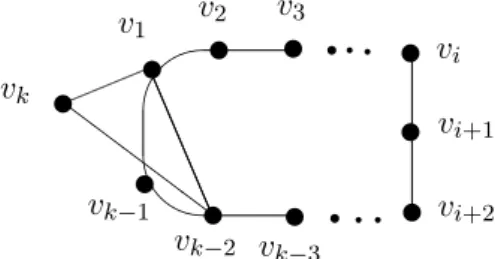
Case 2: If k ≡1 (mod 3), let v1, v2, ..., vk be the vertex set of the cycle Ck. Then the graph G4 which formed fromCk by firstly, removed the edge ek−1 which join
the vertices vk−1 withvk, then insert three new edges e01,e02 and e03, such that e01
join v1 with vk−1,e02 joinv1 with vk−2 and e03 join vk−2 with vk. Figure 2, shows the graph G4.
'
&
u u u
u
u u
u Z
Z Z
Z Z
r q q u
u
u v1 v2 v3
vk−2
vk−1
vk
vk−3
vi
vi+1
vi+2
r q q
Figure 2: The graph G4.
Then the partition{M1, M2, M3} whereM1 ={vi :i≡1 (mod 3)} − {vk},M2 = {vi :i≡2 (mod 3)} and M3 ={vi :i≡0 (mod 3)} ∪ {vk} is M-partition of G4.
Indeed, every partite set Mi fori= 1,2,3 is an independent monopoly set in G4.
Therefore, µ(G4) = 3.
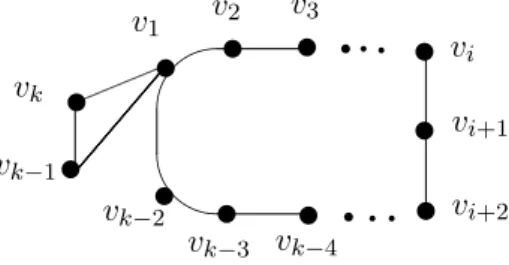
Case 3: If k ≡2 (mod 3), Then the graph G5 which formed from the cycle Ck by removed the edgeewhich join the verticesvk−2 withvk−1 and then insert two new
'
&
u u u
u u
u
r q q u
u
u v1 v2 v3
vk
vi
vi+1
vi+2
r q q u
u vk−1
vk−2
vk−3 vk−4
Figure 3: The graph G5.
Then the partition {M1, M2, M3} where M1 = {vi : i ≡ 1 (mod 3)} − {vk−1},
M2 ={vi :i≡2 (mod 3)} andM3 ={vi :i≡0 (mod 3)} ∪ {vk−1}is M-partition
of G5. Indeed, every partite setMi fori= 1,2,3 is an independent monopoly set inG5. Therefore, µ(G5) = 3.
Acknowledgement
Our thanks are due to the anonymous referee for careful reading and constructive sug-gestions for the improvement in the first draft of this paper.
References
[1] Aharoni,R., Milner,E.C., and Prikry,K., Unfriendly partitions of a graph, J. Combin. Theory, Series B,50(1)( 1990), pp.1-10.
[2] Berger,E.,Dynamic monopolies of constant size, J. Combin. Theory, Series B,83(2001),pp.191-200. [3] Bermond,J., Bond,J., Peleg,D., and Perennes,S.,The power of small coalitions in graphs, Disc. Appl.
Math.,127(2003), pp.399-414.
[4] Bondy,J.A. and Murty,U.S.R., Graph Theory,Springer, Berlin, 2008.
[5] Borodin,A.V. and Kostochka,A.V.,A note on an upper bound of a graph’s chromatic number, depend-ing on the graph’s degree and density, J. Combin. Theory Series B,23(1977), pp.247-250.
[6] Cockayne,E.J. and Hedetniemi,S.T., Towards a theory of domination in graphs, Networks,7(1977), pp.247-261.
[7] Flocchini,P., Kralovic,R., Roncato,A., Ruzicka,P., and Santoro,N., On time versus size for monotone dynamic monopolies in regular topologies, J. Disc. Algor.,1(2003), pp.129-150.
[8] Harary,F., Graph theory,Addison-Wesley Publishing Co., Reading, Mass.-Menlo Park, Calif.-London, 1969.
[9] Haynes,T.W., Hedetniemi,S.T., and Slater,P.J., Fundamentals of Domination in Graphs, Marcel Dekker, New York, 1998.
[10] Khoshkhak,K., Nemati,M., Soltani,H., and Zaker,M., A study of monopoly in graphs, Graph and Combi. Math.,29(2013), pp.1417-1427.
[11] Mishra,A. and Rao,S.B.,Minimum monopoly in regular and tree graphs, Disc. Math.,306(14) (2006), pp.1586-1594.
[12] Naji,A.M. and Soner,N.D.,On the monopoly of graphs, Proce. Jang. Math. Soci.,2(18)(2015), pp.201-210.
[13] Naji,A.M. and Soner,N.D., The maximal monopoly of graphs, J. Comp. Math. Scien., 6(1)(2015), pp.33-41.
[14] Naji,A.M. and Soner,N.D., The connected monopoly in graphs, intern. J. Multi. Resear. Devle., 2(4)(2015), pp.273-277.
[15] Naji,A.M. and Soner,N.D.,Independent monopoly size in graphs, Appl. Appl. Math. Intern. J.,10(2) (2015), pp.738-749.
[16] Naji,A.M. and Soner,N.D.,Monopoly Free and Monopoly Cover Sets in Graphs, Int. J. Math. Appl., 4(2A)(2016), pp.71-77.
[18] Sigarreta,J.M., Yero,I.G., Bermudo,S., and Rodrguez-Velzquez,J.A.,Partitioning a graph into offen-sive k-alliances, Disc. Appl. Math.159(2011), pp.224-231.
[19] Zaker,M.,On dynamic monopolies of graphs with general thresholds, Disc. Math.,312(2012), pp.1136-1143.
[20] https://en.wikipedia.org/wiki/Pigeonhole-principle.
Ahmed Mohammed Najiwas born in Yemen. He got his B.Sc. degree in math-ematics and physics (2002) from Taiz University, Taiz, Yemen. He got his M.Sc. degree in mathematics (2013) from King Faisal University, Saudia Arabia. He is a research scholar and a Ph.D candidate in the field of graph theory, DOS in Math-ematics, at the University of Mysore, Manasagongatri, Mysuru- 570006, India. He has published 9 papers in the field of graph theory.