A NOTE ON CERTAIN TOPOLOGICAL INDICES OF THE DERIVED GRAPHS OF SUBDIVISION GRAPHS
B. BASAVANAGOUD1, CHETANA S. GALI2, §
Abstract. In this note, we correct some errors in S. M. Hosamani et al. [TWMS J. App. Eng. Math., 6(2), (2016) pp. 324–332]. The derived graph [G]† of a graphGis the graph having the same vertex set asG, with two vertices of [G]† being adjacent if and only if their distance in Gis two. Further, we compute generalized Randi´c, general Zagreb, general sum-connectivity, ABC, GA, ABC4, and GA5 indices of the derived graphs of subdivision graphs.
Keywords: derived graph, subdivision graph, line graph, topological index. AMS Subject Classification: 05C90, 05C35, 05C12
1. Introduction
Let G be a simple, finite and undirected graph with vertex set V(G) and edge set
E(G). The degree du of a vertex u in G is the number of edges incident to it in G and Su= P
v∈Nu
dv, whereNu ={v∈V(G)|uv∈E(G)}. Nuis also known as the set of neighbor
vertices ofu inG.
Li and Zhao introduced the first general Zagreb index in [14] as
Mα(G) = X
u∈V(G)
dαu, (1)
whereα is a real number.
The general Randi´c connectivity index of G is defined in [15] as
Rα(G) = X
uv∈E(G)
(dudv)α, (2)
whereα is a real number.
The general sum-connectivity index χα(G) defined in [18] as χα(G) =
X
uv∈E(G)
(du+dv)α, (3)
1 Department of Mathematics, Karnatak University, Dharwad, Karnataka, India, e-mail: [email protected]; ORCID: https://orcid.org/0000-0002-6338-7770. 2 Department of Mathematics, Karnatak University, Dharwad, Karnataka, India,
e-mail: [email protected]; ORCID: https://orcid.org/0000-0002-7759-7891.
§ Manuscript received: June 28, 2018; accepted: October 17, 2018.
TWMS Journal of Applied and Engineering Mathematics Vol.10 No.1 cI¸sık University, Department of Mathematics, 2020; all rights reserved.
whereα is a real number.
Theatom-bond connectivity (ABC) index of graphGis defined in [5] as
ABC(G) = X
uv∈E(G)
r
du+dv−2 dudv
. (4)
Thegeometric arithmetic (GA) index of a graph Gis introduced by D. Vukicevic and B. Furtula in [17] and is defined as
GA(G) = X
uv∈E(G)
2√dudv du+dv
. (5)
Thefourth member of the class of ABC index of a graphG is defined in [6] as
ABC4(G) =
X
uv∈E(G)
r
Su+Sv−2 SuSv
. (6)
Thefifth geometric arithmetic index of a graph Gis defined in [7] as
GA5(G) =
X
uv∈E(G)
2√SuSv Su+Sv
. (7)
Thesubdivision graph S(G) [9] is a graph with the vertex setV(G)∪E(G) such that two vertices of S(G) are adjacent if and only if one corresponds to a vertex v of G and other to an edgeeof G, and v is incident toe inG.
Theline graph L(G) [9] of graphGis the graph whose vertices are the edges ofG, two vertices ofL(G) are adjacent if and only if the corresponding edges inGshare a common vertex.
For undefined terminology we refer [9, 13]. For recent study on topological indices of transformation graphs, one can refer the articles [1, 2, 3, 4, 10, 16].
The derived graph [G]† [8] of a graph G is the graph having the same vertex set as
G, two vertices of [G]† being adjacent if and only if their distance inG is two.
In [11], authors computed topological indices of derived graph of subdivision graph of tadpole graph Tn,k. But the expressions of Rα(Tn,k) and ABC(Tn,k) does not holds
fork= 1. The expressions ofRα(L(Tn,k)),χα(L(Tn,k)),ABC(L(Tn,k)) and GA(L(Tn,k)),
valid for k > 2. Also the expressions GA(Tn,k), ABC4(Tn,k), GA5(Tn,k), Mα(L(Tn,k)), ABC4(L(Tn,k)), GA5(L(Tn,k)) are incorrect. In this paper, we correct all these errors.
Further, we obtain topological indices of derived graph of subdivision graph of a crown graphCWn, a gear graphGn and a friendship graph C3(n).
Theorem 1.1. [8] Let Gbe any simple graph. Then [S(G)]†∼=G∪L(G).
2. Tadpole graph
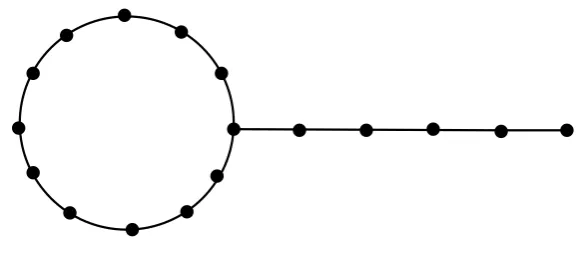
The tadpole graph Tn,k [12] is the graph formed by joining the end point of a path
of lengthk to an-cycle.
Table 1. The edge partition of tadpole graph Tn,k whenk >1
(du, dv) whereuv∈E(Tn,k) (3, 2) (2, 2) (2, 1)
Figure 1. The tadpole graph T12,5
Table 2. The edge partition of tadpole graph Tn,k when n, k >3
(Su, Sv) whereuv ∈E(Tn,k) (6, 5) (5, 4) (4, 4) (4, 3) (3, 2)
Number of edges 3 3 n+k−8 1 1
Theorem 2.1. Let G=Tn,k be the tadpole graph. Then
(1) Rα(G) =
(n+k−4)·4α+ 3·6α+ 2α if k >1
(n−2)·4α+ 2·6α+ 3α if k= 1 ;
(2) ABC(G) =
1
√
2(n+k) if k >1
n √
2+
r
2
3 if k = 1;
(3) GA(G) =
(n+k−4) + 6
√
6 5 +
2√2
3 if k >1 (n−2) + 4
√
6 5 +
√
3
2 if k = 1.
Proof. The tadpole graph hasn+kvertices andn+kedges, among themn+k−2 vertices are of degree two, one vertex of degree three and one vertex of degree one. Therefore we get the edge partition, based on the degrees of vertices as shown in Table 1. Using formulas (2), (4) and (5) to the information in Table 1, we obtain the required result.
Theorem 2.2. [11] Let G=Tn,k be the tadpole graph. Then
(1) Mα(G) = (n+k−2)·2α+ 3α+ 1α ;
(2) χα(G) = (n+k−4)·4α+ 3·5α+ 3α.
Theorem 2.3. Let G=Tn,k be the tadpole graph with n, k >3. Then
(1) ABC4(G) = (n+k−8)
r
3 8+ 3
r
3 10 +
3 2
r
7 5 +
r
5 12 +
1
√
2 ; (2) GA5(G) = (n+k−8) +
6√30 11 +
4√3 7 +
2√6 5 +
4√5 3 .
Proof. Using formulas (6) and (7) to the information in Table 2, we obtain the required
Figure 2. The line graph of tadpole graph T12,5
Table 3. The edge partition of line graph of tadpole graph L(Tn,k) when k >2
(du, dv) whereuv∈E(L(Tn,k)) (3, 3) (3, 2) (2, 2) (2, 1)
Number of edges 3 3 n+k−6 1
Table 4. The edge partition of line graph of tadpole graph L(Tn,k) when n, k >4
(Su, Sv) whereuv ∈E(L(Tn,k)) (8, 8) (8, 5) (5, 4) (4, 4) (4, 3) (3, 2)
Number of edges 3 3 3 n+k−10 1 1
Theorem 2.4. Let H =L(Tn,k) be the line graph of tadpole graph with k >2. Then
(1) Rα(H) = (n+k−6)·4α+ 3·6α+ 3·9α+ 2α ;
(2) χα(H) = (n+k−6)·4α+ 3·5α+ 3·6α+ 3α ;
(3) Mα(H) = (n+k−4)·2α+ 3α+1+ 1α ;
(4) ABC(H) = (n+k)√1
2 + (2−
√
2);
(5) GA(H) = (n+k−3) +6
√
6 5 +
2√2 3 .
Proof. The line graph of tadpole graph Tn,k withk >2 hasn+k vertices and n+k+ 1
edges, among themn+k−4 vertices are of degree two, three vertices of degree three and one vertex of degree one. Therefore we get the edge partition, based on the degrees of vertices as shown in Table 3. Using formulas (1)–(5) to the information in Table 3, we
obtain the required result.
Theorem 2.5. Let H =L(Tn,k) be the line graph of tadpole graph with n, k >4. Then
(1) ABC4(H) = (n+k−10)
r
3 8 +
3√14 8 + 3
r
11 40 +
3 2
r
7 5 +
r
5 12 +
1
√
2 ;
(2) GA5(H) = (n+k−7) +12
√
10 13 +
4√3 7 +
4√5 3 +
2√6 5 .
Proof. Using formulas (6) and (7) to the information in Table 4, we obtain the required
result.
Theorem 2.6. Let [S(G)]† be the derived graph of subdivision graph of tadpole graph G=Tn,k withk >2. Then
(2) χα([S(G)]†) = 2(n+k−5)·4α+ 6·5α+ 2·3α+ 3·6α ;
(3) Mα([S(G)]†) = (n+k−3)·2α+1+ 4·3α+ 2·1α ;
(4) ABC([S(G)]†) =√2(n+k−1) + 2 ;
(5) GA([S(G)]†) = 2(n+k)−7 +12
√
6 5 +
4√2 3 .
Proof. From Theorem 1.1, we have [S(G)]†∼=G∪L(G). Then by using the informations in Theorems 2.1, 2.2 and 2.4 we obtain the desired result.
Theorem 2.7. Let [S(G)]† be the derived graph of subdivision graph of tadpole graph G=Tn,k withn, k >4. Then
(1) ABC4([S(G)]†) = 2(n+k−9)
r
3 8+
3√14 8 + 3
r
11 40 + 3
r
7 5+
r
5 3 + 3
r
3 10 +
√
2;
(1) GA5([S(G)]†) = 2(n+k)−15 +12
√
10 13 +
6√30 11 +
8√3 7 +
4√6 5 +
8√5 3 .
Proof. From Theorem 1.1, we have [S(G)]†∼= G∪L(G). Then by using the information in Theorems 2.3 and 2.5, we obtain the required result.
3. Crown graph
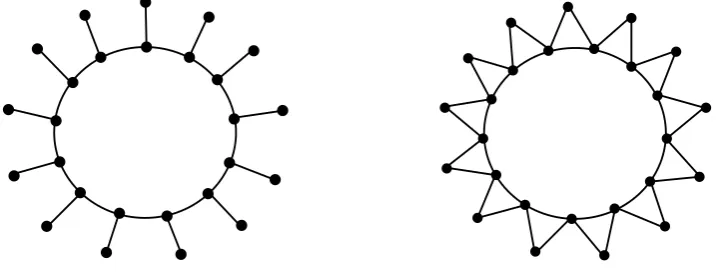
A cycleCnwith a pendent edge attached at each vertex is called acrown graph CWn
[12]. EquivalentlyCWn=Cn◦K1.
Figure 3. The crown graphCW13 and its line graphL(CW13)
Table 5. The edge partition of crown graph
(du, dv) whereuv∈E(CWn) (1, 3) (3, 3)
Number of edges n n
Table 6. The edge partition of crown graph
(Su, Sv) whereuv ∈E(CWn) (3, 7) (7, 7)
Table 7. The edge partition of line graph of crown graph
(du, dv) whereuv∈E(L(CWn)) (2, 4) (4, 4)
Number of edges 2n n
Table 8. The edge partition of line graph of crown graph
(Su, Sv) whereuv ∈E(L(CWn)) (8, 12) (12, 12)
Number of edges 2n n
Theorem 3.1. Let G=CWn be the crown graph. Then
(1) Mα(G) =n[1α+ 3α];
(2) Rα(G) =n·3α[1 + 3α];
(3) χα(G) =n·2α[2α+ 3α];
(4) ABC(G) =n r
2 3
"
1 +
r
2 3
#
;
(5) GA(G) =n "
1 +
√
3 2
#
;
(6) ABC4(G) = 2n
"r
2 21 +
√
3 7
#
;
(7) GA5(G) =n "
1 +
√
21 5
#
.
Proof. The crown graph has 2n vertices and 2n edges, among them n vertices are of degree one and n vertices of degree three. Therefore we get the edge partition, based on the degrees of vertices as shown in Tables 5 and 6. Using formulae (1)–(7) to the information in Table 5 and 6, we obtain the desired result.
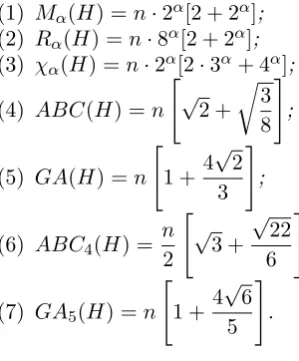
Theorem 3.2. Let H =L(CWn) be the line graph of crown graph. Then
(1) Mα(H) =n·2α[2 + 2α];
(2) Rα(H) =n·8α[2 + 2α];
(3) χα(H) =n·2α[2·3α+ 4α];
(4) ABC(H) =n "
√
2 +
r
3 8
#
;
(5) GA(H) =n "
1 +4
√
2 3
#
;
(6) ABC4(H) = n 2
" √
3 +
√
22 6
#
;
(7) GA5(H) =n
"
1 +4
√
6 5
#
.
Theorem 3.3. Let [S(G)]† be the derived graph of subdivision graph of crown graphG=
CWn. Then
(1) Mα([S(G)]†) =n[1α+ 2α+1+ 3α+ 4α];
(2) Rα([S(G)]†) =n[2·8α+ 16α+ 3α+ 9α];
(3) χα([S(G)]†) =n·2α[3α+1+ 4α+ 2α];
(4) ABC([S(G)]†) =n "r
2 3 +
2 3 +
√
2 +
r
3 8
#
;
(5) GA([S(G)]†) =n "
2 +
√
3 2 +
4√2 3
#
;
(6) ABC4([S(G)]†) =n "
2
r
2 21 +
2√3 7 +
√
3 2 +
√
22 12
#
;
(7) GA5([S(G)]†) = n 5
10 + 4√6 +√21.
Proof. From Theorem 1.1, we have [S(G)]†∼= L(G)∪G. Then by using the information in Theorems 3.1 and 3.2, we obtain the desired result.
4. Gear graph
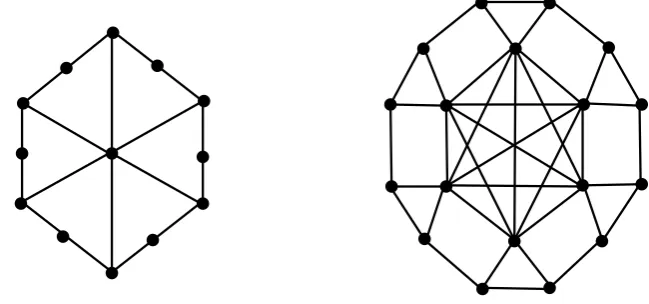
The gear graph Gn [12] is obtained from the wheel Wn by adding a vertex between
every pair of adjacent vertices of then-cycle.
Figure 4. The gear graph G6 and its line graphL(G6)
Table 9. The edge partition of gear graph
(du, dv) whereuv ∈E(Gn) (2, 3) (3, n)
Number of edges 2n n
Table 10. The edge partition of gear graph
(Su, Sv) whereuv ∈E(Gn) (6, n+ 4) (3n, n+ 4)
Table 11. The edge partition of line graph of gear graph
(du, dv) whereuv ∈E(L(Gn)) (3, 3) (3, n+ 1) (n+ 1, n+ 1)
Number of edges 2n 2n
n
2
Table 12. The edge partition of line graph of gear graph
(Su, Sv) whereuv∈E(L(Gn)) (n+ 7,n+ 7) (n+ 7, n2+ 5) (n2+ 5, n2+ 5)
Number of edges 2n 2n
n
2
Theorem 4.1. Let G=Gn be the gear graph. Then
(1) Mα(G) =n·3α+n·2α+nα;
(2) Rα(G) = 2n·6α+ 3α·nα+1;
(3) χα(G) = 2n·5α+n·(n+ 3)α;
(4) ABC(G) =n "
√
2 +
r n+ 1
3n #
;
(5) GA(G) = 2n "
2√6 5 +
√
3n n+ 3
#
;
(6) ABC4(G) = 2n r
n+ 8 6(n+ 4) +
r
2n+ 1 6n(n+ 4)
;
(7) GA5(G) =4n
p
6(n+ 4)
n+ 10 +
np3n(n+ 4) 2(n+ 1) .
Proof. The gear graph has 2n+ 1 vertices and 3n edges, among them n vertices are of degree two,nvertices of degree three and one vertex of degreen. Therefore we get the edge partition, based on the degrees of vertices as shown in Tables 9 and 10. Using formulas (1)–(7) to the information in Tables 9 and 10, we obtain the desired result.
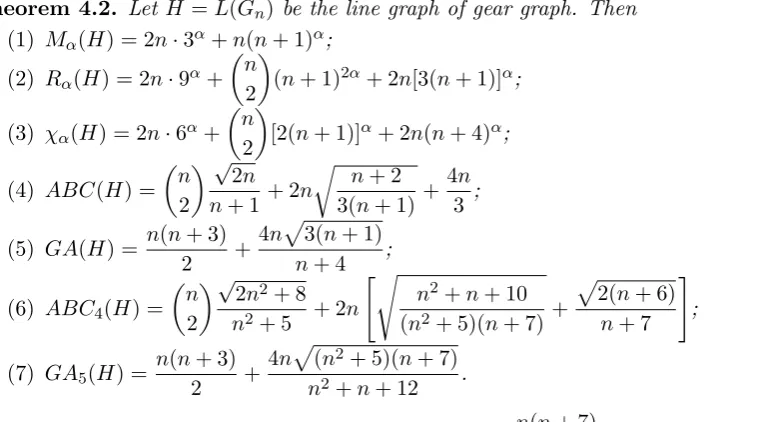
Theorem 4.2. Let H =L(Gn) be the line graph of gear graph. Then
(1) Mα(H) = 2n·3α+n(n+ 1)α;
(2) Rα(H) = 2n·9α+
n
2
(n+ 1)2α+ 2n[3(n+ 1)]α;
(3) χα(H) = 2n·6α+
n
2
[2(n+ 1)]α+ 2n(n+ 4)α;
(4) ABC(H) =
n
2
√
2n n+ 1+ 2n
r
n+ 2 3(n+ 1)+
4n
3 ;
(5) GA(H) = n(n+ 3)
2 +
4np3(n+ 1)
n+ 4 ;
(6) ABC4(H) =
n
2
√
2n2+ 8
n2+ 5 + 2n
"s
n2+n+ 10 (n2+ 5)(n+ 7) +
p
2(n+ 6)
n+ 7
#
;
(7) GA5(H) =
n(n+ 3)
2 +
4np(n2+ 5)(n+ 7)
n2+n+ 12 .
Proof. The line graph of gear graph has 3nvertices and n(n+ 7)
partition, based on the degrees of vertices as shown in Tables 11 and 12. Using formulae (1)–(7) to the information in Table 11 and 12, we obtain the desired result.
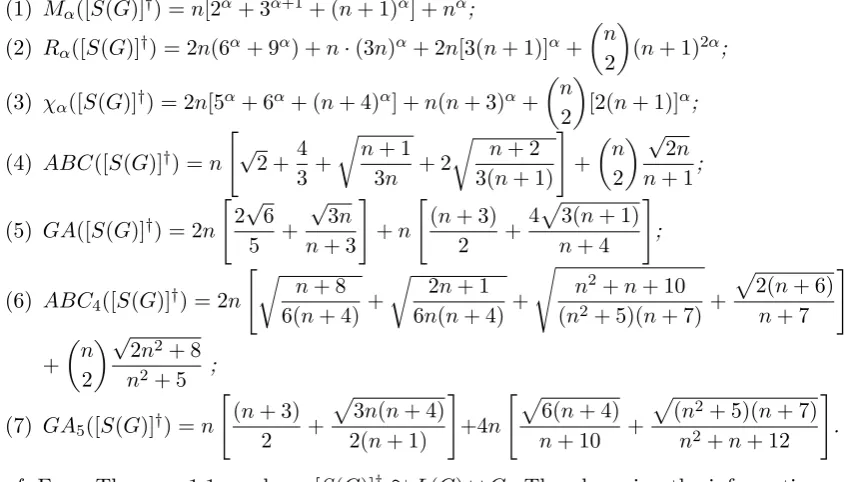
Theorem 4.3. Let[S(G)]†be the derived graph of subdivision graph of gear graphG=Gn. Then
(1) Mα([S(G)]†) =n[2α+ 3α+1+ (n+ 1)α] +nα;
(2) Rα([S(G)]†) = 2n(6α+ 9α) +n·(3n)α+ 2n[3(n+ 1)]α+
n
2
(n+ 1)2α;
(3) χα([S(G)]†) = 2n[5α+ 6α+ (n+ 4)α] +n(n+ 3)α+
n
2
[2(n+ 1)]α;
(4) ABC([S(G)]†) =n "
√
2 +4 3+
r n+ 1
3n + 2 r
n+ 2 3(n+ 1)
#
+
n
2
√
2n n+ 1;
(5) GA([S(G)]†) = 2n "
2√6 5 +
√
3n n+ 3
#
+n "
(n+ 3)
2 +
4p3(n+ 1)
n+ 4
#
;
(6) ABC4([S(G)]†) = 2n
" r
n+ 8 6(n+ 4) +
r
2n+ 1 6n(n+ 4)+
s
n2+n+ 10 (n2+ 5)(n+ 7)+
p
2(n+ 6)
n+ 7
#
+
n
2
√
2n2+ 8
n2+ 5 ; (7) GA5([S(G)]†) =n "
(n+ 3)
2 +
p
3n(n+ 4) 2(n+ 1)
#
+4n " p
6(n+ 4)
n+ 10 +
p
(n2+ 5)(n+ 7)
n2+n+ 12
#
.
Proof. From Theorem 1.1, we have [S(G)]†∼= L(G)∪G. Then by using the information in Theorems 4.1 and 4.2, we obtain the required result.
5. Friendship graph
LetCt(n) denote the one-point union ofncycles of lengtht. The graphC3(n) is called afriendship graph [12].
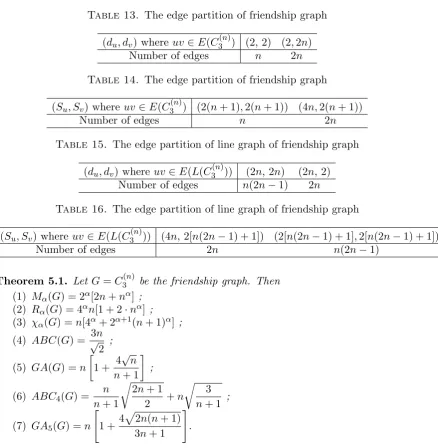
Table 13. The edge partition of friendship graph
(du, dv) whereuv ∈E(C3(n)) (2, 2) (2,2n) Number of edges n 2n
Table 14. The edge partition of friendship graph
(Su, Sv) whereuv∈E(C3(n)) (2(n+ 1),2(n+ 1)) (4n,2(n+ 1))
Number of edges n 2n
Table 15. The edge partition of line graph of friendship graph
(du, dv) whereuv∈E(L(C3(n))) (2n, 2n) (2n, 2) Number of edges n(2n−1) 2n
Table 16. The edge partition of line graph of friendship graph
(Su, Sv) whereuv ∈E(L(C3(n))) (4n, 2[n(2n−1) + 1]) (2[n(2n−1) + 1],2[n(2n−1) + 1])
Number of edges 2n n(2n−1)
Theorem 5.1. Let G=C3(n) be the friendship graph. Then
(1) Mα(G) = 2α[2n+nα];
(2) Rα(G) = 4αn[1 + 2·nα] ;
(3) χα(G) =n[4α+ 2α+1(n+ 1)α];
(4) ABC(G) = √3n
2 ; (5) GA(G) =n
1 + 4
√ n n+ 1
;
(6) ABC4(G) =
n n+ 1
r
2n+ 1 2 +n
r
3
n+ 1 ;
(7) GA5(G) =n "
1 +4
p
2n(n+ 1) 3n+ 1
#
.
Proof. The friendship graph has 2n+ 1 vertices and 3n edges, among them 2n vertices are of degree two and one vertex of degree 2n. Therefore we get the edge partition, based on the degrees of vertices as shown in Tables 13 and 14. Using formulas (1)–(7) to the information in Table 13 and 14, we obtain the desired result.
Theorem 5.2. Let H =L(C3(n)) be the line graph of friendship graph. Then
(1) Mα(H) =n·2α+ (2n)α+1 ;
(2) Rα(H) = 4αn
n2α(2n−1) + 2·nα ;
(3) χα(H) = 4αnα+1(2n−1) + 2α+1n(n+ 1)α ;
(4) ABC(H) =n√2 +(2n−1)
p
(2n−1)
√
2 ;
(5) GA(H) =n(2n−1) +4n
√ n n+ 1;
(6) ABC4(H) =n "r
(2n+ 1) 2n2−n+ 1+
(2n−1)√8n2−4n+ 2 4n2−2n+ 2
#
(7) GA5(H) =n(2n−1) +4n
p
2n[n(2n−1) + 1]
n(2n+ 1) + 1 .
Proof. The line graph of friendship graph has 3n vertices and n(2n+ 1) edges, among themnvertices are of degree two and 2nvertices of degree 2n. Therefore we get the edge partition, based on the degrees of vertices as shown in Tables 15 and 16. Using formulas (1)–(7) to the information in Table 15 and 16, we obtain the desired result.
Theorem 5.3. Let [S(G)]† be the derived graph of subdivision graph of friendship graph G=C3(n). Then
(1) Mα([S(G)]†) = (1 + 2n)(2n)α+ 3n·2α ;
(2) Rα([S(G)]†) =n·4α+ (4n)α+1+n(2n−1)(2n)2α ;
(3) χα([S(G)]†) =n·4α+n(2n−1)(4n)α+ 4n[2(n+ 1)]α ;
(4) ABC([S(G)]†) = √5n
2 +
(2n−1)p(2n−1)
√
2 ;
(5) GA([S(G)]†) = 2n2+8n
√ n n+ 1 ;
(6) ABC4([S(G)]†) =n "
1
n+ 1
r
2n+ 1 2 +
r
3
n+ 1+
r
(2n+ 1) 2n2−n+ 1+
(2n−1)√8n2−4n+ 2 4n2−2n+ 2
#
;
(7) GA5([S(G)]†) = 2n2+
4p2n(n+ 1) 3n+ 1 +
4np2n[n(2n−1) + 1]
n(2n+ 1) + 1 .
Proof. From Theorem 1.1, we have [S(G)]†∼= L(G)∪G. Then by using the information in Theorems 5.1 and 5.2, we obtain the required result.
6. Conclusion
In this paper, we have computed expression for some topological indices of derived graph of subdivision graph of a tadpole graph, a crown graph, a gear graph and a friendship graph.
7. Acknowledgement
1This work is partially supported by the University Grants Commission (UGC), New Delhi, through UGC-SAP DRS-III for 2016-2021: F.510/3/DRS-III/2016(SAP-I).
References
[1] Ashrafi, A. R., Doˇsli´c, T. and Hamzeh, A., (2010), The Zagreb coindices of graph operations, Discrete Appl. Math., 158, pp. 1571-1578.
[2] Basavanagoud, B., Gutman, I. and Gali, C. S., (2015), On second Zagreb index and coindex of some derived graphs, Kragujevac J. Sci., 37, pp. 113-121.
[3] Basavanagoud, B., Gali, C. S. and Patil, S., (2016), On Zagreb indices and coindices of generalized middle graphs, J. Karnatak Univ. Sci., 50, pp. 74-81.
[4] Basavanagoud, B. and Gali, C. S., (2018), Computing first and second Zagreb indices of generalized
xyz–Point-Line transformation graphs, J. Glob. Res. Math. Arch., 5(4), pp. 100-122.
[5] Estrada, E., Torres, L., Rodriguez, L. and Gutman, I., (1998), An atom-bond connectivity index: Modelling the enthalpy of formation of alkanes. Indian J. Chem., 37A, pp. 849-855.
[6] Ghorbani, M. and Hosseinzadeh, M. A., (2010), Computing ABC4 index of nanostar dendrimers, Optoelectron. Adv. Mater.-Rapid Commun., 4(9), pp. 1419-1422.
[8] Hande, S. P., Jog, S. R., Ramane, H. S., Hampiholi, P. R., Gutman, I. and Durgi, B. S., (2013), Derived graphs of subdivision graphs, Kragujevac J. Sci., 37(2), pp. 319-323.
[9] Harary, F., (1969), Graph Theory, Addison−Wesley, Reading.
[10] Hosamani, S. M. and Gutman, I., (2014) Zagreb indices of transformation graphs and total transfor-mation graphs, Appl. Math. Comput., 247, pp. 1156-1160.
[11] Hosamani, S. M., Lokesha, V., Cangul, I. M. and Devendraiah, K. M., (2016), On certain topological indices of the Derived graphs of Subdivision graphs, TWMS J. App. Eng. Math., 6(2), pp. 324-332. [12] Gallian, J. A., (2017), A dynamic survey of graph labeling, Electron. J. Combin.
[13] Kulli, V. R., (2012), College graph theory, Vishwa International Publications, Gulbarga, India. [14] Li, X. and Zhao, H., (2004), Trees with the first three smallest and largest generalized topological
indices, MATCH Commun. Math. Comput. Chem., 50, pp. 57-62.
[15] Randi´c, M., (1974), On characterization of molecular branching, J. Am. Chem. Soc., 97, pp. 6609-6615. [16] Ranjini, P. S., Lokesha, V. and Cangul, I. N., (2011), On the Zagreb indices of the line graphs of the
subdivision graphs, Appl. Math. Comput., 218, pp. 699-702.
[17] Vukicevic, D. and Furtula, B., (2009), Topological index based on the ratios of geometrical and arithmetical means of end-vertex degrees of edges, J. Math. Chem., 46, pp. 1369-1376.
[18] Zhou, B. and Trinajsti´c, N., (2010), On general sum-connectivity index, J. Math. Chem., 47, pp. 210-218.
B. Basavanagoudis a professor in the Department of Mathematics, Karnatak Uni-versity, India. He obtained his Ph. D degree from Gulbarga UniUni-versity, Kalaburgi, Karnataka, India, under the supervision of Prof. V. R. Kulli. He was chairman of the department for two terms, 2010-2012 and 2016-2018. He has more than 30 years of teaching experience, completed 7 research projects and organized 3 international conferences/ workshops, guided 12 M. Phil and 10 Ph. D students. At present 5 stu-dents are working for their Ph. D. He has delivered more than 40 invited /contributed talks and has more than 140 research publications in reputed national/international journals. At present he is an Academic Council member of Karnatak University Dharwad (2017-2019). He is also life member for several academic bodies.