The Impact of Task-based Language Teaching on
ESP Learners’ Productive Skills: From Task-based
Instruction to Investigation of Learners’ and
Instructors’ Attitudes toward the Course
Mohammad Khatib*
Professor of Applied Linguistics, Allameh Tabataba’i University
Ayoub Dehghankar
Ph.D. Candidate of Applied Linguistics, Allameh Tabataba’i University
Abstract
Togetherness of English for Specific Purposes (ESP) and Task-Based Language Teaching (TBLT) has been the subject of many recent studies in English as a Foreign Language (EFL) and English as a Second Language (ESL) domain. Few studies, however, have addressed the impact of TBLT on ESP learners’ linguistic production. This study aimed at investigating the impact of task-based teaching on ESP learners’ speaking and writing. Furthermore, this study aimed to explore the ESP learners’ and instructors’ attitudes toward the nature of program and their perceived needs of tasks to be accomplished in the course. To fulfill this aim, 60 ESP students majoring in Law in 2 different classes at Allameh Tabataba’i University, Iran, and 10 ESP instructors were selected as the participants of the study. Accordingly, the students in one of the two classes received a one-semester long instruction based on the principles of TBLT as the experimental group, while the students in the other class were taught according to the content of the textbook developed for such courses. After the instruction was over, the students were given a set of standardized and teacher-made tests. The results of the data analysis indicated that the experimental group showed a significant difference in terms of improvement in acquiring productive skills. It was also revealed that there were significant differences between the participants’ attitudes regarding the nature of the course and their perceived needs of tasks. The findings of this research could provide an insight into designing opportune syllabi for ESP courses.
Keywords: Task-based language teaching, English for specific purposes, productive skills, attitudes, writing, speaking
INTRODUCTION
Task-based Language Teaching (TBLT), which is regarded as one of the three most significant methodologies extracted from Communicative Language Teaching (CLT) by Brown (2007) and as “a logical development of CLT” by Richards and Rodgers (2001, p. 223), has been the focus of a number of studies so far (e.g., Cao, 2018; Peng & Pyper, 2019). For Long (2016), a task refers to any communicative activity, within which there is a specific linguistic item is practiced as well. TBLT gained more attention when a paradigm shift from a structural to communicative approach was underscored by Richards and Rodgers (2014). The reason for such growing interest in TBLT lie in what Long (2015) called the consistency of this method with the existing 40-year literature as well as its psycho-linguistic plausibility. The same was also confirmed by Han (2018), concluding that those two factors have contributed to the continuation of research on this domain.
TBLT is even being more advocated in various educational contexts after the reports of its success in achieving potential results have been published. It has mainly been examined in teaching English, but not just limited to that. While Carless (2007) attempted to use it for teaching English as a Foreign Language (EFL) in the context of Hong Kong, many other researchers have applied it for teaching other languages. For instance, East (2012) found it applicable for teaching all the existing foreign languages in New Zealand, and the most recent one is Peng and Pyper (2019), who sought to explore the possible effects leading Chinese teachers to embody TBLT in the classrooms. Iran is not an exception to this growing trend regarding the prominent acceptance of TBLT. By far, a number of studies have dealt with the application of this teaching approach to EFL students (e.g., Kamalian, Soleimani, & Safari, 2017; Kazemi & Zarei, 2015; Madhkhan & Mousavi, 2017; Kolaei, Yarahmadi, & Maghsoudi (2013); Mahdavirad, 2017), to the English for Specific Purposes (ESP) (e.g., Mashhadi & Saki, 2018; Sarani & Sahebi, 2012; Setayesh & Marzban, 2017; Tavakoli, Lotfi, & Biria, 2019), and even to students before being accepted to university (e.g., Chalak, 2015).
because the existing literature is replete with studies with a focus on receptive skills (listening and writing) and subskills (vocabulary and grammar). For example, Setayesh and Marzban (2017) conducted a study on the extent TBLT tasks could improve the performance of Law and Mechanical Engineering students’ reading comprehension, and reported the positive impacts of this approach on both genders, but more specifically on females. In another study, taking advantage of technology, Tavakoli, Lotfi, and Biria (2019) focused on the influences of using computer-mediated TBLT on changing non-English learners’ motivation for learning second language (L2) reading. Shabani and Ghasemi (2014) also carried out their study on reading comprehension while focusing on TBLT and Content-Based Language Teaching (CBLT). On the purview of subskills, Sarani and Sahebi (2012) studied the impact of TBLT on Persian literature students’ technical vocabulary development, concluding its significant impact because it boosted their mastery over technical vocabulary in their field of study. A countless of other studies with the same focus can be listed as well, but regarding speaking and writing very few attempts have been recorded so far. Milarisa (2019), for instance, aimed to check the effective of this communicative approach on writing skills and concluded it had a significant impact turning the learning environment active and joyous for the learners. In another study focusing on productive skills, Kafipour, Mahmoudi, and Khojasteh (2018) investigated the effect of TBLT on Iranian EFL learners’ analytic writing. There are not many such examples, though; this shows scant attention has been granted to the effectiveness of TBLT on productive skills, especially for Law students.
number of students including both males and females at State and Azad universities. These issues demand a special contemplation and noteworthy scrutiny on the academic curricula developed and syllabi designed for the students majoring in this discipline from many viewpoints including both those of instructors and learners.
Learners’ attitudes toward courses they undergo has always been of high interest for many scholars (e.g., Genc & Aydin, 2017; Pae, 2017). However, some of the previous studies on this area have focused on examining students or instructors’ attitudes regarding different aspects of learning English as well. For instance, Moussu (2010) investigated the perspectives of native and non-native English students toward learning English and the impact of their first language on that in the context of America. In EFL contexts, many studies have dealt with this notion of attitudes as well. Cheung (2002), for example, conducted a similar study on students’ and teachers’ attitudes in Hong Kong and reported the influential effect of their perspectives on learners’ achievement. The present study, which sought to explore the attitudes of the participants of the study (both learners and instructors), toward the nature of the course, was also motivated by the results of such previous studies.
Considering the issues mentioned above, this research aimed to study and analyze the status of English for Specific Purposes (ESP) in one of the universities in Tehran, namely Allameh Tabataba’i University, and the impacts of adopting Task-based Language Teaching (TBLT) on the productive skills of students of Law as an ESP course. In addition, the study sought to find out whether there was a significant difference in the attitudes of ESP learners and instructors toward the overall nature of the course. It is accordingly expected that the results of this study throw some light on the existing, albeit incomprehensive and inadequate, literature, which has focused on productive skills of law students.
LITERATURE REVIEW
Association of ESP and TBLT
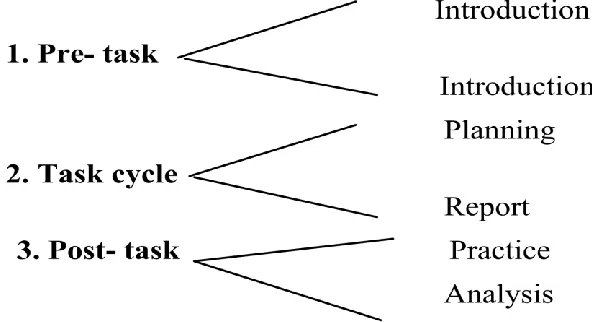
TBLT is “an approach based on the use of tasks as the core unit of planning and instruction in language teaching.” The importance of tasks on different aspects of language learning such as assessing students’ achievement and its inclusion in syllabus design was also highlighted by Nunan (2004). The same claim was also made by Ellis (2003), as the pioneer of developing tasks, who pinpointed the centrality of tasks in acquiring L2. Ellis, accordingly, devised a three-phase procedure, starting with pre-task, which aims to prepare learners to engage in the during task activities by motivating them and activating topic-based lexical resources. In the task phase, learners make use of all their linguistic knowledge to both get the task completed and gain its goals. Based on the post-task phase, which deals specifically with form-focused practice, learners are required to report what they have finalized in an oral or written format to the class. This whole TBLT procedure can be summarized in Willis’s (1996) framework, which can be regarded as a guide for implementing tasks in classroom settings.
Figure 1: Phases of applying TBLT to classroom (Adopted from Willis, 1996)
methods applied to ESP courses because it emphasizes target language use by the learners for communicative purposes. That is why in spite of the rising and falling of different theories and methods, TBLT has been able to optimally cope with the new trends and findings in cognitive and educational psychology (Baralt & Morcillo Gómez, 2017).
Willis’s framework has also been extensively used in ESP courses, more specifically in receptive skills and subskills, as it was previously shown. This highlights the point that more weight should be given to applying the TBLT framework in productive skills as well. From the emergence of ESP in the realm of EFL/ESL, many other theories have been posed by different scholars and researchers, desiring to find out which method and approach is optimal for teaching ESP courses (Richards & Rodgers, 2001). In spite of the differences and divergences in these theories, what all have in common, as Dudley-Evans and St. John (1998) stated, is the awareness of needs. Because the unique and idiosyncratic feature of each ESP course is dealing with needs, wants, and language lacks of learners as the basis of syllabus design (Hutchinson & Waters, 1987), ESP is regarded as applied English language teaching (ELT). This means that introducing a topic to ESP learners, which is the first stage in the pre-task phase, is deemed to address their needs. In addition to meeting the needs, this study used TBLT, as the underlying methodology and provided specific language which was appropriate to the assigned activities regarding genre, lexical resource, grammar, and genre. All these features are known as the absolute characteristics of all ESP courses (Dudly-Evans & St John, 1998); thus, the applicability of TBLT in ESP courses, which has already been confirmed by previously cited scholars, can be claimed anew, for productive skills.
Mountford (1978), the word specific in ESP refers to the special reason or purpose for which learners desire to learn English; hence, different courses, based on their different needs and goals, focus differently on language skills. On the other hand , according to more recent studies, the source of such diversity, could be due to distinctive and idiosyncratic differences among ESP learners including cognitive differences (Kim, Payan, & Pearson, 2015) as well as emotional variances and dissimilarities (Gurzynski-Weiss & Baralt, 2014). Through making use of the learners’ individual differences, the researchers aimed to find the effects of TBLT on productive skills of ESP courses prepared for Law students.
Productive Skills: Description and Significance
According to Olshtain and Cohen (1991), if one wants to master a second or foreign language, one needs to be communicatively competent. The term Communicative Competence was coined in 1996 by Hymes reacting against Chomskyan Linguistic Competence. While Chomsky coined the term Linguistic Competence in 1965, and defined it as the system of linguistic knowledge possessed by all native speakers of a language, one year later, Hymes introduced the notion of Communicative Competence, indicating the inadequacy of syntax, morphology, and phonology to fulfill meaningful interactions. He asserted that in addition to linguistic competence, for a meaningful communication, the speakers of a particular language need a kind of social knowledge about how and when to use the language appropriately.
The dichotomy of usage/use implies the principal function of language. According to Mackay, Davis, and Fanning (1995), from all other functions, the main function of language is the expression of oneself or self-expression. It includes expressing thoughts, feelings, observation, needs, and so forth. This implies that since the phenomenon of language is humane and unique to human beings, it is pivotal to master the active skills, namely speaking and writing, without which the main function of language cannot be fulfilled by the users of language.
language accuracy, proficient instructors should focus on promoting communicative competence of language learners. The importance of productive skills motivated Roquet and Pérez-Vidal (2015) to examine the impacts of content and language integrated learning (CLIL) and formal instruction, as two different contexts of learning, on the productive skill of intermediate learners. The results proved that the learners’ writing skills improved in both contexts, in an insignificant way. All these inspired the researchers in this study to investigate the effectiveness of TBLT on ESP learners’ productive skills of writing and speaking.
Students and Instructors’ Attitudes toward ESP Courses
Owing to the growing interest in the English as an international language (Jordan, 1997) and the increasing attention to technology for educational purposes (Atai & Dashtestani, 2013), there is a demand for promoting ESP courses globally (Eslami, 2010). Although there has been a great endeavor has been done to oppose westernization of Iran after the Islamic revolution (Eslami, 2010), the demand and tendency of university students to technical English in today’s world has opened the door for ESP courses to find their way at Iranian universities as well. This resistance from the government against English can affect learners and instructors’ perspectives toward it too. A number of Iranian studies have by far examined learners and teachers’ attitudes toward ESP programs, mainly the ones enriched with technology (Atai & Dashtestani, 2013). According to Eslami (2010, p. 3), scant attention has been paid to “the effectiveness of these programs from learners’ and instructors’ perspectives.” This study, which also employed TBLT to ESP, is an attempt to respond to a dearth of literature with a focus on the effect of TBLT on the ESP course, while concentrating on both learners and instructors’ attitudes.
PURPOSE OF THE STUDY
practitioners, namely teachers and students, regarding their teaching materials.
Having these purposes in mind, this research was conducted to answer the following questions:
1. Is there any significant difference between the overall performance of ESP students in terms of productive skills in TBLT and Non-TBLT classes?
2. Is there any difference between the attitudes of ESP learners and those of the instructors toward the nature of the course and their perceived needs of tasks?
METHOD
Participants
The participants of this study included 60 students majoring in Law at the Bachelor of Arts (BA) level at Allameh Tabataba’i University in Tehran, Iran. They were at their sophomore year in university and ranged between 19 to 24 years in age. They included both males (N=24) and females (N=36). They consisted of two intact classes, each containing 30 students. Because the students had already passed the Iran’s University Entrance Exam (Konkoor) and were assigned to two classes based on the educational system of the faculty, the sampling method was based on the judgment or purposive strategy. This way thehomogeneity of participants was taken for granted. As for the second research question, 10 university instructors participated in the study based on the convenient sampling method. They were PhD holders who ranged in age from 29 to 55 years old. They enjoyed teaching experiences between 4 and 23 years.
Instrumentation
As for the second research question, to collect the required data, a triangulation method was used. First, a slightly moderated version of a validated questionnaire (Huh, 2006) was used to collect the views and attitudes of both ESP learners and instructors toward the course. The questionnaire was reliable as well as its Cronbach alpha (α), reported by its developer, was .98. Then, to verify, substantiate, and intensify the data collected by means of the questionnaire, a set of semi-structured interviews was utilized as the instrument for data collection.
Data Collection Procedure
This research was a whole-semester long undertaking that lasted about five months. Upon the beginning of the educational year, the participants underwent a sixteen-week instruction phase. The experimental group was treated based on the principles of TBLT, while the students in the control group received no TBLT instruction. They were taught according to the content of a textbook written for the Iranian students of Law. The book was entitled “English for the Students of Public Law,” that was published in 2017 by Iran’s Organization for Research and Composing University Textbooks in the Humanities (SAMT).
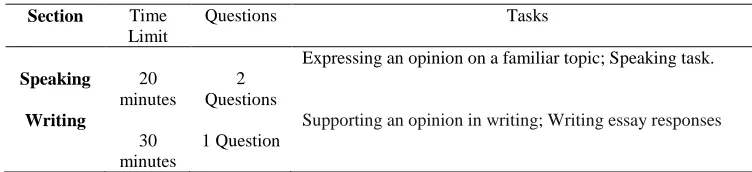
Each week the students received four hours of education divided into two sessions, each lasting two hours. In the first two weeks, the students were given both writing and speaking pretests. The pretests were in line with the independent sections of TOEFL tests in which test takers had to provide their answers through speaking about or writing their ideas, opinions, or attitudes on a given subject or topic. They were of different forms and styles, such as agree/disagree, opinion, preference, give advice, and so forth. It took 20 minutes for each participant to answer two speaking questions, and 30 minutes to answer one writing question. The whole pretest procedure is shown in the Table 1.
Table 1: Pretest Procedure
Section Time
Limit
Questions Tasks
Speaking 20
minutes
2 Questions
Expressing an opinion on a familiar topic; Speaking task.
Writing
30 minutes
1 Question
After the preliminary data were gathered by means of writing and speaking pretests, the participants went through a 16-week instruction. During the semester, the students in the experimental group were taught based on the principles of TBLT. Each class time was divided into three parts. In the first part, the students were engaged in the pre-task phase. In this phase, that took 20 to 30 minutes, one of the researchers acted as the instructor and tried to prepare the students to fulfill the task. According to Lee (2000) and Dornyei (2001), the main purpose of pre-task is to motivate students for doing the task. They asserted that a task should be presented in a way that stimulates the students’ interest and attentiveness. In this regard, the researcher tried to choose the topics and subjects in line with the students’ specific reason for learning English including the real-life activities they have to do in beyond-the-classroom situations. In this phase, all task topics were chosen based on a brainstorming discussion.
Then, the students engaged in the main phase of fulfilling the task. Depending on the task type, they did it individually or in small groups consisting three or four students. Sometimes, the whole class was involved in accomplishing the task. However, in rare occasions that the students’ proficiency was not high enough to complete the task, the teacher/researcher intermediated as a facilitator. Because one of the main dimensions of task is authenticity (Ellis, 2005), the teacher took much care to select tasks that corresponded to the learners’ real-world activities. This was not that difficult because as far as Law was concerned as the subject matter, there were various activities that they had to master in their professional career. In each session, 60 to 70 minutes were devoted to this phase, and different types of tasks, such as focused and unfocused tasks as well as different task categories like information-gap, opinion-gap, and reasoning gap activities were utilized (Prabhu, 1987).
tasks.
As for the control group instruction, the students engaged in a set of reading comprehension, fill in the blanks, true/ false and translation exercises in each session according to the content of the textbook.
After the instruction phase was over, the students were given a set of post-tests as their final examination. The posttests were similar to the pretests in terms of type and format (see Table 1).
To collect the required data for the second research question, a moderated version of a questionnaire, designed and validated for ESP practitioners (Huh, 2006), was distributed among the participants. Then, a series of semi-structured interview was administered (see Appendices 1and 2). Finally, based on this triangular method of data collection, the obtained data were analyzed by means of statistical tests.
Data Analysis
Having collected the required data, the researcher initiated analyzing them. This study was an experimental one in essence in that a set of variables were kept constant while the other set of variables were being measured as the subject of experiment. This reflects Mackey and Gass’s (2005) definition, stating that in an experimental research design, the researcher tries to set a cause-effect relationship and verify the impact of the cause/independent variable on the effect/dependent variable. Accordingly, in this study, the experiment was conducted to examine the impact of TBLT as the independent variable on ESP learners’ productive skills as the dependent variable. However, since the participants were not randomly selected and assigned to the two groups, from all other types of experimental design, it was, a quasi-experimental one. In addition, since there were measurements that were taken both before and after the treatment, the research enjoyed a pretest and posttest quasi-experimental design.
posttest. Fourth, to examine the consistency of responses to the items in the questionnaire, a reliability analysis was performed. Fifth, to determine whether there was a significant difference between the frequencies of the respondents’ answers a Pearson's chi-squared test was performed. Finally, the views and attitudes of the respondents regarding the items in the questionnaire were analyzed using Kruskal Wallis test. The analysis of the data was carried out by means of Statistical Package for the Social Sciences (SPSS Software, ver 24; 2016).
RESULTS
To answer the first research question, the pretest results for the two groups, the pretest/posttest results of the experimental and the control groups, as well as the posttest results for the two groups were examined. To answer the second research question, based on the instruments used in the study, including the questionnaire and the semi-structured interview, a set of nonparametric tests was conducted.
The Pretest Results
Before starting the treatment, a pretest was given to both control and experimental groups. They were equal in size, each consisting of 30 students. Before running thepaired samples t-test, the data were checked to ensure they were extracted from a normally distributed sample population. Regarding the measures of central tendency, the two groups were almost at the same level. The mean of the two groups was calculated out of 100. As for the measures of dispersion or variability, however, the standard deviations of the groups revealed that the students in the experimental group showed a higher deviation from the mean, indicating that the students in the experimental group were more heterogeneous than those in the control group. To check if there was any meaningful difference between the two groups, an independent samples t-test was administered in Table 2.
Table 2: Independent samples t-test for the performance of control and experimental on the pretest
M t df Sig (2-tailed)
Control Group 50.99 .991 58 .311
Experimental Group 41.51 .991 58 .311
As shown in Table 2, the observed t value at p<.05 with 58 degrees of freedom is .991 (sig.422). This is in accordance with the research presupposition that the two groups were not significantly different in terms of proficiency in productive skills.
The Pretest/Posttest Results for the Experimental Group
The descriptive statistics for the experimental group in Table 3 indicates that the posttest mean of the experimental group was different from that of the pretest. However, the researchers needed to see if the difference was significant or not, so a paired samples t-test was run to check the effectiveness of the instruction.
Table 3: Experimental group pretest/posttest results based on paired samples t-test statistics
Experimental Group
Number M SD Std.Error Mean
t df Sig.
(2-tailed) Pretest 30 41.51 13.76 2.22 1.2 59 .08 Posttest 30 65.33 7.28 1.99 7.66 59 .00
P<.05
As Table 3 shows the obtained p-value of this test at p<.05 with 59 degrees of freedom was larger enough than the critical value, and the same was true for t-value with T (t critical = 2.00). Through this, it can be concluded that the difference between the two means was significant, showing that the treatment used in this study was effective in improving the participants’ mastery over productive skills, t(59)=7.66, p=0.00.
The Pretest/Posttest Results for the Control Group
Table 4: Control group pretest/posttest results based on paired samples t-test statistics
Experimental Group
Number M SD Std.Error Mean
t df Sig. (2-tailed) Pretest 30 50.99 13.76 2.22 1.3 59 .09 Posttest 30 56.88 9.12 1.43 1.88 59 .07
P<.05
To examine the statistical meaningfulness of the difference between the two means, a paired samples t-test was run. The results, as shown in Table 4, indicated that the participants in the control none-TBLT group did not significantly improve their performance in language productive skills in the posttest, t(59)=1.88, p=0.07.
The Posttest Results for the Two Groups
The final phase of data analysis was conducted to examine the performance of the two groups in the posttest in comparison to that in the pretest. The statistics showing the performance of the control and experimental groups on the posttest, illustrated in Table 5, indicated that there was a significant difference between mastery of the experimental group and the control group over the language productive skills of writing and speaking, t(58)=2.92, p=0.00.
Table 5: Paired samples t-test statistics on the posttest for experimental and control groups
Groups Number Mean Std. Deviation
Std. Error Mean
t df Sig. (2-tailed)
Control Group 30 56.88 8.76 1.22 1.62 58 .27 Experimental
Group
30 65.33 9.33 1.59 2.92 58 .00*
P<.05
Comparing the Participants’ Attitudes
As for the second research question, first of all, to analyze the internal consistency of the questionnaire items, a reliability Cronbach’s alpha test was performed. In this test, the numerical value of the Cronbach’s alpha for the whole questionnaire equaled .82. Therefore, the internal reliability of the questionnaire items was defined at a good level and more than acceptable (Peters, 2014). In addition, the internal consistency of different categories of the questionnaire was calculated; the results were indicative of .86 for the first category (Informal Correspondence and Interaction), .79 for the second category (Formal Writing), and .81 for the third category of the questionnaire (Oral Satisfaction).
Table 6: Descriptive and Chi square analysis of the questionnaire
Items Mean SD Chi
square
df Asymp. Sig.
Email 2.12 .781 59.930a 3 .000
Phone Call 2.05 .913 59.930a 3 .000
Fax 1.72 1.009 59.930a 3 .000
Writing a Letter 2.47 .774 59.930a 3 .000 Writing a Memorandum 1.80 1.760 59.930a 3 .000 Writing a Proposal 2.36 1.231 59.930a 3 .000 Writing a Report 2.29 .859 59.930a 3 .000 Writing a Contract 2.44 1.444 59.930a 3 .000 Placing an order 2.97 .835 59.930a 3 .000 Receiving an order 2.36 1.411 59.930a 3 .000 Dealing with claims 1.99 .877 59.930a 3 .000
Briefing 2.01 .790 59.930a 3 .000
Presentation 2.88 .751 59.930a 3 .000
Negotiation 2.64 1.349 59.930a 3 .000
Conference 2.78 1.502 59.930a 3 .000
Seminar 2.61 .699 59.930a 3 .000
Social/Private meeting 2.18 .855 59.930a 3 .000 Business Trip to Foreign Countries 2.79 1.007 59.930a 3 .000 Making a Reservation 2.80 .790 59.930a 3 .000 Visiting Other People 2.55 .766 59.930a 3 .000
Sightseeing 1.22 0.753 59.930a 3 .000
Attending to Foreign Guests 2.84 1.112 59.930a 3 .000
Interpretation 2.12 .788 59.930a 3 .000
Translation 3.46 .768 59.930a 3 .000
Gathering Information 2.33 1.448 59.930a 3 .000 Reading Articles, Magazines, and Books
Related to Your Job
Assessing the Views of Participants Based on Marking
Pattern
To examine the responses of participants to the prompts in the questionnaire, a Chi-squared test was performed. Based on Table 6, the results indicated that there was a significant difference in selecting the choices by participants. As the results revealed, for all items a significant value was found. Accordingly, the results of the Chi-squared test indicated that there was a significant difference in selecting the choices by participants.
Assessing the Views of Participants based on the Single Items
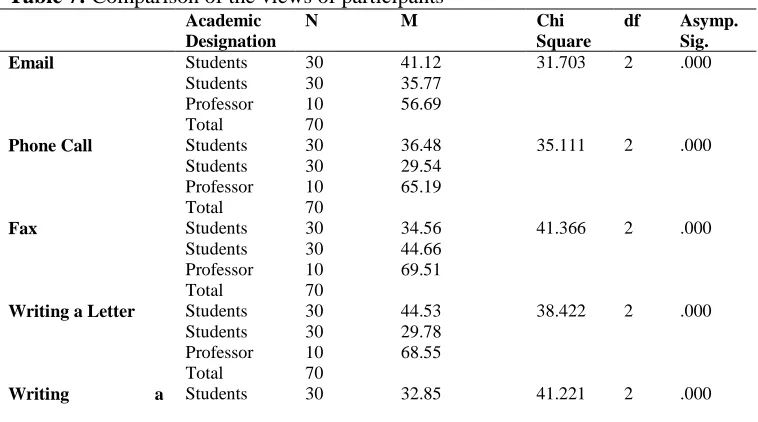
For the final stage of statistical procedure, a Kruskal Wallis test was run to examine the participants’ views on the prompts in the questionnaire. The results, shown in Table 7, revealed that there were significant differences in the views and attitudes of the participants on any single item of the questionnaire. Accordingly, it could be inferred that, as far as the academic and professional careers of the participants are concerned, any of these tasks could work differently in improving their mastery over language productive skills.
Table 7: Comparison of the views of participants
Academic Designation
N M Chi
Square
df Asymp.
Sig.
Email Students 30 41.12 31.703 2 .000
Students 30 35.77 Professor 10 56.69 Total 70
Phone Call Students 30 36.48 35.111 2 .000
Students 30 29.54 Professor 10 65.19 Total 70
Fax Students 30 34.56 41.366 2 .000
Students 30 44.66 Professor 10 69.51 Total 70
Writing a Letter Students 30 44.53 38.422 2 .000
Students 30 29.78 Professor 10 68.55 Total 70
Memorandum Students 30 39.54 Professor 10 70.19 Total 70
Writing a Proposal Students 30 27.33 32.355 2 .000
Students 30 37.44 Professor 10 55.70 Total 70
Writing a Report Students 30 36.29 31.701 2 .000
Students 30 39.11 Professor 10 59.75 Total 70
Writing a Contract Students 30 31.67 36.254 2 .000
Students 30 35.88 Professor 10 68.26 Total 70
Placing an order Students 30 32.32 28.032 2 .000
Students 30 61.77 Professor 10 24.76 Total 70
Receiving an order Students 30 45.23 28.541 2 .000
Students 30 28.48 Professor 10 60.76 Total 70
Dealing with claims Students 30 29.32 31.689 2 .000
Students 30 40.26 Professor 10 55.96 Total 70
Briefing Students 30 32.77 36.154 2 .000
Students 30 35.43 Professor 10 70.56 Total 70
Presentation Students 30 33.67 38.223 2 .000
Students 30 25.78 Professor 10 79.11 Total 70
Negotiation Students 30 34.22 35.433 2 .000
Students 30 41.99 Professor 10 65.74 Total 70
Conference Students 30 40.05 34.443 2 .000
Students 30 30.44 Professor 10 62.17 Total 70
Seminar Students 30 34.66 27.709 2 .000
Students 30 32.95 Professor 10 67.11 Total 70
Social/private meeting
Professor 10 66.51 Total 70
Business Trip to Foreign Countries
Students 30 26.90 35.345 2 .000 Students 30 38.43
Professor 10 70.00 Total 70
Making a
Reservation
Students 30 36.12 39.643 2 .000 Students 30 45.33
Professor 10 69.59 Total 70
Visiting Other
People
Students 30 34.78 38.122 2 .000 Students 30 34.98
Professor 10 72.67 Total 70
Sightseeing Students 30 30.56 35.177 2 .000
Students 30 37.79 Professor 10 69.71 Total 70
Attending to
Foreign Guests
Students 30 26.92 32.553 2 .000 Students 30 37.43
Professor 10 67.12 Total 70
Interpretation Students 30 29.70 36.433 2 .000
Students 30 36.80 Professor 10 71.17 Total 70
Translation Students 30 29.70 26.709 2 .000
Students 30 39.07 Professor 10 61.99 Total 70
Gathering Information
Students 30 29.44 34.346 2 .000 Students 30 39.74
Professor 10 71.32 Total 70
Reading Articles,
Magazines, and
Books Related to Your Job
Students 30 43.65 32.047 2 .000 Students 30 65.11
Professor 10 66.73 Total 70
DISCUSSION
language proficiency in one ad-hoc research due to time constraint and academic limitations. Considering the fact that the notion of ESP is associated with the practitioners’ professional activities in their real-life milieu (Dudley Evans & St John, 1988), this study tried to investigate the impact of TBLT on the participants’ productive skills.
To fulfill this goal, two intact classes of BA students were selected as the participants of the study. Accordingly, the TBLT approach was administered to one of the classes as the experimental group, but the other class received no treatment. Upon conducting a series of statistical tests, it was revealed that TBLT did positively affect the ESP students’ mastery over productive skills, namely speaking and writing. Likewise, the results of this research indicated that there were significant differences among the views and attitudes of the students and professors with regard to the tasks they need to perform in their academic and professional undertaking. This is a very noteworthy issue, from which it could be inferred that the specificity of ESP is much more idiosyncratic than what was believed so far (Hyland, 2002; Widdoson, 1983). In other words, it could be claimed that as regards ESP, it could be unique in terms of the activity type, and it could be unique depending on different practitioners, learners, instructors, and professionals.
One considerable issue in this study was that the observed improvement in students’ performance in the posttest compared to that in the pretest was in a situation where the students’ final examination functioned as the posttest. This is more noteworthy when the students could be naturally susceptive of and prone to test anxiety (Andrews & Wilding, 2004). Although test anxiety could negatively affect the students’ performance in their final examination as the posttest (Pritchars & Wilson, 2003), the results indicated that the students’ performance in the TBLT class was significantly higher than that of the non-TBLT class. This issue per se could be the subject of another research study.
It is worth mentioning that the results of this study were in agreement with those of some other studies on the possible impact of TBLT on ESP learners’ language skills. However, this study was unique in dealing with the ESP learners’ productive skills, with which no other previous studies dealt. In the following, several cases of such studies in the academic context of Iran and other countries are touched upon as a cross-reference.
on ESP classes, regarding productive skills. This was in line with Shabani and Ghasemi (2014), although a skill other than the one tested in our study was investigated. They studied the effect of TBLT and content-based language teaching (CBLT) on the Iranian intermediate ESP learners’ reading comprehension. According to the results of this study, TBLT was more effective than CBLT in teaching reading comprehension to Iranian ESP learners. Although in the present study gender was not focused, the results were in agreement with those in Setayesh and Marzban (2017). They investigated the impact of TBLT on the development of Iranian ESP learners’ reading comprehension skills, majoring in Law and Mechanical engineering. In this study, the researchers investigated the impact of gender and academic discipline on the ESP learners’ performance when they were exposed to TBLT instruction. The results showed that both gender and academic discipline could be effectual in the overall performance of the ESP students. The results were also consistent with Chalak (2015), who tried to study the impact of TBLT on Iranian high school female students’ reading comprehension skills, and verified the positive impact of TBLT on the improvement of students’ reading skills at the pre-university levels.
As a shift in the research focus from ESP to EFL, Kolaei, Yarahmadi, and Maghsoudi (2013) investigated the impact of TBLT on EFL learners’ reading comprehension ability. The results, contrary to the previous ones, showed that TBLT had no significant impact on the EFL students’ performance. However, in another study, which confirm the association between TBLT and ESP in concordance with our study, Kafipour, Mahmoudi, and Khojasteh (2018) found out that TBLT improved EFL learners’ writing competence and other sub-skills such as vocabulary and sentence mechanics. The effectiveness of TBLT on ESP courses, specifically in terms of productive skills, was further supported by Milarisa (2019).
of supplementing the Internet in their classes, they did not use any Internet-oriented activities. However, the results failed to support Eslami’s (2010) results, based on which there was discrepancy between learners and instructors’ attitudes toward EAP.
CONCLUSION AND IMPLICATIONS
The present study aimed at exploring the influence of TBLT on the ESP learners’ productive skills and checking their attitudes along with those of ESP instructors toward the overall nature of the TBTL-enriched ESP program. The miscellaneous results of all these studies indicate that the togetherness of TBLT and ESP is still of high importance in the literature of language learning and teaching. In fact, this issue could be scrutinized from different viewpoints and dimensions such as the context of learning and teaching, language learners’ field of study, participants’ gender, level of study, skills and sub-skills under investigation, the practitioners involved, and the forth. Accordingly, all these factors and aspects could be different subjects for further research provided that they focus on productive skills of learners. In addition, if all these are combined with the use of the Internet, the results might be more fruitful. In the same vein, checking learners’ attitudes while adding Internet-based TBLT activities in ESP courses can be another area to be explored by other researchers.
This research, however, was unique from two viewpoints. Foremost, it was the first study surveying the relationship between TBLT and ESP with a focus on the learners’ productive skills. In this regard, very few studies in the literature dealt with the impact of TBLT on ESP learners’ productive skills; most of the research corpus available dealt with such receptive skills as reading. Second, this research tried not only to adopt a quantitative approach toward the topic, but also to maintain a qualitative approach. The triangular method of data collection, including test, questionnaire, and interviews provided the researchers with a more representative and crystal-clear insight of the issue under research.
To conclude, the findings of this study could be utilized by the ESP instructors and syllabus designers in order to improve the students’ proficiency in both productive language skills by means of adopting task-based method and appropriate materials. This demands ESP instructors to stay up to date and use new teaching approaches such as TBLT so that they can run interactive classrooms with students who have different English proficiency levels; a point which is common in the Iranian university contexts (Eslami, 2010).
References
Andrews, B., & Wilding, J. M. (2004). The relation of depression and anxiety to life-stress and achievement in students. British Journal of Psychology, 95(4), 509–521.
Atai, M. R., & Dashtestani, R. (2013). Iranian English for academic purposes (EAP) stakeholders' attitudes toward using the Internet in EAP courses for civil engineering students: promises and challenges. Computer Assisted Language Learning, 26(1), 21-38.
Baralt, M., & Morcillo Gómez, J. (2017). Task-based language teaching online: A guide for teachers. Language Learning & Technology, 21(3), 28–43.
Brown, H.D. (2007). Teaching by Principles: An Interactive Approach Language Pedagogy (2nd Ed.).New York: Pearson Education.
Cao, P. T. H. (2018). Task-Based Language Teaching: Affordances and Challenges in TBLT Implementation at the Vietnamese Tertiary Level. Journal of Asia TEFL, 15(2), 510-515.
Carless, D. (2007). The suitability of task-based approaches for secondary schools: Perspectives from Hong Kong. System, 35(4), 595-608.
Chalak, A. (2015). The effect of task-based instruction on reading comprehension of Iranian EFL learners. Applied Research on English Language, 4(1), 19-30.
Chomsky, N. (1965). Aspects of the theory of syntax. Cambridge: M.I.T. Press. Cheung, Y. L. (2002). The attitude of university students in Hong Kong towards
native and non-native teachers of English. (Unpublished Master’s thesis).
The Chinese university of Hong Kong, Shatin, Hong Kong.
Crookes, G. (1986). Task classification: A cross-disciplinary review. Technical Report No. 4. Honolulu: Center for Second Language Classroom Research, Social Science Research Institute, University of Hawaii.
Dornyei, Z. (2001). Motivational strategies in the classroom. Cambridge: Cambridge University Press.
purposes: A multi-disciplinary approach. Cambridge: Cambridge University Press.
East, M. (2012). Task-based language teaching from teachers’ perspective: Insights from New Zealand. Amsterdam: John Benjamin Publishing.
Ellis, R. (2003). Task-based language learning and teaching. Oxford: Oxford University Press.
Ellis, R. (2005). Planning and task performance in a second language. Amsterdam: Benjamins.
Eslami, Z. R. (2010). Teachers' voice vs. students' voice: A needs analysis approach to English for academic purposes (EAP) in Iran. English Language Teaching, 3(1), 3-11.
Genc, Z. S., & Aydin, F. (2017). An Analysis of Learners' Motivation and Attitudes toward Learning English Language at Tertiary Level in Turkish EFL Context. English Language Teaching, 10(4), 35-44.
Gurzynski-Weiss, L., & Baralt, M. (2014). Exploring learner perception and use of task-based interactional feedback in FTF and CMC modes. Studies in Second Language Acquisition, 36(1), 1-37.
Han, Z.-H. (2018). Task-based learning in task-based teaching: Training teachers of Chinese as a foreign language. Annual Review of Applied Linguistics, 38, 162–186.
Huh, S. (2006). A Task-based needs analysis for a business language course.
Second LanguageStudies, 24(2), 1-64.
Hutchinson, T., & Waters, A. (1987). English for specific purposes. Cambridge: Cambridge University Press.
Hyland, T. (2002). On the upgrading of vocational studies: Analysing prejudice and subordination in English education, Educational Review, 54(3), 287-296.
Hymes, D. (1966). Two types of linguistic relativity. In W. Bright (Ed.), Sociolinguistics (pp. 114–158). The Hague: Mouton.
IBM Corp. (2016). IBM SPSS Statistics for Windows, (Version 24.0.). Armonk, NY: IBM Corp.
Jordan, R.R. (1997). English for academic purposes: a guide and resource book for teachers. New York, NY: Cambridge University Press.
Kafipour, R., Mahmoudi, E., & Khojasteh, L. (2018). The effect of task-based language teaching on analytic writing in EFL classrooms. Cogent Education,
5(1), 1-16.
Kamalian, B., Soleimani, H., & Safari, M. (2017). The Effect of Task-based Reading Activities on Vocabulary Learning and Retention of Iranian EFL Learners. Journal of Asia TEFL, 14(1), 32-46.
Presentation: Extensive Speaking Assessment Task of Iranian EFL Learners in TBLT. International Journal of Applied Linguistics and English Literature, 4(3), 93-97.
Kim, Y., Payant, C., & Pearson, P. (2015). The intersection of task-based interaction, task complexity, and working memory: L2 question development through recasts in a laboratory setting. Studies in Second Language Acquisition, 37(3), 549-581.
Kolaei, N. N., Yarahmadi, M., & Maghsoudi, M. (2013). The effect of task-based approach on Iranian EFL learner’s reading comprehension ability. Indian Journal of Fundamental and Applied Life Sciences, 3(3), 404-416.
Lee, J. (2000). Tasks and communicating in language classrooms. Boston: McGraw-Hill.
Long, M. H. (2015). Second language acquisition and task-based language teaching.Oxford: Wiley-Blackwell.
Long, M. H. (2016). In defense of tasks and TBLT: Nonissues and real issues.
Annual Review of Applied Linguistics, 36, 5–33.
McKay, M., Davis, M. & Fanning, P. (1995). Messages: Communication skills book, (2nd Ed.) Oakland, CA: New Harbinger Publications.
Mackey, A., & Gass, S. (2005). Second language research: Methodology and design. NJ: Lawrence Erlbaum.
Mackay. R., & Mountford, J. (1978). English for specific purposes: A case study approach. Essex: Longman.
Madhkhan, M., & Mousavi, S. M. (2017). The Effect of Implementation of TBLT in Reading Comprehension Classes of Iranian EFL Learners. English Language Teaching, 10(11), 119-128.
Mahdavirad, F. (2017). Task-Based Language Teaching in Iran: A Study of EFL Teachers’ Perspectives. International Journal of English Language & Translation Studies, 5(4), 14-21.
Milarisa, S. (2019). The Effectiveness of Task Based Language Teaching (TBLT) Toward ESP Students’ Writing Achievement. English Language in Focus (ELIF), 1(2), 121-126.
Moshfeghi, F. (2017). English for the students of public law. Iran: SAMT
Moussu, L. (2010). Influence of teacher‐contact time and other variables on ESL students' attitudes towards native‐and nonnative‐English‐speaking teachers.
TESOL quarterly, 44(4), 746-768.
Nunan, D. (2004). Task-based language teaching. Cambridge: Cambridge University Press.
Pae, T. I. (2017). Effects of the differences between native and non-native English-speaking teachers on students’ attitudes and motivation toward learning English. Asia Pacific Journal of Education, 37(2), 163-178.
Peng, Y., & Pyper, J. S. (2019). Finding success with pedagogical innovation: A case from CSL teachers’ experiences with TBLT. Language Teaching Research, 1362168819862132. https://doi.org/10.1177/1362168819862132
Peters, G. Y. (2014). The alpha and the omega of scale reliability and validity: Why and how to abandon Cronbach’s alpha and the route towards more comprehensive assessment of scale quality. European Health Psychologist,
16(2), 56–69.
Pritchard, M. E., & Wilson, G. S. (2003). Using emotional and social factors to predict student success. Journal of college student development, 44(1), 18-28.
Prabhu, N. S. (1987). Second language pedagogy. Oxford: Oxford University Press.
Richards, J. & Rodgers, T. (2001). Approaches and methods in language teaching. Cambridge: Cambridge University Press.
Richards, J., & Rodgers, T. (2014). Approaches and methods in language teaching
(3rdEd.). Cambridge: Cambridge University Press.
Riggenbach, H., & Lazaraton, A. (1991). Promoting Oral Communication Skills. In M. Celce-Murcia (Ed.), Teaching English as a second or foreign language (pp. 125-136). Los Angeles: University of California.
Sarani, A., & Sahebi, L. F. (2012). The Impact of Task-Based Approach on Vocabulary Learning in ESP Courses. English Language Teaching, 5(10), 118-128.
Setayesh, M., & Marzban, A. (2017). The Impact of Task-Based Language Teaching on the Development of Iranian EFL Learners’ ESP Reading Comprehension Skills. Advances in Language and Literary Studies, 8(2), 70-76.
Shabani, M. B., & Ghasemi, A. (2014). The effect of task-based language teaching (TBLT) and content-based language teaching (CBLT) on the Iranian intermediate ESP learners’ reading comprehension. Procedia-Social and Behavioral Sciences, 98, 1713-1721.
Tavakoli, H., Lotfi, A. R., & Biria, R. (2019). Effects of CALL-mediated TBLT on motivation for L2 reading. Cogent Education, 6(1), 1-21.
Widdowson, H. G. (1983). Learning purpose and language use. Oxford: Oxford University Press.
Birmingham.
Willis, J. (1996). A framework for task-based learning. Harlow: Longman.
Appendix 1: The Questionnaire
1. Bio-data
A. Position (Student/Professor): B. Gender:
C. Age:
D. Years of Teaching Experience:
2. Instruction: Below you can see a set of language tasks that you may use in academic and professional setting. According to the degree of occurrence that you use each task, please mark the relevant frequency type.
Language Tasks Frequency of Use
A.
Correspondence
Never Rarely Sometimes Often Always a. Email
b. Phone call c. Fax
d. Writing a business letter
B. Writing a
document a. Writing a defense
bill /
memorandum b. Writing a proposal
(e.g., project, plan, etc.)
c. Writing a report d. Writing a
contract/agreement
C.
Order/Customer satisfaction
a. Placing an order b. Receiving an order c. Dealing with
claims
D. Business
meeting a. Briefing
Appendix 2: Interview Questions
1. How important is it for you to use English in your course / job?
2. If you can give advice to those who are preparing for a job, what would you recommend them to prepare in terms of English proficency?
3. Have you ever fulfilled a real-life English task? 4. If yes, elaborate on the details?
5. Please briefly describe what the course was like.
6. What aspects of the class helped you to do your job better? 7. Please list the most important things you learned in the class. 8. Would you like to take an English class now or in the near future?
9. If yes, what kinds of tasks would you like to learn to do in relation to your job? 10. If no, what are the reasons that you do not want to take an English class?
f. Social/private meeting
E. Business trip
a. Business trip to foreign countries b. Making a
reservation c.
d. e.
Visiting other People Sightseeing Attending to Foreign Guests
F. Attending to foreign guests G.
Interpretation (e.g., meeting, conference, etc.)