1. Background
ducation is an ongoing process, which provides personal and professional stimulation to improve life. Since life is full of problems, the aim of educa-tion is to help individuals to acquire the knowledge, skills, and attitudes necessary to overcome these problems (Altun 2003). Nursing education is con-stantly striving to promote optimal learning and improve
clinical instruction and problem solving. To achieve these objectives, nurse educators should implement in-novative teaching and learning strategies to help students move away from rote prescriptive learning to a learn-ing environment that facilitates critical thinklearn-ing, concept synthesis, and problem solving (Hicks-Moore 2005). To provide quality in nursing care, teaching problem solv-ing skills to nurssolv-ing students is considered a critical ele-ment (Lee and Brysiewicz 2009). Nursing education is the process whereby students are guided, assisted, and Zeinab Moshirabadi 1, Naiemeh Seyedfatemi 2*, Leili Borimnejad 1, Hamid Haghani 3
1. Department of Nursing, School of Nursing and Midwifery, Iran University of Medical Sciences, Tehran, Iran. 2. Nursing Care Research Center, School of Nursing and Midwifery, Iran University of Medical Sciences, Tehran, Iran.
3. Department of Statistics, School of Health Management and Information Sciences, Iran University of Medical Sciences, Tehran, Iran.
* Corresponding Author: Naiemeh Seyedfatemi, PhD
Address: Nursing Care Research Center, School of Nursing and Midwifery, Iran University of Medical Sciences, Yasemi, St. Valiasr Ave. Tehran, Iran.
Tel: +98 (21) 88201880
E-mail: [email protected], [email protected]
The Perceived Problem Solving Skill of Iranian Nursing Students
Background: Today’s nursing graduates value ability to creatively solve problems and make decisions, as these skills assist them with recognizing and evaluating situations that require prompt attention. This study aimed to determine and compare nursing student’s perceived levels of own problem solving skills in various years of their 4-year program.
Methods: This is a cross-sectional study. All undergaraduate nursing students (350) included in this study. A total of 322 undergraduate nursing students participated in this study. The study setting was Nursing School of Iran University of Medical Sciences, Tehran, Iran. The problem solving inventory (PSI), a widely used measure to assess one’s perceived ability, was used for data collection. Low scores indicated the strong judgment ability and high scores a weak judgment ability. Students involved in the study signed the informed consent forms.
Results: Findings showed that the mean score of total problem solving skill was 89.52±21.58. The mean score of this skill in fourth year students (84.18±27.47) was less than other students i.e. the fourth year (senior) students judged their own problem solving abilities stronger than other students.
Conclusion: Educating should help students reach the high levels of problem solving skills by allowing them to acquire and practice these abilities in the field. Nursing students with advanced problem solving skills are essential for this changing society.
A B S T R A C T
Keywords:
Problem solving, Nursing student, Decision making
Article info:
Received: 01 Mar. 2015 Accepted: 30 Jun. 2015
provided with means enabling them to learn the art and science of nursing and apply it. This procedure requires educational institutions to produce practitioners who have the ability to identify, solve problems, and make decisions through the use of critical and creative think-ing among other critical cross-field outcomes (Mangena and Chabeli 2005).
Nurses are now required to provide professional and multidimensional care in multiple and often unfamiliar settings. Consequently, nurses should be prepared to function as safe, competent, intuitive, and innovative cli-nicians in an environment where new information and clinical situations are constantly changing (Simpson and Courtney 2002). Learning context is one of the factors that affect critical thinking and problem solving skills. Content-based learning makes students memorize the knowledge, rather than analyze and synthesize the true nature of the knowledge. This process reduces students’ ability to think critically and solve complicated problems (Rodzalan and Saat 2015).
The art of care giving requires knowledge, skills, and expertise and central to effective practice is the ability to solve problems (Wang et al. 2004). Although, acquiring new knowledge and skills is essential for nurses to prac-tice safely in their new and extended roles, some debate that nurses are not fully prepared to undertake their new, extended roles, with respect to standards of patient care. Furthermore, nurses are not satisfied with their sense of well-being and working life (Drey et al. 2009). This situation requires educational institutions to train practi-tioners who have the ability to identify, solve problems, and make decisions through critical and creative think-ing (Mangena and Chabeli 2005).
According to Kim and Choi (2014), clinical setting is an unpredictable and emergency situation, so nurse’s problem solving ability is an important skill to identify and solve patient’s need and health problems (Kim and Choi, 2014). The Royal College of Nursing (2002) ar-gued that the complexity of nursing career requires a level of knowledge and cognitive skills that correspond to their degree level of education (Taylor et al. 2010). As
nurses represent the largest sector of health care provid-ers, it is crucial that nursing educators realize the signifi -cance of this responsibility in time (Hewlett et al., 2009). Nurse educators should offer opportunities for this group of students to develop skills in problem solving. Today, with so many changes in health care, nurses must be good problem solvers to deliver safe and professional care. Educating nursing students with advanced problem solving skills will be essential for this changing society (Wang et al., 2004).
Altun (2003) reported that 19.3% of nursing and mid-wifery students considered themselves successful in problem solving. When the mean scores of the students were compared, it was found that the students in midwife-ry considered themselves most successful with regard to problem solving. On the other hand, nursing students considered themselves to be less successful in problem solving (Altun, 2003). Therefore, nursing students should develop the problem solving and critical thinking skills required in the current health care environment. Nurses must be able to respond to a rapidly changing health care environment and to apply knowledge in a variety of clini-cal situations (Oldenburg and Hung, 2010). Few studies on nursing students’ problem solving ability have been conducted in the world so far (Wang et al., 2004) and spe-cially in Iran. This study was conducted to explore and compare the undergraduate nursing student’s perceived levels of own problem solving skills.
2. Materials & Methods
A cross-sectional design was used to determine and compare nursing student’s perceived levels of their problem solving skills. According sex and year of aca-demic study. The study was carried out at Iran Nurs-ing School, Tehran, Iran. All Students (350) involved in the study were in various years of their 4-year BSN program. Some of the students refused to filling in the questionnaires and a few of them filled in the question -naies incompletely. Finally 322 students participated in this study. The participants were 322 students from dif-ferent levels of their study. We used the problem solving inventory (PSI) to assess their problem solving ability.
Table 1. Distribution of nursing students with respect to sex.
Percent No.
Sex
37.7 120
Male
62.3 198
Female
100 318*
Total
This inventory was designed by Heppner in 1982 and revised in 1988 (Heppner et al., 1982). The PSI is a 32-item, self-report measure (Baumberger-Henry, 2005).
The respondents were required to rate each item on a 6-point scale (1=strongly agree to 6=strongly disagree). This scale consists of 3 subscales, 1) problem solving confidence (PSC, 11 items), 2) approach avoidance style (AAS, 16 items), and 3) personal control (PC, 5 items). A total score is derived from adding these 3 subscale scores and serves as a global index of problem solving ability. Fifteen negatively worded items were reverse-scored (Ba-umberger-Henry, 2005; Heppner et al., 2004). The total scale score of PSI ranges between 32 and 192 and for its subscales ranges would be 11-66 for PSC, 16-96 for AAS, and 5-30 for PC. It is to be noted that low scores on all items indicate effective and successful problem solving and high scores indicate inability to reach a successful so-lution when faced with a problem (Altun, 2003).
Furthermore, high scores show that the subject does not trust his/her ability (Salami and Aremu, 2006). Hep-pner and Peterson measured the PSI’s reliability (α=0.9) and tested the validity by examining the correlations between the PSI and other well-established tests (Largo-Wight et al., 2005). In the study conducted by Sahin et al. (1993) and Keskin and Yildirim (2008) on Turkish university students the internal consistency of the scale was 0.88 and 0.91, respectively (Heppner et al., 1982, Keskin and Yıldırım, 2008). For the current study, the reliability was found as 0.89 using the Cronbach α coef -ficient. Ethical approval was granted by the Institution’s Ethics Committee. All participants were provided with
an information sheet and a written consent form, which asked to be signed. They were told that their responses would be kept confidential and that if they refused to par -ticipate they would be allowed to submit a blank ques-tionnaire. In addition, they were promised that as soon as their data had been entered into the computer along with a code number identifier, their questionnaires would be disposed of. The data were coded and analyzed us-ing the SPSS version 2012. In the study, the significance level has been accepted as 0.05. Mean problem solving scores between students’ responses in different years of study and gender were compared by analysis of variance (ANOVA) and T-test.
3. Results
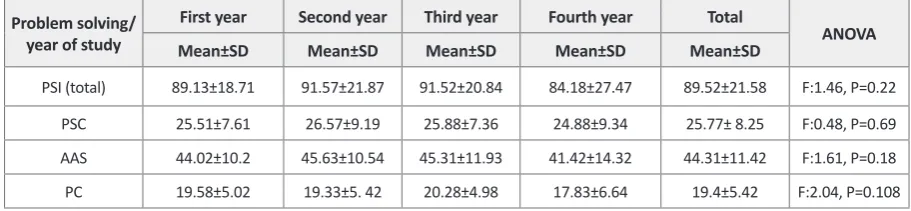
A total of 322 undergraduate nursing students par-ticipated in this study. About 36.7% of them studied in the first year, 26% in the second year, 21.9% in the third year, and 15.4% in the fourth year. The majority of the participants were single (94%) and under 24 years of age (95.9%). The mean (±SD) age of students was 20.8±1.62 years. About 63% of students were female and 37.7% of them were male (Table 1-4). It was found that the mean (±SD) score of the students’ problem solv-ing was 89.5±21.51. With respect to study years, the mean (±SD) scores of students’ PSI were 89.13±18.71 for the first year students, 91.57±21.87 for the second year, 91.52±20.8 for the third year, and 84.18±27.47 for the fourth year students. Comparing these scores, no sta-tistically significant difference were seen among them, although the senior students judged themselves more successful than other years (F:1.46, P=0.22) (Table 5).
Table 2. Distribution of nursing students with respect to the year of study.
Percent No.
Year of study
36.7 117
First year
26 83
Second year
21.9 70
Third year
15.4 49
Fourth year
100 319
Total
*Three cases were missed. Client-CenteredNursingCare
Table 3. Distribution of nursing students with respect to marital status.
Percent No.
Marital status
94 299
Single
6 19
Married
100 318
Total
The mean (±SD) scores of the students’ problem solv-ing in its subscales were as follows: Regardsolv-ing PSC, the mean score of students was 25.77±8.25 and regard-ing different years were 25.51±7.61 for the first year, 26.57±9.19 for the second year, 25.88±7.36 for the third year, and 24.88±9.34 for the fourth year students. When these results were compared, no significant relationship were seen among them (F:0.483, P=0.69). Findings showed that the mean score of the students’ AAS was 44.31±11.42. The mean score of AAS in different years of study were 44.02±10.2 for the first year students, 45.63±10.54 for the second year, 45.31±11.93 for the third year and 41.42±14.32 for the fourth year students. No statistically significant relations were found among these scores (F:1.61, P=0.18) (Table 6).
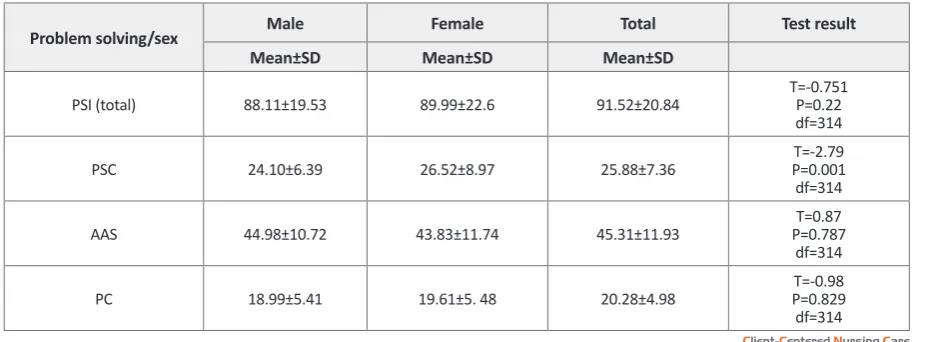
The mean score of the students’ PC was 19.4±5.42. First year students were found to have a mean score of 19.58±5.02 and second year students had an average of 19.33±5.42. The mean score of PC for the third year stu-dents was 20.28±4.98 and for the fourth year stustu-dents was 17.83±6.64. Comparing these scores, no statistically significant relations were found (F:2.04, P=0.108). Gen -erally, no statistically significant differences were seen among student’s perception of own ability and these sub-scales. Also, findings revealed that although males per -ceived their total problem solving (PSI) skill a little bit more successful than females, but the difference of mean score between males and females is not statistically sig-nificant (88.11±19.53 V.S 89.99±22.6). Regarding PSC and PC subscales, males perceived their ability positive in comparison with females. Meanwhile with regard to AAS,
females perceived themselves more successful than male group, but the difference was not statistically significant.
4. Discussion
Generally, problem solving skills are important at all levels of health care system. The art of caregiving re-quires knowledge, skill, and expertise, and the ability to problem solving is the core of effective medical practice (Wang et al., 2004). The ability of the nurse to provide safe and competent care depends on good clinical skills, so nurses need a better understanding of the cognitive strategies in clinical practice.
The total mean score of the students’ problem solving was 89.5±21.51 which is in accordance with Largo-Wight (2005) study that reported 90.0±16.6. According to Baumberger-Henry (2005) study, the mean score of total PSI in 3 subscales were between 82 and 83. It means that judgment of nursing students in Southern New Jersey regarding their abilities is more positive than our study subjects (Baumberger-Henry, 2005). The average score of PSI obtained in a study carried out by Altun (2003) was 83.54±19.14 i.e. students participating in that study perceived themselves better than our study students with regard to problem solving (Altun, 2003). When the mean score and number of education years were compared, no statistically significant difference were seen; how -ever, the fourth year students judged themselves more successful than other students. Although the difference between problem solving and its factors with regard to study years were not statistically significant, but findings showed that the fourth year students had higher percep-Table 4. Distribution of nursing students’ residence.
Residence No. Percent
Living with family 145 45.3
Living in dormitory 175 54.7
Total 320 100
*Two cases were missed. Client-CenteredNursingCare
Table 5: Overall students’ problem solving and its 3 component scores in different years of study
ANOVA Total
Fourth year Third year
Second year First year
Problem solving/
year of study Mean±SD Mean±SD Mean±SD Mean±SD Mean±SD
F:1.46, P=0.22 89.52±21.58
84.18±27.47 91.52±20.84
91.57±21.87 89.13±18.71
PSI (total)
F:0.48, P=0.69 25.77± 8.25
24.88±9.34 25.88±7.36
26.57±9.19 25.51±7.61
PSC
F:1.61, P=0.18 44.31±11.42
41.42±14.32 45.31±11.93
45.63±10.54 44.02±10.2
AAS
F:2.04, P=0.108 19.4±5.42
17.83±6.64 20.28±4.98
19.33±5. 42 19.58±5.02
PC
tion about their problem solving ability. It is notable that this study was cross-sectional and comparing was done among different students in 4 years of study and we need more research, especially longitudinal research on one group of students in 4 years. Mustafa and Cagla study (2010) findings indicated that students’ problem solving abilities increase from the first grade to the fourth grade. There was a meaningful difference in the average score of the variables of PSI for the ages of the students (Uslu and Girgin, 2010). Yavuz et al. study (2010) showed that freshman (first year) prospective teachers have lower problem solving skills than senior (fourth year) class prospective teachers and education period helps them develop this skill (Yavuz et al., 2010).
In this study, total participant’s mean score for PSC was 25.77±8.25, for AAS was 44.31±11.42, and for PC was 19.4±5.42. In Largo-Wight (2005) study, the mean score of for PSC was 26.9±6.4; for AAS, 46.6±9.7; and for PC, 16.4±4.1. Regarding PC factor, the participating students in that study perceived themselves better than students in our study, but regarding the other two factors, our study subjects perceived themselves better than Largo-Wight’s subjects (Largo-Wight et al., 2005).
Findings revealed that males perceived their PSI skill a little bit more successful than females, but the differ-ence of mean score between males and females was not statistically significant. With regard to PSC factor and PC, males perceived their ability more positive in com-parison with females. Meanwhile with regard to AAS, female perceived themselves more successful than male group, but the difference was not statistically signifi -cant. In this regard, Keskin and Yildirim (2008) findings revealed that students’ PSI scores were higher in male group and it was significant (Keskin and Yıldırım, 2008). Mustafa and Cagla (2010) found meaningful difference
between the undergraduate male and female students’ mean scores of PSI. This different means indicated that males are more capable of solving their problems than females (Uslu and Girgin, 2010). Our findings is not in line with Yavuz et al. study (2010) which showed that problem solving skills perceptions of female prospective teachers of social sciences were higher than male coun-terparts and this difference was statistically different too (Yavuz et al., 2010) .It is notable that different child rear-ing styles with respect to gender is a cultural-based issue and affected by social expectations of males and females in Iran community. Iranian females rely more on their families to solve daily problems, so they have fewer ex-periences to deal with problems independently.
The ability of the nurses to provide safe and competent care depend on good skills. To develop better problem solvers, instructors must help students overcome their emotional and cognitive barriers to learn effective skills. The purpose of this cross-sectional study was to identify undergraduate nursing students’ problem solving skills in different years of study. It was found that the average score of the students’ problem solving is 89.52±21.58. In general, they found themselves somewhat successful in regard to problem solving, but they need to develop this skill during education process too.
The nursing profession cannot afford to educate prac-titioners who just perform ‘‘routine work and go off.’’ Through the use of problem solving skill, nursing stu-dents will demonstrate greater independence of mind, intellectual curiosity, courage, empathy, and integrity, at the end of their training (Mangena and Chabeli, 2005). Many believe that if educators have an understanding of the processes involved in problem solving, it will be pos-sible to teach those processes. With so many changes in today’s health care, nurses must be good problem solvers
Table 6. Overall students’ problem solving and its 3 component scores with respect to students’ sex.
Test result Total
Female Male
Problem solving/sex
Mean±SD Mean±SD
Mean±SD
T=-0.751 P=0.22 df=314 91.52±20.84
89.99±22.6 88.11±19.53
PSI (total)
T=-2.79 P=0.001 df=314 25.88±7.36
26.52±8.97 24.10±6.39
PSC
T=0.87 P=0.787
df=314 45.31±11.93
43.83±11.74 44.98±10.72
AAS
T=-0.98 P=0.829 df=314 20.28±4.98
19.61±5. 48 18.99±5.41
PC
to deliver safe and professional care (Wang et al., 2004). Nursing schools are expected to train practitioners who possess high ability to solve problems and make deci-sions. Educating should help students reach the desired levels of problem solving skills by allowing them to acquire and practice these abilities in the field. Nursing students with advanced problem solving skills will be es-sential for our changing society.
Conflict of Interest
The authors declared no conflict of interests.
Acknowledgements
This study was supported by Vice Chancellor for Re-search and Technology of Iran University of Medical sciences. We thank all BSc nursing students for their kind participation and cooperation in this study.
References
Altun, I 2003, ‘The perceived problem solving ability and values of student nurses and midwives’, Nurse Education Today, vol. 23, pp. 575-584.
Baumberger-henry, M 2005, ‘Cooperative learning and case study: does the combination improve students’ perception of problem-solving and decision making skills?’, Nurse Education Today, vol. 25, pp. 238-246.
Drey, N, Gould, D, & Allan, T 2009, ‘The relationship between continuing professional education and commitment to nurs-ing’, Nurse Education Today, vol. 29, pp. 740-745.
Heppner, PP, Hibel, J, Neal, GW, Weinstein, CL, & Rabinowitz, FE 1982, ‘Personal problem solving: A descriptive study of in-dividual differences’, Journal of Counseling Psychology, vol. 29, pp. 580.
Heppner, PP, Witty, TE, & Dixon, WA 2004, ‘Problem-solving appraisal and human adjustment a review of 20 years of re-search using the problem solving inventory’, The Counseling Psychologist, vol. 32, pp. 344-428.
Hewlett, Pon, Bleich, M, Cox, MF, & Hoover, KW 2009, ‘Chang-ing times: The role of academe in health reform’, Journal of Pro-fessional Nursing, vol. 25, pp. 322-328.
Hicks-moore, SL 2005, ‘Clinical concept maps in nursing educa-tion: An effective way to link theory and practice’, Nurse Edu-cation in Practice, vol. 5, pp. 348-352.
Keskin, G, & Yildirim, G 2008, ‘The evaluation of university stu-dents in terms of problem solving, autonomy, multiple intel-ligences based on constructive approach norms’, Journal of the Faculty of Education, vol. 9, pp. 67-88.
Kim, KS, & Choi, JH 2014, ‘The relationship between problem solving ability, professional self-concept, and critical thinking
disposition of nursing students,’ International Journal of Bio-Science & Bio-Technology, vol. 6.
Largo-wight, E, Peterson, PM, & Chen, WW 2005, ‘Perceived problem solving, stress, and health among college students’,
American Journal of Health Behavior, vol. 29, pp. 360-370. Lee, MB, & Brysiewicz, P 2009, ‘Enhancing problem solving and
nursing diagnosis in year III Bachelor of nursing students,’
Nurse Education Today, vol. 29, pp. 389-397.
Mangena, A, & Chabeli, MM 2005, ‘Strategies to overcome ob-stacles in the facilitation of critical thinking in nursing educa-tion’, Nurse Education Today, vol. 25, pp. 291-298.
Oldenburg, NL, & Hung, WC 2010, ‘Problem solving strate-gies used by RN-to-BSN students in an online problem-based learning course’, Journal of Nursing Education, vol. 49, pp. 219. Rodzalan, SA, & Saat, MM 2015, The perception of critical
think-ing and problem solvthink-ing skill among Malaysian undergradu-ate students’, Procedia-Social and Behavioral Sciences, vol. 172, pp. 725-732.
Salami, SO & Aremu, AO 2006, ‘Relationship between problem-solving ability and study behavior among school-going ado-lescents in southwestern Nigeria’, Electronic Journal of Research in Educational Psychology, vol. 4, pp. 139-54.
Simpson, E, & Courtney, MD 2002, ‘Critical thinking in nursing education: Literature review’, International Journal of Nursing Practice, vol. 8, pp. 89-98.
Taylor, J, Irvine, F, Bradbury-jones, C, & Mckenna, H 2010, ‘On the precipice of great things: the current state of UK nurse education,’ Nurse Education Today, vol. 30, pp. 239-244. Uslu, M, & Girgin, C 2010, ‘The effects of residential conditions
on the problem solving skills of university students’, Procedia-Social and Behavioral Sciences, vol. 2, pp. 3031-3035.
Wang, JJ, LO, CHK, & KU, YL 2004, ‘Problem solving strategies integrated into nursing process to promote clinical problem solving abilities of RN-BSN students’, Nurse Education Today,
vol. 24, pp. 589-595.