DEMOGRAPHIC RESEARCH
VOLUME 33, ARTICLE 37, PAGES 1047
−
1066
PUBLISHED 13 NOVEMBER 2015
http://www.demographic-research.org/Volumes/Vol33/37/ DOI: 10.4054/DemRes.2015.33.37
Research Article
Old age insurance participation among
rural-urban migrants in China
Min Qin
Yaer Zhuang
Hongyan Liu
This publication is part of the Special Collection on “Biodemography and Multistate Event History Analysis on Healthy Aging,” organized by Guest Editors Frans Willekens, James Carey, and Li Qiang.
©2015 Min Qin, Yaer Zhuang & Hongyan Liu.
This open-access work is published under the terms of the Creative Commons Attribution NonCommercial License 2.0 Germany, which permits use, reproduction & distribution in any medium for non-commercial purposes, provided the original author(s) and source are given credit.
1 Introduction 1048
2 Pension systems for migrants 1049
2.1 Basic pension insurance for urban employees 1049 2.2 New old age pension scheme for rural residents 1049 2.3 Challenges to old age pension enrolment 1050
3 Data and methods 1051
3.1 Data source 1051
3.2 Analytical approach, variables, and operational definition 1052
4 Results 1054
4.1 Social and demographic characteristics 1054 4.2 Participation in old age pension schemes 1055
4.3 Multinomial regression 1056
5 Discussion and conclusion 1059
6 Acknowledgements 1061
References 1062
Appendix A 1065
Old age insurance participation among
rural-urban migrants in China
Min Qin1
Yaer Zhuang2
Hongyan Liu3
Abstract
BACKGROUND
The Chinese government has been introducing reform policies to improve the existing social security system, including the old age insurance schemes for rural-urban migrants. However, there are still challenges in the current system that hinder migrants who move frequently from participating in old age insurance schemes.
OBJECTIVE
The objectives of this paper are to describe the current coverage of old age insurance amongst migrant workers and examine the associated individual, household, and geographical factors, and to predict the probability of old age insurance participation among rural-urban migrants by province and relevant migrant characteristics.
METHODS
Data for the analysis are drawn from the 2011 Migrant Dynamics Monitoring Survey in China. The sample consists of 110,005 migrant workers with rural household registration. The analysis considers multinomial logistic regression with type of old age insurance as the outcome variable.
RESULTS
Of all rural-urban migrant workers nationwide, 16.4% have participated in the Basic Pension Insurance for urban employees, 9.8% in the New Old Age Pension scheme for rural residents, 3.3% are covered by both schemes, and 70.5% have no coverage with any old age pension scheme. Migrants moving within provinces or from relatively wealthy households are more likely to participate in an old age insurance scheme than those moving across provinces or from relatively poor households. Migrants’
1 China Population and Development Research Centre (Beijing) and China Research Centre, University of Southampton. E-Mail: [email protected].
occupational status also influences their participation in old age pension schemes. The predicted probability of participation varies across China by province.
1. Introduction
With rapid economic growth, China has experienced unprecedented rural-urban migration during the past decades. According to the 2010 population census, migrants constituted 16.5% of the total population and the number of migrant workers reached around 166 million in 2013 (Zou 2011; NBSC 2014). Based on the analysis of census and inter-census survey data since the 1980s, Duan et al. (2008) reported nine specific trends in internal migration in China over the previous three decades: a sharp increase in absolute size; a mature shift in migrants’ age structure, with the percentage of people aged 15−64 increasing from below 60% in 1982 to over 84% in 2005; an overt increase in the proportion of female migrants; independent movement of people between cities; higher educational attainment among migrants; longer duration of stay in destination cities; people migrating primarily to look for work; people congregating towards coastal cities; and people migrating with families.
Historically, China’s social welfare system developed on the basis of a household registration system that divided people into urban and rural residents, and the difference between urban and rural residential statuses continues to shape current reforms. For decades, social welfare has been designed to benefit local citizens almost exclusively, without considering migrants to urban areas who do not have urban residence registration. Migrants do not share the same benefits as urban residents, even though they have made a significant contribution to China’s economic development (Smart and Smart 2001; Watson 2009). However, there is a gradual change in policies and reforms aimed at migrant welfare, especially regarding protection of their social rights by guaranteeing a minimum wage and medical care and enabling access to housing, schooling, and social insurance. During the late 1990s the government introduced a series of policies to reform and improve the social security system, including old age pensions for migrants, particularly the Basic Pension Insurance for urban employees and the New Old Age Pension scheme for rural residents.
pension system for migrants, then a description of data source and methodology, and finally the results and conclusion.
2. Pension systems for migrants
This section provides the features of and background information to the two main pension systems for migrants examined in this study.
2.1 Basic pension insurance for urban employees
China’s urban pension system has been through a series of reforms since it was established in 1951. In the beginning it covered only the state and urban collective sectors, but it later expanded to cover all employees working in cities and towns, regardless of the ownership of the enterprise or organization (Friedman et al. 1996; World Bank 1996). In January 1999 the State Council issued the Tentative Rules on the Payment of Social Security Dues, which was a government policy directive designed to speed up the inclusion of non-state-owned enterprises and migrant workers in the pension system (State Council 1999). This policy is generally termed Basic Pension Insurance for urban employees.
In recent years this scheme has been slowly opened to include workers in other rapidly growing urban sectors, mainly foreign-funded enterprises, private enterprises, and the self-employed (Zhao and Xu 2002). Under this scheme, both the employer and employee can make contributions and the government acts as pension guarantor. Currently, employers contribute 12% or more of the total employee payroll and employees contribute 4%−8% of their wages. Generally, the retirement age is 60 years for men and 50 years for women, the exception being women in certain managerial positions or researchers for whom it is 55 or 60 years. Employees with less than 15 years of contributions are not entitled to any basic pension. Accumulations in individual pension accounts are refunded as a single lump sum. In principle, when migrants move to another province, their personal pension account and employer contribution is transferred (State Council 2000, 2009b).
2.2 New old age pension scheme for rural residents
government introduced a nationwide experimental rural social pension scheme. A major feature of this New Rural Pension scheme is that the government makes direct contributions: local and central government finance a basic pension component and registered individuals contribute to their personal account (State Council 2009a). The central government contributes 55 Yuan per month (about USD8) to the basic pension component, which approximately translates to the amount that demarcates the poverty line in rural China. It is a voluntary programme in which all rural residents aged 16 and above are encouraged to participate. To access the benefit men must be at least 60 years old and women at least 55 years old, and they must have worked for at least 15 years. Those who were already 65 years old when the scheme was introduced can receive the basic pension benefit of 55 Yuan per month without any contributions as long as at least one of their family members aged 16 and over is participating in the pension scheme.
Under the existing framework, rural-urban migrant workers are eligible for Basic Pension Insurance or the New Rural Pension scheme, but are not allowed to join both schemes at the same time. However, there are still obstacles in the current system that make it difficult for migrants who move frequently to participate in the pension schemes, as eligibility is based on household registration and only operates at the local level. Yang (2011) reported an increase in old age insurance coverage of rural-urban migrants who moved to seek a job, from 6.7% in 2006 to 10.7% in 2008, and coverage increased from 9.8% in 2009 to 14.3% in 2012 (NBSC 2013). However, old-age pension coverage among migrant workers in urban areas remains substantially lower than among the local (non-migrant) population that has urban household registration. In 2010 about 63% of the working-age population with urban household registration had old-age pension coverage (Lu 2012).
2.3 Challenges to old age pension enrolment
The government-sponsored old age insurance systems are voluntary endowment schemes that are made available to migrants. While it is generally considered a rational choice for migrants to enrol in these schemes, the decision is also influenced by the nature of the policy, family circumstances, and migrants’ economic status, life plans, and expectations in old age.
illustrates that rural-urban migrants are doubly disadvantaged because they hold rural household registration and are not registered in urban areas, so they cannot use urban facilities. Without being registered as a permanent local household, migrants are not able to fully access local public services and social welfare, such as children’s education, medical insurance, and welfare housing, which has a negative impact on migrants’ settlement and stable employment. Compared to local urban residents and even other urban-urban migrants they have less chance of securing old age insurance. Other studies suggest that individual characteristics of migrants such as age, gender, education, and employment status can determine their participation in old age insurance schemes (Lv and Li 2012; Zhang, Gao, and Hou 2007; Nielsen et al. 2005). However, regional disparity exists even after controlling for individual characteristics (Li 2009).
3. Data and methods
This section describes the data source, analytical approach, and operational definitions and coding of variables considered in the study.
3.1 Data source
Data for this study are drawn from the 2011 Migrant Dynamics Monitoring Survey in China (MDMS), conducted in migrants’ destination cities. The survey was conducted in May 2011, commissioned by the National Population and Family Planning Commission of China and coordinated by the China Population and Development Research Centre. MDMS is a nationally representative sample survey, conducted every year since 2010 (piloted in five cities in 2009), aimed at examining the social and economic status of migrants, including their social welfare and participation in insurance schemes in destination cities.
which was to seek a paid job. Spouses of migrants were not included. A total of 128,000 migrant workers were interviewed face-to-face by trained interviewers using a structured questionnaire. The sample was designed to be nationally representative and was selected using a probability sampling method. Qi and the team reported that the 2011 MDMS sample was a good representation of the population, with sampling errors being relatively small and in the acceptable range. For example, for the indicators the proportion of unmarried, the proportion of employed, and the proportion of those with old-age pension coverage the sampling error was 0.028, 0.003, and 0.025 respectively (Qi, Qin, and Li 2014).
The subjects in our study were rural-urban migrant workers with rural household registration, which is the most vulnerable group in terms of social protection (Zhang 2007; Zheng 2008). Migrant workers with urban household registration who are not entitled to the New Rural Pension were excluded from this study. As very few rural-urban migrant workers participate in old age insurance programmes run by private companies (Zhang 2007; Yang 2011) they were not included in the current study. The final analysis sample comprised 110,005 observations of migrants aged 16−59 years holding rural household registration, who had moved across county boundaries to seek a paid job and had resided at their current destination for more than one month.
3.2 Analytical approach, variables, and operational definition
To identify the factors influencing participation in old age insurance schemes, multinomial logistic regression was carried out, with old age pension insurance participation as the dependent variable, coded into four categories: basic pension insurance, new rural pension scheme, both basic and new rural pension scheme, and no participation (reference category).
The robust standard errors were obtained by considering the clustering effect associated with the sampling design. Theoretically, the cluster robust standard errors should be larger to account for serial correlation and heteroskedasticity, thereby resulting in a less biased estimation of variance and test of statistical significance. After fitting the multinomial logistic regression model, the probability of old age pension insurance participation among rural-urban migrants by province and relevant migrant characteristics was predicted, as explained in Appendix B.
questions. These included respondents’ specific preference and liking for their destination city, their concerns about living in their current city, their willingness to integrate into the city’s society, their expectation of being welcomed by local residents, and concerns that the local community was unwilling to accept migrants. The response options were completely disagree, disagree, agree, and completely agree. A maximum score of 4 was given to the most positive response to each question. For example, a score of 4 was given if a respondent answered positively and reported “completely agree”, whereas a “completely disagree” answer received a score of 1. On the other hand, if the response was negative it would score 1 for “completely agree” and score 4 for “completely disagree”. Finally, the scores for the five questions are summed and recoded to 1 if the sum is lower than the median reflecting relatively negative attitude, and recoded 2 if higher than the median reflecting relatively positive attitudes.
4. Results
4.1 Social and demographic characteristics
All the rural-urban migrants in the sample migrated to seek a paid job, and 51% are male and 49% are female (Table 1). Their mean age is 31.7 years. More than a third of the migrants are aged between 25 and 34 and about 77% are ever married. About 86% of the ever married have moved to their current destination with their spouse or at least one child (data not shown separately). More than half of rural-urban migrants have education up to senior middle-level school.
Seventy-one per cent have migrated across province. Of these, about 87% have flowed into the five coastal provinces of Guangdong, Zhejiang, Jiangsu, Shanghai and Fujian, and the capital Beijing (data not shown separately). More than half of the rural-urban migrants have lived in their current destination for more than 2 years. About 30% have stayed for more than 5 years. The above figures reiterate the increasing trends of feminisation and family migration in China, with long duration in the destination.
Table 1:
Selected socio-demographic characteristics of rural-urban
migrants (n=110,005)
Characteristic %
Age group (in years)
15−24 25.7
25−34 36.1
35−44 29.8
45−59 8.5
Gender
Male 51.0
Female 49.0
Marital status
Never married 22.8 Ever married 77.2
Education
Primary school 17.4 Lower secondary 58.5 Upper secondary and above 24.0
Type of migration
Cross province 70.5 Within province 29.5
Duration of current residence (in years)
Less than 1 23.0
1−5 47.4
6−15 25.8
16+ 3.9
4.2 Participation in old age pension schemes
Overall, about 71% of the rural-urban migrant workers are not participating in any old age pension scheme, 16.4% are participating in Basic Pension Insurance, 9.8% in the New Rural Pension scheme, and 3.3% in both schemes. These figures show an increasing trend compared to about 11% participation in Basic Pension Insurance in 2008 (Yang 2011).
Old age insurance participation varies considerably by province, particularly in Guangdong, Zhejiang, Jiangsu, Shanghai, Fujian, and Beijing, where the number of intra-province rural-urban migrants is substantial (Figure 1). For example, in Jiangsu province, Basic Pension Insurance participation is as high as 26%, whereas in Fujian the New Rural Pension coverage is about 16%.
On the other hand, the percentage of migrants not covered by any scheme varies between around 79% in Zhejiang and 59% in Jiangsu. Interestingly, a reasonable proportion of migrants are covered by both schemes; for example, about 6% in Guangdong. This is not in line with the official recommendation that migrants participate in only one scheme at a time.
Figure 1: Percentage of migrants participating in old age insurance in selected provinces and at the national level
0 10 20 30 40 50 60 70 80 90 100 Jia ng su Gua ng do ng Sha ng ha i Fuj ia n Cou nt ry le ve l Be iji ng Zhe jia ng % o f r es po nd en ts Both
4.3 Multinomial regression
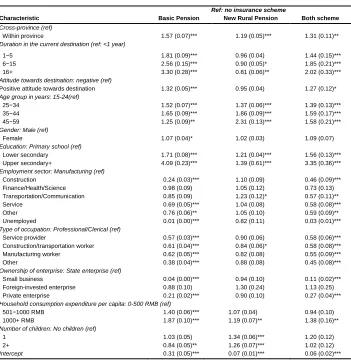
The results of the multinomial logistic regression are shown in Table 2. The dependent variable has four categories, with the most represented category “no participation” as the reference group. Three models are estimated comparing no participation with Basic Pension Insurance, New Rural Pension, and participation in both schemes. The parameter estimates are relative to the reference group, the standard interpretation of the multinomial logit is that for a unit change in the predictor variable, and the logit of outcome relative to the referent group is expected to change by its respective parameter estimate (which is in log-odds units), given that the variables in the model are held constant (Hosmer and Lemeshow 2000). We present the Relative Risk Ratios (RRR) for the predictors rather than logit, for ease of understanding. The RRR are the exponentials of the coefficients, indicating how the risk of the outcome falling in the comparison group compared to the risk of the outcome falling in the referent group changes as the predictor variable changes by one unit (Garson 2011). For example, in Table 2, RRR for female migrants who participate in the Basic Pension is 1.07 with a standard error of 0.04. The RRR indicates that the relative risk of female migrants participating in the Basic Pension over not participating in an insurance scheme is 1.07 times that of male migrants. The difference between female and male migrants is statistically significant at the 5% level.
Table 2: Relative risk ratio and robust standard errors from multinomial logistic regression showing the effect of selected variables on migrant participation in insurance schemes
Characteristic
Ref: no insurance scheme
Basic Pension New Rural Pension Both scheme
Cross-province (ref)
Within province 1.57 (0.07)*** 1.19 (0.05)*** 1.31 (0.11)**
Duration in the current destination (ref: <1 year)
1−5 1.81 (0.09)*** 0.96 (0.04) 1.44 (0.15)*** 6−15 2.56 (0.15)*** 0.90 (0.05)* 1.85 (0.21)*** 16+ 3.30 (0.28)*** 0.81 (0.06)** 2.02 (0.33)***
Attitude towards destination: negative (ref)
Positive attitude towards destination 1.32 (0.05)*** 0.95 (0.04) 1.27 (0.12)*
Age group in years: 15-24(ref)
25−34 1.52 (0.07)*** 1.37 (0.06)*** 1.39 (0.13)*** 35−44 1.65 (0.09)*** 1.86 (0.09)*** 1.59 (0.17)*** 45−59 1.25 (0.09)** 2.31 (0.13)*** 1.58 (0.21)***
Gender: Male (ref)
Female 1.07 (0.04)* 1.02 (0.03) 1.09 (0.07)
Education: Primary school (ref)
Lower secondary 1.71 (0.08)*** 1.21 (0.04)*** 1.56 (0.13)*** Upper secondary+ 4.09 (0.23)*** 1.39 (0.61)*** 3.35 (0.36)***
Employment sector: Manufacturing (ref)
Construction 0.24 (0.03)*** 1.10 (0.09) 0.46 (0.09)*** Finance/Health/Science 0.98 (0.09) 1.05 (0.12) 0.73 (0.13) Transportation/Communication 0.85 (0.09) 1.23 (0.12)* 0.57 (0.11)** Service 0.69 (0.05)*** 1.04 (0.08) 0.58 (0.08)*** Other 0.76 (0.06)** 1.05 (0.10) 0.59 (0.09)** Unemployed 0.01 (0.00)*** 0.82 (0.11) 0.03 (0.01)***
Type of occupation: Professional/Clerical (ref)
Service provider 0.57 (0.03)*** 0.90 (0.06) 0.58 (0.06)*** Construction/transportation worker 0.61 (0.04)*** 0.84 (0.06)* 0.58 (0.08)*** Manufacturing worker 0.62 (0.05)*** 0.82 (0.08) 0.55 (0.09)*** Other 0.38 (0.04)*** 0.88 (0.08) 0.45 (0.08)***
Ownership of enterprise: State enterprise (ref)
Small business 0.04 (0.00)*** 0.94 (0.10) 0.11 (0.02)*** Foreign-invested enterprise 0.88 (0.10) 1.30 (0.24) 1.13 (0.25) Private enterprise 0.21 (0.02)*** 0.90 (0.10) 0.27 (0.04)***
Household consumption expenditure per capita: 0-500 RMB (ref)
501−1000 RMB 1.40 (0.06)*** 1.07 (0.04) 0.94 (0.10) 1000+ RMB 1.87 (0.10)*** 1.19 (0.07)** 1.38 (0.16)**
Number of children: No children (ref)
1 1.03 (0.05) 1.34 (0.06)*** 1.20 (0.12) 2+ 0.84 (0.05)** 1.26 (0.07)*** 1.02 (0.12)
Intercept 0.31 (0.05)*** 0.07 (0.01)*** 0.06 (0.02)***
Note: ref.: reference category; ***p<0.001; **p<0.01; *p<0.05. The estimates for the 32 provinces are not included separately.
participate in the Basic Pension Insurance scheme or both schemes than manufacturing workers and other occupations. The relative risk of a rural-urban migrant as a manufacturing worker participating in the basic pension insurance is 62% of that of a migrant who is a professional or clerk. For manufacturing workers the predicted probability of participating in the Basic Pension Insurance is 0.102, which is slightly higher than for service providers (0.096) but lower than for professionals/clerks (0.134) (data not shown separately). Migrants employed in state-owned enterprises are significantly more likely to participate in an insurance scheme than migrants in small businesses or private enterprises (not foreign).
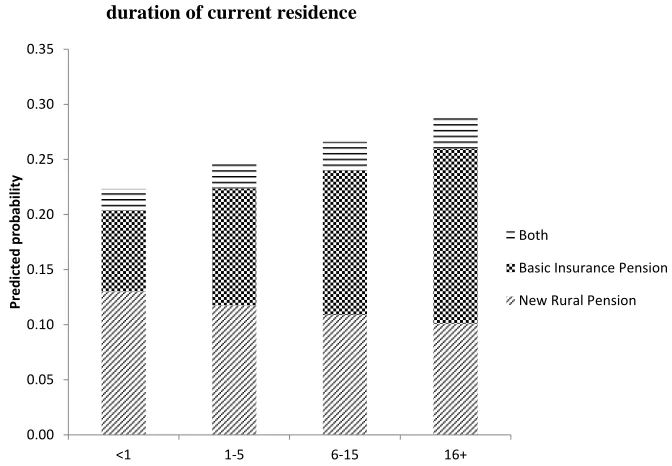
Figure 2: Predicted probability of migrant participation in old age pension by duration of current residence
Migrants living in households with consumption per-capita expenditure of over 500 RMB are significantly more likely to participate in the Basic Pension Insurance scheme compared to those with no insurance. However, households with consumption per-capita expenditure of 1000 RMB or over are highly likely to participate in an insurance scheme and are likely to participate in both schemes.
0.00 0.05 0.10 0.15 0.20 0.25 0.30 0.35
<1 1-5 6-15 16+
Pr
ed
ict
ed
p
rob
ab
ili
ty
Duration of current residence (in years)
Both
Basic Insurance Pension
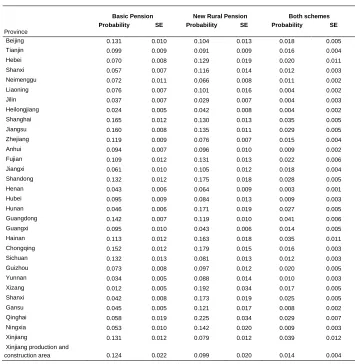
The estimates for the provinces are not shown separately but are presented as predicted probabilities in Table 1A (see Appendix A). The predicted probability for each province varies largely across the country. For instance, rural migrant workers in Shanghai and Jiangsu have the highest probability of participating in Basic Pension Insurance, which is more than 13 times that in Xizang and almost 7 times that in Heilongjiang.
5. Discussion and conclusion
Our results show that migration factors influence old age insurance participation. Rural-urban migrants moving within province are more likely to participate in BasicPension Insurance and New Rural Pension schemes, or even both schemes, than those moving between provinces. This is probably due to the institutional obstacles associated with inter-provincial transfer of pension insurance. Those who have stayed in their current city for a longer period and have a relatively positive attitude towards that city are more likely to participate in the Basic Pension Insurancescheme. This group of migrants has a positive attitude and is more determined, with a greater ability to settle down in cities. Those who have stayed in their current location for a shorter period are more likely to participate in the New Rural Pension scheme. The pilot for this scheme began in 2009, and migrants who have been in their current location for a short period of time may have participated in the scheme in their hometown before they moved to their current residence. However, due to inefficient publicity and drawbacks of the scheme such as low pension amounts, inconvenience in paying the premium, and lack of portability (Gao, Su, and Gao 2012), migrants who left their hometown many years ago may be unaware of the new scheme or may not have had the time to return home to enrol.
Household consumption expenditure per capita has an important influence on migrants’ old age insurance participation. Higher per capita household consumption expenditure leads to higher participation in any kind of old age insurance programme. This is probably explained by more consumption meaning more income and therefore greater capability for allocating resources for social security. Therefore special attention needs to be paid to old age security for poor rural migrants in urban destinations, given that they are less likely to be covered by any kind of old age insurance programme. They have little opportunity to benefit from the schemes which exclusively target the poor, such as the Urban Minimum Living Standards Scheme, the Rural Minimum Living Standards Scheme, and the Five Guarantees Scheme for Rural Residents (Lu 2012), since these schemes are bounded by the household registration. Moreover, insurance premiums are higher for urban residents than for rural residents.
The variation between provinces in participation in old age insurance partially reflects the influence of different social security regulations at the provincial level. In practice, the lack of a nationwide social security regulation that differentiates between the total amount contributed by the individual and the different old age benefits for rural migrant workers and urban non-migrant employees provided by some provinces, discriminates against rural migrant workers, ultimately influencing their willingness to participate (Huang and Ga 2011; Yang and Guo 2006).
establishing a nationwide unified social security system would benefit Chinese migrant workers substantially. Further study is needed to follow up the impact of the reform.
Rural migrant workers often have low social and legal status in urban destinations. Historically, this has been due to dualistic social and economic structures and policies, especially among those employed in informal, contracted, and casual employment sectors. Rural migrants in urban areas are generally marginalised, insecure in the social security system, and are often confronted with identity issues as belonging to neither urban nor rural society. Low old age, medical, work injury, and unemployment insurance coverage is just one aspect of migrants’ vulnerability (Zheng 2002). Other dimensions include discrimination in employment opportunities and public services, underpayment and wage default, long work hours without overtime payment, and lack of work safety protection (Lan 2009). The household registration system and social policies that favour the urban are other challenges that hinder equal employment opportunities and general social treatment of rural migrant workers. These challenges are internal and specific to China but resemble issues and debates concerning international migrant workers, the difference being that in China the household registration system imposes internal migration restrictions (Zheng 2002; Ginneken 2013). The vulnerabilities of rural migrant workers in China highlight substantial unmet need for social protection. Targeted interventions are needed to integrate migrants into urban society and provide them with equal opportunities and economic benefits. Although the newly amended Labour Contract Law and the Employment Promotion Law, both adopted in 2007, and the Social Insurance Law adopted in 2010 are reassuring in terms of securing social protection for migrant workers, there still is a long way to go before social policies are detached from household registration and an efficient, attractive, and nationwide social security scheme is established.
6. Acknowledgements
References
Friedman, B., James, E., Kane, C., and Queisser, M. (1996). How can China provide income security for its rapidly aging population? World Bank, Washington (Policy Research Working Paper, WPS 1674).
Duan, C.R., Yang, K., Zhang, F., and Lu, X.H. (2008). Nine trends of Chinese internal migration since the economic reform. Population Research 32(6): 30−43 (in Chinese).
Gao, Y.X., Su, B.Z., and Gao, F. (2012). New rural pension system of China: is it possible? An exploratory study of Feidong County, Anhui Province. Journal of Cambridge Studies 7(3): 122−126. doi:10.1163/22136746-00801003.
Garson, G.D. (2011). Logistic regression, from Statnotes: topics in multivariate analysis [electronic resource]. http://ondrej.vostal.net/pub/skola/statnote.htm.
Ginneken, W.V. (2013). Social protection for migrant workers: national and international policy challenges. European Journal of Social Security 15(2): 209−221.
Hosmer, D. and Lemeshow, S. (2000) Applied logistic regression. New York: John Wiley & Sons, Inc. doi:10.1002/0471722146.
Huang, K.S. and Ga, R.D. (2011). Social security trap of floating population and floating trap of social security. West Forum 6: 1−8 (in Chinese).
Lan, N. (2009). Is there new hope in labour rights protection for Chinese migrant workers? Asian-Pacific Law & Policy Journal 10(2): 483−518.
Li,B. (2006). Floating population or urban citizens? Status, social provision and circumstances of rural-urban migrants in China. Social Policy and Administration 40(2): 174−195. doi:10.1111/j.1467-9515.2006.00483.x.
Li, B. (2009). Why do migrant workers not participate in urban social security schemes? the case of the construction and service sectors in Tianjin. LSE Research. http://eprints.lse.ac.uk/21775/1/Why_do_migrant_workers_not_ participate_in_urban_social_security_schemes(LSERO).pdf.
Lu, Q. (2012). Analysing the coverage gap in China. London: HelpAge International. Lv, X.J. and Li, J. (2012). Empirical research on the willingness of floating population
National Bureau of Statistics of China (NBSC) (2013). Report of 2012 Rural-urban Migrant Workers Surveillance Survey (in Chinese). http://www.stats.gov.cn/tjsj/zxfb/201305/t20130527_12978.html.
National Bureau of Statistics of China (NBSC) (2014). Report of 2013 Rural-urban Migrant Workers Surveillance Survey (in Chinese). http://www.stats.gov.cn/tjsj/zxfb/201405/t20140512_551585.html.
Nielsen, I., Nyland, C., Smyth, R., Zhang, M., and Zhu, C. (2005). Which rural migrants receive social insurance in Chinese cities? Evidence from Jiangsu survey data. Global Social Policy 5(3): 353−381. doi:10.1177/146801810 5057416.
Qi, J.N, Qin, M., and Li, B.H. (2014). Sampling design of the national migrants survey. Statistics & Decision 3: 14−16 (in Chinese).
Smart, A. and Smart, J. (2001). Local citizenship: welfare reform urban/rural status, and exclusion in China. Environment and Planning A 33(10): 1853−1869. doi:10.1068/a3454.
StataCorp. (2011). Stata 12 base reference manual. College Station, TX: Stata Press: 1221−1231, 1045.
State Council (1999). Tentative rules on the payment of social security dues (in Chinese).
State Council (2000). An experiment to perfect urban social security system (in Chinese).
State Council (2009a). Guide on pilot new rural pension scheme (in Chinese).
State Council (2009b). Tentative rules on transfer basic pension insurance (in Chinese). Sun, J.J, Du, P., and Tang, J. (2011). Major situations and important problems of old-
age insurance of floating population. Journal of Beijing Administrative College 5: 88−93 (in Chinese).
Watson, A. (2009). Social security for china’s migrant workers – providing for old age. Journal of Current Chinese Affairs 38(4): 85−115.
World Bank (1996). China pension system reform. Washington: The World Bank (World Bank Report No. 15121-CHA).
Yang, J.H. (2011). Urban-rural divide and inside-outside disparity: unequal access of migrants to social securities in China. Population Research 35(5): 8−25 (in Chinese).
Zhang, Z. (2007). From urban- rural segregation to regional segregation.Population Research 6: 16−24 (in Chinese).
Zhang, Z., Gao, W., and Hou, H. (2007).Urban- rural divide,regional segmentation and insufficient access of migrants to social security entitlements: evidence from Shanghai and other four Chinese cities. Chinese Journal of Population Science 6: 33−41 (in Chinese).
Zhao, Y.H. and Xu, J.G. (2002). China’s urban pension system: reforms and problems. Cato Journal 21(3): 395−414.
Zheng, B.W. (2008) 30 years of reform and openness in China: development and challenges of social security system for floating population. Chinese Journal of Population Science 5(2): 17−38 (in Chinese).
Zheng, G.C. (2002). Rural migrant workers’ rights and social protection. Chinese Cadres Tribune 8: 22−24 (in Chinese).
Appendix A
Table 1A:
Predicted probability of participation by type of insurance
scheme and province
Province
Basic Pension New Rural Pension Both schemes
Probability SE Probability SE Probability SE
Beijing 0.131 0.010 0.104 0.013 0.018 0.005 Tianjin 0.099 0.009 0.091 0.009 0.016 0.004 Hebei 0.070 0.008 0.129 0.019 0.020 0.011 Shanxi 0.057 0.007 0.116 0.014 0.012 0.003 Neimenggu 0.072 0.011 0.066 0.008 0.011 0.002 Liaoning 0.076 0.007 0.101 0.016 0.004 0.002 Jilin 0.037 0.007 0.029 0.007 0.004 0.003 Heilongjiang 0.024 0.005 0.042 0.008 0.004 0.002 Shanghai 0.165 0.012 0.130 0.013 0.035 0.005 Jiangsu 0.160 0.008 0.135 0.011 0.029 0.005 Zhejiang 0.119 0.009 0.076 0.007 0.015 0.004 Anhui 0.094 0.007 0.096 0.010 0.009 0.002 Fujian 0.109 0.012 0.131 0.013 0.022 0.006 Jiangxi 0.061 0.010 0.105 0.012 0.018 0.004 Shandong 0.132 0.012 0.175 0.018 0.028 0.005 Henan 0.043 0.006 0.064 0.009 0.003 0.001 Hubei 0.095 0.009 0.084 0.013 0.009 0.003 Hunan 0.046 0.006 0.171 0.019 0.027 0.005 Guangdong 0.142 0.007 0.119 0.010 0.041 0.006 Guangxi 0.095 0.010 0.043 0.006 0.014 0.005 Hainan 0.113 0.012 0.163 0.018 0.035 0.011 Chongqing 0.152 0.012 0.179 0.015 0.016 0.003 Sichuan 0.132 0.013 0.081 0.013 0.012 0.003 Guizhou 0.073 0.008 0.097 0.012 0.020 0.005 Yunnan 0.034 0.005 0.088 0.014 0.010 0.003 Xizang 0.012 0.005 0.192 0.034 0.017 0.005 Shanxi 0.042 0.008 0.173 0.019 0.025 0.005 Gansu 0.045 0.005 0.121 0.017 0.008 0.002 Qinghai 0.058 0.019 0.225 0.034 0.029 0.007 Ningxia 0.053 0.010 0.142 0.020 0.009 0.003 Xinjiang 0.131 0.012 0.079 0.012 0.039 0.012 Xinjiang production and
construction area 0.124 0.022 0.099 0.020 0.014 0.004
Appendix B
In order to describe the predicted probability of old age insurance participation by province and relevant migrant characteristics such as duration of current residence and occupation (manufacturing workers), the ‘margins’ command of statistical software STATA (StataCorp. 2011) was used after fitting the multinomial logistic model. Below is an example. The dependent variable “old age pension insurance participation” is named “outcome”; “basic pension insurance participation” is assigned value label 1; “new rural pension scheme participation” is assigned value label 2; “both basic and new rural pension scheme participation” is 3, “no participation” is 0, and the two explanatory variables are “duration” and “province”.
We fit the multinomial logistic model first . mlogit outcome i.duration i.province…
then using ‘margins’ to obtain the probability that outcome = 1 . margins duration, predict(outcome(1))
and to obtain the margins for the probability that outcome = 2 . margins duration, predict(outcome(2))
and to obtain the margins for the probability that outcome = 3 . margins duration, predict(outcome(3))
For each ‘margins’ command, Stata output presents a table with the margins, the standard errors, and the confidence intervals of the margins. Below is the output table of the command. margins duration, predict(outcome(1)).
Delta-method
Margin Std. Err. z P>z [95% Conf. Interval]
duration
1 0.0687838 0.0024577 27.99 0.000 0.0639668 0.0736009 2 0.1017399 0.0021587 47.13 0.000 0.0975088 0.1059709 3 0.1257632 0.0028006 44.91 0.000 0.1202741 0.1312523 4 0.1472964 0.0057771 25.50 0.000 0.1359735 0.1586192