Effects of communication skills training courses on knowledge levels of the
health workforce in Sulaimani
Received: 15/6/2017 Accepted: 2/11/2017
Abstract
* Department of Family and Community Medicine, School of Medicine, Faculty of Medical Science, University of Sulaimani, Sulaimani, Iraq.
Introduction
Effective communication is a vital and cornerstone component in improving the
quality of health care, decreasing
malpractice, and medical error.1,2 When
medical staff uses communication skills effectively, both they and their client's benefit. First, physicians understand their patient's needs and problems more
precisely.3 Second, increasing the level of
patient satisfaction toward health services, with a better understanding of their health problems, investigations, and treatments.
Third, patients are following doctors instruction and line of management effectively, promote their behavior change
positively and to increase drug adherence.4
Fourth, helping patients to decrease mental problems and stress and decrease their vulnerability for getting anxiety and depression. Finally, staffs' own wellbeing
is improved.5-7 There are several basic
principles of communication skills between health care providers and client, which are considered essential needs for providing the most effective communication. These include respect, mutual goals, a supportive environment, shared decision making, correct information, transparency, and a
process of continuous learning.8 Usually,
most complaints from the clients and even general people toward health workforces in general and physicians in specific are the problems of communication not from the
Background and objective: Communication skills are one of the important and effective
skills for healthcare providers. Health provider-patient communication is a core component of the health system and has a strong impact on health user satisfaction. This study aimed to explore the level of communication skills among health workforces, and the role of the training course on communication skills improvement.
Methods: This quasi-experimental study included 571 newly graduated participants of
health workforces from a Sulaimani city center. Standard tools of communication skills were used for pre- and post-test evaluation through 5 hours of training course including 25-30 participants with a total of 24 training courses. Data collection was performed by the self-administered method. Descriptive statistics and analytical statistics were used to test statistical difference and associations.
Results: Minimum required for communication knowledge and skills are reported by the
small percentage of studied participants (12.6%) at the beginning of training. Comparing the mean scores of communication skills showed a statistically significant improvement (mean difference scores is 5.9) after the intervention. Significant communication skills improvement scores have been reported among youngest age groups and physicians.
Conclusion: Well-organized training courses in communication skills can increase the
health workforces' rate of communication skills. Training in communication skills should be widely included during undergraduate studying and in-service training programs.
Keywords: Communication skills; Health care providers; Interpersonal skills;
Communication training.
Methods
The Intervention
The communications training course intervention consisted of a 5-hour morning workshop in one day (8:30 am -1:30 pm), each training course was designed to train as a range between 23-30 participants for only each course. The total number of training courses were 24 training courses, the same material and methodology were used in all courses and by the same trainer. The training was managed scientifically by an academic and certified trainer in communication skills. Different techniques like role-playing, dissection, group work, brainstorming, and mini-lectures were used during training courses. The standard tool of communication skills was used as a measurement tool for pre
and post-test evaluation. 10 It is composed
of fifteen questions; each question was a rating from 1(for complete wrong choice) to 5 (for complete right choice). Mean scores ranking from 15 to 30 was regarded as a clear weakness in communication skills, mean scores of 36-55 means accepted and capable of doing their communication, and grade of excellent in communication skills was reported when total score was ranking from 56 to 75. The total of scores was calculated by adding the score value of all questions. Data collection was performed by the distribution of the questionnaire at the beginning of the training course directly
(pre-test), then similarly the same questionnaire was distributed to the participants at the end of the course (post-test).
Statistical analysis
Collected data were entered into an Excel sheet. After data cleaning
process, data were entered into
the statistical package for the social sciences (version 21). Descriptive analysis
(frequencies and percentages) was performed for the demographic and aspects of communication skills of the participants. Cross-tabulation techniques with Chi-square statistic test were used clinical aspects. One of the commonest
complaints is that the health service provider does not listen actively to them. Patients and clients want more and better information, and knowledge about their health problem and the results, more openness about the adverse effects of treatment, relief of pain and emotional distress, and advice on what they
can do for themselves.9 Therefore, with
consideration of the current situation and based on daily health provides communication skill experiences, the researcher realized that health care provider at different levels is not able to communicate effectively with patients and their surroundings. This may be due to lack of knowledge and skills in this field. The importance of communication skills related to health care performance led
the researcher to study the impact of communication skills training on communication knowledge and skills improvement. The present study aimed to explore the knowledge level of communication and skills among health
workforces, and the role of the training
course on the communication skills improvement with exploring levels of improvement in relation to the socio-demographic characteristics.
Study design
The design of this study was a quasi-experimental study.
Sample size and duration of the study
Study participants were newly health workforce participants from different categories registered as new employees from the planning office of Sulaimani general directorate of health. All newly registered health workforces were included in the study; those who did not complete the training course were excluded from the study. Informing participants regarding time and place of training was arranged in cooperation with the planning department.
The study was carried out from 20th June
communication skills and demographics with the pre and post- test change in the skills. Also, the mean difference was calculated to find improvement in the communication skills of the pre and post-test evaluation. The t-tests (paired and two sample independent) and F test (analysis of variance) were used to find significant difference and associations between studied variables.
Ethical consideration
All participants had provided informed consent. The study was conducted in full accordance with the ethical guidelines of the College of Medicine, University of Sulaimani.
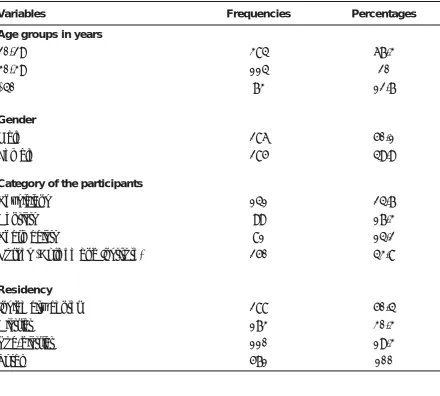
Table 1 shows the socio-demographic characteristics of the sample. Majority of participants (67.3%) were young (20-29 years) with the mean age 29 (±S.D=7.5) years, more than half of them were graduated from medical colleges (Medicine, Pharmacy, and Dentistry), nearly 25% were graduated from Medical School (Physicians). Half of the sample participants were resident inside Sulaimani city center. All participants were assessed for the evaluation of communication skills in pre and post-training to know the change (improvement) in the skills.
Results
Variables Frequencies Percentages
Age groupsin years
20-29 30-39
≥40
384 114 73
67.3 20 12.7
Gender
Male Female
286 285
50.1 49.9
Category of the participants
Physicians Dentists Pharmacists
Nurses (College and Institute)
141 99 81 250
24.7 17.3 14.2 43.8
Residency
Inside city center District
Sub-district Total
288 173 110 571
50.4 30.3 19.3 100
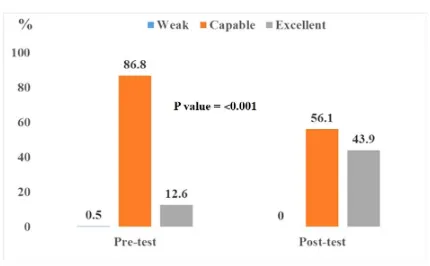
Figure 1 shows that nearly 87% of participants were reported accepted or capable levels of communication skills, and only 12.6% reported excellent level of communication in the pretest evaluation, while the percentage of excellent levels of communication skills was significantly
(P = 0.001) increased after conducting
training course to 43.9%, with reduction in the ratio of accepted or capable levels of communication from 86.1 (pretest)
to 56.1% (post-test evaluation). Table 2
explores significant (P = 0.001) change
(improvement) in total communication skill
mean scores from 50.0 to 55.9. The youngest age groups (20-29 years)
got significantly (P = 0.001) highest benefit
and witnessed more improvement in their communication skills (6.2 ± 2.6) than the other age group (more than 40 years old), (2.3 ± 1.1).
Figure 1: Communication skills levels of the participants in the pre and post test. Table 2: Overall communication skills scores in the pre and post-test evaluation
Training status Mean Std. Deviation P value
Pre-test 50.0 6.6
˂0.001
Similarly, physicians were reported
significantly (P = 0.001) high score
improvement in their communication skills
(7.1 ± 2.6). However, no significant improvement in communication skills was
identified in relation to gender, and
residency of the participants (P = 0.518,
and 0.728, respectively) as shown in Table 3.
courses playing a significant role in improving communication knowledge and skills especially at the time of pre-employment in the medical field, this finding as general is consistent with the results that are reported in other researches 12-14. This indicates that training courses are important techniques in overcoming shortages of communication knowledge and skills. Youngest age groups had got benefit and have been witnessed more improvement in their communication skills than the older age groups. 15 This finding is not similar to the result finding of other research that was performed in Turkey youngest participants are more aware regarding the importance
of the communication skills due to new improvement in the curriculum of
medical schools during previous five years, and they are more motivated to learn new skills, and they undertook more study-related activities to improve doctor-patient communication than older groups. A significant improvement in the
Table 3: Improvement (change) in communication skill scores after conducting training in
relation to socio-demographic characteristics of the participants.
Variables Improvements in communication skills Mean ± Standard deviation P value
Age groups in years 20-29
30-39
≥40
6.2±2.6 3.3±1.6 2.3±1.1
˂0.001
Gender Male Female
5.0±2.8 5.4±1.4
0.518
Category of the participants Physicians
Dentists Pharmacists
Nurses (College and Institute)
7.1±2.6 5.5±3.1 4.8±1.0 4.2±1.3
0.005
Residencies Inside city center District
Sub-district
5.4±2.3 5.2±2.6 4.7±1.4
0.725
Discussion
The results showing the general state of the participants’ communication knowledge and skills were prominently low (excellent rate of communication was reported only among 12.6% of participants). This finding is not consistent with the research finding conducted in Poland during 2013 that reported a higher rate of
communication skills among participants.11
This clearly indicated a defect in the educational training of the students during
undergraduate study and lack of training in professional communication skills. The
communication: the relationship with malpractice claims among primary care physicians and surgeons. JAMA 1997; 277(7):553–9.
3. Khodadadi E, Ebrahimi1 H, Moghaddasian S, Babapour J. The Effect of Communication Skills Training on Quality of Care, Self-Efficacy, Job Satisfaction and Communication Skills Rate of Nurses in Hospitals of Tabriz, Iran. J Caring Sci 2013; 2(1):27–37.
4. Jonathan SI, Suzanne KU, Juliet DR. Text book of Skills for Communicating with Patients.3rd ed. NewYork; CRC Publishers; 2016.
5. Roter DL, Hall JA, Kern DE, Barker LR, Cole KA, Roca RP. Improving physicians’ interviewing skills and reducing patients’ emotional distress. Arch Intern Med 1995; 155:1877–84.
6. Parle M, Jones B, Maguire P. Maladaptive coping and affective disorders in cancer patients. Psychol Med 1996; 26:735–44.
7. Ramirez AJ, Graham J, Richards MA, Cull A, Gregory WM. Mental health of hospital consultants: the effects of stress and satisfaction of work. Lancet 1995; 16:724–8.
8. Paget L, Han P, Nedza S, Kurtz P, Racine E, Russell S, et al. Patient-clinician communication: Basic principles and expectations. Institute of Medicine. Washington, DC. (Discussion Paper); 2011.
9. Peter M, Carolyn P. Key communication skills and how to acquire them. BMJ 2002; 325:697–700. 10. Mind tool team. How good are your
communication skills? (Accessed January 5, 201
11. Anna W, Mirosław J. Selected aspects of a professional doctor-patient communication – education and practice. Ann Agric Environ Med 2013; 20(2):373–9.
12. Cantillon P, Jones R. Does continuing medical education in general practice make a difference? BMJ 1999; 318:1276–9.
13. Peck C, McCall M, McLaren B, Rotem T. Continuing medical education and continuing professional development: international comparisons. BMJ 2000; 320:432–5.
14. Grol R. Improving the quality of medical care: building bridges among professional pride, payer profit and patient satisfaction. JAMA 2001; 286:2578–85.
15. Mehmet A, Orhan C, Levent S, Emel D, Bikem H, Hayri C, et al. Communication Skills Training For Emergency Nurses. Int J Med Sci 2011; 8(5):397–401.
16. Hulsman RL, Ros WJG, Winnubst JAM, Bensing JM. Teaching clinically experienced physicians communication skills. A review of evaluation studies. Med Educ1999; 33:655–68.
17. Cegala DJ, Lenzmeier-Broz S. Physician communication skills training: a review of theoretical backgrounds, objectives and skills.
communication skills was reported among physicians than the other groups; these findings are similar to the results findings of other researches that were performed in
the Netherlands and USA respectively.16,17
This finding can be explained that medical schools recognized the importance of interpersonal and communication skills in the practice of medicine and health services to the target groups. Physicians are more aware of the importance of communication skills during different aspects of doctor-patient interaction. Also,
the highest capability of learning among physicians may explain high level in communication skills improvements than the others.
Limitation of the study
This study is considered a single communication skills training course designed for health workforces. The effectiveness of the training course was evaluated only at the end of the training course. It is important to include a number of factors that may limit the generalizability of the study results like duration of training, training models and techniques, and methods of evaluation of skills.
References
1. Michael L. Physician and Patient Communication: A Grounded Theory Analysis of Physician and Patient Web-Logs. MA thesis in Professional Communication. Southern Utah University, College of Humanities and Social Sciences; 2013.
2. Levinson W, Roter DL, Mullooly JP, Conclusion
Competing interests
The author declares no competing interests.
The results of this study show the benefits of communication skills training among health workforces despite the differences in specialties, age and education levels. Also, it provides an approach for learning
and improving in practice for those interested in the health providers– clients