Vol. 46, No. 1, Spring 2014, pp. 27- 36 )AIJ-EEE)
٭
Corresponding Author, Email: [email protected]
Game-Based Cryptanalysis of a Lightweight CRC-Based
Authentication Protocol for EPC Tags
K. Baghery
1, B. Abdolmaleki
1and M. J. Emadi
2*1-MSc Student, Department of Electrical Engineering, Shahed University, Tehran, Iran
2-Assistant Professor, Department of Electrical Engineering, Amirkabir University of Technology, Tehran, Iran
ABSTRACT
The term "Internet of Things (IoT)" expresses a huge network of smart and connected objects which can
interact with other devices without our interposition. Radio frequency identification (RFID) is a great
technology and an interesting candidate to provide communications for IoT networks, but numerous security
and privacy issues need to be considered. In this paper, we analyze the security and the privacy of a new
RFID authentication protocol proposed by
Shi et al.
in 2014. We prove that although
Shi et al.
have tried to
present a secure and untraceable authentication protocol, their protocol still suffers from several security and
privacy weaknesses which make it vulnerable to various security and privacy attacks. We present our privacy
analysis based on a well-known formal privacy model which is presented by
Ouafi
and
Phan
in 2008.
Moreover, to stop such attacks on the protocol and increase the performance of
Shi et al.
’s scheme, we
present some modifications and propound an improved version of the protocol. Finally, the security and the
privacy of the proposed protocol were analyzed against various attacks.
KEYWORDS
1- INTRODUCTION
RFID is a user friendly technology which is useful in various applications in which identification, tracking or authentication are necessary [1]. An RFID system could be the best choice for asset management, tracking and positioning with precision, supply chain management, healthcare control, automobile ignition keys, production control and pass control [2]-[6]. Besides, RFID systems are interesting and popular candidates to be implemented in the Internet of Things world which is introduced as a next generation of internet [7]. In the IoT paradigm, we will face a huge global network which makes connections between large number of smart and IP-based devices in our environments Anytime, Anyplace, with Anything and Anyone [8]. Communications between IoT elements may be set up via various sensing devices like Global
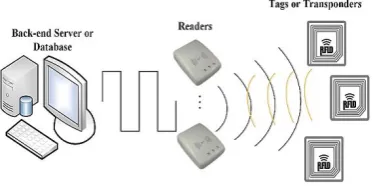
Positioning System (GPS), intelligent sensors, RFID systems or any other smart device that can exchange data between two objects [9]. Mainly, an RFID system has three main parts including back-end server, readers and large number of tags. The architecture of an RFID system is illustrated in Fig. 1. The tags are transponders equipped with a microstrip antenna and communicate with the readers using radio waves. Due to the nature of wireless
communications, communication channels between the tags and the readers are not secure and can be accessed by an outsider agent. Based on the power supply, available memory, operational frequency, processing power and range of work, the tags are classified to various categories which are employed in the desired applications. The second parts of each RFID system are the readers which act as interrogators and exchange messages between the tag and back-end server. This fact is graphically shown in Fig. 1. According to the desired applications, a reader can operate as a fixed or mobile reader. In the case that the reader is mobile, wireless communication channels between the readers and the back-end server might be insecure. The third and the essential part of each RFID system is the back-end server which acts as a core of an RFID system and performs various processing such as identification and authentication of the tags and in some cases the readers. The back-end server has all secret information about the tags and utilizes them in authentication procedures [10]. Usually, the back-end server is a central computer which has a powerful Central Processor Unit (CPU) and is connected to readers over a wireless or wired channel.
Fig. 1. An RFID system architecture
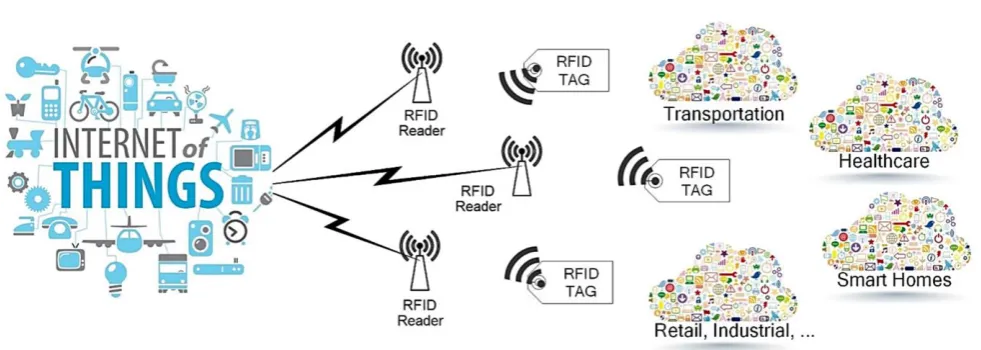
In the IoT paradigm, RFID tags can be attached to different objects and make a wireless connection with the RFID readers which act as an IoT gateway. A simple communication scenario of an RFID system in the IoT world is shown in Fig. 2. According to the figure, it can be seen that RFID readers can play the role of IoT gateway. In [8], Gross et al. proposed a prototype for the IoT paradigm based on the RFID passive tags in which the tags are conforming to the Electronic Product Code Class 1 Generation 2 (EPC C1 G2) standard. The IoT presents new services in which some of them bring security and privacy concerns for end-users. Thus, implementing a secure and confidential authentication protocol between the elements of the IoT significantly decreases these concerns.
The EPC C1 G2 standard is the most famous and popular standard which has been proposed for RFID passive tags by EPC global organization [11]. In the EPC C1 G2 standard, the tags are passive which supply their required powers using electromagnetic fields of readers. The tags, which are conforming to the EPC C1 G2 standard, have some processing limitations and are not allowed to use heavy-duty encryptions as well as hash functions [12]. This type of tag uses Pseudo Random Number Generator (PRNG), Cyclic Redundancy Code (CRC) and bitwise operators to protect the stored information and transmitted data.
In recent years, due to the widespread usage of EPC C1 G2 tags in a variety of modern applications, the security and the privacy of consumers have found great importance [13]-[14]. In this context, various lightweight RFID authentication protocols have been proposed which are under EPC C1 G2 standard and have tried to ensure the security and privacy of RFID end-users [15]-[18]. An EPC-based lightweight RFID authentication protocol is a particular security scheme that is designed to provide secure and confidential authentication between the back-end server and the tags which are conforming to the EPC C1 G2 standard. Although all the mentioned protocols are designed to protect RFID users, in the literature, several drawbacks of some EPC-based RFID authentication protocols are pointed out [12], [15], [19] and [20].
Recently, Shi et al. [21] have proposed a novel CRC-based lightweight RFID authentication protocol for EPC compliant tags. In the proposed protocol, they have used CRC and PRNG functions to protect and update the exchanged messages. In their protocol, communication channel between the tag and the reader is insecure and can be eavesdropped by an adversary. On the other hand, the reader and the back-end server communicate over a secure channel. They have analyzed the security and the privacy of their protocol against lots of existing threats including eavesdropping, traceability attacks, Denial of Service (DoS) attack, replay attack and spoofing attacks. They have claimed that the protocol can protect RFID users against various security and privacy concerns [21]. However, in this paper, we cryptanalyze Shi et al.’s
procedures, their protocol is unable to provide secure and untraceable authentication for RFID end-users and it suffers from several security and privacy attacks. More precisely, we show that Shi et al.’s protocol is vulnerable
to secret parameters reveal, tag impersonation attack and also their protocol does not provide users privacy. Then, in order to prevent all the mentioned attacks and increase the performance of the Shi et al.’s protocol, we apply
some modifications in the structure of the protocol and propose an improved version of it. Our security and privacy analysis show that new modifications overcome all the existing weaknesses in Shi et al.’s protocol.
The privacy of RFID authentication protocols can be studied by two different approaches: ad-hoc [22] and
formal [23]-[24]. In the ad-hoc approach, the adversary defines some notation and performs an attack based on the defined notations. On the other hand, in the formal approaches, the abilities of the adversary are classified into different categories which can be used in different privacy analysis. In the different studies, several RFID formal privacy models are proposed [25]-[31]. In this paper, we use a formal RFID privacy model which proposed by Ouafi and Phan (referred as Ouafi-Phan) [28] in our privacy analysis. In Ouafi-Phan privacy model, the adversary’s abilities are classified into four categories including , , and which are discussed with more details in the following section.
The rest of this paper is organized as follows. In section 2, Ouafi-Phan formal privacy model is described. We review Shi et al.’s protocol in section 3. Security and
privacy weaknesses of Shi et al.’s protocol are
investigated in section 4. In section 5, an improved and robust version of Shi et al.’s protocol is proposed. In this
section, the security and the privacy of the proposed protocol are also analyzed and compared with some similar protocols. The paper is concluded in Section 6.
2-OUAFI AND PHAN PRIVACY MODEL
In 2008, Ouafi and Phan [28] presented a privacy model to evaluate RFID authentication protocols. In this
paper, we use this model for our privacy analysis. So, in this section, we summarize Ouafi-Phan privacy model which will be used in the rest of paper.
In this model, the adversary can eavesdrop all channels between tags and readers and also it can attack them actively or passively. Similarly, the adversary has been allowed to run the following queries:
Execute query ( , , ):Passive attacks take place in this query. In other words, the adversary can eavesdrop all transmitted messages between the tag and the reader in th session. As a result, the adversary obtains all exchanged data between the tag
and the reader .
Send query ( , , , ):This query models the active attacks in RFID systems. In this query, the adversary has permission to impersonate a reader in the th session, and forwards a message to a tag . In addition, the adversary has permission to alert or block the exchanged message between the tag and the reader. Note that and are the members of readers and tags sets, respectively.
Corrupt query ( , ):In this query, the adversary has permission to access secret keys of the tag. In fact, the adversary has physical access to the tag’s database. In addition, the adversary can set secret key to .
Test query ( , ):When this query is executed in
the particular session , after completing th session, a random number bit * + is generated by challenger and delivered * + to the adversary. Now, the adversary succeeds if he/she can guess the bit correctly.
Untraceability privacy (UPriv): Untraceability privacy could be defined by the game G that is played between an adversary and a set of the tag and the reader instances. In other words, an adversary plays game G using collected instances of the reader and the tag. The game G
can be played using mentioned queries as follows.
Learning phase: The adversary has permission to
send each one of the queries such as Execute, Send
and Corrupt, and interact with the reader and ,
that are chosen randomly.
Challenge phase: The adversary selects two tags
, and forwards a ( ) to the challenger. After that, the challenger selects * + randomly and the adversary determines a tag
* + using Execute and Send queries.
Guess phase: Eventually, the adversary finishes
the game G and outputs a bit * + as guess of b. The success of adversary in game G and consequently breaking the notion of UPriv is quantified via ’s advantage in recognizing whether adversary received or , and denoted by
( ) where is the security parameter.
( ) | ( ) ( )|
| ( ) |
Where ( ) . Note that, if
( ) ( ), the protocol is traceable with a
negligible probability.
3-SHI ET AL.’S PROTOCOL
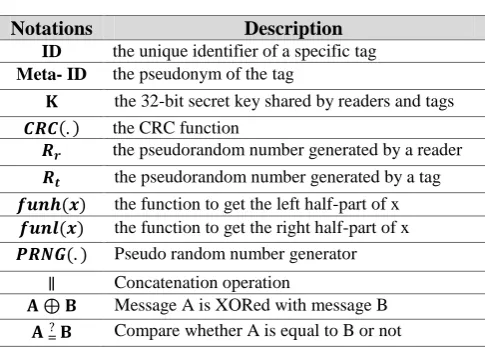
Recently, in [21], Shi et al. presented a five-step CRC-based authentication protocol for RFID systems. The notations used in the paper are presented in Table 1.
TABLE 1. THE NOTATIONS.
Notations Description
ID the unique identifier of a specific tag Meta- ID the pseudonym of the tag
the 32-bit secret key shared by readers and tags
( ) the CRC function
the pseudorandom number generated by a reader the pseudorandom number generated by a tag ( ) the function to get the left half-part of x
( ) the function to get the right half-part of x
( ) Pseudo random number generator
Concatenation operation
Message A is XORed with message B
Compare whether A is equal to B or not
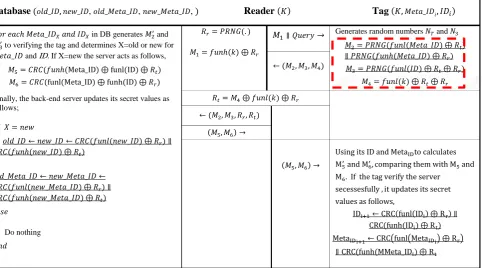
The authentication procedure of Shi et al. protocol is summarized in Fig. 3 and discussed in details in a 5-step round in the following.
Step 1. [Reader Tag]: The reader generates as a random number and computes message
( ) . It then sends a Query and message to the tag.
Step 2. [Tag Reader]: After receiving the reader’s response, the tag calculates ( ), then it generates a random number and computes the following messages and sends them to the reader.
( ( ) )
( ( ) ),
( ( ) ),
( ) .
Step 3. [Reader Back-end server]: By using the message , the reader abstracts the random number , and then it forwards messages ( ) to the back-end server.
Step 4. [Back-end server Reader]: Upon receiving the sent messages from the reader, the back-end server performs the following operations.
a) Using and or and
, It generates
( ( ) )
( ( ) ) and
( ( ) ) for
. Afterwards, it verifies and and determines that . If and for , it authenticates the tag and responds to the reader through the following messages,
( ( ) ( ) ),
( ( ) ( ) ).
Otherwise, the back-end server quit the protocol.
b) Finally, the back-end server updates its secret values as follows;
( ( )
) ( ( ) )
( ( ) )
( ( ) )
do nothing
Step 5. [Reader Tag]: The reader sends message and to the tag. Upon receiving messages from the reader, the tag calculates message and then in order to authenticate the back-end server, the tag verifies and . Finally it updates its secret values as
( ( ) )
( ( ) )
( ( ) )
( ( ) ),
4-CRYPTANALYSIS OF SHI ET AL.’S PROTOCOL
In [21], Shi et al. analyzed their protocol and claimed that their protocol is secure against various security and privacy attacks. We show that Shi et al.’s protocol not
only cannot protect the secret keys properly, but also it is vulnerable to tag impersonation and traceability attacks. In the rest of section, we first introduce a linear property of CRC operator that is used in our presented attacks and then present several practical attacks against Shi et al.’s
protocol.
Linear Property: This property of CRC operator
indicates that ( ) ( ) ( ) , where A and B represent the arbitrary values.
4-1- TAG IMPERSONATION ATTACK
In this subsection, it is shown that an adversary is able to impersonate the legitimate tag. This attack consists of two phases; learning phase and attach phase.
Learning phase: In the round , the adversary acts as an eavesdropper. After one successful run, the adversary saves the exchanged data between the target tag and the reader including ( ) , ( ( ) )
( ( ) ) ,
( ( ) ) ,
( ) . After that, using message the adversary defines ( ( ) ) and ( ( ) ).
Attack phase: In this phase, the adversary acts as a legitimate tag and when the reader sends a and message ( ) to the target tag. The adversary obtains message . Then, by using obtained messages in the learning phase, the following
messages are computed and sent to the reader.
( ( ) ( ))
( ) ( )
.
Based on the receiving messages from the adversary, the reader first calculates as ( ) . Then, the reader sends messages
, , and to the back-end server. To
verify the adversary as a legitimate tag, by using and , the back-end server performs two phases as follows;
phase1: First the adversary calculates message as
( ( ) )
( ( ) ) and verifies
as follows,
( ( ) ( ))
( ( ( ) )
( ( ) ))
By using the linear property,we have
( ( ( )) ( )
( ( )) ( ))
( ( ) ( )) (1)
Then, by substituting ( ( ) ) in equation (1), we have
( ( ( ) )
( ) ( )). (2)
Again, by considering the linear property, is
Database (𝑜𝑙𝑑 𝐼𝐷 𝑛𝑒𝑤 𝐼𝐷, 𝑜𝑙𝑑 𝑀𝑒𝑡𝑎 𝐼𝐷, 𝑛𝑒𝑤 𝑀𝑒𝑡𝑎 𝐼𝐷, ) Reader (𝐾) Tag (𝐾 𝑀𝑒𝑡𝑎 𝐼𝐷𝑖 𝐼𝐷𝑖)
𝑀 𝐶𝑅𝐶(𝑓𝑢𝑛 ( ) ( ) 𝑅𝑡)
𝑀 𝐶𝑅𝐶( ( ) ( ) 𝑅𝑟)
𝐼𝑓 𝑋 𝑛𝑒𝑤
𝑜𝑙𝑑 𝐼𝐷 𝑛𝑒𝑤 𝐼𝐷 𝑃𝑅𝑁𝐺(𝑓𝑢𝑛𝑙(𝑛𝑒𝑤 𝐼𝐷) 𝑅𝑡)
𝑃𝑅𝑁𝐺(𝑓𝑢𝑛 (𝑛𝑒𝑤 𝐼𝐷) 𝑅𝑟)
𝑜𝑙𝑑 𝑀𝑒𝑡𝑎 𝐼𝐷 𝑛𝑒𝑤 𝑀𝑒𝑡𝑎 𝐼𝐷
𝑃𝑅𝑁𝐺(𝑓𝑢𝑛𝑙(𝑛𝑒𝑤 𝑀𝑒𝑡𝑎 𝐼𝐷)
𝑅𝑡) 𝑃𝑅𝑁𝐺(𝑓𝑢𝑛 (𝑛𝑒𝑤 𝑀𝑒𝑡𝑎 𝐼𝐷) 𝑅𝑟)
𝐸𝑙𝑠𝑒
𝐸𝑛𝑑
𝐹𝑜𝑟 𝑒𝑎𝑐 𝑀𝑒𝑡𝑎 𝐼𝐷𝑋 𝑎𝑛𝑑 𝐼𝐷𝑋 in DB generates 𝑀 and 𝑀 to
verifying the tag and determines X=old or new for 𝑀𝑒𝑡𝑎 𝐼𝐷
and ID. If X=new the server acts as follows,
Finally, the back-end server updates its secret values as follows;
Do nothing
𝑅𝑟 𝑃𝑅𝑁𝐺( )
𝑀 𝑓𝑢𝑛 (𝑘) 𝑅𝑟
𝑀 𝑄𝑢𝑒𝑟𝑦
𝑀 𝐶𝑅𝐶(𝑓𝑢𝑛𝑙(𝑀𝑒𝑡𝑎𝐼𝐷) 𝑅𝑡)
𝐶𝑅𝐶(𝑓𝑢𝑛 (𝑀𝑒𝑡𝑎 𝐼𝐷) 𝑅𝑟)
𝑀 𝐶𝑅𝐶(𝑓𝑢𝑛𝑙(𝐼𝐷) 𝑅𝑡 𝑅𝑟)
𝑀 𝑓𝑢𝑛𝑙(𝑘) 𝑅𝑡 𝑅𝑟
Generates random numbers 𝑁𝑇 and 𝑁
(𝑀 𝑀 𝑀)
𝑅𝑡 𝑀 𝑓𝑢𝑛𝑙(𝑘) 𝑅𝑟
(𝑀 𝑀 𝑅𝑟 𝑅𝑡)
(𝑀 𝑀)
(𝑀 𝑀)
U g 𝐼𝐷 𝑀𝑒𝑡𝑎𝐼𝐷
𝑀 𝑀 g 𝑀
𝑀 g
y
𝐼𝐷𝑖 𝑃𝑅𝑁𝐺(𝑓𝑢𝑛𝑙(𝐼𝐷𝑖) 𝑅𝑡)
𝑃𝑅𝑁𝐺(𝑓𝑢𝑛 (𝐼𝐷𝑖) 𝑅𝑟)
𝑀𝑒𝑡𝑎𝐼𝐷𝑖 𝑃𝑅𝑁𝐺(𝑓𝑢𝑛𝑙(𝑀𝑒𝑡𝑎𝐼𝐷𝑖)
𝑅𝑡) 𝑃𝑅𝑁𝐺(𝑓𝑢𝑛 (𝑀𝑒𝑡𝑎 𝐼𝐷𝑖) 𝑅𝑟)
rewritten as
( ( ( )) ( )
( ) ( ))
( ( ( )) ( ))
( ( ( )
)) (3)
Finally, by substituting ( ( )
) in equation (3), we can write ( ( ) )
( ( ( ) ))
( ( ) )
( ( ( ) ))
(4)
Phase 2:
The back-end sever computes message
as
( (
)
)
.
Then, in order to authenticate the adversary as a
legitimate tag, back-end sever verifies
as follows:
( ) ( ).
Substituting ( ( ) ) , ( ) and ( ) , equation (4) can be rewritten as follows,
( ( ) ) ( ( ) ) ( ( ) ) (5)
By using the linear property of CRC operation, we have
( ( ) ) ( )
( ( )) ( )
( ( )) ( )
( ( ) ) ( )
( ( ) )
( ( ) )
. (6)
Therefore, the back-end server authenticates the adversary as a legitimate tag.
4-2- SECRET PARAMETER REVEAL ATTACK
In this subsection, we present a practical secret parameter reveal attack against Shi et al.’s protocol. It is
shown that an adversary is able to reveal secret parameter and . This attack is performed in two phases as follows.
Learning phase:
In this phase, the adversary acts
as an eavesdropper. After two successful runs of the
protocol, the adversary saves the exchanged data
between the target tag and the reader including
( (
)
)
( (
)
)
,
( (
)
)
( (
)
)
,
( (
) (
)
)
and
( (
)
(
)
)
.
Attack phase: The adversary defines two new
parameters and as ( ( )
), ( ( ) ) which are the first and the second parts of message . Then adversary performs the following steps;
a) Since ( ( ) ) is a 16-bit string, thus ( ( ) ) where * +. Now, using the new parameter ,
( )
( ( ) )
b) Now, like step (a), since ( ( ) ) is a 16-bit string, thus ( ( ) ) where * +. Now, using the new parameter ,
( )
( ( ) )
.
Now, by using ( ( ) ) and ( ) in the steps (a) and (b), the adversary calculates the secret value as ( ( ) ) ( ( ) ), that will be used in the round ( ),
c) In order to compute the secret value , the adversary uses the eavesdropped messages , and
in the learning phase and the linear property of
CRC operator, adversary calculates and as follows.
First, in order to calculate , adversary uses the first part of the message and calculates the secret value in steps (a) and (b), so
( ( ) )
( ( ))
Using the linear property, is rewritten as
( ) ( ( )). Now , in order to calculate , adversary uses
the second part of the message and
evaluates secret value in steps (a) and (b), and performs the following process
( ( ) )
( ( ))
By considering the linear property, we have
( ( ))
( ) ( ( )). Then, adversary computes ( ) as
( ) . Substituting ( ) ) and using the linear property,we have
( ) ( )
.
After that, the adversarycomputes ( ) as ( )
By substituting ( ) ) and using the linear propertywe have,
( ) ( )
Finally, adversary concatenates calculated ( ) and ( ) and computes the secret value as
( ) ( ).
4-3- TRACEABILITY ATTACK
The other important weakness of Shi et al.’s protocol
is the privacy of this protocol. We show that the adversary can trace the location of a specific tag. To do so, we have the following procedures.
Learning phase: In round ( ), the adversary sends an ( ) and obtains ( ) . Then, the adversary sends a ( ) and blocks the protocols. As results, the tag does not update the secret values. After that, by using the first and the second parts of the message , the adversary defines new parameters ( ( ) )
and ( ( ) ) and
computes as
( ( ))
( ( )) ( ( ).
Challenge phase: In round ( ), the adversary selects two fresh tags and for test, and sends a ( ). According to the randomly chosen bit * +, the adversary is given a tag * +. After that, the adversary sends an
( ) , and obtains
( ). Then, by using the first and the second
parts of message the adversary defines new
parameters ( ( ) ) and ( ( ) ).
Guess phase: The adversary stops the game G, and
outputs a bit * +as a guess of bit . That is
{ As a result, the advantage function is given by
( ) | ( ) ( )|
| ( ) | | |
Proof: According to Shi et al.’s protocol, the
following equations are given
( ( )
) ( ( ) )
( ( ) ). Using the linear property, we have
( ( )) ( ) (
( )) ( ) ( ( ) ( ) ( ),
( ( )) ( ( ))
( ( )
Using this fact that , we have
( ( ))
( ( )) ( ( )
In the learning phase, since the tag did not update its secret values, so and , as a result ( ( ))
( ( )) ( ( )
.
In summary, we proved that an adversary can trace the location of a specific tag in a specific session.
5- IMPROVED VERSION OF SHI ET AL.’S PROTOCOL
In this section, we propose some modifications in the structure of Shi et al.’s protocol to overcome all the
reported weaknesses in Section 4. It is shown that due to some flaws in the tag responses and updating procedure of the Shi et al.’s protocol, their protocol cannot protect
and traceability attack. Thus, in the improved version, we propose some changes in the exchanges messages between the tag and the reader, and modify the updating procedure of the tag and the back-end server. The changes and modifications are discussed in details in the following. In Shi et al.’s protocol, the values of and are
given by ( ( ) )
( ( ) ) and
( ( ) ) We change their values
to ( ( ) )
( ( ) ) and
( ( ) ).
The next change is in updating the tag and the back-end server as follows:
( ( ) ) ( ( ) )
( ( )
) ( ( ) )
All authentication steps of the improved protocol are the same as Shi et al.’s protocol, except the proposed
modifications in the updating procedure and the tag responses. Final structure of the improved protocol is shown on Fig. 4 wherein the authentication steps are provided with more details.
In the rest of this section, it is shown that how these changes prevent all the presented attacks and make the protocol more efficient and robust than before.
5-1- SECRET PARAMETER REVEAL
As it is shown in subsection 4-1, due to the dependency between the updating of secret keys and the structure of the tag response , Shi et al.’s protocol
cannot protect secret keys and an adversary can obtain the secret parameters with maximum computations. In the improved protocol, this problem is eliminated with our new changes in the updating procedure of and structure.
5-2- IMPERSONATION AND REPLAY ATTACK
In the proposed improved version of Shi et al.’s
protocol, due to some changes applied in messages
( ( ) )
( ( ) ) and
( ( ) ) , which are
exchanged between the tag and the reader, by using PRNG operator instead of CRC operator, the weaknesses that are reported in section 4 are omitted. Therefore, the adversary cannot use the eavesdropped messages and perform impersonation and replay attack.
5-3- PRIVACY
Providing confidential and untraceable
communications for the end-users is one of the main goals of each RFID authentication protocol. In subsection 4-3, we showed that the privacy of Shi et al.’s protocol
has some drawbacks and makes it unable to provide untraceable communication. In the modified protocol, we solve this problem by changing the message as
( ( ) ) and updating of
as ( ( ) )
( ( ) ). With these modifications,
Database (𝑜𝑙𝑑 𝐼𝐷 𝑛𝑒𝑤 𝐼𝐷, 𝑜𝑙𝑑 𝑀𝑒𝑡𝑎 𝐼𝐷, 𝑛𝑒𝑤 𝑀𝑒𝑡𝑎 𝐼𝐷, ) Reader (𝐾) Tag (𝐾 𝑀𝑒𝑡𝑎 𝐼𝐷𝑖 𝐼𝐷𝑖)
𝑀 𝐶𝑅𝐶(𝑓𝑢𝑛 ( ) ( ) 𝑅𝑡)
𝑀 𝐶𝑅𝐶( ( ) ( ) 𝑅𝑟)
𝐼𝑓 𝑋 𝑛𝑒𝑤
𝐸𝑙𝑠𝑒
𝐸𝑛𝑑
𝐹𝑜𝑟 𝑒𝑎𝑐 𝑀𝑒𝑡𝑎 𝐼𝐷𝑋 𝑎𝑛𝑑 𝐼𝐷𝑋 in DB generates 𝑀 and
𝑀 to verifying the tag and determines X=old or new for
𝑀𝑒𝑡𝑎 𝐼𝐷 and ID. If X=new the server acts as follows,
Finally, the back-end server updates its secret values as follows;
𝑜𝑙𝑑 𝐼𝐷 𝑛𝑒𝑤 𝐼𝐷 𝐶𝑅𝐶(𝑓𝑢𝑛𝑙(𝑛𝑒𝑤 𝐼𝐷) 𝑅𝑟)
𝐶𝑅𝐶(𝑓𝑢𝑛 (𝑛𝑒𝑤 𝐼𝐷) 𝑅𝑡)
𝑜𝑙𝑑 𝑀𝑒𝑡𝑎 𝐼𝐷 𝑛𝑒𝑤 𝑀𝑒𝑡𝑎 𝐼𝐷
𝐶𝑅𝐶(𝑓𝑢𝑛𝑙(𝑛𝑒𝑤 𝑀𝑒𝑡𝑎 𝐼𝐷) 𝑅𝑟)
𝐶𝑅𝐶(𝑓𝑢𝑛 (𝑛𝑒𝑤 𝑀𝑒𝑡𝑎 𝐼𝐷) 𝑅𝑡)
Do nothing
𝑅𝑟 𝑃𝑅𝑁𝐺( )
𝑀 𝑓𝑢𝑛 (𝑘) 𝑅𝑟
𝑀 𝑄𝑢𝑒𝑟𝑦
𝑀 𝑃𝑅𝑁𝐺(𝑓𝑢𝑛𝑙(𝑀𝑒𝑡𝑎 𝐼𝐷) 𝑅𝑡)
𝑃𝑅𝑁𝐺(𝑓𝑢𝑛 (𝑀𝑒𝑡𝑎 𝐼𝐷) 𝑅𝑟)
𝑀 𝑃𝑅𝑁𝐺(𝑓𝑢𝑛𝑙(𝐼𝐷) 𝑅𝑡 𝑅𝑟)
𝑀 𝑓𝑢𝑛𝑙(𝑘) 𝑅𝑡 𝑅𝑟
Generates random numbers 𝑁𝑇 and 𝑁
(𝑀 𝑀 𝑀)
𝑅𝑡 𝑀 𝑓𝑢𝑛𝑙(𝑘) 𝑅𝑟
(𝑀 𝑀 𝑅𝑟 𝑅𝑡)
(𝑀 𝑀)
(𝑀 𝑀)
U g
g
g y y
( ( ) )
( ( ) )
( ( )
( ( ) )
an adversary cannot remove the effect of random numbers and and traces the location of a specific tag.
Finally, we compare the security and the privacy of the improved protocol with some similar new-found RFID authentication protocols in Table 2. According to the last column, it can be seen that all the discovered drawbacks are eliminated in the improved version.
TABLE 2.A COMPARISON OF SECURITY ANALYSIS.
: Secure : Insecure A. Chien et al. B. Pang et al. C. Safkhani et al. D. Yeh et al. E. Wang et al. F. Shi et al. G. Proposed protocol
5- CONCLUSION
We cryptanalyzed a CRC-based lightweight mutual authentication protocol which has been proposed recently for RFID systems by Shi et al. [21]. Shi et al. claimed that their protocol is safe against different security and privacy attacks. However, we showed that their protocol has some drawbacks which make it vulnerable to secret parameter reveal, tag impersonation and traceability attacks. We presented our traceability attack based on a well-known RFID formal privacy model proposed by
Ouafi and Phan. Moreover, in order to increase the performance of Shi et al.’s protocol and prevent the presented attacks, we proposed some modifications in the structure of the original protocol and presented an improved protocol which removes all the existing weaknesses. The analysis illustrated that the improved protocol can provide secure and untraceable communication for RFID end-users. Finally, a comparison of security analysis for the improved protocol and some similar RFID authentication protocols was presented.
REFERENCE
[1] J. Banks, M. Pachano. L. Thompson, and D. Hanny, RFID applied, John Wiley & Sons, Inc., 2007.
[2] D. He, and Sh. Zeadally, “An Analysis of RFID Authentication Schemes for Internet of Things in Healthcare Environment Using Elliptic Curve Cryptography,” IEEE Internet of Things Journal, vol. 2, no. 1, pp. 72 - 83 , 2015.
[3] M.H. Ok, and G. Uiwang, “A location tracking by RFID to assist the transportation vulnerable in
subway stations,” in 11th WSEAS International
Conference on Mathematical methods and computational techniques in electrical engineering, 2009.
[4] L. Ruiz-Garcia, and L. Lunadei, “The role of RFID in agriculture: Applications, limitations and challenges,” Computers and Electronics in Agriculture, vol. 79, no. 1, pp. 42-50, 2011.
[5] M. L. Ng, K. S. Leong, D. M. Hall, and P. H. Cole, “A small passive UHF RFID tag for livestock identification,” in IEEE International Symposium on Microwave, Antenna, Propagation and EMC Technologies for Wireless Communications, 2005.
[6] P. Picazo-Sanchez, N. Bagheri, P. Peris-Lopez, and J. E. Tapiador, “Two RFID Standard-based Security protocols for healthcare environments,” Journal of Medical Systems, vol. 37, no. 5, pp. 1-12, 2013.
[7] S. Maharjan, “RFID and IOT: An overview,” Simula Research Laboratory University of Oslo, 2010.
[8] H. Gross, E. Wenger, H. Martín, and M. Hutter, “PIONEER: a Prototype for the Internet of Things Based on an Extendable EPC Gen2 RFID Tag,” in Radio Frequency Identification: Security and Privacy Issues, pp. 54-73, 2014.
[9] L. Yang, P. Yu, W. Bailing, Q. Yun, B. Xuefeng, and Y. Xinling, “Hash-based RFID mutual authentication protocol,” International Journal of Security & Its Applications, vol. 7, no. 3, 2013.
[10] D. Henrici, “RFID Security and privacy: concepts, protocols and architectures,” Lecture Notes Electrical Engineering, Springer-Verlag Berlin Heidelberg, vol. 17, 2008.
[11] EPCglobal Inc., Available:
http://www.epcglobalinc.org.
[12] H. Gross, E. Wenger, H. Martín, and M. Hutter, "PIONEER: a Prototype for the Internet of Things Based on an Extendable EPC Gen2 RFID Tag," in Radio Frequency Identification: Security and Privacy Issues, pp. 54-73, 2014.
[13] H. Hada, and J. Mitsugi, “EPC based internet of things architecture,” in IEEE International Conference on RFID-Technologies and Applications (RFID-TA), 2011.
[14] B. Hameed, I. Khan, F. Durr, and K. Rothermel, “An RFID based consistency management framework for production monitoring in a smart real-time factory,” in 2rd International Conference on the Internet of Things (IOT), Tokyo, 2010.
[15] T. C. Yeh, Y. J. Wanga, T. Ch. Kuo, and S. S. Wanga, “Securing RFID systems conforming to
Protocols Attacks
A [32]
B [33]
C [34]
D [35]
E [36]
F [21]
G
Secret Values
Reveal
Replay
Impersonation
DoS
EPC Class 1 Generation 2 standard,” Expert Systems with Applications, vol. 37, p. 7678–7683, 2010.
[16] M.H. Habibi, M. R. Alaghband, and M. R. Aref, “Attacks on a lightweight mutual authentication protocol under EPC C-1 G-2 standard,” in Information Security Theory and Practice. Security and Privacy of Mobile Devices in Wireless Communication, Springer, 2011, pp. 254-263.
[17] E.-J. Yoon, “Improvement of the securing rfid systems conforming to EPC Class 1 Generation 2 standard,” Expert Syst. Appl., vol. 39, no. 11, p. 1589–1594, 2012.
[18] S. M. Alavi, K. Baghery, B. Abdolmaleki, and M. R. Aref, “Traceability analysis of recent RFID authentication protocols,” Wireless Personal Communications Journal, DOI 10.1007/s11277-015-2469-0, March 2015.
[19] A. Mohammadali, Z. Ahmadian, and M. R. Aref, “Analysis and Improvement of the securing RFID systems conforming to EPC Class 1 Generation 2 standard,” IACR Cryptology ePrint Archive, vol. 66, pp. 1-9, 2013.
[20] F. Xiao, Y. Zhou, J. Zhou, H. Zhu, and X. Niu, “Security protocol for RFID system conforming to EPC-C1G2 standard,” Journal of Computers, vol. 8, no. 3, pp. 605-612, 2013.
[21] Z. Shi, Y. Xia, Y. Zhang, Y. Wang, and J. Dai, “A CRC-based lightweight authentication protocol for EPCglobal Class-1 Gen-2 tags,” in 14th International Conference on Algorithms and Architectures for Parallel Processing (ICA3PP), 2014.
[22] I. Coisel, and T. Martin , “Untangling RFID privacy models,” Journal of Computer Networks and
Communications, pp. 1-26, 2013,
DOI:10.1155/2013/710275.
[23] S. M. Alavi, B. Abdolmaleki, and K. Baghery, “Vulnerabilities and improvements on HRAP+, a hash-based RFID authentication protocol,” Advances in Computer Science: an International Journal, vol. 3, no. 6, pp. 51-56, 2014.
[24] Z. Sohrabi-Bonab, M. R. Alagheband, and M. R. Aref, “Formal cryptanalysis of a CRC-based RFID authentication protocol,” in The 22nd Iranian
Conference on Electrical Engineering (ICEE 2014), Tehran, 2014.
[25] G. Avoine, “Adversarial model for radio frequency identification,” Cryptology ePrint Archive, report 2005/049. http://eprint.iacr.org/2005/049, 2005.
[26] C. H. Lim, and T. Kwon, “Strong and robust RFID authentication enabling perfect ownership transfer,”
In Proceedings of ICICS ’06, LNCS 4307 , pp. 1-20, 2006.
[27] A. Juels, and S.A Weis, “Defining strong privacy for RFID,” in Proceedings of PerCom ′07, pp. 342–347. , 2006.
[28] K. Ouafi and R. C.-W. Phan, “Privacy of recent RFID authentication protocols,” in 4th International Conference on Information Security Practice and Experience, Springer, 2008.
[29] R. H. Deng, Y. Li, M. Yung, and Y. Zhao, “A new framework work for RFID privacy,” in 15th
European Symposium on Research in Computer Security (ESORICS), Athens, 2010.
[30] D. Moriyama, S. Matsuo, and M. Ohkubo, “Relation
among the security models for RFID
authentication,” in In 17th European symposium on
research in computer security, pp. 661–678, 2012.
[31] S. Vaudenay, “On privacy models for RFID,” in ASIACRYPT 2007, LNCS 4833, pp. 68–87., 2007.
[32] H. Y. Chien, and C. H. Chen, “Mutual authentication protocol for RFID confirming to EPC Class 1 Generation 2 standards,” Computer Standards & Interfaces, vol. 29, no. 2, pp.254-259, 2007.
[33] L. Pang, H. Li, L. He, A. Alramadhan, and Y. Wang, “Secure and efficient lightweight RFID authentication protocol based on fast tag indexing,” International Journal of Communication Systems, vol. 27, no. 11, pp. 3244-3254, 2014.
[34] M. Safkhani and N. Bagheri, “For an EPC-C1G2 RFID compliant Protocol, CRC with Concatenation: No; PRNG with Concatenation: Yes,” Cryptology ePrint Archive, Report 2013/490, 2013
[35] Yeh T C, Wanga Y J, Kuo T C, Wanga S S, “Securing RFID systems conforming to EPC Class 1 Generation 2 standard,” Expert Systems with Applications, 37 :7678–7683, 2010.
[36] Wang S, Liu S, Chen D, “Security analysis and improvement on two RFID authentication protocols,” Wireless Personal Communications DOI
![Fig. 3. Shi et al.’s protocol [21].](https://thumb-us.123doks.com/thumbv2/123dok_us/18105.2001877/5.595.50.542.65.331/fig-shi-et-al-s-protocol.webp)