Mn-Metal Organic Framework as Heterogenous Catalyst
for Oxidation of Alkanes and Alkenes
F. Farzaneh
*and L. Hamidipour
Department of Chemistry, Faculty of Physics and Chemistry, Alzahra University, P.O.Box 1993891176, Vanak,Tehran, Islamic Republic of Iran
Received: 29 August 2015 / Revised: 25 October 2015 / Accepted: 30 November 2015
Abstract
Manganese metal-organic framework (Mn-MOF) containing Mn
2+ions,
benzenetricarboxylic acid (BTC) and
N
,
N
-dimethylformamid (DMF) was prepared and
used as catalyst for oxidation of alkenes such as 1,1-diphenylethylene,
trans
-stilbene,
cyclohexene, norbornene, styrene and cyclooctene to epoxides with 33-92% conversion
and 75-100% selectivity and oxidation of alkanes such as fluorene, adamantane,
ethylbenzene and diphenylmethane to alcohols or ketones with
tert-
butylhydroperoxide
(TBHP) with 19-64% conversion and 80-100% selectivity. Study of the catalyst stability
and reusability revealed that Mn-MOF behaves heterogeneously in the oxidation
reactions.
Keywords: Mn metal organic framework; Heterogeneous catalysis; Oxidation reactions; Akanes; Alkenes.
* Corresponding author: Tel: +982188041344; Fax: +982188041344; Email: [email protected], [email protected]
Introduction
The catalytic oxidation of alkanes and alkenes has been a subject of growing interest in the production of chemicals and fine chemicals. New active and selective epoxidation catalysts has been developed due to the key role of epoxides as starting materials for a wide variety of products [1-4]. On the other hand, whereas alkanes are the most abundant and least expensive chemicals for the production of valuable products, methods of selective oxidations are either rare or inefficient [5]. Transition metal complexes are successfully used to catalyze oxidation of hydrocarbons under moderate reaction conditions [6]. Among different transition metals, Mn-Schiff base complexes has been used for different oxidation type reactions [7, 8]. Interestingly, manganese compounds not only are used as active
catalysts for oxidation and epoxidation of hydrocarbons with low cost and less environmentally damaging but also are used by nature as catalytically active in a variety of metalloenzymes [9-16]. To mimic these enzymes, many manganese complexes consisting of Schiff-base ligands, porphyrins, triazamacrocycle and phthalocyanine have been used as selective catalysts for oxidation reactions [17-21].
(MOFs), also known as coordination polymers. MOFs have recently attracted great interest not only because of their versatile intriguing architectures and topologies but also due to their potential applications as functional materials [25-28]. In their structures, the metal ions are locally connected to the organic molecules through coordination bonds, thus resembling a spatially ordered three-dimensional array [29]. Polycarboxylic acids have been found as good candidates for the construction of novel metal–organic compounds as the carboxyl group can form C–O–M–O with four-membered rings with central metal ions [30,31]. The design and synthesis of metal-organic networks via self-assembly of metal ions and multifunctional ligands depend both on the selection of the coordination geometry of metal centers and on the various binding sites and directionality of the organic ligands [32-34]. In this study attempts has been made on using Mn –MOF as catalyst for oxidation of alkenes and alkanes.
Materials and Methods
Materials and Instrumentation Details
All materials were of commercial reagent grade and used without further purification. FTIR spectra were recorded on a Bruker Tensor 27 IR spectrometer in KBr pellets over the range of 4000–400 cm-1 under the
atmospheric conditions. X-ray powder diffraction (XRD) data were recorded on a diffractometer type, Siefert XRD 3003 PTS, using Cu Kα radiation (λ =
1.5406Å). The amount of Mn in crystal was determined by atomic absorption spectroscopy (AAS) with a GBC spectrophotometer using flame approach. Oxidation products were analyzed by GC and GC Mass using an Agilent 6890 Series with FID detector, HP-5% phenylmethylsiloxane capillary and Agilent 5973 Network, mass selective detector, HP-5MS 6989 network GC system, respectively.
Preparation Mn-MOF
The Mn-MOF was prepared as reported [35]. A mixture of MnCl2.4H2O (3.0 mmol, 0.5937 g), H3BTC
(1.0 mmol, 0.210 g), DMF (5.0 ml) and distilled water (5.0 ml) was placed in a 23 ml Teflon-lined stainless autoclave. The autoclave was sealed, heated to 120°C at a rate of a 10°C /h, under autogenous pressure for 5 days and then cooled to room temperature at a rate of 5°C/h. Colorless crystals were filtered, washed with DMF and distilled water and then dried in air. The (CH3)2NH2+
and HCOO- were generated via decomposition of DMF.
Elemental analysis for C15H19NO16Mn3 (Fw: 634.13):
Calcd: C, 27.85%; H, 2.94%; N, 2.16%. Found: C, 28.42%; H, 2.69%; N, 2.17%.
Oxidation of alkenes and alkanes
Oxidation reactions were carried out in a round bottom flask equipped with a magnetic stirrer and a water-cooled condenser under atmospheric pressure. Typically, a mixture of catalyst (0.158mmol, 100 mg) and substrate (1mmol, in 8 ml CH3CN) was added to the
reaction flask upon slow stirring. After stirring for several minutes, TBHP (0.1 ml, 80% in di-tertiary butyl peroxide) was added and the mixture was heated at reflux for 24 h. The solid was then filtered and washed with fresh acetone. The filtrate was subjected to GC and GC mass analysis.
Results and Discussion
The Mn-MOF as a colorless crystal was prepared in high yield on the basis of the previously reported method under hydrothermal condition (Scheme 1) [35].
Catalytic activity
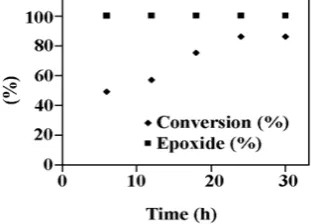
The epoxidation reaction of trans-stilbene as the representing substrate was carried out in the presence of 75 mg of Mn-MOF as catalyst. Results obtained for the effect of time on the epoxidation reaction (Fig.1) reveals 86% of trans-stilbene has been oxidized within 24 h, beyond which no further oxidation occurs during the next 12 h.
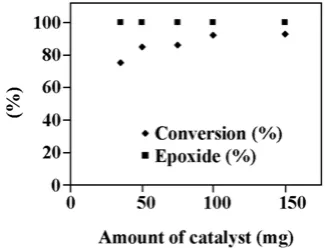
As indicated in Fig. 2, changing the amount of catalyst from 35 mg to 100 mg increases the conversion from 75% to 92%. Therefore, other epoxidation
Scheme 1. Preparation of Mn-MOF.
Figure 1. Effect of time on oxidation of trans-stilbene
reactions were carried out within the optimal conditions (24 h and 100 mg of catalyst).
The epoxidation results of trans-stilbene, styrene, diphenylethylene, cyclohexene, cyclooctene and norbornene with Mn–MOF in acetonitrile as solvent and
TBHP as oxidant are given in Table 1(entries 1-6). Selective epoxidation of norbornene, trans-stilbene and cyclooctene along with styrene which has undergone competitive oxidation to styrene epoxide and benzaldehyde are notable. On the other hand, whereas 1,1-diphenylethylene has totally proceeded to diphenylketone, oxidation of cyclohexene has exceptionally occurred via allylic C-H, affording 2-cyclohexene-1-ol (25%) and 2-cyclohexene-1-one (75%). Observation of no catalyst active species desorption under oxidation conditions due to the stability of the catalysis system is promising. The stability of the Mn-MOF was also studied by recycling of the easily recovered catalyst and redetermination of the metal content using atomic absorption spectroscopy. Compared to the initial catalyst manganese content which was 23.84%, it was found to be 22.87% in the used catalyst.
The oxidation results of flourene, adamantane, ethylbenzene, and diphenylmethane are given in Table Table 1. Results of the oxidation of organic hydrocarbons with TBHP in the persence of Mn-MOF
Entry Substrate Conversion
(%) Major product (%) Minor product (%) Time (h)
1
trans-Stilbene
92
100 -
24
2
Styrene
85
54
H O
46
24
3
1,1-Diphenylethylene
33
84
16
24
4
Cyclohexene
100
75
25
24
5
Cyclooctene
55
100
- 24
6
Norbornene
96
100
- 24
Reaction conditons: substrate (100 mg), catalyst (150 mg), TBHP (80%, 0.1 ml), solvent (8 ml).
OH
Figure 2. Effect of the amount of catalyst on oxidation of
trans-stilbene with TBHP in the presence of Mn-MOF in
2. Whereas Mn-MOF catalyzed oxidation of fluorene, ethylbenzene and diphenylmethane to the corresponding ketones with excellent selectivities (entries 1, 3, 4, Table 2), adamantane has undergone oxidation to a mixture of the corresponding 1-ol and 2-one with the ratio of 4 to 1 (entry 2, Table 2). With the exception of adamantane which is usually used both as substrate and mechanistic probe (vide infra), obtaining ketones with excellent selectivities is notable.
The FT-IR spectra of Mn-MOF before and after reaction are depicted in Fig. 3a-b, respectively. As is observed, the broad band due to symmetric stretching vibration of water appears at 3397 cm-1 [36-37] and the
bands displaying at 1664 to 1500 and 1439 to 1337 cm
-1 correspond to the asymmetric and symmetric
stretching vibrations of the bound carboxylic groups (CO2M) [ 36-39]. In addition, the bands appearing at
864 cm-1 and 772 cm-1 are related to the stretching and
out-of-plane deformation vibrations of the of benzene C-C and C-H groups, respectively. The absence of the absorption bands in the region of 1680 to 1800 cm-1 is in
accord with complete BTC ligand deprotonation[38]. Finally, the group bands displaying at 2866 to 2971 cm-1
are due to the asymmetric and symmetric stretching vibrations of H2N+ groups [35]. Particularly significant
is the similarity of the FTIR spectra of the used catalyst
(Fig. 3b) with that of the fresh catalyst (Fig. 3a). The XRD patterns of the fresh and used catalysts
Table 2. Results of the oxidation of organic hydrocarbons with TBHP in the persence of Mn-MOF
Entry Substrate Conversion
(%) Major product (%) Minor product (%) Time (h)
1
Fluorene
64
100
- 72
2
Adamantane
53
80 20
24
3
Ethylbenzene
34
100
-
24
4
Diphenylmethane
19
100
- 24
Reaction conditons: substra (100 mg), catalyst (150 mg), TBHP (80%, 0.1 ml), solvent (8 ml).
Figure 3. FTIR spectra of Mn-MOF (a) before and (b) after using as catalyst.
indicated in Fig. 4a,b respectively.The simulated XRD pattern of Mn-MOF for comparison are also shown in Figure 4c. The obtained results clearly reveal the survival of the Mn-MOF crystalline structure after using the catalyst in the oxidation reactions. Notably, no change has occurred in the patterns and observation of increased noise seems to be due to partial pore blocking occurred during the reaction [40].
Based on our knowledge comparing this work with those reported before, the stability, selectivity and heterogeneous character of the prepared catalyst is considerable.
Mechanism of catalytic activity
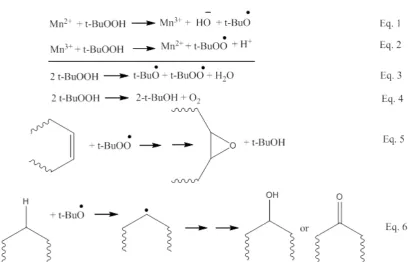
Total suppression of trans-stilbene epoxidation in the presence of an equimolar of diphenylamine as well as the concomitant formation of adamantane-1-ol and 2-one [41] strongly support the operation of a radical pathway. Therefore, the implication of BuO and t-BuOO radical intermediates obtained from one-electron oxidation-reduction processes is conceivable (Eq. 1, 2 and 3, Scheme 2). Therefore, epoxidations and oxidations may have proceeded from addition of t-BuOO radical to the alkene double bonds (Eq. 5, Scheme 2), or H-abstraction to t-BuO radical (Eq. 6, Scheme 2), respectively.
In summary, In this study, Mn-MOF has been used as catalyst for oxidation of cyclic alkenes and alkanes with
TBHP in CH3CN. It was found that Mn-MOF
successfully catalyzes the epoxidation of alkenes such as trans-stilbene, cyclohexene, norbornene, styrene, cyclooctene and 1,1-diphenylethylene and the oxidation of some alkanes such as fluorene, adamantane, ethylbenzene, diphenylmethane. The observation of such catalytic behavior with no significant amount of catalyst desorption or decomposition during the course of the reactions proves the heterogeneous nature of catalyst.
Acknowledgment
The authors would appreciate the Alzahra University for financial support.
References
1. Sheldon R.G. and Kochi B.J. Metal-Catalyzed Oxidations of Organic Compounds Academic Press. New York, (1981).
2. Jorgenson K.A. Transition-Metal-Catalyzed Epoxidations.
Chem. Rev. 89: 431-458 (1989).
3. Dusi M., Mallat T.and Baiker A. Epoxidation of Functionalized Olefins Over Solid Catalysts. Catal. Rev. Sci. Eng. 42: 213-278 (2004).
4. Arends I.W.C.E. and Sheldon R.A. Activities and Stabilities of heterogeneous catalysts in Selective liquid Phase Oxidations: Recent Developments. Appl. Catal A,
5. Stahl S.S., Labinger J.A. and Bercaw J.E.Homogeneous Oxidation of Alkanes by Electrophilic Late Transition Metals. Angew. Chem. Int. Ed.37: 2180-2192(1998).
6. Lu X.H., Xia Q.H. and Zhan H.J. Synthesis characterization and catalytic properties of tetradentate Schiff base complexes for the epoxidation of styrene. J. Mol. Catal. A: 250: 62-69 (2006).
7. Katsuki T. Mn-Salen Catalyst, Competitor of Enzymes, for Asymmetric Epoxidation. J.Mol. Catal A: Chem.113:
87-107 (1996).
8. Katsuki T. Catalytic Asymmetric Oxidations Using Optically Active (Salen) Manganese (III) Complexes as Catalysts. Coord. Chem. Rev.140: 189-214 (1995).
9. Patel S.A., Sinha S. and Mishra A.N. Olefin Epoxidation Catalysed by Mn(II) Schif Base Complex in Heterogenised–Homogeneous Systems. J. Mol. Catal. A: Chem.192: 53-61(2003).
10. Jacob M. and Bhattacharya P.K. Alkene Epoxidation with Iodosylbenzene Catalysed by mono and Binuclear Mn(III)-Schiff Base Complexes. J Mol Catal A: Chem.
54: 131-138 (1989).
11. Trivedi B.M., Bhattacharya P.K. and Ganeshpure P.A. Epoxidation of Olefins Catalysed by Mn(III)-Schiff Base Complexes. J. Mol. Catal. A: Chem.75: 109-115 (1992).
12. Kureshy R.I., Khan N.H. and Abdi S.H. Chiral Mn(III) Schiff Base Complex Catalyzed Aerobic Enantioselective Epoxidation of Prochiral Non-Functionalized Olefins.
Polyhedron.18: 1773-1777 (1999).
13. Kureshy R.I., Khan N.H. and Abdi S.H.R. Dimeric Chiral Mn(III) Schiff Base Complex-Catalysed Enantioselective Epoxidation of Non-Functionalised Alkenes.Tetrahedron Lett.42: 2915-2918 (2001).
14. Jin, C. Fan, W. Jia, Y. Encapsulation of transition metal tetrahydro-Schiff base complexes complexes in zeolite Y and their catalytic properties for the oxidation of cycloalkes. J. Mol. Catal. A: Chem. 249: 23-30 (2006).
15. Singh U.P., Tyagi P. and Upreti S. Manganese Complexes as Models for Manganese-Containing Pseudocatalase Enzymes: Synthesis, Structural and Catalytic Activity Studies. Polyhedron. 26: 3625–3632(2007).
16. Mukhopadhyay S., Mandal S. K., Bhaduri S. and Armstrong W.H. Manganese Clusters with Relevance to Photosystem II. Chem. Rev. 104:3981-4026 (2004).
17. Moreno D., Daier V. and Palopoli C. Synthesis Characterization and Antioxidant Activity of Water Soluble Mn(III) Complexes of Sulphonato-Substituted Schiff Bas Ligands. J.Inorg. Biochem. 104: 496-502
(2010).
18. Najafpour M M., HołynSka M., and Shamkhali A.N. New Mononuclear Manganese (II) Complexes with 2,4,6-Tris(2-pyridyl)-1,3,5-triazine (tptz) – Selective Catalyst in
UHP oxidation of sulfides. Polyhedron, 34: 202-209
(2012).
19. Das S., Incarvito C.D. and Crabtree R.H. Molecular Recognition in the Selective Oxygenation of Saturated C-H Bonds by a Dimanganese Catalyst. Science.
312:1941- 1943 (2006).
20. Kwong H., Lo P. and Lau K. Epoxidation of Alkenes and Oxidation of Alcohols with Hydrogen Peroxide Catalyzed by a Manganese(V) Nitrido Complex. Chem. Commun.47:
4273-4275 (2011).
21. Bhattacharjee S., Yang D. and Ahn W. A New Heterogeneous Catalyst for Epoxidation of Alkenes via One-Step Post-Functionalization of IRMOF-3 with a Manganese(II) Acetylacetonate Complex. Chem. Commun.47: 3637-3639 (2011).
22. Wilson S.T., Lok B.M. and Messina C.A. Aluminophosphate Molecular Sieves: A New Class of Microporous Crystalline Inorganic Solids. J. Am. Chem. Soc. 104: 1146-1147 (1982).
23. Feng P., Bu X., Stucky G.D. Hydrothermal Syntheses and Structural Charaxterization of Zeolite Analogue Compounds Based on Cobalt Phosphate. Nature. 388:
735-741(1997).
24. Gier T.E., Bu X. and Feng P. Synthesis and Organization of Zeolite-Like Materials with Three-Dimensional Helical Pores. Nature. 395: 154-157 (1998).
25. Li J.R. Kuppler R. J. and Zhou H.C. Selective Gas Adsorption and Separation in Metal-Organic Frameworks.
Chem. Soc. Rev.38: 1477-1504 (2009).
26. Cook T.R., Zheng Y.-R., and Stang P. J. Metal–Organic Frameworks and Self- Assembled Supramolecular Coordination Complexes: Comparing and Contrasting the Design, Synthesis, and Functionality of Metal organic materials Chem. Rev.113: 734–777 (2013).
27. Hamidipour L.and Farzaneh F. Cobalt Metal Organic Framework as an Efficient Heterogeneous Catalyst for the Oxidation of Alkanes and Alkenes. Reac. Kine. Mech.
Cat. 109: 67–75 (2013).
28. Muller, U. Yaghi, O. M. Heterogeneity within Order in Metal–Organic Frameworks. Angew. Chem. Int. Ed. 54: 3417–3430 ( 2015).
29. Kitagawa S., Kitaura R. and Noro S. Functional Porous Coordination Polymers. Angew. Chem. Int. Ed. 43:
2334-2375 (2004).
30. Zhou Z.H., Yang J.M. and Wan H.L. Diamine Substitution Reactions of Tetrahydrate Succinato Nickel, Cobalt, and Zinc Coordination Polymers. Cryst. Growth. Des. 5:1825-1830 (2005).
31. Lill D.T., Gunning N.S. and Cahill C.L. Toward Templated Metal−Organic Frameworks: Synthesis, Structures, Thermal Properties, and Luminescence of Three Novel Lanthanide - Adipate Frameworks. Inorg. Chem.44: 258-266 (2005).
32. Wang C.C., Dai S.C. and Lin H.W. Assembly of Metal Coordination Framework, [MII(C5O5)(dpe)], with a 2D
Bi-layer Architecture: Thermal Stability and Magnetic Properties (M = Mn, Fe, Cd and Co; dpe = 1,2-bis(4-pyridyl)ethane).Inorg. Chim. Acta, 360: 4058-4067
(2007).
33. Meng L., Cheng Q., Kim C., Gao W.-Y., Wojtas L., Chen Y.-S., Zaworotko M.J., Zhang X.P. and Ma S. Crystal Engineering of a Microporous, Catalytically Active fcu Topolog MOFUsing a Custom-DesignedMetalloporphyrin Linker. Angew. Chem. Int. Ed. 51: 1–5 (2012).
34. Nakagaki S., Ferreira G.K. B., Ucoski G. M. and Castro K.A. Dias de Freitas.Chemical Reactions Catalyzed by Metalloporphyrin-Based Metal-Organic Frameworks.
Molecules, 18:7279-7308 (2013).
Organic Frameworks Constructed from 1,3,5 Benzenetricarboxylate and Formate Ligands. Inorg. Chim. Acta. 363: 645-652 (2010).
36. Yaghi O.M., Li H.L. and Groy T.L. Construction of Porous Solids from Hydrogen-Bonded Metal Complexes of 1,3,5-Benzenetricarboxylic Acid. J. Am. Chem. Soc.
118: 9096-9101 (1996)
37. Fu Y. Wang X.Y., Li G.B., Liao F.H., Xiong M. and Lin J.H. Synthesis, structure and Magnetic property of Co(H2BTC)2(H2O)4(H3BTC=Benzene 1,3,5-tricarboxylic
acid Chinese J. Inorg. Chem. 24: 1224-1228 (2008).
38. He J.H., Zhang Y.T., Pan Q.H., Yu J.H., Ding, H. and Xu R.R. Three metal-organic frameworks prepared from
mixed solvents of DMF and HAc. Micropor. Mesopor. Mater.90: 145-152 (2006).
39. Chen J.X., Ohba M. and Kitagawa S. Two New Coordination Polymers Based on Hexanuclear Metal Cluster Cores. Chem. Lett. 35: 526-527 (2006).
40. Dhakshinamoorthy, A. Alvaro, M. Garcia, H. Metal organic frameworks as efficient heterogeneous catalysts for the oxidation of benzylic compounds with t-butylhydroperoxide. J. Catal. 267: 1-4 (2009).