Contents
7HATæ)SæAæ4)0VII #ONSENSUSæ0ANELIX +!0æ%XPERTæ0ANELæANDæ&EDERALæ'OVERNMENTæ0ARTICIPANTSæXI &OREWORDæXIII %XECUTIVEæ3UMMARYæXV #HAPTERæ'ROUPSæANDæ3UBSTANCEæ!BUSEæ4REATMENTæ
Overview...1
Introduction...1
Defining Therapeutic Groups in Substance Abuse Treatment...2
Advantages of Group Treatment...3
Modifying Group Therapy To Treat Substance Abuse...6
Approach of This TIP...8
#HAPTERæ4YPESæOFæ'ROUPSæ#OMMONLYæ5SEDæINæ3UBSTANCEæ!BUSEæ4REATMENTæ Overview...9
Introduction...9
Five Group Models ...12
Specialized Groups in Substance Abuse Treatment...29
#HAPTERæ#RITERIAæFORæTHEæ0LACEMENTæOFæ#LIENTSæINæ'ROUPS Overview...37
Matching Clients With Groups...37
Assessing Client Readiness for Group...38
Primary Placement Considerations...40
Stages of Recovery...43
Placing Clients From Racial or Ethnic Minorities...44
Diversity and Placement...52
#HAPTERæ'ROUPæ$EVELOPMENTæANDæ0HASE3PECIFICæ4ASKSæ Overview...59
Fixed and Revolving Membership Groups...59
Preparing for Client Participation in Groups...61
Phase-Specific Group Tasks...72
#HAPTERæ3TAGESæOFæ4REATMENTæ Overview...79
Adjustments To Make Treatment Appropriate...79
The Early Stage of Treatment...80
The Middle Stage of Treatment...85
The Late Stage of Treatment...88
#HAPTERæ'ROUPæ,EADERSHIPæ#ONCEPTSæANDæ4ECHNIQUES
Overview...91
The Group Leader...92
Concepts, Techniques, and Considerations...105
#HAPTERæ4RAININGæANDæ3UPERVISION
Overview...123
Training...123
Supervision...131
!PPENDIXæ!æ"IBLIOGRAPHYæ !PPENDIXæ"æ!DULTæ0ATIENTæ0LACEMENTæ#RITERIA !PPENDIXæ#æ3AMPLEæ'ROUPæ!GREEMENTæ !PPENDIXæ$æ'LOSSARYæ !PPENDIXæ%æ!SSOCIATIONæFORæ3PECIALISTSæINæ'ROUPæ7ORKæ"ESTæ0RACTICEæ'UIDELINESæ !PPENDIXæ&æ2ESOURCEæ0ANELæ !PPENDIXæ'æ#ULTURALæ#OMPETENCYæANDæ$IVERSITYæ.ETWORKæ0ARTICIPANTSæ !PPENDIXæ(æ&IELDæ2EVIEWERS !PPENDIXæ)æ!CKNOWLEDGMENTSæ )NDEXæ 3!-(3!æ4)0SæANDæ0UBLICATIONSæ
Executive Summary
Withtherecognitionofaddictionasamajorhealthprobleminthiscountry,demandhasincreasedfor effectivetreatmentsofsubstanceusedisorders.Becauseofitseffectivenessandeconomyofscale,group therapyhasgainedpopularity,andthegroupapproachhascometoberegardedasasourceofpowerful curativeforcesthatarenotalwaysexperiencedbytheclientinindividualtherapy.Onereasongroups worksowellisthattheyengagetherapeuticforces—likeaffiliation,support,andpeerconfrontation—and thesepropertiesenableclientstobondwithacultureofrecovery.Anotheradvantageofgroupmodalities istheireffectivenessintreatingproblemsthataccompanyaddiction,suchasdepression,isolation,and shame.
Groupscansupportindividualmembersintimesofpainandtrouble,andtheycanhelppeoplegrowin waysthatarehealthyandcreative.Formaltherapygroupscanbeacompellingsourceofpersuasion, stabilization,andsupport.Inthehandsofaskilled,well-trainedgroupleader,thepotentialhealing pow-ersinherentinagroupcanbeharnessedanddirectedtofosterhealthyattachments,providepositivepeer reinforcement,actasaforumforself-expression,andteachnewsocialskills.Inshort,grouptherapycan provideawiderangeoftherapeuticservices,comparableinefficacytothosedeliveredinindividual ther-apy.
Grouptherapyandaddictiontreatmentarenaturalallies.Onereasonisthatpeoplewhoabuse sub-stancesareoftenmorelikelytostaysoberandcommittedtoabstinencewhentreatmentisprovidedin groups,apparentlybecauseofrewardingandtherapeuticbenefitslikeaffiliation,confrontation,support, gratification,andidentification.Thiscapacityofgrouptherapytobondpatientstotreatmentisan impor-tantassetbecausethegreatertheamount,quality,anddurationoftreatment,thebettertheclient’s prog-nosis(Leshner1997;ProjectMATCHResearchGroup1997).
TheprimaryaudienceforthisTIPissubstanceabusetreatmentcounselors;however,theTIPshouldbe ofinteresttoanyonewhowantstolearnmoreaboutgrouptherapy.TheintentoftheTIPistoassist counselorsinenhancingtheirtherapeuticskillsinregardtoleadinggroups.
TheconsensuspanelforthisTIPdrewonitsconsiderableexperienceinthegrouptherapyfield.The panelwascomposedofrepresentativesfromallofthedisciplinesinvolvedingrouptherapyandsubstance abusetreatment,includingalcoholanddrugcounselors,grouptherapists,mentalhealthproviders,and Stategovernmentrepresentatives.
ThisTIPcomprisessevenchapters.Chapter1definestherapeuticgroupsasthosewithtrainedleaders andaprimaryintenttohelppeoplerecoverfromsubstanceabuse.Italsoexplainswhygroupsworkso wellfortreatingsubstanceabuse.
Chapter2describesthepurpose,main charac-teristics,leadership,andtechniquesoffive grouptherapymodels,threespecialtygroups, andgroupsthatfocusonsolvingasingle problem.
Chapter3discussesthemanyconsiderations thatshouldbeweighedbeforeplacingaclient inaparticulargroup,especiallykeyingthe grouptotheclient’sstageofchangeandstage ofrecovery.Thischapteralsoconcentrateson issuesthatarisefromclientdiversity.
Chapter4comparesfixedandrevolvingtypes oftherapygroupsandrecommendswaysto prepareclientsforparticipation:pregroup interviews,retentionmeasures,andmost important,groupagreementsthatspecify clients’expectationsofeachother,theleader, andthegroup.Chapter4alsospecifiesthe tasksthatneedtobeaccomplishedintheearly, middle,andlatephasesofgroupdevelopment.
Chapter5turnstothestagesoftreatment.In theearly,middle,andlatestagesoftreatment, clients’conditionswilldiffer,requiring differ-enttherapeuticstrategiesandapproachesto leadership.
Chapter6isthehow-tosegmentofthisTIP.It explainsthecharacteristics,duties,and con-ceptsimportanttopromoteeffectivegroup leadershipintreatingsubstanceabuse, includ-inghowconfidentialityregulationsforalcohol anddrugtreatmentapplytogrouptherapy.
Chapter7highlightstrainingopportunities availabletosubstanceabusetreatment profes-sionals.Thechapteralsorecommendsthe supervisorygroupasanaddedmeasurethat improvesgroupleadershipandgivescounselors inthegroupinsightsabouthowclientsmay experiencegroups.
ThroughoutthisTIP,theterm“substance abuse”hasbeenusedtorefertoboth sub-stanceabuseandsubstancedependence(as definedbytheDiagnosticandStatistical ManualofMentalDisorders,4thedition,Text Revision[DSM-IV-TR][AmericanPsychiatric Association2000]).Thistermwaschosen
part-lybecausesubstanceabusetreatment profes-sionalscommonlyusetheterm“substance abuse”todescribeanyexcessiveuseof addic-tivesubstances.InthisTIP,thetermrefersto theuseofalcoholaswellasothersubstancesof abuse.Readersshouldattendtothecontextin whichthetermoccursinordertodetermine whatpossiblerangeofmeaningsitcovers;in mostcases,however,thetermwillrefertoall varietiesofsubstanceusedisordersdescribed byDSM-IV.
Thesectionsthatfollowsummarizethecontent inthisTIPandaregroupedbychapter.
Groups and Substance
Abuse Treatment
Becausehumanbeingsbynaturearesocial beings,grouptherapyisapowerfultherapeutic toolthatiseffectiveintreatingsubstance abuse.Thetherapeuticgroupsdescribedinthis TIParethosegroupsthathavetrainedleaders andaspecificintenttotreatsubstanceabuse. Thisdefinitionexcludesself-helpgroupslike AlcoholicsAnonymousandNarcotics Anonymous.
Grouptherapyhasadvantagesoverother modalities.Theseincludepositivepeer sup-port;areductioninclients’senseofisolation; real-lifeexamplesofpeopleinrecovery;help frompeersincopingwithsubstanceabuseand otherlifeproblems;informationandfeedback frompeers;asubstitutefamilythatmaybe healthierthanaclient’sfamilyoforigin;social skillstrainingandpractice;peerconfrontation; awaytohelpmanyclientsatonetime; struc-tureanddisciplineoftenabsentinthelivesof peopleabusingsubstances;andfinally,the hope,support,andencouragementnecessary tobreakfreefromsubstanceabuse.
Groups Commonly
Used in Substance
Abuse Treatment
Fivegroupmodelsarecommoninsubstance abusetreatment:
•Psychoeducationalgroups,whicheducate clientsaboutsubstanceabuse
•Skillsdevelopmentgroups,whichcultivate theskillsneededtoattainandsustain absti-nence,suchasthoseneededtomanageanger orcopewithurgestousesubstances
•Cognitive–behavioralgroups,whichalter thoughtsandactionsthatleadtosubstance abuse
•Supportgroups,whichbuoymembersand provideaforumtosharepragmatic informa-tionaboutmaintainingabstinenceand man-agingday-to-day,chemical-freelife
•Interpersonalprocessgroups,whichdelve intomajordevelopmentalissuesthat con-tributetoaddictionorinterferewithrecovery
Threeotherspecializedtypesofgroupsthatdo notfitneatlyintothefive-modelclassification nonethelessarecommoninsubstanceabuse treatment.Theyaredesignedspecificallyto preventrelapse,tobringaspecificculture’s healingpracticestobearonsubstanceabuse, ortousesomeformofarttoexpressthoughts thatotherwisewouldbedifficultto communi-cate.Groupsalsocanbeformedtohelpclients whoshareaspecificproblem,suchasangeror shyness,thatcontributestotheirsubstance abuse.
Criteria for the
Placement of Clients
in Groups
Noteveryoneissuitedtoeverykindofgroup. Moreover,becauserecoveryisalong, nonlin-earprocess,thetypeoftherapychosenalways shouldbesubjecttore-evaluation.
Appropriateplacementbeginswithathorough assessmentoftheclient’sneeds,desires,and abilitytoparticipate.Evaluatorsrelyonforms andinterviewstodeterminetheclient’slevelof interpersonalfunctioning,motivationto abstain,stability,stageofrecovery,and expec-tationofsuccessinthegroup.
Mostclientscanfunctioninagroupthatis het-erogeneous,thatis,membersmaybemixedin age,gender,culture,andsoon.Whatis essen-tial,however,isthatallclientsinagroup shouldhavesimilarneeds.Someclients,such asthosewithaseverepersonalitydisorder,will needtobeplacedinhomogeneousgroups,in whichmembersarealikeinsomewayother thantheirdependenceproblem.Suchgroups mayincludepeopleofaparticularethnicity,all women,oraparticularagegroup.
Someclientsprobablyarenotsuitablefor certaingroups,orgrouptherapyingeneral, including
•Peoplewhorefusetoparticipate
•Peoplewhocannothonorgroupagreements, includingpreservingprivacyand confiden-tialityofgroupmembersinaccordancewith theFederalregulations(42C.F.R.,Part2) •Peoplewhomakethetherapistvery
uncom-fortable
•Peoplewhoarepronetodroppingoutorwho continuallyviolategroupnorms
•Peopleinthethroesofalifecrisis •Peoplewhocannotcontrolimpulses •Peoplewhoexperiencesevereinternal
discomfortingroups
Professionaljudgmentisalsoessentialand shouldconsidercharacteristicssuchas sub-stancesabused,durationofuse,treatment setting,andtheclient’sstageofrecovery.For example,aclientinamaintenancestagemay needtoacquiresocialskillsforinteractingin newways,addressemotionaldifficulties,or becomereintegratedintoacommunityor cultureoforigin.
Ethnicityandculturecanhaveaprofound effectontreatment.Thegreaterthemixof
ethnicitiesinagroup,themorelikelyitisthat biaseswillemergeandrequiremediation. Specialattentionmaybewarranted,too,if clientsdonotspeakEnglishfluentlybecause theymaybeunabletofollowafast-flowing discussion.Programsshouldensurethatgroup membersarefluentinthelanguagefortheir specificdemographicarea,whichmayormay notbeEnglish.Further,whileitmightbe desir-abletomatchthegroupleaderandallgroup membersethnically,therealityisthatitis sel-domfeasible.Thus,itiscrucialforthegroup leadertounderstandhowethnicityaffects substanceabuseandgroupparticipation.
Group Development
and Phase-Specific
Tasks
Groupmembershipmaybefixed,withastable andrelativelysmallnumberofclients.
Alternatively,membershipmayrevolve,with newmembersenteringagroupwhentheyare readyfortheserviceitprovides.Eithertype canrunindefinitelyorforasettime.
Thepreparationofclientsforgroup participa-tioncommenceswhenthegroupleadermeets individuallywitheachprospectivegroup mem-bertobegintoformatherapeuticalliance, reachconsensusonwhatistobeaccomplished intherapy,educatetheclientaboutgroup ther-apy,allayanxietyrelatedtojoiningagroup, andexplainthegroupagreement.Inthese pre-groupinterviews,itisimportanttobesensitive topeoplewhodiffersignificantlyfromtherest ofthegroupwhetherbyage,ethnicity,gender, disorder,andsoon.Itisimportanttoassure clientsthatadifferenceisnotadeficitandcan beasourceofvitalityforthegroup.
Selectionofgroupmembersisbasedonthe client’sfitwithaspecificgroupmodality. Considerationsincludetheclient’s
•Levelofinterpersonalfunctioning,including impulsecontrol
•Motivationtoabstainfromdrugoralcohol abuse
•Stability
•Stageofrecovery •Expectationofsuccess
Throughouttheinitialgrouptherapysessions, clientsareparticularlyvulnerabletorelapse anddiscontinuationoftreatment.Thefirst monthappearstobeespeciallycritical (MargolisandZweben1998).Retentionrates inagroupareenhancedbyclientpreparation, maximumclientinvolvement,feedback,
promptstoencourageattendance,andthe pro-visionofwraparoundservices(suchaschild careandtransportation).Thetimingand durationofgroupsalsoaffectretention.
Whilegroupleadershavemanyresponsibilities inpreparingclientsforparticipationingroups, clientshaveobligations,too.Agroup agree-mentestablishestheexpectationsthatgroup membershaveofeachother,theleader,and thegroupitself.Itspecifiesthecircumstances underwhichclientsmaybebarredfromgroup andexplainspoliciesregardingconfidentiality, physicalcontact,substanceuse,contactoutside thegroup,groupparticipation,financial responsibility,andtermination.Agroup mem-ber’sacceptanceofthecontractpriorto enter-ingagrouphasbeendescribedasthesingle mostimportantfactorcontributingtothe suc-cessofoutpatienttherapygroups.
Thetasksinthebeginningphaseofagroup includeintroductions,reviewofthegroup agreement,establishmentofanemotionally safeenvironmentandpositivegroupnorms, andfocusingthegrouptowarditswork.Inthe middlephase,clientsinteract,rethinktheir behaviors,andmovetowardproductive change.Theendphaseconcentrateson reach-ingclosure.
Stages of Treatment
Asclientsmovethroughdifferentstagesof recovery,treatmentmustmovewiththem.That is,therapeuticstrategiesandleadershiproles willchangewiththeconditionoftheclients.
Intheearlyphaseoftreatmentclientstendto beambivalentaboutendingsubstanceuse,
rigidintheirthinking,andlimitedintheir abil-itytosolveproblems.Resistanceisachallenge forthegroupleaderatthistime.
Theartoftreatingaddictionintheearlyphase isinthedefeatofdenialandresistance.Groups areespeciallyeffectiveatthistimesincepeople withdependenciesoftenhavehadadversarial relationshipswithpeopleinauthority.Thus, informationfrompeersinagroupismore easilyacceptedthanthatfromalonetherapist.
Peoplewithaddictionsremainvulnerable duringthemiddlephaseoftreatment.Though cognitivecapacityusuallybeginstoreturnto normal,themindcanstillplaytricks.Clients mayrememberdistinctlythecomfortoftheir pastuseofsubstances,yetforgetjusthowbad therestoftheirliveswere.Consequently,the temptationtorelapseremainsaconcern. Becausepeoplewithdependenciesusuallyare isolatedfromhealthysocialgroups,thegroup helpstoacculturateclientsintoacultureof recovery.Theleaderdrawsattentionto posi-tivedevelopments,pointsouthowfarclients havetraveled,andaffirmsthepossibilityof increasedconnectionandnewsourcesof satisfaction.
Inthelatephaseoftreatmentclientsarestable enoughtofacesituationsthatinvolveconflict ordeepemotion.Aprocess-orientedgroupmay becomeappropriateforsomeclientswho final-lyareabletoconfrontpainfulrealities,suchas beinganabusedchildoranabusiveparent. Otherclientsmayneedgroupstohelpthem buildahealthiermarriage,communicatemore effectively,orbecomeabetterparent.Some maywanttodevelopnewjobskillstoincrease employability.
Group Leadership,
Concepts, and
Techniques
Effectivegroupleadershiprequiresa
constellationofspecificpersonalqualitiesand professionalpractices.Thepersonalqualities necessaryareconstancy,activelistening,firm
identity,confidence,spontaneity,integrity, trust,humor,andempathy.
Leadersshouldbeableto
•Adjusttheirprofessionalstylestothe particularneedsofdifferentgroups •Modelgroup-appropriatebehaviors •Resolveissueswithinethicaldimensions •Manageemotionalcontagion
•Workonlywithinmodalitiesforwhichthey aretrained
•Preventthedevelopmentofrigidrolesinthe group
•Avoidactingindifferentrolesinsideand out-sidethegroup
•Motivateclientsinsubstanceabusetreatment •Ensureemotionalsafetyinthegroup
•Maintainasafetherapeuticsetting(which involvesdeflectingdefensivebehavior with-outshamingtheoffender,recognizingand counteringtheresumptionofsubstanceuse, andprotectingphysicalboundariesaccording togroupagreements)
•Curtailemotionwhenitbecomestoointense forgroupmemberstotolerate
•Stimulatecommunicationamonggroup members
Keyconceptsandtechniquesusedingroup therapyforsubstanceabusefollow.
Interventionsareanyactionbyaleaderto intentionallyaffecttheprocessesofthegroup. Interventionsmaybeused,forexample,to clarifyunderstanding,redirectenergy,orstop adamagingsequenceofinteractions.Effective leadersdonotoverdointervention.Todoso wouldresultinaleader-centeredgroup,which isundesirablebecauseintherapygroups,the healingcomesfromtheconnectionsforged betweengroupmembers.Onetypeof interven-tion,confrontation,deftlypointsout inconsis-tenciesinclients’thinking.
Confidentialityrestrictstheinformationthat providerscanrevealaboutclientsandthat clientsmayrevealabouteachother.Group
leadersandclientsshouldunderstandtheexact provisionsofthisimportantboundary.
Diversityplaysahighlyimportantrolein grouptherapy,foritmayaffectcriticalaspects oftheprocess,suchaswhatclientsexpectof theleaderandhowclientsmayinterpretother clients’behavior.Cliniciansshouldbeopento learningaboutotherbeliefsystems,shouldnot assumethateverypersonfromaspecificgroup sharesthesamecharacteristics,andshould avoid appearing as if they are trying to persuade clients to renounce their cultural characteristics.
Manypeopleintreatmentforsubstanceabuse haveothercomplexproblems,suchas co-occurringmentaldisorders,homelessness,or involvementwiththecriminaljusticesystem. Formanyclients,grouptherapymaybeone elementinalargerplanthatalsomarshals biopsychosocialandspiritualinterventionsto addressimportantlifeissuesandrestorefaith orbeliefinsomeforcebeyondtheself.
Integrated care from diverse sources requires cooperation with other healthcare providers. For example, it is critical that all providers working with clients with multiple disorders know what medications they are taking and why.
Twoaspectsofgroupmanagementrelateto conflictandsubgroups.Properlymanaged, conflictcanpromotelearningaboutrespectfor differentviewpoints,managingemotions,and negotiation.Partofthetherapist’sjobasa conflictmanageristorevealcovertconflicts andexposerepetitiveandpredictable argu-ments.Thetherapistalsorevealscovert sub-groupsandintervenestoreconfigurenegative subgroupsthatthreatenthegroup’sprogress.
Varioustypesofdisruptivebehaviormay requirethegroupleader’sattention.Such problemsincludeclientswhotalknonstop, interrupt,fleeasession,arrivelateorskip ses-sions,declinetoparticipate,orspeakonlyto theproblemsofothers.Theleaderalsoshould haveskillstohandlepeoplewithpsychological emergenciesorpeoplewhoareanxiousabout disclosingpersonalinformation.
Training and
Supervision
Nationalprofessionalorganizationsarearich sourceoftraining.Throughconferencesor regionalchapters,nationalassociationsprovide training—bothexperientialanddirect instruc-tion—gearedtotheneedsofawiderangeof persons,fromgraduatestudentstohighly expe-riencedtherapists.Moretrainingoptionsare usuallyavailableinlargeurbanareas.Itis likely,however,thatonlinetrainingwillmake sometypesofprofessionaldevelopment accessi-bletoagreaternumberofcounselorsinremote areas.
Clinicalsupervisionasitpertainstogroup therapyoftenisbestcarriedoutwithinthe con-textofgroupsupervision.Groupdynamicsand groupprocessfacilitatelearningbysettingupa microcosmofalargersocialenvironment.Each groupmember’sstyleofinteractionwill
inevitablyshowupinthegrouptransactions. Asthisprocessunfolds,groupmembers, guid-edbythesupervisor,learntomodeleffective behaviorinanacceptinggroupcontext.
Supervisorygroupsreduce,ratherthan esca-late,thelevelofthreatthatcanaccompany supervision.Inplaceofisolationand alien-ation,groupparticipationgivescounselorsa senseofcommunity.Theyfindthatothers sharetheirworries,fears,frustrations, tempta-tions,andambivalence.Thisreassuranceisof particularbenefittonovicegroupcounselors.
In This
Chapter…
Introduction
Defining
Therapeutic
Groups in
Substance Abuse
Treatment
Advantages of
Group Treatment
Modifying Group
Therapy To Treat
Substance Abuse
Approach of
This TIP
1 Groups and Substance
Abuse Treatment
Overview
Thenaturalpropensityofhumanbeingstocongregatemakesgroup therapyapowerfultherapeutictoolfortreatingsubstanceabuse,one thatisashelpfulasindividualtherapy,andsometimesmoresuccessful. Onereasonforthisefficacyisthatgroupsintrinsicallyhavemany rewardingbenefits—suchasreducingisolationandenablingmembers towitnesstherecoveryofothers—andthesequalitiesdrawclientsinto acultureofrecovery.Anotherreasongroupsworksowellisthatthey aresuitableespeciallyfortreatingproblemsthatcommonlyaccompany substanceabuse,suchasdepression,isolation,andshame.
Althoughmanygroupscanhavetherapeuticeffects,thisTIP concen-tratesonlyongroupsthathavetrainedleadersandthataredesignedto promoterecoveryfromsubstanceabuse.Greatemphasisisplacedon interpersonalprocessgroups,whichhelpclientsresolveproblemsin relatingtootherpeople,problemsfromwhichtheyhaveattemptedto fleebymeansofaddictivesubstances.WhilethisTIPisnotintended asatrainingmanualforindividualstrainingtobegrouptherapists,it providessubstanceabusecounselorswithinsightsandinformationthat canimprovetheirabilitytomanagethegroupstheycurrentlylead.
Introduction
Thelivesofindividualsareshaped,forbetterorworse,bytheir experi-encesingroups.Peoplearebornintogroups.Throughoutlife,theyjoin groups.Theywillinfluenceandbeinfluencedbyfamily,religious,social, andculturalgroupsthatconstantlyshapebehavior,self-image,andboth physicalandmentalhealth.
Groupscansupportindividualmembersintimesofpainandtrouble, andtheycanhelppeoplegrowinwaysthatarehealthyandcreative. However,groupsalsocansupportdeviantbehaviororinfluencean individualtoactinwaysthatareunhealthyordestructive.
Becauseourneedforhumancontactis biologi-callydetermined,weare,fromthestart,social creatures.Thispropensitytocongregateisa powerfultherapeutictool.Formaltherapy groupscanbeacompellingsourceof persua-sion,stabilization,andsupport.Groups orga-nizedaroundtherapeuticgoalscanenrich memberswithinsightandguidance;andduring timesofcrisis,groupscancomfortandguide peoplewhootherwisemightbeunhappyor lost.Inthehandsofaskilled,well-trained groupleader,thepotentialcurativeforces inherentinagroupcanbeharnessedand directedtofosterhealthyattachments,provide
positivepeer rein-forcement,actasa forumfor self-expression,and
Groups provide
positive peer
support and
pressure to abstain
from substances
of abuse.
teachnewsocial skills.Inshort, grouptherapycan provideawiderange oftherapeutic ser-vices,comparable inefficacytothose deliveredin individ-ualtherapy.Insome cases,grouptherapy canbemore benefi-cialthanindividual therapy (Scheidlinger 2000;Toselandand Siporin1986).
Grouptherapyandaddictiontreatmentare naturalallies.Onereasonisthatpeoplewho abusesubstancesoftenaremorelikelyto remainabstinentandcommittedtorecovery whentreatmentisprovidedingroups, appar-entlybecauseofrewardingandtherapeutic forcessuchasaffiliation,confrontation, sup-port,gratification,andidentification.This capacityofgrouptherapytobondpatientsto treatmentisanimportantassetbecausethe greatertheamount,quality,anddurationof treatment,thebettertheclient’sprognosis (Leshner1997;ProjectMATCHResearch Group1997).
Theeffectivenessofgrouptherapyinthe treat-mentofsubstanceabusealsocanbeattributed tothenatureofaddictionandseveralfactors associatedwithit,including(butnotlimitedto) depression,anxiety,isolation,denial,shame, temporarycognitiveimpairment,and charac-terpathology(personalitydisorder,structural deficits,oranuncohesivesenseofself). Whetherapersonabusessubstancesornot, theseproblemsoftenrespondbettertogroup treatmentthantoindividualtherapy(Kanas 1982;KanasandBarr1983).Grouptherapyis alsoeffectivebecausepeoplearefundamentally relationalcreatures.
Defining Therapeutic
Groups in Substance
Abuse Treatment
Allgroupscanbetherapeutic.Anytime some-onebecomesemotionallyattachedtoother groupmembers,agroupleader,orthegroup asawhole,therelationshiphasthepotentialto influenceandchangethatperson.Identifyinga groupas“therapy”doesnotimplythatother groupsarenottherapeutic.Inpreparingthis TIP,theconsensuspaneldebatedatlength whatconstitutes“grouptherapy”andwhat distinguishestherapygroupsfromothertypes ofgroups.
Althoughmanytypesofgroupscanhave thera-peuticelementsandeffects,thegrouptypes includedinthisTIParebasedonthegoalsand intentionsofthegroups,aswellastheintended audienceoftheTIP(especiallysubstanceabuse treatmentcounselorsandothersubstance abusetreatmentprofessionals).Thus,thisTIP islimitedtogroupsthat(1)havetrained lead-ersand(2)intendtoproducesometypeof healingorrecoveryfromsubstanceabuse.This TIPdescribes(inchapter2)fivemodelsof grouptherapycurrentlyusedinsubstance abusetreatment:
•Psychoeducationalgroups,whichteachabout substanceabuse.
•Skillsdevelopmentgroups,whichhonethe skillsnecessarytobreakfreeofaddictions. •Cognitive–behavioralgroups,which
rear-rangepatternsofthinkingandactionthat leadtoaddiction.
•Supportgroups,whichcompriseaforum wherememberscandebunkeachother’s excusesandsupportconstructivechange. •Interpersonalprocessgrouppsychotherapy
(referredtohereafteras“interpersonal pro-cessgroups”or“therapygroups”),which enableclientstorecreatetheirpastsinthe here-and-nowofgroupandrethinkthe rela-tionalandotherlifeproblemsthattheyhave previouslyfledbymeansofaddictive sub-stances.
Treatmentprovidersroutinelyusethefirstfour modelsandvariouscombinationsofthem.The lastisnotaswidelyused,chieflybecauseofthe extensivetrainingrequiredtoleadsuchgroups andthelongdurationofthegroups,which demandsahighdegreeofcommitmentfrom bothprovidersandclients.Allthesame,many peopleentersubstanceabusetreatmentwitha longhistoryoffailedrelationshipsexacerbated bysubstanceuse.Inthesecases,anextended periodoftherapyiswarrantedtoresolvethe client’sproblemswithrelationships.Thereality thatextendedtreatmentisnotalwaysfeasible doesnotnegateitsdesirability.
ThisTIPdoesnotdiscussmultifamilyand mul-ticouplegroups,whicharediscussedinTIP39, SubstanceAbuseTreatmentandFamily Therapy(CenterforSubstanceAbuse
Treatment2004).Eventhoughmultifamilyand multicouplegroupstypicallyaremadeupof unrelatedgroupsoffamilies,theyfocuson familyrelationsastheyaffectandareaffected byamemberwithasubstanceusedisorder. ThisTIPconcentratesontherapygroups, whichhaveadistinctivelydifferentfocus.
AlsooutsidethescopeofthisTIPistheuseof peer-ledself-helpgroupssuchasAlcoholics Anonymous(AA)orgroupactivitieslikesocial events,religiousservices,sports,andgames. Anyorallmayhaveoneormoretherapeutic effects,butarenotspecificallydesignedto
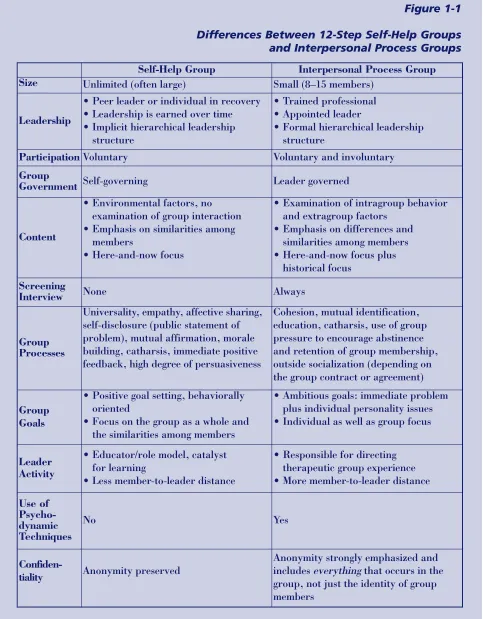
achievethatpurpose.Figure1-1(seep.4) showsotherdifferencesbetweenself-help groupsandinterpersonalprocessgroups.In mostaspects,thecomparisonwouldapplyto theotherfourgroupmodelsaswell.
Advantages of Group
Treatment
Treatingadultclientsingroupshasmany advantages,aswellassomerisks.Any treat-mentmodality—grouptherapy,individual therapy,familytherapy,andmedication—can yieldpoorresultsifappliedindiscriminatelyor administeredbyanunskilledorimproperly trainedtherapist.Thepotentialdrawbacksof grouptherapy,however,arenogreaterthan foranyotherformoftreatment.
Someofthenumerousadvantagestousing groupsinsubstanceabusetreatmentare describedbelow(BrownandYalom1977; Flores1997;Garvinunpublishedmanuscript; Vannicelli1992).
•Groupsprovidepositivepeersupportand pressuretoabstainfromsubstancesofabuse. UnlikeAA,and,tosomedegree,substance abusetreatmentprogramparticipation, grouptherapy,fromtheverybeginning, elic-itsacommitmentbyallthegroupmembersto attendandtorecognizethatfailuretoattend, tobeontime,andtotreatgrouptimeas spe-cialdisappointsthegroupandreducesits effectiveness.Therefore,bothpeersupport andpressureforabstinencearestrong. •Groupsreducethesenseofisolationthat
mostpeoplewhohavesubstanceabuse disor-dersexperience.Atthesametime,groups canenableparticipantstoidentifywith oth-erswhoarestrugglingwiththesameissues. AlthoughAAandtreatmentgroupsofall typesprovidetheseopportunitiesforsharing, forsomepeoplethemoreformaland deliber-atenatureofparticipationinprocessgroup therapyincreasestheirfeelingsofsecurity andenhancestheirabilitytoshareopenly. •Groupsenablepeoplewhoabusesubstances
towitnesstherecoveryofothers.Fromthis
æ æ æ
æ
Figure 1-1 Differences Between 12-Step Self-Help Groups
and Interpersonal Process Groups
3ELF(ELPæ'ROUPæ )NTERPERSONALæ0ROCESSæ'ROUPæ
3IZEæ Unlimited(oftenlarge) Small(8–15members)
,EADERSHIPæ
•Peerleaderorindividualinrecovery •Leadershipisearnedovertime •Implicithierarchicalleadership
structure
•Trainedprofessional •Appointedleader
•Formalhierarchicalleadership structure
0ARTICIPATIONæVoluntary Voluntaryandinvoluntary
'ROUPæ
'OVERNMENTæSelf-governing Leadergoverned
#ONTENTæ
•Environmentalfactors,no examinationofgroupinteraction •Emphasisonsimilaritiesamong
members
•Here-and-nowfocus
•Examinationofintragroupbehavior andextragroupfactors
•Emphasisondifferencesand similaritiesamongmembers •Here-and-nowfocusplus
historicalfocus
3CREENINGæ
)NTERVIEWæ None Always
'ROUPæ 0ROCESSESæ
Universality, empathy, affective sharing, self-disclosure(publicstatementof problem),mutualaffirmation,morale building,catharsis,immediatepositive feedback,highdegreeofpersuasiveness
Cohesion,mutualidentification, education,catharsis,useofgroup pressuretoencourageabstinence andretentionofgroupmembership, outsidesocialization(dependingon thegroupcontractoragreement)
'ROUPæ 'OALSæ
•Positivegoalsetting,behaviorally oriented
•Focusonthegroupasawholeand thesimilaritiesamongmembers
•Ambitiousgoals:immediateproblem plusindividualpersonalityissues •Individualaswellasgroupfocus
,EADERæ !CTIVITYæ
•Educator/rolemodel,catalyst forlearning
•Lessmember-to-leaderdistance
•Responsiblefordirecting therapeuticgroupexperience •Moremember-to-leaderdistance
5SEæOFæ 0SYCHO DYNAMICæ 4ECHNIQUESæ
No Yes
#ONFIDEN
TIALITYæ Anonymitypreserved
Anonymitystronglyemphasizedand includeseverythingthatoccursinthe group,notjusttheidentityofgroup members
æ æ æ
æ æ æ
æ
æ
3ELF(ELPæ'ROUPæ )NTERPERSONALæ0ROCESSæ'ROUPæ
3PONSORSHIPæ
0ROGRAMæ Yes(usuallysamesex) None
$ETERMINA TIONæOFæ4IMEæ INæ'ROUPæ
•Membersmayleavegroupattheirown choosing
•Membersmayavoidself-disclosureor discussionofanysubject
•Predeterminedminimaltermofgroup membership
•Avoidanceofdiscussionseenas possible“resistance”
)NVOLVEMENTæ INæ/THERæ
4HERAPIESæ Yes
Yes—eclecticmodels
No—psychodynamicmodels
4IMEæ
&ACTORSæ Unlimitedoveryearsgroupparticipationpossible Oftentime-limitedgroupexperiences
&REQUENCYæ OFæ-EETINGSæ
Activeencouragementofdaily
participation Meetstwiceweekly)lessfrequently(oftenonceor
Source:AdaptedfromSpitz2001.Usedwithpermission.
inspiration,peoplewhoareaddictedto substancesgainhopethatthey,too,can maintainabstinence.Furthermore,an inter-personalprocessgroup,whichisoflong duration,allowsamagnifiedwitnessingof boththechangesrelatedtorecoveryaswell asgroupmembers’intra- andinterpersonal changes.
•Groupshelpmemberslearntocopewith theirsubstanceabuseandotherproblemsby allowingthemtoseehowothersdealwith similarproblems.Groupscanaccentuatethis processandextendittoincludechangesin howgroupmembersrelatetobosses,parents, spouses,siblings,children,andpeoplein general.
•Groupscanprovideusefulinformationto clientswhoarenewtorecovery.For exam-ple,clientscanlearnhowtoavoidcertain triggersforuse,theimportanceofabstinence asapriority,andhowtoself-identifyasa personrecoveringfromsubstanceabuse. Groupexperiencescanhelpdeepenthese insights.Forexample,self-identifyingasa personrecoveringfromsubstanceabusecan beacomplexprocessthatchanges
signifi-cantlyduringdifferentstagesoftreatment andrecoveryandoftenrevealsthesetof traitsthatmakesthesystemofaperson’sself asaltogetherunique.
•Groupsprovidefeedbackconcerningthe valuesandabilitiesofothergroupmembers. Thisinformationhelpsmembersimprove theirconceptionsofselformodifyfaulty, distortedconceptions.Intermsofprocess groupsinparticular,asspecificthemes emergeinaclient’sgroupexperience, repeti-tivefeedbackfrommultiplegroupmembers andthetherapistcanchipawayatthose faultyordistortedconceptionsinslightly differentwaysuntiltheynotonlyare correctable,butalsotheveryprocessof correctionandchangeisrevealedthrough theexaminationofthegroupprocesses. •Groupsofferfamily-likeexperiences.Groups
canprovidethesupportandnurturancethat mayhavebeenlackingingroupmembers’ familiesoforigin.Thegroupalsogives mem-berstheopportunitytopracticehealthyways ofinteractingwiththeirfamilies.
•Groupsencourage,coach,support,and reinforceasmembersundertakedifficultor anxiety-provokingtasks.
•Groupsoffermemberstheopportunityto learnorrelearnthesocialskillstheyneedto copewitheverydaylifeinsteadofresortingto substanceabuse.Groupmemberscanlearn byobservingothers,beingcoachedby oth-ers,andpracticingskillsinasafeand sup-portiveenvironment.
•Groupscaneffectivelyconfrontindividual membersaboutsubstanceabuseandother harmfulbehaviors.Suchencountersare possiblebecausegroupsspeakwiththe com-binedauthorityofpeoplewhohaveshared commonexperiencesandcommonproblems. Confrontationoftenplaysapartofsubstance abusetreatmentgroupsbecausegroup memberstendtodenytheirproblems. Participatingintheconfrontationofone groupmembercanhelpothersrecognizeand defeattheirowndenial.
•Groupsallowasingletreatmentprofessional tohelpanumberofclientsatthesametime. Inaddition,asagroupdevelops,eachgroup membereventuallybecomesacculturatedto groupnormsandcanactasaquasi-therapist himself,therebyratifyingandextendingthe treatmentinfluenceofthegroupleader. •Groupscanaddneededstructureand
disci-plinetothelivesofpeoplewithsubstanceuse disorders,whooftenentertreatmentwith theirlivesinchaos.Therapygroupscan establishlimitationsandconsequences,which canhelpmemberslearntoclarifywhatis theirresponsibilityandwhatisnot. •Groupsinstillhope,asensethat“Ifhecan
makeit,socanI.”Processgroupscan expandthishopetodealingwiththefull rangeofwhatpeopleencounterinlife, overcome,orcopewith.
•Groupsoftensupportandprovide encourage-menttooneanotheroutsidethegroup set-ting.Forinterpersonalprocessgroups, though,outsidecontactsmayormaynotbe disallowed,dependingontheparticular groupcontractoragreements.
Modifying Group
Therapy To Treat
Substance Abuse
Modifyinggrouptherapytomakeitapplicable toandeffectivewithclientswhoabuse sub-stancesrequiresthreeimprovements.Oneis specifictrainingandeducationfortherapistsso thattheyfullyunderstandtherapeuticgroup workandthespecialcharacteristicsofclients withsubstanceusedisorders.Theimportance ofunderstandingthecurativeprocessthat occursingroupscannotbeunderestimated.
Mostsubstanceabusecounselorshave respond-edbyadaptingskillsusedinindividualtherapy. Counselorshavealsosoughtdirection,clinical training,andpracticalsuggestions.Despite individualefforts,however,grouptherapyoften isconductedasindividualtherapyinagroup.
Individualtherapyisnotequivalenttogroup therapy.Someprinciplesthatworkwellwith individuals are inappropriate for group therapy. Usingthewrongapproachmayleadtoseveral undesirableresults.First,therichpotentialof groups––self-understanding,psychological growth,emotionalhealing,andtrueintimacy–– willbeleftunfulfilled.Second,groupleaders whoareunfamiliarwithandinsensitiveto issuesthatmanifestthemselvesingroup thera-pymayfindthemselvesinadifficultsituation. Third,therapistswhothinktheyaredoing grouptherapywhentheyactuallyarenotmay observethepoorresultsandconcludethat grouptherapyisineffective.Compoundingall thesedifficultiesisthefactthatgrouptherapy issoubiquitous.Thus,poorlyconceived approachesarebeingusedfrequently.
Grouptherapyalsoisnotequivalentto12-Step programpractices.Manytherapistswholack fullqualificationsforgroupworkhaveadapted practicesfromAAandother12-Stepprograms foruseintherapeuticgroups.Tosaythatthis borrowingisinadvisableisnottosaythatthe principlesofAAareinadequate.Onthe con-trary,manypeopleseemtobeunableto recov-erfromdependencywithoutAAoraprogram
similartoit.Forthisreason,mosteffective treatmentprogramsmakeattendanceatAAor another12-Stepprogramamandatorypartof thetreatmentprocess.Bythesametoken,AA andother12-Stepprogramsarenotgroup therapy.Rather,theyarecomplementary com-ponentstotherecoveryprocess.Twelve-Step programscanhelpkeeptheindividualwho abusessubstancesabstinentwhilegroup thera-pyprovidesopportunitiesfortheseindividuals tounderstandandexploretheemotionaland interpersonalconflictsthatcancontributeto substanceabuse.
Progresstowardoptimalgrouptherapyhas alsobeenhinderedbythemisconceptionthat grouptherapywithclientswhohaveaddictions doesnotrequirespeciallyqualifiedleaders. Thisnotionisfalse.Therapygroupscannot justtakecareofthemselves.Grouptherapy, properlyconducted,isdifficult.Onereason thatitischallenginghastodowiththenature oftheclients;anaddictedpopulationposes uniqueproblemsforthegrouptherapyleader. Asecondreasonisthecomplexityofgroup therapy;theleaderrequiresavastamountof specializedknowledgeandskills,includinga clearunderstandingofgroupprocessandthe stagesofdevelopmentofgroupdynamics.Such masteryonlycomeswithextendedtrainingand experienceleadinggroups.
Manygroupsledbyuntrainedorpoorly trainedleadershavenotfulfilledtheirpotential andmayevenhavehadnegativeeffectsona client’srecovery.Itmatterslittlewhetherthe inadequatelytrainedgrouptherapistisa per-sonwhoonceabusedsubstancesorsomeone whodevelopedknowledgeinatraditional courseofacademicallybasedtraining.Where problemsexist,theyusuallyrelatetooneoftwo deficiencies:alackofeffectivegrouptherapy trainingoruseofagrouptherapymodelthatis inadequateforclientswhoarechemically dependent.Additionaltrainingandeducation isneededtoproducetherapistswhoarewell qualifiedtoleadtherapygroupscomposed pri-marilyofindividualswhoarechemically dependent.
Asecondmajorimprovementneededifpeople whohaveaddictionsaretobenefitfromgroup therapyisaclearanswertothequestion, “Whyisgrouptherapysoeffectiveforpeople withaddictions?”Wealreadyhavepartofthe answer,anditliesintheindividualwith addic-tion,apersonwhosecharacterstyleoften involvesadefensiveposturecommonlyreferred toasdenial.Addictionis,infact,frequently referredtoasadiseaseofdenial.
Theindividualwhois chemicallydependent usuallycomesinto treatmentwithan
uncommonlycomplex
Groups instill
hope, a sense that
“If he can make it,
so can I.”
setofdefensesand characterpathology. Anygroupleaderwho intendstohelppeople whohaveaddictions
benefitfrom treat-mentshouldhavea clearunderstanding
ofeachgroup mem-ber’sdefensive pro-cessandcharacter
dynamics.Morethan
20yearsago,JohnWallace(1978)wroteabout
thisimportantissueinaninformativeessayon
thedefensivestyleoftheindividualwhois
addictedtoalcohol.Hereferredtothese char-acter-relateddefensivefeaturesasthe pre-ferreddefensesystemoftheindividual addict-edtoalcohol.
Athirdmajormodificationneededisthe adap-tationofthegrouptherapymodeltothe treat-mentofsubstanceabuse.Theprinciplesof
grouptherapyneedtobetailoredtomeetthe
realitiesoftreatingclientswithsubstanceuse
disorders.
Forthemostpart,grouptherapyhasbeen
basedonamodelderivedfromoutpatient ther-apyforclientswhoseproblemsmayormaynot
includesubstanceabuse.Thetheoretical
underpinningsandpracticalapplicationsof
generalgrouptherapyarenotalways applica-bletoindividualswhoabusesubstances.
Substanceabusetreatmentsometimesis imple-mentedasagrabbagofstrategies,approaches, andtechniquesthatwerenottailoredfor peo-plewithsubstanceusedisorders.Further,the commoncharacteristicsandtypicaldynamics seeninthispopulationhavenotalwaysbeen evaluatedadequately,andthislapsehas inhib-itedthedevelopmentofeffectivemethodsof treatmentfortheseclients.
Thismodelsuitabilityproblemisfurther com-plicatedbythefactthatclientswithsubstance usedisorders,andevenstaffmembers,often becomeconfusedaboutthedifferenttypesof grouptreatmentmodalities.Forinstance,in thecourseoftheirtreatment,clientsmay engageinAA,NarcoticsAnonymous,other 12-Stepgroups,discussiongroups,educational groups,continuingcaregroups,andsupport groups.Giventhismix,clientsoftenbecome
confusedaboutthe purposeofgroup therapy,andthe treatmentstaff
some-This TIP will help
counselors expand
their awareness
and
comprehen-sion of dynamics
occurring in their
treatment groups.
timesunderestimates theimpactthat grouptherapycan makeonan individ-ual’srecovery.
Theupshotofthese problemshasbeen partialorcomplete failure;thatis,the techniquesand strategiesthat usual-lyworkwiththe gen-eralpsychiatric pop-ulationoftendonot workwithpeople abusingsubstances.
Afurthernegativeresultisthattheclientswho haveaddictionsmaybeunfairlyviewedaspoor treatmentrisks—peopleresistanttotreatment andunmotivatedtochange.
Timealsoisanimportantfactorinaperson’s recovery.Whatagroupleaderdoesingroup therapywithclientsinaninpatientsettingina hospitalduringthefirstfewdaysorweeksof recoverywilldifferdramaticallyfromwhat thatsamegrouptherapistwilldowiththesame recoveringpersoninacontinuingcaregroup6 monthsintoabstinencewiththeexpectation thatthepersonwillremaininthegroupatleast another6to12months.
Approach of This TIP
WhilethisTIPdoesnotprovidethetraining neededtobecomeaninterpersonalprocess grouptherapist,thepointofview,attitudes, andconsiderationsofthesegrouptherapists infusethediscussionsthroughoutthisTIP.The panelhopesthatthisTIPwillhelpcounselors expandtheirawarenessandcomprehension ofdynamicsthatmightbegoingonintheir currentsubstanceabusetreatmentgroups. Theseinsightswillhelpcounselorsbecome bet-terpreparedtomanagetheirgroupsandtheir individualmembers,informgroupmembers’ individualtherapistsofpossibleissuesthat needresolution,recorddynamicsandissues foruseintreatmentduringlaterstagesof recovery,andimproveretentionby appropri-atelyacknowledgingissuesthatareoutsidethe scopeofthegroup.TheTIPwillachieveits purposetotheextentthatitassistscounselors astheyjuggleimmediateclientneeds, interac-tionsingroups,tasksleadingtorecovery,and sheerhumancomplexity.
In This
Chapter…
Five Group Models
PsychoeducationalGroups SkillsDevelopmentGroups
Cognitive–Behavioral Groups SupportGroups InterpersonalProcess GroupPsychotherapy
Specialized Groups in Substance Abuse
Treatment
RelapsePrevention Communaland CulturallySpecificGroups
ExpressiveGroups
Groups Focused on
Specific Problems
2
Types of Groups
Commonly Used in
Substance Abuse
Treatment
Overview
Thischapterpresentsfivemodelsofgroupsusedinsubstanceabuse treatment,followedbythreerepresentativetypesofgroupsthatdonot fitneatlyintocategories,butthat,nonetheless,havespecialsignificance insubstanceabusetreatment.Finally,groupsthatvaryaccordingto specifictypesofproblemsareconsidered.Thepurposeofthegroup, itsprincipalcharacteristics,necessaryleadershipskillsandstyles,and typicaltechniquesforthesegroupsaredescribed.
Introduction
Substanceabusetreatmentprofessionalsemployavarietyofgroup treatmentmodelstomeetclientneedsduringthemultiphaseprocessof recovery.Acombinationofgroupgoalsandmethodologyistheprimary waytodefinethetypesofgroupsused.ThisTIPdescribesfivegroup therapymodelsthatareeffectiveforsubstanceabusetreatment:
•Psychoeducationalgroups •Skillsdevelopmentgroups
•Cognitive–behavioral/problemsolvinggroups •Supportgroups
•Interpersonalprocessgroups
Eachofthemodelshassomethinguniquetooffertocertainpopulations; andinthehandsofaskilledleader,eachcanprovidepowerful thera-peuticexperiencesforgroupmembers.Amodel,however,hastobe matchedwiththeneedsoftheparticularpopulationbeingtreated;the goalsofaparticulargroup’streatmentalsoareanimportant determi-nantofthemodelthatischosen.
Thischapterdescribesthegroup’spurpose,principalcharacteristics, leadershiprequisites,andappropriatetechniquesforeachtypeof group.Alsodiscussedarethreespecializedtypesofgroupsthatdonotfit
intothefivemodelcategories,butthatfunction asuniqueentitiesinthesubstanceabuse treat-mentfield:
•Relapsepreventiontreatmentgroups •Communalandculturallyspecifictreatment
groups
•Expressivegroups(includingarttherapy, dance,psychodrama)
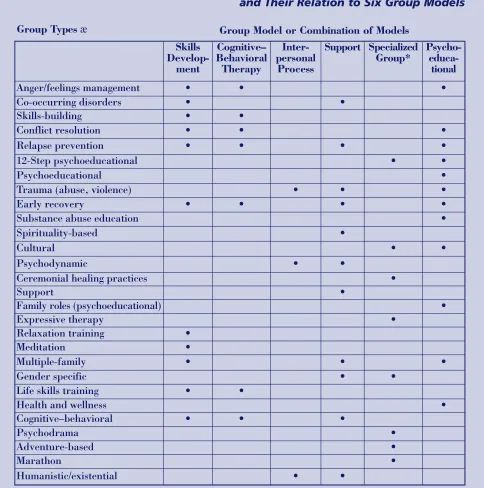
Figure2-1listssomegroupscommonlyusedin substanceabusetreatmentandclassifiesthem intothefive-modelframeworkusedinthisTIP. Thislistofgroupsisbynomeansexhaustive, butitdemonstratesthevarietyofgroupsfound insubstanceabusetreatmentsettings.
Occasionally,discussionsinthisTIPreferto thestagesofchangedelineatedbyProchaska andDiClemente(1984).Theyexamined18 psy-chologicalandbehavioraltheoriesofhow changeoccurs,includingthecomponentsofa biopsychosocialframeworkforunderstanding substanceabuse.Theirresultwasacontinuum ofsixcategoriesforunderstandingclient moti-vationforchangingsubstanceabusebehavior. Thesixstagesare:
•Precontemplation.Clientsarenotthinking aboutchangingsubstanceabusebehavior andmaynotconsidertheirsubstanceabuse tobeaproblem.
•Contemplation.Clientsstillusesubstances, buttheybegintothinkaboutcuttingbackor quittingsubstanceuse.
•Preparation.Clientsstillusesubstances,but intendtostopsincetheyhaverecognizedthe advantagesofquittingandtheundesirable consequencesofcontinueduse.Planningfor changebegins.
•Action.Clientschooseastrategyfor discon-tinuingsubstanceuseandbegintomakethe changesneededtocarryouttheirplan.This periodgenerallylasts3–6months.
•Maintenance.Clientsworktosustain abstinenceandevaderelapse.Fromthis stage,someclientsmayexitsubstanceuse permanently.
•Recurrence.Manyclientswillrelapseand returntoanearlierstage,buttheymaymove quicklythroughthestagesofchangeandmay havegainednewinsightsintoproblemsthat defeatedtheirformerattemptstoquit sub-stanceabuse(suchasunrealisticgoalsor frequentingplacesthattriggerrelapse).
Foradetaileddescriptionofthestagesof change,seeTIP35,EnhancingMotivationfor ChangeinSubstanceAbuseTreatment(Center forSubstanceAbuseTreatment[CSAT]1999b).
Theclient’sstageofchangewilldictatewhich groupmodelsandmethodsareappropriateata particulartime.Ifthegroupiscomposedof membersintheactionstagewhohaveclearly identifiedthemselvesassubstancedependent, thegroupwillbeconductedfardifferently fromonecomposedofpeoplewhoareinthe precontemplativestage.Prioritieschangewith timeandexperience,too.Forexample,agroup ofpeoplewithsubstanceusedisordersontheir seconddayofabstinenceisverydifferentfrom agroupwith1or2yearsofsobriety.
Theoreticalorientationsalsohaveastrong impactonthetasksthegroupistryingto accomplish,whatthegroupleaderobserves andrespondstoinagroup,andthetypesof interventionsthatthegroupleaderwillinitiate. Beforeagroupmodelisappliedintreatment, thegroupleaderandthetreatinginstitution shoulddecideonthetheoreticalframeworksto beused,becauseeachgroupmodelrequires differentactionsonthepartofthegroup lead-er.Sincemosttreatmentprogramsoffera vari-etyofgroupsforsubstanceabusetreatment,it isimportantthatthesemodelsbeconsistent withclearlydefinedtheoreticalapproaches.
Inpractice,however,groupscan,andusually do,usemorethanonemodel,asshownin Figure2-1.Forexample,atherapygroupinan intensiveearlyrecoverytreatmentsettingmight combineelementsofpsychoeducation(toshow howdrugshaveravagedtheindividual’slife), skillsdevelopment(tohelptheclientmaintain abstinence),andsupport(toteachindividuals howtorelatetoothergroupmembersinan honestandopenfashion).Therefore,the
æ æ æ æ æ æ
ææ
'ROUPæ4YPES æ
Figure 2-1 Groups Used in Substance Abuse Treatment
and Their Relation to Six Group Models
'ROUPæ-ODELæORæ#OMBINATIONæOFæ-ODELSæ 3KILLSæ
$EVELOP MENTæ
#OGNITIVEnæ "EHAVIORALæ 4HERAPYæ
)NTER PERSONALæ
0ROCESSæ
3UPPORTæ 3PECIALIZEDæ
'ROUPæ 0SYCHOEDUCA TIONALæ
Anger/feelingsmanagement • • •
Co-occurringdisorders • •
Skills-building • •
Conflictresolution • • •
Relapseprevention • • • •
12-Steppsychoeducational • •
Psychoeducational •
Trauma(abuse,violence) • • •
Earlyrecovery • • • •
Substanceabuseeducation •
Spirituality-based •
Cultural • •
Psychodynamic • •
Ceremonialhealingpractices •
Support •
Familyroles(psychoeducational) •
Expressivetherapy •
Relaxationtraining •
Meditation •
Multiple-family • • •
Genderspecific • •
Lifeskillstraining • •
Healthandwellness •
Cognitive–behavioral • • •
Psychodrama •
Adventure-based •
Marathon •
Humanistic/existential • •
Source:ConsensusPanel.*See“SpecializedGroupsinSubstanceAbuseTreatment”onp.29.
descriptionsofthegroupsinthischapterareof ideal,pureformsthatrarelystandalonein practice.Itmustbeacknowledged,too,that thetermsusedtodescribegroupsarenot alto-getherclear-cutandconsistent.Indifferent treatmentsettings,programs,andregionsof thecountry,atermlike“supportgroup”may beusedtorefertodifferenttypesoftreatment groups,includingarelapsepreventiongroup.
Despitesuchdiscrepanciesbetweenneattheory anduntidypractice,littledifficultywillariseif thegroupleaderexercisessoundclinical judg-mentregardingmodelsandinterventionstobe used.Oneexceptiontothisassurance,however, shouldbenoted.Closeadherencetothetheory thatdictatesthewayaninterpersonalprocess groupshouldbeconductedhascrucial implica-tionsforitssuccess.
Five Group Models
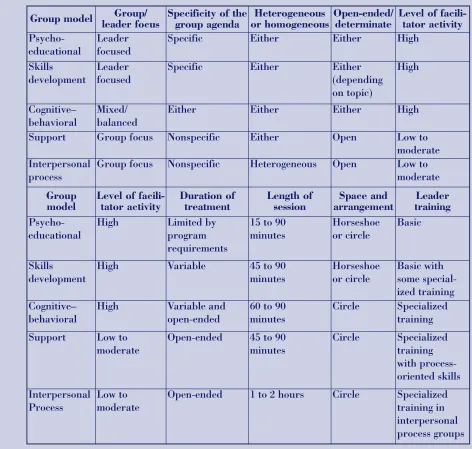
Figure2-2summarizesthecharacteristicsof fivetherapeuticgroupmodelsusedin sub-stanceabusetreatment.Variablefactors includethefocusofgroupattention,specificity ofthegroupagenda,heterogeneityor homo-geneityofgroupmembers,open-endedor determinatedurationoftreatment,levelof facilitatororleaderactivity,trainingrequired forthegroupleader,lengthofsessions,and preferredarrangementoftheroom.
Psychoeducational
Groups
Psychoeducationalgroupsaredesignedto edu-cateclientsaboutsubstanceabuse,andrelated behaviorsandconsequences.Thistypeofgroup presentsstructured,group-specificcontent, oftentaughtusingvideotapes,audiocassette,or lectures.Frequently,anexperiencedgroup leaderwillfacilitatediscussionsofthematerial (Galanteretal.1998).Psychoeducational groupsprovideinformationdesignedtohavea directapplicationtoclients’lives—toinstill self-awareness,suggestoptionsforgrowthand change,identifycommunityresourcesthatcan assistclientsinrecovery,developan under-standingoftheprocessofrecovery,and
promptpeopleusingsubstancestotakeaction ontheirownbehalf,suchasenteringa treat-mentprogram.Whilepsychoeducational groupsmayinformclientsaboutpsychological issues,theydonotaimatintrapsychicchange, thoughsuchindividualchangesinthinkingand feelingoftendooccur.
0URPOSEæThemajorpurposeof psychoeduca-tionalgroupsisexpansionofawarenessabout thebehavioral,medical,andpsychological con-sequencesofsubstanceabuse.Anotherprime goalistomotivatetheclienttoenterthe recov-ery-readystage(Martinetal.1996;Pfeifferet al.1991).Psychoeducationalgroupsare pro-videdtohelpclientsincorporateinformation thatwillhelpthemestablishandmaintain abstinenceandguidethemtomoreproductive choicesintheirlives.
Thesegroupsalsocanbeusedtocounteract clients’denialabouttheirsubstanceabuse, increasetheirsenseofcommitmentto contin-uedtreatment,effectchangesinmaladaptive behaviors(suchasassociatingwithpeoplewho activelyusedrugs),andsupportingbehaviors conducivetorecovery.Additionally,theyare usefulinhelpingfamiliesunderstandsubstance abuse,itstreatment,andresourcesavailable fortherecoveryprocessoffamilymembers.
Someofthecontextsinwhich psychoeducation-algroupsmaybemostusefulare
•Helpingclientsintheprecontemplativeor contemplativelevelofchangetoreframethe impactofdruguseontheirlives,developan internalneedtoseekhelp,anddiscover avenuesforchange.
•Helpingclientsinearlyrecoverylearnmore abouttheirdisorders,recognizeroadblocks torecovery,anddeepenunderstandingofthe paththeywillfollowtowardrecovery.
•Helpingfamiliesunderstandthebehaviorof apersonwithsubstanceusedisorderina waythatallowsthemtosupportthe individu-alinrecoveryandlearnabouttheirown needsforchange.
•Helpingclientslearnaboutotherresources thatcanbehelpfulinrecovery,suchas
æ æ
æ æ æ æ æ æ æ ææ
æ æ æ
æ æ æ æ æ æ
Figure 2-2 Characteristics of Five Group Models Used in Substance Abuse Treatment
'ROUPæMODELæ LEADERæFOCUSæ'ROUPæ 3PECIFICITYæOFæTHEæGROUPæAGENDAæ ORæHOMOGENEOUSæ(ETEROGENEOUSæ /PENENDEDæDETERMINATEæ,EVELæOFæFACILITATORæACTIVITYæ
Psycho-educational Leaderfocused Specific Either Either High
Skills
development Leaderfocused Specific Either Either(depending ontopic)
High
Cognitive–
behavioral Mixed/balanced Either Either Either High
Support Groupfocus Nonspecific Either Open Lowto
moderate Interpersonal
process Groupfocus Nonspecific Heterogeneous Open Lowmoderateto
'ROUPæ
MODELæ ,EVELæOFæFACILITATORæACTIVITYæ $URATIONæOFæTREATMENTæ ,ENGTHæOFæSESSIONæ ARRANGEMENTæ3PACEæANDæ TRAININGæ,EADERæ
Psycho-educational High Limitedprogramby requirements
15to90
minutes Horseshoeorcircle Basic
Skills
development High Variable 45minutesto90 Horseshoeorcircle Basicsomespecial-with izedtraining Cognitive–
behavioral High Variableopen-endedand 60minutesto90 Circle Specializedtraining
Support Lowto
moderate Open-ended 45minutesto90 Circle Specializedtraining with process-orientedskills Interpersonal
Process Lowmoderateto Open-ended 1to2hours Circle Specializedtrainingin interpersonal processgroups
meditation,relaxationtraining,anger
management,spiritualdevelopment,and
nutrition.
0RINCIPALæCHARACTERISTICSæPsychoeducational groupsgenerallyteachclientsthattheyneedto learntoidentify,avoid,andeventuallymaster thespecificinternalstatesandexternal circum-stancesassociatedwithsubstanceabuse.The
copingskills(suchasangermanagementorthe useof“I”statements)normallytaughtina skillsdevelopmentgroupoftenaccompanythis learning.
Psychoeducationalgroupsareconsidered ausefulandnecessary,butnotsufficient, com-ponentofmosttreatmentprograms.For instance,psychoeducationmightmoveclients
æ æ æ
inaprecontemplativeorperhaps contempla-tivestagetocommittotreatment,including otherformsofgrouptherapy.Forclientswho entertreatmentthroughapsychoeducational group,programsshouldhaveclearguidelines aboutwhenmembersofthegroupareready forothertypesofgrouptreatment.
Often,a psychoedu-cationalgroup inte-gratesskills
devel-Psychoeducational
groups are highly
structured and
often follow a
manual or a
preplanned
curriculum.
opmentintoits pro-gram.Aspartofa largerprogram, psychoeducational groupshavebeen usedtohelpclients reflectontheirown behavior,learnnew waystoconfront problems,and increasetheir self-esteem(LaSalvia 1993).
Psychoeducational groupsshouldwork activelytoengage participantsinthegroupdiscussionand
promptthemtorelatewhattheyarelearningto theirownsubstanceabuse.Toignoregroup processissueswillreducetheeffectivenessof thepsychoeducationalcomponent.
Psychoeducationalgroupsarehighly struc-turedandoftenfollowamanualora pre-plannedcurriculum.Groupsessionsgenerally arelimitedtosettimes,butneednotbestrictly limited.Theinstructorusuallytakesavery activerolewhenleadingthediscussion.Even thoughpsychoeducationalgroupshavea for-matdifferentfromthatofmanyoftheother typesofgroups,theyneverthelessshouldmeet inaquietandprivateplaceandtakeinto accountthesamestructuralissues(for
instance,seatingarrangements)thatmatterin othergroups.
Aswithanytypeofgroup,accommodations mayneedtobemadeforcertainpopulations. Clientswithcognitivedisabilities,forexample,
mayneedspecialconsiderations. Psycho-educationalgroupsalsohavebeenshowntobe effectivewithclientswithco-occurringmental disorders,includingclientswithschizophrenia (Addingtonandel-Guebaly1998;Levy1997; PollackandStuebben1998).Formore infor-mationonmakingaccommodationsforclients withdisabilities,seeTIP29,SubstanceUse DisorderTreatmentforPeopleWithPhysical andCognitiveDisabilities(CSAT1998b).
,EADERSHIPæSKILLSæANDæSTYLESæLeadersin psy-choeducationalgroupsprimarilyassumethe rolesofeducatorandfacilitator.Still,they needtohavethesamecorecharacteristicsas othergrouptherapyleaders:caring,warmth, genuineness,andpositiveregardforothers.
Leadersalsoshouldpossessknowledgeand skillsinthreeprimaryareas.First,theyshould understandbasicgroupprocess—howpeople interactwithinagroup.Subsetsofthis knowl-edgeincludehowgroupsformanddevelop, howgroupdynamicsinfluenceanindividual’s behavioringroup,andhowaleaderaffects groupfunctioning.Second,leadersshould understandinterpersonalrelationship dynam-ics,includinghowpeoplerelatetooneanother ingroupsettings,howoneindividualcan influ-encethebehaviorofothersingroupandsome basicunderstandingofhowtohandle problem-aticbehaviorsingroup(suchasbeing with-drawn).Finally,psychoeducationalgroup lead-ersneedtohavebasicteachingskills.Such skillsincludeorganizingthecontenttobe taught,planningforparticipantinvolvementin thelearningprocess,anddeliveringinformation inaculturallyrelevantandmeaningfulway.
Tohelpclientsgetthemostoutof psychoeduca-tionalsessions,leadersneedbasiccounseling skills(suchasactivelistening,clarifying, sup-porting,reflecting,attending)andafew advancedones(suchasconfrontingand termi-nating)(Brown1998).Italsohelpstohave leadershipskills,suchashelpingthegroup getstartedinasession,managing(thoughnot necessarilyeliminating)conflictbetweengroup members,encouragingwithdrawngroup mem-berstobemoreactive,andmakingsurethat
æ
allgroupmembershaveachancetoparticipate. Asthegroupunfolds,itisimportantthatgroup leadersarenondogmaticintheirdealingswith groupmembers.Finally,thegroupleader shouldhaveafirmgraspofmaterialbeing communicatedinthepsychoeducationalgroup.
Duringasession,thegroupleadershouldbe mindfulbothofthegroup’sneedandthe spe-cificneedsofeachmember.Thegroupleader willneedtounderstandgroupmemberroles andhowtomanageproblemclients.Exceptin unusualcircumstances,effortsshouldbemade toincreasemembers’comfortandtoreduce anxietyinthegroup.Leaderswilluseavariety ofresourcestoimpartknowledgetothegroup, soeachsessionalsorequirespreparationand familiarizationwiththecontenttobedelivered.
Groupleadersshouldhaveongoingtraining andformalsupervision.Supervisionbenefits allgroupleadersofalllevelsofskilland train-ing,asithelpstoassurethemthatpeoplein positionsofauthorityareinterestedintheir developmentandintheirwork.Ifdirect super-visionisnotpossible(asmaybethecasein remote,ruralareas),thenInternetdiscussions orregulartelephonecontactshouldbeused.
4ECHNIQUESæTechniquestoconduct psychoedu-cationalgroupsareconcernedwith(1)how informationispresented,and(2)howtoassist clientstoincorporatelearningsothatitleadsto productivebehavior,improvedthinking,and emotionalchange.Adultsinthemidstofcrises intheirlivesaremuchmorelikelytolearn throughinteractionandactiveexplorationthan theyarethroughpassivelistening.Asaresult,it istheresponsibilityofthegroupleaderto designlearningexperiencesthatactivelyengage theparticipantsinthelearningprocess.Four elementsofactivelearningcanhelp.
First,theleadershouldfosteranenvironment thatsupportsactiveparticipationinthegroup anddiscouragespassivenotetaking.
Accordingly, leader lecturing should be limited in duration and extent. The leader should con-centrate instead on facilitating group discussion, especially among clients who are withdrawn and have little to say. They need support and
under-standing of the content before expressing their views. Techniques such as role playing, group problemsolving exercises, and structured experi-ences all foster active learning.
Second,theleadershouldencouragegroup participantstotakeresponsibilityfortheir learningratherthanpassingonthat responsi-bilitytothegroupleader.Fromtheoutsetof thegroup,theleadercanemphasizegroup self-ownershipbyallowingmemberstoparticipate insettingagreementsandothergroup bound-aries.Theleadercanemphasizemember responsibilityforhonest,respectfulinteraction amongallmembersandcande-emphasizethe leaderroleindetermininggrouplife.
Third,becausemanypeoplehavepronounced preferencesforlearningthroughaparticular sense(hearing,sight,touch/movement),itis essentialtouseavarietyoflearningmethods thatcallfordifferentkindsofsensory experi-ence.Excellentmaterialonadapting instruc-tiontolearningstylesisavailablethroughthe AssociationforSupervisionandCurriculum DevelopmentWebsite.Toaccessthemany arti-clesandbookchapters,enter“learningstyles” intothesearchfunctionandclickthe“Go” button.
Mostpeople,atonetimeoranother,havehad unpleasantexperiencesintraditional,formal classroomenvironments.Theresultingshame, rejection,andself-deprecationstrongly moti-vatepeopletoavoidsituationswherethese experiencesmightbebroughtbackinto aware-ness.Thereforeitiscriticallyimportantforthe groupleadertobesensitivetotheanxietythat canbearousediftheclientisplacedinan envi-ronmentthatreplicatesadisturbingscenefrom thepast.Toallaysomeoftheseconcerns, lead-erscanacknowledgetheanxietiesof partici-pants,preventallgroupparticipantsfrom mockingothers’commentsorideas,andshow sensitivitytothemeaningofaparticipant’s withdrawalinthegroup.Overall,leaders shouldcreateanenvironmentwhere partici-pantswhoarehavingdifficultywiththe psychoeducationalgroupprocesscanexpress theirconcernsandreceivesupport.